
The Origins and History of Zoroastrianism
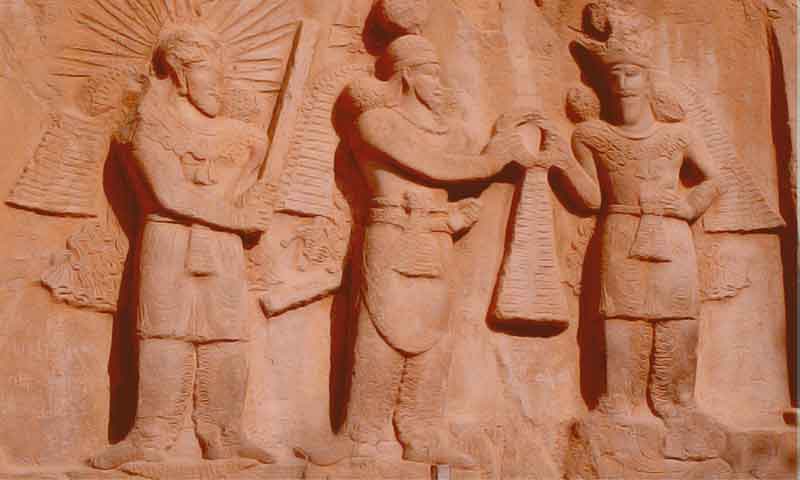
Taq-e Bostan: high-relief of Ardeshir II investiture; from left to right: Mithra, Shapur II, Ahura Mazda. Modified
Zoroastrianism derives its names from its founder Zarathushtra, the Persian prophet, whom the Greeks referred as Zoroaster. Zoroastrianism also goes by the name Parsiism, a name derived after Parsis, a group of ancient Iranians or Persians, who migrated to India in the 7th century AD after the fall of Sassanid dynasty to escape persecution in the hands of Islamic invaders who occupied the country and used various means to convert the vanquished to the new faith. A small but vibrant community of Parsis continue to practice this ancient religion in India and contribute richly to its cultural, religious and ethnic diversity.
The Origins Of Zoroastrianism
Not much is known about the personal history of Zoroaster. There is no unanimity among historians as to the times in which he lived. According to the most faithful followers of the religion he lived some time around 6000 BC. However based on the linguistic and other evidence historians tend to place him between 12th and 6th century BC 1. Zarathushtra probably lived long before the Buddha and Mahavira. Therefore it would be more acceptable to place him nearer 12th century BC rather than 6th, the period during which the Vedic people were establishing themselves as a religious community in the Indian subcontinent. There is also a controversy about the place of his origin. According to one popular theory, he hailed from a family of noble men who lived at Rhages or Ragha, identified to be Ravy, a suburb in Tehran. Others believe that he was probably born outside Iran in some part of Central Asia.
Zoroaster
To them Zarathustra introduced the concept of one supreme God above all, following a series of profound spiritual experiences he underwent, in which Ahura Mazda, the highest god of Zoroaster religion, appeared to him in person and imparted to him the highest knowledge. It is said that when he was about 30, as he was drawing water from a well, a shining angel named Vohu Manah, appeared to him in a vision and led him into the presence of Ahura Mazda. Ahura Mazda declared himself to Zarathustra as the highest, eternal and ethical God and through a series of visions imparted to him the knowledge of Zoroaster religion and its many secrets with an instruction to spread them among his people.
The teachings of Zoroaster are now preserved in the 17 hymns known as the Gathas in the Yasna part of the Zend Avesta, the Zoroastrian's sacred scripture. Zoroaster lived among people who believed in the multitude of spirits and divinities whom they worshipped. They also divided the gods into three categories, corresponding with the social order which they followed. Of them they considered Varuna and Mitra as the highest and most superior lords (asuras). Zoroaster did not entirely reject the prevailing notions about divinities, but introduced the practice of monotheism, declaring Ahuramazda as the highest and righteous creator God and dispenser of justice, aided by six or seven other divinities known as Amesha Spentas each personifying certain qualities which human beings should aspire for and cultivate in order to receive the reward of heavenly life when they leave this world. He also did not entirely abolish the prevailing rituals and animal sacrifices, but only those that involved some decadent practices. He also retained the fire cult and haoma sacrifice.
After receiving enlightenment, Zarathushtra converted some close members of his family to his teaching. But largely he was not successful in converting people to the new faith. However after several years, he was able to convert king Vishtaspa and many of his ministers and court officials. He remained in his court for some time. According to a legend he got his daughter married to Jamasp, a minister in Vishtaspa's court. We do not know clearly how his life ended.
The teachings of Zoroaster began to spread among the people of Persia and adjoining provinces mainly through wandering tribes. When Cyrus became the emperor of the vast Persian empire, he made Zoroastrianism popular throughout Egypt, Greece, Persia and parts of India, mainly with the help of Magi, a priestly community that came originally from Medes. Probably the three Magi who visited Jesus at the time of his birth in Bethlehem, belonged to the same priestly community. Zoroastrianism suffered a temporary decline in Persia when Alexander conquered Persia in 331 BC. However it was revived again in 3rd century AD, when the Sassanians overthrew the Parthenians and established their dynasty. The Sassanians made Zoroastrianism as their state religion. They recognized the religious authority of the priests as an important part of their political power and gave them special privileges to propagate the religion among the people. The state and the religion therefore became inseparable during their time, a concept that was similar in many respects to the one followed by the Romans when they accepted Christianity as the state religion. During this period the Magi made a rigid interpretation of the teachings of Zoroaster and declared any opposition to it as heresy and treason.
Zoroastrianism suffered a serious blow in Persia when the Sassanid dynasty came to an end in 7th century AD, with the Muslim conquest. The invaders subjected the followers of the old religion to persecution and discrimination. As a result of their actions the religion disappeared from the country, first in the cities and then in the rural areas, leaving a few followers most. Some fled the country and went to India where they settled first in Gujarat and then in other parts of the country, especially Mumbai. They continue to live today in India as Parsis, a vibrant community who played an important role in the economic development of India. They constitute the single largest Zoroastrian community in the world. Those who remained behind, suffered persecution in the hands of Muslim rulers for several centuries. They got a relief when Reza Sha Pahlavi overthrew the rule of the Qajar dynasty in 1925 and established his rule. There are still a handful of Zoroastrians in Iran, estimated to be about 30000, who practice the ancient religion, especially in the provinces of Yazd, Kerman, Fars, Tehran, Khuzestan and Kohgilouyeh and Boyerahmad. The Iranian state laws recognize Zoroastrians as a religious minority, along with Christians and Jews. It is however appropriate to say that it is in India that Zoroastrianism found its save haven, where its followers still practice the ancient religion without the fear of persecution or discrimination.
Suggestions for Further Reading
- Zoroastrianism, Life After Death And The Nature of Heaven and Hell
- Zoroastrianism, The Battle Between Good and Evil
- Ahura Mazda Or Ohrmazd, the Zoroastrian God
- Amesha Spentas or Ameshaspands
- Asha, The Zoroastrian Concept of Truth and Universal Order
- Important Beliefs of Zoroastrianism
- The Old Iranian Calendars, Part 1
- Zoroastrianism - Main Concepts
- Zoroastrianism, Cosmogony Or Theories of Creation
- The Zoroastrian Cosmology
- Zoroastrinaism - The Zoroastrian Creed - An Overview
- Zoroastrianism - Genesis and Zoroastrian Calendar
- Zoroastrianism - Overview Of The Zoroastrian Doctrine
- Untitled 1
- Zoroastrianism - Important Zoroastrian or Parsi Festivals
- Funeral Ceremonies, Death and Disposal Of The Dead in Zoroastrianism
- Zoroastrianism - The Funeral Ceremonies of the Parsees, Part 1
- Gender Equality and Status Of Women In Zoroastrianism
- Zoroastrianism, On Good and Bad Religions
- The History of Zoroastrianism
- Asuras and Daevas the Indo Iranian Connection
- Zoroastrianism Links, Resources and Websites
- The Sacred Literature Of Zoroastrianism
- An Overview Of Zoroastrian Religion
- Important Practices of Zoroastrian Religion
- Zoroastrian Priests
- The Nature of Sin, Types of Sin and Expiation of Sin
- Space And Time In Zoroastrianism
- Life and works of Zarathushtra
- Zoroastrianism Main Beliefs
- Zarathushtra - Zoroaster
- Zoroastrianism, Zoroastrian, Links and Web Resources
- Zoroaster, Zarathushtra, Zarathustra
- Essays On Dharma
- Esoteric Mystic Hinduism
- Introduction to Hinduism
- Hindu Way of Life
- Essays On Karma
- Hindu Rites and Rituals
- The Origin of The Sanskrit Language
- Symbolism in Hinduism
- Essays on The Upanishads
- Concepts of Hinduism
- Essays on Atman
- Hindu Festivals
- Spiritual Practice
- Right Living
- Yoga of Sorrow
- Happiness
- Mental Health
- Concepts of Buddhism
- General Essays
1. Merriam-Websters Encyclopedia of World Religions
Image Attribution: The image of Mithra, Shapur II, Ahura Mazda used for this essay has been adapted with alterations from Wikimedia Commons under GNU Free Documentation License, Version 1.2 or later