
The Zoroastrian Cosmology
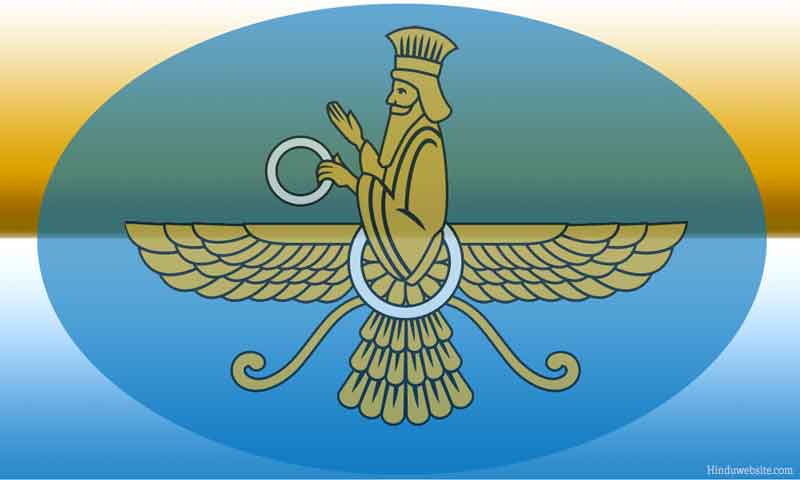
The Faravahar Emblem is a powerful Zoroastrian Religiuos Symbol
Zoroastrian texts interpret creation as a cosmic drama spanning over a period of 12000 years. It is subdivided into four equal periods of 3000 years each. The first period is known as Infinite Time. During this period the good and the evil remained in perfect balance in their respective spheres. For 3000 years Ahura Mazda dwelt in the region of light, while his opponent Ahirman or Angra Mainyu, the evil spirit, remained confined to the region of darkness. A great Void separated them both. At the end of the first period, Ahirman crossed the void and attacked Ahura Mazda. Knowing that the battle would continue for ever, Ahura Mazda recited Ahuna Vairya, the most sacred hymn of Avesta and repelled him back. Having lost the battle, Angra Mainyu withdrew hastily into his dark world and remained there for another 3000 years.
During this interlude, Ahura Mazda brought forth the entire creation. He created the six Amesha Spentas or the Immortal beings, several angel spirits and asuras or spirit lords. He brought forth the primeval Ox and the primeval man (Gayomart). From the primeval man he created the material things such as water, air, earth and the metals. To the preexisting souls (fravashis) He offered a choice, either to remain as spirit beings or take birth upon earth as human beings to assist him in his battle against the evil. The preexisting souls chose to take human birth and assist Him. While this was going on, Ahirman manifested six daevas or evil powers and several evil spirits in his domain to assist him in his battle against God. When God finished creating the material world and its entities, Ahirman was instigated by the Primeval Woman or the Whore to cross the void and attack God's creation. He attacked both the primeval man (Gayomart) and the primeval Ox and succeeded in killing them both. But in the process he became trapped in the material things and the metals. This was exactly what God intended as He knew in advance that the beginning frasgrid or the culmination of the transformation of the cosmos would begin with the entry of Ahirman into the material world and culminate at the end of the fourth period, when he would be finally destroyed and all the evil forces would be consigned to the hell. According to Zoroastrian texts, the fourth period began with the birth of Zoroaster and would come to an end when the future son of Zoroaster would appear upon earth as the savior. He would wage a battle against the evil forces and hold a Judgment Day to punish the evil and reward the righteous.
The Zoroastrian view of the universe
Zoroastrian texts depict a universe consisting of a spiritual world inhabited by spiritual beings of light and great potency, ruled by Ahura Mazda, the highest and the supreme. In the middle is a material world populated with material things and elements such as fire, water, earth and air, human beings, plants, animals, metals and minerals, where a constant battle goes on between the good and the evil. This is the world in which we live. Finally there is a lower dark world, beneath our plaent, inhabited by fierce demons, daevas, bad spirits, ruled by the fiendish and wicked Ahirman who uses fear, greed and malice as his principal weapons to afflict the entities of the middle world. Humans, plants, animals and all the elements are susceptible to his attack and should therefore lead morally righteous and socially responsible lives, seeking the protection of God all the time.
How the world was transformed by the conflict
The spiritual world is invisible and flooded with incredible light. Darkness cannot enter it. It is in the middle sphere or the material world where the battle is raged. The Bundhahisn gives the following information on how the world is transformed by this conflict.
In the month Frawardin and the day Ohrmazd he rushed in at noon, and thereby the sky was as shattered and frightened by him, as a sheep by a wolf. He came on to the water which was arranged below the earth, and then the middle of this earth was pierced and entered by him. Afterwards, he came to the vegetation, then to the ox, then to Gayomard, and then he came to fire; so, just like a fly, he rushed out upon the whole creation; and he made the world quite as injured and dark at midday as though it were in dark night. And noxious creatures were diffused by him over the earth, biting and venomous, such as the snake, scorpion, frog (kalvak), and lizard (vazak), so that not so much as the point of a needle remained free from noxious creatures. 16. And blight was diffused by him over the vegetation, and it withered away immediately. And avarice, want, pain, hunger, disease, lust, and lethargy were diffused by him abroad upon the ox and Gayomard. 18. Before his coming to the ox, Ohrmazd ground up the healing fruit, which some call 'binak,' small in water openly before its eyes, so that its damage and discomfort from the calamity (zanishn) might be less; and when it became at the same time lean and ill, as its breath went forth and it passed away, the ox also spoke thus: 'The cattle are to be created, and their work, labor, and care are to be appointed.' (Bundahishn Chapter 3.12-17)
Because of the attack of the evil forces the following happened
The earth was pierced and an opening was created so that the fiendish forces could enter the world easily through it from the hell which was beneath the earth.
The world became subject to duality and "and persecution, contention, and mingling of high and low became manifest."
The sky and the constellation were disfigured and thrown into utter confusion. Fire was mingled with smoke and darkness.
The planets and the constellation were afflicted with evil influence, resulting in the formation of comets with tails and eclipses.
Days and night became unequal except for one day in a year.
As the evil forces attacked Goshurn, Gayomard, the primeval man and the primeval ox, human beings and cattle became susceptible to fever, disease, weakness, hunger, fear, anger, malice, cruelty and death.
In the conflict with the elements, the evil forces attacked water, air and the earth.
Water responded by producing fierce rains and floods.
Air responded by causing fierce storms.
The earth was shaken, resulting in the formation of mountains.
Conflict with plant resulted in plant becoming susceptible to dryness and disease.
Similarly there were changes in plant and animal world as new forms, shapes and species appeared.
There were also changes in the earth geography, in the formation of inhospitable terrains, snow, mountains, oceans, forests and deserts.
From the primeval ox emerged a number of new animals.
From the primeval man emerged new races. "As there were ten varieties of man, and fifteen races from Fravak, there were twenty-five races all from the seed of Gayomard; the varieties are such as those of the earth, of the water, the breast-eared, the breast-eyed, the one-legged, those also who have wings like a bat, those of the forest, with tails, and who have hair on the body." (Bundahishn 15.31).
The Zoroastrian view of the world
Regarding the picture of Zoroastrian world as presented in the Bundhahishn, Mary Boyce commented in the following manner. "In the main, however, the absorbing interest of the Bd. lies in the antiquity of its material. Here is preserved an ancient, in part pre-Zoroastrian picture of the world, conceived as saucer-shaped, with its rim one great mountain-range, a central peak thrusting up, star-encircled, to cut off the light of the sun by night; a world girdled by two great rivers, from which all other waters flow; in which yearly the gods fight against demons to end drought and famine, and to bring protection to man. Natural phenomena are speculatively explained; the sprouting of the plants, for example, is ascribed to the mythical Tree of All Seeds growing in the ocean, whose seeds are mingled with water and so scattered annually over all the earth when the god Tishtar brings the rains. Not only is the matter ancient and often poetic, but the manner of presentation, although arid, is of great antiquarian interest; for after the distinctively Zoroastrian account of creation, the speculative learning and legendary history is set out in traditional oral fashion, that is to say, in schematised mnemonic lists: so many types of animals, so many kinds of liquid, so many names of mountains, so many great battles. This is the learning of ancient Iran, as it must have been evolved and transmitted by generations in the priestly schools." (From Mary Boyce, Middle Persian Literature', Handbuch der Orientalistik, 1. Abt., IV. Band, 2. Abschn., LFG.1, pg 40-1. )
Conclusion
The Zoroastrians of the ancient world interpreted the cosmos based upon their observation of the natural phenomena and their own experience with in it, tempered by their understanding and interpretation, in the light of the religious knowledge preserved in their oral tradition. The world was perceived as a battle ground between the good and evil forces. While God created the world, much of it had been transformed and disfigured by the activity of the evil forces. Whatever that was beautiful, radiant, pleasant, bright and lively was the result of the divine forces. Whatever that was ugly, dark, unpleasant, repelling, deathly and sickly was caused by the presence of evil.
No one can ever rest in such a conflict ridden world with peace of mind, without the help and protection of God, which is possible only if we lead righteous lives and practice the the three commandments of good thoughts, good words and good actions. No one can take this world for granted because the dangers posed by evil lurks everywhere. People should therefore respect the sanctity of the world in which they live and lead very responsible and morally righteous lives, guarding themselves against the temptations of evil with the help of scriptures, the teachings of the prophet and instructions of God. They should not give themselves to evil. They should not break their covenant with God. They should not do or say anything that would enhance or encourage the evil or create a distance between them and God.
Suggestions for Further Reading
- Zoroastrianism, Life After Death And The Nature of Heaven and Hell
- Zoroastrianism, The Battle Between Good and Evil
- Ahura Mazda Or Ohrmazd, the Zoroastrian God
- Amesha Spentas or Ameshaspands
- Asha, The Zoroastrian Concept of Truth and Universal Order
- Important Beliefs of Zoroastrianism
- The Old Iranian Calendars, Part 1
- Zoroastrianism - Main Concepts
- Zoroastrianism, Cosmogony Or Theories of Creation
- The Zoroastrian Cosmology
- Zoroastrinaism - The Zoroastrian Creed - An Overview
- Zoroastrianism - Genesis and Zoroastrian Calendar
- Zoroastrianism - Overview Of The Zoroastrian Doctrine
- Untitled 1
- Zoroastrianism - Important Zoroastrian or Parsi Festivals
- Funeral Ceremonies, Death and Disposal Of The Dead in Zoroastrianism
- Zoroastrianism - The Funeral Ceremonies of the Parsees, Part 1
- Gender Equality and Status Of Women In Zoroastrianism
- Zoroastrianism, On Good and Bad Religions
- The History of Zoroastrianism
- Asuras and Daevas the Indo Iranian Connection
- Zoroastrianism Links, Resources and Websites
- The Sacred Literature Of Zoroastrianism
- An Overview Of Zoroastrian Religion
- Important Practices of Zoroastrian Religion
- Zoroastrian Priests
- The Nature of Sin, Types of Sin and Expiation of Sin
- Space And Time In Zoroastrianism
- Life and works of Zarathushtra
- Zoroastrianism Main Beliefs
- Zarathushtra - Zoroaster
- Zoroastrianism, Zoroastrian, Links and Web Resources
- Zoroaster, Zarathushtra, Zarathustra
- Essays On Dharma
- Esoteric Mystic Hinduism
- Introduction to Hinduism
- Hindu Way of Life
- Essays On Karma
- Hindu Rites and Rituals
- The Origin of The Sanskrit Language
- Symbolism in Hinduism
- Essays on The Upanishads
- Concepts of Hinduism
- Essays on Atman
- Hindu Festivals
- Spiritual Practice
- Right Living
- Yoga of Sorrow
- Happiness
- Mental Health
- Concepts of Buddhism
- General Essays