Spiritual Symbolism in the Life of Pi: Island and Ocean
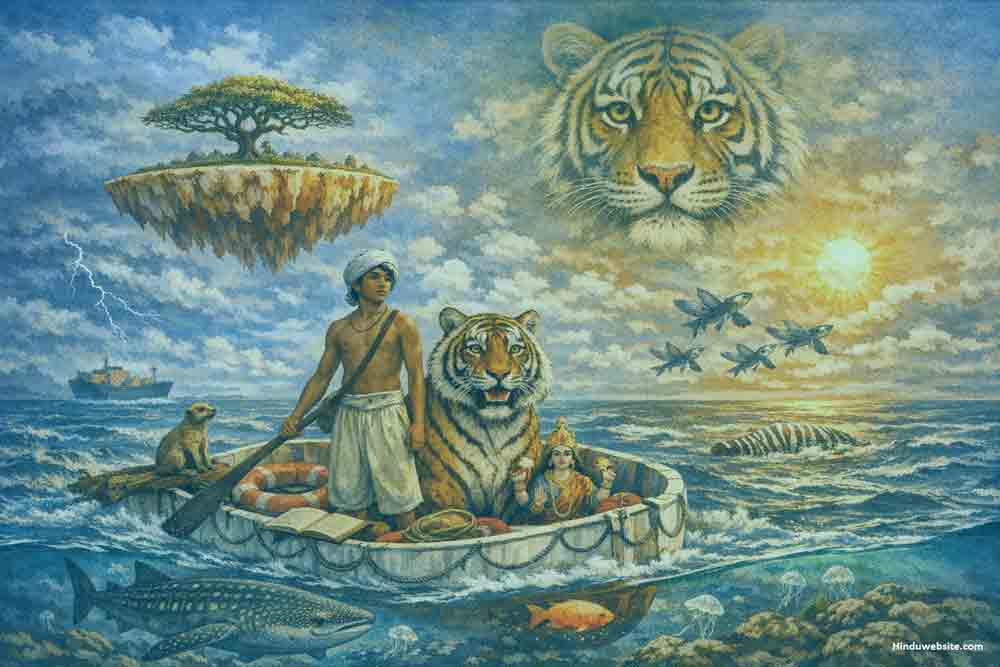
Summary: The Life of Pi weaves multiple layers of meaning beneath its surface narrative, using symbolism to explore how humans create and sustain belief in the face of harsh reality. This analysis focuses on the enigmatic meerkat island episode and its significance within the protagonist's ocean voyage. By examining how the story functions as myth rather than literal truth, it reveals how the film explores humanity's preference for dramatic narratives over plain facts, the transformative power of storytelling, and the ways we reinvent ourselves and our experiences to make them meaningful and memorable.
Through Pi’s passage across the ocean and his encounter with the meerkat island, Life of Pi allegorizes samsara and impermanence, suggesting that belief and story help humans endure suffering.
The Life of Pi is a complex story. It is a story within a story, couched in symbolism. It brings to light the power of myth and its significance in shaping our lives and civilization. The ultimate message of the movie or the story, as I understood, is that people often do not appreciate straight-line stories. They believe more in myths and legends than in reality. They love the drama that evokes their passion and imagination. Few people remember a man who is stranded in an ocean, but if you add some drama, perhaps they will. Pi learned this truth very early. Knowing that his name sounded rather humiliating, he reinvented it by changing it to Pi and creating an aura around it by making himself a legend in the school.
At the very end of the story, Pi speaks again about this truth regarding human nature. He hints that people respect myths more than reality, and religion or God is based on a similar concept. For people to believe in God or religion, you need myths and legends. It all depends upon how you frame an experience and describe it. With that in mind, the ocean voyage and the meerkat island episode can be read not simply as plot events, but as symbolic spaces where belief, fear, and survival are turned into a mythic account.
If history had simply recorded that Krishna was a cowherd who played his flute while herding cows, it is possible that far fewer people would have remembered him. Likewise, if Jesus were remembered only as a poor Jewish peasant who was crucified for his religious beliefs and revolutionary ideas, Christianity might not have taken the same shape or spread with the same force. Much of the appeal of his story lies in the pathos associated with his crucifixion and the powerful legend of his resurrection and return to heaven. Added to that is the legend of his virgin birth and his being the son of God.
That, in my opinion, is what put him above all and sealed the victory of Christianity in the Western world. Human nature is such that the incredulous can be more appealing than the credulous. Reason often has little chance against the power of myth. We love to hear more about supermen rather than mere men. We glorify heaven and the gods, but we are not so generous about earth and ourselves.
From an early age, Pi was torn between the belief system of his mother and the rationalism of his father. In the end, he understood the difference between the two with mathematical precision. He realized that myth would prevail despite our ability to reason and despite contrary evidence because we not only reason but also rationalize and reinvent our own memories.
Much of the symbolism in Life of Pi has already been discussed by others. It is said that each of the animals in the story represents a particular character associated with the life of Pi. The French cook who was rude to his parents in the ship was the hyena. The orangutan was his mother. The tiger itself was the cruel animal hidden in the nature of Pi. Or perhaps it was his own ego. While those readings are useful, this discussion focuses mainly on two broader symbols in the film—the ocean and the meerkat island—because together they frame Pi’s experience as a spiritual and psychological journey rather than a literal adventure.
In this discussion, I would like to focus mainly on two themes of the movie, the ocean and the meerkat island, which Pi visits before he reaches the Mexican Shore. In my opinion, the ocean represents the waters of life, and the island the phenomenal existence, samsara, an idea which is common to Hinduism, Jainism, and Buddhism. It is not a coincidence that in the literature associated with these three religions, the world in which we live is compared to a phenomenon characterized by births and deaths, karma and impermanence.
It is in the ocean of life we all sail, like Pi himself, on a raft or a boat we call our bodies, in the company of other beings, who are either good or bad, friendly or hostile, and with whom we strike a relationship of submission or dominance for our survival.
There is nothing certain about this journey. Each moment, you have to battle against myriad forces that try to destroy you or compete against you for food and survival. You can never be sure of what you have, and what you may lose or gain.
In this epic journey, it is your beliefs, your hope, courage, and ingenuity that come to your rescue. A lot depends upon your actions, choices, and their consequences, in short, your karma.
During the journey, Pi chances upon an island which is filled with hundreds and thousands of meerkats, and a Banyan tree with its roots and branches everywhere. From a long distance, the island appears like a reclining Vishnu or the Buddha sleeping, or rather dreaming on a bed in the ocean. The island represents mortal existence or Samsara in the waters of life. In Hindu and Buddhist literature, it is called Jambudvipa, the island in the midst of seven concentric oceans.
The tree itself is the tree of life or the tree of creation, often compared to a Banyan tree and described in Hindu literature as the Asvattha Tree, with its roots in heaven and branches spread everywhere. The day in the island represents life, and the night death. Existence is characterized by the cycle of creation and destruction.
Just as many dualities of life, they are cyclical and unending. Creation is followed by destruction, and destruction is followed by creation, which are represented in the story as day and night. In the relative time of Brahma, which lasts for billions of years, the day represents creation and the night destruction.
The meerkats are innocent and defenseless against an unrelenting and cruel Nature. Their lives are filled with suffering, ignorance and bondage and they are forever caught in the cycle of creation and destruction or day and night.
The island thus represents both existence and impermanence. You cannot live there forever with peace of mind. When Pi realizes it, like all the true yogis and monks who become aware of the true nature of our existence, he decides not to stay there since it guarantees neither peace nor stability. To live forever or lead a stable life, one has to cross the ocean of mortal life and reach the other shore.
On the island, the thread that Pi unties from his wrist and ties to the tree represents the bonds that we form with the world and that hold us in chains. The water well on the island, which is surrounded by the ocean, represents the limited opportunities we have in this world to satisfy our desires and our thirst for things.
The flower that he opens in the night, while trying to sleep in the branches of the tree, represents consciousness. The tooth he finds in the flower represents the latent impressions (samskaras) in our minds or the relics of our past, which are responsible for our next birth and continuity in the samsara. Finally, the meerkats are the individual souls who are caught on the island (Jambudvipa) in the cycle of life and death.
The scene, where Pi finally parts with the tiger, also has a symbolic significance. The tiger disappears into the forest, weak and emaciated, without even saying goodbye, which rankles Pi to no end. He feels very disappointed that the tiger just disappeared without showing any sign of affection. The tiger represents his past and his former Self. In the story, it disappeared, never to return. When we reach the other side of life, our physical Self drops away, without a trace.
In his journey, Pi lost everything: his parents, his brother, old friends, and associations. His past became a distant memory shrouded in myths, while he recovered from the loss and renewed his life with his wife and children. Through hardships, he learned to deal with the transience of life. This is another aspect of our lives. Our relationships are temporary. During our existence, or in the journey of our lives, we may become attached to things and beings over which we have no control and with which we cannot stay forever. They may disappear from our lives, just like our dreams. You may form an attachment with them, but they may not form an attachment with you. You may keep thinking about them, but they may be gone forever.
The movie Pi ends with a great twist. Many viewers may not fully realize it when it happens. In truth, I felt bored for a moment when Pi described the alternate version of the story to the Japanese officials. The viewers become so caught up with the myth and legend narrated by Pi, based upon his real-life events, that they can easily miss the real story hidden behind the myth when he narrates it in the hospital to the two officials.
Finally, the story contains an important truth concerning our lives. It is that legends, dreams, and myths, however far-fetched they may be, are important and form an integral aspect of our lives. They help us cope with our suffering or distract ourselves from it by entering into an imaginary world or alternate reality.
People create their own illusions to cope with the greatest illusion called life. Whether it is good or bad for them is not always easy to explain through either reason or faith alone. However, it can give them enough reasons to persevere in the inexplicable mystery called life and existence. Myths often help us overlook suffering. They are the beautiful celluloid movies which we create in our minds to endure the contradictions, complexity, and confusion of life.
Attribution: Image for this article created with AI