
A Brief History of Puja or Pooja, Domestic Worship
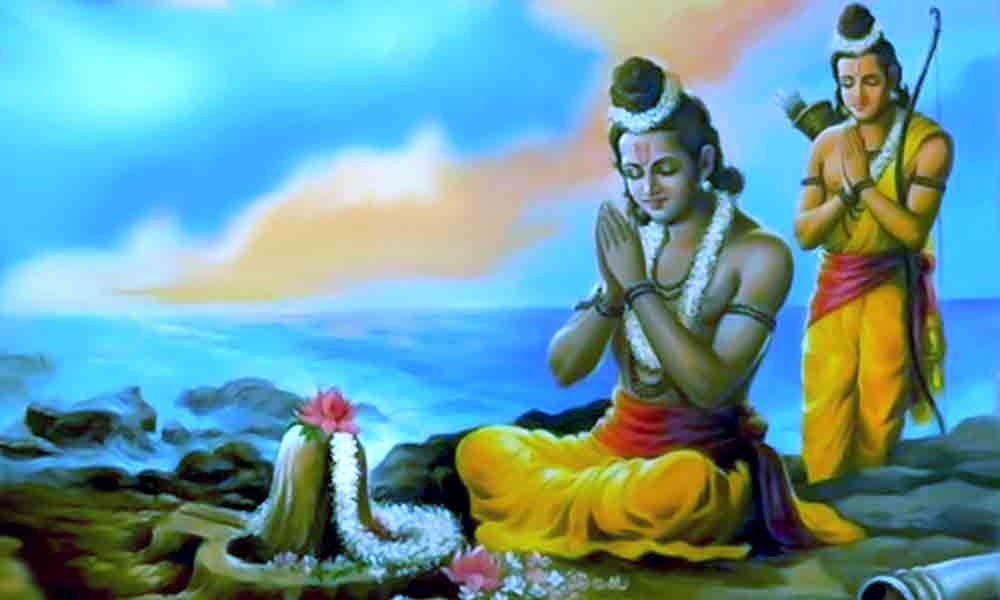
Lord Rama Worshipping Shiva
Domestic worship in Hinduism goes by the name, puja or Pooja. During the worship, Hindus worship one more deities, treating them like house guest with utmost respect and reverence and make them several offerings of water, fruit, incense, light, smoke, clothes, food, praise, prayers and so on. At the end of the ceremony, the food which is offered to the deity is shared by the worshippers or members of the household.
In a very simple format, a worshipper light incense-sticks, offer a fruit or nuts to the deity and recites a few prayers. Puja is permed both in the households and in the temples. The temple worship is more formal and generally performed by a priest, while the worship in the household is more informal and performed by the members of the household. There are no fixed rules how the worship has to be conducted. However, the formal one follows a well-established procedure.
Vedic methods of worship
In its present form puja was not practiced by the ancient Indians during the Vedic period. Vedic Indians followed distinct ways of worshipping gods, which involved elaborate sacrificial ceremonies, which often lasted for day or months. Only trained Vedic priests were allowed to perform them. In more complex form of Vedic ceremonies different sets of priests participated to perform a wide range of duties at different stages.
In a typical Vedic sacrificial ceremony, the priests chanted sacred chants from the Vedas invoking the gods in heaven and making them offerings and oblations, which included both animal and plant substances. The principal aim of the ceremony was to nourish the gods who had immense powers to help the humanity but had to depend upon humans for their nourishment.
The cost of the sacrifices was borne by the hosts (yajamans), who were usually either the warrior classes or the merchant classes. Agni, the elemental god of fire was the principal deity in most of the Vedic rituals as he was supposed to be the mediator and divine messenger between gods and men.
Vedic people worshipped gods to fulfill their desires. They beseeched them for peace, happiness, progeny, wealth of cattle, protection from calamities, sickness, adversity and death. They also used the power of mantras, seeking the destruction of enemies, attract the opposite sex or to change the feelings of a reluctant spouse. For the sacrifices, they built altars in perfect geometric patterns using bricks. Their construction often proceeded in phases over long periods of time, depending upon the financial situation of hosts and the availability of priests who managed them.
The Vedic methods of worship followed the injunctions as laid down in the Vedas and other ancillary texts such as the Grihyasutras, Apastamba Sutras, etc. Vedic scholars envisioned God as the original sacrificer and sacrifice as the source of all manifestation. Everything, our health, happiness, peace, prosperity, progeny, victory and fulfillment emerged out of it and depended upon it. The original meaning of karma was sacrificial ritual. According to the Vedic conception of liberation and rebirth, it was by performing rituals that human beings earned their merit to enter the world of ancestors or the immortal world of Brahman.
By performing rituals, the worshippers secured mystic power and the blessings of gods to protect themselves from evil, harm, retribution, disease, pestilence and natural calamities. As is evident from Rigvedic hymn, the Purushasukta, they also believed that creation itself was a product of ritual only. All the worlds and beings emerged out of a great sacrifice performed by Prajapathi in which he was both the sacrificer and the sacrificed. Using his own body he created gods, demons, different worlds, the sun and the moon, directions, and the four classes of humans. The Mimansa school went a step further and help sacrifice rather than God it as the source of creation.
Non Vedic methods of worship
We are not sure what methods of worship were followed by people who were outside the Vedic fold or by the people of Indus Valley Civilization, which thrived in India before the Vedic Period and covered a vast area in the north western part of the Indian subcontinent all the way up to present day Gujarat. Their impact on the subsequent developments in Hinduism is yet to be fully appreciated due to the constraints in deciphering their language and their social, economic and cultural life.
According to available evidence they probably had city states and lived in walled cities with exceptionally advanced urban planning and civic amenities. Although they were primarily urban communities who practiced agriculture and engaged in trade and commerce with people of distant lands, as far as Sumeria and Israel, they seemed to have practiced rituals and sacrificial ceremonies both individually and collectively to worship or invoke deities. Prominent among them seem to be the Mother Goddess often symbolized by a tree and a Father God who appears in some Indus seals as a Bull, snake or a seated yogi. Besides them, they also appear to have worshipped elements such as water and fire.
The statuettes and symbols unearthed during the excavations at Indus Valley sites suggest that Indus people might have practiced ritual baths of purification and worshipped images and symbols in walled enclosures. Although we do not have direct evidence, recent researches indicate that the Indus Valley Civilization did not disappear altogether but left its mark upon the Vedic culture. It is possible that some of their beliefs and practices were integrated into Hinduism through Vedism or non-Vedic cultures. One of them seems to be the concept of kovilams or sacred ponds which are found adjascent to Hindu temples, where people take ritual baths before entering them, and the worship of Mother Goddess and Father God as the progenitors of the entire creation.
Antecedents of puja
It is difficult to say when and how exactly the puja ceremony of the present form evolved. We have reasons to believe that some form of domestic worship, similar in some respects to the current puja might have existed in ancient India. In both the major epics of Hinduism, namely the Ramayana and the Mahabharata, we find instances where the main characters performed ritual worship of gods akin to the puja ceremony with flowers and offerings. The epics suggest the extent of devotional theism, which was prevalent in ancient India, and how people established a personal relationship with their beloved gods through devotional fervor and expressed it as religious acts like worship or puja. Although the gods lived in a different world of their own, the gods of the epics and the Puranas were neither insensitive nor indifferent to the calls of their devotees. The incarnations of Lord Vishnu as Rama and Krishna are the most notable examples of how God’s unbound love for his devotees emanates from him in proportion to their love and devotion.
Puja as a modified Vedic ritual
The practice of puja may have its source in either Vedism or Shaivism or Vaishnavism or non-Vedic traditions. We may consider puja a simplified version of Vedic sacrificial ceremony. Instead of making the offerings to fire as in case of Vedic sacrifice on behalf of other gods, in puja the offerings are directly made to the deity. If you replace the fire with the image of deity, the altar with the place of worship, and the sacrificial offerings with fruit, flowers, incense, light, etc., you will get the model of puja.
Tantric influence on Hindu worship
The rise of Tantra also seems to have played a significant role in the popular of domestic worship. Mahanirvana Tantra for example state that in the present age, the worship of Brahman with Mantras is fruitless. It also speaks of worshipping the Shivalinga with twenty articles namely the earth, scent, a pebble, paddy, durvva grass, flower, fruit, curds, ghee, svastika, vermillion, conch-shell, kajjala, rochana, white mustard seed, silver, gold, copper, lights, and a mirror. The same text also warns the worshipper that they should not be too carried away by the worship of names and forms stating, “Liberation does not come from japa, homa, or a hundred fasts; man becomes liberated by the knowledge that he himself is Brahman…All imagination of name-form and the like are but the play of a child. He who puts away all this sets himself in firm attachment to the Brahman, is, without doubt, liberated.”
Non-Vedic elements in puja
There is also a possibility that puja was originally practiced by some tribal groups, who existed outside the pale of the Vedic society and was incorporated subsequently into the Vedic religion when they were brought into the Vedic fold. The growing popularity of bhakti movement, which tried to transcend the caste and tribal divisions of society, probably facilitated such integration. The Dravidians who migrated to the South from the northwestern parts of the Indian subcontinent some time during the latter part of the Indus period, could also have brought the practice of puja into the Vedic fold through devotional Saivism and Vaishnavism. While we have reasons to believe in the indigenous development of puja ceremony, some elements of foreign influence in its evolution cannot be entirely ruled out.
Bhakti and devotional worship
The emergence of Bhakti movement or the devotional expression of unconditional love and reverence to God definitely contributed to the emergence of puja as a popular form of religious worship among the Indian masses. In the South, the followers of Saivism worked hard to counter the growing influence of Buddhism and Jainism among the people by introducing personal forms of divine worship which involved the public use of devotional singing, chanting and art forms like dance and drama.
The most pious among them were known as Nayanars, who travelled from village to village spreading the message of Siva and encouraging people to worship Him directly without the need for elaborate rituals or the intervention of the priests who were particularly reluctant to work across caste lines. Their selfless work and teachings made puja a part of Hindu religious activity among the rural people. Legendary devotees of Siva like Kannappa acquired fame for their acts of worship and devotional attitude. In case of Vaishnavism, the Alvars did a tremendous work to popularize devotional worship of Vishnu.
Foreign influence
From a historical perspective, some elements of puja worship seem to have come to us from sources other than Indian. According to one theory, the puja ceremony was introduced in India by the foreigners such as the Greeks or the Bactrians or the Kushanas who established their domains in the Indian subcontinent. They worshipped their own gods and some Indian gods such as Skanda, Siva and Vishnu. Alternatively, it might have also come to us from the merchant caravans that came across the borders by land or by sea during the post Mauryan era. There is also an argument that the idea of ritual offering of flowers, incense and other substances as an act of worship to the images of deities came to Hinduism from distant cultures that existed outside the Indian subcontinent or on its fringes.
Buddhism and Jainism
Buddhism and Jainism also played an important role in the development of puja and its procedural aspects. The Buddha did not encourage rituals. Indeed, he was against all forms of ritualistic worship as he found them to be ineffective in mitigating human suffering. Instead, he preferred monastic life for the preservation of dharma and sangha and for practicing his teachings to overcome desires. He laid more emphasis on character building and ethical living according to the principles of the Eightfold path in the salvation of man rather than performing elaborate rituals and making sacrificial offerings.
However, a few centuries after His nirvana, Buddhism saw the emergence of Mahayana Buddhism as a reaction among some of its followers against its lack of personal allegiance to the Buddha and its unrelenting emphasis on self-denial and monasticism. It advocated devotional worship to the Buddha as an important aspect of spiritual practice, without compromising its emphasis on the ideals of monkhood and monastic life. Followers of this path incorporated several elements of the puja ceremony in their worship of the Buddha.
Unlike Buddhism, Jainism encouraged the personal worship of the Thirthankaras and Arhats from the beginning. It believed that acts of worship were beneficial to the mankind as they were acts of good karma, which resulted in the karmic cleansing of the worshippers. In several respects its methods of worship were similar to those of Hinduism. It was not uncommon to find Hindu priests serving in the Jain temples. It is very likely that both Jainism and Hinduism influenced each other in their methods of worship.
Vaishnavism
Another important factor in the development of devotional worship in India was the rise of Vaishnanivsm and the emergence of religious texts like the Puranas and the Bhagavadgita. By presenting the divine mysteries and activities of various gods in a narrative form, the Puranas captured the attention of the masses and made them aware of the finer aspects of religious practice. They emphasized the importance of adherence to dharma and personal allegiance to God in seeking salvation.
The Bhagavadgita, a notable Vaishnava scripture, is principally a book of devotional worship, which reminds men of their true nature and the need to lead a divine centered life to achieve liberation from the cycle of births and deaths. It stated bhaktimarg or the path of devotion as the best means to transcend oneself and overcome the problems of desire ridden karmic acts, without the need to undergo the hardships of ascetic life. It vouched for the faith and attitude behind our offerings being more important to salvation rather than the offering itself, preferring simple forms of direct worship to elaborate rituals, which characterized the Vedic religion of the times.
Temple tradition
Puja as a special religious ceremony became very popular during the post Mauryan period. The construction of temples all over the subcontinent and the daily worship of deities installed in them by communities of priests following elaborate procedures to appease them contributed to the growing popularity of puja as simple form of divine worship in Hinduism. The temples made the puja form of worship an important and integral theistic practice of Hinduism. While the methods of worship grew along independent lines in the individual households, depending upon their caste backgrounds, with or without the use of Sanskrit mantras, in the temples the puja ceremony acquired a more elaborate structure, becoming a separate ritual by itself. With the use of more formal mantras or sacred chants in the invocations and supplications of the deities installed in the temples, necessitating the mediation of priests, it also became distinctly Vedic in character and an integral aspect of temple traditions.
The Guptas built many temples in northern India during their long rule and encouraged the worship of Vishnu and Siva. The Barashivas who ruled large parts of Northern and Central India before them were great followers of Siva. Besides, Vishnu and Siva people worshipped snakes, trees, water spirits and other deities. The practice of puja continued to flourish during the subsequent periods and became the main form of Hindu worship by the time Sri Adi Shankara emerged on the scene. During the latter and post Gupta periods, the puja ceremony must have influenced, and must have also been influenced in return, by the emergence of Tantricism as a major religious movement both in Hinduism and Buddhism.
The mass appeal of puja
Whatever may be the truths underlying its origin and development, the significance of puja lies in the fact that it brought Hinduism closer to the masses by separating religion from the suffocating grip of the priesthood. It delinked the act of religious worship from the meddling control of the Vedic priests who made religious worship as the means of seeking material comforts rather than spiritual solace. The puja ceremony brought the worshippers face to face with God, in a very personal and touching way and made the act of worship a purely personal and emotional affair. In short it undermined the influence of the priests in the religious life of the Hindus and helped the religion survive the growing influence of Buddhism and Jainism!
It is not true that the puja ceremonies did away with the involvement of priests altogether in the religious affairs of the Hindus. The priest still maintained their exclusive control over the more complex forms of rituals and the pujas performed in the temples because of their caste privileges and their knowledge of the sacred scriptures. However, it did reduce their importance in the worship of God by common people and opened the doors of Hinduism to those who remained on the fringes of society and were ignored by the higher castes.
Today puja is the commonest form of divine worship in Hinduism. It is the most popular medium through which every Hindu worshipper communicates with his or her personal god or goddess. Since the tradition of puja gathered strength for its purity and simplicity, it is better suited for the modern life where people have no time or inclination to perform or participate in more elaborate sacrificial ceremonies and rituals on day to day basis. As the limitations of time and resources would continue to exert their influence upon our lives and activities, the tradition of puja is certain to evolve into more definitive and personal ways in the future.
Suggestions for Further Reading
- Symbolism of Puja, the Ritual Worship of God in Hinduism
- Rites and Rituals in Hinduism
- Significance of Rituals in Hinduism
- Reasons For Idol Worship in Hinduism
- Bhakti yoga or the Yoga of Devotion
- The Art of Prayer - Praying With The Right Attitude
- The Meaning And Significance of Prarthana or Prayer in Hinduism
- Hinduism and prayers
- The Samkhya Philosophy and 24 Principles of Creation
- The Bhagavadgita On The Problem Of Sorrow
- The Concept of Atman or Eternal Soul in Hinduism
- The Practice of Atma Yoga Or The Yoga Of Self
- The Problem of Maya Or Illusion and How To Deal With It
- Belief In Atman, The Eternal Soul Or The Inner Self
- Brahman, The Highest God Of Hinduism
- The Bhagavad Gita Original Translations
- The Bhagavadgita, Philosophy and Concepts
- Bhakti yoga or the Yoga of Devotion
- Hinduism And The Evolution of Life And Consciousness
- Why to Study the Bhagavadgita Parts 1 to 4
- The Triple Gunas, Sattva, Rajas and Tamas
- The Practice of Tantra and Tantric Ritual in Hinduism and Buddhism
- The Tradition Of Gurus and Gurukulas in Hinduism
- Origin, Definition and Introduction to Hinduism
- Hinduism, Way of Life, Beliefs and Practices
- A Summary of the Bhagavadgita
- Avatar, the Reincarnation of God Upon Earth
- The Bhagavadgita on Karma, the Law of Actions
- The Mandukya Upanishad
- The Bhagavadgita On The Mind And Its Control
- Symbolic Significance of Numbers in Hinduism
- The Belief of Reincarnation of Soul in Hinduism
- The True Meaning Of Renunciation According To Hinduism
- The Symbolic Significance of Puja Or Worship In Hinduism
- Introduction to the Upanishads of Hinduism
- Origin, Principles, Practice and Types of Yoga
- Hinduism and the Belief in one God
- Essays On Dharma
- Esoteric Mystic Hinduism
- Introduction to Hinduism
- Hindu Way of Life
- Essays On Karma
- Hindu Rites and Rituals
- The Origin of The Sanskrit Language
- Symbolism in Hinduism
- Essays on The Upanishads
- Concepts of Hinduism
- Essays on Atman
- Hindu Festivals
- Spiritual Practice
- Right Living
- Yoga of Sorrow
- Happiness
- Mental Health
- Concepts of Buddhism
- General Essays