
The Bhagavadgita on Karma, the Law of Actions
Summary: The concept of karma is one of the central beliefs of Hinduism. Hindus believes that actions will have consequences when they are performed with selfish desires and expectations. In this essay we present the belief in karma or the Law of Action according to the Bhagavadgita and how to perform actions without desire and attachment to escape from their consequences.
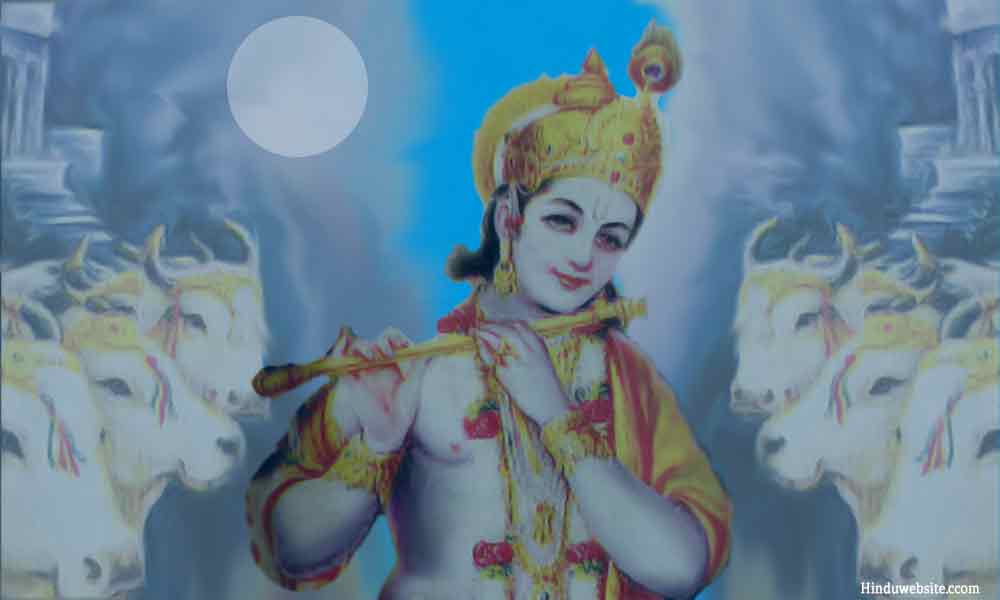
Lord Krishna exemplified karma yoga. He lived a worldly life, but never abandoned his duty to uphold Dharma and protect the world from evil. He supported the virtuous people, without becoming involved with the world or showing any partiality. If he supported the Pandavas, it was to destroy evil and restore Dharma in the world, which was on decline at that time.
Critics may argue about certain actions and decision made by him and the Pandavas during and before the war. However, it must be remembered that Krishna had no personal stakes in the war. He was not benefited by it. In performing those actions and making the decisions, he was putting into practice the essential principles of karma yoga only.
We come to know about it in the Bhagavadgita itself when we read the chapter on his universal form in which he told Arjuna that the fate of the war was already decided by him and his duty was to play his part and unfold the divine plan. His teachings in the scripture reflect the same approach.
He recommended karma yoga for the householder to perform their obligatory duties and ensure the order and regularity of the world and preservation of life and virtue upon earth. No one can avoid karma, but with the help of karma sanyasa yoga one can escape from the consequences that may arise from them and the sin that follows. This is the secret which we learn from the scripture.
The Bhagavadgita does not preach renunciation of action, but renunciation of attachment to action and desire for its fruit. It advocates both performance of action through knowledge and "sanyas" as means for attainment of freedom from the consequences of ones actions.
"Sanyas" means renunciation of action prompted by desire, while "tyaga" means abandonment of the fruit of action. Both these are characteristic of a true karma yogi. The true sanyasi is one who does his work without seeking the fruit of his actions, not the one who gives up activity or the sacred fire.(6.1)
If actions are performed with desires and attachment, and with egoistic assumption of doership, then one has to assume responsibility for all his actions and also face the consequences of all his actions here and hereafter.
He must enjoy or suffer from the fruits of his good actions as well as bad actions, accepting either sorrow and suffering or pleasure and happiness emanating from his actions. In both cases he has no real freedom from the laws and jaws of mortal life. He has to subjugate himself to the conditions of mortal life and remain confined to the world of illusion and ignorance.
It is impossible for one to remain inactive even for a moment or escape from action altogether. The gunas born of nature drive every one coercively to ceaseless activity. Freedom from action cannot be achieved by avoiding action or by mere renunciation of action. He who engages himself in mere meditative practices, restraining his organs of actions is but deluded soul and a hypocrite. By desisting from action, it is not possible to maintain even ones body.
Even the Imperishable Supreme Brahman does His work dutifully although He has no desire either to perform the actions or for the fruit of His actions. There is nothing in the three world for Him to do, not is there anything that He is yet to attain. Still He engages Himself in action, for if He does not do so men would take Him as an example and would avoid actions.
So the true aspirant who wants to attain union with Him should also follow the same path while performing his actions . He must do his enjoined duty without attachment, without any interest whatsoever either in what is done or what is not done, knowing that his right is to work only, but not to the fruit thereof, even minded in success and failure, surrendering to God and offering the fruit of his actions to God and partaking of only that which has been offered to Him.
Actions that are performed with egoism, thinking that one is the doer, with a desire to enjoy the fruit of his actions, bind man to bondage and illusion. He who thinks that he is the doer of his actions, is but a deluded soul who does not know the truth about the spheres of gunas and how they are responsible for all binding actions.
Performing actions out of desire and attachment, with an intention to enjoy the fruit of his actions, such a deluded soul has but to face the consequences of his own actions, both good and the bad. Depending upon the nature of his activities he may gain either sorrow or happiness in this world or heavenly worlds or hellish realms hereafter.
The enlightened Karmayogi on the other hand knows what is action in inaction and inaction in action (4.17). He knows who is the real doer and how the gunas drive men to perform actions and how such actions bind men to sorrow and suffering. When he perform his actions he is aware that it is only the senses which are occupied with the object of his senses and thereby remains unconcerned. Thus he actually becomes inactive even while performing actions and remains untouched by the fruits of his actions like the lotus leaf by water.
Suggestions for Further Reading
- Study guide on Kamma or karma
- Kamma and its fruit
- Jainism and the theory of karma
- The Samkhya Philosophy and 24 Principles of Creation
- The Bhagavadgita On The Problem Of Sorrow
- The Concept of Atman or Eternal Soul in Hinduism
- The Practice of Atma Yoga Or The Yoga Of Self
- The Problem of Maya Or Illusion and How To Deal With It
- Belief In Atman, The Eternal Soul Or The Inner Self
- Brahman, The Highest God Of Hinduism
- The Bhagavad Gita Original Translations
- The Bhagavadgita, Philosophy and Concepts
- Bhakti yoga or the Yoga of Devotion
- Hinduism And The Evolution of Life And Consciousness
- Why to Study the Bhagavadgita Parts 1 to 4
- The Triple Gunas, Sattva, Rajas and Tamas
- The Practice of Tantra and Tantric Ritual in Hinduism and Buddhism
- The Tradition Of Gurus and Gurukulas in Hinduism
- Origin, Definition and Introduction to Hinduism
- Hinduism, Way of Life, Beliefs and Practices
- A Summary of the Bhagavadgita
- Avatar, the Reincarnation of God Upon Earth
- The Bhagavadgita on Karma, the Law of Actions
- The Mandukya Upanishad
- The Bhagavadgita On The Mind And Its Control
- Symbolic Significance of Numbers in Hinduism
- The Belief of Reincarnation of Soul in Hinduism
- The True Meaning Of Renunciation According To Hinduism
- The Symbolic Significance of Puja Or Worship In Hinduism
- Introduction to the Upanishads of Hinduism
- Origin, Principles, Practice and Types of Yoga
- Hinduism and the Belief in one God
- Essays On Dharma
- Esoteric Mystic Hinduism
- Introduction to Hinduism
- Hindu Way of Life
- Essays On Karma
- Hindu Rites and Rituals
- The Origin of The Sanskrit Language
- Symbolism in Hinduism
- Essays on The Upanishads
- Concepts of Hinduism
- Essays on Atman
- Hindu Festivals
- Spiritual Practice
- Right Living
- Yoga of Sorrow
- Happiness
- Mental Health
- Concepts of Buddhism
- General Essays