
Hinduism and the Belief in Rebirth
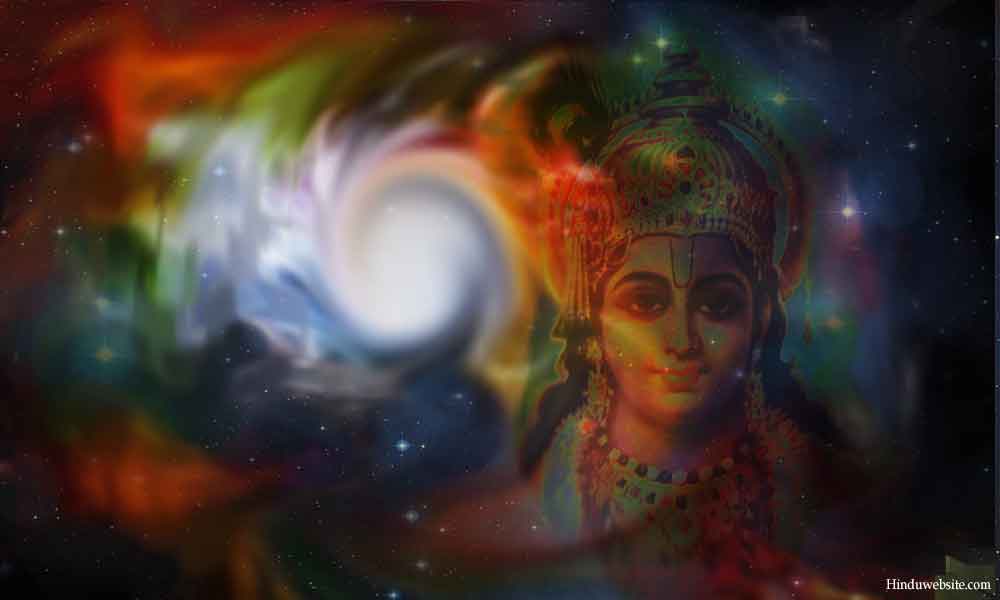
According to Hinduism, a soul reincarnates again and again on earth until it becomes perfect and reunites with it Source. During this process the soul enters into many bodies, assumes many forms and passes through many births and deaths. This concept is summarily described in the following verse of the Bhagavad gita:
"Just as a man discards worn out clothes and puts on new clothes, the soul discards worn out bodies and wears new ones." (2.22)
According to Hinduism, a being has to live many lives and under go many experiences before it attains perfection and becomes one with the Divine. The Hindu theory of creation suggests that creation begins when the individual souls become separated from the undifferentiated One. It continues as the evolution of life and consciousness in matter progresses upon earth in phases. During this process some souls manage to return to God, their source, through the transformation of matter or Prakriti in which they remain hidden and bound. The remaining souls continue their existence and return to Him in the end, not through transformation but through the great destruction that happens at the end of each time cycle. Thus the great cycle of creation, stretching over millions of years, comes to its logical end.
Once the creative process begins, each individual soul is drawn and bound to a false personality called jiva (living being). This jiva, which stands for all living forms, not just humans, is also known as the embodied self or the elemental self. It has an inner subtle body and an outer gross body. The soul remains encased within the subtle body. The subtle body (linga sarira) is made up of the subtle senses, the subtle mind, breath, ego and intelligence. The gross body is made up of the gross mind (animal mind) the elemental body and its organs. Each jiva (being) has an ego-sense (anava) or self-sense arising from perceptions, knowledge, memories, desires, attachments and the notion of diversity and separation. Because of the ego-sense, the jiva remains ignorant about its true identity and experiences delusion (moha), duality (dvanda) and attraction (raga) and aversion (dvesa) to the pairs of opposites such as heat and cold, or pain and pleasure. As a result of attachments (pasas) and delusion, the jivas acts selfishly as if they are different from the rest of creation. Due to egoism, desire-ridden actions and selfishness, they end up suffering, caught hopelessly in the phenomenal world.
Technically, the body is the prison and the soul is held in it as the prisoner for the sins of the physical self. At the time of death, the physical body and the gross mind return to the elements of the earth. But part of the subtle body survives and accompanies the soul to the next world. Depending upon the nature of their past deeds, and the extent of subtle bodies they develop, the jivas either ascend to the ancestral heaven (pitr lok) or descend into the hell. Hiding the indwelling spirit in its core, the subtle being stays in these worlds until the fruits of its good or bad actions are fully exhausted. Having squared off the karma and learned new lessons, it then returns to the earth to take another birth and repeat the process.
Thus the Jivas (living beings) undergo innumerable births and deaths in the mortal world. They remain bound to the mortal world and the laws of nature due to desires and attachments. Death gives them temporary relief from the earthly suffering, but exposes them to the risk of falling into greater depths of sorrow and suffering since each birth bring them newer challenges and opens them to innumerable possibilities and opportunities, both good and bad. This goes on until they achieve liberation and enter into the immortal world of Brahman where they remain liberated forever in a state of unity with the Supreme Self.
Even the Buddha who founded Buddhism did not refute reincarnation, although he was silent about the existence of God and proposed the non-existence of an eternal soul. He preached that there was nothing like an eternal and indestructible soul. What incarnated from birth to birth was but only the subtle body, the vestige of a being in the form of a temporary construct, or the residue of an ever changing individual personality or character, which moved from one birth to another birth, until all changing and becoming came to an end, by virtue of right living on the Eightfold Path and the practice of Dharma.
Hinduism speaks of the existence of multiple heavens above and hells below. The former are sun filled, inhabited by gods (devas), celestial beings, forever immortal souls (anityas) who would never be subject to mortal life, besides innumerable freed souls (muktas) who were once bound to the mortal world but liberated by the grace of God or the merit of their actions. The hells are dark and demonic worlds (asurya lokas), populated by evil and demonic beings who are forever intent upon creating chaos and disturbing the order and regularity of the worlds. The individual souls enter these worlds according to their deeds. But they do not stay there permanently. They go to them as a consequence or the fruit (karma phalam) of their actions, either to enjoy heavenly pleasures or suffer from the consequences of their misdeeds. In both cases. they learn their lessons and return to the mortal world to start a new cycle of life all over again.
Thus, according to Hinduism, life in the ancestral heaven lasts longer, but it still is a temporary because eventually every soul that goes there has to return to the earth to continue its mortal existence. A soul may enjoy great pleasures in the ancestral heaven, but eventually its enjoyment has to end like any pleasant dream. Once its karma is exhausted, the individual soul falls down from the heights of heaven through rain and returns to the earth to participate once again in the turmoil of the unstable earthly phenomena and the ocean of births and deaths (samsara).
The scriptures explain how each soul, having the size of an atom, enters a new body in the mother’s womb upon conception and begins its rebirth. The suggested return journey starts with the falling down of the individual souls to the earth along with rain drops from the ancestral heaven, which is located in the moon. When they fall upon earth along with rain, each soul becomes deposited in the earth along with the seeping rainwater. There, they enter plants or trees through the water they absorb and become part of their sap. When those plants or trees are consumed by humans or animals they enter their bodies. Those souls which enter animal bodies may either take animal birth or await until they are consumed by humans to take human birth according to their karma. When a soul enters a male body through the aforesaid process, and if that person is destined to be its father, it becomes part of his semen (retas). From there it enters the body of female through sexual intercourse, if she is destined to be its mother, and settles in her womb inside the fertilized egg awaiting its rebirth.
The concept of reincarnation, which is common to Hinduism, Buddhism, Jainism and Sikhims, is alien to people who practice Judeo-christian religions. It is mostly misunderstood and misinterpreted in the western world, partly because of ignorance and partly because of some inherent mental block, which is natural to those who practice dogmatic religions and who are conditioned to follow the single minded blind pursuit of religious faith along the rutted paths. It generated a lot of controversy in the past because it directly challenges the western notions of one birth, one God, one heaven and the Day of Judgment.
Today, the belief in reincarnation has been gaining ground among people from all over the world and from people of diverse religious backgrounds. In this regard a few factors are worth mentioning. Firstly, a great mass of evidence has accumulated over the years in favor of reincarnation in the form of personal experiences and recollections of past lives in great detail by a number of people. Those people not only recollected their past lives but also pointed out the place names, the names of people and other details that were associated with their past lives. There were instances where they were able to even locate their past graves or the places where they died or lived.
Secondly, hypnotic regression made it possible for people to travel back in time in their subconscious minds and unearth the hidden memories of their past lives. Millions of people participated in such programs and found them useful and therapeutic to know their past lives and overcome persistent problems. Thirdly many people, endowed with psychic abilities, like Edgar Cayce, confirmed beyond doubt that reincarnation was not just a theory or imagination, but a real phenomenon that could be conclusively proved through psychic means and even used to cure many physical and mental ailments.
The Hindu concept of reincarnation is based upon the logical notion that life on earth did not emerge suddenly, but evolved gradually, involving great epochs of time and a vast multitude of beings. During this process the static and inert consciousness of matter yielded place to the dynamic movement of life and consciousness. The animal tendencies gave way to higher faculties such as perception, reason, intelligence and self-awareness. Extending the same logic, we may further conclude that in future, from this part animal, part human and part divine being, there may emerge a spiritual being of divine consciousness, the Superman of Sri Aurobindo, with supra mental consciousness.
If you examine the personality of an average human being, you will realize that there is a lot in that, which is grosser and denser and cannot be purified or transformed in a shorter time or in one life. What is the lifespan of a hundred years or a few decades of life upon earth compared to continuous evolution of life upon earth, which has been going on for millions of years? Does it not sound illogical to say that only we would remain static and immune forever from the evolutionary pressures of Nature, without any prospect of further evolution or transformation, while change is the nature of life and everything else all around us has been constantly changing and evolving? Our faith in God does not have to be tied to the primitive knowledge of our ancestors. Just we evolve and grow in light and wisdom so should our conception of the world and our understanding of it.
Hinduism does not accept the premise that human beings can overcome all their imperfections in just one lifetime and retune to their Creator as liberated souls. It may happen only in exceptional circumstances, after a soul has gone through innumerable births and deaths. Creation is God's drama, enacted by Him for His sole enjoyment. He is the enjoyer as well as the enjoyed in the worlds which he projects. He is the one who binds, who is bound, who suffers and who watches Himself suffering, while at the same time remains untouched by all the flux and commotion.
Therefore, life has to continue along the ordained paths until the end of the time cycle. During this period, each being (Jiva) has to struggle and strive, through trial and error, until it earns the merit to find its way and enter the immortal world. Each being has to progressively evolve through the cycle of innumerable births and deaths before it reaches perfection. From inert, insentient matter to sluggish, gross consciousness and from there to dynamic, subtle consciousness, from complete ignorance to partial awareness and from there to intelligent self-awareness, from attachment to sense objects and worldly pleasures to detachment and from there to complete freedom, from delusion to discernment and from there to truth and reality, from darkness to dawn and from there to light, from mortality to immortality, this is the forward movement of life in creation. All this cannot happen in one lifespan or even in a few hundred years. The soul has to be burnt in the fire of knowledge and austerity before its impurities fall off and it shines again with full effulgence.
It is very obvious that God did not create the worlds and beings in His likeness, but in a manner that is different from Him and is opposite of Him, with the truth or reality of Him hidden behind, so that there can be duality, diversity and the illusion of movement, attainment, perfection, struggle, conflict, competition and intense drama. If He would have created everything in His true likeness and exactly as Himself, then there would have been no differentiation, diversity or the possibility of any movement or action, or the need for desires, fulfillment or attainment. Creation would have remained static, without an aim and purpose, offering no scope for progress, evolution, transience, movement, achievement and change.
It is true that God is hidden in every aspect of His creation. However, that which is visible and sensible is not His true self. It is His negative and false self, which arises as projection and which tries to compete with Him for attention and strives to preserve its own individuality. It is only in the end, after innumerable births, having been chiseled by karma into perfect shape and having finally lost the battle and realized the futility of it, that it would consent to surrender and submit to Him with humility and obedience.
Thus, the whole drama of creation seems to start when innumerable individual selves become enveloped by Maya and embodied by the finite realities (tattvas) of Nature. In the embodied state they suffer from numerous modifications (vrittis), afflictions and distractions, until they overcome their delusion (Maya) and remember their true nature. Thus, for each soul, which is drawn into the moral world, there is the phase of descent into Nature or materiality and the phase of ascent into its original divinity and purity. Hindu scriptures describe this process variously as bondage, the Self hiding behind a false self, the false self acting as the enemy of the self, God entering Nature and becoming established in it, or the Self suffering from temporary delusion due to ignorance and the impurities of Nature.
The awakening comes afterwards, when the mind and body are purified, when virtues are cultivated, when the mind and senses are restrained and stabilized and when the soul stirs out of its distractions to shine again, radiating its light and discriminating intelligence. When the mind and body become pure like a transparent glass, with the predominance of sattva, the Self shines through the being. Each word which arises from that state then becomes the word of God. Each stirring, a movement of Him. Each decision, a manifestation of His supreme will. With that follows the annihilation of the being’s phenomenal existence and superficial identity. Ignorance is returned to ignorance. Karmic debts are squared through selfless deeds and the grace of God. The seeds of liberation germinate in a mind which is suffused with knowledge and purity. As the impurities drop off, one becomes filled with the light of the soul. As one withdraws and restrain the mind and the senses, the outgoing movement of the individual soul, which began as part of His forced involvement with Nature, comes to a halt. With the mind and rest and desires under control, the seeds of rebirth and the fruit of karma begin to burn. In the purified and awakened state, the soul aspires to return to its source. It becomes a devotee of God, immersed in the thoughts of him, and yearns to reach the immortal heaven rather than return to earth and to attain the life immortal rather than transient pleasures of the earthly life
The inexorable law of karma operates throughout the ignorant phase of the bound soul as the correction mechanism. Karma is the chisel with which the corporeality of embodied self, the inert stone, is chiseled away by the forces of Dharma, until the hidden deity emerges out of it in a perfect form and qualifies to enter the temple of God.
In normal circumstances the awakening of a living being (jiva) takes places through numerous lives, and only after a prolonged period of learning and suffering. Desire-ridden actions shape the destiny of each being upon earth according to the merit or the sin one accumulates. Awareness of the law of karma is the first great awakening in the long journey of a soul upon earth and the first sure step towards the possibility of its liberation. Because of the play of Maya, it does not happen in one lifetime, but over a period of many lives and after much suffering. It arises in the light of accumulated wisdom, when the soul sheds its impurities and awakens to the idea of eternal freedom and infinite bliss.
This is where the idea of the reincarnation of a soul makes perfect sense. If we accept that each cycle of creation lasts for eons and passes through many epochs and great divisions of time, we cannot accept the idea that each soul will appear for a lifetime upon earth and return to its source. Then, how can the souls in the lower organisms such as microbes, insects, birds and animal bodies attain freedom without advancing into higher states of consciousness? One lifetime is not sufficient to learn all the lessons and get rid of all the impurities to attain pure consciousness, especially when we know that we are neither perfect nor complete, and there is a vast difference between the ideal state of human perfection and the reality of human life.
Further, at the level of each individual being, the movement of creation and the course evolution does not necessarily progress on the same lines. While the course of creation is fixed and preordained by the will of God rather than the will of the beings who participate in it, the course of the spiritual evolution of the beings upon earth primarily rests upon their participation, willful actions and resultant karma. Depending upon their actions and intentions and the fruit of the karma, they may either progress on the path towards purity and higher intelligence or regress into darkness and denser bodies. Lacking in discretion and self-control, they may fall down into the darkest hells and make their liberation difficult and prolonged.
Thus, rebirth is the most logical and natural solution offered by Nature to facilitate the journey of the embodied souls upon earth and their escape from existential suffering through incremental stages of purification and transformation. Only human beings are endowed with the intelligence and awareness to hasten that process through self-effort. Otherwise, they have to continue their natural course of spiritual evolution upon earth, bound to the cycle of births and deaths, drifting in the ocean of phenomenal life (samsara sagaram), navigating the waves of uncertainty in the boat of their own karma, under a cloud of worldly illusion. If they are fortunate, they may move towards the shores of liberation, driven by the winds of destiny and the paddle of trial and error, and assisted by the invisible laws and mysterious forces of the universe, while the Self in them remains in the background as their silent witness and passive companion.
The idea of reincarnation is at the heart of Hinduism. Beings reincarnate or transmigrate from body to another body as part of their physical, mental and spiritual evolution. Science validates the physical evolution, while the Vedas, which are considered the verbal testimony to ascertain metaphysical truths, validate the mental and spiritual evolution of beings as part of their liberation. The idea of reincarnation and the doctrine of karma reinforce the idea that the destiny of each individual primarily rests upon self-effort. Skeptics may disagree, but many instances have come to light, which establish that reincarnation or transmigration of souls is not a mere theory, but a fact.
Suggestions for Further Reading
- Bhagavadgita: On the Journey of the Souls
- Do You Have Any Plans For Your Rebirth or Reincarnation?
- Hinduism, Life After Death and Planes Of Existence
- Descriptions of Soul or Atman In The Bhagavadgita
- The Soul Facts of Hinduism
- Essay on rebirth by Sri Aurobindo
- The Reincarnating Soul by Sri Aurobindo
- Hinduism, after Life and planes of existence
- Principles and practice of karma yoga
- Buddhism and heavenly worlds
- The Meaning and Significance of Jiva in Hinduism
- The Bhagavadgita on Karma, the Law of Actions
- The Round of Rebirth - Samsara
- Death and Dying in Buddhism
- Buddhism - Does Rebirth Make Sense
- Jainism - Jivas, the Embodied Souls
- Nature of Jivas in Jainism
- Buddhism - Contemplation of Death
- Essays On Dharma
- Esoteric Mystic Hinduism
- Introduction to Hinduism
- Hindu Way of Life
- Essays On Karma
- Hindu Rites and Rituals
- The Origin of The Sanskrit Language
- Symbolism in Hinduism
- Essays on The Upanishads
- Concepts of Hinduism
- Essays on Atman
- Hindu Festivals
- Spiritual Practice
- Right Living
- Yoga of Sorrow
- Happiness
- Mental Health
- Concepts of Buddhism
- General Essays