
Buddhist Heavens Or Worlds Of Existence
The Buddha was silent about the existence of God. He said to have denied any first cause or the Cause of the Causes as the source of all creation. Creation, according to early Buddhism, is an ongoing and ever continuous process, which is without a beginning and without an end.
All the things that exist in all the worlds are subject to infinite changes. They are becoming continuously, becoming from something into another thing. They pass from state of existence into another, go from one set of conditions to another. This process is continuous and natural to the beings who are subject to change and impermanence. It goes on till a being is full liberated through attainment of Nirvana. Becoming is thus the inexorable law and the fundamental Truth of our existence.
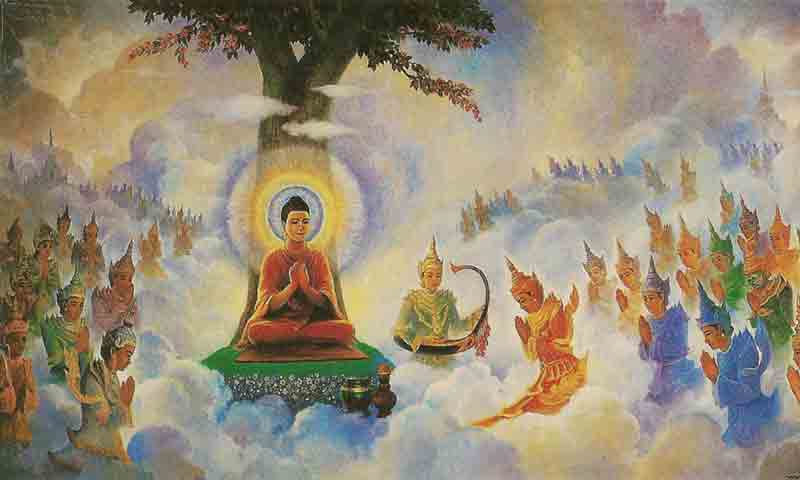
The Buddha denied the existence of God. But he confirmed the existence of other worlds, of heavens and hells populated by celestial beings, some of whom even bore the name of Hindu gods. In the early Buddhist literature, the Buddha himself was described as having gone to the heavens and meeting with the gods. The scriptures also quoted instances of gods descending down to the earth to witness some momentous events in the life of the Buddha.
Prominent among the Buddhist gods are Sakka and Brahma. Sakka is like the Indra of the Buddhist pantheon. He is the ruler of gods and stays in the world of desires. Brahma is the overlord of the highest heavens, the Brahma lokas. He is mentioned frequently in the Buddhist scriptures. In Buddhism he becomes a follower of the Buddha, as if he has become converted to Buddhism by the Buddha himself.
The gods are not immortal, though they may live longer than the earthly beings. They also are subject to decay and change, and the process of becoming. The intensity and the manner in which these processes take place however may be different and involve longer periods of time. But like any other beings, they are with a beginning and an end.
They are inferior in status to the Arhats who have attained Nirvana. The gods were also from the lower worlds originally, but slowly and gradually graduated themselves into higher worlds by virtue of their past deeds and cultivation of virtuous qualities. Since there are many heavens and higher worlds of Brahma, these gods may evolve progressively from one heaven to another through their merit or descend into lower worlds due to some misfortune or right intention.
The gods of Buddhism are therefore not immortal. Neither their position in the heavens is permanent. They may however live for longer durations of time. One of the Buddhist Sutras states that a hundred years of our existence is equal to one day and one night in the world of the thirty three gods. Thirty such days add up to their one month. Twelve such months become their one year, while they live for a thousand such years. If we translate this into our time frame, each Buddhist deity should live for a minimum of thirty six million years.
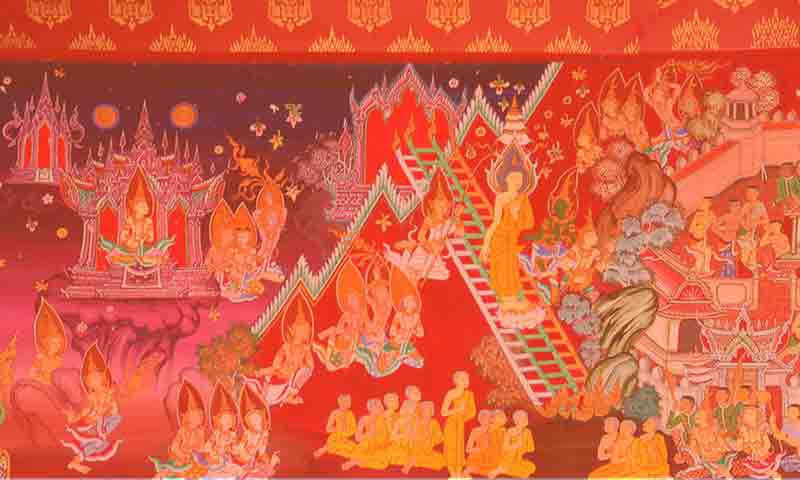 Buddha's return from Tavatimsa heaven - traditional Thai mural in
Traipidok-Hall of Phutthamonthon park, Nakhon Pathom, Thailand
Buddha's return from Tavatimsa heaven - traditional Thai mural in
Traipidok-Hall of Phutthamonthon park, Nakhon Pathom, Thailand
The four tier universe of Buddhist and Hindu cosmology
With minor variations, the Buddhist texts point to four tier universe or planes of consciousness, each again divided into different worlds. At the lowest level is the underworld with four worlds. Then there are the seven worlds of desires known as Kama-lokas (or kamavacara). Above them are the sixteen worlds of forms known as Rupa-lokas (or rupavacara) and above all are the four formless worlds known as Arupa-lokas (or arupavacara). These worlds also exist in each of us in subtle form as planes of consciousness and can be accessed through meditation. The eleven worlds of desires (kama-lokas) are further divided into two spheres: four under worlds of darkness and seven upper worlds of gods and humans of which ours is one.
Thus we have a total of 31 worlds including ours: four worlds below us and a total of 26 worlds above us in a four-tier universe. Interestingly the cosmic structure of the Buddhism recognizes four spheres or planes of existence just as the Vedic cosmology does. For example, in the Vedic cosmology, we have our world (the earth), followed by the mid-region known as Antariksham, inhabited by celestial beings driven by passions (equal to the kamaloka) and the heaven known as Bhuva inhabited by gods having distinct forms (equal to Devaloka). Higher than that is Maha, the immortal and immutable world of Brahman (Brahmaloka). Below the earth is the subterranean world of hells inhabited by demons and sinners.
The four sphere and the 31 worlds of Buddhism are described below from the lowest to the highest.
The Subterranean world
In this realm are four worlds, characterized by darkness, evil and suffering. They are:
1. The world of the demons (asuras),
2. The world of the ghosts(pretas)
3. The world of the animals
4. The hell or purgatory (Niraya).
As in case of humans, beings in these worlds have no fixed life-span. It varies according to the karma of each being.
Kama Lokas or The Worlds of passions and desires
The worlds of desire are six excluding ours. They are also called rupa-lokas, which means the worlds of names and forms. Beings with names, shapes, sizes, forms, and movements populate and define these worlds. Since they are driven by desires, they are caught in the cycle of births and deaths. Hence, the name kama lokas. They are also called deva-lokas because gods with fixed lifespan of thousands of years reside in these worlds.
The worlds of desires (kama-lokas) are attained by the merit of good deeds. The more virtuous a person is, the higher the world he attains. For monk seeking Nirvana, these worlds are a great distraction. While in the higher worlds, one may experience pleasure and happiness in greater intensity, beings in these worlds are still subject to desires, emotions, negativity, karma and their consequences. Hence, they are not to be sought. These worlds are described below:
The first world: At the lowest of the hierarchy in this sphere is the world of humans (manusa-loka) consisting of four great continents and Uttarakuru. Beings in the world also have no fixed life-span.
The second world: This is the world of The Four Great Guardians (catummaharajika devas) who rule the four quarters. They have a fixed lifespan of 9000 human years.
The third world: This is the Tavatimsa Heaven where reside the thirty three gods. Sakka is their chief. In nature and status he is equivalent to the Indra of Hindu pantheon. They have a fixed lifespan of 36 million human years.
The fourth world: This is the world of Mara, Death. Beings in this world have a fixed lifespan of 114 million years.
The fifth world: Known as the Tusita heaven, here the Bodhisattvas await their rebirth on earth as the future Buddhas. Gautama Buddha resided here before he was born on earth. Presently Maitreya Buddha is said to be residing here awaiting his next birth on earth. Beings in this world have a fixed lifespan of 576 million human years.
The sixth world: This is the abode of the Nimmanarati Gods. These gods have a fixed lifespan of 2.304 billion human years.
The seventh world: This is the highest world in the plane of desires and forms (kama or rupa-lokas), where reside the Paranimitta Gods who have a lifespan of 9.219 billion human years.
In deeper meditation one can ascend into these worlds and experience immense pleasure. Of these seven worlds, only human beings are subject to the desire for sexual pleasure (kamavasana). The gods are free from it. However, all beings in these worlds are subject to rebirth. These heavens are attained by virtuous deeds and the practice of Buddha Dharma.
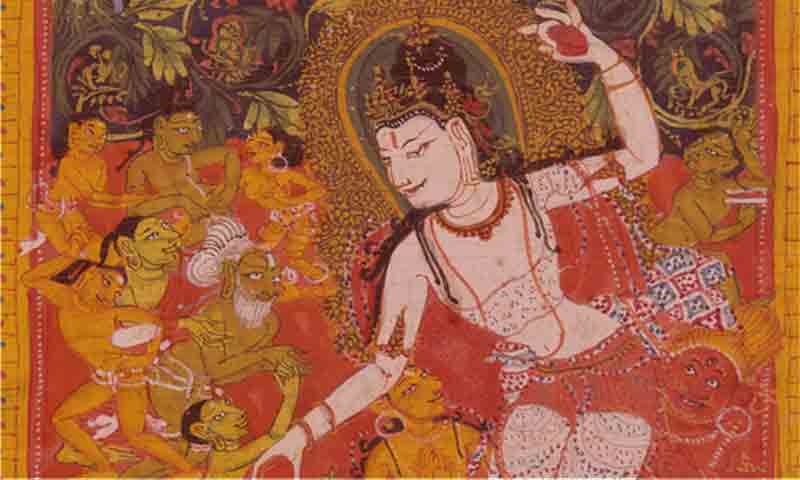 Painting of a bodhisattva,Prajnaparamita. benefiting sentient beings
The Rupa Lokas or the divine worlds of names, forms and perceptions
In all there are sixteen worlds of forms, which constitute the second highest tier, equal to the world of Indra and his retinue in Hinduism. These worlds are free from desires (kama vasanas), but still conditioned by forms and perceptions. These heavens are attained by the practice of the Four Noble Truths. Beings in these world also have a limited lifespan. However, their lifespan is comparatively much higher than those of the worlds below them. The sixteen worlds are further divided into four sphere or jhanas consisting of three, three, three and seven worlds respectively. They are described below:
1st Jhana
1. The world of Brahmaparisajja Devas (who are devoted to Brahma)
having a lifespan of 1/3rd eon.
2. The world of Brahmapurohita Devas (who officiate as priests of
Brahma) having a lifespan of one half of an eon.
3. The world of great Brahmas (Mahabrahmas) with a lifespan of one
eon.
2nd Jhana
1. The world of Pratibha Devas (light beings) with a lifespan
of two eons.
2. The world of Appamanabha Devas with a lifespan of four eons
3. The world of Abhassar Devas with a lifespan of eight eons.
3rd Jhana
1. The world of Parittasubha Devas (pure and auspicious beings)
with a lifespan of 16 eons
2. The world of Appamanasubha Devas (intelligent and auspicious
beings) with a life span of 32 eons
3. The world of Subhakihna Devas with a lifespan of 64 eons
4th Jhana
1. The world of Vehapphala Devas with a lifespan of 100 eons
2. The world of Asanna-satta Devas with a lifespan of 500 eons
3. The world of Aviha Devas with a lifespan of 1000 eons
4. The world of Atappa Devas with a lifespan of 2000 eons
5. The world of Sudassa Devas with a lifespan of 4000 eons
6. The world of Sucassi Devas with a lifespan of 8000 eons
7. The world of Akanittha Devas with a lifespan of 16000 eons.
Arupa Lokas, or Brahma Lokas, or the abstract worlds
In this sphere of disembodied or abstract consciousness, there are four worlds of the formless characterized by pure consciousness (jhana) where existence is reduced to its most subtle impressions. Since they cannot be grasped by the senses but only through the intellect in its most refined and tranquil state, they are called the jhana worlds or the worlds of pure awareness. The four highest heavens, stand above the rest of the planes and worlds. They are free from sensuous desires, and devoid of all forms. These worlds are attained by the practice of the Four Formless Truths. Although they are the highest worlds, beings in them are also subject to fixed lifespans. The four Jhana worlds are:
1. The world of infinite space with a lifespan of 20 eons.>
2. The world of infinite consciousness with a lifespan of 40000 eons.
3. The world of emptiness or nothingness with a lifespan of 60000 eons.
4. The world of neither perception nor non-perception with a lifespan of 84000 eons.
Gods in these four planes experience different levels of bliss. Their rapture is pure, subtle, long-lasting and free from passions and sensuality, which characterize the pleasure and happiness of those who inhabit the lower regions. Human beings may experience those states in various phases of meditation (jhana).
Birth in heavens
While in our world, the birth is through wombs or eggs involving sexual intercourse, in the higher worlds it is spontaneous without sex. Beings in the world of desires and forms (kama and rupalokas) have gender differences, where as those in the Brahma worlds are free from it.
One may take a birth in these worlds spontaneously if one departs from here in a corresponding mental state, having reached a certain level of purity and progressed enough on the Eightfold Path. This is again similar to the Hindu belief that what person thinks at the time of his death, that he attains.
Geography
As in Hindu cosmology, the worlds have a similar geographic location. At the center of the universe is the earth situated on the mount Sineru or Meru, surrounded by seven concentric rings of mountains and oceans. In the outermost ocean are the four continent in four directions. The one in the south is the Jambudvipa or the land of the Buddha (India). The hells are below the earth where sinners and demons inhabit. The ghosts and spirits share the same space with humans in our world. The worlds of devas exist above.
Gender
Both gods and goddesses inhabit these regions. The goddesses may be young (devakanyas), maidens or nymphs (apsaras), goddesses (devis) or divine daughters (deviputris). Since all beings in these sphere have limited lifespan, similar age based divisions also exist among the gods.
Conclusion
Thus Buddhism recognizes 31 worlds of existence of which 26 are heavens, four are hells and one is our earth. The 26 heavens are also collectively called sagga (Sanskrit svarga). These worlds are aligned to our mental states and we have the ability to visit them or experience them in meditation. However, Buddhist are aware as are Hindus, that heavenly life is not a desirable end since it does not free one from suffering and rebirth. Hence, one should rather strive to attain Nirvana or Moksha, which is the highest and the ultimate goal for the humans to achieve.
Suggestions for Further Reading
- Buddhism - The Concept of Anatta or No Self
- Anatta or Anatma in Buddhism
- Anicca or Anitya in Buddhism
- The Buddha on God
- The Buddha on Avijja or Ignorance and on the Origin of Life
- The Buddha On the Self And Anatta, the Not-Self
- History Of The Four Buddhist Councils
- Chinese Buddhism
- The Eightfold Path Of Buddhism
- The Four Noble Truths of Buddhism
- Four Stages of Progress on the Middle Way in Buddhism
- The Practice of Friendliness, Kalyanamittata, in Buddhism
- Karma or Kamma In Buddhism
- Mahayana Buddhism
- Buddha's Last Days and Final Words
- Buddhism - The Middle Way
- The Buddha's Teaching on Right Mindfulness
- The Meaning and Practice of Mindfulness
- Buddhism - Vinaya or Monastic Discipline
- Right Conduct For Lay Buddhists
- Nirvana or Nibbana in Buddhism
- Buddhism - Objects of Meditation and Subjects for Meditation
- Buddhism - Right Speech and Mind Training
- Buddhism - Right Living On The Eightfold Path
- Handbook for the Relief of Suffering by Ajaan Lee
- Theravada Buddhism
- Meat Eating or Vegetarianism in Buddhism
- Essays On Dharma
- Esoteric Mystic Hinduism
- Introduction to Hinduism
- Hindu Way of Life
- Essays On Karma
- Hindu Rites and Rituals
- The Origin of The Sanskrit Language
- Symbolism in Hinduism
- Essays on The Upanishads
- Concepts of Hinduism
- Essays on Atman
- Hindu Festivals
- Spiritual Practice
- Right Living
- Yoga of Sorrow
- Happiness
- Mental Health
- Concepts of Buddhism
- General Essays
Image Attribution: The images of the heaven and Buddhist deities used in this article are licensed under the Creative Commons Attribution-Share Alike 2.0 Generic license. The content is strictly the copyright of the author and Hinduwebsite.com