
Bhagavadgita: 5. The Yoga of Renunciation of Action
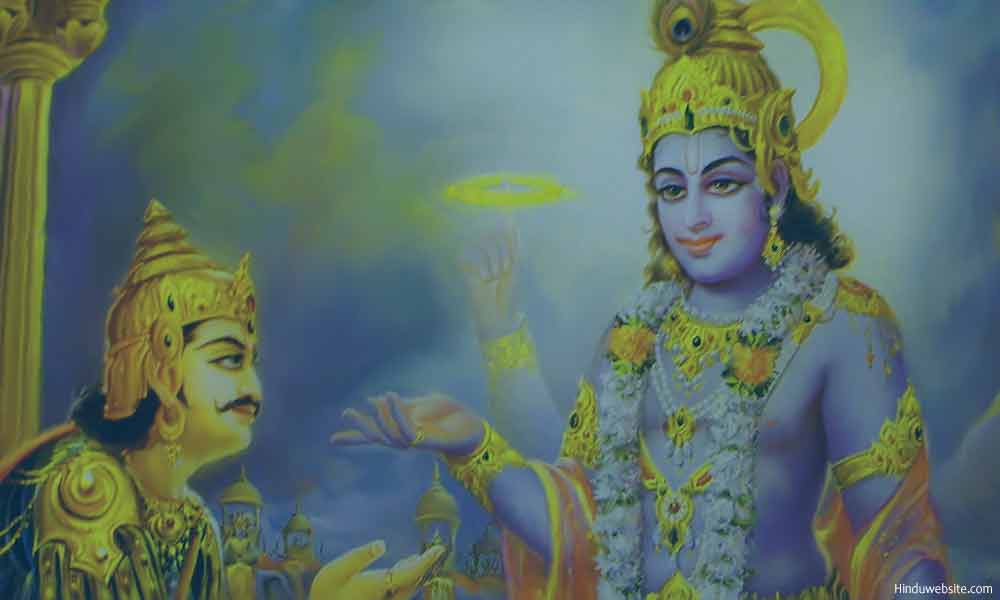
Summary: This chapter deals with the performance of actions with renunciation of desire for their fruit. One should not renounce actions but their fruit. True renunciation is renunciation of desires and doership. A yogi cultivates sameness towards all, and performs actions knowing that Brahman is the ultimate enjoyer.
Karma Sanyasa Yoga
1. Said Arjuna, On the one hand you praise renunciation of action and on other you commend the yoga of action. Please tell me clearly which of the two is better.
2. Said the Supreme Lord, Both the yoga of action and the renunciation of action are good for liberation. But of the two, the yoga of action is superior
3. O Mighty armed, He who neither hates nor desires should be known as the real sanyasi (the renouncer of desire-ridden actions). Such a person, free from the sense of dualities, is happily and completely liberated from all bondage.
4. Ignorant people say that the yoga of knowledge and the yoga of action are different. But the learned ones do not say so. By achieving mastery in either of the two, one can attain the fruit of both.
5. The state that can be achieved by following the yoga of knowledge, can also be achieved by following the yoga of action. He who sees both these yogas as one really sees.
6. O mighty armed, renunciation without karma yoga attracts sorrow. But he who practices renunciation established properly in karma yoga soon attains Brahman.
7. The qualified karma yogi, who is pure in his heart and conquered his mind and his senses, sees his self in all selves and remains free even though engaged in action
8. The knower of truth who is established in the yoga thinks, I am not doing anything at all, while seeing, hearing, touching, smelling, tasting, walking, dreaming and breathing .
9. And while speaking, releasing, grasping, opening and closing of eyes, believes that only his senses are occupied with sense objects.
10. He who acts, offering all his actions to Brahman, giving up all attachment, is never touched by sin, like the lotus leaf which is untouched by water.
11. The karma yogis perform their actions, for the sake of self-purification, using only their bodies, minds, intelligence and senses, giving up all attachment.
12. By renouncing the fruit of his actions, the karma yogi attains the transcendental state of peaceful of mind. But he who works with an intent to enjoy the fruit of his actions, attached thus, becomes entangled in worldly life.
13. By renouncing mentally all his actions, the self-controlled karma yogi lives happily in the city of nine gates( the body) neither doing anything nor making other do any thing.
14. The Supreme Lord of the world does not create neither the doership nor the doings in this world, nor attachment to the fruits of actions. These things happen because of nature only.
15. Nor does the Supreme Lord takes upon Himself anyone's good or bad deeds. By ignorance is enveloped Knowledge. And by this mortals are deluded.
16. But those who destroy their ignorance by means of knowledge, their knowledge illuminates and reveals the Supreme Lord the way Aditya, the sun god illuminates the world.
17. Those whose intelligence and mind are established in the Supreme, with strong determination and exclusively devoted to Him, go to the world of immortality, cleansed of all their impurities by knowledge.
18. The wise, look upon equally a Brahman who is endowed with the wealth of knowledge and humility, a cow, an elephant, a dog or even an outcaste.
19. In this very world do they conquer the life of mortality whose minds are established in equanimity. Since they are flawless like Brahman, they are already established in Brahman.
20. The man of stable of mind, undeluded, knower of Brahman, being established in Brahman, neither rejoices when he achieves what is pleasant nor worries when he gets unpleasant things.
21. He who is disinterested in external sense objects and finds happiness in in himself, such a yogi, his mind firmly established in Brahman, enjoys unlimited bliss.
22. O son of Kunti, the pleasures that are born out of sensory contacts are sources of pain. They certainly are transient, having a beginning and an end. The intelligent man is wise enough not to indulge in them.
23. He who succeeds in his present life in controlling the rushing force of his desires and anger before giving up his body, he is well established in yoga and is a happy human being.
24. He who is inwardly happy , who enjoys within himself, whose inner light is lit up, that mystic attains union with Brahman and becomes the Supreme Self.
25. Those who are inwardly active, whose sins have diminished, who have overcome the sense of duality, whose minds are firmly established in self-realization, and who are engaged in the welfare of all beings in the world, achieve union with Supreme Brahman.
26. Freed from lust and anger, practicing self-restraint, they, who have realized their inner selves, union with Brahman is a constant experience.
27. Shutting out all external objects, concentrating his inner gaze between the two eye brows, controlling his inward and outward breaths,
28. Restraining his mind, senses and intelligence, having left behind desires, fear and anger, the sage is for ever liberated.
29. Knowing Me as the beneficiary of all sacrifices, penances and austerities, the Supreme Lord of all the worlds and friend and well wisher of all living entities, he attains peace.
Thus ends the fifth chapter named Karma Sanyasa Yoga or the Yoga of Renunciation of Action in the Upanishad of the divine Bhagavad-Gita , the knowledge of the Absolute, the yogic scripture, and the debate between Arjuna and Lord Krishna.
Suggestions for Further Reading
- The Samkhya Philosophy and 24 Principles of Creation
- The Bhagavadgita On The Problem Of Sorrow
- The Concept of Atman or Eternal Soul in Hinduism
- The Practice of Atma Yoga Or The Yoga Of Self
- The Problem of Maya Or Illusion and How To Deal With It
- Belief In Atman, The Eternal Soul Or The Inner Self
- Brahman, The Highest God Of Hinduism
- The Bhagavad Gita Original Translations
- The Bhagavadgita, Philosophy and Concepts
- Bhakti yoga or the Yoga of Devotion
- Hinduism And The Evolution of Life And Consciousness
- Why to Study the Bhagavadgita Parts 1 to 4
- The Triple Gunas, Sattva, Rajas and Tamas
- The Practice of Tantra and Tantric Ritual in Hinduism and Buddhism
- The Tradition Of Gurus and Gurukulas in Hinduism
- Origin, Definition and Introduction to Hinduism
- Hinduism, Way of Life, Beliefs and Practices
- A Summary of the Bhagavadgita
- Avatar, the Reincarnation of God Upon Earth
- The Bhagavadgita on Karma, the Law of Actions
- The Mandukya Upanishad
- The Bhagavadgita On The Mind And Its Control
- Symbolic Significance of Numbers in Hinduism
- The Belief of Reincarnation of Soul in Hinduism
- The True Meaning Of Renunciation According To Hinduism
- The Symbolic Significance of Puja Or Worship In Hinduism
- Introduction to the Upanishads of Hinduism
- Origin, Principles, Practice and Types of Yoga
- Hinduism and the Belief in one God
- Essays On Dharma
- Esoteric Mystic Hinduism
- Introduction to Hinduism
- Hindu Way of Life
- Essays On Karma
- Hindu Rites and Rituals
- The Origin of The Sanskrit Language
- Symbolism in Hinduism
- Essays on The Upanishads
- Concepts of Hinduism
- Essays on Atman
- Hindu Festivals
- Spiritual Practice
- Right Living
- Yoga of Sorrow
- Happiness
- Mental Health
- Concepts of Buddhism
- General Essays
Copyright: All rights are reserved. No part of this publication may be reproduced stored in a retrieval system, or transmitted in any form or by any means, electronic, mechanical, photocopying, recording, scanning or otherwise, except for your personal use, without the prior written permission of Hinduwebsite.com or the author Jayaram V. If you want to publish the FREE Translation of the Bhagavad gita on your website please contact us and take our prior and written approval.