
Trisikhi Brahmana Upanishad
|| Advaya Taraka|| The Atharvasikha|| The Atharvasiras|| Brihad Jabala|| The Importance of Breath in Yoga Practice || Morals From the s || Dakshinamurthy || Untitled 2 || Hayagriva || Jabala Darsana|| Jabali || Krishna|| Kshurika || Mahavakya|| Narayana || Nrisimha Poorva and Uttara Tapaniya|| The Paingala|| Pancha Brahma || Pasupata Brahmana|| The Pranagnihotra|| Rama Rahasya|| Rama Poorva and Uttara Tapaniya|| Sarabha|| Trisikhi Brahmana || Vasudeva|| Yoga Chudamani || Yoga Sikha ||
Introduction by Jayaram V
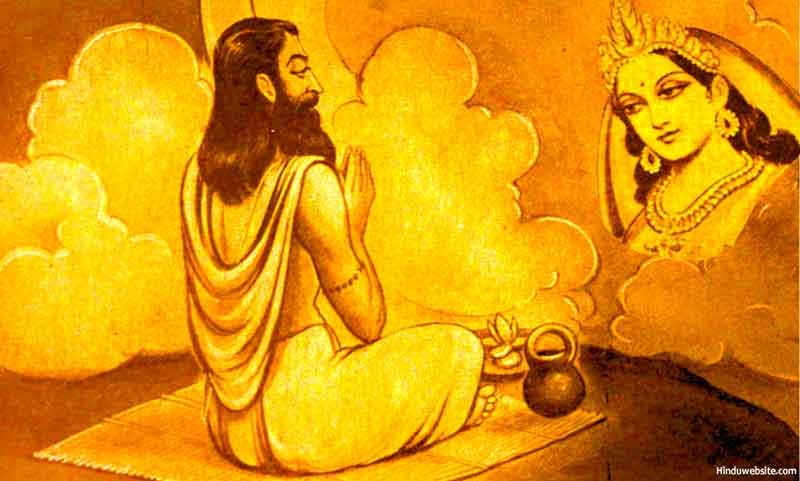
Trisikhi Brahmana Upanishad belongs to the White Yajur Veda. It is about a conversation between a brahmana named Trishakhi and Surya, the sun god, who explains to the former the distinction between the body and the soul and the means to achieve kaivalya or liberation. He describes how Shiva, as the all pervading Supreme Self, created the objective reality (Brahmam), which is a combination of Truth (sath), and ignorance and illusion, and how all the tattvas or principles, from mahat to the mahabhutas, ensued from it.
He further explains how the elements manifest themselves as the twelve aspects of human personality. These twelve aspects of the beings are responsible for the bondage, attachment and births and rebirths of individual souls who are but Sada Shiva only. But because of ignorance and pride, they cannot see the truth about themselves. It is only after taking birth hundreds of times, an individual aspires to become free from the world of illusion and ignorance. With the constant practice of yoga and by renouncing attachment to actions, he succeeds in sending the soul power into his head and becomes enlightened. The Upanishad also holds the view that Shiva is the only Truth and the rest is illusion. The following is an original translation of the Upanishad by P.R. Ramachander. Hope it will help you to understand the meaning and significance of the Upanishad and various aspects (tattvas) of creation.
Translation
Aum ! That (Brahman) is infinite, and this (universe)
is infinite.
The infinite proceeds from the infinite.
(Then) taking the infinitude of the infinite (universe),
It remains as the infinite (Brahman) alone.
Aum ! Let there be Peace in me !
Let there be Peace in my environment !
Let there be Peace in the forces that act on me !
1 A Brahmin called ‘Trishiki Brahmana’ went to the land of Sun God and asked him, “Oh God, What is body? What is soul? What is the cause and what is Athma?” 1
The Sun God replied:
You have to realize that all this is Shiva. Because only Shiva is ever clean, who is devoid of any blemishes, and who is everywhere and for whom there is no second. He is the only one who creates everything by his light and similar to the fire appearing in different forms on different pieces of steel, he appears in different forms. If you ask, to what he gives light, the answer would be, Brahmam which is denoted by the word, “Sath”, and which is merged with ignorance and illusion. That Brhamam gave rise to, “that which is not clear”. “That which is not clear” gave rise to, “Mahat (great)”. “Mahat” gave rise to egoism. Egoism gave rise to “Five Thanmathras”. That “Five Thanmathras” gave rise to “Five Bhoothas” viz earth, water, fire air and ether.
1. Ether is consciousness viz mind, wisdom, self will, and egoism
2. Air is Samana, Udhana, Vyana, Apana and Prana which are the airs in the body.
3. Fire is ears, skin, eyes, tongue and nose.
4. The concept of water is feelings of sound, touch, view, taste and smell.
5. Earth is words, hands, legs and other physical organs.
6. Ether which is the concept of wisdom is decision, behavior and self esteem.
7. The actions related to air are uniting, changing of places, taking, hearing and breathing.
8. The actions related to fire are the feeling of touch, sight, taste, view and sound. These also depend on water.
9. The actions related to earth are talking, giving, taking, going and coming.
10. The actions of the Prana Thanmathra (Symbolic soul) are the organs for doing work and organs for earning wisdom.
11. Egoism is limited to mind, brain and the will to do.
12. The micro aspects of the symbolic soul (Prana Thanmathra) are giving place, scattering, seeing, uniting and being firm.
These twelve are the aspects of philosophy, early concept of godliness and early concept of physical existence. Chandra, Brahma, directions, air, sun, Varuna, Aswini devas (divine doctors), Fire, Indra (king of devas), Upendra, Prajapathi and Yama (God of death) are the Gods of the organs and senses who travel like soul in these twelve aspects.
[Slokas 2 & 3 are not available.]
4 From there, Earth came in to existence, embracing one thing with the other, pervading by criss-cross connections, step by step as the result of Pancha Boothas (Five aspects of earth, air, water, fire and ether) gained life.
5 In that earth, plants, climbers, food and four types of pindas (body centers) arose. The root sections of the body are taste, blood, flesh, fat, bones, nerves and semen.
6 Some Pindas arose because of their own interaction and some Pindas arose because of the interaction of Pancha Boothas. In this that Pinda called “Anna Mayam (area of food)” is in the area of the belly.
7 In the middle of this body is the heart which is like the lotus flower with its stalk. The Gods for management, egoism and action are in there.
8 The seed for this is the thamo guna (baser qualities) pinda which is passion oriented and solidified (does not move or change). This is the world with its varied nature and is situated in the neck.
9 The inside looking happy Athma (soul) is on the summit of the head and is situated in the Parama Patha place. This is in its earth like form and shines with great strength.
10 The state of awakening is every where. The state of dream is also is there in the state of wakefulness. The state of sleep and the state of higher knowledge (Thuriya) is not there in other states.
11 Similar to the tastes pervading in all parts of a good fruit, Shiva Shakthi pervades every where.
12 Similarly all kosas (area of the body) are within Annamaya Kosa. Similar to the kosam is the soul. Similar to the soul is Shiva.
13 The living being is one with feelings. Shiva is one without feelings. The kosas are the places of feelings of living being. And they give rise to states of existence.
14 Similar to the fact that churning of water produces ripples and foam, by churning of mind several painful thoughts are produced.
15 By performing duties, the living being, becomes the slave to those duties. By forsaking them, he attains peace. He becomes one, who sees the world in southern path.
16 The living being with egoism and self esteem is indeed Sadashiva. The living being attains that type of illusion because of his company with the ignorant soul.
17 He attains hundreds of yonis (female reproductive organ) and stays there because of familiarity. Like a fish traveling in between the banks of a river, he keeps on traveling till he attains salvation.
18 Over passage of time due to the wisdom of the knowledge of the soul, he turns on the northern path and step by step goes up.
19 When he is able to send his soul power to his head and does permanent practice of Yoga, he gets wisdom. Because of wisdom, his yoga acts.
20 Once Yoga and wisdom become stable in him, he becomes a yogi. He will never be destroyed. He would see Lord Shiva in his deficiencies and will not see deficiencies in Lord Shiva.
21 To get results of yoga, it has to be done without any other thought. Without practice you will not succeed in Yoga or wisdom. The yogi will not get the results out of these also.
22 So by practice of yoga, mind and soul should be controlled. The Yogi should cut off the problems in yoga similar to the cutting of material with a sharp knife.
[Slokas 23 to 145 are not available.]
146 With pure knowledge of Athma (soul) the sensory organs should be controlled. We should always meditate on Para Vasudeva who is the greatest soul.
147-157 Kaivalya (salvation) is attained by the selected and sorted form of meditation on shape and form. If a yogi is able to meditate at least for a small time on Vasudeva while he is in the Kumbhaka stage of Pranayama, the sins that he has done in seven births will be destroyed. You have to understand that the portion from belly to the heart is the wakeful action. In the neck, there exists the action of the dream. In between the Jaws exists the sleep. Thuriya exists in between the eyelids. That action of synthesis with Parabrahmam which is much above thuriya exists in the skull top middle called Brahmarandra. There in the foremost thuriya corner of thuriya , the soul is called Vishnu. When one meditates in the very pure Paramakasa (great ether), he should meditate on that Adhokshaja who shines for ever with the light of crores of Suns, as sitting in the lotus of his own heart. Otherwise he has to meditate on that Viswa Roopi(One who is of the form of universe), who has several forms, several faces, several planks with several armaments, several eyes which shine like crores of suns, several colours and who is peaceful and also very angry. All the mental preoccupations of a Yogi who meditates in such a manner will be completely calmed down. That Yogi who meditates on that indestructible matter which shines like God’s grace in the center of the heart, on that ultimate truth which is beyond Thuriya, on that Sun who is the form of wisdom which is immeasurable and unending, on that being who is like a shining lamp in a windless place and on that being who is like the shine of unprocessed gems, would have salvation in his grip.
158-159 To that Yogi who is able to see and experience the shine of that deva with the universal macro or micro form or atleast a small portion of him in his lotus like heart, all the occult powers like Anima would be very much within his reach.
160-161 One has to understand that the realization of the universal truth of the unity of Jeevathma (Soul) and Paramathma (God) which is that “I am Brhamam and Brahmam is me" is he real state of Samadhi (an enlightened state of meditation where all the thought process are unified with God). That man becomes Brahmam and he does not take another birth.
162 The one who examines such principles with detachment becomes like a fire without wood and becomes one with himself.
163 Since his mind and soul does not have anything to catch hold of (get attached), he becomes stable in the form of wisdom, and his soul melts like a piece of salt and he merges in to the sea of pure consciousness.
164 He sees the word which is a thing of passion and magic like a dream. In the natural state that Yogi stands without changing as him to himself and attains the nude form in his sleep and attains salvation.
Aum ! That (Brahman) is infinite, and this (universe)
is infinite.
The infinite proceeds from the infinite.
(Then) taking the infinitude of the infinite (universe),
It remains as the infinite (Brahman) alone.
Aum ! Let there be Peace in me !
Let there be Peace in my environment !
Let there be Peace in the forces that act on me !
Here ends the Trisikhi-Brahmanopanishad belonging to the Sukla-Yajur-Veda.
Suggestions for Further Reading
- The Wisdom of the Upanishads, Main Page
- Upanishad Miscellany
- The Brihadaranyaka Upanishad - Translation by Jayaram V
- Symbolism Miscellany
- The Upanishads Translated by Max Muller
- Brahman, The Highest God Of Hinduism
- Atman, Soul or the Eternal Self
- List of 108 Upanishads According To The Muktikopanishad
- Translation Of Various Upanishads
- Introduction to the Upanishads of Hinduism
- Essays on The Upanishads
- Translations of Upanishads - Links
- Essays On Dharma
- Esoteric Mystic Hinduism
- Introduction to Hinduism
- Hindu Way of Life
- Essays On Karma
- Hindu Rites and Rituals
- The Origin of The Sanskrit Language
- Symbolism in Hinduism
- Essays on The Upanishads
- Concepts of Hinduism
- Essays on Atman
- Hindu Festivals
- Spiritual Practice
- Right Living
- Yoga of Sorrow
- Happiness
- Mental Health
- Concepts of Buddhism
- General Essays