
Jabala Darsana Upanishad
|| Advaya Taraka|| The Atharvasikha|| The Atharvasiras|| Brihad Jabala|| The Importance of Breath in Yoga Practice || Morals From the s || Dakshinamurthy || Untitled 2 || Hayagriva || Jabala Darsana|| Jabali || Krishna|| Kshurika || Mahavakya|| Narayana || Nrisimha Poorva and Uttara Tapaniya|| The Paingala|| Pancha Brahma || Pasupata Brahmana|| The Pranagnihotra|| Rama Rahasya|| Rama Poorva and Uttara Tapaniya|| Sarabha|| Trisikhi Brahmana || Vasudeva|| Yoga Chudamani || Yoga Sikha ||
Introduction by Jayaram V
Jabala Darsana Upanishad is a Vaishnava Upanishad. It belongs to the Sama veda. It is presented as a conversation between Sankrithi, a devotee and lord Dattatreya, described here as an incarnation of Vishnu, about the various aspects of the eightfold yoga or the ashtanga yoga, namely Yama, Niyama, Aasana, Pranayama, Prathyahara, Dharana, Dhyana and Samadhi. Lord Dattatreya is considered to be a minor incarnation of Vishnu, born to Atri and Anasuya. He is created with the introduction of magical rites and the creation of Soma plant, which was used to extract Soma juice as an oblation in the Soma sacrifices of the Vedic times.
In some Puranas, Dattatreya is described as an incarnation of the Trinity of gods born to Anasuya under strange circumstances. Because of this he is usually depicted with three heads. He is also shown usually in the company of four dogs which symbolize the four vedas. According to another version, Dattatreya was killed by Parasurama, another incarnation of Vishnu. The Upanishad summarizes the priniciples and practices of the classical Ashtanga yoga system. However you will find some differences and additional information. For example, the Yamas proposed here included some additional qualities such as honesty, cleanliness, compassion etc. Similarly, the Niyamas are also ten instead of the traditional five mentioned by Patanjali. The Upanishad also lists nine important asanas which are not mentioned in the Yogasutras. The following is an original translation of the Jabala Darsana Upanishad by P.R.Ramachander. Hope you will find it useful for your study and understanding of the principles and practice of yoga.
Translation
Om ! Let my limbs and speech, Prana, eyes, ears, vitality
And all the senses grow in strength.
All existence is the Brahman of the Upanishads.
May I never deny Brahman, nor Brahman deny me.
Let there be no denial at all:
Let there be no denial at least from me.
May the virtues that are proclaimed in the Upanishads be in
me,
Who am devoted to the Atman; may they reside in me.
Om ! Let there be Peace in me !
Let there be Peace in my environment !
Let there be Peace in the forces that act on me !
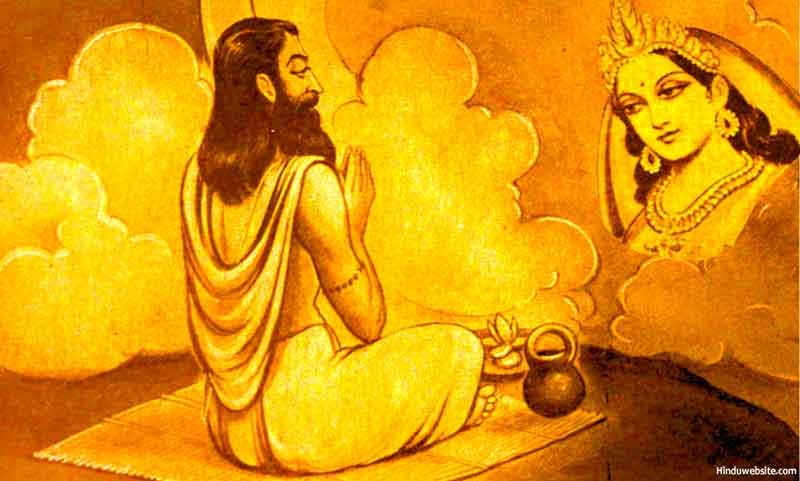
God Dattatreya is the reincarnation of the four armed Vishnu and he is the ruler of the world. Sankrithi is a great devotee and a sage and is an expert in yoga and also a disciple of Dattatreya. He approached his teacher (God Dattatreya) with humility and with folded hands, when his teacher was alone and requested him, “Oh God, please tell me about the science of yoga which has eight branches and five different sthanas (places) by knowing which I will attain salvation. Dattatreya told him, “Hey Sankrithi, I shall tell you about Yoga which has eight branches. The eight branches are Yama, Niyama, Aasana, Pranayama, Prathyahara, Dharana, Dhyana and Samadhi.
1. Yama which is the first is the practice of non-violence, truth, non possession of properties of others, celibacy, mercy, honesty, patience, stability, food discipline and cleanliness.
2. Niyama is the ten aspects of penance, joy, orthodoxy, charity, worship of god, hearing of philosophy, fear for bad actions, clear intellect, chanting and austerities.
3. The nine important Asanas (sitting positions) are Swasthika (Swastika), Gomukha (cows face), Padma (lotus), Veera (valorous), Simha (lion), Badra (safe), Muktha (free), Mayura (peacock) and Sukha (pleasant). Oh sage, that position, whatever it may be but which makes you comfortable and gives you courage to undertake Yoga is called Sukhasana. People who do not have strength to take up other positions can use that. Victory in the seating position is like victory over the three worlds. Once the Asana is fixed, one should practice Pranayama.
4. Either in the top of the mountain or by the shore of the river or under a Bilwa tree in the forest, after choosing a clean place which is acceptable to the mind and after establishing a place to do tapas (Asram), sit in the Asana which is most familiar facing either east or north. Then sit with the body neck and head in a straight line, cover the face and concentrate the vision with best possible attention on the nectar flowing from the fourth state of the moon like dot at the end of the nose. Draw the air inside using the lungs, store it in the stomach, meditate on the flame of fire inside the body and then shift meditation to the root of fire with its sound and dot. Then the intelligent one will exhale and draw the Prana using Pingala (Nadi which is tawny and is on the right side of Sushumna Nadi) and meditate on the Agni Bheeja. Again he has to exhale and inhale again in the middle using the Ida (Nadi which is pleasant and is on the left side of Sushumna). One should have to live in a secret place practicing this exercise six times for 3-4 days or 3-4 weeks at dawn, noon and dusk. This would help him to clean up the Nadis. Slowly symbols will start showing up. Body will become light, the fire in the stomach will burn well and the voice would become clearer. These are the symbols of Siddhi (getting mastery). Till you see this, you have to practice.
5. Now I will tell you about Prathyahara. To use force and divert the sensory organs which normally travel according to their nature is Prathyahara. Those who know Brahma say that seeing whatever we see as the form of Brahman is Prathyahara. Prathyahara also is doing clean or unclean acts as those belonging to Brhaman. Further doing daily religious activities after dedicating them to God and similarly doing the activities which we desire is also Prathyahara. Apart from this inhaling air (oxygen) and stopping it in different places is also Prathyahara. The wise man would sit in Swasthikasana, draw his breath till it fills up from head to toe and hold it in two feet, mooladhara, stomach, middle of the heart, bottom of the neck, jaw, middle of the eyelids, forehead and at the top of the skull. Then he should leave out the belief that the body is oneself and make that thought as nirvikalpa and merge it with Paramatma. The experts in Vedanta say that this is true Prathyahara. There is nothing that cannot be attained by those who practice like this.
6. Now I will tell you about the five types of Dharana (holding steady - a stage in meditation - here we try to hold on what we are mediating upon without wavering). In the sky which is in the middle of the body, Dharana of the sky outside should be made. Similarly in the breath, Dharana of air outside should be made. In the fire in the stomach, Dharana of the fire outside should be made. In the fluid aspects of the body, Dharana of the water outside should be made. In the earthy aspects of the body, Dharana of the earth outside should be made. Sage, also it is necessary to chant the pancha bhootha mantras viz., Ham, Yam, Ram, Vam and Lam. It is said that this very great Dharana destroys all sins. In the body up to the knee is the aspect of the earth, from there till hip it is the aspect of water, up to the heart is the aspect of fire, up to middle of eyelids is the aspect of air and then up to the middle of the skull is the aspect of the sky. In the aspect of earth Brahma has to be placed, in the aspect of water Vishnu should be placed, in the aspect of fire Rudra should be placed, in the aspect of air Iswara should be placed and in the aspect of sky, the Sadashiva should be placed. Hey great sage, I will also tell you another Dharana. In the Jeevatma, that lord Shiva who rules over everything and is the personification of wisdom should be placed. To get rid of all sins, the wise man should suppress the gods like Brahma in the causative self, and place the Avyakta (that which is not clear) which is formless and which is the root cause inside the entire soul with the chanting of pranava. He should control the sensory organs by mind and should merge them with the soul.
7. I will now tell you about Dhyana (meditation) which destroys sorrow. Dhyana should be done of that Maheswara, who is the medicine for problems arising out of birth, who is the discipline and fundamental basis of the world who is of the form of Para Brahma, who has the masculine power upwards, who is of the form of the world, who is Virupaksha, and who is the head of all yogis as “I am He”. Then continue to do Dhyana of him who is beyond the reach of meditation, who is the personification of Sachidananda Brahman and who is soul in person as “I am He” for attaining salvation. In the mind of that great Purusha who practices like this, the science of Vedanta would automatically appear. There is no doubt about it.
8. Now I will tell you about Samadhi (deep meditative state) which destroys the ills of birth and death. Samadhi is that state in which there is knowledge that Jeevatma and Paramatma are one. Atma (soul) is filled all over for ever and does not have motion or stain. Though it is one, due to the effects of illusion, it appears as different objects. Really there is no difference between these so called objects. When one sees all objects within himself and him as a part of all objects, He attains Brahman. When one drowns himself in Samadhi and does not see different objects as different , then he attains the single aim of salvation. When he sees only the true soul and the entire world appears as an illusion to him and he is cured of all sorrow.
Thus advised by Lord Dattatreya the sage Sankrithi fully lost all his fear and attained that blissfull state, deep in himself.
Om ! Let my limbs and speech, Prana, eyes, ears, vitality
And all the senses grow in strength.
All existence is the Brahman of the Upanishads.
May I never deny Brahman, nor Brahman deny me.
Let there be no denial at all:
Let there be no denial at least from me.
May the virtues that are proclaimed in the Upanishads be in
me,
Who am devoted to the Atman; may they reside in me.
Om ! Let there be Peace in me !
Let there be Peace in my environment !
Let there be Peace in the forces that act on me !
Here ends the Jabala Darsanopanishad, included in the Sama-Veda.
Suggestions for Further Reading
- The Wisdom of the Upanishads, Main Page
- Upanishad Miscellany
- The Brihadaranyaka Upanishad - Translation by Jayaram V
- Symbolism Miscellany
- The Upanishads Translated by Max Muller
- Brahman, The Highest God Of Hinduism
- Atman, Soul or the Eternal Self
- List of 108 Upanishads According To The Muktikopanishad
- Translation Of Various Upanishads
- Introduction to the Upanishads of Hinduism
- Essays on The Upanishads
- Translations of Upanishads - Links
- Essays On Dharma
- Esoteric Mystic Hinduism
- Introduction to Hinduism
- Hindu Way of Life
- Essays On Karma
- Hindu Rites and Rituals
- The Origin of The Sanskrit Language
- Symbolism in Hinduism
- Essays on The Upanishads
- Concepts of Hinduism
- Essays on Atman
- Hindu Festivals
- Spiritual Practice
- Right Living
- Yoga of Sorrow
- Happiness
- Mental Health
- Concepts of Buddhism
- General Essays