
Fate And Free Will In Hinduism

What is the difference between the plants, trees and the animals out there and we, apart from a few differences we have with them in name, form and intelligence? The trees, the plants and the animals live for a while, perform certain natural functions and then die. So do we. Does the difference exist in our minds because of the self-importance we ascribe to ourselves or is there any real difference between the two in existential and evolutionary terms?
We believe that we are more evolved than the other living beings upon earth. But that may not be how we are viewed by Nature on the evolutionary scale. Our natural superiority is debatable, because we may have more intelligence, but animals have more muscle power, agility and extraordinary sensitivity. So by virtue of our intelligence we may have the bragging rights to say that we are highly evolved beings upon earth, but our claim is not indisputable. This is not to demean our existence nor our unique abilities, but to suggest that we may need to be more objective about ourselves and our self-importance.
Every living being has a certain life span, lives according to certain laws of nature, performs certain natural functions while it is alive and then suddenly and mysteriously one day dies. Apart from the individual details and unique experiences, the general course of our lives is not much different. So, in terms of birth and death, we are not different from other beings. We presume that we are eternal and there is life beyond death. We have certain beliefs about our existence such as the law of karma, the importance of ethical life, the need to obey the eternal law of God and the existence of the cycle of evolution and involution.
They may be true. But other than some vague indications, we have no clue what happens to us after death. We do not know for sure whether after death we go to heaven as presumed by certain religions and live there eternally or enter some ethereal zone from where we return again after exhausting our karma to continue our mortal existence? In many near death experiences, people saw celestial beings and visions of heaven and hell according to their religious beliefs. There are accounts according to which heaven and hell exist. There also are accounts which confirm that people reincarnate or return to earth again and again. Perhaps our beliefs and faith trick us into experience what we strongly believe, for such is said to be the power of faith.
We are not sure, at least in our mental plane, whether we live upon earth only once or several times. Whether we live in the heavens eternally upon death or return again and again to perfect ourselves and advance into higher planes of intelligence and existence. Despite our intelligence and evolutionary progress, we are not sure of anything that is beyond our senses and human intelligence. The physical universe with its myriad inconsistencies perplexes us. Our intelligence dims before the brilliance of Nature and the Universe. We stand weakly in comparison to that which surrounds and envelops us from all sides. We are overwhelmed by what we are not, what we cannot comprehend and what we cannot control. We are humbled every minute by the uncertainty of life and by the challenges we face.
Are you in control of your life?
But despite all the perplexity that overwhelms us and presses down upon us from the four corners of the universe that exists in us and outside of us, we are sure of one fact: our thoughts and actions have consequences. We reap the rewards and punishments according to our thoughts and actions. We set in motion a chain of events that can reach out to various corners of the universe and impact not only our future but also the future of others. We create ourselves and our lives anew each minute. We are both the cause and effect of our lives. We are the points in time where the present meets with both the past and the future in a single moment. In us the animal becomes the man and the man becomes God by the force of our individual wills. We are Nature's most beloved children and also its most accursed because we are subject to the pairs of opposites and haunted by our own memories. In us the heaven and hell compete for attention while we struggle in a mire of desires and temptations. We seek the limits of happiness while light struggles in us in the shades of darkness. We compete with gods for attention from God, while our passion for perfection stands uncomfortably in close proximity with our deluded pragmatism.
A vast part of the universe runs on the principle of cause and effect. We leave the impressions and footprints of our thoughts and actions upon others and reap the consequences. Right now what I am writing is leaving its own impressions elsewhere in the universe. May be it is the result of an aspiration that has already been set in motion by benevolent minds or may be it is a thought process that has found its meeting point and matching expression. What we are today is largely a product of our own actions and interactions with the world and what we do at present shapes our lives and our future.
There is also an element of chance in all these. We cannot take full credit for all that happens to us in our lives. The chance element is so pervasive that we can never give ourselves complete credit or discredit for our actions and inactions or for our successes and failures. Sometimes even the most notorious criminal gets away with his audacious crime while an innocent person undergoes a severe punishment because of someone's mistake. While uncertainty and ambiguity is deeply interwoven into the fabric of our lives, we cannot also say that we are entirely at the mercy of chance and the world. Through our thoughts and actions and exercise of our individual wills, we can control some aspects of our lives. We can reach our goals and realize our dreams.
Individual effort vs. chance
What happens in our lives is largely a product of our individual effort, with some help from others and the world in general. Chance does play an important role, although we know that we cannot entirely depend upon it for our success and happiness. Some ascetic traditions advocate the ideal that we should surrender to God our morbid fear of the uncertain and let chance dictate everything. There is a certain sublime beauty and extraordinary idealism in such a stance, in the total and unconditional surrender to the vagaries of life as a mark of trust and true devotion to God. But a vast majority of people are not yet prepared for such exalted idealism. They are not perfect enough to trust anyone and themselves.
Religious philosophy in India evolved mostly to resolve the questions surrounding the importance in our lives of individual will and divine will, or, alternatively, individual effort and chance. Some ancient Indian ascetics such as the Ajivikas believed that everything in the world was preordained and that human beings had no alternative other than submitting themselves to the inexorable movement of the world or the law of God, which they equated with fate (niyati). So they asked people to let go of everything and live life as it presented itself to them. Others such as Jainism and Buddhism questioned the validity of fatalism and focused on individual effort. They emphasized the importance of the law of karma and the need to live ethically responsible life.
Fate and free will in Hinduism
In Hinduism we find a fine blend of both the ideals and an attempt to portray life as a product of individual actions as well as chance. In this expansive vision, man is master of his own life but not completely free from the will of God. Man is responsible for his actions but being a movement within a larger movement over which he has no control, he should acknowledge the presence of God and relinquish his doer-ship to enjoy life (Isa Upanishad). Hindu scriptures identify three forces that shape our lives. They are:
- Individual actions performed by oneself according to one's own will,
- Actions of other living beings be they human or non-human, and
- Intervention of chance or fate which is a direct manifestation of divine will enforced directly or through various divinities by God and forces of Nature.
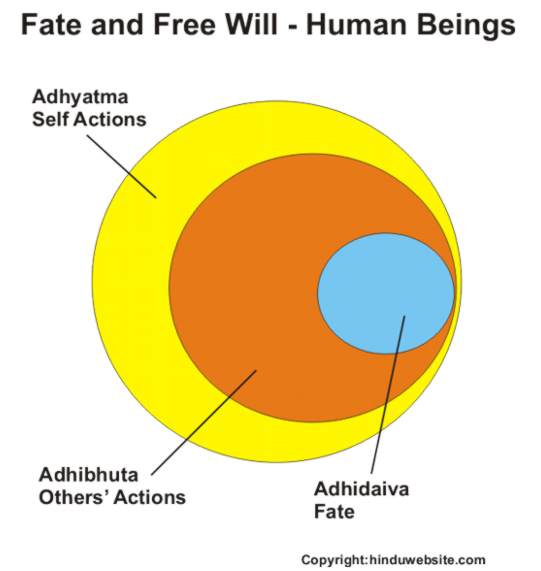
The first one is known as individual factors (adhyatmika). Included in this category are actions we perform as free individuals by the force our own wills and under no particular compulsion. The second one is known as extraneous factors (adhibhautika). It encompasses all the actions performed by others, either on their own or in response to our actions. The others may be fellow human beings such as our close relations, friends, enemies, strangers, government and also other living beings such as plants, animals, insects and micro organisms. The third force is known as adhidaivika or the divine will. All the acts of nature, acts of God, chance events, fortuitous circumstances, unintended causes, unexpected turn of events fall into this category. These three causes are universally present. They propel the wheel of creation and determine the course of our lives, here and here after. They act individually or collectively or in some combination to choreograph the dance of life.
Evolution and fate and free will
There seems to be a correlation between the level of evolution and the relative importance of these three factors. In case of human beings, individual will (adhyatmika) seems to play a predominant role followed by extraneous factors (adhibhautika) and acts of God (adhidaivika). Actions performed on our own according to our intelligences largely shape our lives and determine our future, followed by the actions of our friends and family members, society and the world in general. Nature and elemental forces also play an important role by manifesting earth shaking events and unleashing the fury of Nature.
We cannot say that we live entirely by our free will. Nor are we hopelessly at the mercy of fate. Fate plays its own dice on the checkerboard of our existence, largely as a balancing or corrective force. But through sustained effort, we can with stand the vagaries of life and realize our goals. Also by surrendering ourselves to the will of God and offering Him all our actions, we can remain free from the consequences of our karma and achieve salvation. The decision to surrender to God is again an individual decision (adhyatmika). But when the surrender is complete, the distinction between the individual will and the divine will disappears, and individual actions become part of God's actions (adhidaivika).
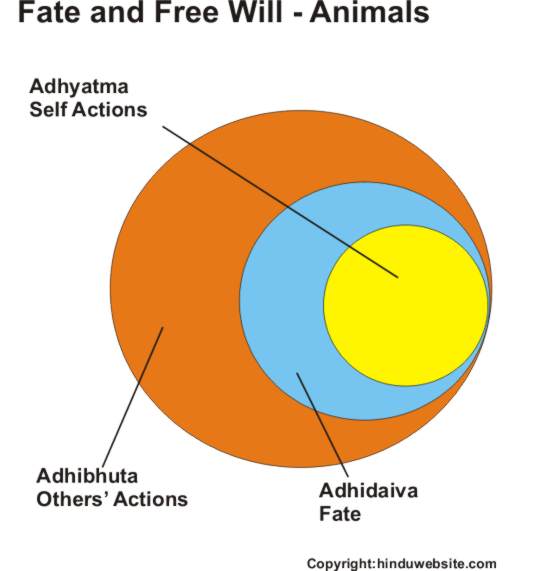
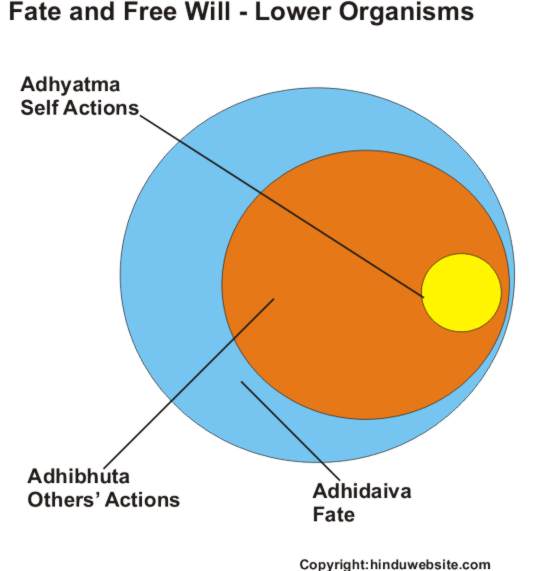
In case of not so evolved beings such as animals, insects, birds and other life forms, extraneous actions (adhibhautika) become more important than their individual actions. These beings are semi-evolved or in various stages of evolution and perfection, below the level of the human beings. Their intelligence (buddhi) is not as illuminated as that of humans. They have some ability to exercise their free wills and determine the course of their lives. But it is not sufficient enough to give them the freedom to be what they are. They are mostly at the mercy of extraneous factors such as the acts of man, Nature and God. with little or no ability to counter them or escape from them.
Besides God and Nature, man is the most powerful, extraneous and destructive force for the plant and animal kingdoms. We have destroyed entire species, tampered with their genetic pools, altered the ecosystems and manipulated Nature to our advantage. It is an unequal battle in which they have little scope for victory and chance of survival against our greed and destructive actions, except through the intervention of fate. So in case of less evolved beings, individual actions (adhyatmika) carry lesser weight compared to external factors such as man made disasters and fate or acts of God such as natural calamities.
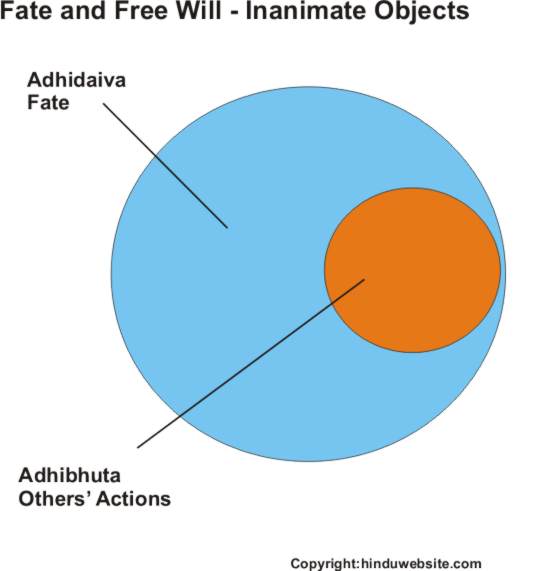
Finally, in case of inanimate objects, individual will disappears completely or remains suspended in state of inertia and their existence is guided by solely by the remaining two forces, namely actions of others (adhibhautika) and fortuitous circumstances (adhidaivika). In our solar system the earth is the only planet where you will see the three forces at work. In the other planets elemental forces and fortuitous circumstances play a dominant role. The importance of these three forces is graphically represented in the following diagrams.
 |
 |
 |
 |
How can you neutralize the three factors in your life?
The three factors, namely individual will, will of others and divine will play an important role in the life of every human being, whether they like it or not and whether they believe in God or not. It is therefore important for us to devise appropriate strategies to deal with them and minimize their impact on our lives. We can minimize the consequences of actions arising from our individual will, by controlling our desires and by consecrating them to God without desiring the fruit of such actions. If we acknowledge God as the real doer and offer Him all our actions, we will not incur any karma. It is important that we lead morally responsible lives and side with the good by cultivating the quality of sattva or purity. We should identify desires as the root cause of our suffering and stay away from the five enemies, namely sexual desire (kama), anger (krodha), delusion (moha), pride (mada) and envy (matsarya). This is how we can deal with the consequences arising from our individual actions.
With regard to the adhibhautika or the actions of others, we can neutralize them by cultivating the friendship of people, who are virtuous, devoted to God and are pure in their hearts; and by avoiding the company of people who are evil, wicked, weak, immoral, impure and cruel. We should also stay away, to the extent possible, from harmful creatures such as snakes and wild animals. In this information age, we should be careful with whom we communicate on the internet, what websites we visit and what videos and television programs we watch. Internet stalkers, identity thieves, spammers, computer viruses and spyware are part of the extraneous factors (adhibhautika) in the virtual world against whom we should remain guarded.
Finally we can minimize the impact of fate or divine will by seeking the intervention of God and the divinities with the help of prayers, rituals and devotional services. We should cultivate detachment and equanimity so that we can learn to bear with what we cannot control. The divinities whom we worship in Vedic rituals, such as Indra, Varuna, Agni and Mitra, reside not only in the macrocosm of the universe but also in the microcosm of our minds and bodies. They are real and present in all of us as subtle forces. They are either strong or weak or active or inactive according to our actions and aspirations. If we keep them happy and strong, they will show their appreciation by actively intervening with our destinies and help us in realizing our temporal and spiritual goals. But, if we keep them weak and undernourished through neglect or disrespect, they will become silent and leave us to our fate.
The Vedic people were well aware of this secret. So they offered them regular prayers and performed various sacrifices on daily, monthly and yearly basis. They offered food to the gods (devayajna), the ancestors (pitryajna) and other beings (bhuta yajna) by various means. They sought their help by showing their devotion and loyalty. At the same time, they kept the evil at bay by not nourishing them and not giving scope for growing strong. From the Upanishads we learn that gods become victorious in our bodies against the demonic forces through controlled breathing and by becoming aware of the real Self. So it is important that we practice yoga regularly and keep our minds and bodies in shape. We should nourish our inner divinities well and keep them active and strong with good thoughts, good words, sattvic food, sacred sounds, fine fragrances, clean air, pure water, resplendent light and sincere aspiration.
Suggestions for Further Reading
- Fate, Freewill and Fatalism in Hinduism
- Hinduism And The Evolution of Life And Consciousness
- Ego, the Lower Self or the Egoistic Self
- The Concept Of Karma Or The Law Of Action In Hinduism
- Kapila and the Samkhya yoga
- The Philosophy of Nyaya and Vaisheshika of Hinduism
- Hinduism And The Law of Karma
- The Ajivika Sect of Ancient India
- Bhakti Marg, the Path of Devotion
- Letting your God live in You - The True Essence of the Hindu Way of Life
- prajnanam brahma - Brahman is Intelligence
- Maslow's Hierarchy Of Needs From The Perspective Of Hinduism
- The Defintion and Concept of Maya in Hinduism
- The Meaning of Nirvana
- Self-knowledge, Difficulties in Knowing Yourself
- Hinduism - Sex and Gurus
- The Construction of Hinduism
- The Meaning and Significance of Heart in Hinduism
- The Origin and Significance of the Epic Mahabharata
- The True Meaning of Prakriti in Hinduism
- Three Myths about Hinduism
- What is Your Notion of God?
- Why Hinduism is a Preferred Choice for Educated Hindus
- Essays On Dharma
- Esoteric Mystic Hinduism
- Introduction to Hinduism
- Hindu Way of Life
- Essays On Karma
- Hindu Rites and Rituals
- The Origin of The Sanskrit Language
- Symbolism in Hinduism
- Essays on The Upanishads
- Concepts of Hinduism
- Essays on Atman
- Hindu Festivals
- Spiritual Practice
- Right Living
- Yoga of Sorrow
- Happiness
- Mental Health
- Concepts of Buddhism
- General Essays