
Fate, Freewill and Fatalism in Hinduism
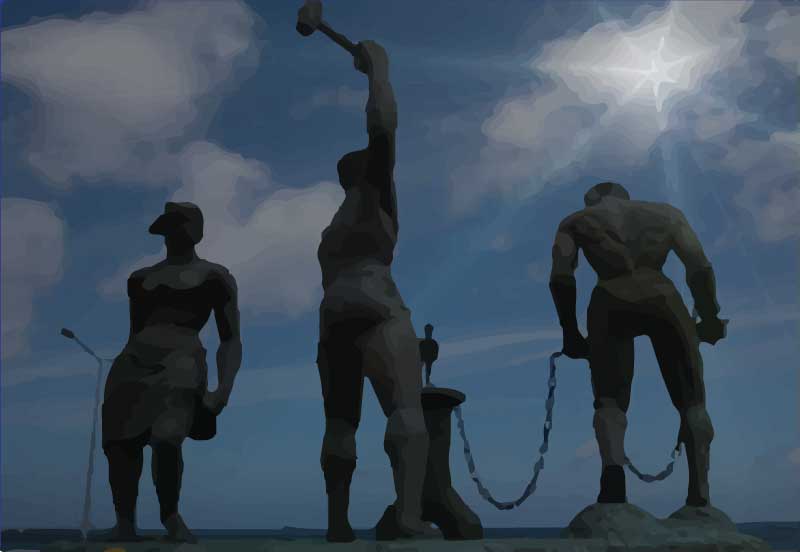
Contrary to the popular belief, Hinduism does not advocate fatalism of the purest kind. In fatalistic thinking there is no place for free will. Every thing is already preordained and you have little choice, other than follow the plan determined for you by God. Hinduism recognizes the importance of both fate and individual free will in the life of a human being. Man is responsible for his actions. At the same the world is considered to be a product of God's creation, in which the real doer is actually the omniscient, omnipresent and omnipotent God.
Nothing actually happens without His knowledge or consent. We are but His creation, either directly as some schools believe or through Prakriti, His dynamic energy, as some other schools believe. So are our actions. The world is an extension of Him and also every movement and object in it. But man because of his ignorance and illusion considers himself to be the real doer and suffers from the consequences of his actions. When people consider themselves to be the real doers and perform actions, out of their egoism and delusion,
God gives them freedom to exercise their free will and makes them responsible for their actions. So they become involved with Prakriti and remain bound to the cycle of births and deaths, suffering from the consequences of their own actions and the limitations caused by the power of maya or delusion. But if a devotee of God surrenders himself completely to God, accepts God as the real Doer and performs actions with a sense of detachment as an offering to God, he is freed from the positive and negative consequences of his actions. God takes care of his life and looks after Him with great care and attention.
In ancient India there were some schools that believed in fatalism, also known as determinism. One such well known sect was known as the Ajivaka sect. They believed in passive living and considered all human effort as mere waste of time. Gosala was one of the chief protagonists of this sect. Both Mahavira and the Buddha were his contemporaries and spent several years in his company before they parted their ways due to irreconcilable differences between them and Gosala on some aspects of the doctrine of the sect, especially fate and free will.
Both Mahavirta and the Buddha believed in karma, while Gosala believed in niyati or determinism, according to which the world moved in a predetermined way, in an orderly fashion, according to a well laid out universal plan in which each being developed in the direction of its destiny following its svabhava or disposition and sangati or chance. In the philosophy of Ajivakas, there was no place for free will. All human effort was just a waste of time. Every being was subject to fate and had to live accordingly.
Hinduism does not endorse the fatalistic approach of Ajivakas. Neither it endorses the mechanical approach of Jainism and Buddhism towards the law of karma. In contrast to Buddhism and Jainism, which do not acknowledge the existence of an absolute cause, in Hinduism God is the Universal Lord of all. He not only creates the worlds, but keeps a watch on all of them.
Some times He interferes with their working, in order to keep balance and order, either directly or through an incarnation, emanation or some other means. If moved, He will cancel the karmic effects of an individual and grant Him whatever boons He deems fit, including salvation. God is thus not a mere spectator, but controller and regulator of dharma also.
While Hinduism does not actually endorse a pure version of fatalism, an average Hindu does believe in fate. He considers it to be a decision of God made for him exclusively. The popular belief is that Brahma, the creator, writes it on the forehead of every being before they are sent into the world. However the fact is that what he considers to be fate is in reality a product of the karma of his previous lives, or the unfinished karma, that he brings along with him at the time of his birth. Karma is believed to be of four types.
- Sanchita Karma. It is sum total of the accumulated karma of previous lives. It is the burden of your past, which is in your account and which needs to be exhausted at some stage in your spiritual journey.
- Prarabdha Karma. It is that part of your sanchita karma which is currently activated in your present life and which influences the course of your present life. Depending upon the nature of your actions, you are either exhausting it or creating more karmic burden for yourself.
- Agami Karma. It is the karma that arises out of your current life activities, whose consequences will be experienced by you in the coming lives. It is usually added to the account of your sanchita karma.
- Kriyamana Karma. This is the karma whose consequences are experienced in the near future or distant future, but in this very life.
As can be seem from the above, what we believe to be fate in Hinduism is but Prarabdha karma that we bring along with ourselves from our previous lives or kriayamana karma, which we have incurred in the recent past and need to exhaust in this very life. While an average Hindu may consider it to be a writing of Brahma on his forehead, in reality it is created by himself, out of his egoism and delusion, which he needs to overcome some day in order to become completely free from all the effects of his actions. While this logic leaves a pessimist with a sense of desperation, an optimist find in it a great opportunity to turn the tide over and recreate his future through careful planning and deliberate action.
Hinduism therefore does not intentionally breed fatalism, but provides an opportunity to every individual to shape his future and if he is inclined spiritually, to liberate himself from the world of births and deaths by 1. developing detachment, 2. controlling desires, 3. cultivating mental stability, 5. performing good actions, 6. devotion and 7. complete surrender to God. True liberation comes when one achieves self realization and becomes free from the cycle of births and deaths.
Suggestions for Further Reading
- Hindu Gods - Lord Ganesha
- God and Self in Hinduism
- Goddesses of Hinduism, Their Symbolism and Significance
- Purusharthas in Hinduism
- The History, Antiquity and Chronology of Hinduism
- Ashrama Dharma in Hinduism
- Hinduism and Buddhism
- Death and Afterlife in Hinduism
- Hinduism and Divorce
- Hinduism and Adultery
- Hinduism, Food and Fasting
- The Future of Hinduism
- Good and Evil in Hinduism
- The Hindu Marriage, Past and Present
- What is Maya in Hinduism?
- The Origin and Definition of Hindu
- Hinduism and Polygamy
- Hinduism and polytheism
- Hinduism and Premarital Relationships
- God and Soul, Atma and Paramatma, in Hinduism
- About Suicides in Hinduism
- Religious Tolerance in Hinduism
- Violence and Abuse in Hinduism
- Traditional Status of Women in Hinduism
- Ashtanga Yoga of Patanjali
- About Hanuman or Anjaneya
- Hinduism and Same-sex Marriage
- Perspectives on What Karma Means
- Hinduism - The Role of Shakti in Creation
- Significance of Happiness in Hinduism
- Hindu God Lord Shiva (Siva) - the Destroyer
- The Role of Archakas, Temple Priests, in Hinduism
- Hinduism - Gods and Goddess in the Vedas
- Essays On Dharma
- Esoteric Mystic Hinduism
- Introduction to Hinduism
- Hindu Way of Life
- Essays On Karma
- Hindu Rites and Rituals
- The Origin of The Sanskrit Language
- Symbolism in Hinduism
- Essays on The Upanishads
- Concepts of Hinduism
- Essays on Atman
- Hindu Festivals
- Spiritual Practice
- Right Living
- Yoga of Sorrow
- Happiness
- Mental Health
- Concepts of Buddhism
- General Essays