
Hinduism, Food and Fasting
"The saintly persons get relief from all kinds of sins by partaking the food that has been first offered to gods as sacrifice. But those who prepare food for their selfish ends eat but only sins. (Bhagavad gita 3:13)
"All beings come into existence from food. Food comes from rains. Rains originate from the performance of sacrifices. And sacrifice is born out of doing prescribed duties. (Bhagavad gita 3:14)
I speak the truth, it is indeed his death. He who nourishes neither the god nor a friend, he who eats alone, gathers sin. (Rig Veda X. 117)
From earth herbs, from herbs food, from food seed, from seed man. Man thus consists of the essence of food. (Taittiriya Upanishad)
'From food are produced all creatures which dwell on earth. Then they live by food, and in the end they return to food. For food is the oldest of all beings, and therefore it is called panacea. (Taittiriya Upanishad)
Food is God
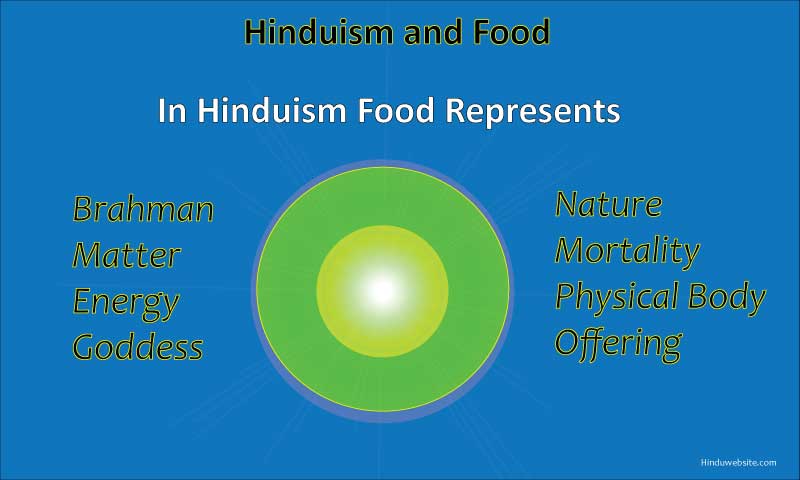
According to Hinduism, food is verily an aspect of Brahman (annam parabrahma swaroopam). Because it is a gift from God, it should be treated with great respect. The gross physical body is called annamayakosh or the food body, because it is nourished by food and grows by absorbing the energies from the food. Orthodox Hindus offer food to God mentally before eating. Food is identified with the element of earth. According to Prasna Upanishad, "Food is in truth the Lord of Creation (Prajapathi). From food is produced retas (the sexul energy or semen) and from it beings are born." According to Manu, "Food, that is always worshipped, gives strength and manly vigor; but eaten irreverently, it destroys them both." Food should be eaten for the survival and strength of the body, with a religious attitude, to practice austerities and gain self control, but not for pleasure. Eating is therefore any other human activity which can be made into either a sacrificial act that would help in the liberation of soul or a mere pleasure activity that would lead to bondage and suffering.
In the Bhagavadgita Sri Krishna declares that food is of three types as are sacrifices, austerity and charity. Sattvic (pure) food is that one which increases longevity, purity, strength, health, happiness and taste and which is juicy, oily, durable in nature and liked by sattvic people. Rajasic (hot) food is that one which is bitter, sour, salty, hot and spicy, burning and which gives unhappiness, sorrow and disease. Tamasic (intoxicating) food is that one which is stored and devoid of any juices, dried, foul smelling, decomposed, left over and indigestible. When a person eats these foods without offering them to God, he develops the qualities they impart and acts according to them. One should therefore be very careful in what one eats and when, where and how it is eaten.
Food Rituals
In Hinduism several rituals are associated with food. A child's first feeding is celebrated as a samskara known as annaprasana. The funeral rites involve serving of of food, offering of food to the departed soul and making of his astral body with food for his continuation in the ancestral world. According to Manu," Food, that is always worshipped, gives strength and manly vigour; but eaten irreverently, it destroys them both." He therefore advices that "a twice-born man should always eat his food with concentrated mind, after performing an ablution; and after he has eaten," he should "duly cleanse himself with water and sprinkle the cavities of his head. Devout Hindus observe some rituals before eating food, which are enumerated below.
- Cleaning the place. Food is always eaten in a clean place. The Hindu law books proscribe eating food in unclean places.
- Sprinkling of water around the food. When food is served, water is sprinkled around it, accompanied by some mantras or prayers. This is meant to purify the food and make it worthy for the gods. Some water is also sipped following this act, in order to clear the throat.
- Making an offering of the food. Food is then offered to five vital breaths (pranas), namely prana, apana, vyana, udana, samanaya and then to Brahman seated in the heart.
Some offer food to their personal gods or divinities before eating instead of the five vital breaths. The purpose of offering food to the deities and God is two fold. It renders the act of eating a sacrificial ritual and signifies internalization of sacrifice, making ones body a sacrificial altar. Secondly it is believed that offering food to gods is a mark of self-surrender and devotion. According to Hindu scriptures, he who eats food after offering it to gods or God would come to no harm as any rajasic or tamasic substances or qualities hidden in the food would be neutralized by the their positive energies and blessings. In addition to these, the twice born were advised to perform five sacrifices every day which are essentially sacrificial offerings of food to different entities. They are
- Ahuta, which is not offered to the fire, usually the vedic mantras,
- Huta, which is the burnt oblation offered to the gods,
- Prahuta which is usually food grains etc offered by scattering it on the ground
- the Bali, which is the sacrificial offering given to the Bhutas or ghosts,
- Brahmya-huta, which is the food offered to the digestive fires of Brahmanas and guests invited to one's house,
- Prasita, which is offered to the to the ancestors.
According to the Bhagavadgita, he who eats food without offering to God verily incurs sin. Food is also served to guests and poor people during festive occasions and important ceremonies. In ancient India young students who were initiated into Brahmacharya were expected to beg for their food. Cooking food is also prohibited for those who have entered the phase of Sanyasa or renunciation. While self-mortification was not suggested, they were expected to gradually reduce their dependence upon food in order to set themselves free from the cravings of the body and the mind.
Vegetarianism
According to Hinduism, food is responsible for our physical birth and also the development of our bodies. What we eat decides our physical well being as well as our mental makeup. If we eat sattvic food (pure food) we become sattvic (pure) beings. If we heat rajasic food (hot and spicy) we become rajasic (ambitious, temparamental, egoistic etc). If we eat animal food or intoxicating foods, we may develop animal qualities and lethargic nature. Therefore we have to be careful about our food. Besides killing innocent and helpless animals for the purpose of filling ones stomach is a bad karma with harmful consequences.
Apart from non vegetarian food, orthodox Hindus also avoid eating spicy food, onions, garlic, mushrooms, intoxicating juices, very sour food and some bulbs and tubers. The following are a few quotations from the Manusmriti.
The eater who daily even devours those destined to be his food, commits no sin; for the creator himself created both the eaters and those who are to be eaten (for those special purposes). ( 5:30)
Meat can never be obtained without injury to living creatures, and injury to sentient beings is detrimental to (the attainment of) heavenly bliss; let him therefore shun (the use of) meat. (5:48)
There is no sin in eating meat, in (drinking) spirituous liquor, and in carnal intercourse, for that is the natural way of created beings, but abstention brings great rewards. (5:56)
Not all Hindus avoid eating meat. A great majority of Hindus eat it. In ancient India even the Brahmins ate certain types of sacrificial meat. Hindu law books do not prohibit the eating of meat in general, but only certain types of meat. To a great extent Jainism and to some extent Buddhism influenced the food eating habits of the Hindu community in ancient India, although we cannot say definitely that the concept of non violence and avoiding meat eating were alien to them before. As early as the rig Vedic period, ancient Hindu sages who spent their lives in meditation and seclusion subsisted on roots and tubers and plant food only to gain control over their minds and bodies and attain self-realization. Hiuen Tsang who visited India in the 7th Century AD noted that Indian ate mostly vegetarian food.
Charity
Hindus believe that serving food to the poor and the needy, to the pious and the religious and to the birds, insects and animas is a very good karma. In ancient India it was an obligatory religious duty to serve food to the begging students and sadhus and to the Brahmanas. Food is also associated with a lot of religious activity. Food is invariably offered to God during most of the religious ceremonies. On specific days in a year food is offered to departed souls. Food is also distributed to people at the end of many religious ceremonies. Many Hindu temples distribute food freely every day to the visiting devotees.
Fasting
If eating is a sacrificial ritual, fasting is another kind of ritual meant to purify the body and the mind and develop the sattvic quality of detachment and equanimity. Devout Hindus observe fasting on special occasions as a mark of respect to their personal gods or as a part of their penance. At certain times in a year like the Durganavami festival they do not take food for days together.
Suggestions for Further Reading
- Hindu Gods - Lord Ganesha
- God and Self in Hinduism
- Goddesses of Hinduism, Their Symbolism and Significance
- Purusharthas in Hinduism
- The History, Antiquity and Chronology of Hinduism
- Ashrama Dharma in Hinduism
- Hinduism and Buddhism
- Death and Afterlife in Hinduism
- Hinduism and Divorce
- Hinduism and Adultery
- Hinduism, Food and Fasting
- The Future of Hinduism
- Good and Evil in Hinduism
- The Hindu Marriage, Past and Present
- What is Maya in Hinduism?
- The Origin and Definition of Hindu
- Hinduism and Polygamy
- Hinduism and polytheism
- Hinduism and Premarital Relationships
- God and Soul, Atma and Paramatma, in Hinduism
- About Suicides in Hinduism
- Religious Tolerance in Hinduism
- Violence and Abuse in Hinduism
- Traditional Status of Women in Hinduism
- Ashtanga Yoga of Patanjali
- About Hanuman or Anjaneya
- Hinduism and Same-sex Marriage
- Perspectives on What Karma Means
- Hinduism - The Role of Shakti in Creation
- Significance of Happiness in Hinduism
- Hindu God Lord Shiva (Siva) - the Destroyer
- The Role of Archakas, Temple Priests, in Hinduism
- Hinduism - Gods and Goddess in the Vedas
- Essays On Dharma
- Esoteric Mystic Hinduism
- Introduction to Hinduism
- Hindu Way of Life
- Essays On Karma
- Hindu Rites and Rituals
- The Origin of The Sanskrit Language
- Symbolism in Hinduism
- Essays on The Upanishads
- Concepts of Hinduism
- Essays on Atman
- Hindu Festivals
- Spiritual Practice
- Right Living
- Yoga of Sorrow
- Happiness
- Mental Health
- Concepts of Buddhism
- General Essays