
Violence and Abuse in Hinduism
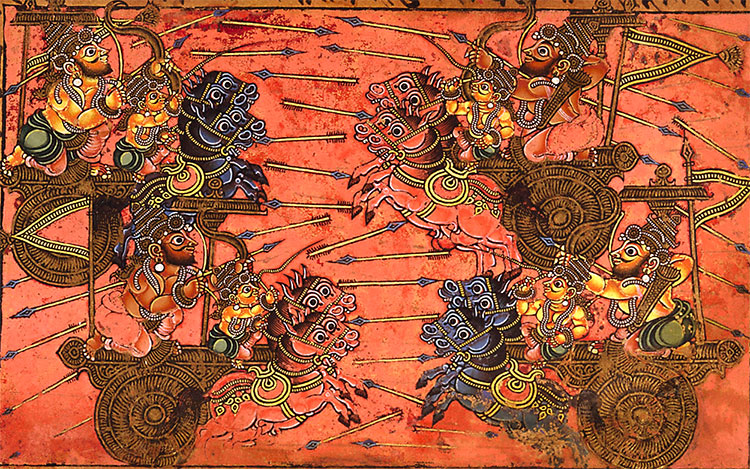
In a general sense, violence means use of force to injure or abuse someone. However, in Hinduism violence (himsa) not only means injuring or hurting others through force but also causing disturbances within oneself or others through intentional physical and mental actions. Use of thoughts, desires and words to hurt or harm others also comes under the perview of the definition. Wilful inactino to hurt others or cause them pain and suffering is also considered violence.
Any modification arising from such actions is deemed a result of violence. Thus, in a spiritual sense, violence means causing any state of agitation or disturbance or modifiction physically or mentally. If you speak hurtful words, think ill of others or mentally plan to cause them harm or invoke fear and such other negative emotions in them, including making them angry, is deemed an act of violence only.
Since the mind is subject to many modifications it is almost impossible to live without disturbing others or disturbing oneself. Hinduism acknowledges this predicament of life and hence recommends the practice of yoga to become totally peaceful and silent.
Those who reach the state of peace and silence by suduing their desiers and passions through renunciation and detachment or considered the wise ones (munis) in whom the state of non-violence finds its fullest expression. They neither disturb nor feel disturbed. They remian in harmony with themselves and others. They live as if they do not exist.
This is the highest state of non-violence glorified in Hindusim, not just the physical one or the one practiced by Mahatama Gandhi. If you do not understand the true meaning of non-violence, you will not understand the purpose of yoga or the importance of self-transformation and self-purification on the path of liberation.
Non-violence in Hinduism
In the mortal world, violence is the foundation of survival and self-preservation. None can live upon earth without indulging in some form of violence. The root cause of violence is desires and attachment. One may avoid physical violence, but one cannot avoid hurting or harming others or their peace through mental and emotional actions.
Hinduism recognizes this fundamental problem of human existence and recommends the practice of yoga as the best solution to suppress the modificaitons of our own minds so that we may cease to disturb ourselves and others.
Thus, in Hinduism, as in Yoga, non-violence is considered the highest virtue or the virtue of virtues, attained only at the end of a prolonged spiritual practice, when one reaches perfection in self-control and makes peace with oneself and with the rest of the world. In the classical yoga, it is rightly identified as the first of the five self-restraints (yamas). Only in a non-violent mind do all the modifications rest in peace even in a state of duality. In yoga non-violence is not only the means but also the end.
The Bhagavadgita aims to achieve the same goal through various paths. It declares that those who do not disturb others and are not disturbed by them in turn are very dearer to God. It is the state of non-violence possible only when the triple gunas are in perfect equilibrium or when sattva predominates. A person is violent when the gunas are active and strive for predominance. Hence the scriptures encourages spiritual aspirants to cultivate sattva which is the key to experience peace. Only those in whom sattva predominates become peaceful and non-violent and qualify for liberation.
Peace and non-violence are therefore synonymous. In today's world, a lot of people want peace, but they are unable to control their emotions. They think that hurting or harming others is only violence. Until they understand what violence truly means, they may not experience peace at all. We learn from the philosophy of Yoga that suffering in all forms whether mild or severe and whether mental or physical, constitutes violence and until we resolve it fully, we cannot experience peace of self-absorption.
The principal goal of human life is liberation, which cannot be attained until one becomes fully non-violent in letter and spirit. When a person transcends the need to hurt any life forms or living beings, including plants, for food, and feels the the pain and suffering of others without being disturbed by it, he reaches the culminating state of perfection and qualifies for liberation.
In Hinduism, causing intentional harm to others in any form is considered sinful, with negative consequences for one's rebirth. One should avoid intentional harm by all means. In this regard, there is no better example than God Himself. He is the epitome of peace. Having created the worlds, He remains a mere witness, letting the beings to exercise their will and live their own lives.
When violence is justified
As we have seen, Hinduism places non-violence at the forefront of all. At the same time it recognizes the harsh realities of life upon earth. Death and decay are inevitable in our lives. No one can escape from death, the ultimate violence unleashed upon a being by Nature.
Violence is hidden in the very transience of life. Every transformation involves some form of destruction and violence. Life is such that beings cannot exist withotu disturbing others or causing some destruction of life or objeccts.
For example, one cannot survive without food and in obtaining food one cannot avoid harming and hurting others. In the struggle for survival beings have to resort to numerous forms of violence and subject themselves to numerous states of want and desire, which may set in motiion further chain reactions and more disturbances,
Hinduism recognizes the imperativness of violence in human life. It is well illustrated in the concept of God as Death. The world in which we live is ruled by Death (Kala), a manifestation of Brahman, who is the most violent of all. He devours everything and leaves nothing to chance.
It was the brutal aspect of life and existence, and the most destructive aspect of God, which Arjuna witnessed in the Bhagavadgita in the form of Death (Kala). It is also the most violent and terrifying form of existence anyone can ever envision. There is no compassion in that God, but a relentless and unforgiving abidance in duty.
The imperative need for violence for the sake of order and regularity of the worlds is also exemplified in the Puranas and in many incarnations of God. On different occaions God incarnated upon earth to destroy evil in violent manner.
It is also well reflected in the destructive aspects of numerous gods and goddesses and in the punishments meted out to sinners in the world of Yama. They and numerous other illustrations in the epics and Puranas, suggest that while non-violence is the highest ideal, one may resort to violence under certain circumstances. Some of them are stated below.
- As a part of one's duty, as in case of a warrior or butcher.
- As part of one's service to God as in case of Hanuman or Arjuna.
- As part of one's obligation to uphold righteousness as in case of a king or a ruler who has to uphold law and punish the law breakers.
Violence is justified in Hinduism in the following circumstances
- When the life of a human being 1 or animal is sacrificed to gods in a sacrificial ceremony.
- When one offers one's own life as a sacrifice to God.
- When one participates in a war either in self-defense or for a righteous cause.
- To punish evil doers
- To feed oneself by hunting etc., in times of famines, scarcity of food, and starvation.
- When the mind and body are subjected to austerities and self-discipline to achieve liberation.
In all the above cases violence is justified only when one resorts to it as an offering to God without selfish intentions and without seeking the fruit of such actions.
Domestic violence and violence against women
Domestic violence is an acute problem in modern Hindu society. Every year hundred and thousands of young girls and women of all ages become victims of domestic violence in the hands of their husbands, brothers, close relatives, in-laws and even parents. The Wikipedia quotes a report published in 2009 in a British journal, Lancet to cite the extent of domestic violence in India, according to which over 100000 women were killed in India in a single year alone, which were not accidental in nature but arising from domestic violence alone. Judging by the way things work in the country, this may not be an accurate figure at all and the number of women dying due to domestic violence may be even higher.
Most of the domestic violence in Hindu families happen in the form of wife beating, bride burnings, acid throwing, eve-teasing, mental and physical harassment, dowry deaths, enforced slavery, verbal abuse malnourishment, neglect, women trafficking, forced marriages rapes, property related homicides and solitary confinement. Milions of women go through numerous hardships in India as victims of various forms of violence.
A number of such incidents also go unnoticed, due to fear, social and domestic pressure and the apathy and inefficiency of the law enforcement machinery who aggravate the situation often by colluding with the aggressors and harassing the victims further.
Death of women due to systematic discrimination against them is an acute problem India, which has one of the highest incidences of gender related abortions and girl child mortality so much so that the sex ratio in the country has fallen considerably in the last few decades by 20% to 30% in some states.
Domestic violence in Hindu families is not confined to India alone. It seems to be a cultural problem because it exists in some Hindu families outside Indian also in countries such as UK, USA, South Africa, Canada and Australia.
Wars and aggression
Hinduism does not approve aggression, but wars fought in self-defense or for upholding good are considered righteous wars. Hindu scriptures acknowledge the destructive nature of wars but also recognize their importance in ensuring the order and regularity of society. The Vedas contain many hymns seeking the victory of patron kings and destruction of their enemies.
In its long history India witnessed many wars. Indian kings fought regularly among themselves and against foreign invaders. From the earliest times Indian warriors excelled in the art of warfare. India suffered some of the worst foreign invasions in the history of the world, since the days of Alexander and probably even before.
In all such wars, the Indians gave a tough fight. Every invader who invaded India learned the lessons of aggressions the hard way. Indian armies never let them go scotfree. They fought hard and they fought well until the end.
If Indian were defeated in them, it was not because they lacked in courage or fighting abilty but because of other factors such as betrayal, superior technology or climatic conditions.
For a Hindu warrior dying in the battlefield was the highest honor. Tradition ensured that no none showed their back to their opponents and fought until the end. For a Hindu woman it was a honor to send her husband to the battlefield. If her husband died in the war, she had the courage to sacrifice her own life or live with dignity. But under no circumstances, she would welcome him if he ever ran away from the battlefield without fighting and returned home in disgrace. Thus Hindus fought their wars with a sense of duty, great valor and unyielding spirit.
The epics and Puranas amply illustrate the importance and justification of wars in the cause of righteousness against evil. Almost all the deities in Hinduism have an aggressive aspect and carry weapons of various kinds. Some of them are invariably invoked in war situations.
During the recent wars, the Indian battlefields often reverberated with the chants of "Har Har Mahadev," a reference to Shiva, the lord of destruction. Even today, Indian army is well known for its valor, strength and fighting spirit.
Animal abuse and cruelty to animals
India is one of the few countries where humans and animals have no problem sharing the same space. In a country of over a billion people, where living space is a huge problem, and where millions live under tin roofs and makeshift houses, people have no problem in letting animals live nearby in the streets and on the roof tops. This is an unprecedented display of compassion and humanity. Colonies of monkeys, and herds of cows, goats and bulls wander in the streets and public places or rest in busy areas in many parts of India.
Traditionally, Hindus are accustomed to treating animals with great respect and in this regard they are influenced greatly by their religious beliefs. Animals have a great significance in Hinduism. Most of the divinities in Hinduism use an animal as their vehicles. Thus Vishnu uses an eagle as his Vehicle, Siva a bull, Brahman a swan, Indra an elephant, Ganesha a rat and Kumara Swami a peacock.
Hindus also believe that animals also have souls and killing them is nothing less than killing humans in terms of karmic consequences. Hence, traditionally most Hindus treat animals with respect and show aversion to subjecting them to cruelty or killing them for food or for fun.
Feeding the animals and other life forms is one of the five daily sacrifices recommended in Hinduism. Many Hindus feed birds and stray animals out of compassion or as part of rituals. Even the poorest of the poor show compassin for animals.
Strict vegetarian diet is the norm in many Hindu families. However, many Hindu families also eat fish, poultry, lamb, pork and in rare cases beef. Wild animals, snakes, birds, rats etc. are eaten in some castes and tribal communities. Traditionally, Hindus regard killing cows and bulls a mortal sin. In rural areas cattle is considered wealth and treated with a lot of care, next only to agricultural wealth. Giving names to their domestic animals and decorating them on festive occasions is also a common feature in rural India.
In many parts of the country, old animals are not killed, but sent to special shelters where they are kept and allowed to die naturally. People also do not like kill animals for fun.
People in general dislike those who hunt and kill animals for sport. They also do not participate in any sports where animals are subjected to cruelty. Cock fights, bull fights and dog fights are in fact banned.
At the same time, illegal slaughter of animals is a major problem in India. For every licensed slaughter house, there seem to be four or five illegal ones. A recent report published in the newspapers suggest that stray animals in some cities are captured by criminals and sold to unlicensed slaughter houses.
Poaching and unlawful trade in wild animals is another major problem. Every years hundreds of rare animals are captured and sold or killed for their bones, skin or other organs. Wild life population in India declined considerably in the last few decades, even though hunting is officially banned and people are generally averse to hunting and holding guns.
Many educated people and voluntary organizations in India are engaged in a relentless struggle to save the wild animals from the poachers. The government has enacted many laws and established necessary machinery to prevent illegal hunting and poaching. Animals and animal specimens are also used in scientific research and for dissection in schools and laboratories.
Violence in politics
Violence has become a way of life in Indian politics. Many politicians in India have criminal background or criminal cases pending against them for rapes, violence and murders. During every general elections, newspapers report violent clashes between or among the supporters of the contesting parties.
Voter intimidation, forceful carrying away of ballot boxes, abduction of candidates, even murders and violence against government official and election offices are part of the Indian election scene. The courts are slow to decide the cases. This gives enough opportunity to the culprits to tamper with evidence and get away with their crimes.
It is sad but true that a country founded on the principle of non-violence which played a key role in the independence struggle of India had long forgotten that principle and allowed some low life characters to gain power and have their say in important matters effecting people's lives.
Suggestions for Further Reading
- Hindu Gods - Lord Ganesha
- God and Self in Hinduism
- Goddesses of Hinduism, Their Symbolism and Significance
- Purusharthas in Hinduism
- The History, Antiquity and Chronology of Hinduism
- Ashrama Dharma in Hinduism
- Hinduism and Buddhism
- Death and Afterlife in Hinduism
- Hinduism and Divorce
- Hinduism and Adultery
- Hinduism, Food and Fasting
- The Future of Hinduism
- Good and Evil in Hinduism
- The Hindu Marriage, Past and Present
- What is Maya in Hinduism?
- The Origin and Definition of Hindu
- Hinduism and Polygamy
- Hinduism and polytheism
- Hinduism and Premarital Relationships
- God and Soul, Atma and Paramatma, in Hinduism
- About Suicides in Hinduism
- Religious Tolerance in Hinduism
- Violence and Abuse in Hinduism
- Traditional Status of Women in Hinduism
- Ashtanga Yoga of Patanjali
- About Hanuman or Anjaneya
- Hinduism and Same-sex Marriage
- Perspectives on What Karma Means
- Hinduism - The Role of Shakti in Creation
- Significance of Happiness in Hinduism
- Hindu God Lord Shiva (Siva) - the Destroyer
- The Role of Archakas, Temple Priests, in Hinduism
- Hinduism - Gods and Goddess in the Vedas
- Essays On Dharma
- Esoteric Mystic Hinduism
- Introduction to Hinduism
- Hindu Way of Life
- Essays On Karma
- Hindu Rites and Rituals
- The Origin of The Sanskrit Language
- Symbolism in Hinduism
- Essays on The Upanishads
- Concepts of Hinduism
- Essays on Atman
- Hindu Festivals
- Spiritual Practice
- Right Living
- Yoga of Sorrow
- Happiness
- Mental Health
- Concepts of Buddhism
- General Essays
Notes
1. Human sacrifices were common in ancient times when a king had the right over the life of his subjects or criminals or those who were captured during wars. It is no more acceptable in Hinduism and considered a criminal act. Even animal sacrifices are considered with great disapproval by many Hindus.