
Fa-hien's Travels to India and Ceylon - Part 2
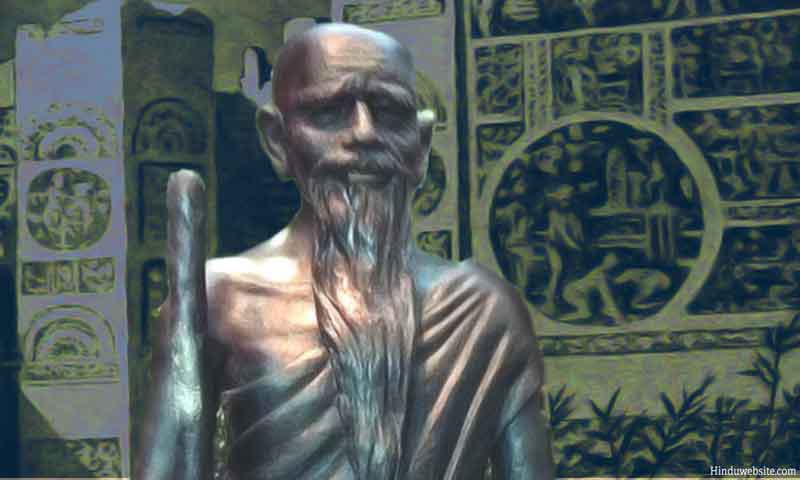
An artistic impression of Fahien
Next >> Part 1 | Part 2
This book has been divided into two parts for convenience. The first part contains chapters 1 to 20 and the second part contain remaining chapters.
CHAPTER XXI
THE THREE PREDECESSORS OF SAKYAMUNI IN THE BUDDHASHIP.
Fifty le to the west of the city bring (the traveller) to a town named Too-wei,[1] the birthplace of Kasyapa Buddha.[1] At the place where he and his father met,[2] and at that where he attained to pari-nirvana, topes were erected. Over the entire relic of the whole body of him, the Kasyapa Tathagata,[3] a great tope was also erected.
Going on south-east from the city of Sravasti for twelve yojanas, (the travellers) came to a town named Na-pei-kea,[4] the birthplace of Krakuchanda Buddha. At the place where he and his father met, and at that where he attained to pari-nirvana, topes were erected. Going north from here less than a yojana, they came to a town which had been the birthplace of Kanakamuni Buddha. At the place where he and his father met, and where he attained to pari-nirvana, topes were erected.
NOTES
[1] Identified, as Beal says, by Cunningham with Tadwa, a village nine miles to the west of Sahara-mahat. The birthplace of Kasyapa Buddha is generally thought to have been Benares. According to a calculation of Remusat, from his birth to A.D. 1832 there were 1,992,859 years!
[2] It seems to be necessary to have a meeting between every Buddha and his father. One at least is ascribed to Sakyamuni and his father (real or supposed) Suddhodana.
[3] This is the highest epithet given to every supreme Buddha; in Chinese {.} {.}, meaning, as Eitel, p. 147 says, "/Sic profectus sum/." It is equivalent to "Rightful Buddha, the true successor in the Supreme Buddha Line." Hardy concludes his account of the Kasyapa Buddha (M. B., p. 97) with the following sentence:--"After his body was burnt, the bones still remained in their usual position, presenting the appearance of a perfect skeleton; and the whole of the inhabitants of Jambudvipa, assembling together, erected a dagoba over his relics one yojana in height!"
[4] Na-pei-kea or Nabhiga is not mentioned elsewhere. Eitel says this Buddha was born at the city of Gan-ho ({.} {.} {.}) and Hardy gives his birthplace as Mekhala. It may be possible, by means of Sanskrit, to reconcile these statements.
CHAPTER XXII
KAPILAVASTU. ITS DESOLATION. LEGENDS OF BUDDHA'S BIRTH, AND OTHER INCIDENTS IN CONNEXION WITH IT.
Less than a yojana to the east from this brought them to the city of Kapilavastu;[1] but in it there was neither king nor people. All was mound and desolation. Of inhabitants there were only some monks and a score or two of families of the common people. At the spot where stood the old palace of king Suddhodana[2] there have been made images of the prince (his eldest son) and his mother;[3] and at the places where that son appeared mounted on a white elephant when he entered his mother's womb,[4] and where he turned his carriage round on seeing the sick man after he had gone out of the city by the eastern gate,[5] topes have been erected.
The places (were also pointed out)[6] where (the rishi) A-e[7] inspected the marks (of Buddhaship on the body) of the heir-apparent (when an infant); where, when he was in company with Nanda and others, on the elephant being struck down and drawn to one side, he tossed it away;[8] where he shot an arrow to the south-east, and it went a distance of thirty le, then entering the ground and making a spring to come forth, which men subsequently fashioned into a well from which travellers might drink;[9] where, after he had attained to Wisdom, Buddha returned and saw the king, his father;[10] where five hundred Sakyas quitted their families and did reverence to Upali[11] while the earth shook and moved in six different ways; where Buddha preached his Law to the devas, and the four deva kings and others kept the four doors (of the hall), so that (even) the king, his father, could not enter;[12] where Buddha sat under a nyagrodha tree, which is still standing,[13] with his face to the east, and (his aunt) Maja-prajapati presented him with a Sanghali;[14] and (where) king Vaidurya slew the seed of Sakya, and they all in dying became Srotapannas.[15] A tope was erected at this last place, which is still existing.
Several le north-east from the city was the king's field, where the heir-apparent sat under a tree, and looked at the ploughers.[16]
Fifty le east from the city was a garden, named Lumbini,[17] where the queen entered the pond and bathed. Having come forth from the pond on the northern bank, after (walking) twenty paces, she lifted up her hand, laid hold of a branch of a tree, and, with her face to the east, gave birth to the heir-apparent.[18] When he fell to the ground, he (immediately) walked seven paces. Two dragon-kings (appeared) and washed his body. At the place where they did so, there was immediately formed a well, and from it, as well as from the above pond, where (the queen) bathed,[19] the monks (even) now constantly take the water, and drink it.
There are four places of regular and fixed occurrence (in the history of) all Buddhas:--first, the place where they attained to perfect Wisdom (and became Buddha); second, the place where they turned the wheel of the Law;[20] third, the place where they preached the Law, discoursed of righteousness, and discomfited (the advocates of) erroneous doctrines; and fourth, the place where they came down, after going up to the Trayatrimsas heaven to preach the Law for the benefit of their mothers. Other places in connexion with them became remarkable, according to the manifestations which were made at them at particular times.
The country of Kapilavastu is a great scene of empty desolation. The inhabitants are few and far between. On the roads people have to be on their guard against white elephants[21] and lions, and should not travel incautiously.
NOTES
[1] Kapilavastu, "the city of beautiful virtue," was the birthplace of Sakyamuni, but was destroyed, as intimated in the notes on last chapter, during his lifetime. It was situated a short distance north- west of the present Goruckpoor, lat. 26d 46s N., lon. 83d 19s E. Davids says (Manual, p. 25), "It was on the banks of the river Rohini, the modern Kohana, about 100 miles north-west of the city of Benares."
[2] The father, or supposed father, of Sakyamuni. He is here called "the king white and pure" ({.} {.} {.}). A more common appellation is "the king of pure rice" ({.} {.} {.});" but the character {.}, or "rice," must be a mistake for {.}, "Brahman," and the appellation= "Pure Brahman king."
[3] The "eldest son," or "prince" was Sakyamuni, and his mother had no other son. For "his mother," see chap. xvii, note 3. She was a daughter of Anjana or Anusakya, king of the neighbouring country of Koli, and Yasodhara, an aunt of Suddhodana. There appear to have been various intermarriages between the royal houses of Kapila and Koli.
[4] In "The Life of the Buddha," p. 15, we read that "Buddha was now in the Tushita heaven, and knowing that his time was come (the time for his last rebirth in the course of which he would become Buddha), he made the necessary examinations; and having decided that Maha-maya was the right mother, in the midnight watch he entered her womb under the appearance of an elephant." See M. B., pp. 140-143, and, still better, Rhys Davids' "Birth Stories," pp. 58-63.
[5] In Hardy's M. B., pp. 154, 155, we read, "As the prince (Siddhartha, the first name given to Sakyamuni; see Eitel, under Sarvarthasiddha) was one day passing along, he saw a deva under the appearance of a leper, full of sores, with a body like a water-vessel, and legs like the pestle for pounding rice; and when he learned from his charioteer what it was that he saw, be became agitated, and returned at once to the palace." See also Rhys Davids' "Buddhism," p. 29.
[6] This is an addition of my own, instead of "There are also topes erected at the following spots," of former translators. Fa-hien does not say that there were memorial topes at all these places.
[7] Asita; see Eitel, p. 15. He is called in Pali Kala Devala, and had been a minister of Suddhodana's father.
[8] In "The Life of Buddha" we read that the Lichchhavis of Vaisali had sent to the young prince a very fine elephant; but when it was near Kapilavastu, Devadatta, out of envy, killed it with a blow of his fist. Nanda (not Ananda, but a half-brother of Siddhartha), coming that way, saw the carcase lying on the road, and pulled it on one side; but the Bodhisattva, seeing it there, took it by the tail, and tossed it over seven fences and ditches, when the force of its fall made a great ditch. I suspect that the characters in the column have been disarranged, and that we should read {.} {.} {.} {.}, {.} {.}, {.} {.}. Buddha, that is Siddhartha, was at this time only ten years old.
[9] The young Sakyas were shooting when the prince thus surpassed them all. He was then seventeen.
[10] This was not the night when he finally fled from Kapilavastu, and as he was leaving the palace, perceiving his sleeping father, and said, "Father, though I love thee, yet a fear possesses me, and I may not stay;"--The Life of the Buddha, p. 25. Most probably it was that related in M. B., pp. 199-204. See "Buddhist Birth Stories," pp. 120- 127.
[11] They did this, I suppose, to show their humility, for Upali was only a Sudra by birth, and had been a barber; so from the first did Buddhism assert its superiority to the conditions of rank and caste. Upali was distinguished by his knowledge of the rules of discipline, and praised on that account by Buddha. He was one of the three leaders of the first synod, and the principal compiler of the original Vinaya books. [12] I have not met with the particulars of this preaching.
[13] Meaning, as explained in Chinese, "a tree without knots;" the /ficus Indica/. See Rhys Davids' note, Manual, p. 39, where he says that a branch of one of these trees was taken from Buddha Gaya to Anuradhapura in Ceylon in the middle of the third century B.C, and is still growing there, the oldest historical tree in the world.
[14] See chap. xiii, note 11. I have not met with the account of this presentation. See the long account of Prajapati in M. B., pp. 306-315.
[15] See chap. xx, note 10. The Srotapannas are the first class of saints, who are not to be reborn in a lower sphere, but attain to nirvana after having been reborn seven times consecutively as men or devas. The Chinese editions state there were "1000" of the Sakya seed. The general account is that they were 500, all maidens, who refused to take their place in king Vaidurya's harem, and were in consequence taken to a pond, and had their hands and feet cut off. There Buddha came to them, had their wounds dressed, and preached to them the Law. They died in the faith, and were reborn in the region of the four Great Kings. Thence they came back and visited Buddha at Jetavana in the night, and there they obtained the reward of Srotapanna. "The Life of the Buddha," p. 121.
[16] See the account of this event in M. B., p. 150. The account of it reminds me of the ploughing by the sovereign, which has been an institution in China from the earliest times. But there we have no magic and no extravagance.
[17] "The place of Liberation;" see chap. xiii, note 7.
[18] See the accounts of this event in M. B., pp. 145, 146; "The Life of the Buddha," pp. 15, 16; and "Buddhist Birth Stories," p. 66.
[19] There is difficulty in construing the text of this last statement. Mr. Beal had, no doubt inadvertently, omitted it in his first translation. In his revised version he gives for it, I cannot say happily, "As well as at the pool, the water of which came down from above for washing (the child)."
[20] See chap. xvii, note 8. See also Davids' Manual, p. 45. The latter says, that "to turn the wheel of the Law" means "to set rolling the royal chariot wheel of a universal empire of truth and righteousness;" but he admits that this is more grandiloquent than the phraseology was in the ears of Buddhists. I prefer the words quoted from Eitel in the note referred to. "They turned" is probably equivalent to "They began to turn."
[21] Fa-hien does not say that he himself saw any of these white elephants, nor does he speak of the lions as of any particular colour. We shall find by-and-by, in a note further on, that, to make them appear more terrible, they are spoken of as "black."
CHAPTER XXIII
RAMA, AND ITS TOPE.
East from Buddha's birthplace, and at a distance of five yojanas, there is a kingdom called Rama.[1] The king of this country, having obtained one portion of the relics of Buddha's body,[2] returned with it and built over it a tope, named the Rama tope. By the side of it there was a pool, and in the pool a dragon, which constantly kept watch over (the tope), and presented offerings to it day and night. When king Asoka came forth into the world, he wished to destroy the eight topes (over the relics), and to build (instead of them) 84,000 topes.[3] After he had thrown down the seven (others), he wished next to destroy this tope. But then the dragon showed itself, took the king into its palace;[4] and when he had seen all the things provided for offerings, it said to him, "If you are able with your offerings to exceed these, you can destroy the tope, and take it all away. I will not contend with you." The king, however, knew that such appliances for offerings were not to be had anywhere in the world, and thereupon returned (without carrying out his purpose).
(Afterwards), the ground all about became overgrown with vegetation, and there was nobody to sprinkle and sweep (about the tope); but a herd of elephants came regularly, which brought water with their trunks to water the ground, and various kinds of flowers and incense, which they presented at the tope. (Once) there came from one of the kingdoms a devotee[5] to worship at the tope. When he encountered the elephants he was greatly alarmed, and screened himself among the trees; but when he saw them go through with the offerings in the most proper manner, the thought filled him with great sadness--that there should be no monastery here, (the inmates of which) might serve the tope, but the elephants have to do the watering and sweeping. Forthwith he gave up the great prohibitions (by which he was bound),[6] and resumed the status of a Sramanera.[7] With his own hands he cleared away the grass and trees, put the place in good order, and made it pure and clean. By the power of his exhortations, he prevailed on the king of the country to form a residence for monks; and when that was done, he became head of the monastery. At the present day there are monks residing in it. This event is of recent occurrence; but in all the succession from that time till now, there has always been a Sramanera head of the establishment.
NOTES
[1] Rama or Ramagrama, between Kapilavastu and Kusanagara.
[2] See the account of the eightfold division of the relics of Buddha's body in the Sacred Books of the East, vol. xi, Buddhist Suttas, pp. 133-136.
[3] The bones of the human body are supposed to consist of 84,000 atoms, and hence the legend of Asoka's wish to build 84,000 topes, one over each atom of Sakyamuni's skeleton.
[4] Fa-hien, it appears to me, intended his readers to understand that the naga-guardian had a palace of his own, inside or underneath the pool or tank.
[5] It stands out on the narrative as a whole that we have not here "some pilgrims," but one devotee.
[6] What the "great prohibitions" which the devotee now gave up were we cannot tell. Being what he was, a monk of more than ordinary ascetical habits, he may have undertaken peculiar and difficult vows.
[7] The Sramanera, or in Chinese Shamei. See chap. xvi, note 19.
CHAPTER XXIV
WHERE BUDDHA FINALLY RENOUNCED THE WORLD, AND WHERE HE DIED.
East from here four yojanas, there is the place where the heir- apparent sent back Chandaka, with his white horse;[1] and there also a tope was erected.
Four yojanas to the east from this, (the travellers) came to the Charcoal tope,[2] where there is also a monastery.
Going on twelve yojanas, still to the east, they came to the city of Kusanagara,[3] on the north of which, between two trees,[4] on the bank of the Nairanjana[5] river, is the place where the World-honoured one, with his head to the north, attained to pari-nirvana (and died). There also are the places where Subhadra,[6] the last (of his converts), attained to Wisdom (and became an Arhat); where in his coffin of gold they made offerings to the World-honoured one for seven days,[7] where the Vajrapani laid aside his golden club,[8] and where the eight kings[9] divided the relics (of the burnt body):--at all these places were built topes and monasteries, all of which are now existing.
In the city the inhabitants are few and far between, comprising only the families belonging to the (different) societies of monks.
Going from this to the south-east for twelve yojanas, they came to the place where the Lichchhavis[10] wished to follow Buddha to (the place of) his pari-nirvana, and where, when he would not listen to them and they kept cleaving to him, unwilling to go away, he made to appear a large and deep ditch which they could not cross over, and gave them his alms-bowl, as a pledge of his regard, (thus) sending them back to their families. There a stone pillar was erected with an account of this event engraved upon it.
NOTES
[1] This was on the night when Sakyamuni finally left his palace and family to fulfil the course to which he felt that he was called. Chandaka, in Pali Channa, was the prince's charioteer, and in sympathy with him. So also was the white horse Kanthaka (Kanthakanam Asvaraja), which neighed his delight till the devas heard him. See M. B., pp. 158-161, and Davids' Manual, pp. 32, 33. According to "Buddhist Birth Stories," p. 87, the noble horse never returned to the city, but died of grief at being left by his master, to be reborn immediately in the Trayastrimsas heaven as the deva Kanthaka!
[2] Beal and Giles call this the "Ashes" tope. I also would have preferred to call it so; but the Chinese character is {.}, not {.}. Remusat has "la tour des charbons." It was over the place of Buddha's cremation.
[3] In Pali Kusinara. It got its name from the Kusa grass (the /poa cynosuroides/); and its ruins are still extant, near Kusiah, 180 N.W. from Patna; "about," says Davids, "120 miles N.N.E. of Benares, and 80 miles due east of Kapilavastu."
[4] The Sala tree, the /Shorea robusta/, which yields the famous teak wood.
[5] Confounded, according to Eitel, even by Hsuan-chwang, with the Hiranyavati, which flows past the city on the south.
[6] A Brahman of Benares, said to have been 120 years old, who came to learn from Buddha the very night he died. Ananda would have repulsed him; but Buddha ordered him to be introduced; and then putting aside the ingenious but unimportant question which he propounded, preached to him the Law. The Brahman was converted and attained at once to Arhatship. Eitel says that he attained to nirvana a few moments before Sakyamuni; but see the full account of him and his conversion in "Buddhist Suttas," p. 103-110.
[7] Thus treating the dead Buddha as if he had been a Chakravartti king. Hardy's M. B., p. 347, says:--"For the place of cremation, the princes (of Kusinara) offered their own coronation-hall, which was decorated with the utmost magnificence, and the body was deposited in a golden sarcophagus." See the account of a cremation which Fa-hien witnessed in Ceylon, chap. xxxix.
[8] The name Vajrapani is explained as "he who holds in his hand the diamond club (or pestle=sceptre)," which is one of the many names of Indra or Sakra. He therefore, that great protector of Buddhism, would seem to be intended here; but the difficulty with me is that neither in Hardy nor Rockhill, nor any other writer, have I met with any manifestation of himself made by Indra on this occasion. The princes of Kusanagara were called mallas, "strong or mighty heroes;" so also were those of Pava and Vaisali; and a question arises whether the language may not refer to some story which Fa-hien had heard,-- something which they did on this great occasion. Vajrapani is also explained as meaning "the diamond mighty hero;" but the epithet of "diamond" is not so applicable to them as to Indra. The clause may hereafter obtain more elucidation.
[9] Of Kusanagara, Pava, Vaisali, and other kingdoms. Kings, princes, brahmans,--each wanted the whole relic; but they agreed to an eightfold division at the suggestion of the brahman Drona.
[10] These "strong heroes" were the chiefs of Vaisali, a kingdom and city, with an oligarchical constitution. They embraced Buddhism early, and were noted for their peculiar attachment to Buddha. The second synod was held at Vaisali, as related in the next chapter. The ruins of the city still exist at Bassahar, north of Patna, the same, I suppose, as Besarh, twenty miles north of Hajipur. See Beal's Revised Version, p. lii.
CHAPTER XXV
VAISALI. THE TOPE CALLED "WEAPONS LAID DOWN." THE COUNCIL OF VAISALI.
East from this city ten yojanas, (the travellers) came to the kingdom of Vaisali. North of the city so named is a large forest, having in it the double-galleried vihara[1] where Buddha dwelt, and the tope over half the body of Ananda.[2] Inside the city the woman Ambapali[3] built a vihara in honour of Buddha, which is now standing as it was at first. Three le south of the city, on the west of the road, (is the) garden (which) the same Ambapali presented to Buddha, in which he might reside. When Buddha was about to attain to his pari-nirvana, as he was quitting the city by the west gate, he turned round, and, beholding the city on his right, said to them, "Here I have taken my last walk."[4] Men subsequently built a tope at this spot.
Three le north-west of the city there is a tope called, "Bows and weapons laid down." The reason why it got that name was this:--The inferior wife of a king, whose country lay along the river Ganges, brought forth from her womb a ball of flesh. The superior wife, jealous of the other, said, "You have brought forth a thing of evil omen," and immediately it was put into a box of wood and thrown into the river. Farther down the stream another king was walking and looking about, when he saw the wooden box (floating) in the water. (He had it brought to him), opened it, and found a thousand little boys, upright and complete, and each one different from the others. He took them and had them brought up. They grew tall and large, and very daring, and strong, crushing all opposition in every expedition which they undertook. By and by they attacked the kingdom of their real father, who became in consequence greatly distressed and sad. His inferior wife asked what it was that made him so, and he replied, "That king has a thousand sons, daring and strong beyond compare, and he wishes with them to attack my kingdom; this is what makes me sad." The wife said, "You need not be sad and sorrowful. Only make a high gallery on the wall of the city on the east; and when the thieves come, I shall be able to make them retire." The king did as she said; and when the enemies came, she said to them from the tower, "You are my sons; why are you acting so unnaturally and rebelliously?" They replied, "If you do not believe me," she said, "look, all of you, towards me, and open your mouths." She then pressed her breasts with her two hands, and each sent forth 500 jets of milk, which fell into the mouths of the thousand sons. The thieves (thus) knew that she was their mother, and laid down their bows and weapons.[5] The two kings, the fathers, thereupon fell into reflection, and both got to be Pratyeka Buddhas.[6] The tope of the two Pratyeka Buddhas is still existing. In a subsequent age, when the World-honoured one had attained to perfect Wisdom (and become Buddha), he said to is disciples, "This is the place where I in a former age laid down my bow and weapons."[7] It was thus that subsequently men got to know (the fact), and raised the tope on this spot, which in this way received its name. The thousand little boys were the thousand Buddhas of this Bhadra-kalpa.[8]
It was by the side of the "Weapons-laid-down" tope that Buddha, having given up the idea of living longer, said to Ananda, "In three months from this I will attain to pavi-nirvana;" and king Mara[9] had so fascinated and stupefied Ananda, that he was not able to ask Buddha to remain longer in this world.
Three or four le east from this place there is a tope (commemorating the following occurrence):--A hundred years after the pari-nirvana of Buddha, some Bhikshus of Vaisali went wrong in the matter of the disciplinary rules in ten particulars, and appealed for their justification to what they said were the words of Buddha. Hereupon the Arhats and Bhikshus observant of the rules, to the number in all of 700 monks, examined afresh and collated the collection of disciplinary books.[10] Subsequently men built at this place the tope (in question), which is still existing.
NOTES
[1] It is difficult to tell what was the peculiar form of this vihara from which it gets its name; something about the construction of its door, or cupboards, or galleries.
[2] See the explanation of this in the next chapter.
[3] Ambapali, Amrapali, or Amradarika, "the guardian of the Amra (probably the mango) tree," is famous in Buddhist annals. See the account of her in M. B., pp. 456-8. She was a courtesan. She had been in many narakas or hells, was 100,000 times a female beggar, and 10,000 times a prostitute; but maintaining perfect continence during the period of Kasyapa Buddha, Sakyamuni's predecessor, she had been born a devi, and finally appeared in earth under an Amra tree in Vaisali. There again she fell into her old ways, and had a son by king Bimbisara; but she was won over by Buddha to virtue and chastity, renounced the world, and attained to the state of an Arhat. See the earliest account of Ambapali's presentation of the garden in "Buddhist Suttas," pp. 30-33, and the note there from Bishop Bigandet on pp. 33, 34.
[4] Beal gives, "In this place I have performed the last religious act of my earthly career;" Giles, "This is the last place I shall visit;" Remusat, "C'est un lieu ou je reviendrai bien longtemps apres ceci." Perhaps the "walk" to which Buddha referred had been for meditation.
[5] See the account of this legend in the note in M. B., pp. 235, 236, different, but not less absurd. The first part of Fa-hien's narrative will have sent the thoughts of some of my readers to the exposure of the infant Moses, as related in Exodus. [Certainly did.--JB.]
[6] See chap. xiii, note 14.
[7] Thus Sakyamuni had been one of the thousand little boys who floated in the box in the Ganges. How long back the former age was we cannot tell. I suppose the tope of the two fathers who became Pratyeka Buddhas had been built like the one commemorating the laying down of weapons after Buddha had told his disciples of the strange events in the past.
[8] Bhadra-kalpa, "the Kalpa of worthies or sages." "This," says Eitel, p. 22, "is a designation for a Kalpa of stability, so called because 1000 Buddhas appear in the course of it. Our present period is a Bhadra-kalpa, and four Buddhas have already appeared. It is to last 236 million years, but over 151 millions have already elapsed."
[9] "The king of demons." The name Mara is explained by "the murderer," "the destroyer of virtue," and similar appellations. "He is," says Eitel, "the personification of lust, the god of love, sin, and death, the arch-enemy of goodness, residing in the heaven Paranirmita Vasavartin on the top of the Kamadhatu. He assumes different forms, especially monstrous ones, to tempt or frighten the saints, or sends his daughters, or inspires wicked men like Devadatta or the Nirgranthas to do his work. He is often represented with 100 arms, and riding on an elephant." The oldest form of the legend in this paragraph is in "Buddhist Suttas," Sacred Books of the East, vol. xi, pp. 41-55, where Buddha says that, if Ananda had asked him thrice, he would have postponed his death.
[10] Or the Vinaya-pitaka. The meeting referred to was an important one, and is generally spoken of as the second Great Council of the Buddhist Church. See, on the formation of the Buddhist Canon, Hardy's E. M., chap. xviii, and the last chapter of Davids' Manual, on the History of the Order. The first Council was that held at Rajagriha, shortly after Buddha's death, under the presidency of Kasyapa;--say about B.C. 410. The second was that spoken of here;--say about B.C. 300. In Davids' Manual (p. 216) we find the ten points of discipline, in which the heretics (I can use that term here) claimed at least indulgence. Two meetings were held to consider and discuss them. At the former the orthodox party barely succeeded in carrying their condemnation of the laxer monks; and a second and larger meeting, of which Fa-hien speaks, was held in consequence, and a more emphatic condemnation passed. At the same time all the books and subjects of discipline seem to have undergone a careful revision.
The Corean text is clearer than the Chinese as to those who composed the Council,--the Arhats and orthodox monks. The leader among them was a Yasas, or Yasada, or Yedsaputtra, who had been a disciple of Ananda, and must therefore have been a very old man.
CHAPTER XXVI
REMARKABLE DEATH OF ANANDA.
Four yojanas on from this place to the east brought the travellers to the confluence of the five rivers.[1] When Ananda was going from Magadha[2] to Vaisali, wishing his pari-nirvana to take place (there), the devas informed king Ajatasatru[3] of it, and the king immediately pursued him, in his own grand carriage, with a body of soldiers, and had reached the river. (On the other hand), the Lichchhavis of Vaisali had heard that Amanda was coming (to their city), and they on their part came to meet him. (In this way), they all arrived together at the river, and Ananda considered that, if he went forward, king Ajatasatru would be very angry, while, if he went back, the Lichchhavis would resent his conduct. He thereupon in the very middle of the river burnt his body in a fiery ecstasy of Samadhi,[4] and his pari-nirvana was attained. He divided his body (also) into two, (leaving) the half of it on each bank; so that each of the two kings got one half as a (sacred) relic, and took it back (to his own capital), and there raised a tope over it. NOTES
[1] This spot does not appear to have been identified. It could not be far from Patna.
[2] Magadha was for some time the headquarters of Buddhism; the holy land, covered with viharas; a fact perpetuated, as has been observed in a previous note, in the name of the present Behar, the southern portion of which corresponds to the ancient kingdom of Magadha.
[3] In Singhalese, Ajasat. See the account of his conversion in M. B., pp. 321-326. He was the son of king Bimbisara, who was one of the first royal converts to Buddhism. Ajasat murdered his father, or at least wrought his death; and was at first opposed to Sakyamuni, and a favourer of Devadatta. When converted, he became famous for his liberality in almsgiving.
[4] Eitel has a long article (pp. 114, 115) on the meaning of Samadhi, which is one of the seven sections of wisdom (bodhyanga). Hardy defines it as meaning "perfect tranquillity;" Turnour, as "meditative abstraction;" Burnouf, as "self-control;" and Edkins, as "ecstatic reverie." "Samadhi," says Eitel, "signifies the highest pitch of abstract, ecstatic meditation; a state of absolute indifference to all influences from within or without; a state of torpor of both the material and spiritual forces of vitality; a sort of terrestrial nirvana, consistently culminating in total destruction of life." He then quotes apparently the language of the text, "He consumed his body by Agni (the fire of) Samadhi," and says it is "a common expression for the effects of such ecstatic, ultra-mystic self-annihilation." All this is simply "a darkening of counsel by words without knowledge." Some facts concerning the death of Ananda are hidden beneath the darkness of the phraseology, which it is impossible for us to ascertain. By or in Samadhi he burns his body in the very middle of the river, and then he divides the relic of the burnt body into two parts (for so evidently Fa-hien intended his narration to be taken), and leaves one half on each bank. The account of Ananda's death in Nien-ch'ang's "History of Buddha and the Patriarchs" is much more extravagant. Crowds of men and devas are brought together to witness it. The body is divided into four parts. One is conveyed to the Tushita heaven; a second, to the palace of a certain Naga king; a third is given to Ajatasatru; and the fourth to the Lichchhavis. What it all really means I cannot tell.
CHAPTER XXVII
PATALIPUTTRA OR PATNA, IN MAGADHA. KING ASOKA'S SPIRIT-BUILT PALACE AND HALLS. THE BUDDHIST BRAHMAN, RADHA-SAMI. DISPENSARIES AND HOSPITALS.
Having crossed the river, and descended south for a yojana, (the travellers) came to the town of Pataliputtra,[1] in the kingdom of Magadha, the city where king Asoka[2] ruled. The royal palace and halls in the midst of the city, which exist now as of old, were all made by spirits which he employed, and which piled up the stones, reared the walls and gates, and executed the elegant carving and inlaid sculpture-work,--in a way which no human hands of this world could accomplish.
King Asoka had a younger brother who had attained to be an Arhat, and resided on Gridhra-kuta[3] hill, finding his delight in solitude and quiet. The king, who sincerely reverenced him, wished and begged him (to come and live) in his family, where he could supply all his wants. The other, however, through his delight in the stillness of the mountain, was unwilling to accept the invitation, on which the king said to him, "Only accept my invitation, and I will make a hill for you inside the city." Accordingly, he provided the materials of a feast, called to him the spirits, and announced to them, "To-morrow you will all receive my invitation; but as there are no mats for you to sit on, let each one bring (his own seat)." Next day the spirits came, each one bringing with him a great rock, (like) a wall, four or five paces square, (for a seat). When their sitting was over, the king made them form a hill with the large stones piled on one another, and also at the foot of the hill, with five large square stones, to make an apartment, which might be more than thirty cubits long, twenty cubits wide, and more than ten cubits high.
In this city there had resided a great Brahman,[4] named Radha- sami,[5] a professor of the mahayana, of clear discernment and much wisdom, who understood everything, living by himself in spotless purity. The king of the country honoured and reverenced him, and served him as his teacher. If he went to inquire for and greet him, the king did not presume to sit down alongside of him; and if, in his love and reverence, he took hold of his hand, as soon as he let it go, the Brahman made haste to pour water on it and wash it. He might be more than fifty years old, and all the kingdom looked up to him. By means of this one man, the Law of Buddha was widely made known, and the followers of other doctrines did not find it in their power to persecute the body of monks in any way.
By the side of the tope of Asoka, there has been made a mahayana monastery, very grand and beautiful; there is also a hinayana one; the two together containing six or seven hundred monks. The rules of demeanour and the scholastic arrangements[6] in them are worthy of observation.
Shamans of the highest virtue from all quarters, and students, inquirers wishing to find out truth and the grounds of it, all resort to these monasteries. There also resides in this monastery a Brahman teacher, whose name also is Manjusri,[7] whom the Shamans of greatest virtue in the kingdom, and the mahayana Bhikshus honour and look up to.
The cities and towns of this country are the greatest of all in the Middle Kingdom. The inhabitants are rich and prosperous, and vie with one another in the practice of benevolence and righteousness. Every year on the eighth day of the second month they celebrate a procession of images. They make a four-wheeled car, and on it erect a structure of four storeys by means of bamboos tied together. This is supported by a king-post, with poles and lances slanting from it, and is rather more than twenty cubits high, having the shape of a tope. White and silk-like cloth of hair[8] is wrapped all round it, which is then painted in various colours. They make figures of devas, with gold, silver, and lapis lazuli grandly blended and having silken streamers and canopies hung out over them. On the four sides are niches, with a Buddha seated in each, and a Bodhisattva standing in attendance on him. There may be twenty cars, all grand and imposing, but each one different from the others. On the day mentioned, the monks and laity within the borders all come together; they have singers and skilful musicians; they pay their devotion with flowers and incense. The Brahmans come and invite the Buddhas to enter the city. These do so in order, and remain two nights in it. All through the night they keep lamps burning, have skilful music, and present offerings. This is the practice in all the other kingdoms as well. The Heads of the Vaisya families in them establish in the cities houses for dispensing charity and medicines. All the poor and destitute in the country, orphans, widowers, and childless men, maimed people and cripples, and all who are diseased, go to those houses, and are provided with every kind of help, and doctors examine their diseases. They get the food and medicines which their cases require, and are made to feel at ease; and when they are better, they go away of themselves.
When king Asoka destroyed the seven topes, (intending) to make eighty- four thousand,[9] the first which he made was the great tope, more than three le to the south of this city. In front of this there is a footprint of Buddha, where a vihara has been built. The door of it faces the north, and on the south of it there is a stone pillar, fourteen or fifteen cubits in circumference, and more than thirty cubits high, on which there is an inscription, saying, "Asoka gave the jambudvipa to the general body of all the monks, and then redeemed it from them with money. This he did three times."[10] North from the tope 300 or 400 paces, king Asoka built the city of Ne-le.[11] In it there is a stone pillar, which also is more than thirty feet high, with a lion on the top of it. On the pillar there is an inscription recording the things which led to the building of Ne-le, with the number of the year, the day, and the month. NOTES
[1] The modern Patna, lat. 25d 28s N., lon. 85d 15s E. The Sanskrit name means "The city of flowers." It is the Indian Florence.
[2] See chap. x, note 3. Asoka transferred his court from Rajagriha to Pataliputtra, and there, in the eighteenth year of his reign, he convoked the third Great Synod,--according, at least, to southern Buddhism. It must have been held a few years before B.C. 250; Eitel says in 246.
[3] "The Vulture-hill;" so called because Mara, according to Buddhist tradition, once assumed the form of a vulture on it to interrupt the meditation of Ananda; or, more probably, because it was a resort of vultures. It was near Rajagriha, the earlier capital of Asoka, so that Fa-hien connects a legend of it with his account of Patna. It abounded in caverns, and was famous as a resort of ascetics.
[4] A Brahman by cast, but a Buddhist in faith.
[5] So, by the help of Julien's "Methode," I transliterate the Chinese characters {.} {.} {.} {.}. Beal gives Radhasvami, his Chinese text having a {.} between {.} and {.}. I suppose the name was Radhasvami or Radhasami.
[6] {.} {.}, the names of two kinds of schools, often occurring in the Li Ki and Mencius. Why should there not have been schools in those monasteries in India as there were in China? Fa-hien himself grew up with other boys in a monastery, and no doubt had to "go to school." And the next sentence shows us there might be schools for more advanced students as well as for the Sramaneras.
[7] See chap. xvi, note 22. It is perhaps with reference to the famous Bodhisattva that the Brahman here is said to be "also" named Manjusri.
[8] ? Cashmere cloth.
[9] See chap. xxiii, note 3.
[10] We wish that we had more particulars of this great transaction, and that we knew what value in money Asoka set on the whole world. It is to be observed that he gave it to the monks, and did not receive it from them. Their right was from him, and he bought it back. He was the only "Power" that was.
[11] We know nothing more of Ne-le. It could only have been a small place; an outpost for the defence of Pataliputtra.
CHAPTER XXVIII
RAJAGRIHA, NEW AND OLD. LEGENDS AND INCIDENTS CONNECTED WITH IT.
(The travellers) went on from this to the south-east for nine yojanas, and came to a small solitary rocky hill,[1] at the head or end of which[2] was an apartment of stone, facing the south,--the place where Buddha sat, when Sakra, Ruler of Devas, brought the deva-musician, Pancha-(sikha),[3] to give pleasure to him by playing on his lute. Sakra then asked Buddha about forty-two subjects, tracing (the questions) out with his finger one by one on the rock.[4] The prints of his tracing are still there; and here also there is a monastery.
A yojana south-west from this place brought them to the village of Nala,[5] where Sariputtra[6] was born, and to which also he returned, and attained here his pari-nirvana. Over the spot (where his body was burned) there was built a tope, which is still in existence.
Another yojana to the west brought them to New Rajagriha,[7]--the new city which was built by king Ajatasatru. There were two monasteries in it. Three hundred paces outside the west gate, king Ajatasatru, having obtained one portion of the relics of Buddha, built (over them) a tope, high, large, grand, and beautiful. Leaving the city by the south gate, and proceeding south four le, one enters a valley, and comes to a circular space formed by five hills, which stand all round it, and have the appearance of the suburban wall of a city. Here was the old city of king Bimbisara; from east to west about five or six le, and from north to south seven or eight. It was here that Sariputtra and Maudgalyayana first saw Upasena;[8] that the Nirgrantha[9] made a pit of fire and poisoned the rice, and then invited Buddha (to eat with him); that king Ajatasatru made a black elephant intoxicated with liquor, wishing him to injure Buddha;[10] and that at the north-east corner of the city in a (large) curving (space) Jivaka built a vihara in the garden of Ambapali,[11] and invited Buddha with his 1250 disciples to it, that he might there make his offerings to support them. (These places) are still there as of old, but inside the city all is emptiness and desolation; no man dwells in it.
NOTES
[1] Called by Hsuan-chwang Indra-sila-guha, or "The cavern of Indra." It has been identified with a hill near the village of Giryek, on the bank of the Panchana river, about thirty-six miles from Gaya. The hill terminates in two peaks overhanging the river, and it is the more northern and higher of these which Fa-hien had in mind. It bears an oblong terrace covered with the ruins of several buildings, especially of a vihara.
[2] This does not mean the top or summit of the hill, but its "headland," where it ended at the river.
[3] See the account of this visit of Sakra in M. B., pp. 288-290. It is from Hardy that we are able to complete here the name of the musician, which appears in Fa-hien as only Pancha, or "Five." His harp or lute, we are told, was "twelve miles long."
[4] Hardy (M. B., pp. 288, 289) makes the subjects only thirteen, which are still to be found in one of the Sutras ("the Dik-Sanga, in the Sakra-prasna Sutra"). Whether it was Sakra who wrote his questions, or Buddha who wrote the answers, depends on the punctuation. It seems better to make Sakra the writer.
[5] Or Nalanda; identified with the present Baragong. A grand monastery was subsequently built at it, famous by the residence for five years of Hsuan-chwang.
[6] See chap. xvi, note 11. There is some doubt as to the statement that Nala was his birthplace.
[7] The city of "Royal Palaces;" "the residence of the Magadha kings from Bimbisara to Asoka, the first metropolis of Buddhism, at the foot of the Gridhrakuta mountains. Here the first synod assembled within a year after Sakyamuni's death. Its ruins are still extant at the village of Rajghir, sixteen miles S.W. of Behar, and form an object of pilgrimage to the Jains (E. H., p. 100)." It is called New Rajagriha to distinguish it from Kusagarapura, a few miles from it, the old residence of the kings. Eitel says it was built by Bimbisara, while Fa-hien ascribes it to Ajatasatru. I suppose the son finished what the father had begun.
[8] One of the five first followers of Sakyamuni. He is also called Asvajit; in Pali Assaji; but Asvajit seems to be a military title= "Master or trainer of horses." The two more famous disciples met him, not to lead him, but to be directed by him, to Buddha. See Sacred Books of the East, vol. xiii, Vinaya Texts, pp. 144-147.
[9] One of the six Tirthyas (Tirthakas="erroneous teachers;" M. B., pp. 290-292, but I have not found the particulars of the attempts on Buddha's life referred to by Fa-hien), or Brahmanical opponents of Buddha. He was an ascetic, one of the Jnati clan, and is therefore called Nirgranthajnati. He taught a system of fatalism, condemned the use of clothes, and thought he could subdue all passions by fasting. He had a body of followers, who called themselves by his name (Eitel, pp. 84, 85), and were the forerunners of the Jains.
[10] The king was moved to this by Devadatta. Of course the elephant disappointed them, and did homage to Sakyamuni. See Sacred Books of the East, vol. xx, Vinaya Texts, p. 247.
[11] See chap. xxv, note 3. Jivaka was Ambapali's son by king Bimbisara, and devoted himself to the practice of medicine. See the account of him in the Sacred Books of the East, vol. xvii, Vinaya Texts, pp. 171-194.
CHAPTER XXIX
GRIDHRA-KUTA HILL, AND LEGENDS. FA-HIEN PASSES A NIGHT ON IT. HIS REFLECTIONS.
Entering the valley, and keeping along the mountains on the south- east, after ascending fifteen le, (the travellers) came to mount Gridhra-kuta.[1] Three le before you reach the top, there is a cavern in the rocks, facing the south, in which Buddha sat in meditation. Thirty paces to the north-west there is another, where Ananda was sitting in meditation, when the deva Mara Pisuna,[2] having assumed the form of a large vulture, took his place in front of the cavern, and frightened the disciple. Then Buddha, by his mysterious, supernatural power, made a cleft in the rock, introduced his hand, and stroked Ananda's shoulder, so that his fear immediately passed away. The footprints of the bird and the cleft for (Buddha's) hand are still there, and hence comes the name of "The Hill of the Vulture Cavern."
In front of the cavern there are the places where the four Buddhas sat. There are caverns also of the Arhats, one where each sat and meditated, amounting to several hundred in all. At the place where in front of his rocky apartment Buddha was walking from east to west (in meditation), and Devadatta, from among the beetling cliffs on the north of the mountain, threw a rock across, and hurt Buddha's toes,[3] the rock is still there.[4]
The hall where Buddha preached his Law has been destroyed, and only the foundations of the brick walls remain. On this hill the peak is beautifully green, and rises grandly up; it is the highest of all the five hills. In the New City Fa-hien bought incense-(sticks), flowers, oil and lamps, and hired two bhikshus, long resident (at the place), to carry them (to the peak). When he himself got to it, he made his offerings with the flowers and incense, and lighted the lamps when the darkness began to come on. He felt melancholy, but restrained his tears and said, "Here Buddha delivered the Surangama (Sutra).[5] I, Fa-hien, was born when I could not meet with Buddha; and now I only see the footprints which he has left, and the place where he lived, and nothing more." With this, in front of the rock cavern, he chanted the Surangama Sutra, remained there over the night, and then returned towards the New City.[6]
NOTES
[1] See chap. xxviii, note 1.
[2] See chap. xxv, note 9. Pisuna is a name given to Mara, and signifies "sinful lust."
[3] See M. B., p. 320. Hardy says that Devadatta's attempt was "by the help of a machine;" but the oldest account in the Sacred Books of the East, vol. xx, Vinaya Texts, p. 245, agrees with what Fa-hien implies that he threw the rock with his own arm.
[4] And, as described by Hsuan-chwang, fourteen or fifteen cubits high, and thirty paces round.
[5] See Mr. Bunyiu Nanjio's "Catalogue of the Chinese Translation of the Buddhist Tripitaka," Sutra Pitaka, Nos. 399, 446. It was the former of these that came on this occasion to the thoughts and memory of Fa-hien.
[6] In a note (p. lx) to his revised version of our author, Mr. Beal says, "There is a full account of this perilous visit of Fa-hien, and how he was attacked by tigers, in the 'History of the High Priests.'" But "the high priests" merely means distinguished monks, "eminent monks," as Mr. Nanjio exactly renders the adjectival character. Nor was Fa-hien "attacked by tigers" on the peak. No "tigers" appear in the Memoir. "Two black lions" indeed crouched before him for a time this night, "licking their lips and waving their tails;" but their appearance was to "try," and not to attack him; and when they saw him resolute, they "drooped their heads, put down their tails, and prostrated themselves before him." This of course is not an historical account, but a legendary tribute to his bold perseverance. CHAPTER XXX
THE SRATAPARNA CAVE, OR CAVE OF THE FIRST COUNCIL. LEGENDS. SUICIDE OF A BHIKSHU.
Out from the old city, after walking over 300 paces, on the west of the road, (the travellers) found the Karanda Bamboo garden,[1] where the (old) vihara is still in existence, with a company of monks, who keep (the ground about it) swept and watered.
North of the vihara two or three le there was the Smasanam, which name means in Chinese "the field of graves into which the dead are thrown."[2]
As they kept along the mountain on the south, and went west for 300 paces, they found a dwelling among the rocks, named the Pippala cave,[3] in which Buddha regularly sat in meditation after taking his (midday) meal.
Going on still to the west for five or six le, on the north of the hill, in the shade, they found the cavern called Srataparna,[4] the place where, after the nirvana[5] of Buddha, 500 Arhats collected the Sutras. When they brought the Sutras forth, three lofty seats[6] had been prepared and grandly ornamented. Sariputtra occupied the one on the left, and Maudgalyayana that on the right. Of the number of five hundred one was wanting. Mahakasyapa was president (on the middle seat). Amanda was then outside the door, and could not get in.[7] At the place there was (subsequently) raised a tope, which is still existing.
Along (the sides of) the hill, there are also a very great many cells among the rocks, where the various Arhans sat and meditated. As you leave the old city on the north, and go down east for three le, there is the rock dwelling of Devadatta, and at a distance of fifty paces from it there is a large, square, black rock. Formerly there was a bhikshu, who, as he walked backwards and forwards upon it, thought with himself:--"This body[8] is impermanent, a thing of bitterness and vanity,[9] and which cannot be looked on as pure.[10] I am weary of this body, and troubled by it as an evil." With this he grasped a knife, and was about to kill himself. But he thought again:--"The World-honoured one laid down a prohibition against one's killing himself."[11] Further it occurred to him:--"Yes, he did; but I now only wish to kill three poisonous thieves."[12] Immediately with the knife he cut his throat. With the first gash into the flesh he attained the state of a Srotapanna;[13] when he had gone half through, he attained to be an Anagamin;[14] and when he had cut right through, he was an Arhat, and attained to pari-nirvana;[15] (and died).
NOTES
[1] Karanda Venuvana; a park presented to Buddha by king Bimbisara, who also built a vihara in it. See the account of the transaction in M. B., p. 194. The place was called Karanda, from a creature so named, which awoke the king just as a snake was about to bite him, and thus saved his life. In Hardy the creature appears as a squirrel, but Eitel says that the Karanda is a bird of sweet voice, resembling a magpie, but herding in flocks; the /cuculus melanoleucus/. See "Buddhist Birth Stories," p. 118.
[2] The language here is rather contemptuous, as if our author had no sympathy with any other mode of disposing of the dead, but by his own Buddhistic method of cremation.
[3] The Chinese characters used for the name of this cavern serve also to name the pippala (peepul) tree, the /ficus religiosa/. They make us think that there was such a tree overshadowing the cave; but Fa-hien would hardly have neglected to mention such a circumstance.
[4] A very great place in the annals of Buddhism. The Council in the Srataparna cave did not come together fortuitously, but appears to have been convoked by the older members to settle the rules and doctrines of the order. The cave was prepared for the occasion by king Ajatasatru. From the expression about the "bringing forth of the King," it would seem that the Sutras or some of them had been already committed to writing. May not the meaning of King {.} here be extended to the Vinaya rules, as well as the Sutras, and mean "the standards" of the system generally? See Davids' Manual, chapter ix, and Sacred Books of the East, vol. xx, Vinaya Texts, pp. 370-385.
[5] So in the text, evidently for pari-nirvana.
[6] Instead of "high" seats, the Chinese texts have "vacant." The character for "prepared" denotes "spread;"--they were carpeted; perhaps, both cushioned and carpeted, being rugs spread on the ground, raised higher than the other places for seats.
[7] Did they not contrive to let him in, with some cachinnation, even in so august an assembly, that so important a member should have been shut out?
[8] "The life of this body" would, I think, fairly express the idea of the bhikshu.
[9] See the account of Buddha's preaching in chapter xviii.
[10] The sentiment of this clause is not easily caught.
[11] See E. M., p. 152:--"Buddha made a law forbidding the monks to commit suicide. He prohibited any one from discoursing on the miseries of life in such a manner as to cause desperation." See also M. B., pp. 464, 465.
[12] Beal says:--"Evil desire; hatred; ignorance."
[13] See chap. xx, note 10.
[14] The Anagamin belong to the third degree of Buddhistic saintship, the third class of Aryas, who are no more liable to be reborn as men, but are to be born once more as devas, when they will forthwith become Arhats, and attain to nirvana. E. H., pp. 8, 9.
[15] Our author expresses no opinion of his own on the act of this bhikshu. Must it not have been a good act, when it was attended, in the very act of performance, by such blessed consequences? But if Buddhism had not something better to show than what appears here, it would not attract the interest which it now does. The bhikshu was evidently rather out of his mind; and the verdict of a coroner's inquest of this nineteenth century would have pronounced that he killed himself "in a fit of insanity."
CHAPTER XXXI
GAYA. SAKYAMUNI'S ATTAINING TO THE BUDDHASHIP; AND OTHER LEGENDS.
From this place, after travelling to the west for four yojanas, (the pilgrims) came to the city of Gaya;[1] but inside the city all was emptiness and desolation. Going on again to the south for twenty le, they arrived at the place where the Bodhisattva for six years practised with himself painful austerities. All around was forest.
Three le west from here they came to the place where, when Buddha had gone into the water to bathe, a deva bent down the branch of a tree, by means of which he succeeded in getting out of the pool.[2]
Two le north from this was the place where the Gramika girls presented to Buddha the rice-gruel made with milk;[3] and two le north from this (again) was the place where, seated on a rock under a great tree, and facing the east, he ate (the gruel). The tree and the rock are there at the present day. The rock may be six cubits in breadth and length, and rather more than two cubits in height. In Central India the cold and heat are so equally tempered that trees will live in it for several thousand and even for ten thousand years.
Half a yojana from this place to the north-east there was a cavern in the rocks, into which the Bodhisattva entered, and sat cross-legged with his face to the west. (As he did so), he said to himself, "If I am to attain to perfect wisdom (and become Buddha), let there be a supernatural attestation of it." On the wall of the rock there appeared immediately the shadow of a Buddha, rather more than three feet in length, which is still bright at the present day. At this moment heaven and earth were greatly moved, and devas in the air spoke plainly, "This is not the place where any Buddha of the past, or he that is to come, has attained, or will attain, to perfect Wisdom. Less than half a yojana from this to the south-west will bring you to the patra[4] tree, where all past Buddhas have attained, and all to come must attain, to perfect Wisdom." When they had spoken these words, they immediately led the way forwards to the place, singing as they did so. As they thus went away, the Bodhisattva arose and walked (after them). At a distance of thirty paces from the tree, a deva gave him the grass of lucky omen,[5] which he received and went on. After (he had proceeded) fifteen paces, 500 green birds came flying towards him, went round him thrice, and disappeared. The Bodhisattva went forward to the patra tree, placed the kusa grass at the foot of it, and sat down with his face to the east. Then king Mara sent three beautiful young ladies, who came from the north, to tempt him, while he himself came from the south to do the same. The Bodhisattva put his toes down on the ground, and the demon soldiers retired and dispersed, and the three young ladies were changed into old (grand-)mothers.[6]
At the place mentioned above of the six years' painful austerities, and at all these other places, men subsequently reared topes and set up images, which all exist at the present day.
Where Buddha, after attaining to perfect wisdom, for seven days contemplated the tree, and experienced the joy of vimukti;[7] where, under the patra tree, he walked backwards and forwards from west to east for seven days; where the devas made a hall appear, composed of the seven precious substances, and presented offerings to him for seven days; where the blind dragon Muchilinda[8] encircled him for seven days; where he sat under the nyagrodha tree, on a square rock, with his face to the east, and Brahma-deva[9] came and made his request to him; where the four deva kings brought to him their alms- bowls;[10] where the 500 merchants[11] presented to him the roasted flour and honey; and where he converted the brothers Kasyapa and their thousand disciples;[12]--at all these places topes were reared.
At the place where Buddha attained to perfect Wisdom, there are three monasteries, in all of which there are monks residing. The families of their people around supply the societies of these monks with an abundant sufficiency of what they require, so that there is no lack or stint.[13] The disciplinary rules are strictly observed by them. The laws regulating their demeanour in sitting, rising, and entering when the others are assembled, are those which have been practised by all the saints since Buddha was in the world down to the present day. The places of the four great topes have been fixed, and handed down without break, since Buddha attained to nirvana. Those four great topes are those at the places where Buddha was born; where he attained to Wisdom; where he (began to) move the wheel of his Law; and where he attained to pari-nirvana. NOTES
[1] Gaya, a city of Magadha, was north-west of the present Gayah (lat. 24d 47s N., lon. 85d 1s E). It was here that Sakyamuni lived for seven years, after quitting his family, until he attained to Buddhaship. The place is still frequented by pilgrims. E. H., p. 41.
[2] This is told so as to make us think that he was in danger of being drowned; but this does not appear in the only other account of the incident I have met with,--in "The Life of the Buddha," p. 31. And he was not yet Buddha, though he is here called so; unless indeed the narrative is confused, and the incidents do not follow in the order of time.
[3] An incident similar to this is told, with many additions, in Hardy's M. B., pp. 166-168; "The Life of the Buddha," p. 30; and the "Buddhist Birth Stories," pp. 91, 92; but the name of the ministering girl or girls is different. I take Gramika from a note in Beal's revised version; it seems to me a happy solution of the difficulty caused by the {.} {.} of Fa-hien.
[4] Called "the tree of leaves," and "the tree of reflection;" a palm tree, the /borassus flabellifera/, described as a tree which never loses its leaves. It is often confounded with the pippala. E. H., p. 92.
[5] The kusa grass, mentioned in a previous note.
[6] See the account of this contest with Mara in M. B., pp. 171-179, and "Buddhist Birth Stories," pp. 96-101.
[7] See chap. xiii, note 7.
[8] Called also Maha, or the Great Muchilinda. Eitel says: "A naga king, the tutelary deity of a lake near which Sakyamuni once sat for seven days absorbed in meditation, whilst the king guarded him." The account (p. 35) in "The Life of the Buddha" is:--"Buddha went to where lived the naga king Muchilinda, and he, wishing to preserve him from the sun and rain, wrapped his body seven times round him, and spread out his hood over his head; and there he remained seven days in thought." So also the Nidana Katha, in "Buddhist Birth Stories," p. 109.
[9] This was Brahma himself, though "king" is omitted. What he requested of the Buddha was that he would begin the preaching of his Law. Nidana Katha, p. 111.
[10] See chap. xii, note 10.
[11] The other accounts mention only two; but in M. B., p. 182, and the Nidana Katha, p. 110, these two have 500 well-laden waggons with them.
[12] These must not be confounded with Mahakasyapa of chap. xvi, note 17. They were three brothers, Uruvilva, Gaya, and Nadi-Kasyapa, up to this time holders of "erroneous" views, having 500, 300, and 200 disciples respectively. They became distinguished followers of Sakyamuni; and are--each of them--to become Buddha by-and-by. See the Nidana Katha, pp. 114, 115.
[13] This seems to be the meaning; but I do not wonder that some understand the sentence of the benevolence of the monkish population to the travellers.
CHAPTER XXXII
LEGEND OF KING ASOKA IN A FORMER BIRTH, AND HIS NARAKA.
When king Asoka, in a former birth,[1] was a little boy and played on the road, he met Kasyapa Buddha walking. (The stranger) begged food, and the boy pleasantly took a handful of earth and gave it to him. The Buddha took the earth, and returned it to the ground on which he was walking; but because of this (the boy) received the recompense of becoming a king of the iron wheel,[2] to rule over Jambudvipa. (Once) when he was making a judicial tour of inspection through Jambudvipa, he saw, between the iron circuit of the two hills, a naraka[3] for the punishment of wicked men. Having thereupon asked his ministers what sort of a thing it was, they replied, "It belongs to Yama,[4] king of demons, for punishing wicked people." The king thought within himself: --"(Even) the king of demons is able to make a naraka in which to deal with wicked men; why should not I, who am the lord of men, make a naraka in which to deal with wicked men?" He forthwith asked his ministers who could make for him a naraka and preside over the punishment of wicked people in it. They replied that it was only a man of extreme wickedness who could make it; and the king thereupon sent officers to seek everywhere for (such) a bad man; and they saw by the side of a pond a man tall and strong, with a black countenance, yellow hair, and green eyes, hooking up the fish with his feet, while he called to him birds and beasts, and, when they came, then shot and killed them, so that not one escaped. Having got this man, they took him to the king, who secretly charged him, "You must make a square enclosure with high walls. Plant in it all kinds of flowers and fruits; make good ponds in it for bathing; make it grand and imposing in every way, so that men shall look to it with thirsting desire; make its gates strong and sure; and when any one enters, instantly seize him and punish him as a sinner, not allowing him to get out. Even if I should enter, punish me as a sinner in the same way, and do not let me go. I now appoint you master of that naraka."
Soon after this a bhikshu, pursuing his regular course of begging his food, entered the gate (of the place). When the lictors of the naraka saw him, they were about to subject him to their tortures; but he, frightened, begged them to allow him a moment in which to eat his midday meal. Immediately after, there came in another man, whom they thrust into a mortar and pounded till a red froth overflowed. As the bhikshu looked on, there came to him the thought of the impermanence, the painful suffering and insanity of this body, and how it is but as a bubble and as foam; and instantly he attained to Arhatship. Immediately after, the lictors seized him, and threw him into a caldron of boiling water. There was a look of joyful satisfaction, however, in the bhikshu's countenance. The fire was extinguished, and the water became cold. In the middle (of the caldron) there rose up a lotus flower, with the bhikshu seated on it. The lictors at once went and reported to the king that there was a marvellous occurrence in the naraka, and wished him to go and see it; but the king said, "I formerly made such an agreement that now I dare not go (to the place)." The lictors said, "This is not a small matter. Your majesty ought to go quickly. Let your former agreement be altered." The king thereupon followed them, and entered (the naraka), when the bhikshu preached the Law to him, and he believed, and was made free.[5] Forthwith he demolished the naraka, and repented of all the evil which he had formerly done. From this time he believed in and honoured the Three Precious Ones, and constantly went to a patra tree, repenting under it, with self-reproach, of his errors, and accepting the eight rules of abstinence.[6]
The queen asked where the king was constantly going to, and the ministers replied that he was constantly to be seen under (such and such) a patra tree. She watched for a time when the king was not there, and then sent men to cut the tree down. When the king came, and saw what had been done, he swooned away with sorrow, and fell to the ground. His ministers sprinkled water on his face, and after a considerable time he revived. He then built all round (the stump) with bricks, and poured a hundred pitchers of cows' milk on the roots; and as he lay with his four limbs spread out on the ground, he took this oath, "If the tree do not live, I will never rise from this." When he had uttered this oath, the tree immediately began to grow from the roots, and it has continued to grow till now, when it is nearly 100 cubits in height.
NOTES
[1] Here is an instance of {.} used, as was pointed out in chap. ix, note 3, for a former age; and not merely a former time. Perhaps "a former birth" is the best translation. The Corean reading of Kasyapa Buddha is certainly preferable to the Chinese "Sakya Buddha."
[2] See chap. xvii, note 8.
[3] I prefer to retain the Sanskrit term here, instead of translating the Chinese text by "Earth's prison {.} {.}," or "a prison in the earth;" the name for which has been adopted generally by Christian missionaries in China for gehenna and hell.
[4] Eitel (p. 173) says:--"Yama was originally the Aryan god of the dead, living in a heaven above the world, the regent of the south; but Brahmanism transferred his abode to hell. Both views have been retained by Buddhism." The Yama of the text is the "regent of the narakas, residing south of Jambudvipa, outside the Chakravalas (the double circuit of mountains above), in a palace built of brass and iron. He has a sister who controls all the female culprits, as he exclusively deals with the male sex. Three times, however, in every twenty-four hours, a demon pours boiling copper into Yama's mouth, and squeezes it down his throat, causing him unspeakable pain." Such, however, is the wonderful "transrotation of births," that when Yama's sins have been expiated, he is to be reborn as Buddha, under the name of "The Universal King."
[5] Or, "was loosed;" from the bonds, I suppose, of his various illusions.
[6] I have not met with this particular numerical category.
CHAPTER XXXIII
MOUNT GURUPADA, WHERE KASYAPA BUDDHA'S ENTIRE SKELETON IS.
(The travellers), going on from this three le to the south, came to a mountain named Gurupada,[1] inside which Mahakasyapa even now is. He made a cleft, and went down into it, though the place where he entered would not (now) admit a man. Having gone down very far, there was a hole on one side, and there the complete body of Kasyapa (still) abides. Outside the hole (at which he entered) is the earth with which he had washed his hands.[2] If the people living thereabouts have a sore on their heads, they plaster on it some of the earth from this, and feel immediately easier.[3] On this mountain, now as of old, there are Arhats abiding. Devotees of our Law from the various countries in that quarter go year by year to the mountain, and present offerings to Kasyapa; and to those whose hearts are strong in faith there come Arhats at night, and talk with them, discussing and explaining their doubts, and disappearing suddenly afterwards.
On this hill hazels grow luxuriously; and there are many lions, tigers, and wolves, so that people should not travel incautiously.
NOTES
[1] "Fowl's-foot hill," "with three peaks, resembling the foot of a chicken. It lies seven miles south-east of Gaya, and was the residence of Mahakasyapa, who is said to be still living inside this mountain." So Eitel says, p. 58; but this chapter does not say that Kasyapa is in the mountain alive, but that his body entire is in a recess or hole in it. Hardy (M. B., p. 97) says that after Kasyapa Buddha's body was burnt, the bones still remained in their usual position, presenting the appearance of a perfect skeleton. It is of him that the chapter speaks, and not of the famous disciple of Sakyamuni, who also is called Mahakasyapa. This will appear also on a comparison of Eitel's articles on "Mahakasyapa" and "Kasyapa Buddha."
[2] Was it a custom to wash the hands with "earth," as is often done with sand?
[3] This I conceive to be the meaning here.
CHAPTER XXXIV
ON THE WAY BACK TO PATNA. VARANASI, OR BENARES. SAKYAMUNI'S FIRST DOINGS AFTER BECOMING BUDDHA.
Fa-hien[1] returned (from here) towards Pataliputtra,[2] keeping along the course of the Ganges and descending in the direction of the west. After going ten yojanas he found a vihara, named "The Wilderness,"--a place where Buddha had dwelt, and where there are monks now.
Pursuing the same course, and going still to the west, he arrived, after twelve yojanas, at the city of Varanasi[3] in the kingdom of Kasi. Rather more than ten le to the north-east of the city, he found the vihara in the park of "The rishi's Deer-wild."[4] In this park there formerly resided a Pratyeka Buddha,[5] with whom the deer were regularly in the habit of stopping for the night. When the World- honoured one was about to attain to perfect Wisdom, the devas sang in the sky, "The son of king Suddhodana, having quitted his family and studied the Path (of Wisdom),[6] will now in seven days become Buddha." The Pratyeka Buddha heard their words, and immediately attained to nirvana; and hence this place was named "The Park of the rishi's Deer-wild."[7] After the World-honoured one had attained to perfect Wisdom, men build the vihara in it.
Buddha wished to convert Kaundinya[8] and his four companions; but they, (being aware of his intention), said to one another, "This Sramana Gotama[9] for six years continued in the practice of painful austerities, eating daily (only) a single hemp-seed, and one grain of rice, without attaining to the Path (of Wisdom); how much less will he do so now that he has entered (again) among men, and is giving the reins to (the indulgence of) his body, his speech, and his thoughts! What has he to do with the Path (of Wisdom)? To-day, when he comes to us, let us be on our guard not to speak with him." At the places where the five men all rose up, and respectfully saluted (Buddha), when he came to them; where, sixty paces north from this, he sat with his face to the east, and first turned the wheel of the Law, converting Kaundinya and the four others; where, twenty paces further to the north, he delivered his prophecy concerning Maitreya;[10] and where, at a distance of fifty paces to the south, the dragon Elapattra[11] asked him, "When shall I get free from this naga body?"--at all these places topes were reared, and are still existing. In (the park) there are two monasteries, in both of which there are monks residing.
When you go north-west from the vihara of the Deer-wild park for thirteen yojanas, there is a kingdom named Kausambi.[12] Its vihara is named Ghochiravana[13]--a place where Buddha formerly resided. Now, as of old, there is a company of monks there, most of whom are students of the hinayana.
East from (this), when you have travelled eight yojanas, is the place where Buddha converted[14] the evil demon. There, and where he walked (in meditation) and sat at the place which was his regular abode, there have been topes erected. There is also a monastery, which may contain more than a hundred monks.
NOTES
[1] Fa-hien is here mentioned singly, as in the account of his visit to the cave on Gridhra-kuta. I think that Tao-ching may have remained at Patna after their first visit to it.
[2] See chap. xxvii, note 1.
[3] "The city surrounded by rivers;" the modern Benares, lat. 25d 23s N., lon. 83d 5s E.
[4] "The rishi," says Eitel, "is a man whose bodily frame has undergone a certain transformation by dint of meditation and ascetism, so that he is, for an indefinite period, exempt from decrepitude, age, and death. As this period is believed to extend far beyond the usual duration of human life, such persons are called, and popularly believed to be, immortals." Rishis are divided into various classes; and rishi-ism is spoken of as a seventh part of transrotation, and rishis are referred to as the seventh class of sentient beings. Taoism, as well as Buddhism, has its Seen jin.
[5] See chap. xiii, note 15.
[6] See chap. xxii, note 2.
[7] For another legend about this park, and the identification of "a fine wood" still existing, see note in Beal's first version, p. 135.
[8] A prince of Magadha and a maternal uncle of Sakyamuni, who gave him the name of Ajnata, meaning automat; and hence he often appears as Ajnata Kaundinya. He and his four friends had followed Sakyamuni into the Uruvilva desert, sympathising with him in the austerities he endured, and hoping that they would issue in his Buddhaship. They were not aware that that issue had come; which may show us that all the accounts in the thirty-first chapter are merely descriptions, by means of external imagery, of what had taken place internally. The kingdom of nirvana had come without observation. These friends knew it not; and they were offended by what they considered Sakyamuni's failure, and the course he was now pursuing. See the account of their conversion in M. B., p. 186.
[9] This is the only instance in Fa-hien's text where the Bodhisattva or Buddha is called by the surname "Gotama." For the most part our traveller uses Buddha as a proper name, though it properly means "The Enlightened." He uses also the combinations "Sakya Buddha,"="The Buddha of the Sakya tribe," and "Sakyamuni,"="The Sakya sage." This last is the most common designation of the Buddha in China, and to my mind best combines the characteristics of a descriptive and a proper name. Among other Buddhistic peoples "Gotama" and "Gotama Buddha" are the more frequent designations. It is not easy to account for the rise of the surname Gotama in the Sakya family, as Oldenberg acknowledges. He says that "the Sakyas, in accordance with the custom of Indian noble families, had borrowed it from one of the ancient Vedic bard families." Dr. Davids ("Buddhism," p. 27) says: "The family name was certainly Gautama," adding in a note, "It is a curious fact that Gautama is still the family name of the Rajput chiefs of Nagara, the village which has been identified with Kapilavastu." Dr. Eitel says that "Gautama was the sacerdotal name of the Sakya family, which counted the ancient rishi Gautama among its ancestors." When we proceed, however, to endeavour to trace the connexion of that Brahmanical rishi with the Sakya house, by means of 1323, 1468, 1469, and other historical works in Nanjio's Catalogue, we soon find that Indian histories have no surer foundation than the shifting sand;--see E. H., on the name Sakya, pp. 108, 109. We must be content for the present simply to accept Gotama as one of the surnames of the Buddha with whom we have to do.
[10] See chap. vi, note 5. It is there said that the prediction of Maitreya's succession to the Buddhaship was made to him in the Tushita heaven. Was there a repetition of it here in the Deer-park, or was a prediction now given concerning something else?
[11] Nothing seems to be known of this naga but what we read here.
[12] Identified by some with Kusia, near Kurrah (lat. 25d 41s N., lon. 81d 27s E.); by others with Kosam on the Jumna, thirty miles above Allahabad. See E. H., p. 55.
[13] Ghochira was the name of a Vaisya elder, or head, who presented a garden and vihara to Buddha. Hardy (M. B., p. 356) quotes a statement from a Singhalese authority that Sakyamuni resided here during the ninth year of his Buddhaship.
[14] Dr. Davids thinks this may refer to the striking and beautiful story of the conversion of the Yakkha Alavaka, as related in the Uragavagga, Alavakasutta, pp. 29-31 (Sacred Books of the East, vol. x, part ii).
CHAPTER XXXV
DAKSHINA, AND THE PIGEON MONASTERY.
South from this 200 yojanas, there is a country named Dakshina,[1] where there is a monastery (dedicated to) the bygone Kasyapa Buddha, and which has been hewn out from a large hill of rock. It consists in all of five storeys;--the lowest, having the form of an elephant, with 500 apartments in the rock; the second, having the form of a lion, with 400 apartments; the third, having the form of a horse, with 300 apartments; the fourth, having the form of an ox, with 200 apartments; and the fifth, having the form of a pigeon, with 100 apartments. At the very top there is a spring, the water of which, always in front of the apartments in the rock, goes round among the rooms, now circling, now curving, till in this way it arrives at the lowest storey, having followed the shape of the structure, and flows out there at the door. Everywhere in the apartments of the monks, the rock has been pierced so as to form windows for the admission of light, so that they are all bright, without any being left in darkness. At the four corners of the (tiers of) apartments, the rock has been hewn so as to form steps for ascending to the top (of each). The men of the present day, being of small size, and going up step by step, manage to get to the top; but in a former age, they did so at one step.[2] Because of this, the monastery is called Paravata, that being the Indian name for a pigeon. There are always Arhats residing in it.
The country about is (a tract of) uncultivated hillocks,[3] without inhabitants. At a very long distance from the hill there are villages, where the people all have bad and erroneous views, and do not know the Sramanas of the Law of Buddha, Brahmanas, or (devotees of) any of the other and different schools. The people of that country are constantly seeing men on the wing, who come and enter this monastery. On one occasion, when devotees of various countries came to perform their worship at it, the people of those villages said to them, "Why do you not fly? The devotees whom we have seen hereabouts all fly;" and the strangers answered, on the spur of the moment, "Our wings are not yet fully formed."
The kingdom of Dakshina is out of the way, and perilous to traverse. There are difficulties in connexion with the roads; but those who know how to manage such difficulties and wish to proceed should bring with them money and various articles, and give them to the king. He will then send men to escort them. These will (at different stages) pass them over to others, who will show them the shortest routes. Fa-hien, however, was after all unable to go there; but having received the (above) accounts from men of the country, he has narrated them.
NOTES
[1] Said to be the ancient name of the Deccan. As to the various marvels in the chapter, it must be borne in mind that our author, as he tells us at the end, only gives them from hearsay. See "Buddhist Records of the Western World," vol. ii, pp. 214, 215, where the description, however, is very different.
[2] Compare the account of Buddha's great stride of fifteen yojanas in Ceylon, as related in chapter xxxviii.
[3] See the same phrase in the Books of the Later Han dynasty, the twenty-fourth Book of Biographies, p. 9b. CHAPTER XXXVI
IN PATNA. FA-HIEN'S LABOURS IN TRANSCRIPTION OF MANUSCRIPTS, AND INDIAN STUDIES FOR THREE YEARS.
From Varanasi (the travellers) went back east to Pataliputtra. Fa-hien's original object had been to search for (copies of) the Vinaya. In the various kingdoms of North India, however, he had found one master transmitting orally (the rules) to another, but no written copies which he could transcribe. He had therefore travelled far and come on to Central India. Here, in the mahayana monastery,[1] he found a copy of the Vinaya, containing the Mahasanghika[2] rules,--those which were observed in the first Great Council, while Buddha was still in the world. The original copy was handed down in the Jetavana vihara. As to the other eighteen schools,[3] each one has the views and decisions of its own masters. Those agree (with this) in the general meaning, but they have small and trivial differences, as when one opens and another shuts.[4] This copy (of the rules), however, is the most complete, with the fullest explanations.[5]
He further got a transcript of the rules in six or seven thousand gathas,[6] being the sarvastivadah[7] rules,--those which are observed by the communities of monks in the land of Ts'in; which also have all been handed down orally from master to master without being committed to writing. In the community here, moreover, we got the Samyuktabhi- dharma-hridaya-(sastra),[8] containing about six or seven thousand gathas; he also got a Sutra of 2500 gathas; one chapter of the Parinir-vana-vaipulya Sutra,[9] of about 5000 gathas; and the Mahasan- ghikah Abhidharma.
In consequence (of this success in his quest) Fa-hien stayed here for three years, learning Sanskrit books and the Sanskrit speech, and writing out the Vinaya rules. When Tao-ching arrived in the Central Kingdom, and saw the rules observed by the Sramanas, and the dignified demeanour in their societies which he remarked under all occurring circumstances, he sadly called to mind in what a mutilated and imperfect condition the rules were among the monkish communities in the land of Ts'in, and made the following aspiration:--"From this time forth till I come to the state of Buddha, let me not be born in a frontier land."[10] He remained accordingly (in India), and did not return (to the land of Han). Fa-hien, however, whose original purpose had been to secure the introduction of the complete Vinaya rules into the land of Han, returned there alone.
NOTES
[1] Mentioned before in chapter xxvii.
[2] Mahasanghikah simply means "the Great Assembly," that is, of monks. When was this first assembly in the time of Sakyamuni held? It does not appear that the rules observed at it were written down at the time. The document found by Fa-hien would be a record of those rules; or rather a copy of that record. We must suppose that the original record had disappeared from the Jetavana vihara, or Fa-hien would probably have spoken of it when he was there, and copied it, if he had been allowed to do so.
[3] The eighteen pu {.}. Four times in this chapter the character called pu occurs, and in the first and two last instances it can only have the meaning, often belonging to it, of "copy." The second instance, however, is different. How should there be eighteen copies, all different from the original, and from one another, in minor matters? We are compelled to translate--"the eighteen schools," an expression well known in all Buddhist writings. See Rhys Davids' Manual, p. 218, and the authorities there quoted.
[4] This is equivalent to the "binding" and "loosing," "opening" and "shutting," which found their way into the New Testament, and the Christian Church, from the schools of the Jewish Rabbins.
[5] It was afterwards translated by Fa-hien into Chinese. See Nanjio's Catalogue of the Chinese Tripitaka, columns 400 and 401, and Nos. 1119 and 1150, columns 247 and 253.
[6] A gatha is a stanza, generally consisting, it has seemed to me, of a few, commonly of two, lines somewhat metrically arranged; but I do not know that its length is strictly defined.
[7] "A branch," says Eitel, "of the great vaibhashika school, asserting the reality of all visible phenomena, and claiming the authority of Rahula."
[8] See Nanjio's Catalogue, No. 1287. He does not mention it in his account of Fa-hien, who, he says, translated the Samyukta-pitaka Sutra.
[9] Probably Nanjio's Catalogue, No. 120; at any rate, connected with it.
[10] This then would be the consummation of the Sramana's being,--to get to be Buddha, the Buddha of his time in his Kalpa; and Tao-ching thought that he could attain to this consummation by a succession of births; and was likely to attain to it sooner by living only in India. If all this was not in his mind, he yet felt that each of his successive lives would be happier, if lived in India.
CHAPTER XXXVII
TO CHAMPA AND TAMALIPTI. STAY AND LABOURS THERE FOR THREE YEARS. TAKES SHIP TO SINGHALA, OR CEYLON.
Following the course of the Ganges, and descending eastwards for eighteen yojanas, he found on the southern bank the great kingdom of Champa,[1] with topes reared at the places where Buddha walked in meditation by his vihara, and where he and the three Buddhas, his predecessors, sat. There were monks residing at them all. Continuing his journey east for nearly fifty yojanas, he came to the country of Tamalipti,[2] (the capital of which is) a seaport. In the country there are twenty-two monasteries, at all of which there are monks residing. The Law of Buddha is also flourishing in it. Here Fa-hien stayed two years, writing out his Sutras,[3] and drawing pictures of images.
After this he embarked in a large merchant-vessel, and went floating over the sea to the south-west. It was the beginning of winter, and the wind was favourable; and, after fourteen days, sailing day and night, they came to the country of Singhala.[4] The people said that it was distant (from Tamalipti) about 700 yojanas.
The kingdom is on a large island, extending from east to west fifty yojanas, and from north to south thirty. Left and right from it there are as many as 100 small islands, distant from one another ten, twenty, or even 200 le; but all subject to the large island. Most of them produce pearls and precious stones of various kinds; there is one which produces the pure and brilliant pearl,[5]--an island which would form a square of about ten le. The king employs men to watch and protect it, and requires three out of every ten such pearls, which the collectors find.
NOTES
[1] Probably the modern Champanagur, three miles west of Baglipoor, lat. 25d 14s N., lon. 56d 55s E.
[2] Then the principal emporium for the trade with Ceylon and China; the modern Tam-look, lat. 22d 17s N., lon. 88d 2s E.; near the mouth of the Hoogly.
[3] Perhaps Ching {.} is used here for any portions of the Tripitaka which he had obtained.
[4] "The Kingdom of the Lion," Ceylon. Singhala was the name of a merchant adventurer from India, to whom the founding of the kingdom was ascribed. His father was named Singha, "the Lion," which became the name of the country;--Singhala, or Singha-Kingdom, "the Country of the Lion."
[5] Called the mani pearl or bead. Mani is explained as meaning "free from stain," "bright and growing purer." It is a symbol of Buddha and of his Law. The most valuable rosaries are made of manis.
CHAPTER XXXVIII
AT CEYLON. RISE OF THE KINGDOM. FEATS OF BUDDHA. TOPES AND MONASTERIES. STATUE OF BUDDHA IN JADE. BO TREE. FESTIVAL OF BUDDHA'S TOOTH.
The country originally had no human inhabitants,[1] but was occupied only by spirits and nagas, with which merchants of various countries carried on a trade. When the trafficking was taking place, the spirits did not show themselves. They simply set forth their precious commodities, with labels of the price attached to them; while the merchants made their purchases according to the price; and took the things away.
Through the coming and going of the merchants (in this way), when they went away, the people of (their) various countries heard how pleasant the land was, and flocked to it in numbers till it became a great nation. The (climate) is temperate and attractive, without any difference of summer and winter. The vegetation is always luxuriant. Cultivation proceeds whenever men think fit: there are no fixed seasons for it.
When Buddha came to this country,[2] wishing to transform the wicked nagas, by his supernatural power he planted one foot at the north of the royal city, and the other on the top of a mountain,[3] the two being fifteen yojanas apart. Over the footprint at the north of the city the king built a large tope, 400 cubits high, grandly adorned with gold and silver, and finished with a combination of all the precious substances. By the side of the top he further built a monastery, called the Abhayagiri,[4] where there are (now) five thousand monks. There is in it a hall of Buddha, adorned with carved and inlaid works of gold and silver, and rich in the seven precious substances, in which there is an image (of Buddha) in green jade, more than twenty cubits in height, glittering all over with those substances, and having an appearance of solemn dignity which words cannot express. In the palm of the right hand there is a priceless pearl. Several years had now elapsed since Fa-hien left the land of Han; the men with whom he had been in intercourse had all been of regions strange to him; his eyes had not rested on an old and familiar hill or river, plant or tree; his fellow-travellers, moreover, had been separated from him, some by death, and others flowing off in different directions; no face or shadow was now with him but his own, and a constant sadness was in his heart. Suddenly (one day), when by the side of this image of jade, he saw a merchant presenting as his offering a fan of white silk;[5] and the tears of sorrow involuntarily filled his eyes and fell down.
A former king of the country had sent to Central India and got a slip of the patra tree,[6] which he planted by the side of the hall of Buddha, where a tree grew up to the height of about 200 cubits. As it bent on one side towards the south-east, the king, fearing it would fall, propped it with a post eight or nine spans round. The tree began to grow at the very heart of the prop, where it met (the trunk); (a shoot) pierced through the post, and went down to the ground, where it entered and formed roots, that rose (to the surface) and were about four spans round. Although the post was split in the middle, the outer portions kept hold (of the shoot), and people did not remove them. Beneath the tree there has been built a vihara, in which there is an image (of Buddha) seated, which the monks and commonalty reverence and look up to without ever becoming wearied. In the city there has been reared also the vihara of Buddha's tooth, on which, as well as on the other, the seven precious substances have been employed.
The king practises the Brahmanical purifications, and the sincerity of the faith and reverence of the population inside the city are also great. Since the establishment of government in the kingdom there has been no famine or scarcity, no revolution or disorder. In the treasuries of the monkish communities there are many precious stones, and the priceless manis. One of the kings (once) entered one of those treasuries, and when he looked all round and saw the priceless pearls, his covetous greed was excited, and he wished to take them to himself by force. In three days, however, he came to himself, and immediately went and bowed his head to the ground in the midst of the monks, to show his repentance of the evil thought. As a sequel to this, he informed the monks (of what had been in his mind), and desired them to make a regulation that from that day forth the king should not be allowed to enter the treasury and see (what it contained), and that no bhikshu should enter it till after he had been in orders for a period of full forty years.[7]
In the city there are many Vaisya elders and Sabaean[8] merchants, whose houses are stately and beautiful. The lanes and passages are kept in good order. At the heads of the four principal streets there have been built preaching halls, where, on the eighth, fourteenth, and fifteenth days of the month, they spread carpets, and set forth a pulpit, while the monks and commonalty from all quarters come together to hear the Law. The people say that in the kingdom there may be altogether sixty thousand monks, who get their food from their common stores. The king, besides, prepares elsewhere in the city a common supply of food for five or six thousand more. When any want, they take their great bowls, and go (to the place of distribution), and take as much as the vessels will hold, all returning with them full.
The tooth of Buddha is always brought forth in the middle of the third month. Ten days beforehand the king grandly caparisons a large elephant, on which he mounts a man who can speak distinctly, and is dressed in royal robes, to beat a large drum, and make the following proclamation:--"The Bodhisattva, during three Asankhyeya-kalpas,[9] manifested his activity, and did not spare his own life. He gave up kingdom, city, wife, and son; he plucked out his eyes and gave them to another;[10] he cut off a piece of his own flesh to ransom the life of a dove;[10] he cut off his head and gave it as an alms;[11] he gave his body to feed a starving tigress;[11] he grudged not his marrow and his brains. In many such ways as these did he undergo pain for the sake of all living. And so it was, that, having become Buddha, he continued in the world for forty-five years, preaching his Law, teaching and transforming, so that those who had no rest found rest, and the unconverted were converted. When his connexion with the living was completed,[12] he attained to pari-nirvana (and died). Since that event, for 1497 years, the light of the world has gone out,[13] and all living beings have had long-continued sadness. Behold! ten days after this, Buddha's tooth will be brought forth, and taken to the Abhayagiri-vihara. Let all and each, whether monks or laics, who wish to amass merit for themselves, make the roads smooth and in good condition, grandly adorn the lanes and by-ways, and provide abundant store of flowers and incense to be used as offerings to it." When this proclamation is over, the king exhibits, so as to line both sides of the road, the five hundred different bodily forms in which the Bodhisattva has in the course of his history appeared:--here as Sudana,[14] there as Sama;[15] now as the king of elephants;[16] and then as a stag or a horse.[16] All these figures are brightly coloured and grandly executed, looking as if they were alive. After this the tooth of Buddha is brought forth, and is carried along in the middle of the road. Everywhere on the way offerings are presented to it, and thus it arrives at the hall of Buddha in the Abhayagiri-vihara. There monks and laics are collected in crowds. They burn incense, light lamps, and perform all the prescribed services, day and night without ceasing, till ninety days have been completed, when (the tooth) is returned to the vihara within the city. On fast-days the door of that vihara is opened, and the forms of ceremonial reverence are observed according to the rules.
Forty le to the east of the Abhayagiri-vihara there is a hill, with a vihara on it, called the Chaitya,[17] where there may be 2000 monks. Among them there is a Sramana of great virtue, named Dharma-gupta,[18] honoured and looked up to by all the kingdom. He has lived for more than forty years in an apartment of stone, constantly showing such gentleness of heart, that he has brought snakes and rats to stop together in the same room, without doing one another any harm.
NOTES
[1] It is desirable to translate {.} {.}, for which "inhabitants" or "people" is elsewhere sufficient, here by "human inhabitants." According to other accounts Singhala was originally occupied by Rakshasas or Rakshas, "demons who devour men," and "beings to be feared," monstrous cannibals or anthropophagi, the terror of the shipwrecked mariner. Our author's "spirits" {.} {.} were of a gentler type. His dragons or nagas have come before us again and again.
[2] That Sakyamuni ever visited Ceylon is to me more than doubtful. Hardy, in M. B., pp. 207-213, has brought together the legends of three visits,--in the first, fifth, and eighth years of his Buddhaship. It is plain, however, from Fa-hien's narrative, that in the beginning of our fifth century, Buddhism prevailed throughout the island. Davids in the last chapter of his "Buddhism" ascribes its introduction to one of Asoka's missions, after the Council of Patna, under his son Mahinda, when Tissa, "the delight of the gods," was king (B.C. 250-230).
[3] This would be what is known as "Adam's peak," having, according to Hardy (pp. 211, 212, notes), the three names of Selesumano, Samastakuta, and Samanila. "There is an indentation on the top of it," a superficial hollow, 5 feet 3 3/4 inches long, and about 2 1/2 feet wide. The Hindus regard it as the footprint of Siva; the Mohameddans, as that of Adam; and the Buddhists, as in the text,--as having been made by Buddha.
[4] Meaning "The Fearless Hill." There is still the Abhayagiri tope, the highest in Ceylon, according to Davids, 250 feet in height, and built about B.C. 90, by Watta Gamini, in whose reign, about 160 years after the Council of Patna, and 330 years after the death of Sakyamuni, the Tripitaka was first reduced to writing in Ceylon;-- "Buddhism," p. 234.
[5] We naturally suppose that the merchant-offerer was a Chinese, as indeed the Chinese texts say, and the fan such as Fa-hien had seen and used in his native land.
[6] This should be the pippala, or bodhidruma, generally spoken of, in connexion with Buddha, as the Bo tree, under which he attained to the Buddhaship. It is strange our author should have confounded them as he seems to do. In what we are told of the tree here, we have, no doubt, his account of the planting, growth, and preservation of the famous Bo tree, which still exists in Ceylon. It has been stated in a previous note that Asoka's son, Mahinda, went as the apostle of Buddhism to Ceylon. By-and-by he sent for his sister Sanghamitta, who had entered the order at the same time as himself, and whose help was needed, some of the king's female relations having signified their wish to become nuns. On leaving India, she took with her a branch of the sacred Bo tree at Buddha Gaya, under which Sakyamuni had become Buddha. Of how the tree has grown and still lives we have an account in Davids' "Buddhism." He quotes the words of Sir Emerson Tennent, that it is "the oldest historical tree in the world;" but this must be denied if it be true, as Eitel says, that the tree at Buddha Gaya, from which the slip that grew to be this tree was taken more than 2000 years ago, is itself still living in its place. We must conclude that Fa-hien, when in Ceylon, heard neither of Mahinda nor Sanghamitta.
[7] Compare what is said in chap. xvi, about the inquiries made at monasteries as to the standing of visitors in the monkhood, and duration of their ministry.
[8] The phonetic values of the two Chinese characters here are in Sanskrit sa; and va, bo or bha. "Sabaean" is Mr. Beal's reading of them, probably correct. I suppose the merchants were Arabs, forerunners of the so-called Moormen, who still form so important a part of the mercantile community in Ceylon.
[9] A Kalpa, we have seen, denotes a great period of time; a period during which a physical universe is formed and destroyed. Asankhyeya denotes the highest sum for which a conventional term exists;-- according to Chinese calculations equal to one followed by seventeen ciphers; according to Thibetan and Singhalese, equal to one followed by ninety-seven ciphers. Every Maha-kalpa consists of four Asankhyeya- kalpas. Eitel, p. 15.
[10] See chapter ix.
[11] See chapter xi.
[12] He had been born in the Sakya house, to do for the world what the character of all his past births required, and he had done it.
[13] They could no more see him, the World-honoured one. Compare the Sacred Books of the East, vol. xi, Buddhist Suttas, pp. 89, 121, and note on p. 89.
[14] Sudana or Sudatta was the name of the Bodhisattva in the birth which preceded his appearance as Sakyamuni or Gotama, when he became the Supreme Buddha. This period is known as the Vessantara Jataka, of which Hardy, M. B., pp. 116-124, gives a long account; see also "Buddhist Birth Stories," the Nidana Katha, p. 158. In it, as Sudana, he fulfilled "the Perfections," his distinguishing attribute being entire self-renunciation and alms-giving, so that in the Nidana Katha is made to say ("Buddhist Birth Stories," p. 159):--
"This earth, unconscious though she be, and ignorant of joy or grief, Even she by my free-giving's mighty power was shaken seven times."
Then, when he passed away, he appeared in the Tushita heaven, to enter in due time the womb of Maha-maya, and be born as Sakyamuni.
[15] I take the name Sama from Beal's revised version. He says in a note that the Sama Jataka, as well as the Vessantara, is represented in the Sanchi sculptures. But what the Sama Jataka was I do not yet know. But adopting this name, the two Chinese characters in the text should be translated "the change into Sama." Remusat gives for them, "la transformation en eclair;" Beal, in his first version, "his appearance as a bright flash of light;" Giles, "as a flash of lightning." Julien's Methode does not give the phonetic value in Sanskrit of {.}.
[16] In an analysis of the number of times and the different forms in which Sakyamuni had appeared in his Jataka births, given by Hardy (M. B., p. 100), it is said that he had appeared six times as an elephant; ten times as a deer; and four times as a horse.
[17] Chaitya is a general term designating all places and objects of religious worship which have a reference to ancient Buddhas, and including therefore Stupas and temples as well as sacred relics, pictures, statues, &c. It is defined as "a fane," "a place for worship and presenting offerings." Eitel, p. 141. The hill referred to is the sacred hill of Mihintale, about eight miles due east of the Bo tree;-- Davids' Buddhism, pp. 230, 231.
[18] Eitel says (p. 31): "A famous ascetic, the founder of a school, which flourished in Ceylon, A.D. 400." But Fa-hien gives no intimation of Dharma-gupta's founding a school.
CHAPTER XXXIX
CREMATION OF AN ARHAT. SERMON OF A DEVOTEE.
South of the city seven le there is a vihara, called the Maha-vihara, where 3000 monks reside. There had been among them a Sramana, of such lofty virtue, and so holy and pure in his observance of the disciplinary rules, that the people all surmised that he was an Arhat. When he drew near his end, the king came to examine into the point; and having assembled the monks according to rule, asked whether the bhikshu had attained to the full degree of Wisdom.[1] They answered in the affirmative, saying that he was an Arhat. The king accordingly, when he died, buried him after the fashion of an Arhat, as the regular rules prescribed. Four of five le east from the vihara there was reared a great pile of firewood, which might be more than thirty cubits square, and the same in height. Near the top were laid sandal, aloe, and other kinds of fragrant wood.
On the four sides (of the pile) they made steps by which to ascend it. With clean white hair-cloth, almost like silk, they wrapped (the body) round and round.[2] They made a large carriage-frame, in form like our funeral car, but without the dragons and fishes.[3]
At the time of the cremation, the king and the people, in multitudes from all quarters, collected together, and presented offerings of flowers and incense. While they were following the car to the burial- ground,[4] the king himself presented flowers and incense. When this was finished, the car was lifted on the pile, all over which oil of sweet basil was poured, and then a light was applied. While the fire was blazing, every one, with a reverent heart, pulled off his upper garment, and threw it, with his feather-fan and umbrella, from a distance into the midst of the flames, to assist the burning. When the cremation was over, they collected and preserved the bones, and proceeded to erect a tope. Fa-hien had not arrived in time (to see the distinguished Shaman) alive, and only saw his burial.
At that time the king,[5] who was a sincere believer in the Law of Buddha and wished to build a new vihara for the monks, first convoked a great assembly. After giving the monks a meal of rice, and presenting his offerings (on the occasion), he selected a pair of first-rate oxen, the horns of which were grandly decorated with gold, silver, and the precious substances. A golden plough had been provided, and the king himself turned up a furrow on the four sides of the ground within which the building was supposed to be. He then endowed the community of the monks with the population, fields, and houses, writing the grant on plates of metal, (to the effect) that from that time onwards, from generation to generation, no one should venture to annul or alter it. In this country Fa-hien heard an Indian devotee, who was reciting a Sutra from the pulpit, say:--"Buddha's alms-bowl was at first in Vaisali, and now it is in Gandhara.[6] After so many hundred years' (he gave, when Fa-hien heard him, the exact number of years, but he has forgotten it), "it will go to Western Tukhara;[7] after so many hundred years, to Khoten; after so many hundred years, to Kharachar;[8] after so many hundred years, to the land of Han; after so many hundred years, it will come to Sinhala; and after so many hundred years, it will return to Central India. After that, it will ascend to the Tushita heaven; and when the Bodhisattva Maitreya sees it, he will say with a sigh, 'The alms-bowl of Sakyamuni Buddha is come;' and with all the devas he will present to it flowers and incense for seven days. When these have expired, it will return to Jambudvipa, where it will be received by the king of the sea nagas, and taken into his naga palace. When Maitreya shall be about to attain to perfect Wisdom (and become Buddha), it will again separate into four bowls,[9] which will return to the top of mount Anna,[9] whence they came. After Maitreya has become Buddha, the four deva kings will again think of the Buddha (with their bowls as they did in the case of the previous Buddha). The thousand Buddhas of this Bhadra-kalpa, indeed, will all use the same alms-bowl; and when the bowl has disappeared, the Law of Buddha will go on gradually to be extinguished. After that extinction has taken place, the life of man will be shortened, till it is only a period of five years. During this period of a five years' life, rice, butter, and oil will all vanish away, and men will become exceedingly wicked. The grass and trees which they lay hold of will change into swords and clubs, with which they will hurt, cut, and kill one another. Those among them on whom there is blessing will withdraw from society among the hills; and when the wicked have exterminated one another, they will again come forth, and say among themselves, 'The men of former times enjoyed a very great longevity; but through becoming exceedingly wicked, and doing all lawless things, the length of our life has been shortened and reduced even to five years. Let us now unite together in the practice of what is good, cherishing a gentle and sympathising heart, and carefully cultivating good faith and righteousness. When each one in this way practises that faith and righteousness, life will go on to double its length till it reaches 80,000 years. When Maitreya appears in the world, and begins to turn the wheel of his Law, he will in the first place save those among the disciples of the Law left by the Sakya who have quitted their families, and those who have accepted the three Refuges, undertaken the five Prohibitions and the eight Abstinences, and given offerings to the three Precious Ones; secondly and thirdly, he will save those between whom and conversion there is a connexion transmitted from the past.'"[10]
(Such was the discourse), and Fa-hien wished to write it down as a portion of doctrine; but the man said, "This is taken from no Sutra, it is only the utterance of my own mind."
NOTES
[1] Possibly, "and asked the bhikshu," &c. I prefer the other way of construing, however.
[2] It seems strange that this should have been understood as a wrapping of the immense pyre with the cloth. There is nothing in the text to necessitate such a version, but the contrary. Compare "Buddhist Suttas," pp. 92, 93.
[3] See the description of a funeral car and its decorations in the Sacred Books of the East, vol. xxviii, the Li Ki, Book XIX. Fa-hien's {.} {.}, "in this (country)," which I have expressed by "our," shows that whatever notes of this cremation he had taken at the time, the account in the text was composed after his return to China, and when he had the usages there in his mind and perhaps before his eyes. This disposes of all difficulty occasioned by the "dragons" and "fishes." The {.} at the end is merely the concluding particle.
[4] The pyre served the purpose of a burial-ground or grave, and hence our author writes of it as such.
[5] This king must have been Maha-nana (A.D. 410-432). In the time of his predecessor, Upatissa (A.D. 368-410), the pitakas were first translated into Singhalese. Under Maha-nana, Buddhaghosha wrote his commentaries. Both were great builders of viharas. See the Mahavansa, pp. 247, foll.
[6] See chapter xii. Fa-hien had seen it at Purushapura, which Eitel says was "the ancient capital of Gandhara."
[7] Western Tukhara ({.} {.}) is the same probably as the Tukhara ({.}) of chapter xii, a king of which is there described as trying to carry off the bowl from Purushapura.
[8] North of the Bosteng lake at the foot of the Thien-shan range (E. H., p. 56).
[9] See chap. xii, note 9. Instead of "Anna" the Chinese recensions have Vina; but Vina or Vinataka, and Ana for Sudarsana are names of one or other of the concentric circles of rocks surrounding mount Meru, the fabled home of the deva guardians of the bowl.
[10] That is, those whose Karma in the past should be rewarded by such conversion in the present.
CHAPTER XL
AFTER TWO YEARS TAKES SHIP FOR CHINA. DISASTROUS PASSAGE TO JAVA; AND THENCE TO CHINA; ARRIVES AT SHAN-TUNG; AND GOES TO NANKING. CONCLUSION OR L'ENVOI BY ANOTHER WRITER.
Fa-hien abode in this country two years; and, in addition (to his acquisitions in Patna), succeeded in getting a copy of the Vinaya- pitaka of the Mahisasakah (school);[1] the Dirghagama and Samyuktagama[2] (Sutras); and also the Samyukta-sanchaya-pitaka;[3]-- all being works unknown in the land of Han. Having obtained these Sanskrit works, he took passage in a large merchantman, on board of which there were more than 200 men, and to which was attached by a rope a smaller vessel, as a provision against damage or injury to the large one from the perils of the navigation. With a favourable wind, they proceeded eastwards for three days, and then they encountered a great wind. The vessel sprang a leak and the water came in. The merchants wished to go to the small vessel; but the men on board it, fearing that too many would come, cut the connecting rope. The merchants were greatly alarmed, feeling their risk of instant death. Afraid that the vessel would fill, they took their bulky goods and threw them into the water. Fa-hien also took his pitcher[4] and washing-basin, with some other articles, and cast them into the sea; but fearing that the merchants would cast overboard his books and images, he could only think with all his heart of Kwan-she-yin,[5] and commit his life to (the protection of) the church of the land of Han,[6] (saying in effect), "I have travelled far in search of our Law. Let me, by your dread and supernatural (power), return from my wanderings, and reach my resting-place!"
In this way the tempest[7] continued day and night, till on the thirteenth day the ship was carried to the side of an island, where, on the ebbing of the tide, the place of the leak was discovered, and it was stopped, on which the voyage was resumed. On the sea (hereabouts) there are many pirates, to meet with whom is speedy death. The great ocean spreads out, a boundless expanse. There is no knowing east or west; only by observing the sun, moon, and stars was it possible to go forward. If the weather were dark and rainy, (the ship) went as she was carried by the wind, without any definite course. In the darkness of the night, only the great waves were to be seen, breaking on one another, and emitting a brightness like that of fire, with huge turtles and other monsters of the deep (all about). The merchants were full of terror, not knowing where they were going. The sea was deep and bottomless, and there was no place where they could drop anchor and stop. But when the sky became clear, they could tell east and west, and (the ship) again went forward in the right direction. If she had come on any hidden rock, there would have been no way of escape.
After proceeding in this way for rather more than ninety days, they arrived at a country called Java-dvipa, where various forms of error and Brahmanism are flourishing, while Buddhism in it is not worth speaking of. After staying there for five months, (Fa-hien) again embarked in another large merchantman, which also had on board more than 200 men. They carried provisions for fifty days, and commenced the voyage on the sixteenth day of the fourth month.
Fa-hien kept his retreat on board the ship. They took a course to the north-east, intending to fetch Kwang-chow. After more than a month, when the night-drum had sounded the second watch, they encountered a black wind and tempestuous rain, which threw the merchants and passengers into consternation. Fa-hien again with all his heart directed his thoughts to Kwan-she-yin and the monkish communities of the land of Han; and, through their dread and mysterious protection, was preserved to day-break. After day-break, the Brahmans deliberated together and said, "It is having this Sramana on board which has occasioned our misfortune and brought us this great and bitter suffering. Let us land the bhikshu and place him on some island-shore. We must not for the sake of one man allow ourselves to be exposed to such imminent peril." A patron of Fa-hien, however, said to them, "If you land the bhikshu, you must at the same time land me; and if you do not, then you must kill me. If you land this Sramana, when I get to the land of Han, I will go to the king, and inform against you. The king also reveres and believes the Law of Buddha, and honours the bhikshus." The merchants hereupon were perplexed, and did not dare immediately to land (Fa-hien).
At this time the sky continued very dark and gloomy, and the sailing- masters looked at one another and made mistakes. More than seventy days passed (from their leaving Java), and the provisions and water were nearly exhausted. They used the salt-water of the sea for cooking, and carefully divided the (fresh) water, each man getting two pints. Soon the whole was nearly gone, and the merchants took counsel and said, "At the ordinary rate of sailing we ought to have reached Kwang-chow, and now the time is passed by many days;--must we not have held a wrong course?" Immediately they directed the ship to the north- west, looking out for land; and after sailing day and night for twelve days, they reached the shore on the south of mount Lao,[8] on the borders of the prefecture of Ch'ang-kwang,[8] and immediately got good water and vegetables. They had passed through many perils and hardships, and had been in a state of anxious apprehension for many days together; and now suddenly arriving at this shore, and seeing those (well-known) vegetables, the lei and kwoh,[9] they knew indeed that it was the land of Han. Not seeing, however, any inhabitants nor any traces of them, they did not know whereabouts they were. Some said that they had not yet got to Kwang-chow, and others that they had passed it. Unable to come to a definite conclusion, (some of them) got into a small boat and entered a creek, to look for some one of whom they might ask what the place was. They found two hunters, whom they brought back with them, and then called on Fa-hien to act as interpreter and question them. Fa-hien first spoke assuringly to them, and then slowly and distinctly asked them, "Who are you?" They replied, "We are disciples of Buddha?" He then asked, "What are you looking for among these hills?" They began to lie,[10] and said, "To-morrow is the fifteenth day of the seventh month. We wanted to get some peaches to present[11] to Buddha." He asked further, "What country is this?" They replied, "This is the border of the prefecture of Ch'ang-kwang, a part of Ts'ing-chow under the (ruling) House of Tsin." When they heard this, the merchants were glad, immediately asked for (a portion of) their money and goods, and sent men to Ch'ang-kwang city.
The prefect Le E was a reverent believer in the Law of Buddha. When he heard that a Sramana had arrived in a ship across the sea, bringing with him books and images, he immediately came to the seashore with an escort to meet (the traveller), and receive the books and images, and took them back with him to the seat of his government. On this the merchants went back in the direction of Yang-chow;[12] (but) when (Fa-hien) arrived at Ts'ing-chow, (the prefect there)[13] begged him (to remain with him) for a winter and a summer. After the summer retreat was ended, Fa-hien, having been separated for a long time from his (fellow-)masters, wished to hurry to Ch'ang-gan; but as the business which he had in hand was important, he went south to the Capital;[14] and at an interview with the masters (there) exhibited the Sutras and the collection of the Vinaya (which he had procured). After Fa-hien set out from Ch'ang-gan, it took him six years to reach Central India;[15] stoppages there extended over (other) six years; and on his return it took him three years to reach Ts'ing-chow. The countries through which he passed were a few under thirty. From the sandy desert westwards on to India, the beauty of the dignified demeanour of the monkhood and of the transforming influence of the Law was beyond the power of language fully to describe; and reflecting how our masters had not heard any complete account of them, he therefore (went on) without regarding his own poor life, or (the dangers to be encountered) on the sea upon his return, thus incurring hardships and difficulties in a double form. He was fortunate enough, through the dread power of the three Honoured Ones,[15] to receive help and protection in his perils; and therefore he wrote out an account of his experiences, that worthy readers might share with him in what he had heard and said.[15]
It was in the year Keah-yin,[16] the twelfth year of the period E-he of the (Eastern) Tsin dynasty, the year-star being in Virgo-Libra, in the summer, at the close of the period of retreat, that I met the devotee Fa-hien. On his arrival I lodged him with myself in the winter study,[17] and there, in our meetings for conversation, I asked him again and again about his travels. The man was modest and complaisant, and answered readily according to the truth. I thereupon advised him to enter into details where he had at first only given a summary, and he proceeded to relate all things in order from the beginning to the end. He said himself, "When I look back on what I have gone through, my heart is involuntarily moved, and the perspiration flows forth. That I encountered danger and trod the most perilous places, without thinking of or sparing myself, was because I had a definite aim, and thought of nothing but to do my best in my simplicity and straightforwardness. Thus it was that I exposed my life where death seemed inevitable, if I might accomplish but a ten-thousandth part of what I hoped." These words affected me in turn, and I thought:--"This man is one of those who have seldom been seen from ancient times to the present. Since the Great Doctrine flowed on to the East there has been no one to be compared with Hien in his forgetfulness of self and search for the Law. Henceforth I know that the influence of sincerity finds no obstacle, however great, which it does not overcome, and that force of will does not fail to accomplish whatever service it undertakes. Does not the accomplishing of such service arise from forgetting (and disregarding) what is (generally) considered as important, and attaching importance to what is (generally) forgotten? NOTES
[1] No. 1122 in Nanjio's Catalogue, translated into Chinese by Buddhajiva and a Chinese Sramana about A.D. 425. Mahisasakah means "the school of the transformed earth," or "the sphere within which the Law of Buddha is influential." The school is one of the subdivisions of the Sarvastivadah.
[2] Nanjio's 545 and 504. The Agamas are Sutras of the hinayana, divided, according to Eitel, pp. 4, 5, into four classes, the first or Dirghagamas (long Agamas) being treatises on right conduct, while the third class contains the Samyuktagamas (mixed Agamas).
[3] Meaning "Miscellaneous Collections;" a sort of fourth Pitaka. See Nanjio's fourth division of the Canon, containing Indian and Chinese miscellaneous works. But Dr. Davids says that no work of this name is known either in Sanskrit or Pali literature.
[4] We have in the text a phonetisation of the Sanskrit Kundika, which is explained in Eitel by the two characters that follow, as="washing basin," but two things evidently are intended.
[5] See chap. xvi, note 23.
[6] At his novitiate Fa-hien had sought the refuge of the "three Precious Ones" (the three Refuges {.} {.} of last chapter), of which the congregation or body of the monks was one; and here his thoughts turn naturally to the branch of it in China. His words in his heart were not exactly words of prayer, but very nearly so.
[7] In the text {.} {.}, ta-fung, "the great wind,"=the typhoon.
[8] They had got to the south of the Shan-tung promontory, and the foot of mount Lao, which still rises under the same name on the extreme south of the peninsula, east from Keao Chow, and having the district of Tsieh-mih on the east of it. All the country there is included in the present Phing-too Chow of the department Lae-chow. The name Phing-too dates from the Han dynasty, but under the dynasty of the After Ch'e {.} {.}, (A.D. 479-501), it was changed into Ch'ang- kwang. Fa-hien may have lived, and composed the narrative of his travels, after the change of name was adopted. See the Topographical Tables of the different Dynasties ({.} {.} {.} {.} {.}), published in 1815.
[9] What these vegetables exactly were it is difficult to say; and there are different readings of the characters for them. Williams' Dictionary, under kwoh, brings the two names together in a phrase, but the rendering of it is simply "a soup of simples." For two or three columns here, however, the text appears to me confused and imperfect.
[10] I suppose these men were really hunters; and, when brought before Fa-hien, because he was a Sramana, they thought they would please him by saying they were disciples of Buddha. But what had disciples of Buddha to do with hunting and taking life? They were caught in their own trap, and said they were looking for peaches.
[11] The Chinese character here has occurred twice before, but in a different meaning and connexion. Remusat, Beal, and Giles take it as equivalent to "to sacrifice." But his followers do not "sacrifice" to Buddha. That is a priestly term, and should not be employed of anything done at Buddhistic services.
[12] Probably the present department of Yang-chow in Keang-soo; but as I have said in a previous note, the narrative does not go on so clearly as it generally does.
[13] Was, or could, this prefect be Le E?
[14] Probably not Ch'ang-gan, but Nan-king, which was the capital of the Eastern Tsin dynasty under another name.
[15] The whole of this paragraph is probably Fa-hien's own conclusion of his narrative. The second half of the second sentence, both in sentiment and style in the Chinese text, seems to necessitate our ascribing it to him, writing on the impulse of his own thoughts, in the same indirect form which he adopted for his whole narrative. There are, however, two peculiar phraseologies in it which might suggest the work of another hand. For the name India, where the first [15] is placed, a character is employed which is similarly applied nowhere else; and again, "the three Honoured Ones," at which the second [15] is placed, must be the same as "the three Precious Ones," which we have met with so often; unless we suppose that {.} {.} is printed in all the revisions for {.} {.}, "the World-honoured one," which has often occurred. On the whole, while I accept this paragraph as Fa-hien's own, I do it with some hesitation. That the following and concluding paragraph is from another hand, there can be no doubt. And it is as different as possible in style from the simple and straightforward narrative of Fa-hien.
[16] There is an error of date here, for which it is difficult to account. The year Keah-yin was A.D. 414; but that was the tenth year of the period E-he, and not the twelfth, the cyclical designation of which was Ping-shin. According to the preceding paragraph, Fa-hien's travels had occupied him fifteen years, so that counting from A.D. 399, the year Ke-hae, as that in which he set out, the year of his getting to Ts'ing-chow would have been Kwei-chow, the ninth year of the period E-he; and we might join on "This year Keah-yin" to that paragraph, as the date at which the narrative was written out for the bamboo-tablets and the silk, and then begins the Envoy, "In the twelfth year of E-he." This would remove the error as it stands at present, but unfortunately there is a particle at the end of the second date ({.}), which seems to tie the twelfth year of E-he to Keah-yin, as another designation of it. The "year-star" is the planet Jupiter, the revolution of which, in twelve years, constitutes "a great year." Whether it would be possible to fix exactly by mathematical calculation in what year Jupiter was in the Chinese zodiacal sign embracing part of both Virgo and Scorpio, and thereby help to solve the difficulty of the passage, I do not know, and in the meantime must leave that difficulty as I have found it.
[17] We do not know who the writer of the Envoy was. "The winter study or library" would be the name of the apartment in his monastery or house, where he sat and talked with Fa-hien.
End of Project Gutenberg Etext Record of Buddhistic Kingdoms, by Fa-Hien
Next >> Part 1 | Part 2
Suggestions for Further Reading
- Discourses of the Ancient Nuns, Bhikkhuni-Samyutta
- The Staus of Buddhist Women in Buddha's Time
- A History of Chinese Buddhism
- The Rock Edicts of King Asoka
- A Record of Fa-hien's Travels to India and Ceylon - Part 1
- A Record of Fa-hien's Travels to India and Ceylon - Part 2
- Chinese Buddhism
- The Jataka Tales
- Maha kassapa, Father of the Buddhist Sangha
- Life and History of Maha Moggallana
- The Mahayana Buddhism - History and Metaphysics
- Readings from the edicts of king Asoka
- Theravada Buddhism Chronology
- The Early Life Of The Buddha
- History Of The Four Buddhist Councils
- History Of Buddhism, Early Period
- History of Buddhism: The Mauryan Period
- History Of Buddhism, The Post Mauryan Period, Reasons For Decline
- Chinese Buddhism
- Mahayana Buddhism
- Schools of Buddhism
- Theravada Buddhism
- Hinduwebsite - the History Section
- The History of Jainism
- Maha-satipatthana Sutta - A Sutra on Buddhist Mindfulness Meditation
- A Short History of Buddhism In Myanmar or Burma
- Life of Sariputta, A Disciple of The Buddha
- The Gospel of the Buddha
- Buddha, Truth and Brotherhood; An Epitome of Many Buddhist Scriptures
- Essays On Dharma
- Esoteric Mystic Hinduism
- Introduction to Hinduism
- Hindu Way of Life
- Essays On Karma
- Hindu Rites and Rituals
- The Origin of The Sanskrit Language
- Symbolism in Hinduism
- Essays on The Upanishads
- Concepts of Hinduism
- Essays on Atman
- Hindu Festivals
- Spiritual Practice
- Right Living
- Yoga of Sorrow
- Happiness
- Mental Health
- Concepts of Buddhism
- General Essays
Source: Etext Record of Buddhistic Kingdoms, by Fa-Hien #1 in our series by James Legge [mostly translations] . Translated and annotated by James Legge March, 2000 [Etext #2124]. Etext prepared by John Bickers, and Dagny. This Etext might have been created from multiple editions, all of which are in the Public Domain in the United States. Please check the status of copyright in the country of your residence before downloading the text into. While due care has been taken, we cannot gurantee the accuracy of the text.