Popular Prayers of Vishnu
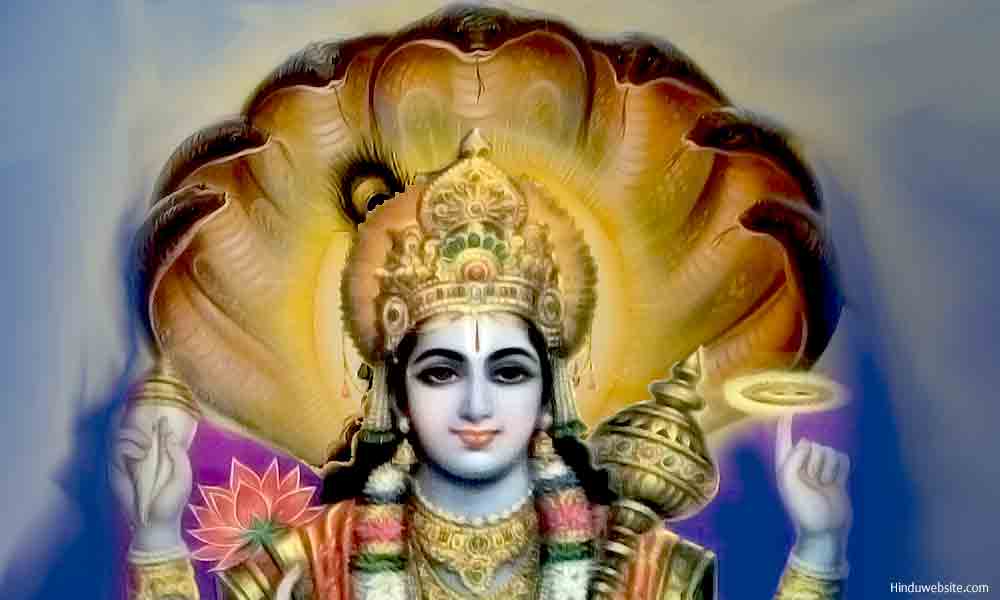
Summary: This page offers a curated collection of devotional prayers addressed to Lord Vishnu, the preserver of the universe and embodiment of sattva. The content includes classical stotras, namavalis, and revered hymns such as the Vishnu Sahasranama. These prayers celebrate Vishnu’s protective, purifying, and all‑pervading nature, guiding devotees toward peace, clarity, and spiritual upliftment. The page serves as a valuable resource for those seeking authentic Sanskrit invocations for worship and contemplation.
Vishnu dhyaanam
shanthaakaaram bhujagashayanam padmanaabham suresham
vishvaakaaram gagana sadrsham meghavarnam shubhaangam
lakshmeekaantham kamalanayanam yogihrddaanagamyam
vande vishnum bhavabhayaharam sarvalokaika naadham
dhyaamai
Maha Vishnu, the Protector and the Pervador
Vishnu is the preserver who is responsible for the order and regularity of the worlds and the duties that ensure the orderly progression of the worlds and beings, their bondage and liberation. In the body and in Nature he repersents the binding, balancing and purifying quality of sattva. In the sky, as the Aditya, he represents the shining and heating power of the sun. His consort is Lakshmi, the goddess of wealth and abundance. His name Vishnu may have been derived from the root words vishir (to pervade), vish (spread or enter), or vishli (surround). According to these intepretation, Vishnu means one or more of the following.
- The all pervading light (visir) in the space,
- He who spreads in all directions (visnati),
- He who enters (visati) the worlds, our hearts and minds as the light
- He who surrounds (visli) us or the worlds with light.
Vis also means material objects. Therefore, Vishnu may also means he who removes or burns our attachments to material objects. As the light in the sky, Vishnu overcomes all darkness and prevails upon the worlds. The world is nourished and sustained by his effulgence. Of the four states, Vishnu as the preserver repersents the dream states (svapnavastha). The world in which we live is but the dream of Narayana only.The following are a few important popular Hindu prayers addressed to him. For pronunciation help, check the footnote in each page.
Guidelines to pronunciation: Sanskrit is essentially a language of sounds and sound vibrations. The efficacy of Sanskrit prayers depends upon the vibrations that are produced during chanting. It is difficult to transliterate Sanskrit words into English with full justification to the original sounds. In the above stated transliteration we followed a simple approach to make it easier even for those who are not familiar with English or Sanskrit. Wherever you find repeat vowels (aa, uu, ee) please stretch the vowel sound (for ex., aa as in vast or path, uu as in cool or root, ee as in eel or feel). Similarly, "ai" should be pronounced as in gait, fight, or tight. Th should be pronounced as in think or thick, but when t alone is used, it should be pronounced as in two, top or tip.