
The Vedic Yagna, Yajna or Yagam
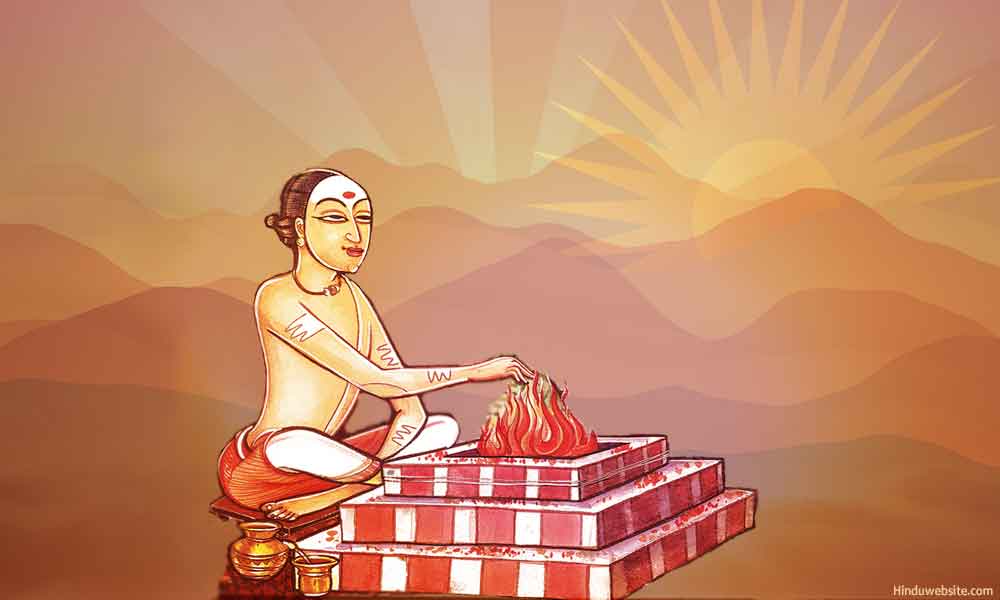
Yajna or Yagna (also called yaga or yagam) is a Vedic sacrifice or an outer form of ritual worship, in which offerings are made to different deities in a prescribed and systematic manner by worshippers to nourish them and thereby supplicate them, so that they would assist the worshippers in achieving their goals and desires in life. It is usually done with the help of qualified priests. Yagam leads to Yogam, the auspicious state of harmony and unity with gods and happiness here and hereafter. Yajna is the means by which human beings can ensure their Wellbeing upon earth and a safe journey to the heaven after death. Indeed, in the Vedic world Yajna was the panacea to all human problems from martial discord to snakebites.
The word Yajna is derived from “yaj,” meaning divine worship. The objects of that worship are usually devas (gods). However, Yajnas are used worship divinities as well as to help and serve others or to commemorate important events and occasions. Hence, they are performed to honor kings, teachers, elders, sacred places, ancestors, venerable people or to celebrate occasions like the birth of a child, marriage, house-warming, etc.
Yajnas have an ethical basis too. They provide the human beings with an opportunity to transcend their selfishness and help others. The Vedas suggest that life itself should be led as a sacrifice in which every action should be an offering. Brahman himself is the ultimate sacrificer and he shows the way to engage in an eternal sacrifice. Thus, service to gods and others as an obligation to God in the upholding of Dharma is the central feature of Vedic Yajnas. They truly help humans lead a divine centered life, or what we today know as the Hindu way of life.
Yajnas are usually fire sacrifices and involves the use of ritual or sacrificial fire. However, in some rituals the use of fire may be symbolic. In Soma Sacrifices, the Soma Juice rather than fire was the main offering. Fire sacrifices were common in the ancient world. However, Vedic people perfected the art and science of Vedic sacrifices to the highest extent and built a whole culture and belief system around them. They made fire sacrifices obligatory to humans by suggesting that gods depended upon them for nourishment. At the zenith of the Vedic civilization, the ancient Zoroastrians also practiced fire sacrifices, which were known as Yasna.
Each Yajna is performed by the host of the sacrifice (Yajamana), his family, one or more attending priests, in the presence of friends, well-wishers and other guests. According to the tradition the remains of the sacrificial food from the yajna is shared by the participants. The Brahmanas receive fees and gifts. The knowledge of the Yajnas is contained in the Shrauta Shastras and Grihya Sutras. The Atharvaveda, in which the Vedic sacrificial rituals reach their highest culmination, extols Yajna as a deity in itself.
A notable feature of the Yajnas is that they are traditionally performed by men only. In Agnichayana or Agnistoma sacrifices, women have no role other than as participants, cooks or cohosts. A wife's duty is to serve the host of the sacrifice and his family to perform his sacrificial duties and help him in fulfilling his obligation to the beneficiaries of the sacrifice. However, in certain types of Yajnas, especially those which were performed on the occasion of marriage or for progeny, consummation of marriage, conception, pregnancy or sexual gratification, the participation of women was mandatory. Women also played an important role in Rajasuya and Asvamedha sacrifices and in full moon and half moon sacrifices.
Although the Yajamana, the host of the sacrifice, was supposed to be the key figure (swamin) in the sacrifices, in course of time he was reduced to a mere donor or supporter of the sacrifice. His main duties were limited to fulfilling his obligation to follow the instructions of the head priest, pay the fees to the participating priests, bear the costs of the sacrifice and ensure fair distribution of food to the guests.
In almost all important Yajnas, priests play a predominantly important role. Their participation and involvement is mandatory for most sacrifices. The Brahmanas are the gods of the mortal world. Hence, they are most qualified to communicate with the gods of heaven. Besides, the Yajnas provide an opportunity to people to make gifts to Brahmanas and thereby accumulate great merit
In the Vedic period the Kshatriyas had an upper hand in certain Yajnas such as Rajasuya and Asvamedha. However, with the decline of the Kshatriya power in the post Vedic period, their influence waned. The kings who established kingdoms in the North and the South after them were mostly from lower castes or foreigners. They had no knowledge of the Vedas and had to depend entirely upon the priestly class to perform the sacrifices.
Further, the codification of caste based laws by Manu and others and restrictions upon the teaching of the Vedas helped the traditional Brahmana families monopolize the knowledge of the sacrifices and keep it out of the reach of common people. Due to such factors, Yajnas became the mainstay of Brahmana caste and remained the main source of their livelihood for centuries.
The Purpose of Yajna
The primary purpose of yajnas is to nourish devas. The word deva originally meant gods or light beings. However in due course it was used to denote, senses, organs in the body, breathe, speech, the mind, king, a Brahmana, a venerable being or a demi-god. Yajnas may be performed to worship any of them. Their primary purpose is to invoke the gods and nourish them.
Their secondary purpose is to harness divine power to fulfill desires, overcome difficulties or achieve the four main goals namely Dharma, Artha, Kama and Moksha. Yajnas may also be performed to discharge karmic debt or uphold Dharma as an obligatory duty. The mantras and hymns which are sung during the sacrifices are meant to appease the gods and help the worshippers to fulfill their desires and seek divine protection.
Yajnas bring gods and humans together to achieve their common goals and participate in God’s eternal duties as active participants in the sacrifice of creation. The source of Yajna is God himself. He created the worlds and beings out of a primal sacrifice, which serves as the model for the Yajnas humans perform upon earth. According to Sayana, Vishnu is the lord of the sacrifice. In other words, Yajnas play an important role in the preservation of the worlds and beings.
Yajnas are used for material and spiritual purposes as well as for constructive and destructive purposes. Their essential purpose is the preservation of the worlds. Some yajnas are performed to create, some to preserve and protect and some to destroy and remove obstacles and threats. In the Vedas we find that they are meant to secure progeny, a place in heaven, conjugal bliss, prevent or cure sickness and diseases, ward off death, ensure health and vitality, achieve name, fame and prosperity, cleanse sinful karma, repair relationships, help the ancestors, mark important occasions in the life of an individual such as birth, initiation, marriage, etc., and so on. They are also performed for good rains, fertility, better harvest, protection from calamities, evil spells, natural disasters and the inherited sin of the ancestors.
The Vedas recognize the Yajna as a potent weapon to destroy one's enemies and rivals in love and marriage. In the Yajurveda and Atharvaveda, several Yajnas are suggested to cast spells and delude people. Any Yajna is incomplete unless it reaches the heaven and fulfills its purpose. In that effort, speech, space, the sacred words of the Vedas, the chanting of the mantras, the devotion and sincerity of the worshippers, the purity of the priests, the sanctity of the ritual place and the perfection shown in its performance play an important role.
Attitude and preparation play an important role in the efficacy of the Yajnas. When yajnas are not performed according to prescribed procedure or when they are performed without reverence or respect, they may either fail to produce the intended results or produce unintended consequences. When Yajnas are performed under the influence of triple gunas, they may produce different results. Hence, the involvement of officiating priests is an important component of major yajnas.
Types of Yajnas
Vedic sacrifices proliferated during the heydays of Vedic civilization and during its expansion into different parts of the Indian subcontinent, which is evident from the innumerable sacrifices which were practiced in ancient times by people of all backgrounds. They performed sacrifices to mark every occasion and resolve every problem. In the absence of viable alternatives, the Yajnas offered hope and salvation to people who were in distress or who sought divine intervention to protect themselves from the vagaries of life. Their importance did not diminish with the decline of the Vedic religion because they were assimilated into various other traditions, which subsequently became part of Hinduism.
Depending upon the frequency at which they are performed, Yajna may be classified as periodical sacrifices, occasional sacrifices and situational sacrifices. Periodical sacrifices may be further classified as daily, weekly, fortnightly, monthly, quarterly, seasonal or annual. The daily sacrifices, also known as Paka Yajnas, involve offering of cooked food (paka) to five different kinds of beings. Hence, they were also known as five great sacrifices pancha yajnas. The Sankhayana Sutra divides the Paka Yajnas into four kinds, Huta, Ahuta, Prahuta, And Prâsita. In addition to them, devout Brahmanas has the obligation to perform oblations to the Sun in the morning, afternoon and evening. In the Vedic times, they also made daily offerings of Soma Juice to divinities such as Indra, Soma, Varuna, etc.
The fortnightly sacrifices are the full moon day and half-moon day sacrifices. The right time to perform them are mid-day or when “the sun shines on the top of the trees.” Some Yajnas are seasonal and performed to mark the onset of a specific season such as spring, summer or the fruit bearing season. Some Yajnas have to be performed once in several years.
Occasional sacrifices are those which are performed to mark specific occasions such as festivals, auspicious occasions and important events in the life of an individual. Some of them involve elaborate rituals and prior preparation. Situational sacrifices are performed to address specific problems such as to remove impurities (doshas), misfortune or some calamity.
Some Yajnas are considered original or natural (Prakrit), and others their derivatives (vikrit). Only the Prakrit Yajnas are mentioned in detail in the Grihya Sutras. They serve as models for the latter. For example, the Agnistoma sacrifice serves as the model for several Soma sacrifices. The Darsapurnamasa sacrifice is the basis for several sacrifices which are known as Isti. The animals sacrifices, which are associated with the Soma sacrifices serve as the model for all the animal sacrifices.
Depending upon their importance, Yajnas are also classified as main (pradhana) and ancillary (anga). The latter are derived from the former. The ancillary rites may be associated with one or more main sacrifices. Yajnas may also be classified according to the type of offerings. Yajnas where food is the main offering are known as Paka Yajnas. Some Yajnas where oblations are poured are known as Homas. The Yajnas primarily comply with the Vedic methods of worship and value system. However, some are performed according to Tantric beliefs.
Yajnas are also named according to the materials which are used in the sacrifice. For example, the Yajna where knowledge is transmitted is known as Jnana Yajna. The sacrifice of gifts is known as Dana Yajna. The sacrifice which is performed to propitiate the earth before cultivating the land is known as Bhu-Yajna. The Vedas contain references to many Yajnas where animals are sacrificed as offerings. The offerings are mainly cooked food, food grains, fruit, seeds, butter, ghee, oil, water, milk, curd, honey, wood of different kinds, perfumes or scented materials, incense, leaves, kusa grass, grass leaves, prayers, chants, etc.
The simplest form of yajna is the domestic ritual performed by the householder who would offer simple oblation into the sacred fire lit in his house. A more complicated version involves setting up of three to five fires and pouring of offerings into them such as food grains, ghee or butter, and other vegetable substances by chosen and qualified priests, chanting mantras simultaneously, invoking various gods especially Agni, Indra, Varuna etc. Householders also
Some yajnas are performed on large scale for the general welfare of the entire community, to increase fertility of soil, to invite rains, to welcome peace and wealth etc. Depending upon the degree of complexity, these yajnas may last from a few hours to several days. The number of priests participating and conducting the ceremony would depend upon the nature and objective for which it is performed.
Yajnas may be performed ritually with material offerings or spiritually with mental offerings. The latter are known as Antar Yajnas. They are essentially meditative practices or approaches to internal worship or mental worship. You may consider them as the basis for the development of classical Yoga. In them, the model of the Yajna is internalized, whereby the body becomes the sacrificial altar, the mind becomes the priest and the deity Yajna, the senses, breath, organs of actions and speech represent the divinities, thoughts and prayers become offerings, while the Self acts as the recipient of the offering.
Parts of Yajna
Yajnas are performed in different ways according to the need, the occasion, the preferences and desires of the worshippers. A typical yajna is performed after choosing a clean place, which shall be free from impurities and evil influences, and after ascertaining an auspicious time as determined by a priest who is well-versed in the subtle nuances of Hindu calendar. A typical Yajna is an elaborate mechanism with many moving parts like the parts in a wheel. It may have all or some of the following parts or components (yajna-anga).
- Yajnastala or Yajnabhumi: The sacrificial place
- Yajnavatika or Yajnashala: Sacrificial hall, shed or enclosure
- Yajnakundam: The sacrificial pit
- Yajnavedi: The sacrificial altar which is usually made of bricks according to specifications
- Yajnadiksha: Formal declaration to perform the yajna
- Yagagni: The consecrated sacrificial fire, which is either specially prepared or taken from domestic fires
- Yajnadravyam: Sacrificial materials or offerings
- Yajnapasu: The sacrificial animal
- Yajnakila: The sacrificial post to which the animal is tied
- Yajamana: The host of the sacrifice.
- Purohita: The chief priest.
- Brahman: The supervising priest
- Devas: The gods for whom sacrifice is performed
- Yajna-amsam: The share which is due to each god in a sacrifice
- Yajnasesha: The remains of the sacrifice
- Yajnasadas: The assembly of men who attend the sacrifice
- Yajnasiddhi or Yajnaphalam: The outcome or the fruit of a sacrifice
- Bhokta: The enjoyer of the sacrifice.
- Bhakta: The offering
- Agnihotri: The Brahmana who keeps sacrificial fire.
The Vedic Yajnas have to be performed strictly according to procedure. Procedural purity is important to ensure that the Yajna produces the intended results. The purity of the participants, chants and the materials used in the sacrifice is also equally important. Some Yajnas may last for a few hours or for days and months and require special preparation. Some are performed in private and some in public. They are also performed individually or collectively according to the need.
A typical yajna has a preparatory part, an introductory part, a middle part and a concluding part. In each stage, the same priests may perform various duties and chant different mantras, or it may be done by different classes of priests who have specialized in them. They do so to propitiate the gods, prepare the sacrificial place, ward off evil powers, invite the gods to the ritual place or convey the desires, intent and purpose of the sacrifice. At the end of the ceremony, priests perform expiatory rituals to safeguard the purity and sanctity of the rituals. Some Yajnas may require the performance of related Yajnas either immediately or after a gap for their successful completion
Aspects of Yajna
To the Vedic priests, yajna was the means to invoke gods and seek their blessings and favors. They performed them for various purposes and at various times during the year, at the time of sowing, at the time of harvest, at the time of initiating some important social event or before going to wars. One very popular yajna of those days was the Asvamedha Yajna, or the Horse Sacrifice which used to be performed by powerful kings to mark their victory and suzerainty. Outwardly, the horse symbolizes the divine power of the king and inwardly it symbolizes Brahman himself. Just as Brahman endlessly expands in all directions, the power of the king is expected to grow in the same manner with the sacrifice.
Thus, each Yajna has an outer aspect and an inner aspect. The outer aspect of yajna consists of all that one can see. It includes the preparation, the participants, the altar, the kindling of consecrated fire, the wood used to keep the fire going, the flames, and the sacrificial material used as offerings and oblations, the prayers and chants, the remains of the offerings, the gifts and so on. All this is the material aspect of the Yajna.
The inner or hidden aspect of Yajna is known to those who are familiar with the Vedic rituals. The yajna is the means of worshipping the highest God or ones own inner self. It symbolizes creation itself and every aspect in it, in which there is an exchange or transference of Nature's materiality and its numerous manifestations. The sacrifice involves the act of giving and taking, and thereby symbolizes the transformative aspect of Nature and the interdependence of worlds and beings. It points to the need to live in harmony with the rest of creation and the importance of transcending selfishness and self-interest.
Even when you strive to achieve your personal goals, you should not ignore your obligatory duties and your commitment to the order and regularity of the world. The Vedas clearly identify human selfishness as a major disrupting factor in the orderly progression of life. If people live for themselves and ignore their collective responsibilities towards each other, gods and other living beings, the world will be in chaos. Hence, they equate selfishness with evil itself.
We learn the same from modern science also, which affirms that you cannot solely live by yourself. It is common sense wisdom that if you want to live in peace, you must live responsibly and ensure the preservation of life around you, just as you cannot pollute the waters of a pond from where you draw your drinking water. Thus, sacrifices are meant to help you outgrow your selfishness and participate in sacrificial duties to ensure the continuation of the worlds and discharge your obligation to God who is the upholder of all.
In the Bhagavad-Gita Lord Krishna explains that every aspect of a ritual of sacrifice, represents Brahman namely the act of offering, the oblation, the sacrificer himself and the sacrificial fire as well (4.23). In the subsequent verses he lists various types of sacrifices which people perform for various reasons and aims (4.25-4.30) and concludes that the sacrifice in the form of knowledge is superior to the sacrifice which is done with material things. In the ninth chapter he declares, " I am kratu (Vedic ritual), I am yajna (sacrifice), svadha (offering), ausadham (medicine), mantra (chant), ajyam (ghee), agni (fire), and hutam (burnt offering). In Chandogya Upanishad, the yajna is compared variously to the world (section 4), the rain god (section 5), the earth (section 6), man (section 7) and woman (section 8). The comparison can be summarized in the table as shown below.
| Parts of Yajna | World as Yajna | Rain as Yajna | Earth as Yajna | Man as Yajna | Woman as Yajna |
| Fire | world | rain | earth | man | woman |
| Fuel | sun | air | year | speech | sex organ |
| Smoke | rays | cloud | space | breath | desire |
| Flame | the day | lightening | night | tongue | vulva |
| Coals | the moon | thunder | quarters | eyes | friction |
| Sparks | stars | thundering | intermediate quarters | ears | pleasure |
| Oblation | faith | soma | rain | food | semen |
| The result | soma | rain | food | semen | fetus |
The physical or the outer aspect of the Vedic rituals has always been viewed with suspicion by the followers of renunciant paths and seekers of knowledge and truth. Several Upanishads declare the knowledge of the sacrificial rituals as ignorance or lower knowledge, which leads to rebirth and continuation of mortal existence. In Satapatha Brahmana we are told that gods and demons tried to perform a sacrifice. Demons, who think that the body is the soul, tried to perform it externally, while gods kindled fire within themselves and thereby became immortal.
The Mandukya Upanishad is very clear in its opinion about the Vedic sacrifices. It declares, "Unsteady are the boats of 18 forms of sacrifice, which are part of inferior karma. The deluded, who take delight in them thinking that they would lead them to good, will fall again into old age and death." It reaffirms the same opinion in the following words," These deluded men who regard sacrifices and works of merit as most important do not know any other good. Having enjoyed in the high place of heaven, which is won by good deeds, they enter again this world or still the lower ones."
Thus, sacrifices have the same consequences as desire-ridden actions because although they are called sacrifices for namesake, they are performed out of desires only. The same Upanishad also declares the knowledge of the Vedas and rituals, grammar, etc., to be the lower (apara) knowledge, while the higher (para) knowledge is that one by which the Imperishable Brahman is realized. Almost a similar view is echoed in the Bhagavad-Gita by Lord Krishna who cautions us against empty ritualism (11.48). The knowers of Vedas who worship God through sacrifices would ascend to heaven and return from there.(9.20&21), but they would not attain liberation.
Yajnas in contemporary world
Sacrificial rituals (karma kanda) dominated the early Vedic religion. However, with the internalization of Vedic rituals and emergence of the Upanishadic philosophy, the importance of rituals diminished. As stated before, the seers of the Upanishads regarded them as lower knowledge or even ignorance (avidya) and encouraged people to pursue the path of liberation to avoid rebirth and continuation of bondage to the cycle of births and deaths. Many Upanishads discourage people from indulging in superficial sacrificial rituals and instead encourage them to contemplate upon the Self or Brahman. However, some suggest a middle path and the need to maintain balance. The Bhagavadgita suggests that sacrifices should be performed as an obligatory duty, as an offering to God, without desire for their fruit.
In todays’ world, sacrificial rituals have lost much of their significance, partly because the they are performed in Sanskrit, which many Hindus do not know and thereby fail to understand their significance. Secondly, many people have little or no faith in them. From a modern perspective, the rituals also appear to them as primitive and rather superstitious. Thirdly, the rituals demand purity, sincerity, austerity and prior preparation, which many people find difficult to practice. They also cost money, time and active participation. Some Yajnas cost a fortune to perform and beyond the capacity of ordinary people. Lastly, secular education and western influence greatly diminished the importance of Yajnas in the minds of many educated people.
Therefore, today many educated Hindus are not seriously committed to performing the yajnas. They may occasionally perform them or participate in them due to family or social pressures on occasions like marriage, the conception of a child, etc., but with certain reservations and indifference. For most of people, the yajnas are a part of an ancient tradition, which they do not understand and which they do not recognize as relevant or important in the present-day world. However, many educated people rightly recognize the importance of the Upanishadic knowledge and the need to pursue self-knowledge.
Vedic rituals generated controversy even in ancient India, resulting in the rise of many independent schools of thought around sixth century B.C. Foremost among were Charvakas, Lokayatas and other materialists and agnostics, who doubted the sanctity of the Vedas or the role of God in creation. Rival traditions such as Jainism and Buddhism also questioned the efficacy of Vedic rituals and sacrificial ceremonies in resolving human suffering and the role of Brahman. The Buddha acknowledged the existence of the Vedic pantheon, but questioned the value of sacrifices and ritual worship and advised his followers to strive for liberation rather than seeking material rewards through superficial rituals.
It is true that the importance of the Yajnas and their value have greatly diminished in today's world due to various reasons such as the influence of modern, secular education, the complexity involved in performing them and the decline in the number of priests who can perform the various yajnas strictly according to the established procedure. However, we should not lose heart.
Although the importance of Yajnas has greatly diminished in the modern world, they still constitute an important part of Hinduism and cannot be ignored. The primary purpose of Yajnas is nourishment of Vedic gods, which is an obligatory duty for the followers of Sanatana Dharma. The gods depend upon us for nourishment. If we do not nourish them through sacrifices, they will grow weaker while evil will grow stronger, which in turn will effect the world itself.
HHence, at least some yajnas still need to be performed physically or mentally to keep the gods nourished and the world safe. Even the simple act of offering the food to gods before you eat will make a world of difference to gods and to you. The puja ceremony which we practice at homes and in temples is also a form of sacrifice only, and a modern substitute for Yajnas. Surely, the food which we offer to gods during the ceremony goes to them. Whether your sacrificial actions are part of a yajna or not, they do cleanse your mind and body and protect you from harm and evil. Therefore, even if you do not perform the physical Yajnas, you should bring the spirit of the Yajnas into your daily life through internal Yajnas and use that approach to improve your life and destiny.
Suggestions for Further Reading
- The Samkhya Philosophy and 24 Principles of Creation
- The Bhagavadgita On The Problem Of Sorrow
- The Concept of Atman or Eternal Soul in Hinduism
- The Practice of Atma Yoga Or The Yoga Of Self
- The Problem of Maya Or Illusion and How To Deal With It
- Belief In Atman, The Eternal Soul Or The Inner Self
- Brahman, The Highest God Of Hinduism
- The Bhagavad Gita Original Translations
- The Bhagavadgita, Philosophy and Concepts
- Bhakti yoga or the Yoga of Devotion
- Hinduism And The Evolution of Life And Consciousness
- Why to Study the Bhagavadgita Parts 1 to 4
- The Triple Gunas, Sattva, Rajas and Tamas
- The Practice of Tantra and Tantric Ritual in Hinduism and Buddhism
- The Tradition Of Gurus and Gurukulas in Hinduism
- Origin, Definition and Introduction to Hinduism
- Hinduism, Way of Life, Beliefs and Practices
- A Summary of the Bhagavadgita
- Avatar, the Reincarnation of God Upon Earth
- The Bhagavadgita on Karma, the Law of Actions
- The Mandukya Upanishad
- The Bhagavadgita On The Mind And Its Control
- Symbolic Significance of Numbers in Hinduism
- The Belief of Reincarnation of Soul in Hinduism
- The True Meaning Of Renunciation According To Hinduism
- The Symbolic Significance of Puja Or Worship In Hinduism
- Introduction to the Upanishads of Hinduism
- Origin, Principles, Practice and Types of Yoga
- Hinduism and the Belief in one God
- Essays On Dharma
- Esoteric Mystic Hinduism
- Introduction to Hinduism
- Hindu Way of Life
- Essays On Karma
- Hindu Rites and Rituals
- The Origin of The Sanskrit Language
- Symbolism in Hinduism
- Essays on The Upanishads
- Concepts of Hinduism
- Essays on Atman
- Hindu Festivals
- Spiritual Practice
- Right Living
- Yoga of Sorrow
- Happiness
- Mental Health
- Concepts of Buddhism
- General Essays