
Arjuna of the Mahabharata
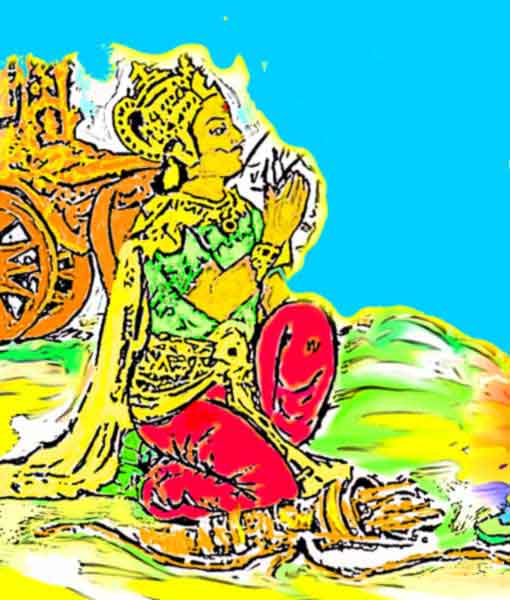
Arjuna was one of the five Pandava brothers of the Mahabharata epic. He was born to Kunti and and king Pandu with the energy of Indra, the leader of the gods. At a very young age he got acclaim for his sincerity and skill in archery. He was known for his steadfastness and single mindedness in pursuing his goals. He was instrumental in winning Draupadi in a contest for himself and his brothers as their joint wife. He also married Subhadra the sister of Krishna and Balarama and kept his friendship with them for ever. Lord Krishna became his mentor and guide for the rest of his life.
He was known by different namesm or rather titles, such as Phaalgun, Keerti, Paartha, Savyashachee, Dhanajaya and so on. During his sojourns to far away places in the subcontinent, he married Chitrangada, daughter of the king of Manipur and Ulupi, a naga princess. Two brave warrior sons were born to him. They were Abhimnyu through Subhadra and Bhabhruvahana through Chitrangada. Both his sons played an important role during the Mahabharata war.
He had a powerful bow by the name Gandiva, which helped him enormously in slaying his enemies. He got it from Varuna, the Vedic god of rain through Agni the god of fire. He also received a divine golden chariot from the latter as a gift which helped him to fight battles with Indra, his godfather and later with the Kauravas his cousins.
During the exile, when all the Pandava brothers had to leave behind their kingdom and wander in the forests for twelve years as a part of their agreement with the Kauravas, Arjuna had a strange encounter with Lord Siva from whom he got Pasupatha. During the same period he met with Indra and other gods in the heavens from whom he received training and also helped them in return by slaying some asuras. While he was in the heavens he displeased Urvashi, the heavenly nymph, by turning away her advances. She cursed him out of anger to turn into a eunuch for a year in his life as chosen by him.
Apart from archery, he also excelled in the arts of dancing, singing and acting which enormously helped the Pandavas when they had to stay in the court of Virat in total disguise as a part of their agreement with the Kauravas in the thirteenth year of their exile. Arjuna took advantage of the curse he got from Urvashi and turned himself into Brihannala, a eunuch and acted as dance master for the royal household, especially Uttara, the daughter of Virat. At the end of the one year stay, he helped king Virat by fighting a battle with Kauravas who invaded his kingdom. After realizing that the five people who working in his court were indeed Pandavas in disguise, king Virat offered to marry his daughter to Abhimanyu the son of Arjuna in return for the services rendered by the brothers, a marriage that proved crucial in the post mahabharata period as the son borne out of the wedlock was the only surviving member of the Pandava clan.
By virtue of his inner purity and his loyalty to Lord Krishna, Arjuna had the fortune of receiving the divine knowledge of the Bhagavad-Gita. In the Mahabharata war he played a very crucial role by slaying such warriors as Bhishma, Karna, Dronacharya and Jayadhrata. The character of Arjuna symbolizes purity, integrity, loyalty and valor. He had many temptations and dilemmas in his life but always chose to remain on the side of God and with his brothers in their trials and tribulations.
He could have been a great king in his own right, but he remained loyal to his elder brother Dharmaraj who ascended the throne of Hastinapur by virtue of being the eldest in the family. After the battle of Mahabharata, he assisted his brother greatly in expanding their empire by annexing several outlying kingdoms and defeating warring tribes. Strangely after the passing away of Lord Krishna, he forgot most of his skills as an archer and spent the rest of his life in humility and devotion. Arjuna serves as an example of a great human being, a dutiful householder, a loyal brother, a great warrior, a devout husband and a sincere devotee of God.
Suggestions for Further Reading
- Abhimanyu, the Son of Arjuna
- The Historical Origin of Lord Krishna, the Incarnation of Vishnu
- The Main Characters of the Bhagavad gita
- Bhagavad gita and the problem of sorrow
- The History of Bharata or India According to Indian Astronomers
- The Mahabharata, the Epic of the Bharatas
- The Concept of Atman or Eternal Soul in Hinduism
- The Problem of Maya Or Illusion and How To Deal With It
- Belief In Atman, The Eternal Soul Or The Inner Self
- Brahman, The Highest God Of Hinduism
- The Bhagavad Gita Original Translations
- The Bhagavadgita, Philosophy and Concepts
- Bhakti yoga or the Yoga of Devotion
- Hinduism And The Evolution of Life And Consciousness
- Why to Study the Bhagavadgita Parts 1 to 4
- Origin, Definition and Introduction to Hinduism
- Symbolic Significance of Numbers in Hinduism
- The Belief of Reincarnation of Soul in Hinduism
- The True Meaning Of Renunciation According To Hinduism
- The Symbolic Significance of Puja Or Worship In Hinduism
- Introduction to the Upanishads of Hinduism
- Origin, Principles, Practice and Types of Yoga
- Essays On Dharma
- Esoteric Mystic Hinduism
- Introduction to Hinduism
- Hindu Way of Life
- Essays On Karma
- Hindu Rites and Rituals
- The Origin of The Sanskrit Language
- Symbolism in Hinduism
- Essays on The Upanishads
- Concepts of Hinduism
- Essays on Atman
- Hindu Festivals
- Spiritual Practice
- Right Living
- Yoga of Sorrow
- Happiness
- Mental Health
- Concepts of Buddhism
- General Essays