
Historical Antecedents of Lord Krishna
Introduction
There is a lot of speculation about the antecedents of Lord Krishna. We do not have any clear historical records about him other than the scriptural evidence and his connection with the epic Mahabharata war. We are not even sure whether the Krishna of Mathura, Gopala of Brindavan and the Vasudeva Krishna of Dwaraka are different historical personalities or one and the same. More intriguing is how he came to be accepted as an incarnation of Lord Vishnu and how exactly his inclusion in the Hindu pantheon happened. He was definitely not a Vedic god and was not worshipped by early Vedic Aryans. He was neither a Brahmin, nor a Kshatriya nor a Vaishya. He came from a non-Vedic background and grew in the company of cowherds.
From the vedic perspective he led a controversial life and preached a philosophy that emphasized the internalization of ritual and liberation through desireless actions, devotion to God and self-surrender. He tried to combine the finer aspects of vedic philosophy with the complex philosophies of Samkhya and Yoga and thereby made his teachings extraordinarily appealing to all sections of society. Long before the Buddha, he tried to reform the Vedic religion through his teachings and by making public the mostly secretive Upanishadic knowledge that remained confined to some selected families and vedic schools.
The following paragraphs are excerpted from the book, the Hinduism and Buddhism An Historical Sketch, by Sir Charles Eliot in which the author tries to trace the origin of the legend of Krishna based on the available literary evidence. The author made best possible effort to trace the historical origin of Krishna from various sources. He also drew some erroneous conclusions such as the possible connection between Krishna and Greek gods such as Herakles and Pan and his clear bias in favor of Christianity and western culture. Those who are devoted to Lord Krishna and consider him to be Supreme God may not appreciate the effort of the author. They are advised to read this information with an open mind and consider this as an exercise in speculation and intellectual exploration. In the absence of valid historical evidence all that we have about Lord Krishna are the scriptures like the Bhagavadgita, the Mahabharata, the Bhagavatapurana and speculative theories such as these.
Jayaram V
Kṛishṇa, the other great incarnation of Vishṇu, is one of the most conspicuous figures in the Indian pantheon, but his historical origin remains obscure. The word which means black or dark blue occurs in the Ṛig Veda as the name of an otherwise unknown person. In the Chândogya Upanishad,[366] Kṛishṇa, the son of Devakî, is mentioned as having been instructed by the sage Ghora of the Ângirasa clan, and it is probably implied that Kṛishṇa too belonged to that clan.[367] Later sectarian writers never quote this verse, but their silence may be due to the fact that the Upanishad does not refer to Kṛishṇa as if he were a deity, and merely says that he received from Ghora instruction after which he never thirsted again. The purport of it was that the sacrifice may be performed without rites, the various parts being typified by ordinary human actions, such as hunger, eating, laughter, liberality, righteousness, etc. This doctrine has some resemblance to Buddhist language[368] and if this Kṛishṇa is really the ancient hero out of whom the later deity was evolved, there may be an allusion to some simple form of worship which rejected ceremonial and was practised by the tribes to whom Kṛishṇa belonged. I shall recur to the question of these tribes [153] and the Bhâgavata sect below, but in this section I am concerned with the personality of Kṛishṇa.
Vâsudeva is a well-known name of Kṛishṇa and a sûtra of Pâṇini,[369] especially if taken in conjunction with the comment of Patanjali, appears to assert that it is not a clan name but the name of a god. If so Vâsudeva must have been recognized as a god in the fourth century B.C. He is mentioned in inscriptions which appear to date from about the second century B.C.[370] and in the last book of the Taittirîya Âraṇyaka,[371] which however is a later addition of uncertain date.
The name Kṛishṇa occurs in Buddhist writings in the form Kaṇha, phonetically equivalent to Kṛishṇa. In the Dîgha Nikâya[372] we hear of the clan of the Kaṇhâyanas (= Kârshṇâyanas) and of one Kaṇha who became a great sage. This person may be the Kṛishṇa of the Ṛig Veda, but there is no proof that he is the same as our Kṛishṇa.
The Ghata-Jâtaka (No. 454) gives an account of Kṛishṇa's childhood and subsequent exploits which in many points corresponds with the Brahmanic legends of his life and contains several familiar incidents and names, such as Vâsudeva, Baladeva, Kaṃsa. Yet it presents many peculiarities and is either an independent version or a misrepresentation of a popular story that had wandered far from its home. Jain tradition also shows that these tales were popular and were worked up into different forms, for the Jains have an elaborate system of ancient patriarchs which includes Vâsudevas and Baladevas. Kṛishṇa is the ninth of the Black Vâsudevas[373] and is connected with Dvâravatî or Dvârakâ. He will become the twelfth tîrthankara of the next world-period and a similar position will be attained by Devakî, Rohinî, Baladeva and Javakumâra, all members of his family. This is a striking proof of the popularity of the Kṛishṇa legend outside the Brahmanic religion.
No references to Kṛishṇa except the above have been found in the earlier Upanishads and Sûtras. He is not mentioned in Manu but in one aspect or another he is the principal figure in the Mahâbhârata, yet not exactly the hero. The Râmâyaṇa would have no plot without Râma, but the story of the Mahâbhârata would not lose its unity if Kṛishṇa were omitted. He takes the side of the Pâṇḍavas, and is sometimes a chief sometimes a god but he is not essential to the action of the epic.
The legend represents him as the son of Vasudeva, who belonged to the Sâttvata sept[374] of the Yâdava tribe, and of his wife Devakî. It had been predicted to Kaṃsa, king of Mathura (Muttra), that one of her sons would kill him. He therefore slew her first six children: the seventh, Balarâma, who is often counted as an incarnation of Vishṇu, was transferred by divine intervention to the womb of Rohinî. Kṛishṇa, the eighth, escaped by more natural methods. His father was able to give him into the charge of Nanda, a herdsman, and his wife Yâsodâ who brought him up at Gokula and Vrindâvana. Here his youth was passed in sporting with the Gopîs or milk-maids, of whom he is said to have married a thousand. He had time, however, to perform acts of heroism, and after killing Kaṃsa, he transported the inhabitants of Mathura to the city of Dvârakâ which he had built on the coast of Gujarat. He became king of the Yâdavas and continued his mission of clearing the earth of tyrants and monsters. In the struggle between the Pâṇḍavas and the sons of Dhṛitarâshtṛa he championed the cause of the former, and after the conclusion of the war retired to Dvârakâ. Internecine conflict broke out among the Yâdavas and annihilated the race. Kṛishṇa himself withdrew to the forest and was killed by a hunter called Jaras (old age) who shot him supposing him to be a deer.
In the Mahâbhârata and several Purâṇas this bare outline is distended with a plethora of miraculous incident remarkable even in Indian literature, and almost all possible forms of divine and human activity are attributed to this many-sided figure. We may indeed suspect that his personality is dual even in the simplest form of the legend for the scene changes from Mathurâ to Dvârakâ, and his character is not quite the same in the two regions. It is probable that an ancient military hero of the west has been combined with a deity or perhaps more than one deity. The pile of story, sentiment and theology which ages have heaped up round Kṛishṇa's name, represents him in three principal aspects. Firstly, he is a warrior who destroys the powers of evil. Secondly, he is associated with love in all its forms, ranging from amorous sport to the love of God in the most spiritual and mystical sense. Thirdly, he is not only a deity, but he actually becomes God in the European and also in the pantheistic acceptation of the word, and is the centre of a philosophic theology.
The first of these aspects is clearly the oldest and it is here, if anywhere, that we may hope to find some fragments of history. But the embellishments of poets and story-tellers have been so many that we can only point to features which may indicate a substratum of fact. In the legend, Kṛishṇa assists the Pâṇḍavas against the Kauravas. Now many think that the Pâṇḍavas represent a second and later immigration of Aryans into India, composed of tribes who had halted in the Himalayas and perhaps acquired some of the customs of the inhabitants, including polyandry, for the five Pâṇḍavas had one wife in common between them. Also, the meaning of the name Kṛishṇa, black, suggests that he was a chief of some non-Aryan tribe. It is, therefore, possible that one source of the Kṛishṇa myth is that a body of invading Aryans, described in the legend as the Pâṇḍavas, who had not exactly the same laws and beliefs as those already established in Hindustan, were aided by a powerful aboriginal chief, just as the Sisodias in Rajputana were aided by the Bhîls. It is possible too that Kṛishṇa's tribe may have come from Kabul or other mountainous districts of the north west, although one of the most definite points in the legend is his connection with the coast town of Dvârakâ. The fortifications of this town and the fruitless efforts of the demon king, Salva, to conquer it by seige are described in the Mahâbhârata,[375] but the narrative is surrounded by an atmosphere of magic and miracle rather than of history.[376]
Though it would not be reasonable to pick out the less fantastic parts of the Kṛishṇa legend and interpret them as history, yet we may fairly attach significance to the fact that many episodes represent him as in conflict with Brahmanic institutions and hardly maintaining the position of Vishṇu incarnate.[377] Thus he plunders Indra's garden and defeats the gods who attempt to resist him. He fights with Śiva and Skanda. He burns Benares and all its inhabitants. Yet he is called Upendra, which, whatever other explanations sectarian ingenuity may invent, can hardly mean anything but the Lesser Indra, and he fills the humble post of Arjuna's charioteer. His kinsmen seem to have been of little repute, for part of his mission was to destroy his own clan and after presiding over it s annihilation in internecine strife, he was slain himself. In all this we see dimly the figure of some aboriginal hero who, though ultimately canonized, represented a force not in complete harmony with Brahmanic civilization. The figure has also many solar attributes but these need not mean that its origin is to be sought in a sun myth, but rather that, as many early deities were forms of the sun, solar attributes came to be a natural part of divinity and were ascribed to the deified Kṛishṇa just as they were to the deified Buddha.[378]
Some authors hold that the historical Kṛishṇa was a teacher, similar to Zarathustra, and that though of the military class he was chiefly occupied in founding or supporting what was afterwards known as the religion of the Bhâgavatas, a theistic system inculcating the worship of one God, called Bhâgavat, and perhaps identical with the Sun. It is probable that Kṛishṇa the hero was connected with the worship of a special deity, but I see no evidence that he was primarily a teacher.[379] In the earlier legends he is a man of arms: in the later he is not one who devotes his life to teaching but a forceful personage who explains the nature of God and the universe at the most unexpected moments. Now the founders of religions such as MahâVîra and Buddha preserve their character as teachers even in legend and do not accumulate miscellaneous heroic exploits. Similarly modern founders of sects, like Caitanya, though revered as incarnations, still retain their historical attributes. But on the other hand many men of action have been deified not because they taught anything but because they seemed to be more than human forces. Râma is a classical example of such deification and many local deities can be shown to be warriors, bandits and hunters whose powers inspired respect. It is said that there is a disposition in the Bombay Presidency to deify the Maratha leader Śivaji.[380]
In his second aspect, Kṛishṇa is a pastoral deity, sporting among nymphs and cattle. It is possible that this Kṛishṇa is in his origin distinct from the violent and tragic hero of Dvârakâ. The two characters have little in common, except their lawlessness, and the date and locality of the two cycles of legend are different. But the death of Kaṃsa which is one of the oldest incidents in the story (for it is mentioned in the Mahâbhâshya)[381] belongs to both and Kaṃsa is consistently connected with Muttra. The Mahâbhârata is mainly concerned with Kṛishṇa the warrior: the few allusions in it to the freaks of the pastoral Kṛishṇa occur in passages suspected of being late interpolations and, even if they are genuine, show that little attention was paid to his youth. But in later works, the relative importance is reversed and the figure of the amorous herdsman almost banishes the warrior. We can trace the growth of this figure in the sculptures of the sixth century, in the Vishṇu and Bhâgavata Purâṇas and the Gîtâ-govinda (written about 1170). Even later is the worship of Râdhâ, Kṛishṇa's mistress, as a portion of the deity, who is supposed to have divided himself into male and female halves.[382] The birth and adventures of the pastoral Kṛishṇa are located in the land of Braj, the district round Muttra and among the tribe of the Âbhîras, but the warlike Kṛishṇa is connected with the west, although his exploits extend to the Ganges valley.[383] The Âbhîras, now called Ahirs, were nomadic herdsmen who came from the west and their movements between Kathiawar and Muttra may have something to do with the double location of the Kṛishṇa legend.
Both archæology and historical notices tell us something of the history of Muttra. It was a great Buddhist and Jain centre, as the statues and vihâras found there attest. Ptolemy calls it the city of the gods. Fa-Hsien (400 A.D.) describes it as Buddhist, but that faith was declining at the time of Hsüan Chuang's visit (c. 630 A.D.). The sculptural remains also indicate the presence of Græco-Bactrian influence. We need not therefore feel surprise if we find in the religious thought of Muttra elements traceable to Greece, Persia or Central Asia. Some claim that Christianity should be reckoned among these elements and I shall discuss the question elsewhere. Here I will only say that such ideas as were common to Christianity and to the religions of Greece and western Asia probably did penetrate to India by the northern route, but of specifically Christian ideas I see no proof. It is true that the pastoral Kṛishṇa is unlike all earlier Indian deities, but then no close parallel to him can be adduced from elsewhere, and, take him as a whole, he is a decidedly un-Christian figure. The resemblance to Christianity consists in the worship of a divine child, together with his mother. But this feature is absent in the New Testament and seems to have been borrowed from paganism by Christianity.
The legends of Muttra show even clearer traces than those already quoted of hostility between Kṛishṇa and Brahmanism. He forbids the worship of Indra,[384] and when Indra in anger sends down a deluge of rain, he protects the country by holding up over it the hill of Goburdhan, which is still one of the great centres of pilgrimage.[385] The language which the Vishṇu Purâṇa attributes to him is extremely remarkable. He interrupts a sacrifice which his fosterfather is offering to Indra and says, "We have neither fields nor houses: we wander about happily wherever we list, travelling in our waggons. What have we to do with Indra? Cattle and mountains are (our) gods. Brahmans offer worship with prayer: cultivators of the earth adore their landmarks but we who tend our herds in the forests and mountains should worship them and our kine."
This passage suggests that Kṛishṇa represents a tribe of highland nomads who worshipped mountains and cattle and came to terms with the Brahmanic ritual only after a struggle. The worship of mountain spirits is common in Central Asia, but I do not know of any evidence for cattle-worship in those regions. Clemens of Alexandria,[386] writing at the end of the second century A.D., tells us that the Indians worshipped Herakles and Pan. The pastoral Kṛishṇa has considerable resemblance to Pan or a Faun, but no representations of such beings are recorded from Græco-Indian sculptures. Several Bacchic groups have however been discovered in Gandhara and also at Muttra[387] and Megasthenes recognized Dionysus in some Indian deity. Though the Bacchic revels and mysteries do not explain the pastoral element in the Kṛishṇa legend, they offer a parallel to some of its other features, such as the dancing and the crowd of women, and I am inclined to think that such Greek ideas may have germinated and proved fruitful in Muttra. The Greek king Menander is said to have occupied the city (c. 155 B.C.), and the sculptures found there indicate that Greek artistic forms were used to express Indian ideas. There may have been a similar fusion in religion.
In any case, Buddhism was predominant in Muttra for several centuries. It no doubt forbade the animal sacrifices of the Brahmans and favoured milder rites. It may even offer some explanation for the frivolous character of much in the Kṛishṇa legend.[388] Most Brahmanic deities, extraordinary as their conduct often is, are serious and imposing. But Buddhism claimed for itself the serious side of religion and while it tolerated local godlings treated them as fairies or elves. It was perhaps while Kṛishṇa was a humble rustic deity of this sort, with no claim to represent the Almighty, that there first gathered round him the cycle of light love-stories which has clung to him ever since. In the hands of the Brahmans his worship has undergone the strangest variations which touch the highest and lowest planes of Hinduism, but the Muttra legend still retains its special note of pastoral romance, and exhibits Kṛishṇa in two principal characters, as the divine child and as the divine lover. The mysteries of birth and of sexual union are congenial topics to Hindu theology, but in the cult of Muttra we are not concerned with reproduction as a world force, but simply with childhood and love as emotional manifestations of the deity. The same ideas occur in Christianity, and even in the Gospels Christ is compared to a bridegroom, but the Kṛishṇa legend is far more gross and naïve.
The infant Kṛishṇa is commonly adored in the form known as Makhan Chor or the Butter Thief.[389] This represents him as a crawling child holding out one hand full of curds or butter which he has stolen. We speak of idolizing a child, and when Hindu women worship this image they are unconsciously generalizing the process and worshipping childhood, its wayward pranks as well as its loveable simplicity, and though it is hard for a man to think of the freaks of the butter thief as a manifestation of divinity, yet clearly there is an analogy between these childish escapades and the caprices of mature deities, which are respectfully described as mysteries. If one admits the worship of the Bambino, it is not unreasonable to include in it admiration of his rogueries, and the tender playfulness which is permitted to enter into this cult appeals profoundly to Indian women. Images of the Makhan Chor are sold by thousands in the streets of Muttra.
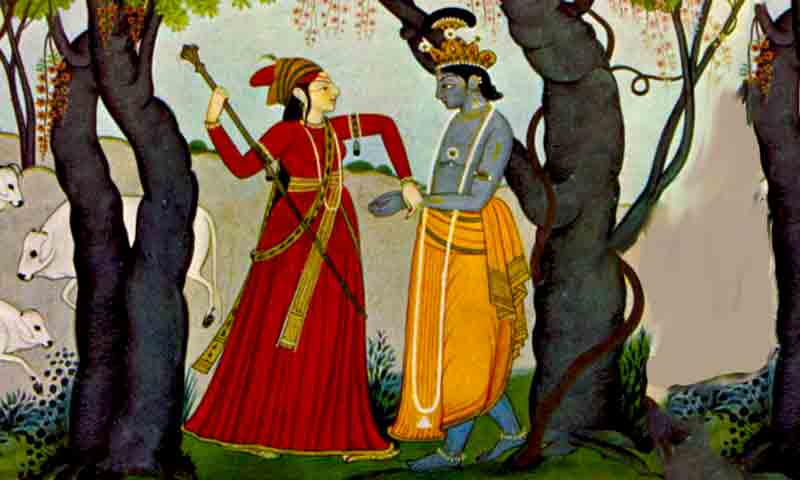
Even more popular is the image known as Kanhaya, which represents the god as a young man playing the flute as he stands in a careless attitude, which has something of Hellenic grace. Kṛishṇa in this form is the beloved of the Gopîs, or milk-maids, of the land of Braj, and the spouse of Râdhâ, though she had no monopoly of him. The stories of his frolics with these damsels and the rites instituted in memory thereof have brought his worship into merited discredit. Krishnaism offers the most extensive manifestation to be found in the world of what W. James calls the theopathic condition as illustrated by nuns like Marguérite Marie Alacoque, Saint Gertrude and the more distinguished Saint Theresa. "To be loved by God and loved by him to distraction (jusqu'à la folie), Margaret melted away with love at the thought of such a thing.... She said to God, 'Hold back, my God, these torrents which overwhelm me or else enlarge my capacity for their reception'."[390] These are not the words of the Gîtâ-govinda or the Prem Sagar, as might be supposed, but of a Catholic Bishop describing the transports of Sister Marguérite Marie, and they illustrate the temper of Kṛishṇa's worshippers. But the verses of the Marathi poet, Tukaram, who lived about 1600 A.D. and sang the praises of Kṛishṇa, rise above this sentimentality though he uses the language of love. In a letter to Sivaji, who desired to see him, he wrote, "As a chaste wife longs only to see her lord, such am I to Viṭṭhala.[391] All the world is to me Viṭṭhala and nothing else: thee also I behold in him." He also wrote elsewhere, "he that taketh the unprotected to his heart and doeth to a servant the same kindness as to his own children, is assuredly the image of God." More recently Râmakṛishṇa, whose sayings breathe a wide intelligence as well as a wide charity, has given this religion of love an expression which, if somewhat too sexual to be perfectly in accordance with western taste, is nearly related to emotional Christianity. "A true lover sees his god as his nearest and dearest relative" he writes, "just as the shepherd women of Vṛindâvana saw in Kṛishṇa not the Lord of the Universe but their own beloved.... The knowledge of God may be likened to a man, while the love of God is like a woman. Knowledge has entry only up to the outer rooms of God, and no one can enter into the inner mysteries of God save a lover.... Knowledge and love of God are ultimately one and the same. There is no difference between pure knowledge and pure love."[392]
These extracts show how Kṛishṇa as the object of the soul's desire assumes the place of the Supreme Being or God. But this surprising transformation[393] is not specially connected with the pastoral and erotic Kṛishṇa: the best known and most thorough-going exposition of his divinity is found in the Bhagavad-gîtâ, which represents him as being in his human aspect, a warrior and the charioteer of Arjuna. Probably some seventy-five millions to-day worship Kṛishṇa, especially under the name of Hari, as God in the pantheistic sense and naturally the more his identity with the supreme spirit is emphasized, the dimmer grow the legendary features which mark the hero of Muttra and Dvârakâ, and the human element in him is reduced to this very important point that the tie uniting him to his worshippers is one of sentiment and affection.
In the following chapters I shall treat of this worship when describing the various sects which practise it. A question of some importance for the history of Kṛishṇa's deification is the meaning of the name Vâsudeva. One explanation makes it a patronymic, son of Vasudeva, and supposes that when this prince Vâsudeva was deified his name, like Râma, was transferred to the deity. The other regards Vâsudeva as a name for the deity used by the Sâttvata clan and supposes that when Kṛishṇa was deified this already well-known divine name was bestowed on him. There is much to be said for this latter theory. As we have seen the Jains give the title Vâsudeva to a series of supermen, and a remarkable legend states[394] that a king called [163] Paundraka who pretended to be a deity used the title Vâsudeva and ordered Kṛishṇa to cease using it, for which impertinence he was slain. This clearly implies that the title was something which could be detached from Kṛishṇa and not a mere patronymic. Indian writings countenance both etymologies of the word. As the name of the deity they derive it from vas to dwell, he in whom all things abide and who abides in all.[395]
Suggestions for Further Reading
- Vedic gods
- Lord Vishnu
- Bhakti, spiritual devotion
- The History, Religious Significance and Temples of Mathura and Vrindavan
- The Bhagavad gita home page
- Introduction to the Bhagavad-Gita
- The Main Characters of the Bhagavad gita
- Samkhya and Yoga in Hinduism and Buddhism
- The Bhagavadgita, Philosophy and Concepts
- Essays On Dharma
- Esoteric Mystic Hinduism
- Introduction to Hinduism
- Hindu Way of Life
- Essays On Karma
- Hindu Rites and Rituals
- The Origin of The Sanskrit Language
- Symbolism in Hinduism
- Essays on The Upanishads
- Concepts of Hinduism
- Essays on Atman
- Hindu Festivals
- Spiritual Practice
- Right Living
- Yoga of Sorrow
- Happiness
- Mental Health
- Concepts of Buddhism
- General Essays
Footnotes
[365] Ekanâtha, who lived in the sixteenth century, calls the Adhyâtma R. a modern work. See Bhandarkar, Vaishn. and Saivism, page 48. The Yoga-Vasishtḥa R. purports to be instruction given by Vasishṭha to Râma who wishes to abandon the world. Its date is uncertain but it is quoted by authors of the fourteenth century. It is very popular, especially in south India, where an abridgment in Tamil called Jñâna-Vasishṭha is much read. Its doctrine appears to be Vedântist with a good deal of Buddhist philosophy. Salvation is never to think that pleasures and pains are "mine."
[366] Châṇḍ. Up. III. 17.6
[367] The Kaush. Brâhm. says that Kṛishṇa was an Ângirasa XXX. g. The Anukramanî says that the Kṛishṇa of Ṛig Veda, VIII. 74 was an Ângirasa. For Ghora Ângirasa "the dread descendent of the Angirases" see Macdonell and Keith, Vedic Index, s.v.
[368] E.g. Dig. Nik. V. The Pâncarâtra expressly states that Yoga is worship of the heart and self-sacrifice, being thus a counterpart of the external sacrifice (bâhyayâga).
[369] Pâṇ. IV. 3. 98, Vâsudevârjunâbhyâm vun. See Bhandarkar, Vaishnavism and Śaivism, p. 3 and J.R.A.S. 1910, p. 168. Sûtra 95, just above, appears to point to bhakti, faith or devotion, felt for this Vâsudeva.
[370] Especially the Besnagar column. See Rapson, Ancient India, p. 156 and various articles in J.R.A.S. 1909-10.
[371] X. i, vi.
[372] III. i. 23, Ulâro so Kaṇho isi ahosi. But this may refer to the Rishi mentioned in R.V. VIII. 74 who has not necessarily anything to do with the god Kṛishṇa.
[373] See Hemacandra Abhidhânacintâmani, Ed. Boehtlingk and Rien, p. 128, and Barnett's translation of the Antagada Dasāo, pp. 13-15 and 67-82.
[374] Apparently the same as the Vṛishṇis.
[375] III. XV.
[376] It would seem that the temple of Dvârakâ was built between the composition of the narrative in the Mahâbhârata and of the Vishṇu Purâṇa, for while the former says the whole town was destroyed by the sea, the latter excepts the temple and says that whoever visits it is freed from all his sins. See Wilson, Vishṇu Purâṇa, V. p. 155.
[377] A most curious chapter of the Vishṇu Purâṇa (IV. 13) contains a vindication of Kṛishṇa's character and a picture of old tribal life.
[378] Neither can I agree with some scholars that Kṛishṇa is mainly and primarily a deity of vegetation. All Indian ideas about the Universe and God emphasize the interaction of life and death, growth and decay, spring and winter. Kṛishṇa is undoubtedly associated with life, growth and generation, but so is Śiva the destroyer, or rather the transmuter. The account in the Mahâbhâshya (on Pân. III. 1. 26) of the masque representing the slaughter of Kaṃsa by Kṛishṇa is surely a slight foundation for the theory that Kṛishṇa was a nature god. It might be easily argued that Christ is a vegetation spirit, for not only is Easter a spring festival but there are numerous allusions to sowing and harvest in the Gospels and Paul illustrates the resurrection by the germination of corn. It is a mistake to seek for uniformity in the history of religion. There were in ancient times different types of mind which invented different kinds of gods, just as now professors invent different theories about gods.
[379] The Kṛishṇa of the Chândogya Upanishad receives instruction but it is not said that he was himself a teacher.
[380] Hopkins, India Old and New, p. 105.
[381] Bhandarkar. Allusions to Kṛishṇa in Mahâbhâshya, Ind. Ant. 1874, p. 14. For the pastoral Kṛishṇa see Bhandarkar, Vaishṇavism and Śaivism, chap. IX.
[382] The divinity of Râdhâ is taught specially in the Brahma-vaivarta Purâṇa and the Nârada pâncarâtra, also called Jñânâmṛitasâra. She is also described in the Gopâla-tâpanîya Upanishad of unknown date.
[383] But Kaṃsa appears in both series of legends, i.e., in the Ghata-Jâtaka which contains no hint of the pastoral legends but is a variant of the story of the warlike Kṛishṇa.
[384] Vishṇu Purâṇa, V. 10, 11 from which the quotations in the text are taken. Much of it is repeated in the Harivamsa. See for instance H. 3808.
[385] The Muttra cycle of legends cannot be very late for the inscription of Glai Lomor in Champa (811 A.D.) speaks of Nârâyana holding up Goburdhan and a Cambojan inscription of Prea Eynkosey (970 A.D.) speaks of the banks of the Yamunâ where Kṛishṇa sported. These legends must have been prevalent in India some time before they travelled so far. Some of them are depicted on a pillar found at Mandor and possibly referable to the fourth century A.D. See Arch. Survey Ind. 1905-1906, p. 135.
[386] Strom, III. 194. See M'Crindle, Ancient India, p. 183.
[387] Vincent Smith, Fine Art in India, pp. 134-138.
[388] In the Sutta-nipâta Mâra, the Evil One is called Kaṇha, the phonetic equivalent of Kṛishṇa in Prâkrit. Can it be that Mâra and his daughters have anything to do with Kṛishṇa and the Gopîs?
[389] Compare the Greek stories of the infant Hermes who steals Apollo's cattle and invents the lyre. Compare too, as having a general resemblance to fantastic Indian legends, the story of young Hephæstus.
[390] Mgr. Bongard, Histoire de la Bienheureuse Marguérite Marie. Quoted by W. James, Varieties of Religious Experience, p. 343.
[391] Viṭṭhal or Viṭṭoba is a local deity of Pandharpur in the Deccan (perhaps a deified Brahman of the place) now identified with Kṛishṇa.
[392] Life and Sayings of Râmakṛishṇa. Trans. F. Max Müller, pp. 137-8. The English poet Crashaw makes free use of religious metaphors drawn from love and even Francis Thompson represents God as the lover of the Soul, e.g. in his poem Any Saint.
[393] Though surprising, it can be paralleled in modern times for Kabir (c. 1400) was identified by his later followers with the supreme spirit.
[394] Mahâbhâr. Sabhâp. XIV. Vishṇu Pur. V. xxxiv. The name also occurs in the Taittirîya Âraṇyaka (i. 31) a work of moderate if not great antiquity Nâzâyanâya vidmahe Vasudevâya dhîmahi.
[395] See. Vishṇu Pur. VI. V. See also Wilson, Vishṇu Purâṇa, I. pp. 2 and 17.
Source: Book 5, Chapter 25, Section 4 of the Hinduism and Buddhism An Historical Sketch by Sir Charles Eliot reproduced by Jayaram V for Hinduwebsite.com. During reproduction, page references have been removed. Certain Sanskrit words might not have reproduced exactly due to font issues. While all possible effort has been made to reproduce the text, we can guarantee neither the accuracy nor the correctness of the text reproduced. Serious students of Hinduism are requested to refer the original text for their quotations and references.