The Ramayana Book IV: The Meeting of the Princes (Rama-Bharata-Sambada)
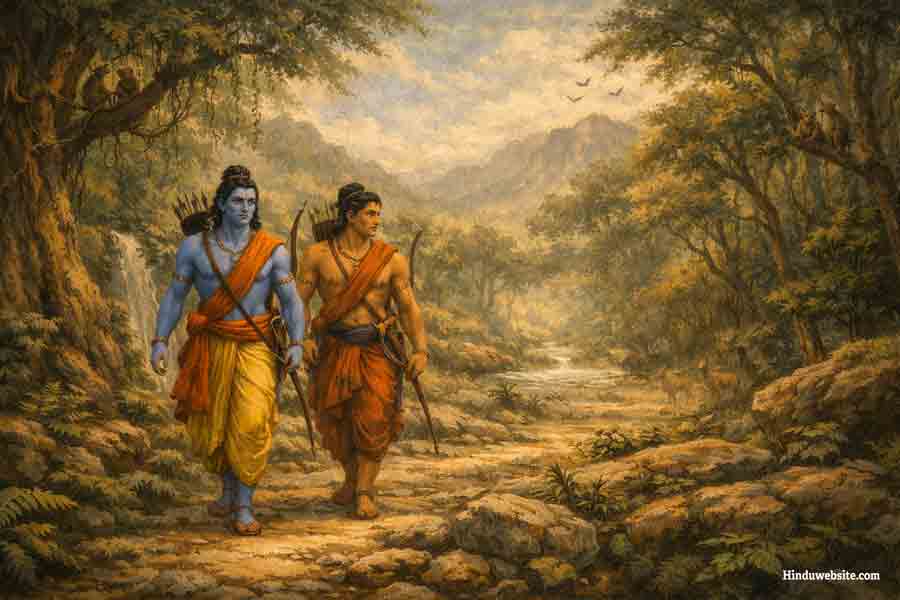
Summary: Book IV of the Ramayana, translated by Romesh Chunder Dutt, presents the Meeting of the Princes at Chitrakuta. This section narrates Bharata's journey through forests after learning of his father's death and Rama's exile, culminating in his entreaty to Rama to reclaim the throne of Ayodhya. The narrative explores themes of duty, honor, and righteousness as Rama steadfastly maintains his commitment to his father's word despite his brother's appeals.
Book IV - RAMA-BHARATA-SAMBADA - (The Meeting of the Princes)
THE scene of this Book is laid at Chitra-kuta. Bharat returning from the kingdom of the Kaikeyas heard of his father's death and his brother's exile, and refused the throne which had been reserved for him. He wandered through the woods and jungle to Chitra-kuta, and implored Rama to return to Ayodhya and seat himself on the throne of his father. But Rama had given his word, and would not withdraw from it.
Few passages in the Epic are more impressive than Rama's wise and kindly advice to Bharat on the duties of a ruler, and his firm refusal to Bharat's passionate appeal to seat himself on the throne. Equally touching is the lament of Queen Kausalya when she meets Sita in the dress of an anchorite in the forest.
But one of the most curious passages in the whole Epic is the speech of Jabali the Sceptic, who denied heaven and a world here-after. In ancient India as in ancient Greece there were different schools of philosophers, some of them orthodox and some of them extremely heterodox, and the greatest latitude of free thought was permitted. In Jabali, the poet depicts a free-thinker of the broadest type. He ridicules the ideas of Duty and of Future Life with a force of reasoning which a Greek sophist and philosopher could not have surpassed. But Rama answers with the fervour of a righteous, truth-loving, God-fearing man.
All persuasion was in vain, and Bharat returned to Ayodhya with Rama's sandals, and placed them on the throne, as an emblem of Rama's sovereignty during his voluntary exile. Rama himself then left Chitra-kuta and sought the deeper forests of Dandak, so that his friends and relations might not find him again during his exile. He visited the hermitage of the Saint Atri; and the ancient and venerable wife of Atri welcomed the young Sita, and robed her in rich raiments and jewels, on the eve of her departure for the unexplored wildernesses of the south.
The portions translated in this Book are the whole or the main portions of Sections xcix., c., ci., civ., cviii.. cix., exii., and cxix. of Book ii. of the original text.
I - THE MEETING OF THE BROTHERS
Sorrowing for his sire departed Bharat to Ayodhya came,
But the exile of his brother stung
his noble heart to flame,
Scorning sin-polluted empire, travelling with each widowed queen,
Sought through wood and
trackless jungle Chitra-kuta's peaceful scene.
Royal guards and Saint Vasishtha loitered with the dames behind,
Onward pressed the eager
Bharat, Rama's hermit-home to find,
Nestled in a jungle thicket, Rama's cottage rose in sight,
Thatched with leaves and twining
branches, reared by Lakshman's faithful might.
Faggots hewn of gnarl d branches, blossoms culled from bush and tree.
Coats of bark and
russet garments, kusa spread upon the lea,
Store of horns and branching antlers, fire-wood for the dewy night,--
Spake the dwelling
of a hermit suited for a hermit's rite.
"May the scene," so Bharat uttered, "by the righteous rishi told,
Markalvati's rippling waters, Chitra-kuta's summit bold,
Mark the dark and trackless forest where the untamed tuskers roam,
And the deep and hollow
caverns where the wild beasts make their home,
Mark the spacious wooded uplands, wreaths of smoke obscure the sky,
Hermits feed their flaming
altars for their worship pure and high.
Done our weary work and wand'ring, righteous Rama here we meet,
Saint and king and honoured
elder! Bharat bows unto his feet,
Born a king of many nations, he hath forest refuge sought,
Yielded throne and mighty kingdom
for a hermit's humble cot,
Honour unto righteous Rama, unto Sita true and bold,
Theirs be fair Kosala's empire, crown
and sceptre, wealth and gold!
Stately Sal and feathered palm-tree on the cottage lent their shade.
Strewn upon
the sacred altar was the grass of kusa spread,
Gaily on the walls suspended hung two bows of ample height,
And their back with gold was
pencilled, bright as INDRA's bow of might,
Cased in broad unfailing quivers arrows shone like light of day,
And like flame-tongued
fiery serpents cast a dread and lurid ray,
Resting in their golden scabbards lay the sword of warriors bold,
And the targets broad
and ample bossed with rings of yellow gold,
Glove and gauntlet decked the cottage safe from fear of hostile men,
As from creatures of
the forest is the lion's lordly den!
Calm in silent contemplation by the altar's sacred fire,
Holy in his pious purpose though
begirt by weapons dire,
Clad in deer-skin pure and peaceful, poring on the sacred flame,
In his bark and hermit's
tresses like an anchorite of fame,
Lion-shouldered, mighty-arm d, but with gentle lotus eye.
Lord of wide earth ocean-girdled,
but intent on penance high,
Godlike as the holy BRAHMA, on a skin of dappled deer
Rama sat with meek-eyed Sita, faithful
Lakshman loitered near!
"Is this he whom joyous nations called to fair Ayodhya's throne,
Now the friend of
forest-rangers wandering in the woods alone,
Is this he who robed in purple made Ayodhya's mansions bright..
Now in jungle bark and deer-skin
clad as holy anchorite,
Is this be whose wreath d ringlets fresh and holy fragrance shed,
Now a hermit's matted
tresses cluster round his royal head,
Is this he whose royal yajnas filled the earth with righteous fame,
Now inured to
hermit's labour by the altar's sacred flame,
Is this he whose brow and forehead royal gem and jewel graced,
Heir to proud Kosala's empire,
eldest, noblest, and the best!"
Thus lamented pious Bharat, for his heart was anguish-rent,
As before the feet of Rama he
in loving homage bent,
"Arya!" in his choking accents this was all that Bharat said,
"Arya!"
spake the young Satrughna and he bent his holy head!
Rama to his loving bosom raised his brothers from his feet,
Ah, too deep is love for utterance
when divided brothers meet,
Faithful Guha, brave Sumantra, bowed to Rama's righteous feet,
And a joy and mingled sadness
filled the hermit's calm retreat!
II - BHARAT'S ENTREATY AND RAMA'S REPLY
"Speak, my true, my faithful Bharat," so the righteous Rama cried,
"Wherefore
to this jungle dwelling hast thou from Ayodhya hied,
Speak, my fond and loving brother, if our father bade thee come,
Leaving throne and spacious
empire in this wilderness to roam?
Heir and Regent of Kosala! Dost thou tend our father well,
And obey the lofty mandate from
his royal lips that fell,
And the ancient Dasa-ratha, glorious still in regal might,
Doth he pass his bright life's
evening in each pure and holy rite?
Doth my mother, Queen Kausalya, still for Rama wet her eye,
And the gentle Queen Sumitra
for her banished Lakshman sigh,
Doth the peerless Queen Kaikeyi pass her days in duties fair,
Guard her Bharat's mighty
empire, tend him with a mother's care?
Is each holy rite and homage to the Gods and Fathers done,
Is the honour due to elders rendered
by each duteous son,
Do thy warriors guard thy kingdom as of yore with matchless skill,
And with counsel deep
and duteous do thy min'sters serve thy will?
Rich thy fields in corn and produce fed by rivers broad and deep,
Rich thy green unending
pastures with the kine and fattened sheep,
Tend the herdsman and his cattle, tend the tiller of the soil,
Watch and help with all thy
bounty workmen in their peaceful toil,
For the monarch's highest duty is to serve his people's weal
And the ruler's richest glory
is to labour and to heal!
Guard thy forts with sleepless caution with the engines of the war,
With the men who shoot
the arrow and who drive the flying car,
Guard Kosala's royal treasure, make thy gifts of wealth and food,
Not to lords and proud
retainers, but to worthy and the good!
Reader justice pure and spotless as befits thy royal line,
And to save the good and guiltless,
Bharat, be it ever thine,
For the tears of suffering virtue wither like the thunder levin,
And they slay our men and
cattle like the wrath of righteous heaven,
Fruitful be thy lore of Veda, fruitful be each pious rite,
Be thy queen a fruitful mother,
be thy empire full of might!"
Weeping, weeping, Bharat answered Dasa-ratha's eldest son,
"Dasa-ratha walks the bright
sky, for his earthly task is done!
For impelled by Queen Kaikeyi to the woods he bade thee go,
And his spotless fame was clouded
and his bosom sank in woe,
And my mother, late repenting, weeps her deed of deepest shame,
Weeps her wedded lord departed,
and a woman's tarnished fame!
Thou alone canst wipe this insult by a deed of kindness done,
Rule o'er Dasa-ratha's empire,
Dasa-ratha's eldest son,
Weeping queens and loyal subjects supplicate thy noble grace,
Rule o'er Raghu's ancient
empire, son of Raghu's royal race!
For our ancient Law ordaineth and thy Duty makes it plain,
Eldest-born succeeds his father
as the king of earth and main,
By the fair Earth loved and welcomed, Rama, be her wedded lord,
As by planet-jewelled Midnight
is the radiant Moon adored!
And thy father's ancient min'sters and thy courtiers faithful still,
Wait to do thy righteous
mandate and to serve thy royal will,
As a pupil, as a brother, as a slave, I seek thy grace,
Come and rule thy father's empire,
king of Raghu's royal race!"
Weeping, on the feet of Rama, Bharat placed his lowly head,
Weeping for his sire departed,
tears of sorrow Rama shed,
Then he raised his loving brother with an elder's deathless love,
Sorrow wakes our deepest
kindness and our holiest feelings prove!
"But I may not," answered Rama, "seek Ayodhya's ancient throne,
For a righteous
father's mandate duteous son may not disown,
And I may not, gentle brother, break the word of promise given,
To a king and to a father
who is now a saint in heaven!
Not on thee, nor on thy mother, rests the censure or the blame,
Faithful to his father's
wishes Rama to the forest came,
For the son and duteous consort serve the father and the lord,
Higher than an empire's glory
is a father's spoken word!
All inviolate is his mandate,--on Ayodhya's jewelled throne,
Or in pathless woods and jungle
Rama shall his duty own,
All inviolate is the blessing by a loving mother given,
For she blessed my life in exile
like a pitying saint of heaven!
Thou shalt rule the kingdom, Bharat, guard our loving people well,
Clad in wild bark and
in deer-skin I shall in the forests dwell,
So spake saintly Dasa-ratha in Ayodhya's palace hall,
And a righteous father's mandate duteous
son may not recall!"
III - KAUSALYA'S LAMENT AND RAMA'S REPLY
Slow and sad with Saint Vasishtha, with each widowed royal dame,
Unto Rama's hermit-cottage
ancient Queen Kausalya came,
And she saw him clad in wild bark like a hermit stern and high,
And an anguish smote her
bosom and a tear bedewed her eye.
Rama bowed unto his mother and each elder's blessings sought,
Held their feet in salutation
with a holy reverence fraught,
And the queens with loving fingers, with a mother's tender care,
Swept the dust of wood
and jungle from his head and bosom fair,
Lakshman too in loving homage bent before each royal dame,
And they blessed the faithful
hero spotless in his righteous fame.
Lastly came the soft-eyed Sita with obeisance soft and sweet,
And with hands in meekness
folded bent her tresses to their feet,
Pain and anguish smote their bosoms, round their Sita as they prest,
As a mother clasps
a daughter, clasped her in their loving breast!
Torn from royal hall and mansions, ranger of the darksome wood,
Reft of home and kith and
kindred by her forest but she stood!
"Hast thou, daughter of Videha," weeping thus Kausalya said,
"Dwelt in woods
and leafy cottage and in pathless jungle strayed,
Hast thou, Rama's royal consort, lived a homeless anchorite
Pale with rigid fast and penance,
worn with toil of righteous rite?
But thy sweet face, gentle Sita, is like faded lotus dry,
And like lily parched by sunlight,
lustreless thy beauteous eye,
Like the gold untimely tarnished is thy sorrow-shaded brow,
Like the moon by shadows darkened
is thy form of beauty now!
And an anguish scathes my bosom like the withering forest fire,
Thus to see thee, duteous
daughter, in misfortunes deep and dire,
Dark is wide Kosala's empire, dark is Raghu's royal house,
When in woods my Rama wanders
and my Rama's royal spouse!
Sweetly, gentle Sita answered, answered Rama fair and tall,
That a righteous father's mandate
duteous son may not recall!
IV - JABALI'S REASONING AND RAMA'S REPLY
Jabali a learned Brahman and a Sophist skilled in word,
Questioned Faith and Law and Duty,
spake to young Ayodhya's lord:
Wherefore, Rama, idle maxims cloud thy heart and warp thy mind,
Maxims which mislead the
simple and the thoughtless human kind?
Love nor friendship doth a mortal to his kith or kindred own,
Entering on his Nvide earth
friendless, and departing all alone,
Foolishly upon the father and the mother dotes the son,
Kinship is an idle fancy,-save thyself
thy kith is none!
In the wayside inn he halteth who in distant lands doth roam,
Leaves it with the dawning
daylight for another transient home,
Thus on earth are kin and kindred, home and country, wealth and store,
We but meet them
on our journey, leave them as we pass before!
Wherefore for a father's mandate leave thy empire and thy throne,
Pass thy days in trackless
jungle sacrificing all thy own,
Wherefore to Ayodhya's city, as to longing wife's embrace,
Speed'st thou not to rule thy
empire, lord of Raghu's royal race?
Dasa-ratha claims no duty, and this will is empty word,
View him as a foreign monarch, of
thy realm thou art the lord,
Dasa-ratha is departed, gone where all the mortals go,
For a dead man's idle mandate wherefore
lead this life of woe?
Ah! I weep for erring mortals who on erring duty bent
Sacrifice their dear enjoyment till
their barren life is spent,
Who to Gods and to the Fathers vainly still their offerings make,
Waste of food! for God
nor Father doth our pious homage take!
And the food by one partaken, can it nourish other men,
Food bestowed upon a Brahman, can
it serve our Fathers then?
Crafty priests have forged these maxims and with selfish objects say,
Make thy gifts and
do thy penance, leave thy worldly wealth and pray!
There is no Hereafter, Rama, vain the hope and creed of men,
Seek the pleasures of the present,
spurn illusions poor and vain,
Take the course of sense and wisdom, cast all idle faith aside,
Take the kingdom Bharat
offers, rule Ayodhya in thy pride!"
"Fair thy purpose," answered Rama," false thy reason leads astray,
Tortuous
wisdom brings no profit, virtue shuns the crooked way,
For the deed proclaims the hero from the man of spacious lies,
Marks the true and upright
Arya from the scheming worldly-wise!
If assuming virtue's mantle I should seek the sinful path,
Gods who judge our secret motives
curse me with their deepest wrath,
And thy counsel helps not, rishi, mansions of the sky to win,
And a king his subjects
follow adding deeper sin to sin!
Sweep aside thy crafty reasoning, Truth is still our ancient way,
Truth sustains the earth
and nations and a monarch's righteous sway,
Mighty Gods and holy sages find in Truth their haven shore,
Scorning death and dark destruction,
Truth survives for evermore!
Deadlier than the serpent's venom is the venom of a lie,
From the false, than from the cobra,
men with deeper terror fly,
Dearer than the food to mortals, Truth as nourishment is given,
Truth sustains the wide
creation, Truth upholds the highest heaven,
Vain were gifts and sacrifices, rigid penances were vain,
Profitless the holy Vedas but
for Truth which they sustain,
Gifts and rites and rigid penance have no aim or purpose high,
Save in Truth which rules
the wide earth and the regions of the sky!
I have plighted truth and promise and my word may not unsay,
Fourteen years in pathless
forests father's mandate I obey,
And I seek no spacious reasons my relinquished throne to win,
Gods nor Fathers nor the Vedas
counsel tortuous paths of sin!
Pardon, rishi, still unchanging shall remain my promise given
To my mother Queen
Kaikeyi, to my father now in heaven,
Pardon, rishi, still in jungle we shall seek the forest fare,
Worship Gods who watch
our actions, and pervade the earth and air!
Unto AGNI, unto VAYU, shall my constant prayers run,
I shall live like happy INDRA, hundred
sacrifices done,
And the deep and darksome jangle shall be Rama's royal hall,
For a righteous father's mandate
duteous son may not recall!"
V - THE SANDALS
Tears nor sighs nor sad entreaty Rama's changeless purpose shook,
Till. once more with hands
conjoin d Bharat to his elder spoke:
"Rama, true to royal mercy, true to duties of thy race,
Grant this favour to thy mother,
to thy brother grant this grace,
Vain were my unaided efforts to protect our father's throne,
Town and hamlet, lord and tiller,
turn to thee and thee alone!
Unto Rama, friends and kinsmen, chiefs and warriors, turn in pain,
And each city chief and
elder, and each humble village swain,
Base thy empire strong, unshaken, on a loyal nation's will,
With thy worth and with thy
valour serve thy faithful people still!"
Rama raised the prostrate Bharat to his ever-loving breast,
And in voice of tuneful hansa
thus his gentle speech addrest:
"Trust me, Bharat, lofty virtue, strength and will to thee belong,
Thou could'st rule
a worldwide empire in thy faith and purpose strong,
And our father's ancient min'sters, ever faithful, wise and deep,
They shall help thee with
their counsel and thy ancient frontiers keep.
List! the Moon may lose his lustre, Himalaya lose his snow,
Heaving Ocean pass his confines
surging from the caves below,
But the truth-abiding Rama will not move from promise given,
He hath spoke and will not
palter, help him righteous Gods in heaven!"
Blazing like the Sun in splendour, beauteous like the Lord of Night,
Rama vowed his Vow
of Duty, changeless in his holy might!
"Humble token," answered Bharat, "still I seek from Rama's hand,
Token of
his love and kindness, token of his high command,
From thy feet cast forth those sandals, they shall decorate the throne.
They shall nerve
my heart to duty and shall safely guard thy own,
They shall to a loyal nation absent monarch's will proclaim,
Watch the frontiers of the
empire and the people's homage claim!"
Rama gave the loosened sandals as his younger humbly prayed,
Bharat bowed to them in homage
and his parting purpose said:
"Not alone will banished Rama barks and matted tresses wear,
Fourteen years the crown
d Bharat will in hermit's dress appear,
Henceforth Bharat dwells in palace guised as hermit of the wood,
In the sumptuous hall of
feasting wild fruit is his only food,
Fourteen years shall pass in waiting, weary toil and penance dire
Then, if Rama comes not
living, Bharat dies upon the pyre!"
VI - THE HERMITAGE OF ATRI
With the sandals of his elder Bharat to Ayodhya went,
Rama sought for deeper forests on
his arduous duty bent,
Wandering with his wife and Lakshman slowly sought the hermitage,
Where resided saintly
Atri, Vedic Bard and ancient sage.
Auasuya, wife of Atri, votaress of Gods above,
Welcomed Sita in her cottage, tended her
with mother's love,
Gave her robe and holy garland, jewelled ring and chain of gold,
Heard the tale of love
and sadness which the soft-eyed Sita told:
How the monarch of Videha held the plough and tilled the earth,
From the furrow made by
ploughshare infant Sita sprang to birth,
How the monarch of Videha welcomed kings of worth and pride,
Rama 'midst the gathered monarchs
broke the bow and won the bride,
How by Queen Kaikeyi's mandate Rama lost his father's throne,
Sita followed him in exile
in the forest dark and lone!
Softly from the lips of Sita words of joy and sorrow fell,
And the pure-souled pious priestess
wept to hear the tender tale,
And she kissed her on the forehead, held her on her ancient breast,
And in mother's tender
accents thus her gentle thoughts exprest:
"Sweet the tale you tell me, Sita, of thy wedding and thy love,
Of the true and tender
Rama, righteous as the Gods above,
And thy wifely deep devotion fills my heart with purpose high,
Stay with us my gentle daughter
for the night shades gather nigh.
Hastening from each distant region feathered songsters seek their nest,
Twitter in the leafy
thickets ere they seek their nightly rest,
Hastening from their pure ablutions with their pitcher smooth and fair,
In their dripping
barks the hermits to their evening rites repair,
And in sacred agni-hotra holy anchorites engage,
And a wreath of smoke ascending
marks the altar of each sage.
Now a deeper shadow mantles bush and brake and trees around,
And a thick and inky darkness
falls upon the distant ground,
Midnight prowlers of the jungle steal beneath the sable shade,
But the tame deer by the
altar seeks his wonted nightly bed.
Mark! how by the stars encircled sails the radiant Lord of Night,
With his train of silver
glory streaming o'er the azure height,
And thy consort waits thee, Sita, but before thou leavest, fair,
Let me deck thy brow and
bosom with these jewels rich and rare,
Old these eyes and grey these tresses, but a thrill of joy is mine,
Thus to see thy youth
and beauty in this gorgeous garment shine!"
Pleased at heart the ancient priestess clad her in apparel meet,
And the young wife glad
and grateful bowed to Anasuya's feet,
Robed and jewelled, bright and beauteous, sweet-eyed Sita softly came,
Where with anxious
heart awaited Rama prince of righteous fame.
With a wifely love and longina Sita met her hero bold,
Anasuya's love and kindness in her
grateful accents told,
Rama and his brother listened of the grace by Sita gained,
Favours of the ancient priestess,
pious blessings she had rained.
In the rishi's peaceful asram Rama passed the sacred night,
In the hushed
and silent forest silvered by the moon's pale light,
Daylight dawned, to deeper forests Rama went serene and proud,
As the sun in midday splendour
sinks within a bank of cloud!
Source: The Ramayana And The Mahabharata Condensed Into English Verse By Romesh C. Dutt (1899) Dedicated To The Right Hon. Professor F. Max Muller. The text has been reformatted and summary has been added to each page by Jayaram V for Hinduwebsite.com. The title image used for this page has been generated by AI and is not a part of the original text.
Disclaimer: While we have made every effort to reproduce the text correctly, we do not guarantee or accept any responsibility for any errors or omissions or inaccuracies in the reproduction of this text. This text has been reproduced for general reading purposes only and readers are advised to refer the original text for any research or academic studies and references.