
Chapter 8 - The Chinese Yoga
Buy the Book - Great systems of yoga
| Ch.1 | | Ch.2 | | Ch.3 | | Ch.4 | | Ch.5 | | Ch.6 | | Ch.7 | | Ch.8 | | Ch.9 | | Preface | | Index |
WHEN the Buddha wished to allude to the final achievement or attainment of human life he spoke of nirvāna, a "blowing-out." This means that in that experience, there will be an absence of our familiar limitations known as body and mind. Even the mind is for us an object of knowledge. The field of our knowledge can be divided into objective and subjective. Both are within the field—both the knower and the known, the subject and the object.
Buddha's doctrine was that only in the presence of knowing are "subject and object" to be seen. Mind with its reasoning activity—its logic—generally considered as the subject, is in reality only an instrument. It does not know. 1 Behind or beyond this mind is what among Chinese Buddhists came to be called Essence of Mind. It is Bodhi, Wisdom. If a man could put aside the error or delusion of the-self-as-mind there would be the elimination of object and subject relation from his experience, and then—nirvāna.
It was always held that only man can perform this feat, because he—not the lower animals—has mind as reason. Of course, there was lower mind, or instinct, in the animals, but this was accumulated knowledge—recognition and memory. And every idea or mental picture in this store of knowledge was accompanied by feeling and therefore by desire. In modern terms we would call this collection the subconscious mind, instinct. The sub-conscious mind could not be regarded as merely a matter of bodily habit. The body is always changing its particles. The incoming particles cannot be regarded as possessing the habits which have been learned by the outgoing particles. So even the continuity of its form is carried on by the "sub-conscious mind"—not by any powers of the body. This continuity governs not only the bodily reactions to environmental impacts, but also the emotions and flow of mental pictures, or association of ideas. So there is instinct. Buddha called this complex of continuity the skandhas.
Man has something more than instinct. He has reason, although it must be admitted that very often he acts by instinct, and reason is often if not generally far from its maturity and power.
The height of reasoning or thinking is meditation, called dhyāna among the old psychologists of India. In a boat, instinct would tell us to row, but reason would tell us to put up a sail, until even the putting up of a sail passed into the sub-conscious and reason led us further to install a motor. Whatever our problem, reason will improve our reaction, but reason demands time—we must think the matter over, consider the nature of water, of boats, of many things involved, study their relations in mental pictures, and then, after this process, which takes time, the problem is solved. Meditation is the complete mental review of the materials of the problem and the study of their combination. It is applied to ordinary material problems and to the most abstruse psychological and philosophical ones.
But this does not tell the whole story of meditation. If properly carried out it ends up with intuition—something you did not know before, and have not found in the world. This is sometimes called prajnā. This intuition is not reason, but is direct perception, and the state of the mind in which this prajnā or intuition is in power is called samādhi, which literally taken means completely in agreement or order.
This experience by direct perception is called in China and Japan a satori. But I am running ahead. Let us first look at the way in which the mind gets knowledge for us.
Mind is called "sixth sense." By mind we get to know things not available to the senses of hearing, touching, seeing, tasting and smelling. It can operate in three stages, and usually does—through testimony, reasoning and seeing for ourselves. Someone comes into the house and says there is a fire on the mountain; this is supported by reason, because there is smoke; then we can go and find the fire—and perhaps put it out. So there is testimony and then reasoning and then direct perception. This applies in religious matters. Buddha says he has found joy and knowledge; it is reasonable; we are to go and find it.
When the dhyāna or meditation process was carried into China by the famous Indian "missionary" Bodhidharma, it came to be known as Chan, and a little later when it had found its way to Japan the word was further modified and became Zen. Zen is Japanese meditation-yoga.
It is not to be thought that in either India or China the results of dhyāna were merely improved subjective experience. In India the fruit of samādhi was viveka or discrimination, which means a new valuation. This is stated emphatically by Patanjali in his aphorism no. ii 28, which describes the final effect of the performance of the eight Limbs of Yoga, culminating in samādhi. 2 This is not a perfection of the subjective, but a transcendence of the subjective conception of the subject-object relation. Subject and object now live together in the Knowing or Consciousness in a new way. Subject-self is overcome. It was a piece of Ignorance, a five-branched tree of ignorance.
In the case of Buddha we have exactly the same teaching, when avidyā, ignorance, is given as the final "fetter" to be cast off, as shown in our previous chapter. This was essentially ignorance or error about self or the subjective entity.
It is natural that the method of practice of the Chan and the Zen should be somewhat different from that in India, as befits the racial types of China and Japan. The method is well described in The Sūtra of Wei Lang, translated by Wong Mou-Lam, 3 and in Christmas Humphreys' Zen Buddhism, 4 and in several books by Professor D. T. Suzuki.
Before we turn to the practices of Zen it is necessary to say that the fundamental conceptions associated with it are also found in the old Tao-ism of China, coming down even from Lao Tsu, who lived about the same time as Buddha. Buddhism became blended with this. The difference was that Buddha desired not to give a name to nirvāna, as that would almost inevitably lead to some mental idea of it, which would then stand in the way of the transcendental experience. Even the idea of transcendence does so.
In the old teaching there was Tao, the motionless, master of all, both the subjective and objective sides of Nature, including man. It could equally be called the absolute motion, which, passing through every point of space in every direction in every moment of time, becomes the ever-present soul of all motions, but is motionless from the standpoint of the subject-object world. 5
From Tao come yang and yin, the active and passive sides of Nature, light and shadow. In man the two elements appear as intellect and instinct. The instinct-flow is natural, outward-going, but the intellect-flow, which is "backward-going, reversed, turned round," can become so pure that it gains release, when things are recognized but not desired. The Secret of the Golden Flower, translated by Richard Wilhelm, gives the lay-out of principles, and is a splendid source-book for this study.
Introspectively, all can see that knowledge and desire go opposite ways. Desire draws man into complicated experiences, bringing problems which can be solved only by the intellect seeing things as they are, untainted by desires concerning them. The path of yoga, in this field, thus means knowing or seeing without desire. There is, of course, knowing, or consciousness, in both cases. The animal is highly conscious, but instinctual; in man the consciousness is becoming intellectual; in the bodhisattwa (which means one whose intellect is pure, or whose very nature is intellect) we have man on the verge of nirvāna, or Tao. In all three cases feeling and knowledge go hand in hand. Where there is pure knowledge, the feeling is love—love without desire, full consciousness and approach completely without antagonism. This is the Zen outlook, whatever terminology of China or India, of Tao or Buddhism may be used. The practice of meditation in this field is "seeing without desire." And the height of it is reached when there is direct perception, intuition in which reasoning stops. There is no desire for logic to stop; it does so naturally when its function is fulfilled; then intuition appears.
If we compare the art of China with that of Greece we find that one is more the product of imaginative observation, the other of introspectional observation. The word imaginative here means image-making. It is less creative and more contemplative. If the poise of the Chinese has the relative proportions shown in diagram A, that of the Indo-European is relatively somewhat as in diagram B.
It is to be understood, of course, that while this rotary motion is the same for all sane minds, the standard or evolutionary status is individual. In the individual there is growth through use or exercise, whereby each of the three elements is advanced in ability. Taking this into consideration, it will be seen that the movement is spiral as well as rotary.
The difference of different minds, and races of men, is a difference in the proportions and status of these three. I have cited art here because art is yoga in action, action free from the taint of desire and utility or use. It gives us a peep-hole into the mind. So the meditation-systems of China did not develop on very introspectional lines, as meditation in Europe has done.
In The Secret of the Golden Flower a form of meditation is given in which a superphysical self is built. Intellect or the light of seeing is to be freed from the instinctual, is to build a body of its own. This is done by stopping the flight of thoughts—concentrate, but quickly pass into contemplation; when contemplation
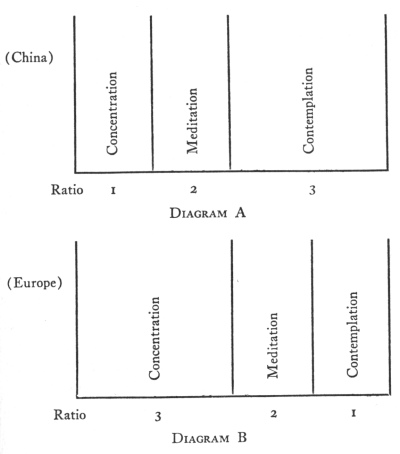
It is to be understood, of course, that while this rotary motion is the same for all sane minds, the standard or evolutionary status is individual. In the individual there is growth through use of exercise, whereby each of the three elements is advanced in ability. Taking this into consideration, it will be seen that the movement is spiral as well as rotary. It falls into flights again, renew the concentration. This "circulates" the process—brings it into circle, not drives it round, but puts an end to wandering off. As in India, attention is to be given at first to the body—body comfortable, breathing rhythmic, senses quiet. Then one listens within, to the no-sound, listens to the silence. Thus within the heart another "body" is gradually built up, which is a spiritual body.
Though many details are given in The Secret of the Golden Flower there is no room for them here; besides, the serious student will supply his own details. It is the body or focus of knowing (Confucius), of the heart-view (Buddha), of inward vision (Lao Tsu). The intuition will come; one must hardly ask for it, and certainly not presuppose its nature. The magical material side of it will be that the new "body" will be the intuition-vehicle for living free from the space-limitation of the body, and so, being concerned with seeing and doing remote from the body, giving what may be called a practical or objective side also to the intuition, which is not one-sided but concerns object as well as subject.
Buddha said: "Nor sink the string of thought into the Fathomless." But men cannot leave it at that; they strive to realize the truth. Buddha does not object to that, but says it will not be done by thought. Intuition which is not thought will do it. But intuition comes to us; we do not make it. Is it different from the objective, or different from the subjective? We must answer, "No," because difference is a thought, a comparison, an attribute. So not by the suppression of the world or the mind is intuition to be sought. Without their absence comes this something which they as such cannot present. They would not be themselves without it. Ordinarily the mind is taken up with objective or subjective interests and activities, leaving no opening for the third. When people seek that third, intellectual desire is usually present, even if instinctual desire has been overcome. The first point of Zen meditation is therefore, "Drop it!" Any means which will start the process and thwart the intellectual desire will be permissible, provided it does not prevent the "Go on" or, if there is a teacher, the "Come on!" which is like that of a mother calling a young child to walk, without a word about the mechanism of walking.
Three techniques have been specially prominent in the schools of Zen—the wall-gazing, the sudden question (mondo) and the enigmatic statement (koan). The first is not gazing at a wall, as one might think, but gazing like a wall. You are the wall, upright to the world, set by the plumb-line of your own nose, unaffected, intent on the Essence of Mind. Bodhidharma is said to have practiced this for nine years, avoiding commitments and desires, like an upright wall. He taught for fifty years in China. The sixth Patriarch in his succession was Hui-neng, or Wei-Lang, through whom Chinese Buddhism, harmonized with the Tao, emerged as a definite way of life, allowing no dogmas, requiring an enquiring mind, searching within, demanding humble faith in the coming of sudden enlightenment, and—materially—a simple life of self-restraint, industry and sympathy.
Teachings of Buddha much used by the founders of the Zen sect were: the Lankavatara Sūtra, the Avatansaka Sūtra, the Surangama Sūtra, the Mahayana Shraddhotpāda Shastra and the Diamond Sūtra. To these were added the Sūtra of Wei-Lang. The whole collection is very conveniently gathered together and presented in Goddard's Buddhist Bible. 6
The teaching of meditation in the Diamond Sūtra prescribes sitting alone, erect, motionless, quieting the mind, with attention on no definite thing, excluding recollection and imagination, abandoning all notions of an external world, turning to inner intuitive consciousness, gradually entering samādhi, ideal tranquility, and thus passing from vagrant thinking and even intellectual activity into the realization of insight.
It was especially among the Chinese and Japanese that the sudden enlightenment was brought about by sudden means. Intuition is by its very nature always sudden—not built up—but sudden means or methods were also now brought in, in the shape of koans and mondos.
The koan is a mind-baffling statement to be meditated upon. The teacher requires an answer; there is no hurry about it, but you are expected to tackle it, and to stick at it until you have a solution. The statement is of such a nature that the intellect cannot understand it, and all its efforts to do so are in vain. It is thus thwarted and nullified, and the yogī must therefore sweat and strain, so to speak, with great will power until an intuitive answer comes. It is very strenuous, and dangerous unless the koan is given by a competent teacher to an appropriate student. The intuition is such that it cannot be expressed in words, but when it comes there will be a lighting-up of the mind which will cause an involuntary exclamation or action, such as the laugh or the slap of the thigh which one gives when there is a sudden seeing of the point of a joke or the solution of a conundrum, and one says, "I never thought of that."
As an example, the teacher may say: "You have knees, you have feet. Come, let us fly." Or, a classical one, "The two hands clap with a noise; listen to the clap of one hand." There should be no agreed upon, traditional or conventional meaning to these koans. They may be invented ad lib. A good example occurs accidentally, as it were, in the Glorious Presence where, after expounding the Vedāntic doctrine of "Not thus, not thus" from the commentary on the Mūndūkya Upanishad where Gaudapāda says: "There is no limitation, no creation, no bondage, no maker, no aspirant, nobody freed—this is the correct knowledge," the continuation is: "And no 'no,' and there we are." Another example occurred when the Sixth Patriarch wrote his first statement: in reply to:
Our body is the Bodhi-tree,
And our mind a mirror bright.
Carefully we wipe them hour by hour,
And let no dust alight.
His stanza said:
There is no Bodhi-tree,
Nor stand of a mirror bright.
Since all is void,
Where can the dust alight?
The last two lines form a perfect koan.
The resulting enlightenment is called a satori. This "goal" as well as the method is called Zen, just as in India yoga means both the practice and the attainment. Mr. Christmas Humphreys thus explains it: "Zen is not an escape from things but a new way of looking at things, whereby they are seen to be already in Nirvana." 7 We are denying ourselves, which is the great Error. Still, one must take care not to call Zen or Nirvāna a state; for that conception, or any conception, is within the māyā or error. Nor "looking."
The mondo is question and answer. Here there is no continued wrestling as it were in terrible unmental attentiveness, as in the case of the koan. An immediate answer is required, without thought. It will be noticed that this is another way of side-stepping the thought process while maintaining the attentiveness. For example, a Zen master once held out a stick and said, "Call it not a stick; if you do you assert. Nor deny that it is a stick; if you do, you negate. Without affirmation or denial, speak, speak!" It is not recorded what the pupils said, but I tried this on myself and out came "On, on!" And this carried knowledge, like a dream.
Life sets us koans and mondos all the time, for never do we know enough to act with full intelligence. As far as we ourselves are concerned:
All things are rushing to their doom;
Trying to slow the
rush
The mind preserves their death.
Suggestions for Further Reading
- Relax With Yogay
- Hinduwebsite - Yoga Science Resources
- The Power of Concentration
- The Prophet, by Kahlil Gibran
- Dharmashastras or the Books of Laws for Hindus
- The Gautama Sutras, Chapters 1 to 14
- The Sankhya Sutras of Kapila, Index page
- The Hungry Stones and Other Stories
- A Brief Biography Of Kabir, the Mystic Poet Saint of India
- The Songs of Kabir - About Kabirdas
- Gitanjali - By Tagore
- The Daily Zen Sutras
- Confucian Analects
- The Works of Mencius, Complete Text
- Tao Te Ching by Lao-tzu
- The Doctrine of the Mean by Confucius
- Words of Truth, A Prayer by Dalai Lama
- The Art of Money Getting or Golden Rules for Making Money
- Essays On Dharma
- Esoteric Mystic Hinduism
- Introduction to Hinduism
- Hindu Way of Life
- Essays On Karma
- Hindu Rites and Rituals
- The Origin of The Sanskrit Language
- Symbolism in Hinduism
- Essays on The Upanishads
- Concepts of Hinduism
- Essays on Atman
- Hindu Festivals
- Spiritual Practice
- Right Living
- Yoga of Sorrow
- Happiness
- Mental Health
- Concepts of Buddhism
- General Essays
Source: Reproduced from the Great Systems of Yoga, by Ernest Wood, 1954. This text is in the public domain in the United States because it was not renewed at the US Copyright Office in a timely fashion. These files may be used for any non-commercial purpose provided this Notice of Attribution is left intact in all copies.