
The Yajur Veda - Kanda 2
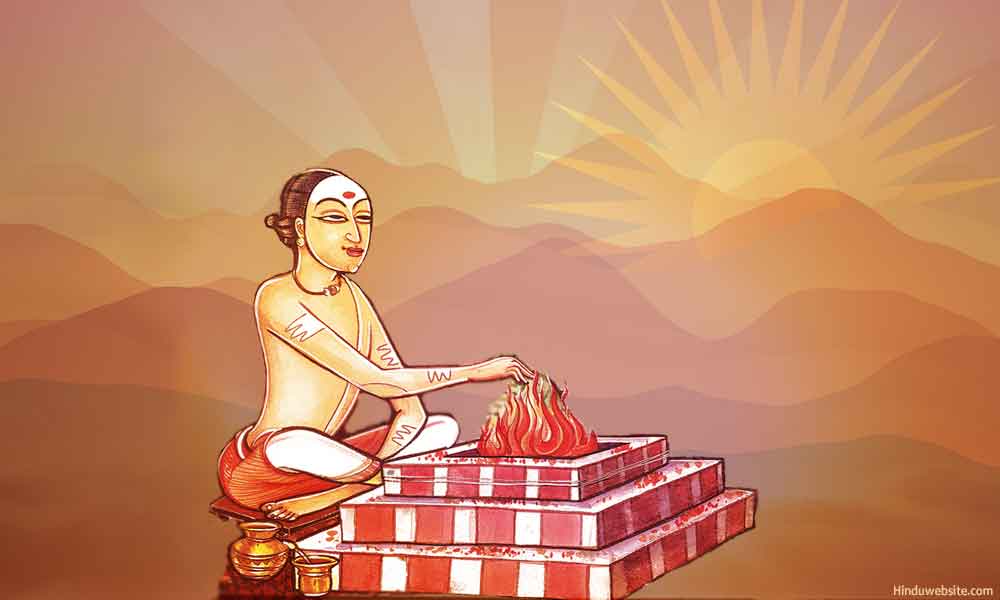
Contents
- Prapathaka 1. The special animal sacrifices
- Prapathaka 2. The special sacrifices
- Prapathaka 3. The special sacrifices (continued)
- Prapathaka 4. The special sacrifices(continued
- Prapathaka 5. The now and full moon sacrifices
- Prapathaka 6. The now and full moon sacrifices
PRAPATHAKA 1

The Special Animal Sacrifices
ii. 1. 1.
He who desires prosperity should offer a white (beast) to Vayu; Vayu is the swiftest deity; verily he has recourse to him with his own share; verily he makes him attain prosperity; he prospers. 'He is an overswift deity,' they say, 'he has power to burn him up.' This (beast) he should offer to Vayu of the team; the team is his support; verily, being supported he attains prosperity to avoid being burnt; he prospers [1]. He who desires a village should offer to Vayu of the team; Vayu leads these creatures tied by the nose; verily he has recourse to Vayu of the team with his own share; verily he assigns him creatures led by the nose; he becomes possessed of a village. It is offered to (Vayu) of the team; verily he makes creatures abide steadfast with him. He who desires offspring should offer to Vayu of the team; Vayu is expiration, the team is inspiration; expiration and inspiration depart from the offspring of him [2] who being fit for offspring yet obtains not offspring. Verily he has recourse to Vayu of the team with his own share; verily he for him begets offspring by means of expiration and inspiration; he obtains offspring. He who has long been ill should offer to Vayu of the team; Vayu is expiration, the team is inspiration, expiration and inspiration depart from him whose illness is long. Verily he has recourse to Vayu of the team with his own share [3], he bestows on him expiration and inspiration; even if his life be gone, he yet lives. Prajapati was here alone; he desired, 'May I create offspring and cattle'; he took out from his body the omentum, and placed it in the fire. The hornless goat then came to life; he offered it to its own deity; then did he create offspring and cattle. He who desires offspring [4] and cattle should offer to Prajapati a hornless goat. Verily he has recourse to Prajapati with his own share; verily he begets for him offspring and cattle. The beard is the characteristic of man, the lack of horns of the horse, having incisors on one side only that of cattle, having sheep-like hooves that of sheep, the goat-nature that of goats; so many are the domesticated animals; verily by their characteristics he wins them [5]. He who desires cattle should offer one of a triplet to Soma and Pusan; the she-goat has two teats, two are born separately, the third for strength and growth. Verily he has recourse to Soma and Pusan with their own share; verily they produce cattle for him; Soma is the depositor of seed, Pusan the producer of cattle; Soma deposits seeds for him, Pusan produces cattle. The sacrificial post is of Udumbara; the Udumbara is strength, cattle are strength; verily by strength he wins for him strength and cattle.
ii. 1. 2.
Prajapati created offspring; they being created went away from him; they went to Varuna; he pursued them and asked them back; he would not give them back to him; he said, 'Choose a boon, and then give them back to me.' He chose a boon from them, it was the black (beast) with one white foot. He who is seized by Varuna should offer this black (beast) with one white foot to Varuna. Verily he has recourse to Varuna [1] with his own share; verily he sets him free from Varuna's noose. It is a black (beast) with one white hoof, for it has Varuna for its deity (and serves) for prosperity. Svarbhanu, the Asura, pierced the sun with darkness; the gods desired an atonement for him; the first darkness of his they struck off became a black sheep; the second a bright-coloured one; the third a white one; what they cut from the upper part of the bone became a barren ewe [2]. The gods said, 'Here has come into being a divine beast; to whom shall we offer him?' Now then the earth was small, plants were not born, they offered the barren ewe to the Adityas as desire.' Then the earth became broad, the plants grew. He who desires, 'May I be extended with cattle, with offspring be propagated' should offer this barren ewe to the Adityas as desire [3]. Verily he has recourse to the Adityas as desire with their own share; verily they extend him with cattle and propagate him with offspring. Yonder sun did not shine; the gods desired an atonement for him; for him they offered these dewlapped (beasts), to Agni one with a black neck, to Indra one of different colours, to Brhaspati a white one; verily by means of them they restored his brilliance, For him who desires splendour he should offer dewlapped (beasts) [4], to Agni one with a black neck, to Indra one of different colours, to Brhaspati a white one. Verily he has recourse to these deities with their own share; verily they bestow splendour upon him; he becomes resplendent.
In the spring in the morning should he offer (the beast) with a black neck to Agni; in the summer at midday (the beast) of different colours to Indra; in the autumn in the after noon the white (beast) to Brhaspati. These are the brilliances of the sun, in the spring in the morning, in the summer at midday, in the autumn in the afternoon; verily he wins whatever brilliances there are [5]. They are offered in the course of the year; the year is the giver of splendour; verily the year gives him splendour; he becomes resplendent. They are (beasts) with young; the foetus is power; verily he bestows power upon him. He who being master of uttering speech cannot speak properly should offer a ewe to Sarasvati; Sarasvati is speech; verily he has recourse to Sarasvati with her own share, she bestows on him [6] speech, and he becomes an utterer of speech. Its teeth are complete; therefore men utter speech whole. He who is long ill should offer to Agni (a beast) with black neck, and a brown (beast) to Soma; the body of him whose illness is long goes to Agni, the sap to Soma; verily he ransoms from Agni his body, from Soma his sap, and even if his life is gone, yet he lives. He who desires offspring should offer to Soma a brown (beast), and to Agni one with a black neck; Soma [7] is the depositor of seed, Agni the producer of offspring; verily Soma deposits seed for him, Agni produces offspring; he obtains offspring. The Brahman who despite study does not win fame should offer to Agni (a beast) with a black neck, and to Soma a brown (one); in that (the beast) is offered to Agni, thereby he places brilliance in him; in that (the beast) is offered to Soma, thereby (be places) splendour. The one with a black neck is for Agni; verily he drives away the darkness from him: it is white [8]; verily he bestows brilliance on him. There is a brown one for Soma; verily he bestows splendour and radiance on him. He who has a dispute for a Purohitaship should offer (a beast) with a black neck to Agni, a brown one to Soma, and one with a black neck to Agni; the Brahman is connected with Agni, the prince with Soma; on either side of (the beast) for Soma there is one for Agni; verily with brilliance, with the Brahman, he seizes on either side the kingdom, and forthwith appropriates it; they choose him as Purohita.
ii. 1. 3.
The gods and the Asuras strove for these worlds; Visnu saw this dwarf, he offered it to its own deity; then he conquered these worlds. One who is engaged in a struggle should offer a dwarf (beast) to Visnu; then he becomes Visnu and conquers these worlds. He should offer on an uneven (place), for these worlds are uneven as it were; (verily it serves) for prosperity. He who is engaged in a contest should offer (a beast) with a spot on its forehead and horns bent forward to Indra, the angry, the wise [1]. By power (indriy ), by anger, by wisdom, one wins a contest. Verily he has recourse to Indra, the angry, the wise, with his own share; verily he bestows on him power, anger, wisdom; he wins that contest. He who desires a village should offer (a beast) with dappled thighs to Indra with the Maruts. Verily he has recourse to Indra with the Maruts with his own share; verily he subdues his relatives to him; he becomes possessed of a village. In that it is an ox [2], it is Indra's; in that it is dappled, it is of the Maruts, for pros perity. It has dappled thighs behind; verily he makes the folk dependent on him. He who desires food should offer a brown (beast) to Soma; food is connected with Soma; verily he has recourse to Soma with his own share; he bestows food on him; verily he becomes an eater of food. It is brown; that is the colour of food; (verily it serves) for prosperity. He who being meet for kingship obtains not a kingdom should offer a brown (beast) to Soma [3]; the kingdom is connected with Soma; verily he has recourse to Soma with his own share; Soma bestows on him a kingdom; the kingdom comes to him. It is brown, that is the colour of Soma; (verily it serves) for prosperity. He whose prosperity is gone and who desires support should offer (a beast) with a spot on the forehead and horns bent forward to Indra, the conqueror of Vrtra; verily he overcomes the evil foe and attains support. 'He who is seized by evil should offer (a beast) with a spot on the forehead and horns bent forward to Indra, the overcomer of enemies [4]; the enemy is the evil; verily he has recourse to Indra, the overcomer of enemies with his own share, and he drives away from him the enemy, the evil. He who being meet for kingship obtains not a kingdom should offer (a beast) with a spot on the forehead and horns bent forward to Indra of the thunderbolt. Verily he has recourse to Indra of the thunderbolt with his own share; he bestows his thunderbolt on him, the bolt kindles him for prosperity, the kingdom comes to him. It has a spot on its forehead and horns bent for ward, that is the shape of the bolt, (and so it serves) for prosperity.
ii. 1. 4.
Yonder sun did not shine; the gods desired an atonement for him; for him they offered this offering of ten bulls; verily thereby they restored his brilliance. For him who desires splendour he should offer this offering of ten bulls; verily he has recourse to yonder sun with his own share; verily he bestows on him splendour; he becomes resplendent. He should offer in the spring in the morning three with spots on the forehead; in the summer at midday [1] three with white backs; in the autumn in the afternoon three with white tails. Three are the brilliances of the sun, in the spring in the morning; in the summer at midday; in the autumn in the afternoon; verily he wins whatever brilliances there are. They are offered in sets of three; verily in order he bestows brilliance on him. They are offered in the course of the year; the year is the giver of splendour; verily the year gives him splendour; he becomes resplendent. At the end of the year he should offer a reddish brown one to Prajapati [2] all the gods are Prajapati; verily he rests on all the gods. If he fears, 'I shall become diseased in the skin,' he should offer a dark (beast) to Soma and Pusan; man has Soma as his deity, cattle have Pusan; verily by his own deity, by cattle, he makes a skin for him; be does not become diseased in the skin. The gods and Yama were at strife over this world; Yama appropriated (ayuvata) the power and strength of the gods; therefore Yama has his name [3]. The gods reflected, 'Yama here has become what we are.' They had recourse to Prajapati. Prajapati from his body fashioned out the bull and the cow; the gods offered a cow to Visnu and to Varuna, a bull to Indra; they caused him to be seized by Varuna and by Visnu, the sacrifice, they drove him away; his power they appropriated by means of that for Indra. He who has foes should in strife offer to Visnu and Varuna a cow [4], to Indra a bull; verily causing his foe to be seized by Varuna, by Visnu, the sacrifice, he drives him away, he appropriates his power by means of that for Indra, he prospers, his foe is defeated. Indra slew Vrtra; him Vrtra slain bound with sixteen coils; from the head of Vrtra came out cows, they were (cows) of Videha; behind them came the bull. It Indra [5] perceived; he reflected, 'He who shall offer him shall be freed from this evil'; he offered to Agni one with a black neck, to Indra a bull. Agni, being approached with his own share, burned into sixteen pieces the coils of Vrtra, and by (the offering) to Indra he bestowed power on himself. He who is seized by evil should offer (a beast) with a black neck to Agni, and a bull to Indra; verily Agni, being approached with his own share [6], burns away his evil, and by (the offering) to Indra he bestows power on himself, he is freed from the evil, he prospers. He who is long in exile should offer a cow to sky and earth; for he is not established in them; verily also he who is long in exile has recourse to sky and earth with their own share; verily they establish them; he is established. It is one which is long in labour, for Iong in labour as it were is the kingdom of him who is long in exile; (verily it serves) for prosperity. To Vayu [7] he should offer a calf; Vayu is their calf; these worlds are barren for him, the people are barren; verily also he who is long in exile has recourse to Vayu with his own share; verily Vayu causes these worlds and the people to give to him; these worlds drop milk for him; the people wait upon him in service.
ii. 1. 5.
Indra opened the hole of Vrtra; the topmost cattle he grasped by the back and pulled out; a thousand cattle followed it, it became hump backed. He who desires cattle should offer this humpbacked (one) to Indra; verily he has recourse to Indra with his own share; verily he bestows cattle upon him; he becomes possessed of cattle. It is humpbacked [1]; the hump backed is fortune a thousandfold; verily by fortune he wins cattle. When he obtains a thousand cattle, he should offer a dwarf (beast) to Visnu; upon it the thousand rested; therefore the dwarf, stretched out, affords support to cattle when born. 'Who can obtain a thousand cattle?' they say; verily he should make up a thousand days and nights and sacrifice. The days and nights [2] are cattle; verily he gives support to cattle when born. He who desires offspring should offer a barren cow to the plants, the plants hinder him from offspring who being fit for offspring does not obtain offspring; the plants indeed destroy the pregnancy of that one which becomes barren, verily he has recourse to the plants with their own share; verily they from his own self beget him offspring; he obtains offspring [3]. The plants are the waters, man is what is not; verily the waters give him being from non-existence; therefore they say, both he who knows thus and who (knows) not, 'The waters verily give being from non-existence.' He who desires prosperity should offer to Indra (a cow) which is barren after one birth; he is unborn who being fit for prosperity obtains it not; the (cow) became barren after bearing Indra, [4]; verily he has recourse to Indra with his own share; verily he causes him to attain prosperity; he prospers. He should offer to Indra (the calf) through bearing which (the cow) became barren; that indeed is power (indriy ); verily straightway he obtains power. He whose ancestors and himself for three generations have not drunk Soma should offer (a bull) which has again been let loose to Indra and Agni; the Soma drinking of a Brahman is interrupted if his ancestors and himself for three generations have not drunk Soma [5]; verily he has recourse to Indra and Agni with their own share; verily they bestow on him the drinking of Soma, the drinking of Soma comes to him. In that it is offered to Indra, the Soma drink is power; verily he wins power, the Soma-drink. In that it is offered to Agni, the Brahman is connected with Agni, verily he continues his own deity. It is let loose again, for his drinking of Soma is as it were let loose again [6]; (verily it serves) for prosperity. When practising witchcraft, he should offer a hornless (beast) to Brahmanaspati; verily he has recourse to Brahmanaspati with his own share; verily he cuts him down to him; swiftly he reaches destruction. It is a hornless one; prosperity is razor-edged; in that it is hornless, (it serves) for prosperity. The sacrificial post is shaped like a wooden sword; the wooden sword is a thunderbolt; verily he hurls a thunderbolt against him; the strew is made of ara grass; verily he crushes him; the kindling-wood is of Vibhidaka; verily he splits him.
ii. 1. 6.
He who desiring a village desires, 'May I be the back of my equals', should offer to Brhaspati (a beast) with a white back; verily he has recourse to Brhaspati with his own share; verily he makes him to be the back of his peers; he becomes possessed of a village. It is with a white back, for it has Brhaspati as its deity; (verily it serves) for prosperity. He who desires food should offer a dark (beast) to Pusan; Pusan is food; verily he has recourse to Pusan with his own share; verily he gives him [1] food; he becomes an eater of food. It is dark, that is the form of food; (verily it serves) for prosperity. He who desires food should offer a dappled (beast) to the Maruts; the Maruts are food; verily he has recourse to the Maruts with their own share; verily they give him food; he becomes an eater of food. It is dappled; that is the form of food; (verily it serves) for prosperity. He who desires power should offer a ruddy (beast) to Indra; verily he has recourse to Indra [2] with his own; verily he bestows power on him; he becomes possessed of power. It is ruddy and has eyebrows; that is the form of Indra; (verily it serves) for prosperity. He who desires gain should offer to Savitr a spotted (beast); Savitr is lord of production; verily he has recourse to Savitr with his own share; verily he produces gain for him, his offspring desire gifts. It is spotted, for it has Savitr as its deity [3]; (verily it serves) for prosperity. He who desires food should offer to the All-gods (a beast) of many forms; food is connected with the All-gods; verily he has recourse to the All-gods with their own share; verily they give him food; he becomes an eater of food. It is of many forms; food is of many forms; (verily it serves) for prosperity. He who desires a village should offer to the All-gods (a beast) of many forms; his relatives are connected with the All-gods; verily he has recourse to the All-gods with their own share; verily they subdue his [4] relations to him; he becomes possessed of a village. It is of many forms, for it is connected with many deities; (verily it serves) for prosperity. He who is long ill from an unknown cause should offer to Prajapati (a beast) without horns; man is connected with Prajapati; Prajapati verily knows of him who is long ill from an unknown cause; verily he has recourse to Prajapati with his own share; verily he releases him from this weariness. It is without horns, for it has Prajapati as its deity; (verily it serves) for prosperity.
ii. 1. 7.
The Vasat cry cleft the head of the Gayatri; the sap thereof fell away. Brhaspati seized it; it became a cow with a white back. The second (sap) which fell Mitra and Varuna seized; it became a cow of two forms. The third (sap) which fell the All-gods seized; it became a cow of many forms. The fourth (sap) which fell entered the earth; Brhaspati [1] seized it, (saying), 'Be this (mine) for enjoyment'; it became a bull and a cow. The blood which fell Rudra seized; it became a fierce red cow. He who desires splendour should offer to Brhaspati (a beast) with white back; verily he has recourse to Brhaspati with his own share; verily he bestows splendour upon him; he becomes resplendent. The cow is the sap of the metres [2]; splendour is as it were sap; verily with the sap of the metres he wins the sap which is splendour. He who desires rain should offer to Mitra and Varuna (a cow) of two forms; the day is connected with Mitra, the night with Varuna; by day and night Parjanya rains; verily he has recourse to Mitra and Varuna with their own share; verily they by day and night make Parjanya rain for him. The cow is the sap of the metres, the rain indeed is as it were sap; verily by the sap of the metres [3] he wins the sap which is rain. He who desires offspring should offer to Mitra and Varuna (a cow) of two forms; the day is connected with Mitra, the night with Varuna; by day and night indeed offspring are born; verily he has recourse to Mitra and Varuna with their own share; verily they by day and night beget offspring for him. The cow is the sap of the metres, offspring indeed are as it were sap; verily with the sap of the metres he wins the sap which is offspring [4]. He who desires food should offer to the All-gods (a cow) of many forms; food is connected with the All-gods; verily he has recourse to the All-gods with their own share; verily they give him food; he becomes an eater of food. The cow is the sap of the metres, food indeed is as it were sap; verily by the sap of the metres he wins the sap that is food. He who desires a village should offer to the All-gods (a cow) of many forms; his relatives are connected with the All-gods [5]; verily he has recourse to the All-gods with their own share; verily they subject his relatives to him; he becomes possessed of a village. The cow is the sap of the metres, relatives indeed are as it were sap; verily with the sap of the metres he wins the sap which is relatives. He who desires splendour should offer to Brhaspati a bull and a cow; verily he has recourse to Brhaspati with his own share; verily he bestows splendour on him [6]; he becomes resplendent. The bull grazes at will, splendour indeed is as it were will; verily by will he wins will which is splendour. He who practises witchcraft should offer a red (cow) to Rudra; verily he has recourse to Rudra with his own share; verily he cuts him down to him; swiftly he reaches destruction; it is red, for it has Rudra as its deity; (verily it serves) for prosperity. The sacrificial post is shaped like the wooden sword, the wooden sword is a thunderbolt; verily he hurls a thunderbolt against him; the strew is made of ara grass; verily he crushes him; the kindling-wood is of Vibhidaka; verily he splits him.
ii. 1. 8.
Yonder sun did not shine; the gods desired an atonement for him; for him they offered a white cow to Surya; verily thereby they restored his brilliance. For him who desires splendour, he should offer this white cow to Surya; verily he has recourse to yonder sun with his own share; verily he bestows splendour upon him; he becomes resplendent. The sacrificial post is of Bilva wood. Whence yonder [1] sun was born, thence the Bilva arose; verily he wins splendour with its place of origin. He who practises witchcraft should offer to Brahmanaspati (a cow) with brown ears; first he should make to Varuna an offering on ten potsherds; verily he causes Varuna to seize his foe and lays him low with the Brahman. It has brown ears; that is the symbol of the Brahman; (verily it serves) for prosperity. The sacrificial post is shaped like the wooden sword; the wooden sword is a thunderbolt; verily he hurls a thunderbolt against him; the strew is made of ara grass; verily he crushes [2] him; the kindling-wood is of Vibhidaka; verily he splits him. He to whom the sacrifice does not come should offer a dwarf (beast) to Visnu; the sacrifice is Visnu; verily he has recourse to Visnu with his own share; verily he gives him the sacrifice, the sacrifice comes to him. It is a dwarf (beast), for it has Visnu for its deity; (verily it serves) for prosperity. He who desires cattle should offer to Tvastr a horse; Tvastr is the producer of pairings of animals [3]; verily he has recourse to Tvastr with his own share; verily he produces animals in pairs for him, for in him offspring and cattle have entered; verily also the male horse straightway wins offspring and cattle. He who when a contest is joined desires an agreement should offer to Mitra a white (beast); verily he has recourse to Mitra with his own share; verily he brings him into harmony with his friend [4]. It is spacious; verily he encourages him. He who desires rain should offer to Prajapati a black (beast), Prajapati is the lord of rain; verily he has recourse to Prajapati with his own share; verily he makes Parjanya rain for him. It is black, that is the form of rain; verily by its form he wins rain. It is spotted; verily he produces the lightning and makes rain for him. It has low horns; verily he brings down the rain for him.
ii. 1. 9.
Food came not to Varuna when he had pressed. He beheld this black cow which is Varuna's; it he offered to its own deity; then food came to him. He to whom being fit for food food does not come should offer to Varuna this black cow; verily he has recourse to Varuna with his own form; verily he gives him food; he becomes an eater of food [1]. It is black, for it has Varuna as its deity; (verily it serves) for prosperity. He who desires food should offer a white (beast) to Mitra and a black to Varuna at the union of the waters and the plants; the plants are connected with Mitra, and the waters with Varuna; on the sap of the water and of the plants do we live; verily lie has recourse to Mitra and Varuna with their own share; verily they give him food; he becomes an eater of food [2]. He should offer at the union of the waters and of the plants, to attain both. The sacrificial post is bifurcate, for there are two deities; (verily it serves) for prosperity. He who is long ill should offer a white (beast) to Mitra, and a black to Varuna; in that one is offered to Mitra, by means of Mitra he appeases Varuna for him; in that one is offered to Varuna, straightway he sets him free from Varuna's noose; even if his life be gone, he yet lives. The gods could not find prosperity [3]; they saw it in the pair; they could not agree about it; the A vins said, 'Ours is it; do not claim it.' It became the A vins' only. He who desires prosperity should offer to the A vins a twin cow; verily he has recourse to the A vins with their own share; verily they bestow prosperity upon him; he prospers in offspring and cattle.
ii. i. 10.
He who being a bad Brahman desires to drink Soma should offer to the A vins a dusky (beast) with spots on the forehead; the A vins were among the gods those who did not drink Soma; they later acquired the drinking of Sonia; the A vins are the gods of the bad Brahman who desires to drink Soma; verily he has recourse to the A vins with their own share; verily they give to him the drinking of Soma; the drinking of Soma comes to him. In that it is dusky, verily he drives away the darkness from him. In that it has spots on the forehead [1], verily at the beginning he bestows brilliance on him. He whom men calumniate though he has slain no one should offer a Gayal to Vayu; impure speech comes to him whom men calumniate though he has slain no one; the Gayal is neither a domestic nor a wild animal; he is neither in the village nor the forest whom men calumniate though he has slain no one; Vayu is the purifier of the gods; verily he has recourse to Vayu with his own share; verily he [2] purifies him. The dawn shines away from him and he enters the darkness, the evil, to whom when the litany to the A vins is being recited the sun becomes not visible; he should offer to Surya (a beast) of many forms; verily he has resort to yonder sun with its own share; verily it drives away the darkness, the evil, from him, the dawn shines upon him, he strikes away the darkness, the evil.
ii. 1. 11.
a Indra on all sides.
b On Indra men.
c O Maruts, what
time from the sky.
d The protection which ye.
e In contests
we invoke Indra, swift to hear,
The divine folk working good,
freeing from distress,
Agni, Mitra, Varuna, for gain, Bhaga,
Sky and earth, the Maruts for welfare.
f May the moving one
who strikes at morning delight us;
May Vata delight us, pourer
of waters;
Indra and Parvata quicken us;
May the All-gods
vouchsafe us this.
g I hail the dear names [1] of yon impetuous
ones,
That, O Maruts, calling they may rejoice.
h For
glory they are wreathed in flames,
In the rays (of the sun),
adorned with rings they (are accompanied) with singers;
They
wearing daggers, impetuous, fearless,
Here found the dear
home of the Maruts.
i First let Agni with the Vasus aid us;
Let Soma with the Rudras protect (us);
Let Indra with the
Maruts act in due course;
Let Varuna with the Adityas quicken
us.'
k God Agni with the Vasus [2],
Soma with the dread
forms,
Indra with the Maruts, worthy of sacrifice,
Varuna
with the Adityas hath been in harmony with us.
l As the Adityas
are united with the Vasus,
The Rudras with the Maruts,
So, O thou of three names,
May the All-gods without anger
be of one mind.
m He in whose presence wheresoever
Men
rejoice in the dwellings of men,
Whom in honour they kindle,
Whom together they produce.
n When we offer food,
The
oblations of men,
He by the might of his glory [3],
Graspeth
the reins of sacred law.
o The sacrifice seeketh the goodwill
of the gods;
Be kindly, O ye Adityas;
Make your loving
kindness turn (to us),
Which shall more plenteously deliver
us from distress.
p Pure he dwelleth, undeceived,
Among
waters rich in grass, waxing old with noble sons;
None slayeth
him from near or from afar,
Who is in the guidance of the
Adityas.
q Ye Adityas support the world,
Gods, guardians
of all the universe,
Far-seeing, guarding [4] the holy,
Righteous, enacting debts.
r Three earths they support, and
three skies;
Three rules are in their ordinance;
Through
sacred law great is your mightiness, O Adityas;
Sweet is
that, O Aryaman, O Mitra, O Varuna.
s Let us make supplication
To those heroes, the Adityas,
The tender, for help.
t
Nor right is visible, nor left;
Nor the east, O Adityas,
nor the west;
Despite my feeble mind, O Vasus [5],
Led
by you, may I attain the light without fear.
u With the most
recent help of the Adityas,
With their most present succour,
may we be united;
May the mighty ones, hearkening, establish
this sacrifice
For release from sin, for freedom.
v Hear
my cry, O Varuna,
And be merciful this day;
Seeking for
help I call on thee.
w I implore this of thee, praising thee
with my hymn;
The sacrificer seeketh this with his offerings;
Be here, not angry, O Varuna;
O wide ruler, strike not away
our life.
PRAPATHAKA II
The Special Sacrifices
ii. 2. 1.
Prajapati created offspring. On their creation Indra and Agni hid them away. Prajapati reflected, 'Indra and Agni have hidden away from me offspring.' He then perceived this offering to Indra and Agni on eleven potsherds, and offered it, and the two (gods) restored offspring to him. Indra and Agni indeed conceal his offspring, who being fit for offspring, yet obtains not offspring; so let a man who desires offspring offer a sacrifice to Indra, and Agni on eleven potsherds. Verily Indra and Agni [1] he has recourse to with their own share; verily they make manifest offspring to him, he obtains offspring.
He should make an offering to Indra and Agni on eleven potsherds who has a dispute about a field or with his neighbours. Verily Indra and Agni he has recourse to with their own share, by means of them he over powers the power and strength of his rival, he overcomes the evil foe. Now power and strength depart from him who advances to battle; let him who is about to advance to battle offer to Indra and Agni an offering on eleven potsherds [2]. Verily Indra and Agni he has recourse to with their own share; verily they two place power and strength in him; with power and strength he approaches the battle and conquers in it. Now power and strength is he bereft of who wins a battle; let him who has won a battle make an offering to Indra and Agni on eleven potsherds. Verily Indra and Agni he has recourse to with their own share; verily they two place power and strength in him [3], he is not bereft of power and strength. Now power and strength depart from him who goes to the assembly; let him who is about to go to the assembly make an offering to Indra and Agni on eleven potsherds. Verily Indra and Agni he has recourse to with their own share; verily they two place power and strength in him, with power and strength he goes to the assembly. Let him next offer an oblation to Pusan. Pusan is the giver of power and strength, verily Pusan [4] he has recourse to with his own share; verily he gives to him power and strength. When he has gone to the assembly he should offer an oblation to Ksetrapati; Ksetrapati is this (earth); verily on this earth he takes firm root. Thereafter let him make the offering to Indra and Agni on eleven potsherds; verily taking stand on this earth he next places power and strength in his body.
ii. 2. 2.
To Agni, maker of paths, he should offer a cake on eight potsherds who being a sacrificer at full and new moon passes over the offering either at the new or the full moon; he wanders from the path on a trackless way who being a sacrificer at new and full moon passes over the offering either at the new or the full moon; verily he has recourse to Agni with his own share; verily he leads him to the path from the trackless way. A draught ox is the sacrificial fee, for it is the drawer; (verily it serves) for prosperity. To Agni, lord of vows [1] he should offer a cake on eight potsherds, who having established a sacred firebreaks his vow as it were; verily he has recourse to Agni, lord of vows, with his own share; verily he makes good his vow for him; he becomes a keeper of vows. To Agni, slayer of Raksases, he should offer a cake on eight potsherds, whom Raksases infest; verily he has recourse to Agni, slayer of Raksases, with his own share; verily he smites away the Raksases from him. He should offer at night [2], for at night the Raksases are active; verily he smites them when active; he should offer in (a place) which is closed in, to prevent the Raksases entering; the Yajya, and the Anuvakya are Raksas-slaying, to lay low the Raksases. To Agni with the Rudras he should offer a cake on eight potsherds when he practises witchcraft; Rudra is his dread form; verily he cuts him down to him; swiftly he reaches misfortune. He whose cows or men perish or who is afraid should offer to Agni, the fragrant, a cake on eight potsherds [3]; the fragrant is his healing form; verily by it he applies healing to him; it is offered to the fragrant, to smite away the fetid odour. When a battle is joined he should offer a cake on eight potsherds to Agni, the burnt; verily by his own share he pacifies him and indicates his foes; whomsoever of those near (him) they pierce, he lives; whomsoever of the foe, he dies; he wins that battle [4]. He loves to frequent those whose oldest and youngest die continuously, for the human sacrifice is dearest to him, lie should offer to Agni, the burnt, a cake on eight potsherds; verily with his own share he pacifies him, and none other of them dies before his day. He loves to frequent the house of him whose house he burns; he should offer a cake on eight potsherds to Agni, the burnt; verily he pacifies him with his own share, and he burns not his house again.
ii. 2. 3.
He who does not attain his desires should offer a cake on eight potsherds to Agni as desire; verily he has recourse to Agni as desire with his own share; verily he unites him with his desire; his desire comes to him. He who has a dispute over a field or with his relatives should offer a cake on eight potsherds to Agni, the youngest; verily he has recourse to Agni, the youngest, with his own share; verily thereby he appropriates the power and strength of his foe [1]; he overcomes the evil foe. He against whom witchcraft is practised should offer a cake on eight potsherds to Agni, the youngest; verily he has recourse to Agni, the youngest, with his own share; verily he drives away the Raksases from him; he who practises witchcraft does not lay him low. He who desires, 'May I live all my days', should offer a cake on eight potsherds to Agni of life; verily he has recourse to Agni of life with his own share; verily he bestows life upon him [2]; he lives all his days. He who desires prosperity should offer a cake on eight potsherds to Agni, the all-knower; verily he has recourse to Agni, the all-knower, with his own share; verily he makes him attain prosperity; he prospers. He who desires radiance should offer a cake on eight potsherds to Agni, the radiant; verily he has recourse to Agni, the radiant, with his own share; verily he bestows radiance on him; he is radiant. He who desires brilliance should offer a cake on eight potsherds to Agni, the brilliant [3]; verily he has recourse to Agni, the brilliant, with his own share; verily he bestows brilliance upon him; he becomes brilliant. He who seeks to be strong should offer a cake on eight potsherds to Agni, the strong; verily he has recourse to Agni, the strong, with his own share; verily thereby he is strong who seeks to be strong.
ii. 2. 4.
He who desires, 'May I possess food', should offer to Agni, possessor of food, a cake on eight potsherds; verily he has recourse to Agni, possessor of food, with his own share; verily he makes him to possess food; he becomes a possessor of food. He who desires, 'May I be an eater of food', should offer a cake on eight potsherds to Agni, eater of food; verily he has recourse to Agni, eater of food, with his own share; verily he makes him an eater of food; he becomes an eater of food [1]. He who desires, 'May I be a lord of food', should offer to Agni, lord of food, a cake on eight potsherds; verily he has recourse to Agni, lord of food, with his own share; verily he makes him a lord of food; he becomes a lord of food. He who is long ill should offer a cake on eight potsherds to Agni, the purifying, to Agni, the purifier, to Agni, the pure; in that he offers to Agni, the purifying, thereby he bestows health upon him; in that (he offers) to Agni, the purifier [2], thereby he bestows speech upon him; in that (he offers) to Agni, the pure, thereby he bestows life upon him; even if his life is gone, he yet lives. He who desires sight should make the same offering; in that he offers to Agni, the purifying, he thereby bestows breath upon him; in that (he offers) to Agni, the purifier, thereby he bestows speech upon him; in that (he offers) to Agni, the pure, thereby he bestows sight upon him [3]; even if he is blind, he yet sees. He who desires offspring should offer a cake on eight potsherds to Agni with sons, and a cake on eleven potsherds to Indra, who has sons; verily Agni begets offspring for him and Indra makes it grow. He who desires, 'May I be possessed of sap', should offer an oblation cooked in goat's milk to Agni, full of sap; verily he has recourse to Agni, full of sap, with his own share; verily he makes him possessed of sap [4]; he becomes possessed of sap. It is cooked in goat's milk; the she-goat is connected with Agni; verily straightway he wins sap. He who desires, 'May I be possessed of wealth', should offer a cake on eight potsherds to Agni, possessed of wealth; verily he has recourse to Agni, possessed of wealth, with his own share, and he makes him possessed of wealth; he becomes possessed of wealth. When battle is joined, he should offer a cake on eight potsherds to Agni, the racer, for a race [5] he desires to run, who is fain to conquer in battle; Agni of the gods is the racer; verily he has recourse to Agni with his own share; he runs the race, he slays the foe, he conquers in the battle, and like Agni he is not to be overcome. He for whom fire they take out again (from the Garhapatya fire) to place on the Ahavaniya should offer a cake on eight potsherds to Agni with Agni; one of these (fires) has a portion assigned, one has not a portion assigned; they uniting overpower the sacrificer [6], and he is liable to suffer ruin; in that he offers to Agni with Agni, he appeases him with his own share; the sacrificer does not suffer ruin. He whose fire goes out after it has been taken out (from the Garhapatya) before the Agnihotra has been offered should offer a cake on eight potsherds to Agni with light; (they say), 'Should another be taken out, after lighting up (from the Garhapatya)'? That should not be done. Since the former is taken out for a definite share, how should another [7] be taken out for (it)? He should deposit the extinguished embers and produce fire by friction, (with the words), 'Hence first was Agni born, from his own womb, the all-knower; he with Gayatri, Tristubh, Jagati shall bear the oblation to the gods, the wise ones'; with the metres he begets him from his own womb; 'this is the fire', they say, I what falls from it is light'; in that he offers to Agni with light, he wins the light which has fallen from it.
ii. 2. 5.
He who is calumniated should offer on twelve potsherds to Vai vanara, an oblation to Varuna, and an oblation to Dadhikravan; in that there is (an offering) on twelve potsherds to Vai vanara, and Agni Vai vanara is the year; verily he satisfies him with the year, he smites off the evil hue; by (the offering) to Varuna he frees him from the noose of Varuna; by Dadhikravan he purifies him. The sacrificial fee is gold; gold is a purifier; verily he purifies him; his food becomes fit to eat. The same (offering) he should make who desires offspring; the year [1] unpropitiated burns up the womb of offspring, of cattle, for him who being fit for offspring does not obtain offspring; in that there is (an offering) on twelve potsherds for Vai vanara, and Agni Vai vanara is the year; verily he propitiates the year with its own share; it propitiated begets offspring for him from his own womb; by (the offering) to Varuna he frees him from the noose of Varuna; by Dadhikravan he purifies him. The sacrificial fee is gold; gold is a purifier; verily he purifies him [2]; he obtains offspring. When a son is born he should offer on twelve potsherds to Vai vanara; in that there is (an offering) on eight potsherds, he purifies him with the Gayatri, with splendour; in that there is (an offering) on nine potsherds, he bestows brilliance upon him with the Trivrt (Stoma); in that there is (an offering) on ten potsherds, he bestows proper food upon him with the Viraj; in that there is (an offering) on eleven potsherds, he bestows power upon him with the Tristubh; in that there is (an offering) on twelve potsherds, he bestows cattle upon him with the Jagati; he upon whose birth he offers this sacrifice becomes pure [3], brilliant, an eater of food, powerful, possessed of cattle. He is cut off from the world of heaven who, being a sacrificer at new and full moon, the sacrifice either at the new or the full moon omits, for the new and full moon offerings are made for the world of heaven; if he has omitted the sacrifice either at the new or the full moon, he should offer to Vai vanara on twelve potsherds; Agni Vai vanara is the year; verily he delights the year; verily also he brings up the year for him for the winning of the world of heaven [4]; verily also grasping the deities he goes to the world of heaven. He who removes the fire is the slayer of the hero among the gods; formerly righteous Brahmans did not eat his food; he should offer to Agni on eight potsherds, to Vai vanara on twelve potsherds, when he is about to remove the fire; in that there is (an offering) on eight potsherds, the Gayatri has eight syllables, Agni is connected with the Gayatri; to Agni in his full extent he shows hospitality; verily also that is as when one makes preparation for a man about to go to (another) people [5]. (The offering) to Vai vanara is on twelve potsherds; the year has twelve months; the birthplace of Agni is the year; verily he makes him go to his own birth place; his food becomes fit to eat. He who desires a village should offer on twelve potsherds to Vai vanara, and to the Maruts on seven potsherds. (the offering) to Vai vanara he places on the Ahavaniya, that to the Maruts on the Garhapatya, for the avoidance of confusion. (The offering) to Vai vanara is on twelve potsherds; the year has twelve months; verily by the year he removes his rivals for him; there is one to the Maruts [6]; the Maruts are the subject class among the gods; verily by the subjects among the gods he wins for him the subjects among men; (the offering) is on seven potsherds; the Maruts are in seven troops; verily in troops he wins his rivals for him; he deposits (the offering) when (the verses) are being repeated; verily he makes the people follow him.
ii. 2. 6.
He who is about to engage in a conflict should offer an oblation to Aditi; Aditi is this (earth); verily in time gone by they were used to rest upon it. He who has come to the place should offer to Vai vanara on twelve potsherds; Agni Vai vanara is the year, the place of the gods is the year; from that place the gods drove the Asuras in defeat; in that he offers to Vai vanara on twelve potsherds, he strives for the abode of the gods; he wins this conflict. Those two wipe (their sin) off upon him [1] who eats the food of two enemies; he who has eaten the food of two enemies should offer to Vai vanara on twelve potsherds; Agni Vai vanara is the year; verily he eats what the year has made sweet; those two do not wipe (their sin) off upon him. For the year these two make compact who make compact; him of them who first acts with treachery Varuna seizes; he who of two who have made compact first shows treachery should offer on twelve potsherds to Vai vanara; Agni Vai vanara is the year; verily having obtained the year thereafter he acts with treachery against one who has lost Varuna's protection [2]; Varuna does not seize him. The nature of the sheep he accepts who accepts a sheep; having accepted a sheep he should offer to Vai vanara, Agni Vai vanara is the year; verily he accepts (the ewe) made suitable by the year; he does not accept the nature of the sheep. A measure of himself he obtains who accepts (an animal) with teeth in both jaws, whether horse or man; he who has accepted (an animal) with teeth in both jaws [3] should offer on twelve potsherds to Vai vanara; Agni Vai vanara is the year; verily he accepts it made suitable by the year; he does not obtain a measure of himself. He who is eager to win wealth should offer to Vai vanara on twelve potsherds; Agni Vai vanara is the year; when a man for a year goes about among folk he becomes worthy of wealth. In that he offers to Vai vanara on twelve potsherds, he moves towards wealth gained by the year: people are fain to give him gifts. He, who having yoked the year [4], does not let it go, becomes without support; after his return he should offer the same sacrifice to Vai vanara; (the year) which he yokes he lets go with its own share, for support; the rope with which he drives the last of his cows he should cast against his foe; verily he casts misfortune upon him.
ii. 2. 7.
He who desires cattle should offer an oblation to Indra; cattle are connected with Indra; verily he has recourse to Indra with his own share; verily he gives him cattle; verily he becomes possessed of cattle; it is an oblation; verily for him from his own place of birth he produces cattle. He who desires cattle should offer a cake on eleven potsherds to Indra, the powerful; cattle are power; verily he has recourse to Indra, the powerful, with his own share; he gives him [1] power and cattle; verily he becomes possessed of cattle. He who desires splendour should offer a cake on eleven potsherds to Indra, possessed of heat; heat is splendour; verily he has recourse to Indra with his own share; he bestows upon him splendour, verily he becomes resplendent. He who desires food should offer a cake on eleven potsherds to Indra of the hymn; the hymn is the food of the gods; verily he has recourse to Indra of the hymn with his own share [2]; he gives him food; verily he becomes an eater of food. He who desires prosperity should offer a cake on eleven potsherds to Indra, possessed of heat, and to Indra, the powerful, and to Indra of the hymn; in that he offers to Indra, possessed of heat, he thereby makes his head; in that (he offers) to Indra, the powerful, he thereby makes his body; in that (he offers) to Indra of the hymn, he becoming prosperous finds support in food; verily he prospers. He who is seized by misfortune should offer a cake on eleven potsherds to Indra [3], deliverer from tribulation, tribulation is misfortune; verily he has recourse to Indra, deliverer from tribulation, with his own share; verily he delivers him from the misfortune, from tribulation. He whom enemies menace or invade his realms should offer a cake on eleven potsherds to Indra, repeller of foes; verily he has recourse to Indra, repeller of foes, with his own share; verily he repels foes from him [4]. He who is bound or beset should offer a cake on eleven potsherds to Indra, the protector; verily he has recourse to Indra, the protector, with his own share; verily he protects him. He to whom the great sacrifice does not resort should offer a cake on eleven potsherds to Indra, of the Arka and the A vamedha; the Arka and the A vamedha are the two end bodies of the great sacrifice; verily he has recourse to Indra, of the Arka and the A vamedha, with his own share; verily he moves for him the great sacrifice from the ends, and the great sacrifice resorts to him.
ii. 2. 8.
He who desires a village should offer a cake on eleven potsherds to Indra, who goes straight forward; verily he has recourse to Indra, who goes straight forward, with his own share; verily he makes his followers obedient to him; he becomes possessed of a village. He whose dart is not as it were sharp should offer an oblation to Indrani; the deity of the arrow is Indrani; verily he has recourse to Indrani with her own share; she sharpens his arrow. Balbaja grass he should fasten to the kindling-stick [1]; where the cow being covered made water, thence grew the Balbaja; verily making him follow the way of the cows he causes him to obtain cows. To Indra, the angry, the wise, he should offer a cake on eleven potsherds when battle is joined; with power, with anger, and with wisdom one wins the battle; verily he has recourse to Indra, the angry, the wise, with his own share; verily he bestows upon him power, anger, and mind; he wins [2] the battle. The same offering should he make whose mind is affected and who as it were injures himself, for these are departed from him; verily he whose mind is affected and who injures himself has recourse to Indra, the angry, the wise, with his own share; verily he bestows upon him power, anger, and wisdom; his mind is not affected and he does not injure himself. He who desires, 'May people be fain to give to me', should offer a cake on eleven potsherds to Indra, the giver [3]; verily he has recourse to Indra, the giver, with his own share; verily he makes people fain to give to him; people become fain to give to him. He upon whom what is as it were ready to be given is not bestowed should offer a cake on eleven potsherds to Indra, the bestower; verily he has recourse to Indra, the bestower, with his own share; verily he makes (men) bestow upon him. He who has been expelled or is being expelled should offer a cake on eleven potsherds to Indra, the good protector [4]; verily he has recourse to Indra, the good protector, with his own share; verily he protects him; he becomes unexpellable. Indra was equal with the gods, he did not attain distinction, he had recourse to Prajapati, for him, he offered this (offering) to Indra on eleven potsherds, and thereby he bestowed power upon him; he makes the Yajya and the Puronuvakya of the akvari (metre); the akvari is the thunderbolt, the thunderbolt kindled him for prosperity [5], he became prosperous; having become prosperous, be became afraid, (thinking) 'It shall burn me'; he had recourse again to Prajapati; Prajapati from the akvari fashioned the (verse containing the word) 'rich', for atonement, to prevent burning. For him who being fit for prosperity is equal with his fellows he should offer this (offering) for Indra on eleven potsherds; verily he has recourse to Indra with his own share; verily he bestows power upon him. The (verse containing the word) 'rich' is the Puronuvakya, for atonement, to prevent burning; the Yajya is in the akvari (metre) -, the akvari is the thunderbolt, the thunderbolt kindles him for prosperity, he becomes prosperous.
ii. 2. 9.
He who practises witchcraft should offer to Agni and Visnu on eleven potsherds; Sarasvati should have a portion of the butter, and to Brhaspati an oblation (be offered); in that there is (an offering) on eleven potsherds to Agni and Visnu, and all the gods are Agni and the sacrifice is Visnu, with all the gods and the sacrifice be practises witchcraft against him; Sarasvati has a portion of the butter; Sarasvati is speech; verily with speech he practises against him; the oblation is Brhaspati's, Brhaspati is the holy power (Brahman) of the gods; verily with the holy power (Brahman) he practises against him [1]. Him who practises witchcraft they practise then against; he should double each of the Puronuvakyas, for special employment. With the same (offering) should he sacrifice who is practised against; verily he sets gods against gods, the sacrifice against the sacrifice, speech against speech, the Brahman against the Brahman; between the gods and the sacrifice he creeps along; from no quarter is be injured; he who practises against him does not lay him low. He to whom the sacrifice does not resort should offer on eleven potsherds to Agni and Visnu [2]; all the gods are Agni, the sacrifice is Visnu; verily he has recourse to Agni and Visnu with their own share; verily they give him the sacrifice; the sacrifice resorts to him. He who desires sight should offer an oblation in ghee to Agni and Visnu by the eye of Agni men see, (by the eye) of the sacrifice the gods (see) verily he has recourse to Agni and Visnu with their own share; verily they [3] bestow sight upon him; he becomes possessed of sight. The butter is the seed of the cow, the rice grain of the ox; verily from the pair he produces for him sight. The oblation is (made) in ghee, ghee is brilliance, sight is brilliance; verily by brilliance he wins for him brilliance and sight. His foe in sacrificing gains the power and strength of him who sacrifices not; when his foe is sacrificing he should offer against him a sort of sacrifice; he does not then gain his power [4] and strength. He should offer before speech is uttered; all the speech of his foe he thus gains unuttered, and his speech as uttered other speeches follow after; they bestow upon the sacrificer power and strength. Just at the time of the morning pressing he should offer on eight potsherds to Agni and Visnu; Sarasvati should have a share of the butter, and to Brhaspati an oblation (be offered); in that it is (offered) on eight potsherds, and the Gayatri has eight syllables, and the morning pressing is connected with the Gayatri, he obtains thereby the morning pressing [5]. Just at the time of the midday pressing he should offer on eleven potsherds to Agni and Visnu; Sarasvati should have a portion of the butter and to Brhaspati an oblation (be offered); in that (the offering) is on eleven potsherds, and the Tristubh has eleven syllables, and the midday pressing is connected with the Tristubh, he obtains thereby the midday pressing. Just at the time of the third pressing he should offer to Agni and Visnu on twelve potsherds; Sarasvati should have a share of the butter, and to Brhaspati the oblation (be offered); in that (the offering) is on twelve potsherds, and the Jagati has twelve syllables, and the third pressing is connected with the Jagati, he obtains thereby the third pressing. Verily he sets gods against gods [6], the sacrifice against the sacrifice, speech against speech, the Brahman against the Brahman; verily by means of the potsherds he makes up the metres, by means of the cakes the pressings. At the time of the (offering of the) cow, he should offer on one potsherd to Mitra and Varuna, this (offering) corresponds to his foe's cow which is to be slaughtered; his (offering) is on one potsherd, for he cannot obtain the animal (offering) by means of (many) potsherds.
ii. 2. 10.
Yonder sun did not shine, the gods sought an atonement for him, for him they offered this oblation to Soma and Rudra: verily thereby they bestowed brightness upon him. If he desires to become resplendent, he should offer for him this oblation to Soma and Rudra; verily he has recourse to Soma and Rudra with their own portion; verily they bestow upon him splendour; he becomes resplendent. He should offer on the full moon day of the month Tisya; Tisya is Rudra [1], the full moon is Soma; verily straightway he wins splendour. He makes him sacrifice on an enclosed (altar), to acquire splendour. The butter is churned from milk of a white (cow) with a white calf; butter is used for the sprinkling, and they purify themselves with butter; verily he produces whatever splendour exists. 'Too much splendour is produced', they say, 'he is liable to become a leper'; he should insert the verses of Manu's; whatever Manu said is medicine [2]; verily he makes medicine for him. If he fear, 'I shall become a leper', he should offer an oblation to Soma and Pusan; man has Soma as his deity, cattle are connected with Pusan; verily he makes him a skin by means of his own deity and cattle; he does not become a leper. He who desires offspring should offer an oblation to Soma and Rudra; Soma is the bestower of seed, Agni is the begetter of offspring; verily Soma bestows on him seed, Agni begets offspring; he obtains [3] offspring. He who practises witchcraft should offer an oblation to Soma and Rudra; man has Soma as his deity, Agni is this Rudra; verily ransoming him from his own deity he entrusts him to Rudra; swiftly he attains ruin. He who is long ill should offer an oblation to Soma and Rudra; the sap of him who is long ill goes to Soma, the body to Agni; verily from Soma he ransoms his sap, from Agni his body; even if [4] his life be gone, he yet lives. The Hotr loosens him that is swallowed by Soma and Rudra and he is liable to be ruined; an ox must be given by the Hotr; the ox is a carrier, the Hotr is a carrier; verily he saves himself as a carrier by means of a carrier. He who desires, 'In his own abode may I produce a foe for him', should offer an oblation to Soma and Rudra; selecting an altar he should dig up half, and half not, spread half the strew, and half not, pile on half the kindling-wood and half not; verily in his own abode he produces a foe for him.
ii. 2. 11.
He who desires a village should offer on eleven potsherds to Indra, on seven potsherds to the Maruts; verily he has recourse to Indra and the Maruts with their own share; verily they make his fellows subject to him; he becomes possessed of a village. He places (the offering) for Indra on the Ahavaniya, that for the Maruts on the Garhapatya, for the prevention of confusion. (The offering) for the Maruts is on seven potsherds; the Maruts are in seven troops; verily by troops he wins his fellows for him. He places (it) down when the recitation is proceeding; verily he makes the people [1] obedient to him. The same offering should he make who desires, 'May I cause strife between the ruling class and the people.' As he cuts off from Indra's (cake), he should say, 'Do thou recite for Indra'; having directed (the Agnidh) to utter the rausat call, he should say, 'Utter the Yajya, for the Maruts'; as he cuts off from the Maruts' cake, he should say, 'Do thou recite for the Maruts'; having directed (the Agnidh), he should say, 'Utter the Yajya for Indra'; verily he produces strife between them for their shares, and they keep piercing each other. The same offering [2] should he make who desires, 'May they be at unity.' According to each deity should he cut off and according to each utter the Yajya; verily he arranges them in due order with their portions; they are at unity. He who desires a village should offer on eleven potsherds to Indra, and on twelve potsherds to the All-gods; verily he has recourse to Indra and the All-gods with their own share; verily they subject his fellows to him; he becomes possessed of a village. Having cut off from Indra's (cake) he should cut off from the All-gods, and then from Indra's [3]; verily with power (indriy na) he surrounds his fellows on both sides. The sacrificial fee is a garment with a fringe, for the delectation of his fellows. He who desires a village should offer to the Maruts an oblation of panic seed in the milk of a speckled (cow); from the milk of a speckled (cow) were the Maruts born, of the speckled (cow) panic seed; his fellows have the Maruts for their deity; verily he has recourse to the Maruts with their own share; verily they subject his fellows to him; he becomes possessed of a village. The Yajya and the Anuvakya contain the word 'dear' [4]; verily he makes him dear to his fellows; the Puronuvakya, has two feet; verily he wins bipeds; the Yajya has four feet; verily he wins quadrupeds. The gods and the Asuras were in conflict; the gods were mutually at variance; unwilling to accept the pre-eminence of another they went apart in four bodies, Agni with the Vasus, Soma with the Rudras, Indra with the Maruts, Varuna with the Adityas. Indra had recourse to Prajapati; he made him [5] sacrifice with the verse for harmony; to Agni with the Vasus he offered a cake on eight potsherds, to Soma with the Rudras an oblation, to Indra with the Maruts a cake on eleven potsherds, to Varuna with the Adityas an oblation; then indeed the gods agreed to recognize Indra's pre-eminence. Him who is mutually at variance with his fellows he should cause to offer with the verse for harmony; he should offer to Agni with the Vasus a cake on eight potsherds, to Soma with the Rudras an oblation, to Indra with the Maruts a cake on eleven potsherds, to Varuna with the Adityas an oblation; so him becoming Indra his fellows recognize as superior; he becomes the best of his fellows.
ii. 2. 12.
a The golden germ.
b When the waters.
c O Prajapati.
d He as a son knoweth the father, he the mother,
He is a
son, he is of generous returns;
He hath enveloped the sky,
the atmosphere, he the heaven;
He hath become all the worlds,
he hath come to be.
e Up that.
f The radiant.
g Thou
from of old with thy new glory,
O Agni, with thy companion
light,
Hast mightily outstretched.
h He doth put down
the wise contrivings of every worshipper;
Bearing in his
arm [1] many a manly deed;
Agni hath become the lord of riches,
Making ever all immortal things.
i To help us I summon
The golden-handed Savitr;
He as a god knoweth the place.
k Prosperity to-day, O Savitr prosperity to-morrow,
Day by
day prosperity mayst thou procure for us;
Through this prayer
may we win the prosperity
Of many a prosperous dwelling,
O god.
l O earth, thou bearest
The weight of the mountains,
Thou that dost, O great earth,
With thy hills, quicken with
thy might [2].
m The songs salute thee,
Thee that extendest
far, each day,
Thee that, O bright one, dost shoot forward
The seed like great riches.
n May I be in companionship with
the friend pleasant within,
Who being drunk shall not harm
me, O thou of the tawny steeds;
This Soma that hath been
deposited within us,
For that I go to Indra to prolong (my
life).
o Giving spirit when drunken, with swift onset,
Impetuous, strong, bearing arrows, with the residue is Soma;
All plants and trees deceived not aforetime
As substitutes
Indra.
p Soma [3] the righteous as pressed becometh visible,
Jamadagni singing the hymn to Indra;
Thou art the mighty
restrainer of impetuous might;
Ward it off and strengthen
the support for the singer.
q In unison men that make prayers
offer to thee this prayer
That giveth delight and invigoration;
When the hymn with the radiance of Soma shall speed forth,
Then shall Indra show his might in the contests.
r From the
mouth to thee, O Visnu, do I utter the Vasat call;
Do thou
accept my oblation, O ipivista [4];
Let my fair hymns of
praise cause thee to wax great;
Do ye protect us ever with
blessings.
s That name of thee, the noble, to-day I celebrate,
O ipivista, knowing the ways;
I, the weaker, sing thee the
strong,
That rulest beyond this region.'
t What was there
to be disclosed in thee, O Visnu,
What time thou didst declare,
'I am ipivista'?
Conceal not from us that form of thine
What time thou dost change thy shape in battle [5].
u O Agni,
give to the giver
Wealth of heroes in abundance;
Quicken
us to richness in sons.
v Give to us, O Agni, a hundred,
give a thousandfold;
Like doors disclose for us booty for
renown;
Make with the prayer sky and earth propitious;
Like bright heaven the dawns have shone forth.
w Agni give
wealth that decketh the hero;
Agni the Rsi who winneth thousands;
Agni hath placed the oblation in the sky;
In many a place
are the abodes of Agni.
x Destroy [6] us not.
y Bring
to us.
z Thy body is faultless,
Like ghee purified, like
pure gold
That of thine shineth like an ornament, O thou
powerful one.
aa O bright one, in thy mouth thou cookest
Both ladles (full) of butter;
Do thou make us full
For
our hymns, O lord of strength;
Do thou bear food to the praisers.
bb O Vayu, a hundred of bay (steeds)
Worthy of nourishment
do thou yoke;
Or let the chariot of thee that hast a thousand
(steeds)
Come with might.
cc The teams [7] wherewith thou
comest to the giver,
O Vayu, for seeking in the house,
Grant us wealth rich in enjoyment,
And a treasure of heroes,
of horses, of cows.
dd Rich banquets be ours with Indra,
With mighty strength,
Wherewith fed we may rejoice.
ee
Rich should he be, the praiser
Of a generous and wealthy
one like thee;
(Famed) be (the praiser) of thee that art
famed, O thou with the bays.
PRAPATHAKA III
The Special Sacrifices (continued)
ii. 3. 1.
He who desires prosperity should offer to the Adityas, giving prosperity; it is the Adityas who repel from prosperity him who being fit for prosperity does not obtain prosperity; verily he has recourse to the Adityas, giving prosperity, with their own share; verily they make him attain prosperity; he becomes prosperous. He who has been expelled or is being expelled should offer an oblation to the Adityas, the sustainers; the Adityas are the expellers, the Adityas are the procurers; verily he has recourse to the Adityas, the sustainers [1] with their own share; verily they support him in the people; he is unexpellable. 'O Aditi, do thou confirm', (with these words) be who is being expelled should take the foot (dust) of him (who is expelling him); Aditi is this (earth); verily she confirms the kingdom for him; 'Be the blessing fulfilled', he says; verily he makes the blessing come true; 'Mind here', he says; verily he makes the people of one mind with him; 'Come hither, O ye Maruts [2] rich in dew, with this lord of the people against yon king', he says; the people are connected with the Maruts, the lord of the people is the highest; verily he unites him with the people and the realm. From the house of a village judge further on he should take rice; he should separate out the white and the black; of the white he should offer an oblation to the Adityas; the people have the Adityas for their deity; verily he attains the people [3]; 'The people he has attained, the realm he has not attained', they say; of the dark ones he should offer an oblation to Varuna; the realm is connected with Varuna; verily he attains both the people and the realm. Should he not attain (them), he should offer (saying), 'To the Adityas this portion I offer to attain the people N. N. for N. N.'; verily the Adityas desiring the portion make him attain the people [4]. Should he not attain (them), he should knock in seven pegs of A vattha wood in the middle shaft, (saying), 'Here do I bind the Adityas to attain the people N. N. from N. N.'; verily the Adityas, their heroes bound, make him attain the people. Should he not attain (them), he should offer this oblation to the Adityas and attach pegs to the kindling-wood; verily he attains what cannot be taken away. (The pegs) are of A vattha wood; the A vattha is the might of the Maruts; verily with might he attains the people; seven are they, the Maruts are in seven troops; verily in troops he attains the people.
ii. 3. 2.
The gods were afraid of death; they had recourse to Prajapati for them he offered this (offering) to Prajapati of a hundred Krsnalas in weight verily by it he bestowed upon them immortality; for him who fears death he should offer to Prajapati this (offering) of a hundred Krsnalas: verily he has recourse to Prajapati with his own share; verily he bestows life upon him; he lives all his days. It is of a hundred Krsnalas in weight; man has a hundred (years of) life, and a hundred powers; verily in life, in power [1] he finds support. (The offering) is in ghee; ghee is life, gold is immortality; verily he unites him with life and immortality; four Krsnalas weight on each occasion he cuts off to obtain the four cuttings-off; one by one he brings to the Brahman priest, and one by one he bestows life upon the sacrificer. Yonder sun did not shine, the gods sought an atonement for it, for it they offered this oblation to Surya; verily thereby they bestowed upon it [2] radiance. For him who desires splendour he should offer this oblation to Surya; verily he has recourse to yonder sun with his own share; verily he bestows upon him splendour; he becomes resplendent. On both sides are ornaments (of gold); verily on both sides he bestows radiance upon him. At each fore-offering he offers a Krsnala weight; verily from the quarters he wins splendour for him, He should offer on eight potsherds to Agni, on twelve potsherds to Savitr, and an oblation to earth [3] who desires, 'May I gain gold; may gold resort to me.' In that it is (offered) to Agni, gold is connected with Agni; verily by him whose is gold he gains it; it is (offered) to Savitr; verily instigated by Savitr he gains it; to earth an oblation is offered; verily on it he gains it; gold resorts to him. He who gains gold is deprived of power and strength; the same offering should he make who gains gold; he is not deprived of power and strength. The same [4] offering he should make whose gold is lost; in that it is (offered) to Agni, and gold is connected with Agni, by him whose is gold he gains it; it is (offered) to Savitr; verily instigated by Savitr he gains it; to earth an oblation is offered; in this what is lost is lost; verily in it he gains it. Indra [5] by force drunk the Soma of Tvastr, he went apart on all sides, he was deprived of power, of Soma drinking; what he vomited up, that became panic seeds; he had recourse to Prajapati; for him he offered this oblation of panic seeds to Soma and Indra; verily thereby he bestowed upon him power and Soma drinking; he who vomits Soma is deprived of power, of Soma drinking; for him who vomits Soma [6], he should offer this oblation of panic seeds; verily he has recourse to Soma and Indra; verily they bestow upon him power and Soma drinking; he is not deprived of power and of Soma drinking. In that it is (offered) to Soma, he wins Soma drinking; in that it is (offered) to Indra, and Soma drinking is power, verily he wins power and Soma drinking; it is of panic seeds, Soma is it [7]; verily straightway he wins Soma drinking. He who desires cattle should offer a cake on eight potsherds to Agni, the giver, and a cake on eleven potsherds to Indra, the bestower; verily Agni produces cattle for him, Indra makes them grow up. These are curds, honey, ghee, waters, and parched grain; that is the form of cattle; verily by their form he wins cattle; there are five takings, for cattle are fivefold; I it is of many forms, for cattle are of many forms [8], (verily it serves) for completion; it is offered to Prajapati; cattle are connected with Prajapati; verily Prajapati produces cattle for him; honey is the body of man; in that he offers honey on the fire, verily thus the sacrificer places his body in the fire; the Yajya and the Anuvakya are in the Pa kti metre, man is fivefold, cattle are fivefold; verily ransoming his body from death he wins cattle.
ii. 3. 3.
The gods desiring glory performed a sacrificial session bounded by success; to Soma the king among them glory came, he went to the hill, Agni followed him; Agni and Soma, those two, united; Indra, being parted from the sacrifice followed after them; to them be said, 'Make me to sacrifice.' For him they offered this sacrifice, to Agni on eight potsherds, to Indra on eleven potsherds, to Soma an oblation; verily thereby they conferred upon him brilliance [1], power, and splendour. For him who is parted from the sacrifice he should offer this sacrifice, to Agni on eight potsherds, to Indra on eleven potsherds, to Soma an oblation; in that it is (offered) to Agni, thereby he bestows brilliance upon him; in that it is (offered) to Indra, thereby (he bestows) power upon him; in that it is (offered) to Soma, thereby (he bestows) splendour; part of the offerings to Agni and Soma he should unite with that to Indra; verily he unites him with brilliance and splendour [2]. He whose desire is not fulfilled should offer on eleven potsherds to Agni and Soma; the Brahman is connected with Agni, he drinks Soma; verily he has recourse to his own deity with his own share; verily he unites him with his desire; his desire is fulfilled. He who desires splendour should offer on eight potsherds to Agni and Soma; verily he has recourse to Agni and Soma with their own share; verily they bestow upon him splendour; he becomes resplendent [3]. In that it is on eight potsherds, it is connected with Agni; in that it is of panic seeds, it is connected with Soma; (verily it serves) for prosperity. He who is afraid of impotence should offer ,an oblation of panic seeds to Soma, the strong. For the seed, the strength, departs from him, then he fears impotence; verily he has recourse to Soma, the strong; verily he bestows upon him seed and strength; he does not become impotent. He who desires a village should offer on eleven potsherds to Brahmanaspati [4]; verily he has recourse to Brahmanaspati with his own share; verily he subjects his fellows to him; he becomes possessed of a village. The Yajya and the Anuvakya have the word 'troop'; verily he makes him possess troops of his fellows. The same sacrifice should he offer who desires, 'May I bring the people to ruin with respect to the Brahman'; he should use as the Yajya and the Anuvakya verses referring to the Maruts; verily he brings the people to ruin with respect to the Brahman.
ii. 3. 4.
He who desires the heaven should offer an oblation to Aryaman; Aryaman is yonder sun; verily he has recourse to Aryaman with his own share; he makes him attain the world of heaven. He should offer an oblation to Aryaman who desires, 'May people be fain to give to me'; Aryaman is yonder sun, Aryaman is he who gives; verily he has recourse to Aryaman with his own share; he makes [1] people fain to give to him; people are fain to give to him. He should offer an oblation to Aryaman who desires, 'May I go prosperously among men'; Aryaman is yonder sun; verily he has recourse to Aryaman with his own share; verily be makes him go whither he is fain to go. Indra was the lowest in rank of the gods, he had recourse to Prajapati; for him he offered this (offering) of the after-shoots of rice to Indra on eleven potsherds [2]; verily he led him to the top of the gods; he made as the Yajya and the Anuvakya (verses) containing the words 'depth' and 'top'; verily from the depths he led him to the top; for the prince who is low in rank he should offer to Indra on eleven potsherds this (offering) of the after-shoots of rice; verily he has recourse to Indra with his own share; verily he leads him to the top of his fellows; the Yajya, and the Anuvakya contain the words 'depth' and 'top'; verily from the depth he leads him to the top [3]; it is of the after-shoots of rice, for it is the deity of him who is low in rank; (verily it serves) for prosperity. For the Brahman who is low in rank he should offer to Brhaspati this oblation of the after-shoots of rice; verily he has recourse to Brhaspati with his own share; verily he leads him to the top of his equals; the Yajya and the Anuvakya contain the words 'depth' and 'top'; verily he leads from the depth to the top; it is of the after-shoots of rice, for it is the deity of him who is low in rank; (verily it serves) for prosperity.
ii. 3. 5.
Prajapati had thirty-three daughters; he gave them to Soma, the king; of them he associated with Rohini; they returned in anger; then he followed and asked for them back; them he would not return; he said, 'Swear on oath that thou wilt equally associate (with them): then will I return them to you.' He took the oath, and he returned them. He associated with Rohini alone [1]. Illness seized him; 'Illness has seized the king', that (saying) is the origin of the 'king's evil'; in that he became worse, that is (the origin) of the 'bad illness'; because he got it from his wives, that is (the origin) of the 'wife's disease' (Jayenya); him who knows thus the origin of these illnesses, these illnesses do not visit. He approached them respectfully; they said, 'Let us choose a boon; do thou associate equally with us.' For him [2] they offered this oblation to the Adityas; they freed him from his evil case. For him who is seized by the bad illness he should offer this oblation to the Adityas; verily he has recourse to the Adityas with their own share; verily they free him from his evil case. He should offer at the new moon; verily with its waxing he makes him wax. The Puronuvakya is, 'He is born ever new'; verily thereby he bestows life upon him. The Yajya is, 'The shoot which the Adityas make to wax'; verily thereby he makes him wax.
ii. 3. 6.
Prajapati assigned food to the gods; he said, 'Whatever shall be left over these worlds, be that mine.' That was left over these worlds, Indra, the king, Indra, the overlord, Indra, the sovereign; thence he milked these worlds threefold; that is the cause of its having three elements. For him of whom he desires, 'May he be an eater of food', let him offer this (offering) of three elements, to Indra, the king, a cake [1] on eleven potsherds, to Indra, the overlord, to Indra, the sovereign. Indra, the king, is this (world of earth), Indra, the overlord, is this (atmosphere), Indra, the sovereign, is yonder (world of heaven); verily he has recourse to these worlds with their own share; verily they bestow food on him; he becomes an eater of food. Even as one milks a cow ready to give milk by reason of its calf, so he milks these worlds, made ready, for desire, for food; he places (the cake) on potsherds face upwards, for variety. There are three cakes, these worlds are three; (verily they serve) to obtain these worlds; each one above the other is larger, for so as it were are these worlds; (verily they serve) for prosperity; he cuts off from all (the cakes) as he sets them up without making a failure; be recites (the verses) alternating, to prevent burning.
ii. 3. 7.
The gods and the Asuras were in conflict: the Asuras conquered the gods, the gods being defeated became the servants of the Asuras; from them power and strength departed; Indra perceived this; he departed in pursuit of it; he could not win it. Then he departed from it, he had recourse to Prajapati; he made him sacrifice with this (offering) with all the Prstha (Stotras); verily with it he bestowed upon him power and strength. Him who desires power [1], desires strength, he should make him sacrifice with this (offering) with all the Prsthas; verily he has recourse to these deities with their own share; verily they bestow upon him power and strength. In that he offers to Indra of the Rathantara, verily he wins the brilliance of Agni; in that (he offers) to Indra of the Brhat, verily he wins the brilliance of Indra; in that (he offers) to Indra of the Vairupa, verily he wins the brilliance of Savitr [2]; in that (he offers) to Indra of the Vairaja, verily he wins the brilliance of the creator; in that (he offers) to Indra of the akvara, verily he wins the brilliance of the Maruts; in that (he offers) to Indra of the Raivata, verily he wins the brilliance of Brhaspati. So many are the brilliances, verily he wins them; he places (the cakes) on potsherds face upwards, for variety; the cake is on twelve potsherds [3], to secure the All-gods. He cuts off all around; verily all around he bestows on the sacrificer power and strength; he recites (the verses) alternating, to prevent burning. A horse, a bull, a ram, a goat, these are the sacrificial fee; for manliness. With this he should sacrifice who is being practised against; if these deities eat his food, men eat his also.
ii. 3. 8.
Rajana Kauneya went to Kratujit Janaki for a cure for eyesight; for him he offered this sacrifice, to Agni, the blazing, a cake on eight potsherds, to Surya an oblation, to Agni, the blazing, a cake on eight potsherds; verily thereby he bestowed sight upon him. For him who desires sight he should offer this sacrifice, to Agni, the blazing, a cake on eight potsherds; to Surya an oblation, to Agni, the blazing, a cake on eight potsherds; by the eye of Agni men see [1], (by the eye) of the sun the gods; verily he has recourse to Agni and Surya with their own share; verily they bestow sight upon him; he becomes possessed of sight. In that there are two for Agni, he restores his eyes for him; in that there is (an oblation) for Surya, (he restores) his nose; the two for Agni are on either side of that for Surya; therefore the two eyes are on either side of the nose, therefore by the nose the eyes are separated. The Yajya, and the Anuvakya, are alike, for the eye is alike; (verily it serves) for prosperity. 'Up that god that knoweth all', 'Seven bays in thy chariot', 'The radiant countenance of the gods hath arisen', (with these words) he offers lumps; verily he gives sight to him; what was his, that (is his again).
ii. 3. 9.
a Thou art secure; may I be secure among my equals, wise,
a guardian, a gainer of wealth; thou art secure; may I be secure
among my equals, dread, a guardian, a gainer of wealth; thou
art secure; may I be secure among my equals, dread, a guardian,
a gainer of wealth.
b Thou art affection; O ye gods of affection,
those equals, youths, of one mind, them I love with my heart;
may they love me with their hearts; make them of one mind with
me; hail! Thou [1] art affection; O ye gods of affection, the
women of one mind, them I love with my heart; may they love
me with their hearts; make them of one mind with me; hail!
He who desires a village should offer to the All-gods (the sacrifice) for taking possession; his equals are connected with the All-gods; verily he has recourse to the All-gods with their own share; verily they subject his equals to him; he becomes possessed of a village. It is (the offering) for taking possession; taking possession is grasping the mind; verily he grasps the mind of his equals [2]. 'Thou art secure; may I be secure among my equals', (with these words) he puts the enclosing-sticks round; verily he invokes this blessing. Then all this comes to pass with regard to the equals of him for whom knowing thus these enclosing-sticks are put around. 'Thou art affection; O ye gods of affection', (with these words) he offers three oblations; so many are his equals, great, small, and women, them he wins, they being won wait on him.
ii. 3. 10.
a What went new that became fresh butter; what crept that
became clarified butter; that which became firm became ghee.
b Thou art the breath of the A vins; of that to thee let the
two give whose breath thou art; hail! Thou art the breath of
Indra; of that to thee let him give whose breath thou art; hail!
Thou art the breath of Mitra and Varuna; of that to thee let
them give whose' breath thou art; hail! Thou art the breath
of the All-gods [1]; of that to thee let them give whose breath
thou art; hail!
c Stream of ghee, path of ambrosia,
Given
by Indra, presented by the Maruts,
Thee Visnu perceived,
Then Ida moved thee in the cow.
d Let the god Savitr set
thee free for life, for living, with the Pavamana Stoma, with
the path of the Gayatra (Saman), with the strength of
the
Upan u (Graha); let the god Savitr set thee free for life, for
living,
[2] with the Brhat and Rathantara's Stoma with the
path of the Tristubh,
with the strength of the ukra (Graha);
let the god Savitr set thee free
with the measure of Agni,
with the path of the Jagati, With the strength
of the Agrayana
(Graha).
e Him quicken, O Agni, for life, for radiance,
Make dear his seed, O Varuna, O Soma, O king;
Like a mother,
O Aditi, give him protection,
O ye All-gods, that he may
win old age.
f Agni is full of life; he is full of life through
the trees; with this life I make thee full of life. Soma is
full of life; he is (full) through the plants; the sacrifice
is full of life; it is (full) through the sacrificial fees;
the Brahman is full of life; that is full of life through the
Brahmans; the gods are full of life; they are (full of life)
through the ambrosia; the Pitrs are full of life; they are full
of life through the Svadha-call with this life I make thee full
of life.
ii. 3. 11.
To Agni his body goes, to Soma his sap,--Varuna grasps him with Varuna's noose--to Sarasvati the speech, to Agni and Visnu the body Of him who long is ill. For him who is long ill or who desires, 'May I live all my days', he should offer this sacrifice, to Agni on eight potsherds, to Soma an oblation, to Varuna on ten potsherds, to Sarasvati an oblation, to Agni and Visnu on eleven potsherds; verily he ransoms his body from Agni, his sap from Soma [1]; by the offering to Varuna he frees him from Varuna's noose; by the offering to Sarasvati he bestows speech; all the gods are Agni, the sacrifice is Visnu; verily by the gods and the sacrifice he heals him; even if his life is gone, he yet lives. 'What went new, that became fresh butter', (with these words) he looks upon the butter; verily he describes its form and greatness. 'Thou art the breath of the A vins', he says; the A vins are the physicians of the gods [2]; verily by them he makes healing for him. 'Thou art the breath of Indra', he says; verily thereby he bestows power upon him. 'Thou art the breath of Mitra and Varuna', he says; verily thereby he bestows expiration and inspiration upon him. 'Thou art the breath of the All-gods', be says; verily thereby he bestows strength on him. 'Stream of ghee, path of ambrosia' [3], he says; that is according to the text. 'With the Pavamana Stoma thee', he says; verily thereby he bestows breath upon him. 'By the Brhat and Rathantara's Stoma thee', he says; verily thereby he bestows force upon him. 'With the measure of Agni thee', he says; verily thereby he bestows body upon him. The priests speak (these words) around; as many as are the priests, they heal him. Grasping the hand of the Brahman (priest) they speak around (him); separately they bestow life on the sacrificer; what was his that (is his again). From the gold [4] he drinks away the ghee; ghee is life, gold is ambrosia; verily from the ambrosia he drinks away life; it is a hundred (Krsnalas) in weight; man has a hundred (years) of life, a hundred powers; verily he finds support in life, in power. Or as many seasons as he deems that he will live, so many be the number, for prosperity. 'Him quicken, O Agni, for life, for radiance', he says; verily he bestows life and radiance upon him. 'O ye All-gods, that he may win old age', he says; verily he makes him win old age. 'Agni is full of life', (with these words) he takes his hand; these gods are full of life, they bestow life upon him, he lives all his life.
ii. 3. 12.
Prajapati led the horse to Varuna, it went to its own deity, he was afflicted; he saw this (offering) to Varuna on four potsherds, he offered it; then indeed was he set free from Varuna's noose. Varuna seizes him who accepts the horse. As many horses as he accepts, so many (offerings) to Varuna should he offer; verily he has recourse to Varuna with his own share; verily he frees him from Varuna's noose [1]. (The offerings) are on four potsherds, for the horse has four feet; (verily they serve) for prosperity. He should offer an extra one; whatever (horse) he is going to accept or whatever (horse) he has overlooked, from that noose of Varuna is he set free. If he is going to accept another, he should offer in supplement an offering to Surya, on one potsherd; verily he makes yonder sun to rise. He goes to the waters as the final bath, Varuna is in the waters; verily straightway he appeases Varuna. After his return he should offer an oblation to Apam Napat; the horse has its birthplace in the waters; verily he makes him go to his own birthplace; appeased he attends on him.
ii. 3. 13.
a That body of yours, to be striven for, 'O Indra and Varuna,
with that do ye free this one from tribulation; that strong,
protecting, brilliant body of yours, with that do ye free him
from tribulation.
b That disease of yours, O Indra and Varuna,
that is in the fire, that of yours I appease hereby; that disease
of yours, O Indra and Varuna, that is in the two-footed cattle,
the four-footed, the cattle-yard, the houses, the waters, the
plants, the trees, that of yours I appease hereby.
Indra departs with his [1] power, Varuna seizes him with Varuna's noose, who is seized by evil; for him who is seized by evil, he should offer this (offering of) clotted milk to Indra and Varuna; verily Indra bestows power upon him, Varuna frees him from Varuna's noose. (The offering) is of clotted milk, for milk departs from him; verily he is seized with evil; in that it is of clotted milk, thereby he bestows milk upon him. In the clotted milk [2] he puts down the cake; verily he makes him possessed of a body, and also possessed of an abode. He separates it into four pieces; verily he finds supports in the quarters; he unites (the fires) again; verily he procures healing for him from the quarters; having united (them) he cuts off (portions); that is as when one cuts up what has been pierced. (That disease of yours, O Indra and Varuna, that is in the fire, that of yours I appease hereby', he says; verily he protects him from error in sacrifice. 'That disease of yours, O Indra and Varuna, that is in the two footed cattle, that of yours I appease hereby', he says; so many are the waters, the plants, the trees, offspring and cattle on whom to live; verily does he free them for him from Varuna's noose.
ii. 3. 14.
a Thou from of old.
b The wise contrivings.
c Indra
on all sides.
d Indra men.
e Do thou guard us, O Soma,
on all sides,
O king, from him who plots evil;
Lot not
the friend of such as thou come to harm.
f Thy places in
the sky, in the earth,
In the mountains, in the plants, in
the waters,
With all of these, kindly and without anger,
Do thou, O king Soma, accept our oblations.
g O Agni and
Soma, united,
With common offering, accept our prayers,
Ye were born together among the gods.
h Ye [1], O Agni and
Soma, with common inspiration,
Placed these lights in the
sky;
Ye freed the streams from the dread imprecation
When
they were held fast.
i O Agni and Soma, hearken kindly,
O ye strong ones, to my invocation;
Accept gladly our songs,
Be a refreshment to the giver.
k One from the sky Matari
van bore,
The falcon churned another from the rock;
Agni
and Soma, waxing great through prayer,
Ye made broad room
for the sacrifice.
l O Agni and Soma, the oblation which
is set forth [2],
Do ye taste, accept it, rejoice in it,
O ye strong ones
Of good protection, of good help be ye,
And give to the sacrificer health and wealth.
m Swell.
n Together thee.
o Troop lord of troops we invoke thee,
Sage of sages, most famous;
Highest king of Brahmans, O lord
of prayer,
Hearkening to us with help do thou sit on thy
place.
p He shall win booty and prizes with tribe,
With
clan, with family, with sons, with men,
Who shall seek to
win the father of the gods [3],
Pious with oblations, the
lord of prayer.
q He with his fair singing, harmonious troop,
Crushed Vala and Phaliga with his cry;
Brhaspati drove out
the cows, which mix the offerings,
Thundering as they lowed.
r O Maruts, what time from the sky.
s The protections that
ye.
t Aryaman goeth, the mighty bull,
The giver of wealth,
much invoked, deserving;
With a thousand eyes, opening the
cow-pens, with the thunderbolt in his arm,
May the god bestow
upon us wealth.
u Thy many paths, O Aryaman, on which the
gods go,
O king, which come from the sky [4],
With these,
O god, grant us great protection;
Be auspicious to our bipeds,
to our quadrupeds.
v From the depth to the top, sung by the
Angirases,
He moved asunder the firm places of the mountains;
He burst their cunningly-made obstructions;
These things
did Indra in the joy of the Soma.
w From the depth with the
top he meted with measures,
With the thunderbolt he crushed
the hollows of the streams;
Lightly he freed them with paths
of long wanderings;
These things did Indra in the joy of
the Soma [5].
x Who was born knowing his connexion,
The
god declareth all births,
From the middle of holy power he
bore out holy power,
From low on high he arose at his will.
y Born in greatness, he established apart the great ones,
The sky as a seat and the atmosphere of earth;
From the depth
be hath won to the top with his race,
Whose deity is Brhaspati,
the sovereign.
z Him who with might riseth from the depth
to the top,
Brhaspati the gods desire to win;
He broke
Vala, he rendeth the forts,
Thundering he won the heaven
and the waters.
PRAPATHAKA IV
The Special Sacrifices (continued)
ii. 4. 1.
The gods, men, and the Pitrs were on one side, the Asuras, Raksases, and Pi acas on the other. Of the gods the little blood they drew the Raksases smothered by the nights and dawn dawned on them smothered and dead. The gods understood, 'Him who of us dies, it is the Raksases who kill.' They invited the Raksases; they said, 'Let us choose a boon; what [1] we win from the Asuras, let that be shared between us.' Then indeed did the gods conquer the Asuras, and having conquered the Asuras, they drove away the Raksases. The Raksases (saying), 'Ye have done falsely', surrounded the gods on all sides. The gods found a protector in Agni; they offered to Agni, the forward, a cake on eight potsherds, to Agni, the overcomer, to Agni with the face. In that they offered to Agni, the forward, the Raksases in front [2] they repelled thereby; in that (they offered) to Agni, the overcomer, the Raksases that were around they repelled thereby; in that (they offered) to Agni with the face, the Raksases behind were repelled thereby. That the gods prospered, the Raksases were defeated. He who has foes should in conflict sacrifice with this offering; he should offer to Agni, the forward, a cake on eight potsherds, to Agni, the overcomer [3], to Agni with the face. In that he offers to Agni, the forward, he repels thereby the foe who is superior to him; in that (he offers) to Agni, the overcomer, he repels thereby (the foe) who is equal to him; in that (he offers) to Agni with the face, he repels thereby the foe which is inferior to him. He repels the foe who is superior, he surpasses him who is like, the inferior does not equal him who knowing thus sacrifices with this offering.
ii. 4. 2.
The gods and the Asuras were in conflict; the gods said, 'Let us hold on to the strongest of us'; they said to Indra, 'Thou art the strongest of us; let us hold on to thee.' He said, 'Three are these forms of my own that have strength; satiate them, and then shall ye overcome the Asuras.' They said, 'Name (them).' He said, 'This is that which frees from tribulation; this is that which drives away the foe; this is that which has power' [1]. They offered to Indra, the freer from tribulation, a cake on eleven potsherds, to Indra, the driver away of the foe, to Indra, the powerful. In that they offered to Indra, the freer from tribulation, thereby they were freed from tribulation; in that they offered to Indra, the driver away of foes, thereby they drove away foes; in that they offered to Indra, the powerful, thereby they bestowed power upon themselves. They offered a cake on thirty-three potsherds; the gods are thirty-three; verily Indra takes hold of them in himself, for prosperity [2]. That was the highest victory that the gods won over the Asuras. He who has foes should in conflict sacrifice with this offering; to Indra, the freer from tribulation, he should offer a cake on eleven potsherds, to Indra, the driver away of the foe, to Indra, the powerful; by tribulation is he seized whose foe is superior to him; in that he offers to Indra, the freer from tribulation, he is freed thereby from tribulation; by foes is he beset, to whom one of his equals is superior, even [3] if no foe; in that (he offers) to Indra, the driver away of the foe, he smites away thereby his foes; in that (he offers) to Indra, the powerful, he bestows thereby power upon himself; he offers a cake on thirty-three potsherds; the gods are thirty-three; verily the sacrificer takes hold of them in himself, for prosperity, Thus is the sacrifice called 'the victorious'; he who knowing thus sacrifices with this offering wins thus the highest victory over his foe.
ii. 4. 3.
The gods and the Asuras were in conflict; the Gayatri, grasping and taking their force, might, power, strength, offspring, and cattle, remained away; they reflected, I Whomsoever of us she shall resort to, they shall become this (world)'; they hailed her in rivalry, 'O All worker', said the gods; 'O Deceiver', said the Asuras; neither did she resort to. The gods saw this formula, 'Thou art force, thou art strength, thou art might [1], thou are blazing, thou art by name the home of the gods, thou art all, of all life thou art everything, thou art of every life, the overcoming.' (So saying) the gods appropriated the force, might, power, strength, offspring, and cattle of the Asuras. Because the Gayatri remained away, therefore they style this offering the Gayatri; the Gayatri is the year, so the year remained away; because the gods thereby appropriated the force, might, power, strength [2], offspring, and cattle of the Asuras, therefore they style this offering the gatherer. He who has foes should in conflict sacrifice with this offering. To Agni, the gatherer, he should offer a cake on eight potsherds; this when cooked and put in place he should stroke with this formula; verily he appropriates the force, might, power, strength, offspring, and cattle of his foe; he prospers with himself, his foe is defeated.
ii. 4. 4.
Prajapati created offspring; they created went away from him; where they stayed, thence sprung the bean. Those he followed with Brhaspati; Brhaspati said, 'With this will I go before thee, then shall offspring have resort to thee.' He went before him; then indeed did offspring resort to Prajapati. For him who desires offspring he should offer this oblation of beans to Prajapati verily he has recourse to Prajapati with his own share [1]; verily he produces offspring for him. Prajapati created cattle; they created went away from him; where they stayed, thence sprung the bean; those he followed with Pusan; Pusan said, 'With this do thou go before me; then shall cattle resort to thee.' 'Do thou go before me', said Soma, 'mine [2] is what grows on untilled (land).' 'Both of you shall I go before', he said; he went before them both; then indeed did cattle resort to Prajapati. For him who desires cattle should he offer this oblation of beans to Soma and Pusan; verily he has recourse to Soma and Pusan with their own share; verily they produce cattle for him. Soma is the impregnator of seed, Pusan the producer of cattle; verily Soma bestows seed upon him, Pusan produces cattle.
ii. 4. 5.
a O Agni come to us with kine;
O drop, delight us with
increase;
Indra is the supporter in our homes.
b Savitr,
the thousandfold,
May he delight us in our homes;
May
Pusan come, may wealth (be ours).
c May Dhatr give us wealth,
The lord, the ruler of the world;
May he favour us with a
full (gift).
d Tvastr the bull, the strong,
May he delight
us in our homes,
With a thousand, with ten thousand.
e
Thou whereby the gods moved immortality [1],
Enduring fame,
in the sky,
O increase of wealth, vouchsafe us
A herd
of kine for life.
f Agni, lord of the house, Soma, all-winning,
Savitr the wise; hail!
g O Agni, lord of the house, with
thy ghee portion do thou vouchsafe strength and force to him
who advanceth; may I not wander from the highest of the path;
may I become the head; hail!
ii. 4. 6.
He who desires cattle should sacrifice with the itra (offering); itra is this (earth); in that in this (earth) all things are produced, thereby is this (earth) variegated (citra); he who knowing thus sacrifices with the itra desirous of cattle is propagated with offspring, with cattle, with pairings. With the offering to Agni he strews, with that to Soma he impregnates seed, the seed impregnated Tvastr develops into forms; there are (offerings) to Sarasvant and Sarasvati; that is the divine pair; verily in the midst he bestows upon him a divine [1] pair, for growth, for propagation. There is an oblation to Sinivali; Sinivali is speech, speech is growth; verily he approaches speech and growth. The last is to Indra, and thereby there is a pair. Seven are these offerings, the tame animals are seven, the wild seven; the metres are seven, for the winning of both. Then he offers these oblations; these gods are the lords of growth; verily they bestow growth upon him, he grows with offspring and cattle; moreover in that he offers these oblations, (they serve) for support.
ii. 4. 7.
a Thou I art connected with the Maruts, thou art the force
of the Maruts, cleave the stream of the waters.
b Stay, O
Maruts, the speeding falcon,
Swift as mind, the strong, the
glorious;
That whereby the dread host goeth set loose,
Do ye, O A vins, put around; hail!
c East wind, raining,
quicken; Ravat! Hail! Storming, raining, dread; Ravat! Hail!
Thundering, raining, formidable; Ravat! Hail! Thundering without
lightning, lightning, raining, resplendent; Ravat! Hail! Raining
over night, satisfying; Ravat! [1] Hail! Famed as having rained
I much; Ravat! Hail! Raining while the sun shines, radiant;
Ravat! Hail! Thundering, lightning, raining, waxing great; Ravat!
Hail!
d Gladdening, obedient, purifying, agile,
Full of
light, full of darkness, flooding, with fair foam,
Supporting
friends, supporting the warrior caste,
With fair realms,
do ye help me.
e Thou art the fetter of the strong steed;
for rain I yoke thee.
ii. 4. 8.
a O gods granting protection, O Mitra and Varuna, Aryaman;
O gods who drink together, O son of the waters, with swift onset,
Give of the water, cleave the holder of the waters; from the
sky, from Parjanya, from the atmosphere, from the earth, thence
do ye help us with rain.
b Even by day they make the darkness,
With Parjanya, water bearer;
What time they inundate the
earth.
c The treasure-house of sky which the heroes rich
in dew
Make to shake for the generous giver,
The Parjanyas
set thee free from along the firmaments;
The rains pour over
the desert [1].
d From the ocean, O Maruts, ye make (the
rain) to start,
Ye make the rain to fall, O ye that are rich
in moisture;
Your cows, O ye wondrous, fail not;
As ye
fly swiftly your chariots turned.
e Set free the rain from
heaven;
With waters fill the ocean;
Thou art born of waters,
first-born;
Thou art the might of the ocean.
f Flood the
earth,
Break this divine cloud;
Give to us of the divine
water,
Ruling loosen the water bag.
g The gods whose portion
is in the sky, the gods whose portion is in the atmosphere,
the gods whose portion is on earth, may they aid this sacrifice,
may they enter this place, may they inhabit this place.
ii. 4. 9.
'Thou art connected with the Maruts, thou art the force of the Maruts', (with these words) he puts on a black garment with a black fringe; that is the hue of rain; verily becoming of like hue he causes Parjanya to rain. 'Stay, O Maruts, the speeding falcon', (with these words) he pushes back the west wind; verily he produces the east wind, to win the rains. He makes offering to the names of the wind; the wind rules the rain; verily he has recourse to the wind with its own share; verily it makes Parjanya rain for him. Eight offerings [1] he makes; the quarters are four, the intermediate quarters are four; verily from the quarters he makes the rain to move. He unites (them) on a black antelope skin; verily he makes the offering; he unites within the Vedi, for accomplishment. When the Yatis were being eaten, their heads fell away; they became Kharjuras; their sap rose upwards, they became Kariras; the Kariras are connected with Soma; the offering connected with Soma makes rain to move from the sky; in that there are Kariras (in the sacrifice) [2], by means of an offering which is connected with Soma he wins the rain from the sky. With honey he unites (them); honey is the sap of the waters and the plants; verily it rains from the waters and the plants; verily also he brings down rain from the waters and the plants. 'Gladdening, obedient', (with these words) he unites (them); verily he approaches them by their names; just as one may say, 'Come hither, N. N.', so by their names [3] he makes them move forward. Thou art the fetter of the strong horse; for rain I yoke thee', he says the horse is strong, Parjanya is strong; becoming black as it were he rains; verily he unites him with his hue, to win the rains.
ii. 4. 10.
'O gods having wealth, O gods granting protection, O gods drinking together', (with these words) he ties on; verily by means of the gods he daily seeks rain. If it should rain, so much only should be offered; if it should not rain, on the next day he should offer an oblation. Mitra and Varuna are day and night, by day and night Parjanya rains, for by night or by day he rains; verily he has recourse to Mitra and Varuna with their own share; verily they [1] make Parjanya rain for him by day and night. To Agni, hiding his abode, he should offer a cake on eight potsherds, to the Maruts on seven potsherds, to Surya on one potsherd; Agni thence causes the rain to arise, the Maruts lead it out when produced; when yonder Sun Moves low with his rays, then he rains; becoming a hider of his abode, as it were, he rains; these deities are the lords of rain; them he has recourse to with their own share; they [2] make Parjanya rain for him; even if he is not minded to rain yet he rains. 'Let free the rain from heaven; with waters fill the ocean', he says; verily these and yonder waters he unites; then with these he approaches yonder (waters). 'Thou art born of waters, first-born; thou art the might of the ocean', he says; that is according to the text. 'Flood the earth', (with these words) he offers in a Boerhavia procumbens; this of plants is that which wins rain, and thereby he causes rain to fall. 'The gods whose portion is in the sky', (with these words) he shakes the black antelope skin; verily to him these worlds become dear and desired.
ii. 4. 11.
'All' the metres are to be recited in this sacrifice', they say; the Kakubh is the strength of the Tristubh, the Usnih of the Jagati; in that he repeats the Usnih and the Kakubh, thereby he wins all the metres. The Usnih is the Gayatri; the four syllables over are fourfooted cattle; just as cake is over cake, so it is with the syllables which are over the verse; if he were to close with a Jagati [1], he would end the sacrifice; he closes with a Tristubh, the Tristubh is power and strength; verily he establishes the sacrifice on power and strength, he does not end it. 'O Agni, three are thy strengths, three thy abodes', with this (verse) containing the word 'three' he closes, for similarity of form: that which has three constituents is the whole of the sacrifice; for every desire it is employed, for the sacrifice is employed for all desires. He who is practising witchcraft should sacrifice with that of three constituents; that which has three constituents is the whole of the sacrifice [2]; verily with the whole of the sacrifice he bewitches him, and lays him low. With the same (offering) should he sacrifice who is practised against, that which has three constituents is the whole of the sacrifice; verily he sacrifices with the whole of the sacrifice, and he who practises witchcraft does not lay him low. With the same (offering) should he sacrifice who is going to sacrifice with a thousand; verily he produces and gives (it). He who has sacrificed with a thousand should sacrifice with the same (offering) he goes to the end of cattle [3] who sacrifices with a thousand; Prajapati created cattle; he created them with (the offering) of three constituents; he who knowing thus sacrifices, desirous of cattle, with (the offering) of three constituents, creates cattle from the very source whence Prajapati created them; and the thousand resorts to him. He becomes a prey to the gods who having said, 'I shall sacrifice', does not sacrifice; he should sacrifice with (the offering) of three constituents; (the offering) of three constituents [4] is the whole of the sacrifice; verily he sacrifices with the whole of the sacrifice, and does not become a prey to the gods. The cake is on twelve potsherds; these are three (sets of) four potsherds, to bring about the three. There are three cakes, these worlds are three; (verily they serve) to win these worlds. Each one above the other is larger, for so as it were are these worlds. The middle one is made of barley, that is the form of the atmosphere; (verily it serves) for prosperity. He cuts off from all (the cakes) as he sets them up without making a failure. He gives gold; verily he wins brilliance [5]; he gives the silken garment; verily he wins cattle; he gives a cow; verily he wins his prayers; gold is the colour of the Saman, the silken garment of the formulae, the cow of the praises and rejoicings; verily he wins all these colours.
ii. 4. 12.
Tvastr, his son slain, offered Soma excluding Indra. Indra desired an invitation to the rite, but he did not invite him, (saying), 'Thou hast slain my son.' He made a disturbance of the sacrifice, and forcibly drank the Soma. The remains of it Tvastr cast upon the Ahavaniya (fire), saying, 'Hail! wax great, Indra's foe. While (the fire) was flaming upwards to strike, just then of itself it stayed; whether so much was before [1], or so much was over the fire, be sprang up alive and came into union with Agni and Soma. He grew on all sides an arrow(shot), he enveloped these worlds. Because he enveloped these worlds, therefore is Vrtra, Vrtra. Indra feared him, and Tvastr too; Tvastr dipped his bolt for him; the bolt was fervour; he could not restrain it. Visnu [2] was another god; he said, 'Visnu, come hither; we will grasp that by which he is this world. Visnu deposited himself in three places, a third on the earth, a third in the atmosphere, a third in the sky, for he was afraid of his growth. By means of the third on earth Indra raised his bolt, aided by Visnu. He said, 'Hurl it not at me; there is this [3] strength in me; I will give it to you.' He gave it to him, he accepted it, and (saying), 'Thou didst further me', gave it to Visnu. Visnu accepted it (saying), 'Let Indra place power (indriya) in us.' By means of the third in the atmosphere Indra raised his bolt, aided by Visnu. He said, 'Hurl it not at me; there is this [4] strength in me; I will give it to you.' He gave it to him; he accepted it, and (saying), 'Twice hast thou furthered me', gave it to Visnu. Visnu accepted it (saying), 'Let Indra place power in us.' By means of the third in the sky Indra raised his bolt, aided by Visnu. He said, 'Hurl it not at me; I will give to thee that by which I [5] am this world! He said, 'Yes.' (He replied), 'Let us make a compact; let me enter thee.' 'If thou dost enter me, in what way wilt thou enjoy me?' 'I will kindle thee; I will enter thee for thine enjoyment', he answered. Vrtra entered him. Vrtra is the belly; hunger is man's enemy; he who [6] knows this slays the enemy hunger. He gave it to him; he accepted it, and (saying), 'Thrice hast thou furthered me', gave it to Visnu. Visnu accepted it (saying), 'Let Indra place power in us.' In that thrice he gave and thrice he accepted, that is the reason of the threefold character of the threefold. In that Visnu aided him and he gave (it) to Visnu, therefore the offering belongs to Indra and Visnu. Whatever there is here he gave to him, the Rces, the Samans, the Yajuses. A thousand he gave to him; therefore there are a thousand gifts.
ii. 4. 13.
The gods were afraid of the warrior on his birth. While still within (the womb) they fettered him with a bond. The warrior thus is born fettered; if he were born not fettered he would continually slay his foes. If one desire of a warrior, 'May he be born not fettered, may he continually slay his foes', one should offer for him the offering for Indra and Brhaspati, for the warrior is connected with Indra, Brhaspati is the holy power (Brahman); verily by the holy power (Brahman) he frees him from the bond that fetters him. The sacrificial present is a golden bond; verily manifestly he frees him from the bond that fetters him.
ii. 4. 14.
a He is born ever new;
The banner of the days goeth before
the dawns.
He appointeth their portion to the gods as he
advanceth
The moon extendeth length of days.
b The drop
which the Adityas make to swell,
The imperishable which the
imperishable drink,
With that may king Varuna, Brhaspati,
The guardians of the world make us to swell.
c In the eastern
quarter thou art king, O Indra
In the northern, O slayer
of Vrtra, thou art slayer of foes
Where the streams [1] go,
thou hast conquered;
On the south be the bull whom we invoke.
d Indra shall conquer, he shall not be conquered;
Over-lord
among kings shall he rule;
In all conflicts shall he be a
protector,
That he may be reverenced and honoured.
e His
greatness surpasseth
Sky or earth or heaven;
Indra sole
lord, hailed by all, in his home
Boisterous and brave, waxeth
great for the conflict.
f We call on thee, O hero, in praise,
Like kine unmilked,
Lord [2] of this moving world, seeing
the heavenly light,
Lord, O Indra, of what standeth.
g
We call on thee,
We poets, to gain the prize;
Men call
on thee, lord of heroes, O Indra, amongst foes,
On thee in
the racing of the horse.
h If, O Indra, a hundred skies,
A hundred earths were thine,
Not a thousand suns could match
thee at birth,
Nor the two worlds.
i Drink the Soma, O
Indra; let it gladden thee,
(The Soma) which for thee, O
lord of bays, the stone
Through the arms of the presser [3],
like a horse well guided hath expressed.
k With Indra may
splendid feasts be ours,
Rich in strength,
Wherewith we
may rejoice in food.
l O Agni, thy pure.
m With the light.
n Thee, Jatavedas.
o Seven bays in thy chariot
Bear thee,
O god Surya,
With hair of light, O wise one.
p The radiant
countenance of the gods hath arisen,
The eye of Mitra, Varuna,
and Agni;
He hath filled the sky, the earth, and the atmosphere;
Surya is the soul of that which moveth and standeth [4].
q May the All-gods who further right,
Who hearken to the
call in due season,
Find pleasure in this proper drink.
r O ye All-gods, hear my invocation,
Ye that are in the atmosphere,
ye that are in the sky;
Ye with Agni as your tongue, worthy
of sacrifice,
Sit on this strew and rejoice.
PRAPATHAKA V
The New and Full Moon Sacrifices
ii. 5. 1.
a Vi varupa, son of Tvastr, was the domestic priest of the gods, and the sister's son of the Asuras. He had three heads, one which drank Soma, one Sura, and one which ate food. He promised openly the share to the gods, secretly to the Asuras. Men promise openly the share to every one; if they promise any one secretly, his share is indeed promised. Therefore Indra was afraid (thinking), 'Such an one is diverting the sovereignty (from me).' He took his bolt and smote off his heads. (The head) which drank Soma [1] became a hazelcock; (the head) which drank Sura a sparrow; (the head) which ate food a partridge. He seized with his hand the guilt of slaying him, and bore it for a year. Creatures called out upon him, 'Thou art a Brahman slayer.' He appealed to the earth, 'Take a third part of my guilt.' She said, 'Let me choose a boon. I deem that I shall be overcome through digging. Let me not be overcome by that.' He replied, 'Before [2] a year is out it will grow up for thee.' Therefore before the year is out the dug-out portion of earth grows up again, for that was what she chose as a boon. She took a third of his guilt. That became a natural fissure; therefore one who has piled up a fire-altar and whose deity is faith should not choose a natural fissure, for that is the colour of guilt. He appealed to the trees, 'Take a third part of my guilt.' They said, 'Let us choose a boon. We deem that we shall be overcome through pruning [3]. Let us not be overcome by that.' He replied, 'From pruning shall more (shoots) spring up for you.' Therefore from the pruning of trees more (shoots) spring up, for that was what they chose as a boon. They took a third part of his guilt, it became sap; therefore one should not partake of sap, for it is the colour of guilt. Or rather of the sap which is red or which comes from the pruning one should not partake [4], but of other sap at will. He appealed to a concourse of women, 'Take the third of my guilt.' They said, 'Let us choose a boon; let us obtain offspring from after the menses; let us enjoy intercourse at will up to birth.' Therefore women obtain offspring from after the menses, and enjoy intercourse at will up to birth, for that was what they chose as a boon. They took a third of his guilt, it became (a woman) with stained garments; therefore one should not converse with (a woman) with stained garments [5], one should not sit with her, nor eat her food, for she keeps emitting the colour of guilt. Or rather they say, 'Woman's food is unguent, and there fore one should not accept (from her) unguent, but anything else (can be accepted) at will.' The son born of intercourse with (a woman) with stained garments is accursed; (the son born) of intercourse in the forest is a thief; (the son born) of intercourse with a (woman) who turns away is shamefaced and retiring; (the son born) of intercourse with a woman bathing is fated to drown; (the son born) of one who [6] anoints herself has a skin disease; (the son born) of one who combs her hair is bald and feeble; (the son born) of one who anoints (her eyes) is blind; (the son born) of one who cleans her teeth has dirty teeth; (the son born) of one who cuts her nails has bad nails; (the son born) of one who spins is a eunuch; (the son born) of one who weaves ropes is unrestrained; (the son born) of one who drinks from a leaf is drunken; (the son born) of one who drinks from a mutilated (vessel) is mutilated. For three nights he should keep a vow and should drink from his hand or from a perfect vessel, to guard his offspring.
ii. 5. 2.
Tvastr, his son being slain, offered Soma excluding Indra. Indra desired an invitation to the rite, but he did not invite him; (saying) 'Thou hast slain my son.' He made a disturbance of the sacrifice, and forcibly drank the Soma. The remains of it Tvastr cast upon the Ahavaniya (fire), (saying), 'Hail! wax great, Indra's foe.' In that he cast it (avartayat), Vrtra is Vrtra; in that he said, 'Hail! wax great, Indra's foe', therefore [1] Indra became his foe. He sprang into life and came into union with Agni and Soma. He grew on all sides an arrow(shot), he enveloped these worlds. Because he enveloped these worlds, therefore is Vrtra, Vrtra. Indra feared him. He ran up to Prajapati, (saying), 'A foe has sprung up for me.' He dipped his bolt and gave it to him, (saying), 'Slay with it.' He went against (him) with it. Agni and Soma said, 'Hurl it not [2]; we are within.' 'Ye are mine', he replied, 'come to me.' They asked for a share; he gave them at the full moon this offering for Agni and Soma on eleven potsherds. They said, 'We are bitten all round, and cannot come.' Indra produced from himself cold and fever heat; that was the origin of cold and fever heat. Him who knows thus the origin of cold and fever heat [3] neither cold nor fever heat slays. By them he led him on, and as he gaped Agni and Soma went forth from him. Then expiration and inspiration deserted him; skill is expiration, intelligence is inspiration; therefore one who gapes should say, 'Skill and intelligence (remain) in me'; verily he places expiration and inspiration in himself and lives all his days. He, having called off the gods from. Vrtra offered at the full moon the oblation to the Vrtra slayer; they slay him at the full moon [4], but make him swell at the new moon; therefore verses are uttered at the full moon referring to the slaying of Vrtra, at the new moon referring to his increase. Having performed the oblation to the Vrtra slayer, he took his bolt and again went against (him). Sky and earth said, 'Hurl it not; he rests in us two.' They said, 'Let us choose a boon.' 'May I be adorned with the Naksatras', said yonder (sky); I May I be adorned with variegated things', said this (earth). Therefore yonder (sky) is adorned with the Naksatras, this (earth) with variegated things. He who knows thus the boon of sky and earth [5] attains a boon. Indra thus impelled by these two slew Vrtra. The gods having slain Vrtra said to Agni and Soma, 'Bear the offering for us.' They said, 'We two have lost our brilliance, our brilliance is in Vrtra.' They said, 'Who is there to go for it?' 'The cow', they said, 'The cow is the friend of all.' She said [6], 'Let me choose a boon; ye shall feed off both when they are in me.' The cow brought the (brilliance); therefore they feed off both things that are in the cow; ghee indeed is the brilliance of Agni, milk the brilliance of Soma. He who knows thus the brilliance of Agni and Soma becomes brilliant. The theologians say, 'What is the deity of the full moon (rite)?' He should reply, 'Prajapati; by means of it he established his eldest son, Indra.' Therefore they establish their eldest sons with wealth.
ii. 5. 3.
When Indra had slain Vrtra, his enemies threatened him. He saw this enemy-dispelling (oblation) to be offered subsequently at the full moon. He offered it, and with it drove away his enemies. In that the enemy-dispelling (oblation) is to be offered subsequently at the full moon, the sacrificer by it drives away his enemies. Indra, having slain Vrtra, lost the gods and his power. He saw the (offering) to Agni on eight potsherds at the new moon, and the curds for Indra [1]. He offered it, and by it he won the gods and his power. In that at the new moon there is (an offering) to Agni on eight potsherds, and curds for Indra, the sacrificer wins by it the gods and power. When Indra had slain Vrtra, his power and strength went into the earth; then the plants and roots were born. He ran up to Prajapati, (saying), 'Now that I have slain Vrtra, my power and strength [2] have gone into the earth; then the plants and roots have been born.' Prajapati said to cattle, 'Collect it for him.' The cattle collected it from the plants in themselves; they milked it. In that they collected it, has the collected oblation (sammayya) its name; in that they milked it, has fresh milk its name (pratidhuk). 'They have collected it; they have milked it; but it rests not in me', he said. 'Make it ready for him' [3], he replied. They made it ready for him; they made power and strength rest in him; verily the ready (milk) has its name ( rta). 'They have collected it; they have milked it; they have made it ready; but it does not impel me', he said. 'Make it curds for him', he replied. They made it curds for him; that impelled (ahinot) him; verily curds (dadhi) has its name. The theologians say, 'One should offer curds first, for curds is made first' [4]. One should disregard that and offer ready (milk) first; verily one places power and strength in him and later impels him by curds; and he proceeds in order (of production). If he curdles it with Putika plants or with bark, that is fit for Soma; if with jujubes, that is for the Raksases; if with rice grains, for the All-gods; if with rennet, for men; if with curds, that has Indra. He curdles it with curds [5] that it may have Indra. He curdles the remains of the Agnihotra, for the continuity of the sacrifice. Indra having slain Vrtra went to a great distance, thinking, 'I have sinned.' The gods sought to start him. Prajapati said, I He who first finds him will have the first share.' The Pitrs found him; therefore an offering is made to the Pitrs on the day before. He approached the new moon night; the gods met him, (saying), 'Our treasure to-day at home [6] dwells', for Indra is the treasure of the gods, and that is why the new moon night has its name (ama-vasya), 'home dwelling'). The theologians say, What is the deity of the Samnayya?' 'The All-gods', he should reply, for so the All-gods won that as their share.' Or rather he should reply, 'Indra, for it was in healing Indra that they won it.'
ii. 5. 4. The theologians say, 'He would indeed offer the new and full moon (sacrifices) who should offer them with Indra.' At the full moon there is the subsequent offering of the enemy-dispelling (oblation), and by it the full moon has Indra. There are curds for Indra at the new moon; verily the new moon has Indra. He who knowing thus offers,' the new and full moon sacrifices, offers them with Indra, and day after day it becomes better for him who has so sacrificed. What the gods did at the sacrifice, the Asuras did. The gods [1] saw this offering, one on eleven potsherds for Agni and Visnu, an oblation for Sarasvati, an oblation for Sarasvant; after performing the full moon (sacrifice) they offered this. Then the gods prospered, the Asuras were defeated. He who has enemies should offer this offering after performing the full moon (sacrifice). With the full moon (sacrifice) he hurls the bolt at his enemy, with (the offering) to Agni and Visnu he appropriates the gods and the sacrifice of his enemy, his pairing cattle with (the offerings) to Sarasvati and Sarasvant. Whatever he has, all that [2] he appropriates. One should sacrifice at the full moon, if one has enemies, not at the new moon; having slain one's enemy one does not cause him to grow again. He who desires cattle should sacrifice with the Sakamprasthayiya. The man to whom they bring (any thing) in small measure is not himself pleased, and does not give to another. But he, to whom they bring in large measure, is himself pleased, and gives to another. One should offer in full and large measure; Indra then being pleased delights him with offspring and cattle. He offers with a wooden vessel, for an earthenware one does not hold the offering. It is of Udumbara wood [3]; the Udumbara is strength, cattle are strength; verily by strength he wins for him strength and cattle. One should not sacrifice to, Mahendra, if one is not prosperous. The prosperous are three; a learned (Brahman), a village headman, and a warrior. Their deity is Mahendra. He who sacrifices beyond his own deity loses his own deity, and does not obtain another, and becomes worse. For a year one should sacrifice to Indra, for the vow extends not beyond the year; verily [4] his own deity, being sacrificed to, kindles him with prosperity and he becomes richer. After the year he should offer a cake on eight potsherds to Agni, lord of vows; verily for a year Agni, lord of vows, causes him to take up the vow who has slain his foe (vrtra). Thereafter he may sacrifice at will.
ii. 5. 5.
No one who is not a Soma sacrificer should offer the Samnayya. For the milk of him who is not a Soma sacrificer is imperfect, and if one who is not a Soma sacrificer offers the Samnayya he is a thief and does wrong, and (his milk) is poured forth in vain. A Soma sacrificer only should offer the Samnayya. Soma is milk, the Samnayya is milk; verily with milk he places milk in himself. The moon deprives him of offspring and cattle, and makes his enemy wax great on whose sacrifice when offered it rises in the east [1]. He should divide the rice grains into three parts; the mean size he should make into a cake on eight potsherds for Agni, the giver, the largest lie should give as a mess to Indra, the bestower, the smallest (he should give) as a mess in boiled (milk) to Visnu ipivista. Agni thus generates offspring for him; Indra gives it in crease; Visnu is the sacrifice, and ipi cattle; verily on the sacrifice and cattle he rests. He should not offer twice [2]. If he were to offer now with the first he would make a failure with the second; if with the second now, he would make a failure with the first; there is no offering at all and no sacrifice, for that cause a son is born shamefaced and retiring. One offering only should one make; a valiant son is born to him. One should disregard this and offer twice. With the first (offering) one grasps the mouth of the sacrifice, and sacrifices with the second. Verily one wins the gods with the first, power with the second; verily one conquers the world of the gods [3] with the first; the world of men with the second; he performs several forms of sacrifice. This offering is called 'the friendly'; for him there is in this world prosperity on whom the moon rises in the west after he hag sacrificed on that day. He who desires heaven should sacrifice with the Daksayana sacrifice. On the full moon he should offer the Samnayya; on the new moon he should sacrifice with clotted curds for Mitra and Varuna. On the full moon (the Soma) is pressed for the gods; during this half-month it is pressed forth for them, and a cow for Mitra and Varuna is to be slaughtered for them at the new moon. In that [4] he sacrifices on the day before, he makes the sacrificial enclosure. In that he drives away the calves, he metes out the seat and the oblation holder. In that he sacrifices, he produces with the gods the pressing day. He drinks for the half-month Soma in carouse with the gods. In that he sacrifices at the new moon with clotted curds for Mitra and Varuna, the cow which is slaughtered for the gods becomes his also. He mounts upon the gods in truth who mounts upon their sacrifice [5]. Just as a great man who has attained (fortune) desires (and does), so he does. If he misses the mark he becomes worse; if he does not, he remains the same. One who desires distinction should sacrifice with it, for this sacrifice has a razor edge, and swiftly he becomes holy or perishes. His vow is: he shall not speak untruth; be shall not eat meat; he shall not approach for all a woman; they shall not clean his raiment with cleansing stuff; for all these things the gods do not do.
ii. 5. 6.
The new and the full moon (sacrifices) are the chariot of the gods. He, who having offered the new and the full moon (sacrifices) Sacrifices with Soma, rests in the chosen resting-place of the gods which is conspicuous for its chariot (tracks). The new and the full moons are the limbs and joints of the year; he who knowing thus offers the new and the full moon (sacrifices) thus unites the limbs and joints of the year. The new and the full moon are the eyes of the year; he who knowing thus offers the new and the full moon (sacrifices) thus sees with them along the world of heaven [1]. The new and the full moon are the striding of the gods; he who knowing thus offers the new and the full moon (sacrifices) steps in the striding of the gods. The new and the full moon are the path on which the gods fare; he who knowing thus offers the new and the full moon (sacrifices) mounts the path on which the gods fare. The new and the full moons are the bay steeds of the gods; he who knowing thus offers the new and the full moon (sacrifices) carries to the gods with their two bay steeds [2] the offering. The new and the full moon (sacrifices) are the mouth of the gods; he who knowing thus offers the new and the full moon (sacrifices) manifestly sacrifices in the mouth of the gods. He who offers the new and the full moon sacrifices possesses an oblation holder. He offers the Agnihotra morn and evening, he offers the new and the full moon (sacrifices); on every day (the Soma) of those who have oblation holders is pressed. By him who knowing thus offers the new and the full moon (sacrifices) regarding himself as possessiug an oblation holder, everything is given as on the strew. The gods [3] could not find the suitable day for the sacrifice. They purified the new and full moons; the new and the full moon (sacrifices) are these pure and sacrificial (days). He who knowing thus offers the new and the full moon (sacrifices) offers them as pure and sacrificial. One should not approach a woman on the new moon or the full moon night; if one were to do so, one would be impotent. The nights of the half-month were the wives of King Soma; of these be did not approach the new moon night and the full moon night [4]. They grasped him about, and illness seized him. 'Illness has seized the king'; that (saying) is the origin of the 'king's evil '. In that he became worse, that is (the origin) of the 'bad illness'; because he got it from his wives, that is (the origin) of the 'wife's disease' (Jayenya), him who knows thus the origin of these illnesses, these illnesses do not visit. He ran up to these two in reverence; they said, 'Let us choose a boon; let us be the appointers of portions for the gods [5]; from us let the gods be sacrificed to.' Therefore of the series of nights it is on the new and the full moon night that the gods are sacrificed to; for they are the appointers of portions for the gods. Men appoint portions to him who knows thus. Creatures slew hunger, man at once, the gods at the half-month, the Pitrs in a month, trees in a year. Therefore day by day men desire food, at the half-month the gods are sacrificed to, every month offering is made to the Pitrs, in a year trees produce fruit. He who knows thus slays the enemy, hunger.
The Part of the Hotr at the New and Full Moon Sacrifices
ii. 5. 7.
The gods could not rest on the Rc or the Yajus. On the Saman only could they rest. He makes the noise 'Him'; verily he makes the Saman. He makes the noise 'Him'; where the gods rested, there he sets them in motion. He makes the noise 'Him'; this is the yoking of speech. He makes the noise 'Him'; thus the sacrificers produce offspring. He repeats the first (verse) thrice, the last thrice; verily he ties the end of the sacrifice [1] so that it may not slip. He repeats (it) continuously, for the continuity of the breaths and of food, and for the smiting away of the Raksases. The first he repeats is connected with the Rathantara (Saman), this world is connected with the Rathantara; verily he conquers this world. He divides it thrice; these worlds are three; verily he conquers these worlds. The last he repeats is connected with the Brhat (Saman); yonder world is connected with the Brhat; verily he conquers yonder world. 'Forward [2] your viands', he repeats, a verse which has not any indication (of its deity) and (therefore) is addressed to Prajapati. Prajapati is the sacrifice; verily he grasps the sacrifice as Prajapati. 'Forward your viands', he repeats; viands are food; verily he wins food. 'Forward your viands', he repeats; therefore seed is deposited in front. 'O Agni, come hither for the feast', he repeats; therefore offspring are born at the back. 'Forward your viands', he repeats [3]; 'viands' are the months, 'heavenwards' are the half-months, 'rich in the oblation' are the gods, 'full of butter' is the cow, 'he goes to the gods' (that is) the sacrifice, 'desirous of favour ' is the sacrificer. 'Thou art this, thou art this', (with these words) he wins the dear abode of the sacrifice. If he desire for a man, 'May he live all his days', he should repeat for him 'Forward your viands', and then continuously the next half-verse of 'Agni, come hither to the feast' [4]. Verily by expiration does he make steadfast his inspiration, and he lives all his days. He, who knows the elbow of the Samidhenis, puts his enemy in his elbow. He joins the half-verses; this is the elbow of the Samidhenis; he who knows thus puts his foe in his elbow. The Samidhenis were brought out by Rsi after Rsi; if they were not connected together, they would go away from the sacrificer's offspring and cattle. He unites the half-verses; verily he connects them together, and being so connected and secured they yield him all his desires.
ii. 5. 8.
Without a Saman there is no sacrifice. 'O Agni, come hither for the feast', he says; this is the character of the Rathantara. 'Thee with the kindling-sticks, O Angiras', he says; this is the character of the Vamadevya. 'The great and powerful one, O Agni', he says. This is the character of the Brhat. In that he repeats this Trca, he makes the sacrifice have Samans. Agni was in yonder world, the sun in this; these worlds were disturbed [1]. The gods said, 'Let us change them about.' (Saying), 'O Agni, come hither for the feast', they placed Agni in this world, and (saying),'The great and powerful one, O Agni', they placed the sun in yonder world. Then indeed these worlds became calm. In that he repeats (it) thus, (it serves) for the calming of these worlds; these worlds become calm for him who knows thus. He repeats fifteen Samidhenis [2]. The nights of the half-month are fifteen; the year is made up of half-months. There are three hundred and sixty syllables in the Samidhenis; there are as many nights in the year; verily by syllables he obtains the year. Nrmedha and Paruchepa had a theological dispute (and said), 'Let us generate fire in the dry wood (to see) which of us two is the more of a theologian.' Nrmedha spoke; he generated smoke. Paruchepa spoke; he generated fire. 'O Rsi', he said, [3], 'seeing that our knowledge is equal, how didst thou generate fire and not I?' 'I know the character of the Samidhenis', he replied. The character of the Samidhenis is the quarter-verse which is repeated with the word 'ghee' in it. 'Thee with the kindling-sticks, Angiras', he says; verily he generates light in the Samidhenis. They are feminine in that they are Rc (verses), they are feminine in that they are Gayatri (verses), they are feminine in that they are Samidhenis. He repeats a verse with the word 'Male' in it [4]. By it he gives them a husband, makes them possess Indra, and mates them. Agni was the messenger of the gods, U anas Kavya of the Asuras. They went to question Prajapati; he turned away (from U anas) (with the words). 'Agni as messenger we choose.' Then the gods prospered, the Asuras were defeated. The man for whom, knowing thus, he repeats, 'Agni as messenger we choose, prospers himself, his enemy is defeated. He repeats a verse with the word 'imperishable'; verily by it he causes his enemy to perish [5]. 'The flaming locked, him we adore', he says; that is purifying; verily with it he makes pure the sacrificer. 'Thou art lit, O Agni, worshipped', he says; verily he places around a barrier that may not be climbed. If he were to add anything further, it would be just as when (a libation) falls outside the barriers. There are three Agnis, the oblation bearer of the gods, the bearer of the offering of the Pitrs, the guardian of the Asuras. They repeat, 'Me will he choose, me' [6]. 'Choose ye the bearer of the oblation', he says; 'let him choose him who is of the gods. He chooses one of a Rsi's family; verily he departs not from the connexion, (and so it serves) for continuity. He chooses, beginning at the further end, in order of descent; therefore the Pitrs drink after men in order of descent, beginning at the further end.
ii. 5. 9.
'O Agni, thou art great', he says, for Agni is great. 'O Brahman', he says, for he is a Brahman. 'O Bharata',' he says, for he bears the sacrifice to the gods. 'Kindled by the gods', he says, for the gods kindled him. 'Kindled by Manu', he says, for Manu kindled him after the gods. 'Praised by the Rsis', he says, for the Rsis praised him. 'Rejoiced in by sages', he says [1], for learned people are sages. 'Celebrated by the poets', he says, for learned people are the poets. 'Quickened by the holy power (Brahman)', he says, for he is quickened by the holy power (Brahman). 'With ghee offering', he says, for ghee is his dearest offering. 'Leader of the sacrifices', he says, for he is the leader of the sacrifices. 'Charioteer of the rites', he says, for he is the chariot of the gods. 'The Hotr unsurpassed', he says, for no one surpasses him [2]. 'Surpassing, bearing the oblation', he says, for he surpasses all. 'The mouth dish, the ladle of the gods', he says, for he is the ladle of the gods. 'The bowl from which the gods drink', he says, for he is the bowl from which the gods drink. 'O Agni, like a felly the spokes, thou dost surround the gods', he says, for he surrounds the gods. If he were to say, 'Bring hither the gods to the pious sacrificer', he would produce an enemy for him [3].2 'Bring hither the gods to the sacrificer', he says; verily with that be makes the sacrificer to grow great. 'O Agni, bring Agni hither, bring Soma hither', he says; verily he summons the gods in order. 'Bring hither the gods, O Agni; and sacrifice to them with a fair sacrifice, O Jatavedas', he says; verily he quickens Agni, and quickened by him he bears the oblation to the gods. 'Agni the Hotr' [4], he says; Agni is the Hotr of the gods; him he chooses who is the Hotr of the gods. 'We are', he says; verily he makes himself attain reality. 'Fair be to thee the deity, O sacrificer', he says; verily he invokes this blessing (on him). If he were to say 'Who hast chosen Agni as Hotr', he would surround the sacrificer with Agni on both sides, and he would be liable to perish. The ladle has the sacrificer for its deity, the Upabhrt the enemy as its deity [5]. If he were to say two as it were, he would produce an enemy for him. 'Take, Adhvaryu, the spoon (sruc) with ghee', he says; verily by it he causes the sacrificer to wax great. 'Pious', he says, for he aids the gods, 'With all boons', he says, for he aids all. 'Let us praise the gods worthy of praise; let us honour those worthy of honour; let us sacrifice to those worthy of sacrifice', he says. Those worthy of praise are men; those worthy of honour are the Pitrs; those worthy of sacrifice are the gods; verily he sacrifices to the deities according to their portions.
ii. 5. 10.
In the case of a Rajanya let him repeat the Trcas thrice three other sorts of men are there besides the warrior, the Brahman, Vai ya and udra; verily he makes them obedient to him. He should repeat fifteen (Samidhenis) in the case of a Rajanya; the Rajanya is fifteenfold; verily he makes him find support in his own Stoma. Let him surround it with a Tristubh; the Tristubh is power, the Rajanya sacrifices in desire of power; verily by the Tristubh he secures power for him. If he desires [1], 'May there be splendour', he should surround it with a Gayatri, the Gayatri is splendour; verily there is splendour. He should repeat seventeen for a Vai ya; the Vai ya is seventeenfold; verily he makes him find support in his own Stoma. He should surround it with a Jagati; cattle are connected with the Jagati, the Vai ya sacrifices in desire of cattle; verily by the Jagati he secures cattle for him. He should repeat twenty one for one who desires support; the Ekavin a is the support of the Stomas; (verily twenty-one serve) for support [2]. He should repeat twenty-four for one who desires splendour: the Gayatri has twenty-four syllables, splendour is the Gayatri; verily by the Gayatri he secures splendour for him. He should repeat thirty for one who desires food; the Viraj has thirty syllables, the Viraj is food; verily by the Viraj he secures food for him. He should repeat thirty-two, for one who desires support; the Anustubh has thirty-two syllables, the Anustubh is the support of the metres; (verily thirty-two serve) for support. He should repeat thirty-six for one who desires cattle; the Brhati has thirty-six syllables, cattle are connected with the Brhati; verily by the Brhati he secures cattle for him [3]. He should repeat forty-four for one who desires power, the Tristubh has forty-four syllables, the Tristubh is power; verily by the Tristubh he secures power for him. He should repeat forty-eight for one who desires cattle; the Jagati has forty-eight syllables, cattle are connected with the Jagati; verily with the Jagati he secures cattle for him. He should repeat all the metres for one who makes many sacrifices, for all the metres are won by him who makes many sacrifices. He should repeat indefinitely to win that which is not definite.
ii. 5. 11.
The thread is worn around the neck for men, over the right shoulder for the Pitrs, over the left for the gods. He puts it over the left shoulder; verily he makes the mark of the gods. He repeats standing, for standing he speaks more audibly. He repeats standing, to conquer the world of heaven. He sacrifices sitting; verily he finds support in this world. In that he repeats in the Krau ca, note, that is connected with the Asuras, in the low note, that is connected with men, in the intermediate note, that is connected with the gods. One should repeat in the intermediate note, to secure the gods. Clever indeed [1] were the Hotrs of old; there fore the ways were held apart, and the paths did not conflict. One foot should be within the sacrificial altar, the other outside; then he repeats, to hold the ways apart and to avoid conflict of the paths. Then does he win the past and the future, the measured and the unmeasured does he win, domestic and wild cattle both does he win [2]; verily also the world of the gods and the world of men he conquers.
The gods having repeated the Samidhenis could not see the sacrifice. Prajapati in silence performed the sprinkling of the butter. Then indeed did the gods see the sacrifice. In that he silently sprinkles, (it serves) to light up the sacrifice. Verily also he anoints the kindling-sticks. He who knows thus becomes soft. Verily also he delights them. He delights in offspring and cattle [3] who knows thus. If he were to sprinkle with one (verse), he would delight one; if with two, (he would delight) two; if with three, he would make (the offering) go beyond (all others). He sprinkles (repeating the verse) in the mind, for what is imperfect is made perfect by mind. He sprinkles across so as not to make a failure. Speech and mind disputed; 'I will bear the offering to the gods', speech said; 'I to the gods', mind said. They went to question Prajapati; he said [4], Prajapati, 'Thou art the messenger of mind, for what one thinks of in the mind, one utters in speech'. 'Then assuredly they will not sacrifice to you with speech', said (speech). Therefore in the mind they offer to Prajapati, for Prajapati is, as it were, the mind; (verily it serves) to obtain Prajapati. He rubs the enclosing-sticks; verily he purifies them. (He rubs) the middle one thrice; the breaths are three; verily he conquers the breaths. (He rubs) the southern one thrice; these worlds are three [5]; verily he conquers these worlds. (He rubs) the northern one thrice; three are the paths leading to the gods; verily he conquers them. Thrice he fans (the fire); the worlds of the gods are three; verily he conquers the worlds of the gods. They make twelve; the year has twelve months; verily he delights the year; verily also he brings up the year for him, to gain the world of heaven. He sprinkles; the world of heaven is as it were secret [6]; verily he makes the world of heaven resplendent for him. He sprinkles straight, for the breath is as it were straight. He sprinkles continuously, for the continuity of the breaths and of food and for the smiting away of the Raksases. If he desire of a man, 'May he be likely to perish', he should sprinkle crookedly for him; verily he leads his breath crookedly from him, and swiftly he perishes. The sprinkling is the head of the sacrifice, the ladle is the body [7]. Having sprinkled, he anoints the ladle; verily he places the head of the sacrifice on its body. Agni was the messenger of the gods, Daivya of the Asuras; they went to question Prajapati. Prajapati spake to a Brahman (saying), 'Explain the phrase, "Make announcement"', 'Hearken to this, O ye gods', he said; 'Agni the god is the Hotr', (he said). He chose him of the gods. Then the gods [8] prospered, the Asuras were defeated. The man, who knows thus and for whom they chose his list of ancestors, prospers himself, his enemy is defeated. If a Brahman and a non-Brahman have a litigation, one should support the Brahman; if one supports the Brahman, one supports oneself; if one opposes the Brahman, one opposes oneself therefore one should not oppose a Brahman.
ii. 5. 12.
a Life to thee.
b Life-giving, O Agni,
c Swell up.
d Together thee.
e Thy wrath.
f The uppermost.
g Forward,
O goddess.
h From the sky to us.
i O Agni and Visnu.
k O Agni and Visnu.
l This for me, O Varuna.
m To thee
for that I go.
n Upwards that.
o The radiant.
p The
child of the waters hath mounted the lap
Of the devious ones,
rising up and clothed in the lightning;
Bearing his highest
greatness
The golden-coloured young ones go about.
q Some
[1] meet, some go up,
The streams fill their common stall;
Round the pure shining son of the waters
The pure waters
stand.
r The austere maidens, go around the youth;
The
waters, making him clean;
Agni shineth forth with pure radiance
with wealth,
Unkindled, butter-clad in the waters.
s I
seek the help
Of Mitra and Varuna, joint kings;
May they
be gracious to such as I.
t O Indra and Varuna, grant ye
great protection
To our tribe, our people, for the sacrifice
[2]
May we conquer in battle the evil-minded,
Him who
is fain to overpower the man who long sacrificeth.
u To us,
O Mitra and Varuna.
v Forth your arms.
w O Agni, do thou,
wise one,
Appease by sacrifice for us the wrath of Varuna;
Best sacrificer, best of bearers, radiant,
Free us from every
foe.
x Do thou, O Agni, be nearest to us,
Closest to help,
at the dawning of this dawn;
Appease for us by sacrifice
Varuna [3], bestowing (on him);
Show thy mercy and be ready
to hear our call.
y Far-famed is this Agni of Bharata,
Since his great light shineth like the sun;
He who overcame
Puru in battle,
Hath shone forth, the heavenly guest, propitious
for us.
z I sacrifice to thee, I cast forward my prayer to
thee,
That thou mayst be invoked at our invocation;
Thou
art like a well in the desert,
Thou, O Agni, to the man eager
to worship, O ancient king [4].
aa With his lustre.
bb
With light.
cc Agni, with thy front,
Burn the sorceresses,
Shining in the broad dwellings.
dd Thee of fair face, of
fair look, the rapid one,
The wiser, let us ignorant people
follow;
Let him sacrifice who knoweth all the ways,
Let
him proclaim the oblation among the immortals.
ee To the
freer from trouble.
ff Which hath entered me.
gg Away
for us, O Indra.
hh O Indra, might.
ii Powers, O atakratu.
kk To thee hath been given.
PRAPATHAKA VI
The New and Full Moon Sacrifices
ii. 6. 1.
He offers to the kindling-sticks; verily he wins spring among the seasons. He offers to Tanunapat; verily he wins the hot season. He offers to the oblations; verily he wins the rains. He offers to the sacrificial strew, verily lie wins autumn. He offers with the cry of 'Hail!'; verily he wins the winter. Therefore in winter animals over which the cry of 'Hail!' is raised perish. He offers to the kindling-sticks; verily he wins the dawns of the goddesses. He offers to Tanunapat; verily he wins the sacrifice [1]. He offers to the oblations; verily he wins cattle. He offers to the sacrificial strew; verily he wins offspring. He takes (the oblation) from the Upabhrt. The oblation is brilliance, the sacrificial strew off spring; verily he places brilliance in offspring. He offers with the cry of 'Hail!'; verily he wins speech. They make up ten, the Viraj has ten syllables, the Viraj is food; verily he wins food by the Viraj. He offers to the kindling-sticks; verily he finds support in this world. He offers to Tanunapat [2]; verily in the sacrifice and in the atmosphere he finds support. He offers to the oblations; verily in cattle he finds support. He offers to the sacrificial strew; verily he finds support in the paths that lead to the gods. He offers with the cry of 'Hail!'; verily he finds support in the world of heaven. So many are the worlds of the gods; verily in them in order he finds support. The gods and the Asuras contended as to these worlds. The gods by the fore-sacrifices drove the Asuras away from these worlds; that is why the fore-sacrifices [3] are so called. He for whom knowing thus are offered the fore-sacrifices, drives his enemy away from these worlds. He offers stepping near, for conquest. He who knows the pairing of the fore sacrifices is propagated with offspring, with cattle, with pairings. He offers to the kindling-sticks as many, to Tanunapat as one, and that makes a pair. He offers to the kindling-sticks as many, to the sacrificial strew as one, and that makes a pair. That is the pairing of the fore-sacrifices. He who knows thus [4] is propagated with offspring, with cattle, with pairings. These deities were not sacrificed to by the gods; then the Asuras were fain to harm the sacrifice. The gods divided the Gayatri, five syllables in front and three behind. Then the sacrifice was protected, and the sacrificer. In that the fore- and after-sacrifices are offered, protection is afforded to the sacrifice and to the sacrificer, for the overcoming of the enemy. Therefore a covering is larger in front and smaller behind. The gods thought that the sacrifice must be completed (in the fore-sacrifice) before the Raksases [5] with the cry of 'Hail!' They completed it with the cry of 'Hail!' in the fore-sacrifices. They split the sacrifice who complete it with the cry of 'Hail!' in the fore-sacrifices. Having offered the fore sacrifices he sprinkles the oblations, for the continuity of the sacrifice; then verily he makes the oblation, and then he proceeds in order. The fore-sacrifices are the father, the after-sacrifices the son; in that having offered the fore-sacrifices he sprinkles the oblations, the father makes common property with the son [6]. Therefore they say, who know it or who know not, 'How is it the son's only, how is the father's common?' That which spills when the fore-sacrifices are offered is not really spilt. The Gayatri conceives through it, and produces offspring and cattle for the sacrificer.
ii. 6. 2.
The two portions of the oblation are the eyes of the sacrifice. In that he offers the two portions of the oblation, he inserts the two eyes of the sacrifice. He offers in the front place; therefore the eyes are in front. He offers evenly; therefore the eyes are even. By Agni the sacrificer discerns the world of the gods, by Soma the world of the Pitrs; in the north part he offers to Agni, in the south to Soma, for these worlds are thus, as it were, to illumine these worlds. Agni and Soma are the kings of the gods [1]. They are sacrificed to between the gods, to separate the gods. Therefore men are separated by the king. The theologians say, 'What is it that the sacrificer does in the sacrifice to support both those animals which have incisors on one side only and those which have incisors on both?' When he has repeated a Rc, he makes an offering of the portion of the oblation with the jusana formula; by that means he supports those with incisors on one side only. When he has repeated a Rc, he makes an offering of the sacrificial food (havis) with a Rc; by that means he supports those with incisors on both sides. The Puronuvakya contains the word 'head'; verily he makes him head of his peers [2]. He offers with averse containing the word 'team' (niyut); verily he appropriates (ni-yu) the cattle of his enemy. Ke in Satyakami said to Ke in Darbhya, 'The seven-footed akvari I shall use for thee at the sacrifice to-morrow, by whose strength one defeats the enemies that have arisen and those that shall be, by the first half of whose strength the ox feeds, by the second half the cow.' The Puronuvakya is marked in front; verily he defeats the enemies that have arisen; the Yajya is marked behind [3]; verily he defeats the enemies that shall be. The Puronuvakya is marked in front; verily he places light in this world; the Yajya is marked behind; verily he places light in yonder world. Full of light become these worlds to him who knows thus. The Puronuvakya, is marked in front; therefore the ox feeds with the first half. The Yajya is marked behind; therefore the cow feeds with the second half. Him who knows thus these two enjoy. The oblation is a bolt, the portions of the oblation are a bolt [4], the Vasat call is a bolt; thus forges be a threefold bolt and hurls it at his foe, so as not to make a failure. He utters the Vasat call in anger, to lay low his foe. The Puronuvakya is the Gayatri, the Yajya the Tristubh; verily he makes the ruling class dependent on the priestly class; therefore the Brahman is the chief. The chief he becomes who knows thus. He proclaims him with the Puronuvakya, leads him forward with the Yajya, and makes him go with the Vasat call. He takes him with the Puronuvakya, he gives him with the Yajya, and [5] establishes him with the Vasat call. The Puronuvakya has three feet; these worlds are three; verily he finds support in these worlds. The Yajya has four feet; verily he wins four footed cattle. The Vasat call has two syllables, the sacrificer has two feet; verily afterwards he finds support in cattle. The Puronuvakya is the Gayatri, the Yajya, the Tristubh, and this is the sevenfooted akvari. Whatever the gods were fain to do by it, that they were able to do; he who knows thus can do whatever he is fain to do.
ii. 6. 3.
Prajapati assigned the sacrifices to the gods. He placed in himself the oblation. The gods said to him, 'The oblation is the sacrifice; let us have a share in it.' He said, 'Lot them offer to you the portions of the oblation, let them pour out (a layer), let them sprinkle (it).' Therefore they offer the portions of the oblation, they pour out (a layer), and sprinkle (it). The theologians say, 'For what reason are the other offerings worn out, but the oblation fresh?' He should reply, 'Because it is Prajapati's [1], for Prajapati is of the gods the fresh one.' The metres ran away from the gods (saying), 'We will not bear the offering, if we have no share.' They kept for them (the offering) divided into four parts, for the Puronuvakya, the Yajya, the deity, the Vasat call. In that he offers (the offering) in four parts, he delights the metres, and they delighted by him carry the offering to the gods. The Angirases were the last to go hence to the world of heaven. The Rsis came to the place of sacrifice; they [2] saw the sacrificial cake creeping about, having become a tortoise. They said to it, 'Be firm for Indra; be firm for Brhaspati: be firm for the All-gods.' It did not become firm. They said to it, 'Be firm for Agni.' It became firm for Agni. In that (the cake) for Agni on eight potsherds is unmoved at the full and at the new moon, (it serves) to conquer the world of heaven. They said to it, 'How hast thou been left?' 'I have not been anointed', he said, 'just as an axle not anointed [3] goes wrong, so I have gone wrong.' After anointing it above, he anoints it below, to gain the world of heaven. He spreads (the cake) on all the fragments; so many cakes does he conquer in yonder world. That which is burnt belongs to Nirrti, that which is not cooked to Rudra, that which is cooked to the gods. Therefore one should cook it, without burning it, for the gods. He covers it with ashes; therefore the bones are clothed with flesh. He covers it with the bunch of grass; therefore [4] the head is covered with hair. The offering which is cooked without being sprinkled has fallen from this world, but has not reached the world of the gods. He sprinkles it before covering it; verily he makes it go among the gods. If one fragment were lost, one month of the year would be omitted, and the sacrificer would perish. If two were lost, two months of the year would be omitted, and the sacrificer would perish. He counts before covering, to guard the sacrificer [5]. If it be lost, be should make an offering on two potsherds to the A vins, and on one potsherd to sky and earth. The A vins are the physicians of the gods; verily by them he heals it. Then is offered an offering on one potsherd to sky and earth; in them is lost what is lost; verily in them he finds it, (and it serves) for support.
ii. 6. 4.
(Saying) 'On the impulse of the god Savitr thee', he takes the sword, for impelling. 'With the arms of the A vins', he says, for the A vins were the Adhvaryus of the gods. 'With the hands of Pusan', he says, for restraint. 'Thou art a hundred-edged, of the tree, slayer of the foe', he says; verily he sharpens the bolt, being about to hurl it at his enemy. He throws away the grass with a Yajus. The earth is the size of the altar; verily he deprives his enemy of so much of that [1]. Therefore they do not deprive one who has no share. He throws it away thrice; these worlds are three; verily he excludes him from these worlds. He throws it silently a fourth time; verily he excludes him from the unmeasured. He uproots it; verily what of it is impure he cuts off. He uproots it; therefore the plants perish. He cuts the root; verily he cuts the root of the enemy. If dug too deep, it has the Pitrs for its deity; so much does he dig as is measured [2] by Prajapati as the mouth of the sacrifice. He digs until (he reaches) support; verily he causes the sacrificer to reach support. He makes it higher on the south; verily he makes it the form of the sacrificial ground. He makes it full of loose earth; loose earth is offspring and cattle; verily he makes him full of offspring and cattle. He performs the second drawing of a boundary. The earth is the size of the altar; verily having excluded his enemy from so much of it, he performs the second drawing of a boundary for himself. Cruelly he acts [3] in making an altar. (With the words) 'Thou art the holder, thou art the self holder', it is made smooth, for healing. He places the sprinkling waters; the waters are Raksas-slaying; (verily they serve) for slaying the Raksases. He places them in the path made by the sword, for the continuity of the sacrifice. He should think of any one whom he hates; verily does he inflict trouble upon him.
ii. 6. 5.
The theologians say, 'Thou hast sprinkled the offerings with water; but the waters with what?' 'With the holy power (Brahman)', he should say, for verily he sprinkles the offerings with water, and the waters with the holy power (Brahman). He sprinkles the kindling-wood and the sacrificial strew; verily he makes it pure. He sprinkles the altar, the altar was rough, hairless, and impure; verily he makes it pure. 'To the sky thee, to the atmosphere thee, to earth thee', (with these words) he places the sacrificial strew and sprinkles it [1]; verily he sprinkles it for these worlds. Cruelly indeed does he act in that he digs. He pours down the waters, for healing. He takes the bunch in front; verily he makes it the chief. He takes so much as is measured by Prajapati as the mouth of the sacrifice. He spreads the sacrificial strew, the sacrificial strew is offspring, the altar is the earth; verily he places offspring on the earth. He strews it so as not to be very discernible; verily he makes him not very discernible by offspring and cattle [2]. He puts the bundle over the sacrificial strew, the strew is offspring, the bundle the sacrificer; verily he makes the sacrificer superior to the non-sacrificer. Therefore the sacrificer is superior to the non-sacrificer. He puts (grass) between, for separation. He anoints it; verily he makes it into an offering and causes it to go to the world of heaven. He anoints it in three places; these worlds are three; verily he anoints it for these worlds. He does not break off (its edges); if he were to break them off, it would not go aloft for the sacrificer. He pushes it upwards as it were [3], for the world of heaven is upwards as it were. He depresses it; verily he brings down rain for him. He should not put forward the points too much; if he were to do so, there would be a violent torrent to destroy the Adhvaryu. He should not throw it (so that the roots are) in front. If he were to do this, he would thrust the sacrificer from the world of heaven. He puts it forward (with its points) to the east; verily he makes the sacrificer go to the world of heaven. He should not spread (the bunch) in all directions. If he were to spread (it) in all directions [4], a daughter would be born to him. He strews it upwards, for upwards is as it were connected with a man; verily a male child is born to him. If he were to smooth it with the sword or the poking-stick, that would be his ruin. He smooths it with his hand, for the protection of the sacrificer. The theologians say, 'What in the sacrifice is the sacrificer' 'The bundle' (is the reply). 'Where in it is the world of heaven?' 'The Ahavaniya (fire)' he should reply. In that he puts the bundle on the Ahavaniya, he makes the sacrificer [5] go to the world of heaven. The sacrificer is rent in that they smooth the bundle; he throws the strew along after it, for calming. The Adhvaryu has no support, and he is liable to be seized by shivering. (With the words), 'Thou art firm (dhruva)', he strokes it; the Dhruva is this (earth); verily he finds support in it, and shivers not. 'Has he gone, O Agnidh? he says. If (the Agnidh) were to say, 'Agni has gone?' he would make Agni go into the fire, and exclude the sacrificer from the world of heaven. So he should say only 'Has he gone?' Verily he makes the sacrificer go to the world of heaven.
ii. 6. 6.
Agni had three elder brothers; they perished while carrying the offering to the gods. Agni was afraid, 'Thus indeed will this one fall on misfortune.' He ran away, and entered the waters. The gods sought to start him up. The fish proclaimed him, and he cursed it, 'At Pleasure may they slay thee, since thou hast proclaimed me.' So they slay the fish at pleasure, for he is cursed [1]. They found him; they said, 'Come to us, and carry the offering for us.' He said, 'Let me choose a boon; whatever of the offering when it is taken (in the ladle) falls outside the enclosing-sticks, let that be the share of my brothers.' There fore whatever of the offering when it is taken falls outside the enclosing sticks is their share; verily by it he delights them. He puts the enclosing sticks around, to smite away the Raksases. He makes them touch [2], so that the Raksases may not creep through. He puts none in front, for the sun rises in front and smites away the Raksases. He places the two kindling-sticks upright, for upwards they smite away the Raksases. (He places) one with a Yajus, the other in silence, to make a pair. He places two, the sacrificer has two feet, for support. The theologians say, 'He indeed would be a sacrificer who should be the stronger for a failure in the sacrifice.' (The words), 'To the lord of earth hail! To the lord of the world, hail! To the lord of creatures [3] hail! ' he should pronounce over the spilt (offering). Thus by a failure in the sacrifice he becomes stronger, for he delights more gods (than usual). There is sameness in the sacrifice, in that there are two sacrificial cakes (offered) in order. Between them he offers the silent sacrifice, to break the sameness and to make a pair. Agni was in yonder world, Yama in this. The gods said, 'Come, let us interchange them'; with food the gods invited Agni [4], with the kingdom the Pitrs Yama; therefore is Agni the food-eater of the gods, Yama the king of the Pitrs; he who knows thus obtains the kingdom and food. To him they gave that share which they cut off for Agni Svistakrt. In that he cuts off a share for Agni Svistakrt, he gives Rudra a share. He cuts off one in each case, for Rudra is one as it were. He cuts off from the north part, for this is Rudra's [5] quarter; verily he appeases Rudra in his own quarter. He sprinkles it twice, to make it divided into four. The former offerings are cattle, Agni is Rudra here; if he were to pour over the former offerings, he would give Rudra cattle, and the sacrificer would be without cattle. He offers leaving the former oblations aside, to protect the cattle.
The Part of the Hotr in the New and Full Moon Sacrifice
ii. 6. 7.
Manu desired what of earth was sacrificial. He found the poured out ghee. He said, 'Who is able to produce this also at the sacrifice?' Mitra and Varuna said, 'We are able to produce the cow.' Then they set the cow in motion. Wherever she stepped, there ghee was pressed out; therefore she is called ghee-footed; that is her origin. 'The Rathantara is invoked with the earth', he says [1]. The Rathantara is this (earth); verily he invokes her with food. 'The Vamadevya is invoked with the atmosphere', he says. The Vamadevya, is cattle; verily he invokes cattle with the atmosphere. 'The Brhat is invoked with the sky', he says. The Brhat is connected with food; verily he invokes food with the sky. ' The seven Hotras are invoked', he says; verily he invokes the Hotras. 'The cow is invoked with the bull', he says [2]; verily he invokes a pair. 'The friend food is invoked', he says; verily he invokes the Soma drink. 'It is invoked; ho!' he says; verily he invokes the self, for the self is the best of those invoked. He invokes food, food is cattle; verily he invokes cattle. He invokes four, for cattle are four-footed. 'Offspring of Manu', he says, for Manu first saw her [3]. 'Ghee-footed', he says. Because ghee was pressed out of her foot, therefore be says thus. 'Of Mitra and Varuna', he says, for Mitra and Varuna set her in motion. 'The Brahman, god made, is invoked', he says; verily he invokes the Brahman. 'The divine Adhvaryus are invoked, the human are invoked', he says; verily he invokes the gods and men. 'Who shall help this sacrifice and make the lord of the sacrifice prosper', he says [4]; verily he invokes a blessing for the sacrifice and the sacrificer. 'Sky and earth are invoked', he says; verily he invokes sky and earth. 'Born of yore, the righteous', he says, for they were born of yore and are righteous. 'Divine, with gods for children', he says, for they are divine and have gods for children. 'Invoked is this sacrificer', he says; verily he invokes the sacrificer. 'Invoked in the highest sacrifice, invoked in the greater offering, invoked in the divine abode' [5], he says. The highest sacrifice is offspring, the greater offering is cattle, the divine abode is the world of heaven. (With the words), 'Thou art this; thou art this', he invokes the dear abode of the sacrifice. 'All that is dear to it is invoked', he says; verily not vainly does he invoke.
ii. 6. 8.
Food is cattle, he takes it himself; verily by himself he fills his desires of cattle, for no one else can grant him his desire of cattle. 'Thee offered to the lord of speech I eat', he says; verily he delights speech with a share. 'Thee offered to the lord of the Sadas I eat', he says, for completion.' (The food) is divided. in four; what is divided in four is the offering, what is divided in four is cattle; if the Hotr were to eat it, the Hotr would [1] experience misfortune; if he were to offer it in the fire, he would give the cattle to Rudra, and the sacrificer would be without cattle. 'Thee offered to the lord of speech I eat', he says; verily secretly does he offer it. 'Thee offered to the lord of the Sadas', he says, for completion. They eat; they eat at a suitable moment; he gives a sacrificial gift; at a suitable moment be gives a gift. They cleave the sacrifice [2], if they eat in the middle. They purify it with water; all the gods are the waters; verily they connect the sacrifice with the gods. The gods excluded Rudra from the sacrifice; he pierced the sacrifice, the gods gathered round it (saying), 'May it be right for us.' They said, 'Well offered will this be for us, if we propitiate him.' That is why Agni is called the 'well offerer' (svistakrt). When it was pierced (by him) [3] they cut off (a piece) of the size of a barleycorn; therefore one should cut off (a piece) the size of a barleycorn. If one were to cut off more, he would confuse that part of the sacrifice. If he were to make a layer and then to sprinkle, lie would make it swell on both sides. He cuts it off and sprinkles it; there are two operations; the sacrificer has two feet, for support. If he were to transfer it (to the Brahman) crosswise, he would pierce the unwounded part of the sacrifice; lie transfers it in front; verily he transfers it in the proper way. They transferred it for Pusan [4]. Pusan having eaten it lost his teeth; therefore Pusan has pounded food for his share, for he has no teeth. The gods said of him, 'He has lost (his teeth), he is not fit for the offering.' They transferred it to Brhaspati. Brhaspati was afraid, 'Thus indeed will this one fall on misfortune.' He saw this Mantra; 'With the eye of the sun I gaze on thee', he said, for the eye of the sun harms no one [5]. He was afraid, 'It will harm me as I take it.' 'On the impulse of the god Savitr, with the arms of the A vins, with the hands of Pusan I take thee', he says; verily, impelled by Savitr, he took it with the holy power (Brahman) and with the gods. He was afraid, 'It will harm me as I eat.' 'Thee with the mouth of Agni I eat', he said, for nothing harms the mouth of Agni. He was afraid [6], 'It will harm me when I have eaten.' 'With the belly of the Brahman', he said, for nothing harms the belly of the Brahman. 'With the holy power (Brahman) of Brhaspati', (he said), for he is fullest of the holy power (Brahman). The breaths indeed depart from him who eats this offering; by purifying it with water he grasps the breaths; the breaths are ambrosia, the waters ambrosia; verily he summons the breaths according to their places.
ii. 6. 9.
He takes a portion for the Agnidh; verily he delights the seasons whose mouth is Agni. He takes a kindling-stick, for the support of the subsequent offerings; verily he pours on that which has a kindling stick. He rubs the enclosing-sticks; verily he purifies them. He rubs each once, for the sacrifice there is as it were turned away. It makes up four, cattle are four-footed; verily he wins cattle. 'O Brahman, will we set out?' he says; there indeed is the sacrifice placed [1], where the Brahman is; where the sacrifice is placed, thence does he commence it. If he were to instigate him with his hand, he would shiver; if with his head, he would have a headache; if he were to sit in silence, the sacrifice would not proceed; he should say, 'Set out! In speech the sacrifice is placed; where the sacrifice is placed, thence does he bestow it. 'O god Savitr, that he [2] hath proclaimed to thee', he says, for impelling. 'Brhaspati is the (priest) Brahman', he says, for he is fullest of the holy power (Brahman). 'Do thou guard the sacrifice, guard the lord of the sacrifice, guard me', he says; for the sacrifice, the sacrificer, and himself, for these he thus invokes a blessing, to prevent misfortune, Having caused (him) to call out, he says, 'Utter the verse for sacrifice to the gods.' The theologians say, 'The gods have been sacrificed to; what gods are they?' 'The metres', he should reply, 'Gayatri Tristubh [3], and Jagati.' Then they say, 'The metres are the Brahmans'; verily he sacrifices to them. The deities were sacrificed to by the gods; then Agni did not burn forth; the gods found him by the offerings in the after-sacrifices; in that he offers the after-sacrifices verily thus one kindles Agni. There was an Asura, named Etadu. He then appropriated the blessing of the sacrifice. If one were to say, 'That indeed (et d u) hath been glorious, O sky and earth' [4], one would cause Etadu to attain the blessing of the sacrifice. 'This (id m) has been glorious, sky and earth', he should say; verily he makes the sacrificer attain the blessing of the sacrifice. 'We have won the utterance of prayer and homage', he says; 'we have won this', he says in effect. 'It resteth on sky and earth', he says, for the sacrifice rests on the sky and earth. 'Helpful for thee in this sacrifice, O sacrificer, be sky and earth' [5], he says; verily he invokes this blessing. If he were to say, 'easy of access and easy to dwell on', the sacrificer would be likely to perish, for when he perishes he has recourse to this (earth). 'Easy of approach, and easy to move on', he should say; verily he invokes for him a wider sphere, and he is not likely to perish. 'In the knowledge of these two Agni hath rejoiced in this offering', he says; 'the gods we have sacrificed to [6], we have made them to prosper', he says in effect. If he were not to indicate (the sacrificer), the blessing of the sacrifice would go to his neighbour. 'This sacrificer imploreth (a blessing) N. N.', he says; verily by indicating him he makes him attain the world of heaven. 'He imploreth length of days, he imploreth a noble offspring, he says; verily he invokes this blessing. 'He imploreth superiority over his equals', he says; his equals are the breaths; verily he does not obstruct his breaths [7]. 'Agni shall win, god, from the gods, we men from Agni', he says, 'Agni wins from the gods, we from men', he says in effect. 'Here is the path of favour, and this our homage to the gods', he says; to both the gods whom he sacrifices to and those to whom he does not sacrifice, he pays homage, for his own security.
ii. 6. 10.
The gods could not find any one to utter the call Svaga at the sacrifice. They spoke to amyu Barhaspatya, 'Perform the Svaga call at this sacrifice for us.' He said, 'Let me choose a boon; if a faithless man sacrifice, or a man sacrifices without prescription, let the blessing of such a sacrificer be mine.' Therefore if a faithless man sacrifices, or a man sacrifices without prescription, the blessing of such a sacrifice goes to amyu Barhaspatya. 'That is mine', he said, 'What is to belong to my offspring? [1].' 'Him, who reviles him, he shall fine with a hundred; him, who strikes him, he shall fine with a thousand; he, who draws blood from him, shall not behold the world of the Pitrs for as many years as are the grains of dust which the blood in its fall seizes upon', (they replied). Therefore one should not revile a Brahman, nor strike him, nor draw blood from him; for so great is his sin. 'That health and wealth we choose', he says; verily he utters the call Svaga, over the sacrifice. 'That [2] health and wealth we choose', he says; verily he gives amyu Barhaspatya his portion. 'Success to the sacrifice, success to the sacrificer', he says; verily he invokes this blessing. He sacrifices to Soma; verily he places seed; he sacrifices to Tvastr; seed is placed and Tvastr moulds forms; he sacrifices to the wives of the gods, to make a pair; he sacrifices to Agni, lord of the house, for support. There is sameness in the sacrifice [3] in that the fore-sacrifices are offered with butter, and the sacrifices to the wives (are offered) with butter. Having repeated the Rc, of the sacrifices to the wives he offers with a Rc, to prevent sameness, and to make a pairing. The sacrifice has a fivefold prelude and a fivefold end; there are offered five fore-sacrifices; there are four sacrifices to the wives, the fifth is the Samistayajus by they make up five as a prelude, and five as an end.
ii. 6. 11.
a. Yoke like a charioteer, Agni,
The steeds that best
invite the gods
Set down as ancient Hotr.
b And, O god,
for us do thou the gods,
Most wise one, call hither;
Make
all our wishes true;
c Since thou, O most young,
O son
of strength, who art sacrificed to,
Art righteous and worthy
of sacrifice.
d This Agni is lord of a thousandfold,.
A hundredfold, strength;
The sage, the head of wealth.
e Bring him hither with common call
Lower to our sacrifice,
O Angiras.
As the Rbhus bend the felly (of the chariot) [I]
f To him, the heavenly,
Now with constant voice, O Virupa,
To the strong one urge the hymn of praise.
g What Pani shall
we lay low among the kine
With the missile of this Agni
Who seeth from afar?
h May not the clans of the gods forsake
us,
Like the dawns entering the waters,
As cows a poor
man.
i Let not the assault
Of any ill-minded foe smite
us,
As a wave a ship.
k Homage to thee, O Agni, for might,
The people sing, O god;
With strength [2] trouble thou the
foe.
l Wilt thou not, O Agni,
Bring us wealth for our
quest for cattle?
O room maker, make room for us.
m Cast
us not aside in this great contest,
Like a bearer his burden;
Gather wealth and conquer it.
n May this terror, this misfortune,
O Agni, fasten on another than us;
Increase our impetuous
strength.
o The reverent or generous man
In whose offering
he hath delighted,
Agni aideth indeed with furtherance.
p From a far [3] region
Come hither to these lower ones,
Favour those in the region where I am.
q Since we have known
of old
Of thy help, O Agni, as a father's,
Now we seek
thy favour.
r Thou, who art like a mighty man who slayeth
with the dart
Or a sharp-horned bull,
O Agni, hast rent
the forts.
s O friends, together (offer) fit
Food and
praise to Agni,
Highest over the folk,
The son of strength,
the mighty.
t Thou gatherest, O strong one,
All that belongeth,
O Agni, to the niggard;
Thou art kindled in the place of
offering;
Do thou bear us good things.
u O Prajapati.
v He knoweth.
w O Soma and Pusan.
x These gods.
ii. 6. 12.
a Eagerly we hail thee,
Eagerly would we kindle thee;
Eager bring the eager,
The fathers, to eat the offering.
b Thou, O Soma, art pre-eminent in wisdom;
Thou movest along
the straightest path;
Through thy guidance, O drop, our fathers
wisely divided
The treasure among the gods.
By thee, O
Soma Pavamana, our ancient fathers
Wisely ordained the offerings;
Conquering, untroubled, do thou open the barriers;
Be generous
to us in heroes and horses [1].
d Thou, O Soma, in accord
with the fathers,
Hast stretched over sky and earth;
To
thee, O drop, let us make sacrifice with offering;
Let us
be lords of wealth.
e O fathers, made ready by Agni, come
hither;
With good leadership sit ye on each seat;
Eat
ye the offerings set out on the strew;
And give us wealth
with many heroes.
f O fathers that sit on the sacrificial
strew, come hither with your aid;
We have made these offerings
for you; accept them,
And then come to us with your most
healing aid,
Give us [2] health, wealth, and safety!
g
I have found the kindly fathers,
The scion and the step of
Visnu;
They that sit on the sacrificial strew and enjoy the
drink
That is pressed for them with the Svadha call are most
eager to come hither.
h Invoked are the fathers who love
the Soma
To their dear homes on the sacrificial strew;
May they come hither; may they hear us here
May they speak
for us; and may they aid us.
i Let them arise, the lower
and the higher
And the middle fathers who love the Soma;
They who lived their lives [3] in goodness and without sin;
May these fathers help us when we call.
k Be this homage
to-day to the fathers,
Who went before and who went after;
Who are seated in the earthly region
Or who are now in abodes
with fair dwellings.
l As our fathers before,
Of old,
O Agni, furthering right,
Sought the pure, the devotion,
singing hymns
Cleaving the earth they disclosed the red ones.
m When, O Agni [4], bearer of oblations,
Thou sacrificest
to the righteous fathers,
Thou shalt bear the oblations
To the gods and to the fathers.
n Thou, O Agni, praised,
all-knower,
Didst carry the offerings making them fragrant;
Thou didst give them to the fathers who ate them at the Svadha
call;
Eat thou, O god, the offerings set before thee.
o Matali with the Kavyas, Yama with the Angirases,
Brhaspati
rejoicing with the Rkvans,
Those whom the gods magnified
and those who magnified the gods;
Some in the Svaha call,
some in the Svadha rejoice [5].
p Sit on this strew, O Yama,
In accordance with the Angirases, the fathers
Let the verses
made by the poets bring thee hither
Rejoice, O king, in this
offering.
Come with the Angirases who deserve the sacrifice
Yama, rejoice here with the Vairupas;
I summon Virasvant
who is thy father,
Sitting down on the strew at this sacrifice.
r The Angirases, our fathers, the Navagvas,
Atharvans, Bhrgus,
who love the Soma;
May we be in the favour of those ones
worthy of sacrifice,
May we have their kindly good will.
Suggestions for Further Reading
- The Yajur Veda Kanda One
- The Yajur Veda Kanda Two
- The Yajur Veda,Kanda Three
- The Yajur Veda, Kanda Four
- The Yajur Veda translation Kanda Five
- The Yajur Veda Kanda Six
- The Yajur Veda, Kanda Seven
- Hymns of the Sama veda translated by Ralph T.H. Griffith
- Rig Veda translation by Griffith, Introduction
- Hymns Of The Atharva-Veda
- The Sanskrit Dictionary
- Essays On Dharma
- Esoteric Mystic Hinduism
- Introduction to Hinduism
- Hindu Way of Life
- Essays On Karma
- Hindu Rites and Rituals
- The Origin of The Sanskrit Language
- Symbolism in Hinduism
- Essays on The Upanishads
- Concepts of Hinduism
- Essays on Atman
- Hindu Festivals
- Spiritual Practice
- Right Living
- Yoga of Sorrow
- Happiness
- Mental Health
- Concepts of Buddhism
- General Essays
Source: Translated by Arthur Berriedale Keith, CAMBRIDGE, MASSACHUSETTS [1914]