
The Jains and Their Creed
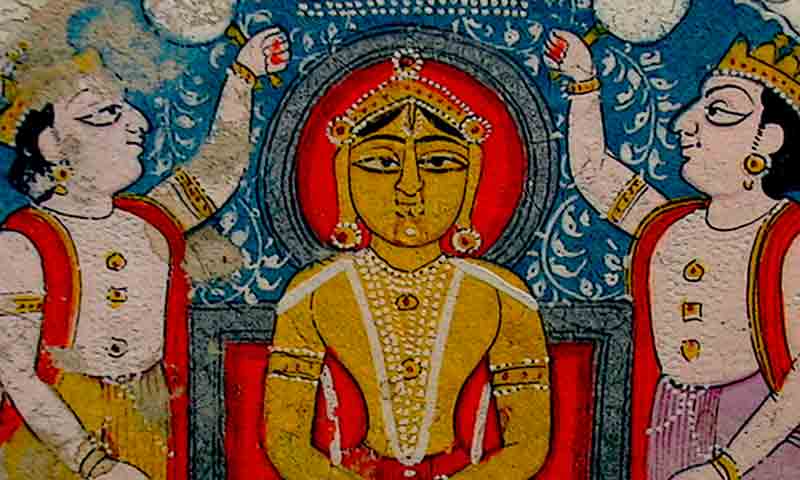
A Miniature Painting of the 13th Tirthankara of Jainism
Introductory Note
Notes: This chapter has been reproduced for historical reasons. However, it should not be relied upon blindly for an understanding of Jainism because author's conclusions are at times erroneous and completely off the mark. For example, in the very beginning of the chapter Eliot states that Buddhism is a culmination of the movement which gave birth to Jainism. This is far from truth. Throughout the chapter the author continued the thought process and tried to draw parallels between the two.
While Buddhism and Jainism originated in the same region and share some common ideas and doctrines such as karma and rebirth, they have a few fundamental and irreconcilable differences and cannot be said to represent a general movement. Jainism was at least a thousand years older than Buddhism and it was already well established by the time the Buddha was born. Mahavira might be a contemporary of the Buddha, but he was not the founder of Jainism. Buddhism does not believe in eternal souls or eternal beings. Jainism believes in eternal souls and eternal beings called the Siddhas or Arhats. In Jainism karma is an ethereal substance.
In Buddhism it is an effect or a consequence. In Buddhism there is no existence beyond Nirvana. In Jainism upon liberation one enters the immortal world and remains there above all. Therefore, you may read this chapter with an open mind to gain an insight into how an outsider's view of Jainism developed in the past few centuries and to know the persecution the Jains suffered from the hands of Hindu rulers in the past. I have made a few changes to the original text by adding headings to make it more readable and web friendly. However, I have not made any changes to the original texts or to the views and opinions expressed by the author.
Jayaram V
Before leaving pre-Buddhist India, it may be well to say something of the Jains. Many of their doctrines, especially their disregard not only of priests but of gods, which seems to us so strange in any system which can be called a religion, are closely analogous to Buddhism and from one point of view Jainism is part of the Buddhist movement. But more accurately it may be called an early specialized form of the general movement which culminated in Buddhism.
Its founder, Mahâvîra, was an earlier contemporary of the Buddha and not a pupil or imitator[252]. Even had its independent appearance been later, we might still say that it represents an earlier stage of thought. Its kinship to the theories mentioned in the last chapter is clear. It does not indeed deny responsibility and free will, but its advocacy of extreme asceticism and death by starvation has a touch of the same extravagance and its list of elements in which physical substances and ideas are mixed together is curiously crude.
Elements of atheism
Jainism is atheistic, and this atheism is as a rule neither apologetic nor polemical but is accepted as a natural religious attitude. By atheism, of course, a denial of the existence of Devas is not meant; the Jains surpass, if possible, the exuberant fancy of the Brahmans and Buddhists in designing imaginary worlds and peopling them with angelic or diabolical inhabitants, but, as in Buddhism, these beings are like mankind subject to transmigration and decay and are not the masters, still less the creators, of the universe. There were two principal world theories in ancient India. One, which was systematized as the Vedânta, teaches in its extreme form that the soul and the universal spirit are identical and the external world an illusion. The other, systematized as the Sânkhya, is dualistic and teaches that primordial matter and separate individual souls are both of them uncreated and indestructible. Both lines of thought look for salvation in the liberation of the soul to be attained by the suppression of the passions and the acquisition of true knowledge.
Individual souls
Jainism belongs to the second of these classes. It teaches that the world is eternal, self-existent and composed of six constituent substances: souls, dharma, adharma, space, time, and particles of matter[253]. Dharma and adharma are defined by modern Jains as subtle substances analogous to space which make it possible for things to move or rest, but Jacobi is probably right in supposing that in primitive speculation the words had their natural meaning and denoted subtle fluids which cause merit and demerit. In any case the enumeration places in singular juxtaposition substances and activities, the material and the immaterial. The process of salvation and liberation is not distinguished from physical processes and we see how other sects may have drawn the conclusion, which apparently the Jains did not draw, that human action is necessitated and that there is no such thing as free will. For Jainism individual souls are free, separate existences, whose essence is pure intelligence. But they have a tendency towards action and passion and are misled by false beliefs. For this reason, in the existence which we know they are chained to bodies and are found not only in Devas and in human beings but in animals, plants and inanimate matter. The habitation of the soul depends on the merit or demerit which it acquires and merit and demerit have respectively greater or less influence during immensely long periods called Utsarpinî and Avasarpinî, ascending and descending, in which human stature and the duration of life increase or decrease by a regular law. Merit secures birth among the gods or good men. Sin sends the soul to baser births, even in inanimate substances. On this downward path, the intelligence is gradually dimmed till at last motion and consciousness are lost, which is not however regarded as equivalent to annihilation.
Karma
Another dogmatic exposition of the Jain creed is based on seven principles, called soul, non-soul, influx, imprisonment, exclusion, dissipation, release[254]. Karma, which in the ordinary language of Indian philosophy means deeds and their effect on the soul, is here regarded as a peculiarly subtle form of matter[255] which enters the soul and by this influx (or âsrava, a term well-known in Buddhism) defiles and weighs it down. As food is transformed into flesh, so the Karma forms a subtle body which invests the soul and prevents it from being wholly isolated from matter at death. The upward path and liberation of the soul are effected by stopping the entrance of Karma, that is by not performing actions which give occasion to the influx, and by expelling it. The most effective means to this end is self-mortification, which not only prevents the entrance of new Karma but annihilates what has accumulated.
Transmigration
Like most Indian sects, Jainism considers the world of transmigration as a bondage or journey which the wise long to terminate. But joyless as is its immediate outlook, its ultimate ideas are not pessimistic. Even in the body the soul can attain a beatific state of perfect knowledge[256] and above the highest heaven (where the greatest gods live in bliss for immense periods though ultimately subject to transmigration) is the paradise of blessed souls, freed from transmigration. They have no visible form but consist of life throughout, and enjoy happiness beyond compare. With a materialism characteristic of Jain theology, the treatise from which this account is taken[257] adds that the dimensions of a perfected soul are two-thirds of the height possessed in its last existence.
Right faith and right knowledge
How is this paradise to be reached? By right faith, right knowledge and right conduct, called the three jewels, a phrase familiar to Buddhism. The right faith is complete confidence in Mahâvîra and his teaching. Right knowledge is correct theology as outlined above. Knowledge is of five degrees of which the highest is called Kevalam or omniscience. This sounds ambitious, but the special method of reasoning favoured by the Jains is the modest Syâdvâda[258] or doctrine of may-be, which holds that you can (1) affirm the existence of a thing from one point of view, (2) deny it from another, and (3) affirm both existence and non-existence with reference to it at different times. If (4) you should think of affirming existence and non-existence at the same time and from the same point of view, you must say that the thing cannot be spoken of. The essence of the doctrine, so far as one can disentangle it from scholastic terminology, seems just, for it amounts to this, that as to matters of experience it is impossible to formulate the whole and complete truth, and as to matters which transcend experience language is inadequate: also that Being is associated with production, continuation and destruction. This doctrine is called anekânta-vâda, meaning that Being is not one and absolute as the Upanishads assert: matter is permanent, but changes its shape, and its other accidents. Thus in many points the Jains adopt the common sense and primâ facie point of view. But the doctrines of metempsychosis and Karma are also admitted as obvious propositions, and though the fortunes and struggles of the embodied soul are described in materialistic terms, happiness is never placed in material well-being but in liberation from the material universe.
We cannot be sure that the existing Jain scriptures present these doctrines in their original form, but the full acceptance of metempsychosis, the animistic belief that plants, particles of earth and water have souls and the materialistic phraseology (from which the widely different speculations of the Upanishads are by no means free) agree with what we know of Indian thought about 550 B.C. Jainism like Buddhism ignores the efficacy of ceremonies and the powers of priests, but it bears even fewer signs than Buddhism of being in its origin a protestant or hostile movement. The intellectual atmosphere seems other than that of the Upanishads, but it is very nearly that of the Sânkhya philosophy, which also recognizes an infinity of individual souls radically distinct from matter and capable of attaining bliss only by isolation from matter. Of the origin of that important school we know nothing, but it differs from Jainism chiefly in the greater elaboration of its psychological and evolutionary theories and in the elimination of some materialistic ideas. Possibly the same region and climate of opinion gave birth to two doctrines, one simple and practical, inasmuch as it found its principal expression in a religious order, the other more intellectual and scholastic and, at least in the form in which we read it, later[259].
Right Conduct
Right conduct is based on the five vows taken by every Jain ascetic, (1) not to kill, (2) not to speak untruth, (3) to take nothing that is not given, (4) to observe chastity, (5) to renounce all pleasure in external objects. These vows receive an extensive and strict interpretation by means of five explanatory clauses applicable to each and to be construed with reference to deed, word, and thought, to acting, commanding and consenting. Thus the vow not to kill forbids not only the destruction of the smallest insect but also all speech or thought which could bring about a quarrel, and the doing, causing or permitting of any action which could even inadvertently injure living beings, such as carelessness in walking. Naturally such rules can be kept only by an ascetic, and in addition to them asceticism is expressly enjoined. It is either internal or external. The former takes such forms as repentance, humility, meditation and the suppression of all desires: the latter comprises various forms of self-denial, culminating in death by starvation. This form of religious suicide is prescribed for those who have undergone twelve years' penance and are ripe for Nirvana[260] but it is wrong if adopted as a means of shortening austerities. Numerous inscriptions record such deaths and the head-teachers of the Digambaras are said still to leave the world in this way.
Tirthankaras - The Teachers
Important but not peculiar to Jainism is the doctrine of the periodical appearance of great teachers who from time to time restore the true faith[261]. The same idea meets us in the fourteen Manus, the incarnations of Vishnu, and the series of Buddhas who preceded Gotama. The Jain saints are sometimes designated as Buddha, Kevalin, Siddha, Tathâgata and Arhat (all Buddhist titles) but their special appellation is Jina or conqueror which is, however, also used by Buddhists[262]. It was clearly a common notion in India that great teachers appear at regular intervals and that one might reasonably be expected in the sixth century B.C. The Jains gave preference or prominence to the titles Jina or Tîrthankara: the Buddhists to Buddha or Tathâgata.
According to the Jain scriptures all Jinas are born in the warrior caste, never among Brahmans. The first called Rishabha, who was born an almost inexpressibly[263] long time ago and lived 8,400,000 years, was the son of a king of Ayodhyâ. But as ages elapsed, the lives of his successors and the intervals which separated them became shorter. Parśva, the twenty-third Jina, must have some historical basis[264]. We are told that he lived 250 years before Mahâvîra, that his followers still existed in the time of the latter: that he permitted the use of clothes and taught that four and not five vows were necessary[265]. Both Jain and Buddhist scriptures support the idea that Mahâvîra was a reviver and reformer rather than an originator. The former do not emphasize the novelty of his revelation and the latter treat Jainism as a well-known form of error without indicating that it was either new or attributable to one individual.
Mahavira
Mahâvîra, or the great hero, is the common designation of the twenty-fourth Jina but his personal name was Vardhamâna. He was a contemporary of the Buddha but somewhat older and belonged to a Kshatriya clan, variously called Jñâta, Ñâta, or Ñâya. His parents lived in a suburb of Vaiśâlî and were followers of Parśva. When he was in his thirty-first year they decided to die by voluntary starvation and after their death he renounced the world and started to wander naked in western Bengal, enduring some persecution as well as self-inflicted penances. After thirteen years of this life, he believed that he had attained enlightenment and appeared as the Jina, the head of a religious order called Nirgaṇṭhas (or Niganthas). This word, which means unfettered or free from bonds, is the name by which the Jains are generally known in Buddhist literature and it occurs in their own scriptures, though it gradually fell out of use. Possibly it was the designation of an order claiming to have been founded by Parśva and accepted by Mahâvîra.
The meagre accounts of his life relate that he continued to travel for nearly thirty years and had eleven principal disciples. He apparently influenced much the same region as the Buddha and came in contact with the same personalities, such as kings Bimbisâra and Ajâtasattu. He had relations with Makkhali Gosâla and his disciples disputed with the Buddhists[266] but it does not appear that he himself ever met Gotama. He died at the age of seventy-two at Pâvâ near Râjagaha. Only one of his principal disciples, Sudharman, survived him and a schism broke out immediately after his death. There had already been one in the fifteenth year of his teaching brought about by his son-in-law.
Schism
We have no information about the differences on which these schisms turned, but Jainism is still split into two sects which, though following in most respects identical doctrines and customs, refuse to intermarry or eat together. Their sacred literature is not the same and the evidence of inscriptions indicates that they were distinct at the beginning of the Christian era and perhaps much earlier.
The Digambara sect, or those who are clothed in air, maintain that absolute nudity is a necessary condition of saintship: the other division or Śvetâmbaras, those who are dressed in white, admit that Mahâvîra went about naked, but hold that the use of clothes does not impede the highest sanctity, and also that such sanctity can be attained by women, which the Digambaras deny. Nudity as a part of asceticism was practised by several sects in the time of Mahâvîra[267] but it was also reprobated by others (including all Buddhists) who felt it to be barbarous and unedifying. It is therefore probable that both Digambaras and Śvetâmbaras existed in the infancy of Jainism, and the latter may represent the older sect reformed or exaggerated by Mahâvîra. Thus we are told[268] that "the law taught by Vardhamâna forbids clothes but that of the great sage Parśva allows an under and an upper garment." But it was not until considerably later that the schism was completed by the constitution of two different canons[269]. At the present day most Digambaras wear the ordinary costume of their district and only the higher ascetics attempt to observe the rule of nudity. When they go about they wrap themselves in a large cloth, but lay it aside when eating. The Digambaras are divided into four principal sects and the Śvetâmbaras into no less than eighty-four, which are said to date from the tenth century A.D.
Laity
Apart from these divisions, all Jain communities are differentiated into laymen and members of the order or Yatis, literally strivers. It is recognized that laymen cannot observe the five vows. Killing, lying, and stealing are forbidden to them only in their obvious and gross forms: chastity is replaced by conjugal fidelity and self-denial by the prohibition of covetousness. They can also acquire merit by observing seven other miscellaneous vows (whence we hear of the twelvefold law) comprising rules as to residence, trade, etc. Agriculture is forbidden since it involves tearing up the ground and the death of insects.
Spread of Jainism
Mahâvîra was succeeded by a long line of teachers sometimes called Patriarchs and it would seem that their names have been correctly preserved though the accounts of their doings are meagre. Various notices in Buddhist literature confirm the idea that the Jains were active in the districts corresponding to Oudh, Tirhut and Bihar in the period following Mahâvîra's death, and we hear of them in Ceylon before our era. Further historical evidence is afforded by inscriptions[270]. The earliest in which the Jains are mentioned are the edicts of Asoka. He directed the officials called "superintendents of religion" to concern themselves with the Niganthas[271]: and when [272] he describes how he has provided medicine, useful plants and wells for both men and animals, we are reminded of the hospitals for animals which are still maintained by the Jains. According to Jain tradition (which however has not yet been verified by other evidence) Samprati, the grandson of Asoka, was a devout patron of the faith. More certain is the patronage accorded to it by King Khâravela of Orissa about 157 B.C. which is attested by inscriptions. Many dedicatory inscriptions prove that the Jains were a flourishing community at Muttra in the reigns of Kanishka, Huvishka and Vasudeva and one inscription from the same locality seems as old as 150 B.C. We learn from these records that the sect comprised a great number of schools and subdivisions. We need not suppose that the different teachers were necessarily hostile to one another but their existence testifies to an activity and freedom of interpretation which have left traces in the multitude of modern subsects.
Jainism in the south
Jainism also spread in the south of India and before our era it had a strong hold in Tamil lands, but our knowledge of its early progress is defective. According to Jain tradition there was a severe famine in northern India about 200 years after Mahâvîra's death and the patriarch Bhadrabâhu led a band of the faithful to the south[273]. In the seventh century A.D. we know from various records of the reign of Harsha and from the Chinese pilgrim Hsüan Chuang that it was nourishing in Vaiśâlî and Bengal and also as far south as Conjeevaram. It also made considerable progress in the southern Maratha country under the Câlukya dynasty of Vatapi, in the modern district of Bijapur (500-750) and under the Râshṭrakûta sovereigns of the Deccan. Amoghavarsha of this line (815-877) patronized the Digambaras and in his old age abdicated and became an ascetic. The names of notable Digambara leaders like Jinasena and Gunabhadra dating from this period are preserved and Jainism must in some districts have become the dominant religion. Bijjala who usurped the Câlukya throne (1156-1167) was a Jain and the Hoysala kings of Mysore, though themselves Vaishnavas, protected the religion. Inscriptions[274] appear to attest the presence of Jainism at Girnar in the first century A.D. and subsequently Gujarat became a model Jain state after the conversion of King Kumarapala about 1160.
Persecution of Jains
Such success naturally incurred the enmity of the Brahmans and there is more evidence of systematic persecution directed against the Jains than against the Buddhists. The Cola kings who ruled in the south-east of the Madras Presidency were jealous worshippers of Siva and the Jains suffered severely at their hands in the eleventh century and also under the Pândya kings of the extreme south. King Sundara of the latter dynasty is said to have impaled 8000 of them and pictures on the walls of the great temple at Madura represent their tortures. A little later (1174) Ajayadeva, a Saiva king of Gujarat, is said to have raged against them with equal fury. The rise of the Lingâyats in the Deccan must also have had an unfavourable effect on their numbers. But in the fourteenth century greater tolerance prevailed, perhaps in consequence of the common danger from Islam. Inscriptions found at Sravana Belgola and other places[275] narrate an interesting event which occurred in 1368. The Jains appealed to the king of Vijayanagar for protection from persecution and he effected a public reconciliation between them and the Vaishnavas, holding the hands of both leaders in his own and declaring that equal protection would be given to both sects. Another inscription records an amicable agreement regulating the worship of a lingam in a Jain temple at Halebid. Many others, chiefly recording grants of land, testify to the prosperity of Jainism in the Hindu kingdom of Vijayanagar and in the region of Mt Abu in the sixteenth and seventeenth centuries[276]. The great Emperor Akbar himself came under the influence of Jainism and received instruction from three Jain teachers from 1578 to 1597.
Jainism in modern times
Persecution and still more the steady pressure and absorptive power of Hinduism have reduced the proportions of the sect, and the last census estimated it at one million and a third. It is probable, however, that many Jains returned themselves as Hindus, and that their numbers are really greater. More than two-fifths of them are found in Bombay, Rajputana, and Central India. Elsewhere they are generally distributed but only in small numbers. They observe caste, at least in some districts, and generally belong to the Baniyas. They include many wealthy merchants who expend large sums on the construction and maintenance of temples, houses for wandering ascetics and homes for cattle. Their respect and care for animal life are remarkable. Wherever Jains gain influence beasts are not slaughtered or sacrificed, and when old or injured are often kept in hospitals or asylums, as, for instance, at Ahmadabad[277]. Their ascetics take stringent precautions to avoid killing the smallest creature: they strain their drinking water, sweep the ground before them with a broom as they walk and wear a veil over their mouths. Even in the shops of the laity lamps are carefully screened to prevent insects from burning themselves.
The principal divisions are the Digambara and Śvetâmbara as above described and an offshoot of the latter called Dhundia[278] who refuse to use images in worship and are remarkable even among Jains for their aversion to taking life. In Central India the Digambaras are about half the total number; in Baroda and Bombay the Śvetâmbaras are stronger. In Central India the Jains are said to be sharply distinguished from Hindus but in other parts they intermarry with Vaishnavas and while respecting their own ascetics as religious teachers, employ the services of Brahmans in their ceremonies.
Jain literature
The Jains have a copious and in part ancient literature. The oldest works are found in the canon (or Siddhânta) of the Śvetâmbaras, which is not accepted by the Digambaras. In this canon the highest rank is given to eleven works[279] called Angas or limbs of the law but it also comprises many other esteemed treatises such as the Kalpasûtra ascribed to Bhadrabâhu. Fourteen older books called Puvvas (Sk. Pûrvas) and now lost are said to have together formed a twelfth anga. The language of the canon is a variety of Prakrit[280], fairly ancient though more modern than Pali, and remarkable for its habit of omitting or softening consonants coming between two vowels, e.g. sûyam for sûtram, loo for loko[281]. We cannot, however, conclude that it is the language in which the books were composed, for it is probable that the early Jains, rejecting Brahmanical notions of a revealed text, handed down their religious teaching in the vernacular and allowed its grammar and phonetics to follow the changes brought about by time.
According to a tradition which probably contains elements of truth the first collection of sacred works was made about 200 years after Mahâvîra's death by a council which sat at Pataliputra. Just about the same time came the famine already mentioned and many Jains migrated to the south. When they returned they found that their co-religionists had abandoned the obligation of nakedness and they consequently refused to recognize their sacred books.
The Śvetâmbara canon was subsequently revised and written down by a council held at Valabhi in Gujarat in the middle of the fifth century A.D. This is the edition which is still extant. The canon of the Digambaras, which is less well known, is said to be chiefly in Sanskrit and according to tradition was codified by Pushpadanta in the second century A.D. but appears to be really posterior to the Śvetâmbara scriptures[282]. It is divided into four sections called Vedas and treating respectively of history, cosmology, philosophy and rules of life[283].
Though the books of the Jain canon contain ancient matter, yet they seem, as compositions, considerably later than the older parts of the Buddhist Tripitaka. They do not claim to record recent events and teaching but are attempts at synthesis which assume that Jainism is well known and respected. In style they offer some resemblance to the Pitakas: there is the same inordinate love of repetition and in the more emotional passages great similarity of tone and metaphor[284].
Besides the two canons, the Jains have a considerable literature consisting both of commentaries and secular works. The most eminent of their authors is Hemacandra, born in 1088, who though a monk was an ornament of the court and rendered an important service to his sect by converting Kumârapâla, King of Gujarat. He composed numerous and valuable works on grammar, lexicography, poetics and ecclesiastical biography. Such subjects were congenial to the later Jain writers and they not only cultivated both Sanskrit and Prakrit but also had a vivifying effect on the vernaculars of southern India. Kanarese, Tamil, and Telugu in their literary form owe much to the labours of Jain monks, and the Jain works composed in these languages, such as the Jîvakacintâmaṇi in Tamil, if not of world-wide importance, at least greatly influenced Dravidian civilization.
Though the Jains thus occupy an honourable, and even distinguished place in the history of letters it must be confessed that it is hard to praise their older religious books. This literature is of considerable scientific interest for it contains many data about ancient India as yet unsifted but it is tedious in style and rarely elevated in sentiment. It has an arid extravagance, which merely piles one above the other interminable lists of names and computations of immensity in time and space. Even more than in the Buddhist suttas there is a tendency to repetition which offends our sense of proportion and though the main idea, to free the soul from the trammels of passion and matter, is not inferior to any of the religious themes of India, the treatment is not adequate to the subject and the counsels of perfection are smothered under a mass of minute precepts about the most unsavoury details of life and culminate in the recommendation of death by voluntary starvation.
Jainism in real practice
But observation of Jainism as it exists to-day produces a quite different impression. The Jains are well-to-do, industrious and practical: their schools and religious establishments are well ordered: their temples have a beauty, cleanliness, and cheerfulness unusual in India and due to the large use made of white marble and brilliant colours. The tenderness for animal life may degenerate into superstition (though surely it is a fault on the right side) and some observances of the ascetics (such as pulling out the hair instead of shaving the head) are severe, but as a community the Jains lead sane and serious lives, hardly practising and certainly not parading the extravagances of self-torture which they theoretically commend. Mahâvîra is said to have taught that place, time and occasion should be taken into consideration and his successors adapted their precepts to the age in which they lived. Such monks as I have met[285] maintained that extreme forms of tapas were good for the nerves of ancient saints but not for the weaker natures of to-day. But in avoiding rigorous severity, they have not fallen into sloth or luxury.
Jain art and architecture
The beauty of Jainism finds its best expression in architecture. This reached its zenith both in style and quantity during the eleventh and twelfth centuries which accords with what we know of the growth of the sect. After this period the Mohammedan invasions were unfavourable to all forms of Hindu architecture. But the taste for building remained and somewhat later pious Jains again began to construct large edifices which are generally less degenerate than modern Hindu temples, though they often show traces of Mohammedan influence. Hathi Singh's temple at Ahmadabad completed in 1848 is a fine example of this modern style.
There is a considerable difference between Jain and Buddhist architecture both in intention and effect. Jain monks did not live together in large communities and there was no worship of relics. Hence the vihâra and the stûpa—the two principal types of Buddhist buildings—are both absent. Yet there is some resemblance between Jain temples (for instance those at Palitâna) and the larger Burmese sanctuaries, such as the Shwe Dagon Pagoda. It is partly due to the same conviction, namely that the most meritorious work which a layman can perform is to multiply shrines and images. In both localities the general plan is similar. On the top of a hill or mound is a central building round which are grouped a multitude of other shrines. The repetition of chapels and images is very remarkable: in Burma they all represent Gotama, in Jain temples the figures of Tîrthankaras are nominally different personalities but so alike in presentment that the laity rarely know them apart. In both styles of art white and jewelled images are common as well as groups of four sitting figures set back to back and facing the four quarters[286]: in both we meet with veritable cities of temples, on the hill tops of Gujarat and in the plain of Pagan on the banks of the Irawaddy. As some features of Burmese art are undoubtedly borrowed from India[287], the above characteristics may be due to imitation of Jain methods. It might be argued that the architectural style of late Indian Buddhism survives among the Jains but there is no proof that the multiplication of temples and images was a feature of this style. But in some points it is clear that the Jains have followed the artistic conventions of the Buddhists. Thus Pârśvanâtha is sheltered by a cobra's hood, like Gotama, and though the Bo-tree plays no part in the legend of the Tîrthankaras, they are represented as sitting under such trees and a living tree is venerated at Palitâna.
As single edifices illustrating the beauty of Jain art both in grace of design and patient elaboration of workmanship may be mentioned the Towers of Fame and Victory at Chitore, and the temples of Mt Abu. Some differences of style are visible in north and south India. In the former the essential features are a shrine with a portico attached and surmounted by a conical tower, the whole placed in a quadrangular court round which are a series of cells or chapels containing images seated on thrones. These are the Tîrthankaras, almost exactly alike and of white marble, though some of the later saints are represented as black. The Śvetâmbaras represent their Tîrthankaras as clothed but in the temples of the Digambaras the images are naked.
In the south are found religious monuments of two kinds known as Bastis and Bettus. The Bastis consist of pillared vestibules leading to a shrine over which rises a dome constructed in three or four stages. The Bettus are not temples in the ordinary sense but courtyards surrounding gigantic images of a saint named Gommateśvara who is said to have been the son of the first Tîrthankara[288]. The largest of these colossi is at Sravana Belgola. It is seventy feet in height and carved out of a mass of granite standing on the top of a hill and represents a sage so sunk in meditation that anthills and creepers have grown round his feet without breaking his trance. An inscription states that it was erected about 983 A.D. by the minister of a king of the Ganga dynasty[289].
Temples
But even more remarkable than these gigantic statues are the collections of temples found on several eminences, such as Girnar and Satrunjaya[290] mountain masses which rise abruptly to a height of three or four thousand feet out of level plains. On the summit of Satrunjaya are innumerable shrines, arranged in marble courts or along well-paved streets. In each enclosure is a central temple surrounded by others at the sides, and all are dominated by one which in the proportions of its spire and courtyard surpasses the rest. Only a few Yatis are allowed to pass the night in the sacred precincts and it is a strange experience to enter the gates at dawn and wander through the interminable succession of white marble courts tenanted only by flocks of sacred pigeons. On every side sculptured chapels gorgeous in gold and colour stand silent and open: within are saints sitting grave and passionless behind the lights that burn on their altars. The multitude of calm stone faces, the strange silence and emptiness, unaccompanied by any sign of neglect or decay, the bewildering repetition of shrines and deities in this aerial castle, suggest nothing built with human purpose but some petrified spirit world.
Soon after dawn a string of devotees daily ascends the hill. Most are laymen, but there is a considerable sprinkling of ascetics, especially nuns. After joining the order both sexes wear yellowish white robes and carry long sticks. They spend much of their time in visiting holy places and usually do not stop at one rest house for more than two months. The worship performed in the temples consists of simple offerings of flowers, incense and lights made with little ceremony. Pilgrims go their rounds in small bands and kneeling together before the images sing the praises of the Jinas.
It is remarkable that Jainism is still a living sect, whereas the Buddhists have disappeared from India. Its strength and persistence are centred in its power of enlisting the interest of the laity and of forming them into a corporation. In theory the position of the Jain and Buddhist layman is the same. Both revere and support a religious order for which they have not a vocation, and are bound by minor vows less stringent than those of the monks. But among the Buddhists the members of the order came to be regarded more and more as the true church[291] and the laity tended to become (what they actually have become in China and Japan) pious persons who revere that order as something extraneous to themselves and very often only as one among several religious organizations. Hence when in India monasteries decayed or were destroyed, little active Buddhism was left outside them. But the wandering ascetics of the Jains never concentrated the strength of the religion in themselves to the same extent; the severity of their rule limited their numbers: the laity were wealthy and practically formed a caste; persecution acted as a tonic. As a result we have a sect analogous in some ways to the Jews, Parsis, and Quakers[292], among all of whom we find the same features, namely a wealthy laity, little or no sacerdotalism and endurance of persecution.
Buddhism and Jainism differences
Another question of some interest is how far Jainism should be regarded as separate from Buddhism. Historically the position seems clear. Both are offshoots of a movement which was active in India in the sixth century B.C. in certain districts and especially among the aristocracy. Of these offshoots—the survivors among many which hardly outlived their birth—Jainism was a trifle the earlier, but Buddhism was superior and more satisfying to the intellect and moral sense alike. Out of the theory and practice of religious life current in their time Gotama fashioned a beautiful vase, Mahâvîra a homely but still durable pot. The resemblances between the two systems are not merely obvious but fundamental. Both had their origin outside the priestly class and owed much of their success to the protection of princes. Both preach a road to salvation open to man's unaided strength and needing neither sacrifice nor revealed lore. Both are universal, for though Buddhism set about its world mission with more knowledge and grasp of the task, the Jain sûtras are addressed "to Aryans and non-Aryans" and it is said that in modern times Mohammedans have been received into the Jain Church. Neither is theistic. Both believe in some form of reincarnation, in karma and in the periodical appearance of beings possessed of superhuman knowledge and called indifferently Jinas or Buddhas.
The historian may therefore be disposed to regard the two religions as not differing much more than the varieties of Protestant Dissenters to be found in Great Britain. But the theologian will perceive real differences. One of the most important doctrines of Buddhism---perhaps in the Buddha's own esteem the central doctrine—is the non-existence of the soul as a permanent entity: in Jainism on the contrary not only the human body but the whole world including inanimate matter is inhabited by individual souls who can also exist apart from matter in individual blessedness. The Jain theory of fivefold knowledge is unknown to the Buddhists, as is their theory of the Skandhas to the Jains. Secondly as to practice Jainism teaches (with some concessions in modern times) that salvation is obtainable by self-mortification but this is the method which the Buddha condemned after prolonged trial. It is clear that in his own opinion and that of his contemporaries the rule and ideal of life which he prescribed differed widely from those of the Jains, Âjîvikas and other wandering ascetics.
Suggestions for Further Reading
- The Atomic Theory of Jainism
- History of Jainism
- Jainism - Philosophy and Doctrine
- Major Beliefs of Jainism
- Jain Literature and Canonical Texts
- Jainism Cosmology
- The Jains And Their Creed
- Jainism - Doctrine and History
- An Introduction to Jainism or Jain Dharma
- The Philosophy and Practice of Jainism
- Information Websites on Jainism
- Jainism and the Belief in God
- Jainism - Jivas, the Embodied Souls
- Jainism - Belief in Karma
- The Theory of Knowledge in Jainism
- History of Jainism after Mahavira
- Vardhamana Mahavira
- Jainism - Anekantavada or Nayavada
- An Outsider Perspective on Jainism
- Jainism - Sects and Subsects
- Syadavada or Saptabhangi
- The Tattvas of Jainism
- Jain Thirthankaras
- Ethics of Jainism - The Three Jewels
- Tirthahkaras Before Mahavira
- Essays On Dharma
- Esoteric Mystic Hinduism
- Introduction to Hinduism
- Hindu Way of Life
- Essays On Karma
- Hindu Rites and Rituals
- The Origin of The Sanskrit Language
- Symbolism in Hinduism
- Essays on The Upanishads
- Concepts of Hinduism
- Essays on Atman
- Hindu Festivals
- Spiritual Practice
- Right Living
- Yoga of Sorrow
- Happiness
- Mental Health
- Concepts of Buddhism
- General Essays
Footnote
: In J.R.A.S. 1917, pp. 122-130 s.v. Venkateśvara argues that Vardhamâna died about 437 B.C. and that the Nigaṇṭhas of the Pitakas were followers of Parśva. His arguments deserve consideration but he seems not to lay sufficient emphasis on the facts that (a) according to the Buddhist scriptures the Buddha and Gosâla were contemporaries, while according to the Jain scriptures Gosâla and Vardhamâna were contemporaries, (b) in the Buddhist scriptures Nâtaputta is the representative of the Nigaṇṭhas, while according to the Jain scriptures Vardhamâna was of the Ñata clan.]
[Footnote 253: The atoms are either simple or compound and from their combinations are produced the four elements, earth, wind, fire and water, and the whole material universe. For a clear statement of the modern Jain doctrine about dharma and adharma, see Jagmanderlal Jaini, l.c. pp. 22 ff.]
[Footnote 254: Jîva, ajîva, âsrava, bandha, saṃvara, nirjarâ, moksha. The principles are sometimes made nine by the addition of punya, merit, and pâpa, sin.]
[Footnote 255: Paudgalikam karma. It would seem that all these ideas about Karma should be taken in a literal and material sense. Karma, which is a specially subtle form of matter able to enter, stain and weigh down the soul, is of eight kinds (1 and 2) jñâna- and darśana-varanîya impede knowledge and faith, which the soul naturally possesses; (3) mohanîya causes delusion; (4) vedanîya brings pleasure and pain; (5) ayushka fixes the length of life; (6) nâma furnishes individual characteristics, and (7) gotra generic; (8) antarâya hinders the development of good qualities.]
[Footnote 256: Kevalam also called Jñâna, moksha, nirvâṇa. The nirvâṇa of the Jains is clearly not incompatible with the continuance of intelligence and knowledge.]
[Footnote 257: Uttarâdhyâyana XXXVI. 64-68 in S.B.E. XLV. pp. 212-213.]
[Footnote 258: S.B.E. XLV. p. xxvii. Bhandarkar Report for 1883-4, pp. 95 ff.]
[Footnote 259: Somewhat similar seems to be the relation of Jainism to the Vaiśeshika philosophy. It accepted an early form of the atomic theory and this theory was subsequently elaborated in the philosophy whose founder Kaṇâda was according to the Jains a pupil of a Jain ascetic.]
[Footnote 260: E.g. see Acarânga S. I. 7. 6.]
[Footnote 261: They seem to have authority to formulate it in a form suitable to the needs of the age. Thus we are told that Parśva enjoined four vows but Mahâvîra five.]
[Footnote 262: When Gotama after attaining Buddhahood was on his way to Benares he met Upaka, a naked ascetic, to whom he declared that he was the Supreme Buddha. Then, said Upaka, you profess to be the Jina, and Gotama replied that he did, "Tasmâ 'ham Upakâ jinoti." (Mahâvag. I. 6. 10.)]
[Footnote 263: The exact period is 100 billion sâgaras of years. A sâgara is 100,000,000,000 palyas. A palya is the period in which a well a mile deep filled with fine hairs can be emptied if one hair is withdrawn every hundred years.]
[Footnote 264: See M. Bloomfield, Life and Stories of Pârçvanâtha (1919).]
[Footnote 265: See the discussions between followers of Parśva and Mahâvîra given in Uttarâdhyâyana XXIV. and Sûtrakritânga II. 7.]
[Footnote 266: There are many references to the Nigaṇṭhas in the Buddhist scriptures and the Buddha, while by no means accepting their views, treats them with tolerance. Thus he bade Siha, General of the Licchavis, who became his disciple after being an adherent of Nâtaputta to continue to give alms as before to Nigaṇṭha ascetics (Mahâvag. VI. 32).]
[Footnote 267: Especially among the Âjîvikas. Their leader Gosâla had a personal quarrel with Mahâvîra but his teaching was almost identical except that he was a fatalist.]
[Footnote 268: Uttarâdhyâyana. XXIII. 29.]
[Footnote 269: According to Śvetâmbara tradition there was a great schism 609 years after Mahâvîra's death. The canon was not fixed until 904 (? 454 A.D.) of the same era. The Digambara traditions are different but appear to be later.]
[Footnote 270: See especially Guérinot, Répertoire d'Éipigraphie Jaina]
[Footnote 271: So Bühler, Pillar Edict no. VIII. Senart Inscrip. de Piyadasi II. 97 translates somewhat differently, but the reference to the Jains is not disputed.]
[Footnote 272: Rock Edict VI.]
[Footnote 273: Rice (Mysore and Coorg from the Inscriptions, 1909, p. 310) thinks that certain inscriptions at Sravana Belgola in Mysore establish that this tradition is true and also that the expedition was accompanied by King Candragupta who had abdicated and become a Jain ascetic. But this interpretation has been much criticised. It is probably true that a migration occurred and increased the differences which ultimately led to the division into Śvetâmbaras and Digambaras.]
[Footnote 274: Guérinot, Épig. Jaina, no. 11.]
[Footnote 275: Rice, Mysore and Coorg from the Inscriptions, 1909, pp. 113-114, 207-208.]
[Footnote 276: Similar tolerance is attested by inscriptions (e.g. Guérinot, nos. 522 and 5776) recording donations to both Jain and Saiva temples.]
[Footnote 277: They also make a regular practice of collecting and rearing young animals which the owners throw away or wish to kill.]
[Footnote 278: Or Sthânakavâsi. See for them Census of India, 1911, 1. p. 127 and Baroda, p. 93. The sect waa founded about A.D. 1653.]
[Footnote 279: Their names are as follows in Jain Prakrit, the Sanskrit equivalent being given in bracketa:
1. *Âyârângasuttam (Âcârânga).
2.*Sûyagadangam
(Sûtrakṛitângam).
3. Thânangam (Sthâ.).
4. Samavâyangam.
5. Viyâhapaññatti (Vyâkhyâprajnâpti). This work is commonly known
as the Bhagavatî.
6. Ñâyâdhammakahâo (Jñâtadharmakathâ).
7.
*Uvâsagadasao (Upâsakadasâh).
8. *Antagadadasao (Antakritad.).
9. *Anuttarovavâidasâo (Anuttaraupapâtikad.).
10. Panhâvâgaranâim
(Prasnavyakaraṇâni).
11. Vivâgasuyam (Vipâkasrutam).
The books marked with an asterisk have been translated by Jacobi (S.B.E. vols. XXII. and XIV.), Hoernle and Barnett. See too Weber, Indischie Studien, Bd. XVI. pp. 211-479 and Bd. XVIII. pp. 1-90.]
[Footnote 280: It is called Ârsha or Ardha-Mâgadhi and is the literary form of the vernacular of Berar in the early centuries of the Christian era. See H. Jacobi, Ausgewählte Erzählungen in Maharashtri, and introduction to edition of Ayarânga-sutta.]
[Footnote 281: The titles given in note 2 illustrate aome of its peculiarities.]
[Footnote 282: When I visited Sravana Belgola in 1910, the head of the Jains there, who professed to be a Digambara, though dressed in purple raiment, informed me that their sacred works were partly in Sanskrit and partly in Prakrit. He showed me a book called Trilokasâra.]
[Footnote 283: But see Jagmanderlal Jaini, l.c. appendix V.]
[Footnote 284: Compare for instance Uttarâdyayana X., XXIII. and XXV. with the Sutta-Nipâta and Dhammapada.]
[Footnote 285: I have only visited establishments in towns. Possibly Yatis who follow a severer rule may be found in the country, especially among Digambaras.]
[Footnote 286: In Gujarat they are called Cho-mukhji and it is said that when a Tîrthankara preached in the midst of his audience each side saw him facing them. In Burma the four figures are generally said to be the last four Buddhas.]
[Footnote 287: This seems clear from the presence in Burma of the curvilinear sikra and even of copies of Indian temples, e.g. of Bodh-Gaya at Pagan. Burmese pilgrims to Gaya might easily have visited Mt Parasnath on their way.]
[Footnote 288: I have this information from the Jain Guru at Sravana Belgola. He said that Gomateśvara (who seems unknown to the Śvetâmbaras) waa a Kevalin but not a Tîrthankara.]
[Footnote 289: Two others, rather smaller, are known, one at Karkâl (dated 1431) and one at Yannur. These images are honoured at occasional festivals (one was held at Sravana Belgola in 1910) attended by a considerable concourse of Jains. The type of the statues is not Buddhist. They are nude and represent sages meditating in a standing position whereas Buddhists prescribe a sitting posture for meditation.]
[Footnote 290: The mountain of Satrunjaya rises above Palitâna, the capital of a native state in Gujarat. Other collections of temples are found on the hill of Parasnath in Bengal, at Sonâgir near Datiâ, and Muktagiri near Gâwîlgarh. There are also a good many on the hills above Rajgîr.]
[Footnote 291: The strength of Buddhism in Burma and Siam is no doubt largely due to the fact that custom obliges every one to spend part of his life—if only a few days—as a member of the order.]
[Footnote 292: One might perhaps add to this list the Skoptsy of Russia and the Armenian colonies in many European and Asiatic towns.]
[Footnote 293: Throughout this book I have not hesitated to make use of the many excellent translations of Pali works which have been published. Students of Indian religion need hardly be reminded how much our knowledge of Pali writings and of early Buddhism owes to the labours of Professor and Mrs Rhys Davids.]
[Footnote 294: Sanskrit Sûtra, Pali Sutta. But the use of the words is not quite the same in Buddhist and Brahmanic literature. A Buddhist sutta or sûtra is a discourse, whether in Pali or in Sanskrit; a Brahmanic sûtra is an aphorism. But the 227 divisions of the Pâtimokkha are called Suttas, so that the word may have been originally used in Pali to denote short statements of a single point. The longer Suttas are often called Suttanta.]
[Footnote 295: E.g. Maj. Nik. 123 about the marvels attending the birth of a Buddha.]
[Footnote 296: See some further remarks on this subject at the end of chap. XIII. (on the Canon).]
[Footnote 297: Also Sakya or Sakka. The Sanskrit form is Śâkya.]
Source: Reproduced from Hinduism And Buddhism An Historical Sketch by Sir Charles Eliot in three volumes Volume I Routledge & Kegan Paul Ltd Broadway House, 68-74 Carter Lane, London, E.C.4. First published 1921 reprinted 1954 reprinted 1957 reprinted 1962 printed in Great Britain By Lund Humphries London o Bradford. This chapter has been edited by Jayaram V for Hinduwebsite.com