
Major Beliefs of Jainism
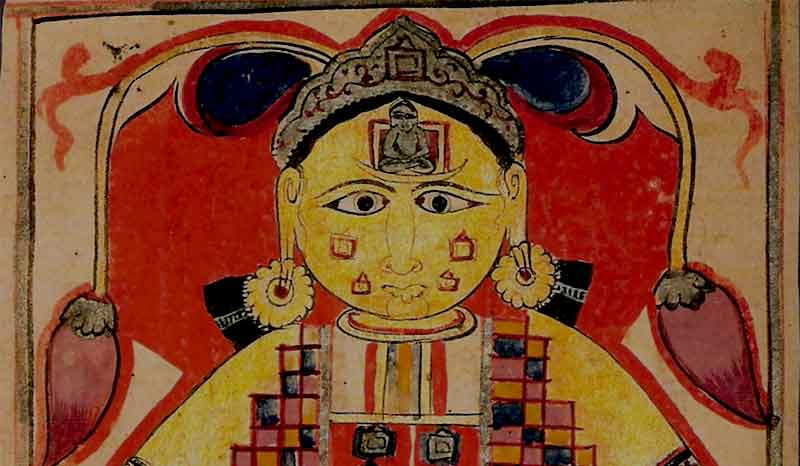
Loka Purusha, The Cosmic Being
I adore so greatly the principles of the Jain religion, that I would like to be reborn in Jain community - George Bernard Shaw.
In the ancient world, the Jain tradition was known as the Sramana tradition.
The sramanas were ascetics, who led pure and austere lives, without possessions, wandering from place to place and subjecting themselves to rigorous austerities and self-discipline.
They focused on renouncing the causes of sin and suffering to achieve liberation from pain and the cycle of births and deaths.
Through the teachings of Parsvanatha and Mahavira, the last two of the 24 Thirthankaras, the tradition grew into an organized religion, attracting a sizeable following in various parts of the Indian subcontinent.
To those who are familiar with Hinduism, the beliefs and concepts of Jainism sound familiar, making one wonder whether there was any connection between the two in some remote past.
There is an argument that Jainism was a popular ascetic tradition of India with its roots in prehistoric times, whose beliefs regarding soul, nature of existence, liberation, austerities, time, karma and incarnation of souls found their way into Hinduism directly or indirectly and enriched it greatly with a strong spiritual and philosophical base.
In this article we will discuss some of the important concepts and core beliefs of Jainism, by knowing which we will gain a fair understanding of how it differs from Hinduism.
Three Tier Universe
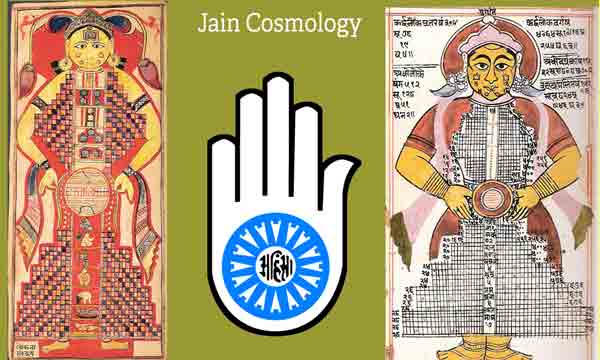 Jains acknowledge a three tier universe, consisting of an upper,
middle and the lower worlds.
Jains acknowledge a three tier universe, consisting of an upper,
middle and the lower worlds.
The universe is eternal and indestructible. It has no creator and it is indestructible. From time to time some aspects of it however may undergo changes.
The upper world is known as siddhasila, inhabited by eternally free and pure souls, who remain permanently in a state of pure bliss and peace.
The middle world is inhabited by embodied beings such as humans, plants, animals and beings with inert bodies (inanimate objects), subject to the law of karma.
The lower world is inhabited by beings, passing through various stages of punishments for the sin they incurred upon earth. They return to our world of embodied souls when their punishment is complete.
Jains view the world in which we live to be full of misery and suffering and the souls that inhabit it are not free because they are attached to matter or substance and vulnerable to the inflow of karmic matter.
As the Akaranaga Sutra describes, the living world of ours is afflicted, miserable, difficult to instruct, and without discrimination. In this world full of pain, the individual beings suffer by their different acts.
Jiva and Ajiva
Jainism views the whole universe in terms of two eternal, independent, indestructible and coexisting components, Jiva and Ajiva, which are similar in some respects to the concept of Purusha and Prakriti of the Samkhya school. Jiva is interpreted differently as being, embodied soul and conscious soul. Ajiva is the lifeless inert matter having qualities (gunas) and atoms (paramanus). In a being Jiva is the soul and Ajiva the physical body. Jiva is the dynamic aspect and ajiva the passive aspect. Jiva is the subject and Ajiva the object. Jiva is the knower and the enjoyer, while Ajiva is the known and the enjoyed, perceived by the Jiva through the senses. The Jiva contains three types of consciousness: knowing, feeling and willing, while Ajiva being inert has no consciousness. For the embodied soul, Ajiva is the allurement, the trap. It comes in many shapes - love for the sense objects, attachment to possessions and material things, desire for sensual pleasures, identification with body and so on. For a Jiva, the Ajiva in which it is caught is a burden, a baggage, which reduces the brilliance of its consciousness and its ability to experience bliss, which is its true nature.
According to Jain tenets, karma is a kind of Ajiva or inert substance, made of fine particles of matter, invisible to the naked eye, but present every where in the universe. It is the binding force and the source of bondage and misery. As an embodied soul engages in various actions, the karmic matter flows into its body and clings to it like an impurity, according to the nature of its actions. The karmic substance is an impurity which leaves its imprint upon the soul and according to its deeds. As a result the soul loses its freedom as becomes bound to a vicious cycle of actions and consequences or causes and effects. Unlike the Atman of the Upanishads, the soul of Jainism has plasticity and dimension. It has the ability to expand or contract, according to the size and shape of the body in which it resides. In a womb it enters like a small seed. But as the body begins to grow it also expands correspondingly to fit into its shape and size. At the end of its current corporeal life, it contracts again into a seed and leaves the body to begin a new journey in another body according to its karma.
The Souls
Jainism envisions a universe filled with innumerable eternal souls in varying degrees of perfection and purity. Soul is the basic unit of consciousness which makes all experience possible because it is capable of perception and experience both in its mundane state and its pure state. Based on their level of perfection three types of souls are recognized. The Nityasuddhas are eternally pure and perfect. They are impervious to the inflow of karmic substance. The Muktas are the liberated souls, who are freed from the cycle of births and deaths and the ordeals of embodiment. They live in a blissful and transcendental state, indifferent to what is going on in different worlds. As freed souls, living in a state of pure existence, they possess ananta jnana (infinite knowledge), ananta darsana (infinite perception), ananta virya (infinite power) and ananta sukha (infinite bliss). The thrid type of souls are baddhas also known as sopadhi jivas. They are the bound souls, who are imperfect, subject to the cycle of births and deaths and karma produced by their own actions. Not all souls have the potential to become free. To become free a soul needs to have bhavyatva, a special quality that has to be activated by its karma to set the process of its liberation in motion. Some souls either do not possess this quality or can never activate it by their karma. So them remain bound for ever.
Depending upon the number of senses they possess, the jivas are divided into five categories, those having one, two, three, four and five senses respectively. Plants have only one sense, the sense of touch. The mammals have all the five senses. In between there two are the jivas having two, three or four senses. Human beings, gods and higher beings possess an additional sixth sense, called manas or mind, which gives them the ability to think and act rationally. The number of senses is an important criteria in selecting right kind of food for consumption to practice the principle of ahimsa or non injury. Since it is not possible to consume food without indulging in some form of violence of injury to living beings, it is better to select plants which have only one sense. Eating food prepared by killing animals having two or more senses would lead to greater sin and adverse karma.
One of the distinguishing features of Jainism is its belief that souls exists both in animate and inanimate objects. The souls are found every where, in every conceivable object, not only in men and animals, but also in the plants, planets, stars, elements, oceans, rivers, wood, metal and even a dew or a rain drop. The Jain believe that there are planetary souls, elementals souls, ethereal souls and souls living beyond the reach of our senses in invisible and subtle matter. The condition of a soul depends upon the body it occupies. The consciousness of souls which reside in inanimate objects or elemental bodies remains in a latent state in contrast to souls living in more dynamic bodies. The condition of one soul per one body also does not apply in Jainism. Some times a multitude of souls may occupy one body as in case of some tuberous plants. Innumerable souls may also exist together as a loosely held cluster occupying vast stretches of space encompassing the whole world as one complex organism. They are called nigodas, which act like a vast store houses of souls. Suspended in the atmosphere, the nigodas keep filling the empty spaces automatically, whenever they are left vacant by the departing or liberated souls. Like the major air currents that crisscross our planet, the nigodasput great responsibility on us to act carefully lest we harm some souls unknowingly.
Dharma, Adharma, Space & Time
Ajiva dravya or the inert matter is of two types, rupa (with form) and arupa (without form). They are further divided into dharma, adharma, space, time and pudgala. Of them only pudgala is matter with form, which can be perceived through senses, and the rest are formless. Unlike in Hinduism and Buddhism, dharma, adharma, space and time are not some abstract concepts or processes, but objective aspects of the universe, grouped under the category of substances (dravyas) in order to distinguish them from the soul, which is not a substance. In Jainism dharma and adharma do not represent merit or demerit or right and wrong. They are the motivating or moving forces of the things in the universe. If space is what holds things like a container, dharma is what moves them and adharma is what brings them to rest within that container. All things, both animate and inanimate, occupy the space and are subject to movement (dharma) and rest (adharma). Space, movement and rest are the three permanent realities of the universe, within the field of our experience. All actions of a Jiva are induced by the movements and rest of its body, mind and senses, In other words, karma is induced by both dharma and adharma. Dharma is what makes the inflow and out flow of karmic substance possible and adharma is what makes it stick to the jiva or rest in it.
Kala is another aspect of Ajiva dravya. It is unilateral and without extension. It is a persistent continuation of successive movements, strung together from the past into the present as one endless continuum. Kala is both absolute and relative. The absolute time, kala, is without a beginning and without an end, indivisible and formless. The relative time, samaya, has a beginning and an end. It has a form and it is divisible into seconds, minutes, hours, days, months, years and so on. Relative time caused by changes in the motion of things. It is also cyclical because it has an ebb and flow in which the condition of souls fluctuate according to a predictable pattern. As in Hinduism, in Jainism also time is perceived as a destroyer because eventually in death as in liberation the body of a jiva is temporarily destroyed.
Pudgala and The Atomic Theory
Pudgala is matter with form. It is what the bodies of jivas are made of, or what the earth and the planets are made of. It has certain perceivable qualities, shapes or forms and properties. It is what is perceived and experienced by the jivas through their senses. It is subject to modifications, but eternal. It embodies energy and prone to motion (parispanda) and evolution (parinama). Everything in the universe, except the souls is made out of pudgala. In its gross form it is grasped by the senses, but the senses cannot reach its subtle forms. The karmic matter is a subtle pudgala that becomes attached to the bodies of the souls because of their actions.
Pudgula is made up of infinitesimally small atoms or paramanus, which are eternal, cannot be created and indestructible. The atoms are responsible for the qualities and nature of pudgala. Each atom has some weight. The lighter atoms stay above and the weightier ones below. Each atom occupies a certain point in space. The atoms also possess certain qualities such as taste, color, smell and texture. Atoms of the gross matter are much larger in size and occupy greater area in space than atoms of the subtle matter. Things are produced by the combination of atoms of dissimilar nature, prone to mutual attraction. The movement of atoms in the space are caused by dharma and adharma, which we have discussed before. Atoms have a tendency to come together and form into aggregates (skandha) of different types. Aggregates constitute one aspect of pudgala, the other being atoms. Our material universe is in fact a giant aggregation of countless atoms (mahaskandha), subject to change and transience made possible by the aggregation and disintegration of atoms. The atoms are eternal. So is the universe. What undergoes change is the combination of atoms or the aggregates. Atoms are homogenous, but by developing certain qualities and grouping themselves into various combinations they manifest as numerous substances. Atoms have motion and can travel swiftly from one part of the universe to another at infinite speeds.
Karma
According to Jainism Karma is a kind of matter (pudgalika) which enters the body of a jiva according to the nature of its actions. The karmic matter is present in the whole universe and has a tendency to modify the future of a jiva by entering into it and creating effects of merits and demerits. The karmic substance remains in the jiva till it is cleansed through neutralizing actions. By indulging in various actions and interacting with the external world, each jiva keeps on attracting the karmic substance into itself which leads to the development of a karmic body (karmana sarira). This karmic body remains with the jiva through its various reincarnations till the soul is completely liberated. Every action performed by a jiva leaves upon it an impression and forms the basis for an action or event in its future. The karmic substance envelops the soul and camouflages its brilliance like a layer of black soot forming on the glass of a lamp. This happens in case of both mental and physical actions. Bhavakarma is the substance that enters a jiva through its mental actions and dravya karma through its physical actions.
On account of karma a jiva passes through five different types of karmic conditions. The first one is the Audayika state. It is the normal state in which karma does its regular work. The next one is Aupamasika state, in which karma is not removed but neutralized and prevented temporarily from producing its results. In the Ksaayika state, the jiva is able to remove its karma completely so that it will not produce any effects, resulting in its liberation. In the Ksayopamasika state, which is the next one, a jiva find itself in all the three preceding states, that is some karma is present in its normal state, some karma is neutralized temporarily and some karma is permanently removed. In the fifth state a jiva is completely immune to the effects of karma. This is the state of liberation. The Ksayika and Aupamasika states are found in the holy men while the Aupamasika state is normally found in pious and virtuous people who perform good deeds.
Liberation
Liberation in Jainism actually means liberation of soul from matter including the karmic matter. For human beings it is freedom from cycle of births and deaths and the impurity of karma. Karma is what binds the soul (jiva) to the matter (ajiva). Jainism recognizes seven tattvas or principles namely jiva, ajiva, asrava, bandha, samvara, niraja and moksha. A jiva (soul) becomes free from ajiva (matter or material body) through various stages to reach the highest state of absolute liberation called moksha. Asrava is the flow of kamric substance into the body of jiva. Bandha is the bondage that binds the soul to the body, caused by wrong belief, non-renunciation, carelessness, passion and the vibration caused in the soul by the actions of the body, mind and senses. Samvara is that which prevents the inflow of karma completely. Niraja is that which neutralizes and eliminates all the previous sins and purifies the soul. Moksha is the state of complete liberation, to which soul can reach to experience its highest and purest state of blissful consciousness. Jains take the concept of liberation to its extreme when they ultimately subject their bodies to self destruction through fasting and other austerities to attain liberation. Suicide is an acknowledged short cut to liberation in Jainism. It is prescribed as an alternative to extreme asceticism when one is unable to overcome attachment and passions. A monk is also allowed to kill himself after twelve years of ascetic practices to attain nirvana.
Suggestions for Further Reading
- The Atomic Theory of Jainism
- History of Jainism
- Jainism - Philosophy and Doctrine
- Major Beliefs of Jainism
- Jain Literature and Canonical Texts
- Jainism Cosmology
- The Jains And Their Creed
- Jainism - Doctrine and History
- An Introduction to Jainism or Jain Dharma
- The Philosophy and Practice of Jainism
- Information Websites on Jainism
- Jainism and the Belief in God
- Jainism - Jivas, the Embodied Souls
- Jainism - Belief in Karma
- The Theory of Knowledge in Jainism
- History of Jainism after Mahavira
- Vardhamana Mahavira
- Jainism - Anekantavada or Nayavada
- An Outsider Perspective on Jainism
- Jainism - Sects and Subsects
- Syadavada or Saptabhangi
- The Tattvas of Jainism
- Jain Thirthankaras
- Ethics of Jainism - The Three Jewels
- Tirthahkaras Before Mahavira
- Essays On Dharma
- Esoteric Mystic Hinduism
- Introduction to Hinduism
- Hindu Way of Life
- Essays On Karma
- Hindu Rites and Rituals
- The Origin of The Sanskrit Language
- Symbolism in Hinduism
- Essays on The Upanishads
- Concepts of Hinduism
- Essays on Atman
- Hindu Festivals
- Spiritual Practice
- Right Living
- Yoga of Sorrow
- Happiness
- Mental Health
- Concepts of Buddhism
- General Essays
Attribution: The image files of Jain deity used in this essay is licensed under the Creative Commons Attribution-Share Alike 2.5 Generic license