
About Goddess Parvathi or Shakti
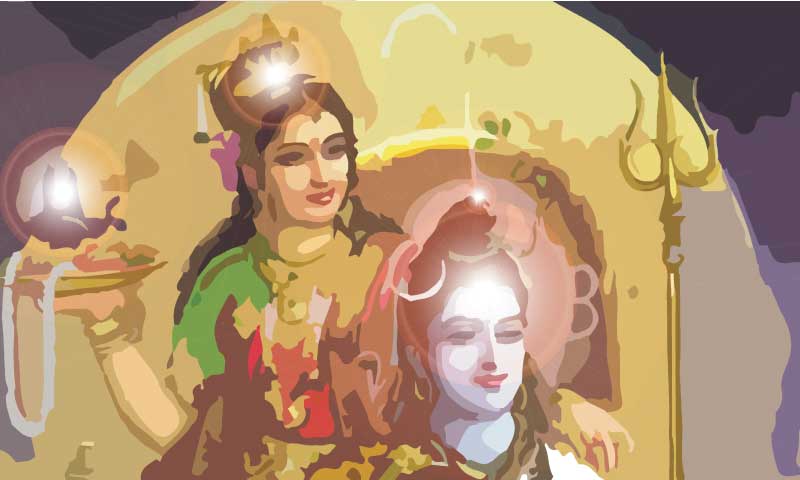
Parvathi is the consort of Siva. She got her name because she is the daughter of the mountains (parvatha) and also because she as Prakriti occupies one half (parva) of the universe while the other half is occupied by Siva in his aspect as Iswara or Purusha. She is known by many names and worshipped by many both as a consort of Siva and also independently as the Mother Goddess. We do not find any direct reference to her in the Rigveda, but in the Kenopanishad she is mentioned as Uma Haimavathi, the daughter of Himavat, who declares to the gods the greatness of Brahman.
According to Hindu mythology Parvathi was Dakshayani in her previous incarnation. Dakshayani was the daughter of Daksha and Prasuti. She became the wife of Siva much against her father's wishes. The story is that Daksha once performs a sacrifice and invites all gods to grace the occasion. During the ceremony, infront every one he speaks insultingly about Siva who has not been invited to attend the function. Unable to bear the insult to her husband, Dakshyani immolates herself infront of every one. In her next birth she is born again as Parvathi and through her austerities and penances she wins over Siva and marries him again.
Parvathi is generally shown seated by the side of her husband or in the company of her children and husband. She is also shown separately as a Shakti, seated on a pedestal, or a lion or a tiger with four hands and a cheerful face. Two of her hands hold lotus flowers while the remainign two are in the abhaya and varada mudras (postures). Parvathi is also known by many other names such as Uma, Amba or Ambika and Gauri.
The Seven Aspects of Parvathi
Brahmi, Mahesvari, Kaumari, Vaisnavi, Vahahi, Narasimhi and Aindri are considered be the seven manifestations of Kali, who is Parvathi in her terrible form. These goddesses were actually created by the combined energies of seven different gods (Brahman, Siva, Kumara, Vishnu, Varaha ) who wanted to help Kali who was fighting Raktabija a powerful demon. These goddesses display the basic attributes of the gods from which they descended and also carry the same weapons as their counterparts.
The Ten Aspects of Parvathi
The Tantras speak of ten powers, known as dasamahavidyas or ten great branches of knowledge. These are Kali, Tara, Sodasi, Bhuvanesvari, Bhairavi, Chinnamasta, Dhumavathi, Bagala, Matangi and Kamala.
Parvathi is also known and worshipped as Annapurna, Aparajita, Bala, Bhadrakali, Bhutamata, Chamunda, Gayatri, Indrakshi, Jagadhatri, Kamesvari, Katyayani, Manonmani, Rajarajesvari and Sivaduti. As Annapurna she is the personification of food and source of all food. The Kasi Annapurna is very popular. Gayatri, is the presiding deity of the Gayantri Mantra.
Durga
Durga is the Mother Goddess aspect of Parvathi. A whole lot of tradition is associated with her, which goes back to the prevedic period. The Devibhagavatham , a purana, is entirely dedicated to her. So is the case with Devimahatyam, also known as Durgasaptasathi. Durga is the Mother of all, universal love personified, who is considered by her followers to be superior to even the Trinity. She slew the demon Mahishasura, the bull headed demon who was troubling all the worlds and whom no god was able to fight.
Riding on a ferocious lion, holding innumerable weapons, and with several hands, she fought the demon and put an end to him. The festival Dussehara, one of the most popular Hindu festival, is observed to celebrate the victory of good over the evil. Because of this victory, Durga is also called Mahishasuramardini (slayer of Mahisha). She also slew several demons, like Chanda and Munda, Sumbha and Nisumbha and earned her reputation as terror to all the evil in the universe.
Durga as the controller of the universe and the Highest Self has a trinity of her own represented by Mahasarasvathi, Mahalakshmi and Mahakali. They are not counterparts to Brahma, Vishnu and Mahesh, but considered by her worshippers as the Trinity Itself, representing the creative, preservative and destructive aspects of Durga as Iswari or Mahadevi.
Kali
Durga has many aspects some of which we have already mentioned while dealing with the aspects of Parvathi. Mahakali is her most terrible aspect. Mahakali is a ferocious goddess, dark blue in color, with ten faces and feet, with a garland of skulls or slain heads dangling around her neck, her hands holding various kinds of destructive weapons, with one feet resting on the body of a fallen Siva.
Laltha
Lalitha is all that is beautiful, brilliant, soft and refined in the manifestation of Durga. She is worshipped mostly in South India and is associated with Sri Chakra. According to mythology she was born out of a sacrifice performed by Indra, from the midst of a disc of brilliance. She married Kamesvara, who is Lord Siva in his sensuous aspect. She is also credited with the slaying of a demon Bhandasura and destruction of his city Sonitapura. She resides in Sripura, a city built by Visvakarma along with her husband. In the images Lalitha is depicted as beautiful goddess, holding a stem of sugarcane, arrow, the goad (ankusa) and noose, with Srichakra drawn at her feet.
Sri Chakra
Sri Chakra is a geometric pattern believed to be invested with the power of the Devi and possess the capacity to
manifest desired reality if it is worshipped in a proper manner
accompanied by appropriate mantras. People use these patterns knows
as yantras as amulets and protective devices against evil spirits
and adverse conditions. Each devi has her own Yantra. People are
advised to exercise caution while dealing with these powerful sources
of spiritual energy for they may cause immense harm to an innocent
worshipper if he or she does not know how to worship them or use
inapproptiate mantras or rituals. What we have presented here is
a copy of the Sri Chakra without the associated sacred syllables.
invested with the power of the Devi and possess the capacity to
manifest desired reality if it is worshipped in a proper manner
accompanied by appropriate mantras. People use these patterns knows
as yantras as amulets and protective devices against evil spirits
and adverse conditions. Each devi has her own Yantra. People are
advised to exercise caution while dealing with these powerful sources
of spiritual energy for they may cause immense harm to an innocent
worshipper if he or she does not know how to worship them or use
inapproptiate mantras or rituals. What we have presented here is
a copy of the Sri Chakra without the associated sacred syllables.
Suggested Further Reading
Suggestions for Further Reading
- Hindu Gods - Lord Ganesha
- God and Self in Hinduism
- Goddesses of Hinduism, Their Symbolism and Significance
- Purusharthas in Hinduism
- The History, Antiquity and Chronology of Hinduism
- Ashrama Dharma in Hinduism
- Hinduism and Buddhism
- Death and Afterlife in Hinduism
- Hinduism and Divorce
- Hinduism and Adultery
- Hinduism, Food and Fasting
- The Future of Hinduism
- Good and Evil in Hinduism
- The Hindu Marriage, Past and Present
- What is Maya in Hinduism?
- The Origin and Definition of Hindu
- Hinduism and Polygamy
- Hinduism and polytheism
- Hinduism and Premarital Relationships
- God and Soul, Atma and Paramatma, in Hinduism
- About Suicides in Hinduism
- Religious Tolerance in Hinduism
- Violence and Abuse in Hinduism
- Traditional Status of Women in Hinduism
- Ashtanga Yoga of Patanjali
- About Hanuman or Anjaneya
- Hinduism and Same-sex Marriage
- Perspectives on What Karma Means
- Hinduism - The Role of Shakti in Creation
- Significance of Happiness in Hinduism
- Hindu God Lord Shiva (Siva) - the Destroyer
- The Role of Archakas, Temple Priests, in Hinduism
- Hinduism - Gods and Goddess in the Vedas
- Essays On Dharma
- Esoteric Mystic Hinduism
- Introduction to Hinduism
- Hindu Way of Life
- Essays On Karma
- Hindu Rites and Rituals
- The Origin of The Sanskrit Language
- Symbolism in Hinduism
- Essays on The Upanishads
- Concepts of Hinduism
- Essays on Atman
- Hindu Festivals
- Spiritual Practice
- Right Living
- Yoga of Sorrow
- Happiness
- Mental Health
- Concepts of Buddhism
- General Essays