
Dhyana or Meditation In Hindu Tradition
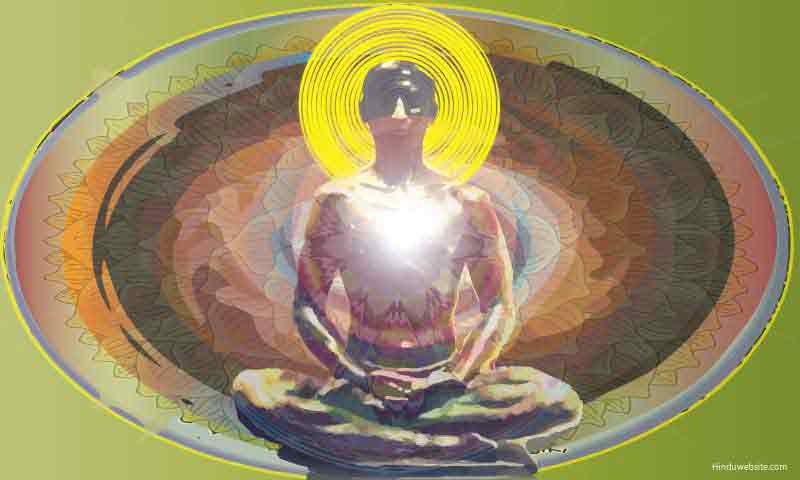
This essays explores the practice of dhyana or meditation in Hinduism, from a historical perspective, based on the Hindu scriptures such as the Veda Samhitas, the Upanishads, the Bhagavadgita and the Tantra shastras, with a brief analysis of meditation practices of Jainism and Buddhism
The purpose of meditation or dhyana is to become consciously aware of or investigate into one's own mind and body to know oneself. It is essentially an exclusive as well as an inclusive process, in which one withdraws one's mind and senses from the distractions of the world and contemplates upon a chosen object or idea with concentration. It is focused thinking with or without the exercise of individual will, in which the mind and the body has to be brought together to function as one harmonious whole. With the help of meditation we can overcome our mental blocks, negative thinking, debilitating fears, stress and anxiety by knowing their cause and dealing with them.
In dhyana we gain insightful awareness whereby we can control over our responses and reactions. Through its regular practice, we come to understand the nature of things, the impermanence of our corporeal existence, the fluctuations of our minds, the source of our own suffering and its possible resolution. The difference between meditation and contemplation is mostly academic. According to, some meditation is an insightful observation and contemplation a concentrated reflection, with detachment being the common factor between the two. In this essay both the words are used interchangeably to convey the same meaning as dhayna.
Dhyana is a Sanskrit word. "Dhi" means receptacle or the mind and "yana" means moving or going. Dhyana means journey or movement of the mind. It is a mental activity of the mind (dhi). In Hindu philosophy, the mind (manas) is viewed as a receptacle (dhi) into which thoughts pour back and forth from the universal pool of thought forms. According to Hindu tradition, the human mind has the creative potency of God. You become what you think. You are a sum total of your thoughts and desires, not only of this life but also of your past lives. What you think and desire grows upon you, becomes part of your latent impressions (samskaras) and influence the course of your life here and here after. These samskaras determine the future course of your lives as they accompany you to the next world. All your mental actions are part of your karma as much as any physical action. Even the animals have the ability to evolve into higher being through their mental focus1.
Meditation is observing the inward and outward movement of thoughts that are coming and going out of the mind, with silence (maunam), stability (dhiram) and detachment (vairagyam). According to Hindu theories of creation, all the beings and worlds emanated from God (mentioned as Brahma in some scriptures and Brahman in others) through meditation only. Its mysteries and its dimensions can be comprehended in transcendental states of self-absorption which is possible through meditation only. Since each individual is a carbon copy of the universe, by understanding ourselves we can understand the manifest universe. Thus our ancient rishis practiced meditation and contemplation to discover the truths concerning themselves and the world around them. In their deep meditative states they envisioned the Vedic wisdom and Universal Self. Since the knowledge poured forth into their receptive and stabilized minds from the universal consciousness, on its own, without any egoistic intention or selfishness on their part, it is considered as not man made (apaurusheya), but divine and truthful (pramana).
All thoughts and knowledge exist in the universe. We do not create thoughts, although we erroneously believe so, just as we are not the real doers of our actions, as declared in the Bhagavadgita, but mere instruments in the hands of God. We can only receive them and make meaning out of them according to the flow of our inclinations, intentions, intellect and attitudes. The most exalted spiritual truths are revealed to us in our moments of reverential silence, when our minds are focused, the senses and the self-sense are asleep and the desires are extinguished. The six Hindu schools of philosophy are so called darshanas (visions) because they are products of such receptive process in which knowledge was envisioned (darsanam) in the pit of the human mind that was untainted by the impurities of worldly life. While the followers of respective schools may argue or quarrel about the merits and demerits of their respective systems of philosophy, from a spiritual perspective, we hold them to be different standpoints of the same universal knowledge revealed to man at different points of time in history, and like any other standpoint they represent a particular view of the reality and do not wholly represent the universal reality itself, which is well rounded, eternal, infinite and absolute in itself without divisions, grades and contradictions.
The Vedic seers did not use the word dhyana in the early Vedic theology. But through their own personal experience, they were aware of the importance of the mind and its ability to manifest things. They viewed creation as the mental manifestation of the Isvara or Brahman, the universal Self and they believe through austerities and penances man could acquire similar potencies. The creation of an alternate heaven(trisanku) by sage Viswamitra is a case in point. According to Jenine Miller, a British scholar, the Vedic prayer was a form of dhyana in which the two sense functions, "vision and sound, seership and singing are intimately connected."2
The Vedic concept of dhayna or meditation seems to have evolved gradually with the emergence of Upanishadic thought and the idea that man personified the entire universe within himself and by himself and that hidden deep within him was an eternal principle that was Universal Self in its individual aspect. Either man (purusha) was a projection of the universe in its own mode or the universe was a projection of the individual self (purusha) in its own form. Both views enjoyed patronage of scholarly minds. If the former was true, our existence was ephemeral and part of a much larger dream, and If the latter was true, then the universe might be an illusion. In either case the world seemed to be unreal or illusory, a view that caught the attention of Hindu scholars for centuries and found its way into the monistic (advauta) philosophy of Shankara.
Miller proposed the view that in the beginning the Vedic seers held Brahman to be a meditative state, not a universal entity. She suggested that the Vedic seers practiced three different types of meditation and were familiar with three states of transcendental reality, which they identified with Brahman. In addition they were also familiar with the forth state although it was not explicitly mentioned in the early Vedic hymns. They are:
- Mantric meditation or meditation on the Vedic mantras with concentration,
- Visual meditation or meditation on a particular deity with illumined thought,
- Absorption in mind and heart or meditation on illumined insight residing in the mind and the heart.
- Samadhi or the experience of the ecstatic state of Brahman was the fourth state of Brahman, which is not mentioned in the Rigveda but described in the Mandukya Upanishad as the Fourth state (turiya)..
The early Vedic hymns may not mention the word dhyana or dharana explicitly, but we have indications in the scriptures to believe that the Rigvedic seers were familiar with contemplative and meditative methods of self-enquiry. The Upanishads are not speculative works of human imagination, but revelatory scriptures envisioned by the Seers as they were exploring the riddles of human existence. Similarly the Vedic hymns, constituting the samhitas, were transmitted to them in deep meditative states.
Apart from the Seers and Rishs, the Vedic texts mention many types of ascetics, including kesins,3 the long haired ones, who appear to have practiced some kind of breath control, with elements of shamanism, mantra and tantra yoga, and had the ability to display some siddhis (perfectiosn) such as levitation. Vratyas were another group of ascetics, outside the pale of Vedic society, who seem to have been treated rather unfairly by the Vedic scholars and who practiced austerities and esoteric rituals, some of which found their way into Hinduism possibly through Saivism.
Descriptions of meditation practice in the Upanishads
In the Upanishads words such as dhaya, dhvai, manta, drsti, mati are used to denote meditation4. Tapas was a more popular spiritual practice in which meditation formed part of a set of austerities and penances that were aimed to generate bodily heat or inner fire to burn away the impurities of the mind and the body. Tapas was rooted in Vedic tradition, a system by itself, having its own body of practices, which thrived prior to the emergence of the classical yoga as a standard spiritual practice. It was practiced by many seers and sages of the Vedic and epic age, who believed that tapas was the source of the creative potency even in case of gods. According to the Rigveda, the word emanated from the primordial Being by the great heat of austerity (tapas)5 Another word that is used in the Upanishads frequently to denote meditation is "upasana", a meditative practice that seems to have gradually evolved into dhyana. Compared to upasana, dhayana is a more concentrated and meditative practice without the outward ritual component and the devotional fervor. The word upansana is used in the Upanishads in a boarder sense to denotes ritual worship or service, with or without the employment of udgita (Aum), ritual chants or sacrificial mantras. The practice seems to have developed with the evolution of the Vedic thought, as is evident in the Briahdaranyaka Upanishad, one of the earliest Upanishads, which led to the identification of the human body with the cosomos6, internalization of Vedic ritual and internal worship, through contemplation, of various divinities such as the vital breaths, fire, water, speech, mind, the eyes, the body and the consciousness, each representing a particular aspect of the manifest creation. In this progressive form of meditation, which proceeded from the outer to the inner, worshipping the inmost Self or Brahman was considered to be the best7.
These early ideas gradually gave way to more advanced forms of meditation which sought to control the mind and the body for experiencing various transcendental states of consciousness. The knowledge of these states was kept confidential and expressed mostly in symbolic terms. Brahman was now recognized as the highest and supreme Reality rather than mere meditative state. The realization that beyond all divinities existed the resplendent and inmost Self and that it could be attained by withdrawing the outgoing senses, stabilizing the mind and concentrating upon the inmost Self, gave way to the emergence of dhyana as an essential and useful contemplative technique. In this process, silence (mauna) and renunciation of worldly life were the contributing or facilitating factors8.
The Chandogya Upanishad
The Chandogya Upanishad reflects this progressive development in the Vedic thought. The Upanishad views meditation or contemplation (dhyna) as a journey into oneself till one reaches the reality that is permanent, reliable and beyond which there is nothing else to be found or realized. It explains the various ways in which one can meditate upon Aum (udgita). In a conversation between Narada and Sanatkumara, which is recorded in the Upanishad, the latter explains the progressive forms of meditation (upasana) upon the various aspects of the mind and the body, from the outer to the inner, in order to overcome suffering and realize the true nature of Brahman. He begins by saying that one should meditate (upasana) upon the name (nama) as Brahman, then the speech (vak), then the mind (manas), then the cit consciousness (citta), then contemplation (dhyana), then intelligence (vijnanam), then strength (balam), then food (annam), then water, then heat, then ether and so on. Each of these methods of meditations said to result in some specific benefit.
The following verse from the Upanishad9 envisions the whole universe and its constituent parts being in a state of deep meditation.
"Contemplation is assuredly greater than thought. The earth contemplates as it were. The atmosphere contemplates as it were. The heaven contemplates as it were. The waters contemplate as it were, the mountains contemplate as it were. Gods and men contemplate as it were. Therefore he among men here attains greatness, he seems to have obtained a share of (the reward of) contemplation. Now the small people of quarrelsome, abusive and slandering, the superior men have obtained a share of (the reward of) contemplation. Meditate on contemplation."
The verse identifies stability or firmness as the outcome of contemplation (dhyana), a concept that became the focal point in the subsequent scriptures such as the Yogasutra and the Bhagavadgita. According to the Upanishad, contemplation is better than routine thinking because the former leads to stability while the latter leads to disturbances. The earth and the mountains are firm and stable because they are forever immersed in meditation. So men too can achieve greatness and firmness through contemplation. Ordinary people have no control on their minds so they speak carelessly. But superior men control their thoughts and speech because of contemplation.
The Katha Upanishad
The Katha Upanishad10 also suggests a similar approach by emphasizing the need to stabilize the mind through the practice of self-contemplation (adhyatma yoga) to overcome both joy and sorrow and realize Brahman who is difficult to be seen (durdasam), deeply hidden (gudham), inside a cave (guhatitam) and dwells in the deep (gahvarestham).
Realizing through self-contemplation that primal God, difficult to be seen, deeply hidden, set in the cave (of the heart), dwelling in the deep, the wise man leaves behind both joy and sorrow.
The Svetasvatara Upanishad
The Svetasvatara Upanishad, with its definitive leanings towards Saivism, mentions the word "dhyana-yoga" in one verse11 and "dhyana" in two verses suggestive of the changing times and the systematization of the knowledge of yoga. It declares that those who practiced dhayna-yoga saw the self power of the divine (devatma sakti) hidden in His own qualities (sva gunair nigudham) as the first cause (karanam) of creation, which they understood in their contemplative mode12 as a rotating wheel having fifty spokes (energies), three tires (qualities) and one hub (Isvara or God). In creation there is perishable matter (pradhana) and imperishable Lord (Hara). By meditating upon Him, uniting with him and reflecting upon Him one is freed from illusion of the world (maya nivrittih)13.
The Upanishad also explains how meditation should be performed. It is by using the body as the lower friction stick (arani) and the syllable aum (pranava) as the upper friction stick one may see hidden God (devam) in meditation. This effort has to be accompanied by truthfulness (satyam) and austerity (tapas). According to the Upanishad, yoga of which dhyana is an important component, is a cleansing process. Just as a mirror covered with dust is able to reflect well when it is cleaned, when through yoga we overcome the illusion and ignorance we have about ourselves and our existence, we are able to discern the Universal Self hidden in all as the source of all and transcend death.
Maitri Upanishad
According to Maitri Upanishad, Prajapati Brahma, the creator god, being alone and unhappy, meditated upon himself (atmanam abhdhyat) and differentiated himself into diverse beings. When he found them to be lifeless and inert like stone, he entered into them and divided himself into five breaths and the internal fire (vaisvanara). Then, residing in the heart, he pierced five openings in each body and through them began enjoying things using the five senses as his reigns. The Upanishad further states that when the soul resides in the body and mind which is made up of the elements, it is known as the elemental-self (bhutatma). The elemental-self does not remember its highest state (parama padam) because of ignorance. It becomes free from such an evil existence (papam) only when it gains the knowledge of Brahman (Brahma vidya) through the triad, namely knowledge (vidya), austerity (tapas) and meditation (cinta). The Upanishad distinguishes two types of Brahman, the one with form and the other without form. Of the two, the formless Brahman is real, upon whom one should meditate as Aum to become united with Him.
The Six fold Yoga
Apart from the three fold practice mentioned above, the Maitri Upanishad prescribes six fold yoga (sadanga yoga) for the liberation of the elemental soul from both good and evil. It consists of control of breath (pranayama), withdrawal of the senses (pratyahara), meditation (dhyanam), dharana (concentration), logical enquiry (tarka) and self-absoprtion (samadhi). In contrast to the classical yoga of Patanjali, in this yoga, concentration (dharana) comes after dhyana. Probably in this system dhyana means passive meditation and tarka means concentrated meditation. According to S.Radhakrishnan, it is contemplative enquiry or reflective self-absorption (savitarka samadhi ). "It may also mean an enquiry whether the mind has become transformed or not into object of meditation or investigation into the hindrances of concentration caused by the inferior powers acquired by meditation."15. The Upanishad mentions a higher concentration technique (parasya dharana) of seeing Brahman through contemplative thought (tarka), known as lumbika-yoga. It consists of holding the tip of the tongue down the palate, restraining the speech, the mind and the breath and seeing the (shining) self through the (elemental or impure ) self.
The Paingala Upanishad
The Paingala Upanishad distinguishes four kinds of spiritual practice to attain Brahman and explains the purport of each. They are hearing (sravanam), reflection (mananam), meditation (nidhidhaysanam) and self realization (atma darsana). Investigation into the meaning and purpose (vakyartha vicara) of the Vedic mantras such as "Thou art That," and "I am Brahman," constitute hearing (sravanam). Paying undivided attention to what is being being heard is reflection. Concentrating the thought solely on what has been understood through hearing and reflection is meditation. When the distinction between the subject and the object disappears in the heightened state of concentration, it is called cognition of the self (atma darsana). With it all the karmas become destroyed and one experiences a shower of supreme bliss coming from thousand directions. The wise call such a state as dharma megha samadhi (self-absorption of the virtuous kind). As all the impurities are removed and the past and present karmas are neutralized, the knower of Brahman becomes a liberated being (jivan mukta). When the time of his departure from this world comes, he leaves his embodied state and enters into the supreme state of non-movement (aspandatam), which is eternal, devoid of sensations, constant, alone and perfect.
The Kaivalya Upanishad
The Kaivalya Upanishad emphasizes the importance of devotion in the practice of yoga and meditation. It identifies faith (sraddha), devotion (bhakti), meditation (dhyana) and concentration as the means to know Brahman who is equated with Siva. One should meditate upon the lotus of the heart which is pure, without passion, where in lies the source of Brahma who is eternal. blue throated and companion of Uma.
The Bhagavadgita
In the Bhagavadgita, Lord Krishna touches upon the subject of dhyana on many occasions during the course of his long conversation with Arjuna. Verses 10 to 16 in the 6th chapter entitled, Dhayana Yoga, explain how and in what conditions a yogi should subdue his mind through concentration. Living alone in solitude, in a clean place covered with kusa grass, a deer skin and a cloth, one over the other, on a firm seat, a yogi, who is pure and self-controlled, without desires and free from possessions, should sit with his body, head and neck erect and concentrate his mind upon the tip of the nose. With concentration and subdued mind, he eventually attains lasting peace. So although the chapter is entitled the yoga of meditation (dhyana yoga), it basically speaks about the practice of concentration to control the mind and the senses. The same chapter defines yoga as disconnection from union with pain16. In Chapter 12 meditation is described to be superior to knowledge and renunciation of the fruit of action better than meditation from which peace follows immediately17. In Chapter 13 it is said that through dhyana one can see the Self in the Self by the Self18.
Dhyana in the Bhagavadgita
Dhyana is an important limb of the eightfold (ashtanga) yoga of Patanajali, whose work the Yogasutra, considered to be the most authoritative ancient treatise on Yoga, presents the practice of Yoga in a systematic and orderly manner. The eight limbs of yoga are inter related and are not meant to be practiced in isolation. The purpose of yoga is to control the fluctuations of the citta and facilitate its stability by cultivating purity (sattva) through a cleansing process so that one can become absorbed in oneself and realize his true identity. Of the eightfold yoga, meditation (dhyana) is penultimate limb, preceded by yama, niyama, pranayama, pratyahara, asana, dharana and followed by samadhi. All the limbs are important and complimentary. In other words success in meditation depends upon the progress achieved in other areas, especially the ones preceding it in the order. So is the case with samadhi, which is not possible unless there is perfection in all the other areas of yoga. Dhyana is an important component of classical yoga. According to Patanjali stability of the mind can be achieved by practsing meditation of objects that are pleasing to us (Yatabhimata dhyanat va)19. In the third section of the Yogasutra he defines dhyana as the steady (pratyata) and continuous flow of awareness (ekantata) towards the same point20.
The Puranas and the symbolism
The epics and the Puranas are replete with the stories of seers, sages and gods practicing yoga, tapas and other forms of spiritual practices. Some of the stories have deep symbolism, such as the story of the churning of the oceans (sagara manthanam) in which gods and demons come together to churn the ocean to extract the elixir (amrita)21. The story symbolically represents various yogic practices which culminate in immortality. In the story the ocean represents the citta (often referred as the mind stuff or cit consciousness) which is subject to mental fluctuations (citta vrittis). The gods and demons represents the pure and impure thoughts and energies of the mind and the body (the physical realm). the serpent Vasuki represent desire or the vaisvanara fire. The mount mandhara represents concentration (dharana) of the mind (manas). The churning represents the reflective or contemplative process in search of immortality. The poison that emerged during the churning represent the pain and suffering generated from the practice of austerities (tapas). Lord Siva represents the teacher who takes upon himself the suffering of his sincere disciples. The various magical objects that came out of the ocean during the churning represent the various perfections (siddhis) or supernatural powers described in the Yogasutra. Dharana (concentration) is focused bare attention and dhayana is focused meditation.
Dhyana and tantra
Saivism has many sects and each has its own set of techniques and theories of yoga, rooted in the theoretical and philosophical aspects of Saiva religious texts (Agama) and tantras some of which are left handed (vamachara) and some right handed (sadacara). The former use the mind and body, intoxicants, sexual intercourse and socially reprehensible behavior as a part of their self-cleansing process to achieve self-realization. All sects of Saivism and Shaktism worship Siva or shakti or both and aim to achieve union with them through various practices of which meditation or dhyana is an important component. Symbols and images of Shiva and shakti and various mystica diagrams (yantras) used religious worship, meditation and concentration, apart from proper conduct and devotion to keep the mind pure and elevated. The yoga traditions of Saivims go by different names such as hatha yoga, tantra yoga and kundalini yoga. According to Kularnava Tantra, one of the well known texts of Kaula tradtion composed during the medieval period, meditation is of two type coarse (sthula) and subtle (sukshma). The former is meditation on form, usually an object, image or symbol and the latter meditation on the formless, usually an abstract concept or state of Siva as pure and resplendent light, bliss. In both types of meditation, the mind has to become stable or immobile and the distinction between the subject and object shoulld disappear to achieve the ectasic state of self-absorption (samadhi).
Meditation in hatha yoga
Hatha yoga is an important offshoot of Tantrism, which aims to develop the human body, through various ascetic and yogic practices, into a strong diamond (vajra) like and divine body that would be strong and pure enough to house the splendor of Siva or Shakti. When the body is transmuted and filled with light and the higher spiritual energies it becomes a fit vehicle for enlightenment and possession extraordinary powers and abilities (siddhis) such as the will to assume any form and live in the subtle regions in the subtle body at will. Hatha yoga is followed by many traditions of Saivism but it was made popular by the natha tradition established by Gorakshanath who probably lived between 10th and 11th century C.E. Hatha yoga has many features common with the classical yoga but differ from the latter with regard to the intensity and intent of such practices. Hatha yoga used more painful and austere physical posture and cleansing processes to perfect the mind and body and make it fit transcendental experiences. Gheranda Samhita, prescribes six acts of purification for this purpose of which meditation (dhyana) is one. According to it, the postures (asana) make the body strong, the gestures (mudras) make it stable, sense withdrawal (pratyahara) leads to calmmess, breath control (pranayama) brings lightness, dhyana leads to the perception of the self and with samadhi comes the ecstasic union. Dhauli, basti, neti, lauli, trataka and kapala-bhati are the important and more specific techniques suggested by the scripture for cleansing the variuos part of the mind and the body. It also mentions three types of dhyana:
- Visualization of coarse objects (sthula dhyana), considered to be the least effective of all
- Contemplation of Absolute being as the light (tejo dhyana) which is said to be a hundred times better than the above.
- Visualization of subtle objects (sukshma dhayna) such as the essence of the Self, which is said to be the greatest of all and hundred time better than the meditation on light.
The Goraksha Paddathi22 describes meditation as two fold, "composite (sakala) and impartite (nishkala). It is composite owing to differences in performance, and impartite owing to differences in performance," which is also devoid of qualities (nirguna). Meditation has to be practiced by visualizing the various chakras in detail concentrating with focus on the serpent (kunadlini) starting from the base (muladhara) and gradually moving upward to the top of the head (ajna-cakra). "Anus, penis, navel, lotus, the one above that (i.e., the throat), the bell, the place of 'hanger' (i.e.the Uuvula), the spot between the eyebrows, and the space cavity (at the crown of the head)," are the nine locations (sthana) of the body for focusing the mind and practicing visual meditation. It is important to remember that these techniques should not be followed in isolation but in conjunction with the remaining five acts of purification described above.
Jain yoga
Our knowledge of Jain yoga comes to us mainly from the work of writes like Haribhadra Suri ( 8th century C.E). Jain yoga shares some common features with the yoga traditions of Hinduism and probably derived some of the concepts and practices from the classical yoga of Patanjali. has two components:
- a preparatory course (purva seva) meant for the lay followers who have become dissolutioned with their worldly lifes and embarked upon a journey of liberation (apunar bandhaka)
- and the yoga proper meant for the more advanced practitioners, who have advanced on the path and have achieved some degree of right or mixed vision (samyag drishti).
Yoga for the lay followers consists of ritual worship (pujana), proper conduct (sadacara), austerities (tapas), and no negative feelings towards liberation (mukti advesha). Five levels of practice is suggested for the advanced followers: centering in the self (adhyatma yoga), contemplation (bhavana), meditation (dhyana), equanimity (samata), cessation of the modifications (vritii samskhaya) of the consciousness. Dhayna or meditation is to be practiced everyday one or more times, but at least once for 48 minutes, by all followers of Jainism as per the techniques prescribed in their tradition.
Dhyana in Buddhism
The purpose of yoga in Buddhism to cultivate right attentiveness of the mind and the body and control the movements of the mind so that we can experience peace and equanimity (samatha). Buddhism does not believe in the existence of soul. So unlike in classical yoga or in Hinduism, annihilation of the ego-sense or the ephemeral and aggregate personality rather than realization of the self is the ultimate goal of Buddhist yoga. Through meditation practitioners of Buddhism aim to develop insight into themselves, how they think and act motivated by various desires and subject themselves to suffering in numerous ways. Thus, understanding and awareness or insight and mindfulness are the two important elements of Buddhist dhyana. Balance or the middle approach is another important aspect of this practice so that we will neither over indulge nor neglect our duty to meditate regularly. As regards to the postures (asanas), breath control (pranayama ), with drawl of the senses (pratyahara), methods and meditation and states of self-absorption, there is a correlating between the yogic practices of Buddhism and Hinduism. But as we have already said, the difference lies mainly in the intent and the ultimate purpose of all of the practices.
In truth, in Buddhism, every aspect of the mundane life, every activity and movement of the mind and the body can be an object of meditation. Various techniques are followed to cultivate insightful awareness and end suffering, such as tranquility (samatha) meditation, insightful (vipassana) meditation In samatha meditation a meditator sits in a quietly place, closing his eyes and calmly and rather passively lets go of his thoughts and desires with detachment, with his attention focused on his breathing. Whenever his attention is strayed, he brings it back to his breath. Regular practice of this meditation said to result in calmness of the mind (samatha). Insight meditation,. also known as vipassana meditation, involves a deep exploration of all the movements that arise in the consciousness with mindfulness and detachment. When a mediator becomes mindful of the contents of his mind, he develops a deep understanding of the source of his suffering and the impermanence of the world and eventually experiences peace. Sitting meditation and walking meditation are other popular forms of meditation in Buddhism.
Conclusion
There is an attempt on the part of some scholars to disassociate yoga and its practices like meditation from Hinduism and paint them either as non-religious or secular in nature. Yoga and its various practices have been part of Hindu tradition since the early Vedic times, long before Patanajali systematized them in his Yogasutra and the followers of Buddhism followed their meditation techniques. One should not overlook the fact that even Zen Buddhism came to China and Japan from India through Bodhidharma and the word "Zen" originated from the word "dhyana,23" which was a Sanskrit word of Hindu origin. Many ascetic traditions, including those of Jainism and Buddhism followed different versions of Yoga practiced in India since ancient times. They originated essentially from the Hindu traditions, both Vedic and non-Vedic, starting from the munis and rishis who received the knowledge of the Veda Samhitas and the Upanishads and groups like the Vratyas and the Kapalikas who were outside the pale of Vedic society. Dhyana is not meant to be practiced in isolation but as a part of various other practices which are meant to prepare the mind and the body to experience altered states of consciousness and assimilate higher forms of energy without side effects.
Suggestions for Further Reading
- The yoga techniques and practices
- Yoga's Best Kept Secrets, Citta, Purusha, Prakriti And Liberation
- The Concept of Chakras or Energy Centers Of The Human Body
- The History, Practice, Benefits and Types of Yoga
- Samkhya and Yoga in Hinduism and Buddhism
- How is meditation like cooking?
- Anapana Sati, Meditation on Breathing
- Anapanasati Sutta Mindfulness of Breathing
- The Power of Mindfulness
- Basic Breath Meditation Instructions
- Bring Concentration Into Your Daily Life Right Now and Right Here
- A Series of Lessons in Raja Yoga by yogi Ramacharaka Index
- The Meaning and Significance of Heart in Hinduism
- The Origin and Significance of the Epic Mahabharata
- The True Meaning of Prakriti in Hinduism
- Three Myths about Hinduism
- What is Your Notion of God?
- Why Hinduism is a Preferred Choice for Educated Hindus
- Essays On Dharma
- Esoteric Mystic Hinduism
- Introduction to Hinduism
- Hindu Way of Life
- Essays On Karma
- Hindu Rites and Rituals
- The Origin of The Sanskrit Language
- Symbolism in Hinduism
- Essays on The Upanishads
- Concepts of Hinduism
- Essays on Atman
- Hindu Festivals
- Spiritual Practice
- Right Living
- Yoga of Sorrow
- Happiness
- Mental Health
- Concepts of Buddhism
- General Essays
Footnotes
6. Brihadaranyaka Upanishad Chapter 1 and Chapter 2
7 Brihadaranyaka Upanishad Chapter 2, First Brahmana.
8. Briahdaranyaka Upanishad 3.5.1
9. Briahdaranyaka Upanishad 7:6
15. The Principal Upanishads, S.Radhakrishnan
16. Dukha samyoga viyogam yoga samjnitam
17. Bhagavadgita, Chatper 12, Verse 12.
18. Bhagavadgita, Chapter 13, Verse 24.
20. Yogasutra tatra pratyaya ekanta dhyanam (3.2)
21. Sagar Manthan - Symbolism of The Churning Of The Ocean, by Jayaram V https://www.hinduwebsite.com/churning.asp
22. Goraskha Paddathi, Translation as publised in the The Yoga Tradition, Its History, Literature, Philosophy And Practice by George Feuerstein
23. The word "zen" is Japanese, derived from the Chinese word chanan-na, which in turn is a corrupted form of dhyana.