Brihadaranyaka Upanishad, Chapter 1.1.2
Ch:1.1.1 | Ch:1.1.2 | Philosophy
2. ahar va asvam purastan mahima nvajayata. tasya purve samudre yonih, ratrir enam pascan mahima nvajayata, tasyapare samudre yonih, etau va asvam mahimanav abhitah sambabhuvatuh hayo bhutva devan avahat, vaji gandharvan, arvasuran, asvo manusyan; samudra evasya bandhuh, samudro yonih.
Meaning
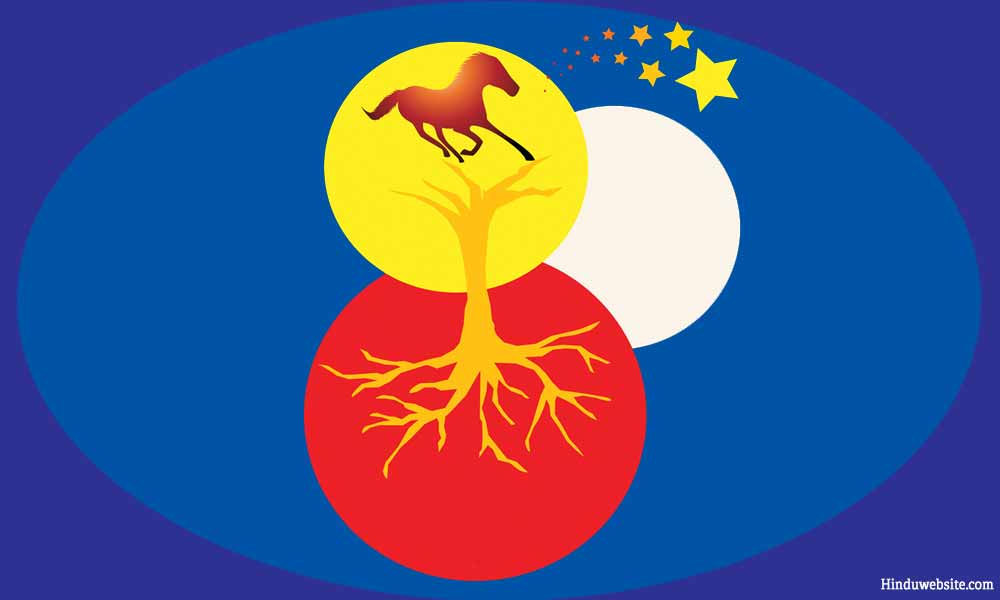
The sacrificial golden vessel called Mahiman placed in front of the horse is clearly the day. Its source is (in) the eastern sea. The night is the sacri-ficial silver vessel called Mahiman placed behind the horse. Its source is (in) the western sea. These two, called Mahiman, appeared on both sides of the horse. Having become Haya, it carried the gods, as Vaji the celes-tial beings, as Arva the demons and as Asva the humans. The sea is its relation, and the sea is its womb.
Commentary
In the previous verse, the emphasis was on the bodily parts of the sacrificial horse. Here, it is on the ritual elements or the utensils used in the sacrifice. In the horse sacrifice, as per tradition, they used to place two sacrificial cups, one gold and one silver, on the front and back sides of the sacrificial horse. Water in these cups was used for different purposes. The golden cup is compared to the day because it has the color of the sun and the silver cup to the night because it has the color of the moon. The horse represents the body of the Cosmic Self as well as the body of all beings in all the worlds. Hence, it is giv-en different names in different worlds, namely Haya, Vaji, Arva, and Asva. Shankara interpreted samudra as the Supreme Self and trans-lated the last line as,” The Supreme Self is its stable, and the Su-preme Self (or the sea) is its source.”