The Brihadaranyaka Upanishad - Chapter 1.1.1
Ch:1.1.1 | Ch:1.1.2 | Philosophy
1. aum! usa va asvasya medhyasya sirah, suryas caksuh, vatah pranah, vyattam agnir vaisvanarah; samvatsara atmasvasya medhyasya, dyauh prstham, antariksam udaram, prthivi pajasyam, disah parsve, avantaradisah parsavah, rtavongani, masas cardhamasas ca parvani, ahoratrani pratisthah, naksatrany asthini, nabho mamsani; uvadhyam sikatah, sindhavo gudah, yakrc ca klomanas ca parvatah, osadhayas ca vanaspatayas ca lomani, udyan purvardhah nimlocan jaghanardhah, yad vijrmbhate tad vidyotate, yad vidhunute tat stanayati, yan mehati tad varsati; vag evasya vak.
Meaning
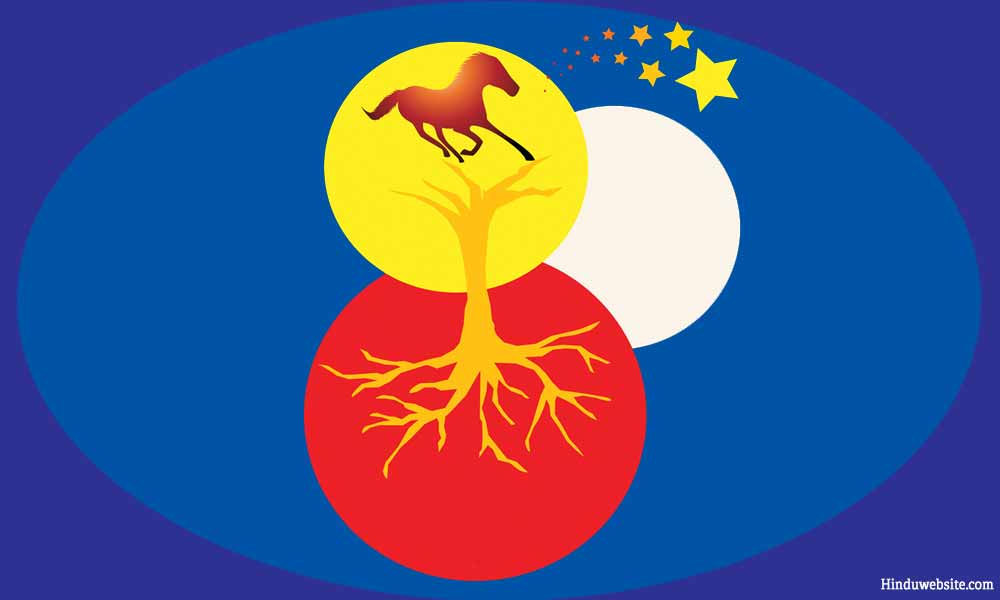
Aum! The dawn is the head of the sacrificial horse. The sun is its eyes, the wind is its vital breath and the vaisvanara fire is its open mouth. The year is the very body of the sacrificial horse, the outer space is its back, the sky is its belly, the earth is its hoof, the quarters its sides, the intermediate quarters it ribs, the seasons its limbs, the months and half-months its joints, days and nights its feet. The stars are its bones, the clouds its flesh, the sand its food in the stomach, the rivers are its blood vessels, the mountains are its liver and lungs, the herbs and trees its hair. The rising sun is its anterior; the setting sun is its posterior. When it yawns, then lightning; when it stirs then thunder; when it urinates it rains; and when it makes noise it is speech itself.
Commentary
The sacrificial horse is compared to the entire material manifestation. It is compared part by part to Purusha, the Cosmic Self. This is the description of a horse that was part of an ancient Vedic ceremony called the Horse Sacrifice (Ashvamedha Yajna), in which it would eventually be killed and deified to signify the divine authority the king commanded as the earthly representative of Prajapati himself. Horse sacrifices were common in ancient India when the kings of the original Kshatriya clans ruled the land. By all means, it was an ancient Vedic tradition that is now defunct. It was customary for the kings to perform this sacrifice to extend their empires and conquer new lands. The horse was set free to herald their intention to launch the conquest, using it as the symbol of their royalty, authority, sway, and lordship. The ritual usually lasted until the king concluded his conquest and returned to his capital, having established his divine authority and sovereignty.
At the beginning of the sacrifice, the king who intended to host the sacrifice would choose an able horse and set it free in a public ceremony, declaring his intent to conquer new lands. Once the horse was decorated and set free with royal fanfare, he and his army would follow it as it galloped into the open country and pasture lands according to its will. Whatever places it passed through, the king would claim them as a part of his conquered territory. If anyone caught the horse and held it captive, it signaled that his sovereignty was challenged and he must prove his prowess by fighting the opposing party. At the end of the expedition, if the king remained unopposed or survived all the challenges and remained victorious, he would return from the conquest with the sacrificial horse and formally complete the concluding part of the sacrifice by performing a ceremony along with his queens in which he would formally and ritually sacrifice the horse under the guidance of the royal priests. The meat from the sacrificial horse would be consumed by the king, his queens, and his relations. By that sacrifice, the king would consolidate his position as the lord of the four directions, just as the all-pervading Brahman, the Lord of the universe, symbolically represented by the horse. Brahma Prajapati, who was the chief deity of the Kshatriyas during their heydays, figures prominently in this Upanishad as the Cosmic Being (Purusha). The Horse sacrifice was thus an ancient Vedic tradition practiced by kings, which vested them with the divine power and authority of Brahman, the lord of the sacrifices with unsurpassed strength and power. The practice fell into disuse subsequently, as the ancient lineages of kings and their dynasties perished.
The symbolism of the sacrifice has been well documented in this section of the Brihadaranyaka Upanishad. The horse is compared to Brahman. Like the horse, Brahman has four feet or four quarters. Like the horse, Brahman is swift and moving. Like the horse, Brahman is the support for the king and his lands. Like the horse, Brahman also underwent a self-sacrifice. Just as the horse carries the intention of the king across the earth, Brahman carries the intentions of the sacrificer across the space to heaven. With the sacrifice of the horse, the king attained sameness or oneness with Brahman as the Lord of the Four Directions with unsurpassable power and glory.
Spiritually speaking, a Vedic sacrifice is a creative and transformative process. Through the sacrifices, you seek divine help to increase your powers or manifest your desires and wishes. Through the sacrifices, you also transform yourself and your life and destiny with the help of the gods. Through sacrificial actions, you enter into the realm of Brahman and end your association with Nature and the mortal world and the possibility of another birth. The horse sacrifice deified the horse as well as the king who performed it. Through the sacrifice, a worshipper also elevates all the offerings to the level of the Cosmic Being since the Cosmic Being Himself is the sacrificed and the sacrificer in every sacrifice. The same happened in the case of the horse also. Through sacrifice, the horse, the offering, became the Cosmic Being (Brahman or Purusha) and the worshipper, too, as the sacrificer. The horse represented the materiality or the corporeality of the creation. It was the body of the Cosmic Being, the mighty Purusha, who spread across the endless empyrean. It was the Prajapati Himself who used parts of Himself to manifest creation.
The comparison is usually called Nasya. The sacrificial horse is laid down in an easterly direction, with its head towards the east and tail to the west. Vaisvanara fire is the fire in the body, which is responsible for the body’s warmth and its various functions. Its visible aspect is speech. Its hidden aspect is digestion. Its subtle aspect is breath or the flow of prana. The year is viewed as the body of Kala (Time) since it has months as its organs, parts, or divisions. Dhyau is heaven, beyond the sky. The sky is actually the mid-region. Since it is hollow, it is compared to the belly. The horse’s bones are compared to the stars because they are white like them. The clouds are compared to the flesh because clouds have water, while flesh has blood and water.