
Nataraja, The Lord of the Cosmic Dance
Synopsis: According to the author, the image of Nataraja is an iconic representation of the whole of Saiva Siddhanta School of Saivism that gained popularity in Southern India as early as 3rd Century B.C.
Nataraja literally means lord of the dance. Siva is the lord, the ultimate and effective cause of all creation and the dance is his act of creation, a dynamic rhythmic movement. His dance is a guided action, under his complete mastery, not an act of chaotic, random movements. The lord and the dance together constitute the projection of the Paramasiva, the highest eternal and formless Nirguna Brahman on the canvas of his own awakened state as Saguna Brahman.
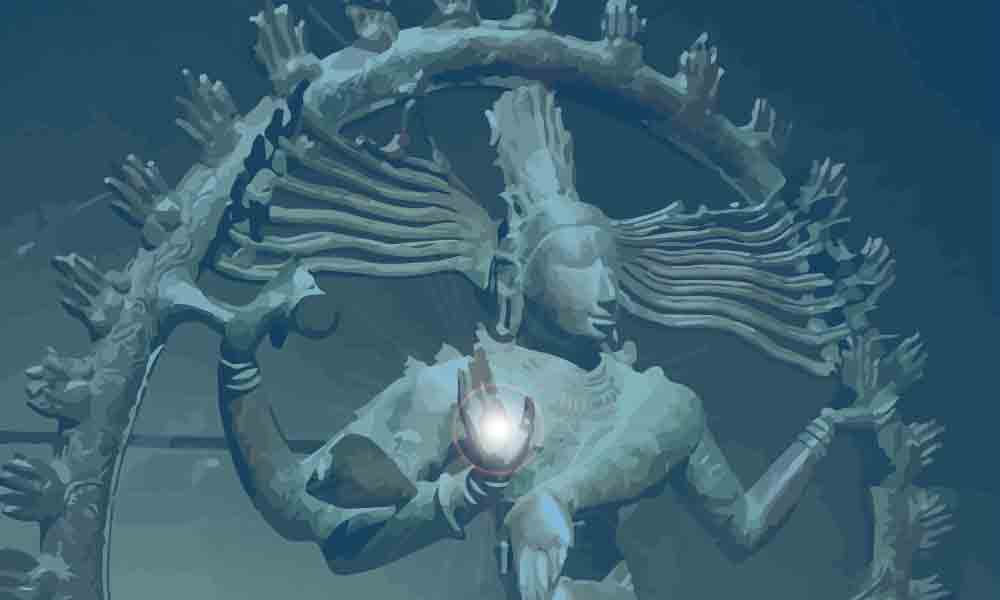
Every aspect in the image of Nataraja represents an aspect of creation. The lord is surrounded on all sides by a circular ring of fire. The ring represents the whole of creation. It is finite, cyclical and filled with energy or Shakti shown here as flames. It ensues from the hands and limbs of the Lord suggestive of the fact that he is the primal and effective cause of all creation.
Nataraja holds a tongue of flame in his upper left hand. The fire represents the energy that is responsible for creation and also the dissolution of the worlds at the end of creation. As a creator he creates, upholds and also destroys the worlds.
The upper right hand holds a drum or damaru which is a musical instrument that produces rhythmic sounds. It is suggestive of the sound of breath, the sound of life, the vibrations underlying all currents of creation and manifestation. It also represents the vibrations that arise from our thoughts, emotions, mental activity, movement of the senses and the very samsara with all its constituent tattvas in which the jivas continue their existence till they find an escape.
The lower left hand is held in an assuring mode (abhaya-mudra) suggesting that the jivas need not have to despair and that they can escape from the impurities of samsara (anava, karma and maya) and achieve sameness (saujya) with Siva through his grace (anugraha) and intervention. The second right hand is shown pointing towards the downside with the palm upside drawing our attention to the figure lying beneath his feet suggesting that the lord is not holding anything back but revealing the knowledge of creation and the secrets of our bondage so that jivas can find means of escape through the assurance they find in his lower left hand.
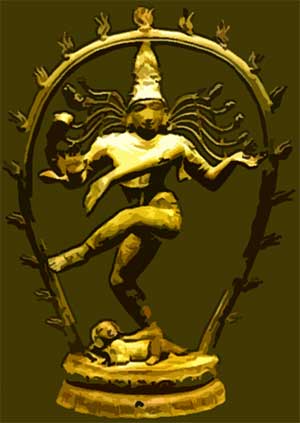
The matted hair of Siva is shown as flying high and flowing in all directions. These are the symbols of divinities or the higher gods and energies who live in the higher realms and participate in the cosmic dance enacted by Lord Siva. The tiger skin worn by the deity suggests that even God has respect for the rules of right conduct and the dharma he has established in the manifest creation for the guidance of the souls. The snake around his waist enjoying the dance with a raised hood is suggestive of the kundalini-shakti that remains ever awakened in Siva and is in unison with him.
The dwarf lying at the feet of the dancing Nataraja is known as apasmara-murthy. It symbolically represents the jiva that has forgotten about its own infiniteness and its Siva nature because of the impurity of anava which makes it believe to be a dwarf or anu (atomic or minute or finite being) and become a subject of the dance of creation.
Thus we can see that the image of Nataraja is an iconic representation of the whole Saiva Siddhanta philosophy, one of the most ancient schools of Saivism that gained popularity in southern India, also the place from where the images of Nataraja emerged. The various aspects of the image represent the nature of Siva, the act of creation, the state of the jivas and the means of liberation. By creating it or serving it or by contemplating upon it one can initiate the process of liberation through the grace of Siva, who usually comes to you in the form of an enlightened Guru.
Suggestions for Further Reading
- Aspects of Lord Shiva
- Saivism or Shaivism - Basic Concepts
- Shaivism Literature
- Mantra and Yoga
- Nataraja, The Lord of the Cosmic Dance
- What Shankara Means?
- Shaivism Sects
- Siva and Bhavani
- Devotional Prayers to Lord Shiva
- Significance of Lord Shiva
- Shaivism Links, Websites and Resources
- Famous Saints of Saivism
- The Worship of Lord Shiva
- History of Shaivism, Lord Shiva in Vedic Literature and Recorded History
- Methods of Worship in Shaivism
- Hindu Gods - Lord Ganesha
- Gods and Goddesses of Hinduism
- About Goddess Parvathi or Shakti
- Quotes on Religious Tolerance in Hinduism
- Sects and Sectarian Movements in Hinduism
- Hinduism - The Role of Shakti in Creation
- Hindu God Lord Shiva (Siva) - the Destroyer
- A Critical Study of the Chronology of Siddhas
- Hindu God Murugan, Kumaraswami, Skanda or Ayyappa
- Symbolic Significance of The Hindu Trinity, Brahma, Vishnu And Siva
- Essays On Dharma
- Esoteric Mystic Hinduism
- Introduction to Hinduism
- Hindu Way of Life
- Essays On Karma
- Hindu Rites and Rituals
- The Origin of The Sanskrit Language
- Symbolism in Hinduism
- Essays on The Upanishads
- Concepts of Hinduism
- Essays on Atman
- Hindu Festivals
- Spiritual Practice
- Right Living
- Yoga of Sorrow
- Happiness
- Mental Health
- Concepts of Buddhism
- General Essays