
The Buddha's Life and Teachings
Contents
- § Chapter One - Shakyamuni Buddha
- § Chapter Two - The Eternal And Glorified Buddha
- Chapter Three - The Form Of Buddha And His Virtue
CHAPTER ONE - SHAKYAMUNI BUDDHA
I. THE LIFE OF THE WORLD-HONORED ONE
1. The Shakya clansmen dwelt along the river Rohini that flowed among the southern foothills of the Himalayas. Their King Suddhodana Gautama had transferred his capitol to Kapila and there had built a great castle and had ruled wisely, winning the joyful acclaim of his people. The Queen's name was Maya. She was the daughter of the King's uncle who was also a king of the neighboring division of the same Shakya clan.
For twenty years they had no children, then, after dreaming a strange dream of an elephant entering her side, Queen Maya became pregnant. The King and the people looked forward with joyful expectancy to the birth of a royal child. According to their custom the Queen returned to her own home for the birth, and while on the way, in the beautiful spring sunshine, she rested in the flower garden of Lumbini Park. All about her were Asoka blossoms and in delight she reached out her right arm to pluck a branch and the Prince was born. All expressed their heartfelt delight and extolled the glory of the Queen and her princely child; even Heaven and Earth manifested their joy. This memorable day was the eighth day of April. The joy of the King was extreme as he named the child: Siddhartha, which means, "Every wish fulfilled."
2. In the palace of the King, however, delight was quickly followed by sorrow, for after a few days lovely Queen Maya suddenly passed away. Fortunately her younger sister, Prajapati became the child's foster mother and brought it up with loving care. A hermit, who lived in the mountains not far away, noticing a glory about the castle and interpreting it as a good omen, came down to the palace and was shown the child. He predicted: "This prince, if he remains in the palace after his youth, will become a great King to rule the Four Seas. But if he forsakes the household life to embrace a religious life, he will become a Buddha and the world's Savior." At first the King was pleased because of the prophecy, but later became troubled at the thought of the possibility of his only son leaving the palace to become a homeless recluse. At the age of seven the Prince began his lessons in literature and the military arts, but his thoughts more naturally ran to other things.
One spring day he went out of the castle with his father and they were watching a farmer at his plowing; he noticed a bird flying down to the ground and carrying away a little worm which had been thrown out of the ground by the farmer's plough. He who had lost his mother so soon after his birth, was deeply affected by the tragedy of these two little creatures. He sat down in the shade of a tree and thought about it, whispering to himself: "Alas! Do all living creatures kill each other?" This spiritual wound was deepened day after day as he grew up; like a little scar on a young tree, the sufferings of human life were more and more deeply carved into his mind. The King was increasingly worried as he recalled the hermit's prophecy and tried in every possible way to cheer the Prince and to turn his thoughts in other directions. At the age of nineteen, the King arranged the marriage of the Prince to the Princess Yasodhara, who was the daughter of Suprabuddha, Lord of Koliya castle and a brother of the late Queen Maya.
3. For ten years the Prince was immersed in a round of music, dancing and pleasure, in the different pavilions of Spring, Autumn and Winter, but ever his thoughts reverted to the problem of suffering as he pensively tried to understand the true meaning of human life. "Luxuries of the palace, healthy bodies, rejoicing youth! what do they mean to me?" he meditated. "Some day we may be sick, we shall become aged, from death we can not eventually escape. Pride of youth, pride of health, pride of existence, all thoughtful people must cast them aside." "A man struggling for existence will naturally look for help. There are two ways of looking for help, a right way and a wrong way. To look the wrong way means that, while he recognizes that sickness, old age and death are unavoidable, he looks for help among the same class of empty, transitory things. To look the right way means that he recognizes the true nature of sickness, old age and death, and looks for life in that which transcends all human suffering. In this palace life of pleasure I seem to be looking for help in the wrong way."
4. Thus the mental struggle went on in the mind of the Prince until his twenty-ninth year when his only child, Rahula, was born. This seemed to bring things to a climax and he decided to leave his palace home and seek the solution of his mental unrest in the homeless life of a mendicant. This plan he carried out one night, by leaving the castle with only his personal servant, Channa, and his favorite horse, the snow-white Kanthaka, and even these he left behind him when he had crossed the river at the b ounds of his Father's kingdom. But his mental troubles were not at an end and many doubts beset him. "Perhaps it would be better for me to return to the castle and seek some other solution; then the whole world will be mine." But he resisted these doubts by realizing that nothing worldly could satisfy him. So he shaved his head, carried a begging bowl in his hand, and turned his mendicant steps to the south. The Prince first visited the hermit Bhagava and watched his ascetic practices; then he went successively to Arada Kalama and Udraka Ramaputra to learn their methods of attainment, but after practicing them for a time became convinced that they would not lead him to enlightenment. Finally he went to the Magadha country and practiced asceticism in the forest of Uruvilva on the banks of the Nairanjana river where it flows by the Gaya Castle.
5. The methods of his practice were unbelievably intense. He spurred himself on with the thought that "no ascetic in the past, none in the present, and none in the future, ever have or ever will practice more earnestly that I do." Still, the Prince could not get what he sought. After six years in the forest he gave up the practice of asceticism. He bathed in the river and accepted a bowl of food from the hand of Sujata, a maid who lived in the neighboring village. The five companions who had lived with the Prince for the six years of his ascetic practices looked on with amazement that he could receive food from the hand of a maiden; they thought him degraded thereby and left him. The Prince, thus, was left alone. He was still feeble but at the risk of his life he attempted a final meditation, saying to himself, "Blood may become exhausted, flesh may decay, bones may fall apart, but I will never leave this place until I find the way to enlightenment." It was an intense and incomparable struggle! His mind was desperate, was filled with confusing thoughts, dark shadows overhung his spirit, he was beset with all the lures of evil. But carefully and patiently he examined them one by one and rejected them all. It, indeed, was a hard struggle, that made his blood run thin, his flesh creep, and his bones crack. But when the morning star appeared in the eastern sky, the struggle was over and the Prince's mind was as clear and bright as the day-break. He had found the path to enlightenment at last. It was December the 8th, when he was thirty-five years of age that the Prince became Buddha.
6. From this time on the Prince was known by different names; some spoke of him as Buddha, the Perfectly Enlightened One; some spoke of him as Shakyamuni, the Sage of the Shakya clan; and still others spoke of him affectionately as the Blessed One. He went first to Mrigadava in Varanasi where the five mendicants who had lived with him during the six years of his ascetic life were staying. At first they shunned him, but after he had talked with them, they believed in him and became his first followers. Then he went to Rajagriha castle and won over King Bimbisara who had always been his friend. From there he went about the country living on alms and persuading men to accept his way of life, and men responded to him as thirsty men seek water and hungry men seek food. Two great teachers, Sariputra and Maudgalyayana, and their two thousand disciples came to him. At first the Buddha's Father, King Suddhodana, suffering inwardly from his son's retirement, held aloof, but afterward became his faithful disciple; and Maha-Prajapati, the Buddha's step-mother, and the Princess Yasodhara, his wife, and all the members of the Shakya clan, believed in him and followed him. And multitudes of others became his devoted and faithful followers.
7. For forty-five years the Buddha went about the country preaching and persuading men to follow his way of life, but at last, at Vaisali on the way from Rajagriha to Sravasti, he became ill and predicted that after three months he would enter Nirvana. Still he journeyed on until he reached Pava where he was made critically ill by food offered by Cunda, a blacksmith. Then by easy stages in spite of great pain and weakness, he reached the forest on the border of Kuninagara castle. Lying between two large sala trees, he continued his teachings to his favorite disciples until the last moment. Thus passed into the unknown the greatest of the world's teachers and the kindest of men.
8. Under the oversight of Ananda, the Buddha's favorite disciple, the body was cremated by his friends in Kusinagara castle. Seven of the neighboring rulers under the lead of King Ajatasatru demanded that the ashes be divided among them. The King of the Kunsinagara castle at first refused and the dispute even threatened to end in war, but by the advice of a wise man named Dona, the crises passed and the ashes were divided and buried under eight great monuments. Even the embers of the fire and the earthen jar that had held the ashes were divided and given to two others to be likewise honored.
II. THE FINAL TEACHING OF THE BUDDHA
1. In his final words to his disciples under the sala trees, the Buddha uttered these words: "Make my teaching your light! Rely upon it; do not depend upon any other teaching. Make of yourself a light. Rely upon yourself; do not depend upon anyone else." "Consider your body; think of its impurity; how can you indulge its cravings as you see that both its pain and delight are alike causes of suffering? Consider your soul; think of its transiency; how can you fall into delusion about it and cherish pride and selfishness, knowing that they must all end in inevitable suffereing? Consider all substances; can you find among them any enduring 'self'? Are they not all aggregates that sooner or later will break apart and be scattered? Do not be confused by the universality of suffering, but follow my teaching and you will be rid of pain. Do this and you will indeed be my discples."
2. "My disciples. The teachings that I have given you are never to be forgotten nor abandoned. They are to be treasured, they are to be thought about, they are to be practiced! If you follow these teachings you will always be happy." "The point of the teachings is to control your own mind. Restrain your mind from greed, so shall you keep your body right, your mind pure, your words faithful. Always thinking of the transiency of your life, you will be able to desist from greed and anger and will be able to keep clear from all evil. "If you find your mind entangled in greed and tempted, you must suppress the greed and control the entangled mind; be the master of your own mind. A man's mind may make of him a Buddha, or it may make of him a beast. Being misled by error one becomes a demon; being enlightened one becomes a Buddha. Therefore keep your mind under control and do not let it deviate from the Noble Path."
3. "Under my teachings, brothers should respect each other and refrain from disputes; they should not repel each other like water and oil, but should mingle together like milk and water. Study together, learn together, practice the teachings together. Do not waste your mind and time in idleness and bickering. Enjoy the blossoms of enlightenment in their season and harvest the fruit of benevolence. "The teachings which I have given you, I gained by following the path myself. You should follow the teachings and conform to their spirit on every occasion. If you neglect them it means that you have never really met me. It means that you are far from me even though you are actually with me, but if you accept and practice my teachings then you are very near to me, even though you are far away."
4. "My disciples. The end is approaching, our parting is near, but do not lament. Life is ever changing; none escape the dissolution of the body. Now I am to manifest the Dharma by my own death, the body falling apart like a decayed cart. Do not vainly lament, but wonder at the rule of transiency and learn from it the emptiness of human life. Do not cherish the unworthy desire that the changeable might become unchanging. The demon of worldly desire is always seeking chances to deceive the mind. If a viper lives in your room, if you wish to have a peaceful sleep, you must chase it out. You must break the bonds of worldly passions and get rid of them as you would a viper."
5. "My disciples. The last moment has come, but do not forget that death is but the vanishing of a body. The body was born from parents and was nourished by food, so sickness and death is unavoidable. But the true Buddha is not a human body: it is Enlightenment. A human body must vanish, but the wisdom of Enlightenment will exist forever in the truths of the Dharma, and in the practice of the Dharma. He who sees my body only, is not the one who truly sees me. He who accepts my teachings, is the one who truly sees me. After my death, Truth shall be your teacher. Follow Truth and you will be true to me. "During the last forty-five years of my life I have kept back nothing from my teaching. There is no secret teaching, no hidden meaning, everything has been taught openly and clearly. "My dear disciples; this is the end. In a moment I shall be passing into Nirvana."
CHAPTER TWO - THE ETERNAL AND GLORIFIED BUDDHA
I. HIS COMPASSION AND VOWS
1. The spirit of Buddha is a great compassion and love to save all people by any and all means. It is the spirit of a mother toward her child nourishing and protecting it; it is the spirit that prompts it it to be ill with the sickness of people, to suffer with their suffering. "Your suffering is my suffering and your happiness is my happiness," said Buddha, and he does not forget that spirit for a single moment, for it is the self-nature of Buddhahood to be compassionate. A mother realizes her motherhood by loving her child; then the child reacting to its mothers's love feels safe and at ease. The Buddha's spirit of compassion is stimulating according to the need of a man; man's faith is the reaction to this spirit, and it leads him to enlightenment. Yet the people do not understand this spirit of Buddha and go on suffering from the illusions and desires that spring from their ignorance; they suffer from the karma accumulated by worldly passions, and wander about among the mountains of delusion with a heavy burden of pain.
2. Do no think that the compassion of the earthly Buddha is only for the present life; that was only a manifestation of the timeless compassion of the eternal Buddha that has been operative since mankind first went astray from ignorance. The eternal Buddha ever appears before people in most friendly forms and brings to them the wisest methods of relief. Shakyamuni Buddha was born a Prince among his Shakya kinsmen, he left the comforts of his home to practice asceticism, then by Dhyana he realized enlightenment, he preached it among his kinsmen and finally manifested an earthly death. Yet this was nothing but one of Buddha's manifestations of compassion. The task of Buddhahood is as everlasting as human life is everlasting; and as the depth of ignorance is bottomless, so Buddha's compassion is boundless. When Buddha decided to break from the worldly life, he made four great vows: To save all people; to renounce all worldly desires; to learn all the teachings; and to attain perfect enlightenment. These vows were not original with him, they were but a manifestation of the love and compassion that is fundamental in the self-nature of Buddhahood.
3. Buddha first trained himself to be kind to all animate life and to avoid the sin of killing any living creature, and then he wished for all people that they might have the blessedness of a long life. The Buddha trained himself to avoid the sin of stealing, and then he wished for all people that they might have everything they wanted. Buddha trained himself to avoid impure thoughts, and then with its virtuous deed he wished for all people that they might know the blessedness of a pure spirit and not suffer from unsatisfied desires. Buddha, aiming at his ideal, trained himself to keep free from all deception, and then by its virtuous deed he wishes for all people that they might know the tranquility of mind that follows speaking the truth. He trained himself to avoid all duplicity, and then wished for all people that they might know the joy of fellowship among those who follow his teachings. He trained himself to avoid abusing others, and then he wished for everybody that they might have the peaceful mind that follows living at peace with others. He kept himself free from idle talk, and then wished for everybody that they might know the blessedness of understanding sympathy. The Buddha, aiming at his ideal, trained himself to keep free from greed, and then by its virtuous deed he wished for all people that they might know the peacefulness that goes with freedom from all greed. He trained himself to avoid anger, and then he wished for all people that they might love one another. He trained himself to understand the true significance of things and not to be stupid, and then he wished for all people that they might understand Karma and not disregard it. Thus Buddha's compassion embraces all people and his never lessening desire is for their happiness. He loves people as parents love their children and he wishes for them the highest blessedness, namely, that they might be able to pass beyond this ocea n of life and death.
II. BUDDHA'S RELIEF AND HIS METHOD OF RELIEF
1. It is very difficult for the words of the Buddha spoken on the hither bank of Enlightenment to reach the people struggling in the sea of delusion, so Buddha crosses the sea himself and applies his method of relief. "Now I will tell you a fable," Buddha said. "Once there lived a wealthy man whose house was on fire. The rich man found that the children absorbed in play, had not noticed the fire but remained inside. "The father called to them: 'Run children; come out of the house; hurry!' "But the children did not heed him, so the anxious father shouted again: 'Children; I have some wonderful toys here, come out of the house and get them!' Heeding his cry this time, the children escaped from the burning house." This world is a burning house, but the people unaware that the house is on fire, are in danger of being burned to death. So Buddha in compassion devises ways of saving them.
2. Buddha said: "I will tell you another parable. Once upon a time the only son of a wealthy man left his home and fell into extreme poverty. The father moving away from the old home, they lost track of each other. The father did everything he could to find the son but in vain. In the course of time the son, now reduced to wretchedness, wandered near where the father was living. The father recognized his son and sent his servants to bring the wanderer home, but the son was suspicious and feared a trick and would not go with them. Then the father sent his servants again and told them to offer his son money to become a servant in the rich man's house. The son accepted this offer and returned with the servants to the father's house and became a servant. The father gradually advanced him until he had charge of all the father's property and treasures, but still the son did not recognize his own father. "The father was pleased with his son's faithfulness, and as the end of his life drew near, he called together his relatives and friends and said to them: Friends, this is my only son, the son I have been seeking for many years. From now on, all my property and treasures belong to him." The son was surprised at his father's confession and said: "Not only have I found my father but all this property and treasures are mine." Buddha's compassion embraces all people with the love of a father for an only son. In that love he conceives the wisest methods to lead, teach and enrich them with all his treasures.
3. Just as rain falls on all vegetation, so Buddha's compassion extends equally to all people; but just as different plants receive particular benefits from the same rain, so people of different nature and circumstances are blessed by different methods.
4. Parents love all their children, but their love is expressed with particular tenderness toward a sick child. Buddha's compassion is equal toward all people, but it is expressed with especial care toward those who have a heavier load of evil and suffering to bear because of their ignorance. The sun rises in the eastern sky and clears away the darkness of the world without any prejudice toward any substance or any favoritism. So Buddha's compassion encompasses all people to encourage them in the right and to guide them against evil; thus he clears away the darkness of ignorance and leads the people to enlightenment. In their ignorance and bondage the worldly desire they often act like crazy people, Buddha out of compassion for them acts like a crazy man, too. They are helpless without Buddha's compassion; they should receive his methods of relief with the teachableness of children.
III. THE ETERNAL AND GLORIFIED BUDDHA
1. Common people believe that Buddha was born a prince and learned the path of enlightenment as a mendicant, but in fact, there had been a long, long preparation, for Buddha has always existed in a beginningless world. As Eternal Buddha he has known all people and applied all methods of relief. Though the teaching varies from age to age, its aim is always the same: to lead all people to rid themselves of delusions. There is no falsity in the Eternal Dharma, for Buddha knows the world and all things as they truly are, and Buddha teaches all people. Indeed it is very difficult to understand the world as it truly is, for it is not real though it seems so and it is not false though it seems so. Ignorant people can not know the truth concerning the world. Buddha alone truly and fully understands it and he never says that it is real or false, or good or evil, as it exists in itself. He simply points out the world as it is. But what Buddha does teach is this: that all people should cultivate roots of virtue according to the nature, the deed and the belief of people. This Dharma surpasses all affirmation and all negation as to the world in itself.
2. Buddha teaches not only in words, he demonstrates by his life. He demonstates that life is endless, and then to teach people who are greedy for eternal life, he uses the method of birth and death, to awaken their attention. "While a physician was away from his home his children tasted of a poison. When the physician returned, he noticed their sickness and prepared an antidote. Some of the children who were not seriously poisoned accepted the medicine and were cured, but others were so seriously affected that they refused to take the medicine, preferring the poison to the cure. The physician, prompted by his father-love for his children, decided on an extreme method to get them to take the cure. He said to the children: I must go away on a distant journey. I am old and may pass away any day. If I am with you I can care for you, but if I should pass away, you will become worse and worse. If you hear of my death, I implore you to take the antidote and be cured of this subtle poisoning. Then he went away on the long journey. "After a time, he sent a messenger to his children to inform them of his death. The children receiving the message were deeply affected by the thought of their father's death and that they would no longer have the benefit of his thoughtful care. They recalled his parting request of them and because of their sorrow and feeling of helplessness, they took the medicine and recovered." People may condemn the deception of this father-physician, but Buddha is like that father: he, too, employs the fiction of life and death to persuade people, who are immersed in the bondage of desire, to take this the only means to break the bondage. And the Eternal Buddha is very wise and kind-hearted, and has lived a very long time.
CHAPTER THREE - THE FORM OF BUDDHA AND HIS VIRTUES
I. BUDDHA'S THREE BODIES
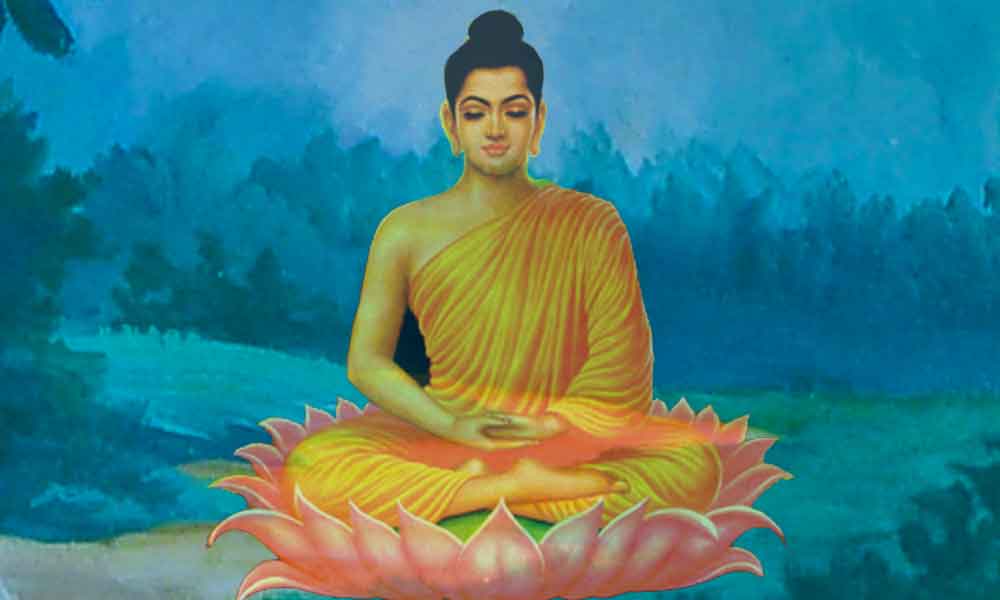
1. Do not seek to know Buddha by his form and attributes; for neither the form nor attributes are the real Buddha. The true Buddha is Enlightenment itself. Therefore aspiration to realize Enlightenment is the true way to know Buddha. If anyone after seeing an excellent image of Buddha thinks that he knows Buddha, it is a mistake of dull eyes, for the true Buddha can not be embodied in form or seen by human eyes. Neither can one know Buddha by a faultless description of his attributes. It has never been found possible to describe his attributes in human words. Though we speak of his form, the Eternal Buddha has no form, but he can manifest himself in any form. Though we describe his attributes, yet the Eternal Buddha has no attributes, but he can manifest himself in any and all attributes. So if any one sees distinctly the form of Buddha, or visions his attributes clearly, and yet does not become attached to the form or to the attributes, he has the capacity to see and know Buddha.
2. Buddha's body is Enlightenment itself. Being formless and substanceless it always has been and always will be. It is not a physical body that has had a beginning and must be nourished by food. It is an ethereal body whose substance is Wisdom. Buddha has no fear, no disease; he is eternally changeless. Therefore Buddha will never disappear as long as the path of Enlightenment exists. Enlightenment appears as a light of Wisdom on the path that awakens people into a newness of life and causes them to be reborn into the likeness of Buddhahood. Those who are thus quickened become the children of Buddha; they keep his Dharma, honor his teachings and pass them on to posterity. Nothing can be more miraculous nor more natural than the power of Buddha.
3. Buddhahood has three aspects. There is an aspect of Essence which is all-inclusive, universal and inconceivable; there is an aspect of Potentiality which is boundless but unmanifest; and there is an aspect of Manifestation which is both activity and changeless Peace. As Essence it is the substance of the Dharma; that is, it is the substance of Truth as it is in itself. As Potentiality it is the Dharma considered as the Truth Principle, potent but unmanifest; it is the glorified Compensation Body of Buddhahood. As Manifestation it is Buddhahood manifesting itself in the temporal bodies of Shakyamuni Buddha and other earthly Buddhas. As the aspect of Essence, Buddha has no figure nor color, and since he has no form nor color, Buddha comes from nowhere and there is nowhere for him to go. Like the blue sky he overarches everything, and since he is all things he lacks nothing. He exists not because people think that he does or as they think, neither does he disappear because people forget him. He is under no particular compulsion to appear when people are happy and comfortable, neither is it necessary for him to disappear when people are inattentive and idle. Buddha transcends every conceivable trend of human thought; Buddha's body fills every corner of the universe; it reaches everywhere, it exists forever, regardless of whether people believe in him or doubt his existence.
4. The aspect of Potentiality signifies that in the nature of Buddha there is the merging of both Compassion and Wisdom into one imageless spirit, that is capable of both manifesting this imageless spirit under the symbols of birth and death, ignorance and enlightenment, and then under the symbols of making vows and undergoing training he leads all people and saves them. Thus compassion is the Essence of the Dharma and in its spirit Buddha uses all manner of skillful devices to emancipate as many people as are ready for emancipation. Like a fire that once kindled never dies away until the fuel is consumed, so the Compassion of Buddha never fails until all world passion is consumed away. Just as a wind blows away the dust, so the compassion of Buddha blows away the dust of human suffering. The aspect of Manifestation signifies that in order to complete the relief of Buddha, the Buddha appeared in flesh in the world, and showed the people the aspect of birth, renunciation and obtaining of the Enlightenment, according to their natures and capacities. Buddha teaches the Dharma and then applies all manner of skillful means to lead them. There is birth and ignorance and discrimination and suffering and death, but with them go awakening faith, knowledge and enlightenment.
5. The form of Buddha is the image of the Dharma, but as the nature of people varies, Buddha's form appears differently. Although the form of Buddha varies according to the different desires, tasks and faculties of people, Buddha is concerned only with the truth of the Dharma. Though Buddha has different aspects, his spirit and purpose is one, and that one purpose is to save all people. Though in all circumstances Buddha is manifest in his purity, yet the manifestation is not Buddha because Buddha is not form. Buddhahood fills everything, making enlightenment his body and as enlightenment he appears before all those who have capacity to realize Truth.
II. THE APPEARANCE OF BUDDHA
1. It is seldom that a Buddha appears in the world. When a Buddha does appear, he establishes Enlightenment, introduces the Dharma, cuts the net of suspicion, removes the lure of desire at its root, plugs the fountain of evil; and unhindered by anything, walks where he will over all the world. There is no greater merit than to recognize a Buddha and pay reverence to him and learn from him. Buddha appears in the world because he can not desert suffering people; his only purpose is to spread the Dharma a nd to bless all people with the Truth. It is very difficult to introduce the Dharma into a world filled with injustice and false standards, a world that is vainly struggling with insatiable desires and discomforts. Buddha is facing these difficulties because of his great love and compassion.
2. Buddha is a friend of every one in the world. If Buddha finds a man suffering under a heavy burden of worldly passions, he has sympathy for the man and shares the burden with him. If he meets a man suffering from delusions, he will clear away the man's illusions by the pure light of his wisdom. Like a calf which enjoys living with its mother, those who have heard the Buddha's teachings are afterward unwilling to leave him because his teachings bring them happiness.
3. When the moon disappears, people say that the moon has gone; and when the moon reappears, they say that the moon has come. But, in fact, the moon never goes nor comes, but shines changelessly in the sky. Buddha is exactly like the moon: he neither appears nor disappears; he only seems to do so, out of love for the people that he may teach them. At one phase of the moon's appearance, people speak of it as the full-moon; and at another phase, they call it a crescent, but the moon itself is always perfectly round, never waxing nor waning. Buddha is precisely like the moon. In the eyes of people Buddha may seem to change in appearance, but in truth, Buddha changes not. The moon appeares everywhere, over a crowded city, a sleepy village, a mountain, a river! it is seen in the depths of a pond, in a jug of water, in a drop of dew on a leaf. If a man walks hundreds of miles the moon goes with him. The moon does not change, but to people it seems to change. Buddha is like the moon in following the people of this world in all their changing circumstances, but in his Essence he changes not. It is because of the compassion and wisdom of Buddha that he employs the device of causes and conditions to lead them to faith in his unchangeableness.
4. The fact that Buddha appears and disappears can be explained by causality: Namely, when conditions are propitious, Buddha appears; when conditions are unpropitious, Buddha seems to disappear from the world. But whether Buddha appears or disappears, Buddhahood always remains the same. Knowing this principle the wise will keep to the path to Enlightenment and Perfect Wisdom, undisturbed by the apparent changes in the image of Buddha and in the conditions of the world and in the fluctuations of human th ought. It has been explained that Buddha is not body but is Enlightenment. Body may be thought of as a recepticle; then, if this recepticle is filled with Enlightenment, it may be called Buddha. But, if anyone falls into the belief that Buddha is a body external to themselves and laments his disappearance, he will be unable to realize the real Buddha. In reality, all things are empty and all aspects of appearing and disappearing, of comings and goings, of differentiations of this and that, of good and evil. All things are perfect emptiness and perfect homogeneity. It is because of the combination of a principle cause, of other contributing causes, and of all other conditions, that delusion as to the form of Buddha and as to his attributes, arise and disappear. But the true form of Buddha never appears nor disappears.
III. BUDDHA'S VIRTUE
1. Buddha receives the respect of the world because of five virtues: Superior conduct; superior point of view; perfect wisdom; superior preaching ability; and the power to lead people to the practice of his teaching. Buddha has also eight other virtues: He bestows blessings and happiness upon people; the practice of his teachings bring immediate benefit in this world; he rightly adjudicates between good and bad, right and wrong; by teaching the right way he leads people to enlightenment; he leads all people by an equal way; in Buddha there is no boasting; he willingly completes his spiritual practices and by doing so fulfills the vows of his compassionate heart. By the practice of meditation, Buddha preserves a calm and peaceful spirit radiant with mercy, compassion and happiness. He deals equitably with all people, clearing away their defilment of mind and bestowing happiness in perfect singleness of spirit.
2. Buddha is both father and mother to the people of the world. For many months after a child is born the father and mother have to speak with it in childish words, then they gradually teach him better words. Like earthly parents, Buddha first cares for people and then leaves them to care for themselves; he first brings things to pass according to their desires and then he brings them to a peaceful and safe shelter. What Buddha preaches in his language, people receive and assimilate in their own language as if it was specially intended for them. Buddha's horizon surpasses human thought; it can not be made clear by words or examples, it can only be hinted at in pa rables. A little brook is mudied by the trampling of horses and cows and is disturbed by the movement of fish and turtles, but a great river flows on pure and undisturbed by such trifles. Buddha is like a great river. The fish and turtles of the teachings swim about in its depths and push against its current but in vain; Buddha's Dharma flows on pure and undisturbed.
3. Buddha's Wisdom being perfect keeps away from the extremes of prejudice and preserves moderation beyond all words to describe. Being all-wise he knows the thoughts and feelings of people and appreciates all their circumstances. As the stars of the heavens are reflected in a calm sea, so people's thoughts, feelings and circumstances are reflected in the depths of Buddha's Wisdom. This is why Buddha is called, The Perfectly Enlightened One. Buddha's Wisdom refreshes the arid minds of people, enlightens them and its effects, its appearings and disappearings. Indeed, apart from Buddha's Wisdom, what aspects of the world can be understood at all?
4. Buddha does not always appear as a Buddha. Sometimes he appears as an incarnation of evil, sometimes as a woman, a god, a king, a statesman; sometimes he appears in a brothel or in a gambling house, and in an epidemic he appears as a physician bringing healing; but always he is preaching and manifesting the Dharma, for the emancipation of the world. In a war he preaches forbearance and mercy for the sufferings of the people; for those who are content with things as they are, he preaches transiency and uncertainty; for those who are proud and egotistic, he preaches humility and self-sacrifice; for those who are entangled in the web of worldly pleasures, he reveals the misery of the world. The task of Buddha is to manifest in all affairs and on all occasions the pure essence of Dharmakaya; so Buddha's mercy and compassion flow out from the same Dharmakaya in endless lives and boundless light bringing salvation. The world is like a burning house that is forever being destroyed and forever being rebuilt. People being confused by the darkness of ignorance lose their minds in anger, displeasure, jealousy, prejudice and worldly passion. They are like babies needing a mother; everyone is de pendent upon Buddha's mercy.
5. Buddha is a father to all the world; all human beings are children of Buddha; Buddha is the most saintly of saints. The world is afire with decrepitude and death; there is suffering everywhere, but people being engrossed in the vain search for worldly pleasure are not wise enough to fully realize it. Buddha saw that his place of pleasure was really a burning house, so he fled from it and found refuge and peace in the quiet forest. There, in its solitude and silence, a great heart of compassion came to him and he learned to say: "This world of change and suffering is my world; these ignorant, heedless people are my children; I am the only one who can save them from their delusion and misery." As Buddha is the great king of Dharma, he can preach to all people as he wishes; so Buddha appears in the world to bless the people, and to save them from suffering he preaches Dharma, but the ears of people are dulled by greed and they are heedless. But those who li sten to his teachings are free from the delusions and the miseries of life. "People can not be saved by relying on their own wisdom," he said, "they must enter into my Dharma through faith." Therefore, one should listen to Buddha's Dharm a and put it into practice.
Suggestions for Further Reading
- The Teaching of the Buddha, the Buddhist Bible
- Amitabha A Story Of Buddhist Theology
- Buddha Dhamma - The Concepts and Philosophy of Buddhism
- Confucian Analects by James Legge
- The Life of the Buddha, the Buddhist Bible
- The Teachings of the Buddha, the Buddhist Bible
- The Gospel of the Buddha
- Buddha, The Word. The Four Noble Truths and The Eightfold Path
- Buddhism scriptures
- Buddha, Truth and Brotherhood; An Epitome of Many Buddhist Scriptures
- Understanding the significance of a Buddhist shrine
- Buddho, Initiation Into Buddhist Meditation
- The Diamond Sangh Sutras
- Essays On Dharma
- Esoteric Mystic Hinduism
- Introduction to Hinduism
- Hindu Way of Life
- Essays On Karma
- Hindu Rites and Rituals
- The Origin of The Sanskrit Language
- Symbolism in Hinduism
- Essays on The Upanishads
- Concepts of Hinduism
- Essays on Atman
- Hindu Festivals
- Spiritual Practice
- Right Living
- Yoga of Sorrow
- Happiness
- Mental Health
- Concepts of Buddhism
- General Essays