
Historical Relationship Between Sanskrit and Hittite
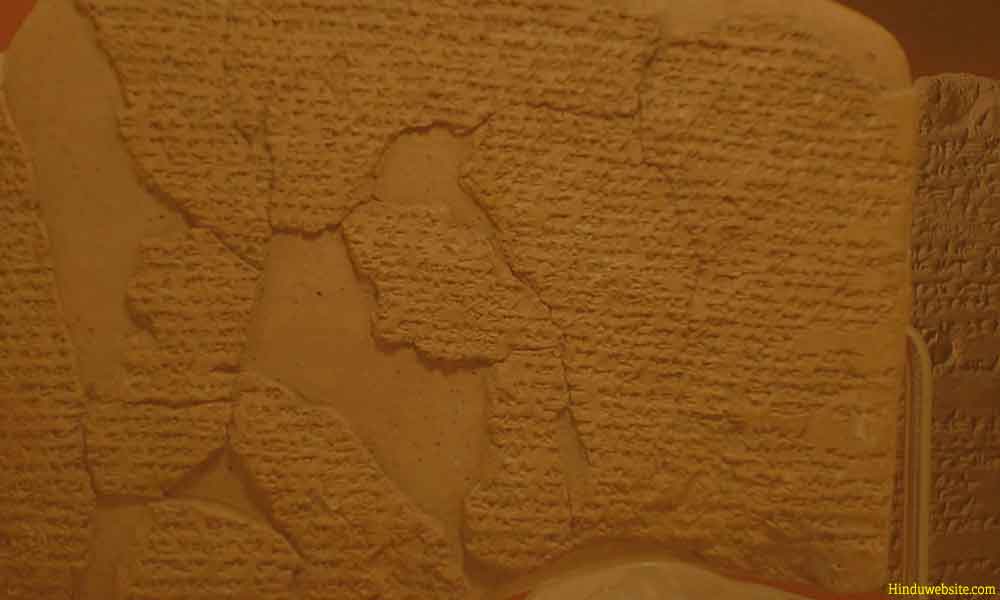
A Hittite Language Clay Tablet
Professor Jay Kumar is a scholar and instructor of Latin, Vedic Sanskrit, Ancient Greek, as well as other Ancient Indo-European Languages for the past 10 years. In response to the article on Sanskrit provided at Hinduwebsite, Prof. Jay Kumar made the following observations.
"...As an Indian myself I am very proud of our rich Sanskrit and Hindu tradition which is one reason for my desire to study Sanskrit and other Ancient Languages. I always assumed Sanskrit was the originator of the other languages- Latin, Greek, Germanic,Slavic,etc...
However over the years of my academic career and doctoral dissertation in Indo-European Languages, Cultures, and Linguistics I know now am convinced that there was an earlier language which you already document in your webpage as Proto-Indo-European.
There are literally thousands of words as well as commonalties in grammar, phonology, morphology, syntax, archeology, mythology, and culture that Sanskrit shares w/ her sister languages.
I commend you on your website's explanation of this often unknown and undervalued theory of Sanskrit and her origins to Indo-European. Your info. is very accurate and is fair to offer alternative theories which as an academic myself is very important to have.
Just two quick comments. Just want you to know that:
ARMENIAN and ALBANIAN are two separate language groups of PIE. The website has Armenian and Albanian listed together.
Secondly re. Anatolian languages, although the first WRITTEN records of Old Hittite go back to 1700 BCE it doesn't mean that is when the language first began. Many languages of the world have been in use orally for millennia before written down in an alphabet. Writing after all was only invented 3,500 BCE. Thus both Sanskrit and Hittite are VERY old languages indeed. The Vedas for example were transmitted orally for millennia until actually written down 600BC or so.
Thus my point is that despite the first written evidence of Anatolian languages being only 1,700 BCE they too like the VEDAS were spoken millennia before documentation. Another theory which in my opinion adds credence to Hittite being the oldest IE language is what linguists now call Laryngeal Theory. It briefly states that PIE based on linguistic reconstruction had three phonemes that were laryngeals (produced in back of larynx). Anatolian languages are the only languages that still have these 3 sounds WRITTEN in it's alphabet. No other IE alphabet (Sanskrit, Latin, Greek) has them - they all developed into vowels. Sanskrit has merged all three laryngeals of PIE into "i". So a word lie Skt. pitr "father" came from PIE *pHtr. Hittite as I sai is FULL of laryngeals. Saussure proposed this theory in late 1800's. It was confirmed by the discovery of Hittite in early 1900s.
Another VERY important recent theory is that Indo-European and Anatolian may actually be sisters. Indo-Hittite theory believes that the Anatolian languages broke off from this even EARLIER stage of PIE around 7000 BCE to develop on its own. This would explain a lot of the Archaic features of Hittite not found in Sasnskrit, Greek, etc...Although evidence of Hittite comes from Catul Hayuk in Turkey, it doesn't equate to this being the motherland of PIE. As recent evidence now suggests, PIE may be around 5,000 BCE BUT Indo-Hittite (Precursor to PIE) may be 9,000-10,000 BCE!! Thus Sanskrit may be the oldest Indo-European language, BUT Hittite broke away from Proto-Indo-Hittite much before in antiquity.
It also proposes that the original PIE homeland WAS NOT Asia Minor but perhaps closer to the Russian Steppe Region north of Black Sea. There is so much info. on recent trends in Indo-European Homeland, archeology, and linguistics. I will be happy to share more as I learn of them."
Who Were Hittites?
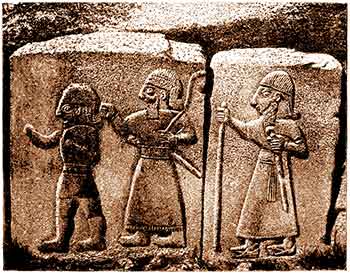
The Hittites were an Ancient Anatolian people who established an empire at Hattusa in north-central Anatolia around the 18th century BC. This empire reached its height during the mid-14th century BC under Suppiluliuma I, when it encompassed an area that included most of Asia Minor as well as parts of the northern Levant and Upper Mesopotamia. After c. 1180 BC, the empire came to an end during the Bronze Age collapse, splintering into several independent "Neo-Hittite" city-states, some of which survived until the 8th century BC. The Hittite language was a member of the Anatolian branch of the Indo-European language family. They referred to their native land as Hatti, and to their language as Nešili (the language of Neša). The conventional name "Hittites" is due to their initial identification with the Biblical Hittites in 19th century archaeology. Despite the use of Hatti for their core territory, the Hittites should be distinguished from the Hattians, an earlier people who inhabited the same region (until the beginning of the 2nd millennium BC) and spoke a language possibly in the Northwest Caucasian languages group known as Hattic.
The Hittite military made successful use of chariots. Although belonging to the Bronze Age, they were the forerunners of the Iron Age, developing the manufacture of iron artifacts from as early as the 14th century BC, when letters to foreign rulers reveal the latter's demand for iron goods. After 1180 BC, amid general turmoil in the Levant associated with the sudden arrival of the Sea Peoples, the kingdom disintegrated into several independent "Neo-Hittite" city-states, some of which survived until as late as the 8th century BC. The history of the Hittite civilization is known mostly from cuneiform texts found in the area of their kingdom, and from diplomatic and commercial correspondence found in various archives in Egypt and the Middle East.
Hittite Language
Hittite is one of the Anatolian languages. It is known from cuneiform tablets and inscriptions erected by the Hittite kings. The script formerly known as "Hieroglyphic Hittite" has been changed to Hieroglyphic Luwian. The Anatolian branch also includes Cuneiform Luwian, Hieroglyphic Luwian, Palaic, Lycian, Milyan, Lydian, Carian, Pisidian, and Sidetic. Hittite lacks some features of the other Indo-European languages, such as a distinction between masculine and feminine grammatical gender, subjunctive and optative moods, and aspect. Various hypotheses have been formulated to explain these contrasts.
Some linguists, most notably Edgar H. Sturtevant and Warren Cowgill, have argued that it should be classified as a sister language to Proto-Indo-European, rather than a daughter language, formulating the Indo-Hittite hypothesis. The parent, Indo-Hittite, lacked the features not present in Hittite, which Proto-Indo-European innovated. Other linguists, however, have taken the opposite point of view, the Schwund ("loss") Hypothesis, that Hittite (or Anatolian) came from a Proto-Indo-European possessing the full range of features, but simplified. A third hypothesis, supported by Calvert Watkins and others, viewed the major families as all coming from Proto-Indo-European directly. They were all sister languages or language groups. Differences might be explained as dialectical.
According to Craig Melchert, the current tendency is to suppose that Proto-Indo-European evolved, and that the "prehistoric speakers" of Anatolian became isolated "from the rest of the PIE speech community, so as not to share in some common innovations."[4] Hittite, as well as its Anatolian cousins, split off from Proto-Indo-European at an early stage, thereby preserving archaisms that were later lost in the other Indo-European languages. In Hittite there are many loanwords, particularly religious vocabulary, from the non-Indo-European Hurrian and Hattic languages. Hattic was the language of the Hattians, the local inhabitants of the land of Hatti before being absorbed or displaced by the Hittites. Sacred and magical texts from Hattusa were often written in Hattic, Hurrian, and Luwian, even after Hittite became the norm for other writings. The Hittite language has traditionally been stratified into Old Hittite (OH), Middle Hittite (MH) and New or Neo-Hittite (NH; not to be confused with the "Neo-Hittite" period, which is actually post-Hittite), corresponding to the Old, Middle and New Kingdoms of the Hittite Empire (ca. 1750–1500 BC, 1500–1430 BC and 1430–1180 BC, respectively). These stages are differentiated partly on linguistic and partly on paleographic grounds.
A Brief Note on Indo Euripean Languages
The Indo-European languages are a family (or phylum) of several hundred related languages and dialects. There are about 439 languages and dialects, according to the 2009 Ethnologue estimate, about half (221) belonging to the Indo-Aryan subbranch.[1] It includes most major current languages of Europe, the Iranian plateau, and Indian Subcontinent, and was also predominant in ancient Anatolia. With written attestations appearing since the Bronze Age in the form of the Anatolian languages and Mycenaean Greek, the Indo-European family is significant to the field of historical linguistics as possessing the second-longest recorded history, after the Afro-Asiatic family.
Indo-European languages are spoken by almost 3 billion native speakers,[2] the largest number by far for any recognised language family. Of the 20 languages with the largest numbers of native speakers according to SIL Ethnologue, 12 are Indo-European: Spanish, English, Hindi, Portuguese, Bengali, Russian, German, Marathi, French, Italian, Punjabi, and Urdu, accounting for over 1.7 billion native speakers.[3] Several disputed proposals link Indo-European to other major language families.
The various subgroups of the Indo-European language family include ten major branches, given in the chronological order of their earliest surviving written attestations: 1.Anatolian(Asia Minor), the earliest attested branch. 2.Indo-Aryan or Indic languages 3.Hellenic. 4.Indo-Iranian. 5.Italic, including Latin and its descendants 6.Celtic, descended from Proto-Celtic. 7.Germanic (from Proto-Germanic). 8.Armenian. 9.Tocharian 10.Balto-Slavic 11.Albanian In addition the following languages also belong to the same group. Illyrian, Venetic, Liburnian, Messapian, Phrygian, Paionian, Thracian, Dacian, Ancient Macedonian, Ligurian , Sicel, Lusitanian.
Suggestions for Further Reading
- The Origin and History of Celtic People
- THE EGYPTIAN STORY OF THE CREATI
- Nine Simple Steps How a Lady Gets Her Book Published
- Origin and Development of Sanskrit
- Historical Events, Birthdays And Quotations
- Your Ancestors For 50 Generations
- Grimm's Law - Indo-European Languages
- Historical Relationship Between Sanskrit and Hittite
- Common words of Indo-European languages
- Sanskrit - Links and Resources
- Hypnotism - Theory and Practice
- The World as a Matrix
- Symbolism of Meerkat Island in the Life of PI
- ExperienceFestival Illegal Copying From Other Websites
- Pollution and Evolution
- UFOs and Extra Terrestrial Intelligences
- Afghanistan A Dangerous Place
- Thoughts, Quotes and Quotations
- World Factbook of Countries, Almanacs, Biographies, News Stories
- Currency converter
- Online Dictionaries
- Directory Service
- Online Encyclopedias
- Hinduwebsite - FREE online EBooks and Texts
- The Great Literature E-Page
- Internet Resources on Philosophy and Philosophers
- Hinduwebsite.com - Poetry Links and Resources
- Hinduwebsite.com - Page Replace or Removed
- Spiritual and Devotional Poems and Prayers
- Good Thoughts
- Inspiring Thoughts and Quotations
- The Buddha on God
- Hinduwebsite.com - The General Encyclopedia
- Essays On Dharma
- Esoteric Mystic Hinduism
- Introduction to Hinduism
- Hindu Way of Life
- Essays On Karma
- Hindu Rites and Rituals
- The Origin of The Sanskrit Language
- Symbolism in Hinduism
- Essays on The Upanishads
- Concepts of Hinduism
- Essays on Atman
- Hindu Festivals
- Spiritual Practice
- Right Living
- Yoga of Sorrow
- Happiness
- Mental Health
- Concepts of Buddhism
- General Essays
Source: This section is adpated with suitable modifications from Wikipedia under the Creative Commons Attribution-ShareAlike License.