Dharmashastras: The Hindu Books of Law, Duty, and Moral Conduct
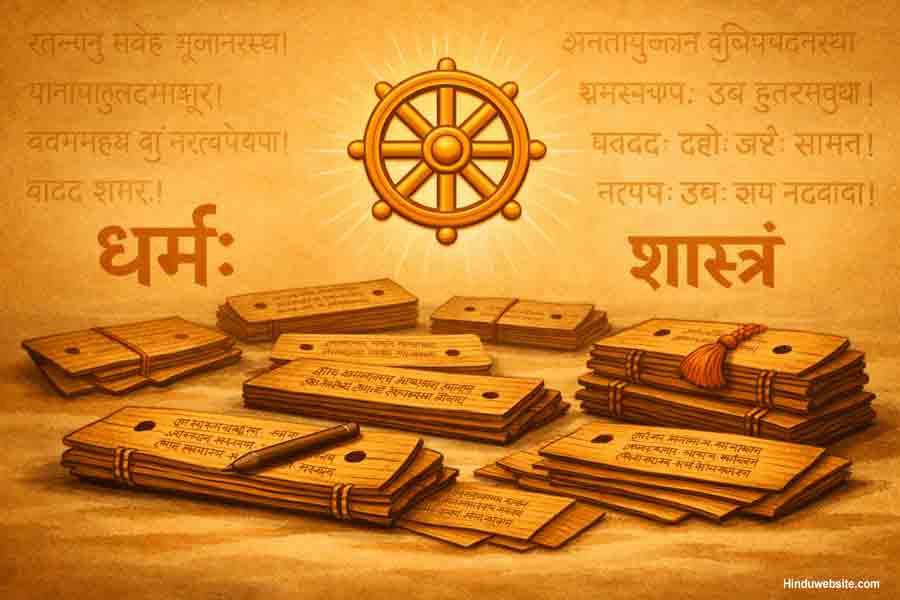
Summary: The Dharmashastras are ancient Hindu law books that establish guiding principles for morality, religious duty, and righteous conduct within society. These sacred texts address the philosophical foundations of karma and social order while prescribing specific duties based on gender and caste divisions. This page examines the Dharmashastras' approach to dharma, their historical context, and their continued relevance to Hindu ethics and spirituality.
The Dharmashastras are Hindu law books concerned with morality and religious duty. They provide guiding rules and principles for the order and regularity of society and for righteous conduct. They recognize the importance of karma in creating divisions and disparities in society and prescribe methods to address social friction and moral confusion. However, since they reflect the archaic conditions of an ancient society, some of their passages are bound to shock the sensibilities of many people in today's world. The Dharmashastras did not envisage an egalitarian society in which both men and women competed for the same duties, professions, and resources. The same was true with regard to caste divisions. They accepted gender and caste inequality as a social imperative and prescribed a different set of laws for each.
It is therefore necessary to study these law books with caution, tolerance, and understanding, accepting the principles of human conduct that are still valid and relevant and examining the rest for their historical value. They belong to an age in which people held different worldviews and conducted their lives according to certain beliefs, values, traditions, and assumptions. It is not fair to judge them solely on the basis of our contemporary values, norms, and principles of social justice. On the positive side, Hinduism remained largely free from the restrictive views of the law books and moved forward with time, accommodating change and adaptation to meet the challenges of human progress, while the law books lost their relevance, authority, and importance partly because of their impracticality in changing times and partly because of the decline in the power of Hindu rulers during the medieval period. Despite many setbacks, Hinduism continued to grow, assimilating new currents of thought and transforming itself into a complex spiritual tradition encompassing a wide range of beliefs, philosophies, and practices.
Dharma in Hinduism is a highly elaborate concept with divergent meanings, which we have described elsewhere. Its primary aim is to ensure the orderly progression (Rta) of creation and existence by preserving their foundational structure, supporting mechanisms, values, order, and regularity. According to Hinduism, one of the self-appointed duties of God is to protect the worlds and beings by enforcing the Dharma specific to each of them. The rules of Dharma are universal in the sense that their ultimate source is God alone. However, variations arise in their implementation, as they are applied at different levels and in different worlds according to the duties, roles, and responsibilities prescribed to each.
Dharma is eternal, but its enforcement and observance are subject to fluctuations according to the progression of time. Hence, they are subject to change. Dharma is also applicable to beings who are bound either by duty or by mortality, but not to those who are forever liberated. In the liberated state, souls (muktas) enjoy eternal power in the world of Brahman, where there are no boundaries and no laws, but only all-knowing awareness and immeasurable existence that is not subject to any laws or limitations. In that eternal and infinite state, each soul governs itself, exists by itself, is bound to nothing, and is complete and perfect, very much like God in a state of unity.
The Dharma Shastras were meant for people who are bound to the mortal world because of their ignorance, sinful karma, delusion, and desires, and who engage in desire-ridden actions. For such people, guidance is required to distinguish the lawful from the unlawful and to perform those duties that flow directly from God, thereby ensuring the orderly progression of the world and the preservation of the moral, social, and political order.
The Dharmashastras are not products of divine revelation like the Vedas. Hence, they are vulnerable to the imperfections to which the human mind is prone. Yet we cannot dismiss them as mere intellectual works of limited vision. They were crafted with care to provide guidance from a divine perspective. In them, one finds a sincere attempt to provide practical solutions to possible social anarchy, disorder, and moral confusion. They also contain divine wisdom as distilled by the human mind and filtered through discerning intelligence.
Hence, they are considered smriti rather than sruti. They represent the collective wisdom of spiritual teachers, scholars, rulers, and lawmakers who were instrumental in their creation and enforcement. The law books prescribed the best possible solutions for each class of beings to pursue the four ideals of dharma, artha, kama, and Moksha, but in doing so they were not entirely free from the caste predilections that favored a few social classes. They also reveal a veiled attempt by ingenious minds to preserve the status quo and maintain the social, economic, and political privileges of select castes.
Using the authority of God and religion, the Dharma Shastras tried to ensure the order and regularity of the world on an ongoing basis, but in this they were not completely successful, as is evident from the decline of their jurisdictional power following the decline in the power of Hindu rulers in the Indian subcontinent. However, on the positive side, they created a framework for envisioning ideal human conduct and standards to distinguish right from wrong. They laid down elaborate rules to govern human conduct and instill respect for moral and temporal authority.
Some of the laws and principles of inequality prescribed in the Dharma Sutras are bound to offend the sensibilities of present-day educated Hindus, who have been heavily influenced by modern Western education and brought up on the values of equality, fraternity, individual liberty, and social and moral justice. Many verses in them stand in contrast to these modern values and seem retrogressive. Therefore, when studying them, one should suspend judgment and evaluate the material from an academic or historical point of view, as a work in progress. It is unwise to use them as a reference to justify any social or gender inequality in today's society or to argue that we must draw inspiration from them to regulate our social conduct. One may take from them a few principles that are still valid in the present-day world and observe them in life, but one may not use them as a justifiable basis to argue for their universal adoption.
Some critics of Hinduism use these law books to denigrate Hinduism and cast aspersions on Hindu society. Since present-day Hindus follow a common civil code rather than the law books, such attempts must be countered at every level. Humanity advanced to its current stage through many dark periods of history. Human civilization was never perfect. We have made progress through trial and error, learning from our mistakes and failures and making amendments to the past. Therefore, to judge Hinduism on the basis of the law books would be similar to judging today's Americans on the basis of the slave practices of the eighteenth century, or Europeans on the basis of the inquisitions and religious persecutions of the medieval period.
Hinduism has come a long way from the days of the Vedic people and from the ancient practices of human and animal sacrifice. Despite such dark elements in its long history, over time Hinduism managed to resolve many of the inconsistencies and anachronisms of its past and evolve into a tradition with a strong spiritual base and broader appeal. This became possible because of the untiring work of numerous individuals who shaped the tradition as an expression of the highest intelligence of humanity and the best in the vision of God. Such people remain active even today, preparing Hinduism for future generations and to meet the expectations of those who will be scientifically well prepared and spiritually advanced. The silent revolution within Hinduism has continued despite attacks from within and without, as it seeks to embrace the future that is taking shape in the womb of the earth. Hinduwebsite salutes all those who are trying to redefine Hinduism and make it more relevant to the complex contemporary world as well as to the ages to come.
Jayaram V
20 June, 2015
Edited: 20 May 2026