What is Sanatana Dharma? Understanding Hinduism's Eternal Foundation
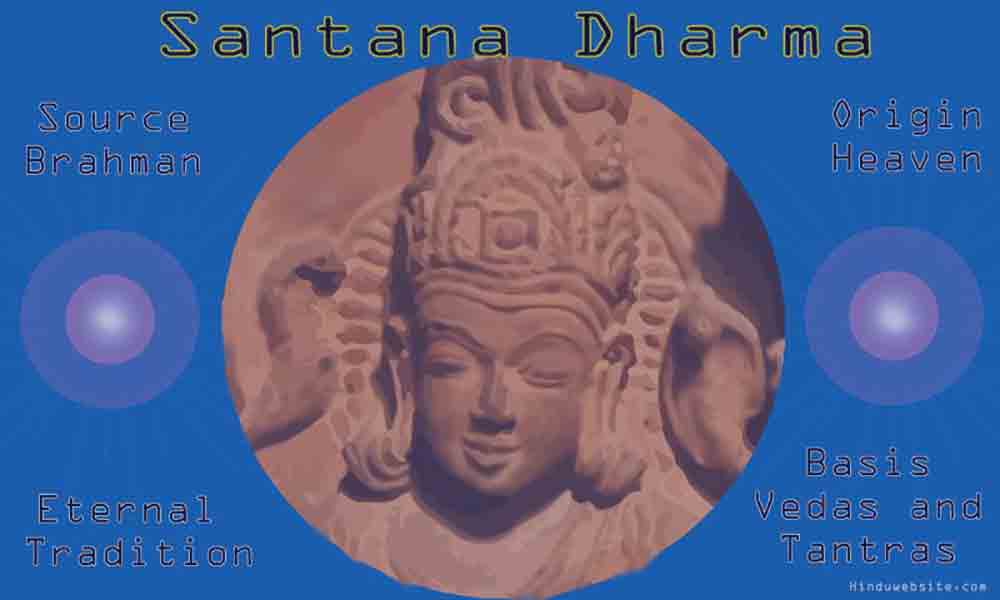
Summary: Sanatana Dharma means "eternal religion" or "eternal duty," representing Hinduism's ancient self-designation rooted in heavenly origins and divine revelation. The term reflects twin meanings: eternal duty binding all beings across creation cycles, and eternal scripture foundation in the Vedas, which God reintroduces at each creation's beginning. Unlike "Hinduism"—a secular geographic term associated with historical invasion trauma—Sanatana Dharma emphasizes continuous divine obligation maintaining cosmic order (rta). Each being, from humans to gods, performs eternal duties ensuring world stability across infinite creation-dissolution cycles.
Hinduism is traditionally known as Sanatana Dharma, the eternal faith. Nowadays, some educated Hindus prefer to use it instead of Hinduism since they believe that Hinduism is a colonial legacy and a remnant of Muslim rule. Further, it does not in any way represent its depth and diversity. Besides, they believe it also evokes many unpleasant memories of India’s past and how its people were oppressed and discriminated against by the invaders and British rulers who had no love or respect for India or Indians. They came to plunder and convert. Therefore, they believe one should go back to the roots of its ancient history, when India had glorious empires and golden periods, and use its original Vedic name, Sanatana Dharma.
Sanatana Dharma means eternal dharma, function, or obligatory duty. The name has broader implications. One is that the Vedas, which form its core, ordain obligatory duties for all humans, especially the householder. They also suggest that everyone, including plants, animals, and inanimate objects, have obligatory duties and natural functions, qualities, propensities, and properties. For example, the dharma of fire is to burn, that of water is to flow, and that of air is to move freely. The primary duty of animals is to support humans, that of humans is to support gods, and that of gods is to support humans and serve God. By performing these duties, they all are also supposed to support creation and assist the Supreme Being in his eternal duties of creation, preservation, and dissolution.
The source of these duties is the Supreme Lord, Isvara, himself. He performs many duties to uphold the world and liberate the beings. He bequeaths similar duties to gods, humans, and others and expects them to perform them. These duties are eternal, in the sense that creation after creation, every animated and inanimate thing in creation must perform them to keep the world and creation going. The same is the case with God also. His duties are eternal and continue in every cycle of creation. At the beginning of each Kalpa, he wakes up and creates all the worlds and beings. At the end of it, he dissolves them. The same is the case with us. We have to wake up every day and complete our duties before we go to sleep. When we die, we return to the earth to take another birth and complete our unfinished tasks.
Thus, all the duties assigned by the Creator to all the created ones are eternal and obligatory. If they do not perform them, the world becomes chaotic, and creation will fall into disarray. For humans, these duties fall under karma kanda or natural functions. They are obligatory for humans since they are meant to be the guardians of the planet and all life on Earth. Hence, Hinduism is aptly called an eternal religion or a religion of eternal duties. Secondly, Hinduism is derived primarily from the Vedas, which are believed to be eternal and indestructible. Accordingly, it also becomes an eternal faith without a beginning and an end. Creation after creation and at the beginning of each Manvantara (the reign of a Manu, the progenitor of the human race), the creator God reintroduces the knowledge of obligatory duties to humans through the Vedas for the welfare of all so that they can perform them and keep the wheel of creation moving. Thus, Hinduism is an eternal Dharma, an eternally recurring and continuing faith. It will continue as long as creation lasts and humans exist and will reappear again in the next creation cycle. It has the force, knowledge, and authority of the Creator and is thus indestructible. Thus, there are enough reasons to identify Hinduism as a Sanatana Dharma.