Introduction to Hinduism Book by Jayaram V
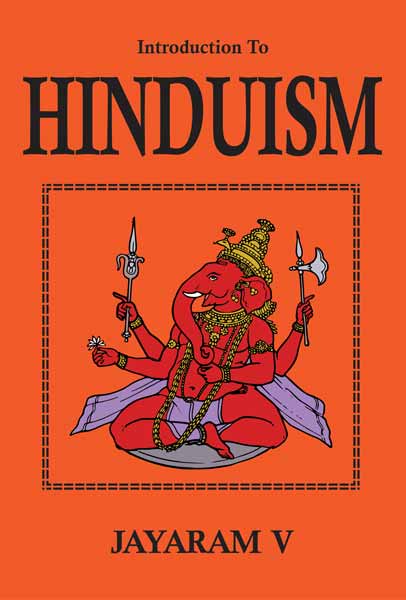
Introduction to Hinduism Book by Jayaram V
Summary: Introduction to Hinduism by Jayaram V presents a clear, structured, and reader‑friendly overview of Hinduism’s origins, evolution, and living traditions. Revised in 2024, the book explains essential concepts such as dharma, karma, atman, Brahman, maya, rebirth, and moksha, while outlining the role of major scriptures including the Vedas, Upanishads, epics, and later texts. It also explores worship, ritual life, and the Hindu way of living, showing how philosophy and practice shape daily conduct. This edition serves as an accessible and substantive starting point for anyone seeking to understand Hinduism in a coherent and balanced way.
Detailed Book Summary
Introduction to Hinduism offers a clear, wide-ranging entry into one of the world’s most enduring religious and spiritual traditions. Written for curious readers as well as students and scholars, it explains Hinduism’s origins, evolving identity, and distinctive character without reducing it to a single doctrine or sect. You’ll explore core ideas such as dharma, karma, atman, Brahman, maya, rebirth, and liberation (moksha), along with the role of the Vedas, Upanishads, epics, and later sources. The book also outlines major forms of worship and the “Hindu way of life,” helping readers understand how philosophy, practice, and culture intertwine in daily life. A practical starting point for anyone seeking an accessible, substantive introduction to Hinduism.
Introduction to Hinduism by Jayaram V is a wide-ranging, reader-friendly guide to Hinduism’s
essential ideas, sources, and lived practices,
written for laypeople, students, scholars,
and advanced practitioners who want a coherent introduction to Hinduism without flattening its
diversity. Revised in 2024 from the first edition (2012), the book retains its original structure
while improving readability and clarity. Across self-contained chapters that can be read in any
order, it presents Hinduism as both a religion and a continuing tradition: a complex body of spiritual
knowledge, ritual life, and philosophical inquiry rooted in the Indian subcontinent yet practiced
globally.
Hinduism’s antiquity, identity, and definition
The book opens by addressing the antiquity of Hinduism, framing it as Sanatana Dharma,
an “eternal dharma” grounded in the idea of enduring duties and a recurring cosmic order. It explores
why Hinduism is difficult to date with certainty, how it evolved through long historical processes,
and how it relates to the Vedas as foundational revelation. A key theme is that Hinduism is not
a single uniform system; it is better understood as a broad family of traditions and perspectives
that share deep continuities in worldview, sacred literature, and spiritual aims.
From there, the author examines the definition of Hinduism and how the terms “Hindu” and “Hinduism” developed historically as later identifiers rather than original self-designations. Readers are introduced to why many contemporary Hindus prefer “Sanatana Dharma,” and how “Hinduism” became a convenient umbrella for multiple traditions, sects, and schools. This context helps readers understand common questions in religious studies: what makes Hinduism “one” tradition despite being many, and why it can be described as a religion, a civilization, and a Hindu way of life.
What makes Hinduism distinct, and why it appears contradictory
A central section explains the distinction of Hinduism: its lack of a single founder, its openness
to multiple paths, and its long-standing encouragement of inquiry and debate. The book directly
addresses the contradictions of Hinduism,
not as a flaw to be dismissed, but as a natural
outcome of a tradition that holds together different levels of truth, practice, and temperament.
It highlights tensions such as ritual and renunciation, theism and atheism, monotheistic and polytheistic
expressions, and competing philosophical conclusions (including Advaita and Dvaita). This section
is especially useful for readers who encounter Hinduism primarily through stereotypes,
because
it clarifies how Hindu traditions can accommodate difference while still emphasizing dharma, spiritual
discipline, and liberation.
Scriptures and sources: Vedas, Upanishads, epics, and beyond
The book then maps the scriptures of Hinduism and explains why Hinduism is not built on a single book. It introduces Sruti (revelation) and Smriti (remembered tradition), emphasizing the Vedas as core and the Upanishads as the philosophical “end of the Vedas” associated with Vedanta. It also explains the importance of the Mahabharata, Ramayana, and the Bhagavadgita, as well as supporting bodies of literature such as Puranas, Sutras, Dharma Shastras, and Agamas/Tantras. This scriptural overview functions like a roadmap for readers trying to understand what counts as authority in Hinduism and how different texts shape belief, ritual, and spiritual practice.
Core beliefs: dharma, karma, atman, Brahman, maya, rebirth, and moksha
In its treatment of Hindu doctrine, the book introduces the main beliefs of Hinduism with a
strong emphasis on ideas that appear across multiple traditions: Brahman (Supreme Reality), Atman
(the individual Self), Purusha and Prakriti, and the pursuit of moksha (liberation). It discusses
karma not merely as fate but as action and consequence tied to responsibility and spiritual progress,
and it explains maya as the principle of delusion or misperception that keeps beings bound to
samsara (the cycle of births and deaths). The book also treats rebirth or reincarnation (including
“transmigration”) as central to Hindu understandings of moral causality and spiritual evolution.
Throughout, the author aims for balance and clarity,
presenting philosophical ideas without
requiring specialized prior knowledge.
Practice and lived religion: worship, ritual, and the Hindu way of life
Finally, the book turns to methods of worship in Hinduism, describing how devotion is expressed through home worship (puja), temple worship, Vedic-style sacrifices (yajnas/homas), and a wide range of devotional and yogic disciplines. It explains how Hindu practice can be both simple and highly structured, ranging from daily offerings and festival observances to elaborate rites and samskaras (life-cycle rituals). These practices are presented as more than cultural customs: they are portrayed as ways of cultivating devotion, fulfilling duty, and shaping character in accordance with dharma.
Taken together, Introduction to Hinduism offers a clear, structured entry into Hindu beliefs and practices, Hindu philosophy, and Hinduism’s scriptural foundations, useful both as an online-facing overview and as a foundational text for further study.