Four Types of Monks Who Practice Ānāpānasati in Buddhist Tradition
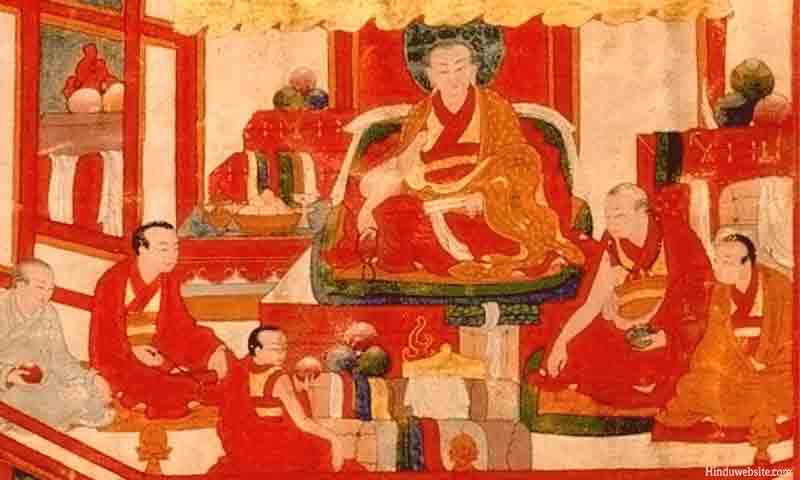
Buddhist monks in a Tibetan Monastery
Summary: This essay examines the four types of Buddhist monks described in the Ānāpānasati Sutta, who practice mindfulness of breathing to progress through spiritual stages from stream-entry to Arhatship. It explains the 16 steps of mindfulness meditation grouped into four contemplations and their connection to the four foundations of mindfulness, seven enlightenment factors, and ultimate liberation.
Anapanasati Sutta from Majjima Nikaya refers to four Buddhist communities of monks, who pass through four progressive stages of perfection and purification to reach the final stage of Arhatship. The Sutta begins with the highest type of awakened and enlightened monks who have overcome all the fetters such as belief in the Self, doubt, attachment to rites and rituals, sensual desires, ill will, lust, envy, and so on, and ends with the fresh initiates or those who have just started their journey on the Eightfold Path. The Sutta is reproduced below and it is self-explanatory.
Anapanasati Sutta Translation
In this community of monks there are monks who are arahants, whose mental effluents are ended, who have reached fulfillment, done the task, laid down the burden, attained the true goal, totally destroyed the fetter of becoming, and who are released through right gnosis: such are the monks in this community of monks.
"In this community of monks there are monks who, with the total ending of the first five fetters, are due to be reborn [in the Pure Abodes], there to be totally unbound, never again to return from that world: such are the monks in this community of monks.
"In this community of monks there are monks who, with the total ending of [the first] three fetters, and with the attenuation of passion, aversion, & delusion, are once-returners, who — on returning only one more time to this world — will make an ending to stress: such are the monks in this community of monks.
"In this community of monks there are monks who, with the total ending of [the first] three fetters, are stream-winners, steadfast, never again destined for states of woe, headed for self-awakening: such are the monks in this community of monks.
"In this community of monks there are monks who remain devoted to the development of the four frames of reference... the four right exertions... the four bases of power... the five faculties... the five strengths... the seven factors for Awakening... the noble eightfold path: such are the monks in this community of monks.
"In this community of monks there are monks who remain devoted to the development of good will... compassion... appreciation... equanimity...[the perception of the] foulness [of the body]... the perception of inconstancy: such are the monks in this community of monks.
Background information
The Buddha delivered the Ānāpānasati Sutta at Sāvatthī, in the Eastern Park, on the full‑moon day of the Pavarana ceremony, marking the end of the rains retreat (vassa), when a large number of monks gathered to hear the Buddha. They listened as the Buddha spoke about the four communities or the four groups of practitioners (parisā) who follow the Eightfold Path diligently to cultivate virtues and right living.
- Bhikkhus — fully ordained monks
- Bhikkhunīs — fully ordained nuns
- Upāsakas — male lay followers
- Upāsikās — female lay followers
According to the Sutta, the Buddha further noted that within these four communities, one could find practitioners at different stages of spiritual development, such as the following.
- Those who had attained stream-entry
- Those who had attained once-returning
- Those who had attained non-returning
- Those who had attained arahantship
- Others engaged in the practice to attain these stages
Ānāpānasati refers to the practice of mindfulness of breathing. It is
suitable for practitioners at every stage to establish the four foundations
of mindfulness and progress through the four stages, which lead to seven
factors of enlightenment and the culmination of knowledge and liberation.
In other words, anapanasati is foundational to advancing spiritually on
the path of liberation through spiritual transformation and inner awakening.
The core of Ānāpānasati Sutta presents 16 steps of mindfulness of breathing,
grouped into four tetrads:
- Contemplation of the body
- Contemplation of feelings
- Contemplation of the mind
- Contemplation of mental objects (dhammas)
These steps gradually refine awareness, calm the mind, and lead toward insightful awareness, inner awakening, silence of the unwholesome thoughts, and liberation.
The Ānāpānasati Sutta is one of the most complete meditation manuals in the Pāli Canon, as it integrates samatha (calming) and vipassanā (insight), connects breath meditation to the entire structure of the path, is accessible to all four communities, regardless of stage, and helps them reach the ultimate goal of Nirvana.
Ānāpānasati → Satipaṭṭhāna → Bojjhaṅga → Liberation
The following is a schematic diagram of Ānāpānasati → Satipaṭṭhāna → Bojjhaṅga → Liberation that expresses the completeness of ānāpānasati as a path, from the 16 steps of mindfulness of breathing, through the 4 foundations, into the 7 enlightenment factors, culminating in liberation.
I. 16 Steps of Mindfulness of Breathing
1. Contemplation of the Body
- Knowing a long breath
- Knowing a short breath
- Experiencing the whole body
- Calming bodily formations
2. Contemplation of Feelings
- Experiencing rapture
- Experiencing pleasure
- Experiencing mental formations
- Calming mental formations
3. Contemplation of the Mind
- Experiencing the mind
- Gladdening the mind
- Steadying the mind
- Liberating the mind
4. Contemplation of Dhammas
- Seeing impermanence
- Fading of passion (dispassion)
- Cessation
- Letting go
II. Four Foundations of Mindfulness (Satipaṭṭhāna)
- Body
- Feelings
- Mind
- Dhammas
III. Seven Factors of Enlightenment (Bojjhaṅga)
- Mindfulness (sati)
- Investigation of dhammas (dhammavicaya)
- Energy (viriya)
- Joy (pīti)
- Tranquillity (passaddhi)
- Concentration (samādhi)
- Equanimity (upekkhā)
IV. True Knowledge and Liberation (Vijjā‑vimutti)
- Direct knowledge
- Release from clinging
- Unbinding (Nibbāna)