
The Life Of Guru Nanak
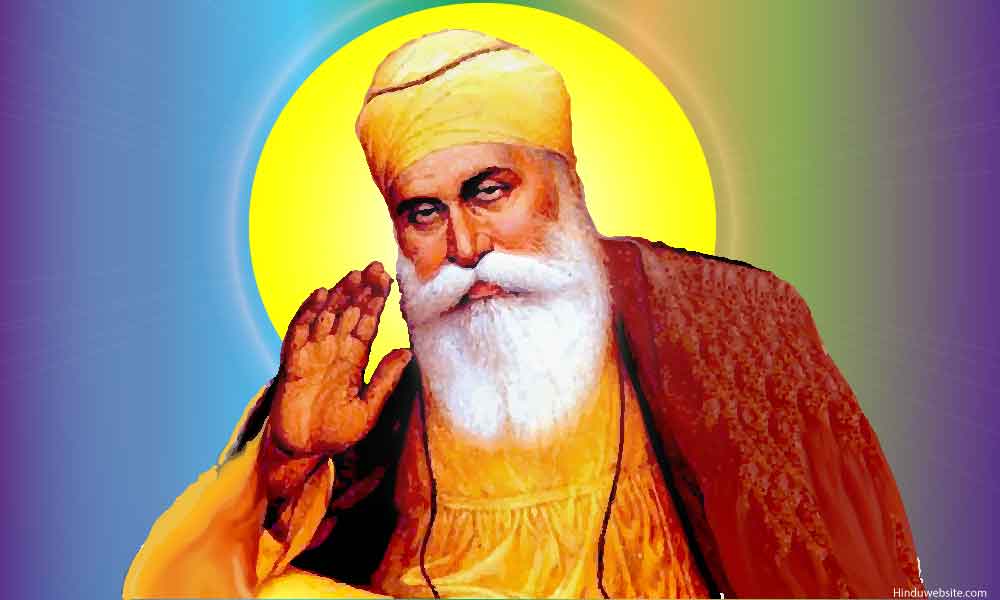
CHAPTER I
To recapitulate what has been more fully stated in the Introduction, Guru Nanak, the founder of the Sikh religion, was born, according to all ancient Sikh records, in the early morning of the third day of the light half of the month of Baisakh (April-May) in the year A.D. 1469; but for convenience sake his anniversary is now observed by the Sikhs on the occasion of the full moon in the month of Kartik (October-November). His father, who was called Kalu, was accountant in the village of Talwandi in the present Lahore District of the Panjab, and his mother was Tripta, memorable in Sikh writings for heir devotion to her son.
The Sikh biographers recount in minute detail all the circumstances of the birth of Guru Nanak. Daulatan, a midwife, assisted on the occasion. When next morning interrogated by the astrologer Hardial, who came to write the child's horoscope, as to the nature of the voice uttered by him at birth, she said it was as the laughing voice of a wise man joining a social gathering; and she expressed herself at her wits' end to comprehend the child's nature. The astrologer desired to see him, but his mother refused owing to the chillness of the weather. He pressed the matter, and the child was brought to him in his swaddling clothes. The astrologer on seeing the infant is said to have worshipped him with clasped hands. He declared the child should wear the umbrella, the symbol of regal or prophetic dignity in the East. At the same time he regretted that he should never live to see young Nanak's eminence, worshipped as he should be alike by Hindus and Musalmans, and not merely by Hindus as in the previous human manifestations of the Creator. The child's name should resound both in earth and heaven. Inanimate nature should cry out 'Nanak, Nanak!' He should have power over matter so as to traverse unscathed the depths of the ocean. He should worship and acknowledge but one God, and the creature he should treat as a creature. In other words he should be a monotheist, not a worshipper of minor deities and idols.
At the unripe age of five years Nanak is said to have begun to talk of divine subjects, and to have fully understood the meaning of his language. Great trust was reposed in him; and both Hindus and Musalmans lavished on him. their characteristic language of religious adulation.
At Nankana[1] every place with which Nanak had any association is deemed sacred. On the spot where he used to play with children of his own age and subsequently spend nights in devotion, there was a small tank constructed by Rai Bular, the landlord of the village, in affectionate remembrance of the childhood of the Guru, at a time when his fame had extended far and wide. The tank was greatly enlarged by Kaura Mal, the Diwan or financial minister of Zakaria Khan, who was satrap of Lahore. Kaura Mal was an enthusiastic admirer of Guru Nanak, and lent his great material and political influence to the amelioration of the condition of the Sikhs. The spot is called Balkrira or the child's playground.
When Nanak was seven years of age, his father in the manner of Hindus asked the village astrologer to select an auspicious time for the commencement of the boy's education. The schoolmaster thought the time had arrived. The school appears to have been a humble one, and the tuition fees not exorbitant. Kalu's wife and not, as in modern times, the village moneylender was the custodian of the wealth of the house. Kalu took from her a coin corresponding to three
[1. By which name Talwandi is now known.]
farthings of English money, some betel-nut, and rice, and presented them to the schoolmaster with his son. In India wooden tablets painted black are employed in teaching children the letters of their language. The schoolmaster writes the letters with a kind of liquid chalk on the tablet; and the children repeat their names aloud with much noise and energy. The schoolmaster wrote the alphabet for Nanak, and the latter copied it from memory after one day.
It is said that on that occasion the young Guru made an acrostic on his alphabet. As in similar compositions in other languages, the letters were taken consecutively, and words whose initials they formed were employed to give metrical expression to the Guru's divine aspirations, his tenets, and his admiration of the attributes of the Creator.
The acrostic called the patti or tablet in the Rag[1] Asa is as follows:--
S. The one Lord who created the world is the Lord of all.
Fortunate is their advent into the world, whose hearts remain attached to God's service.
O foolish man, why hast thou forgotten Him?
When thou adjustest thine account, my friend, thou shalt be deemed educated.
I. The Primal Being is the Giver; He alone is true.
No account shall be due by the pious man who understandeth by means of these letters.
[1. Indian writers enumerate six principal Râgs or musical measures, namely, Sri Râg, Bhairav, Mâlkaus, Hindol, Dîpak, Megh. To these are allotted 'wives' and 'sons', which are modifications of the principal airs, and are often sung differently in different provinces of India. The hymns of the Granth Sâhib were composed to as many as thirty-one such musical measures, the names of which are as follows:--Sri Râg, Mâjh, Gauri, Âsa, Gûjari, Devgandhâri, Bihâgra, Wadhans, Sorath, Dhanâsari, Jaitsari, Todi, Bairâri, Tilang, Sûhi, Bilâwal, Gaund, Râmkali, Nat, Mâlîgaura, Mâru, Tukhâri, Kedâra, Bhairo, Basant, Sârang, Malâr, Kânra, Kaliân, Prabhâti, Jaijâwanti. For further information see Râja Sir Surindra Mohan Tagore's learned works on Indian music. The Râgs in European musical notation will be found at the end of the fifth volume of this work.]
U. Praise Him whose limit cannot be found.
They who practise truth and perform service shall obtain their reward.
N. He who knoweth divine knowledge is the learned pandit.[1]
He who knoweth the one God in all creatures would never say 'I exist by myself '.
K. When the hair groweth white, it shineth without soap.
King Death's hunters follow him who is bound by the chain of mammon.[2]
KH. The Creator, Lord of the world, giveth sustenance to His slaves.
All the world is bound in His bonds; no other authority prevaileth.
G. He who hath renounced the singing of God's word, is arrogant in his language.
He who fashioned vessels made kilns in which He put them and burnt them.
GH. The servant who performeth the Guru's[3] work, who remaineth obedient to His commands,
Who deemeth bad and good as the same, shall in this way be absorbed in Him.
CH. He who made the four Veds,[4] the four mines,[5] and the four ages[6]
Hath been in every age a Jogi, a worldly man, or a learned pandit.
[1. Pandit means a learned man, but the title is now appropriated by Brâhmans versed in Sanskrit literature.
2. Mâyâ. In the sacred writings of the Sikhs this word has two meanings--one is mammon, as the word is here translated; the other is illusion or God's mystic power by which He created matter.
3. The word Guru means great. Here it stands for God, In a secondary sense it is applied to a great religious teacher.
4. They are the Rig, Sâm, Yajur, and Atharv, composed in the most ancient form of the Sanskrit language. In Sikh literature they are named the white, the red, the yellow, and the black Veds.
5. In the East four sources of life are enumerated. It is there said that animals are born from eggs, wombs, the earth, and perspiration.
6. The Sat, Tretâ, Dwâpar, and Kal, corresponding to the golden, silver, brass, and iron ages of Greece and Rome.]
CHH. God's shadow is over everything; doubt is His doing.
O God, having created doubt, Thou Thyself leadest man astray. They whom Thou favourest meet the Guru.
Thy slave, who wandered in the eighty-four lakhs[1] of existences, beggeth and prayeth for divine knowledge.
There is One who taketh, One who giveth; I have heard of none other.
JH. Why die of grief, O mortal? What God hath to give He continueth to give.
He giveth, beholdeth and issueth His orders how living things are to obtain sustenance.
N. When I look carefully I see no other than God.
The one God pervadeth all places; the one God dwelleth in the heart.
T. O mortals, why practise deceit? Ye shall have to depart in a ghari [2] or two.
Lose not the play of your lives, run and fall under God's protection.
TH. Comfort pervadeth the hearts of those whose minds are attached to God's feet.
They whose minds are so attached are saved, O Lord, and obtain happiness by Thy favour.
D. O mortal, why make display? all that existeth is transitory.
Serve Him who pervadeth all things, and thou shalt obtain happiness.
DH. He Himself destroyeth and buildeth; He acteth as He pleaseth.
He beholdeth the work of His hands, issueth His orders, and saveth those on whom He looketh with favour.
N. He in whose heart God dwelleth singeth His praises.
The Creator blendeth men with Himself, and they are not born again.
[1. It is believed in the East that there are 8,400,000 species of animal life through which the soul may wander in transmigration. A lakh is one hundred thousand.
2. A ghari is a period of twenty-four minutes.]
T. The terrible ocean[1] is deep, and none findeth its end.
We have no boat or raft; we are drowning; save us, O Saviour King.
TH. He who made all things is in every place.
What do men call doubt? What mammon? That which pleaseth God is good.
D. Impute not blame to any one, but rather to thine Own karma.[2]
I have suffered the consequences of my acts; I may blame no one else.
DH. He who made things after their kinds holdeth the power in His own hands.
All receive what He giveth under His most bountiful order.
N. The Master ever enjoyeth pleasure; He cannot be seen or grasped.
I am called a married woman, my sister, but in reality I have never met my Husband.[3]
P. The King, the Supreme God, made the play of the world to behold it.
He seeth, understandeth, and knoweth everything; He is within and without His creation.
PH. The whole world is entangled with a noose and bound by Death's chain.
They who by the Guru's favour have run to God for protection, are saved.
[1. In Sikh writings this world is likened to a terrible and stormy ocean which can only be traversed with difficulty, and in which man is ever liable to founder without spiritual guidance. The Guru supplies a boat for salvation.
2. Karma are acts which follow the soul in its transmigration and hinder its progress to Nirvân.
3 The Gurus speak of God as a husband and themselves as His wives; and spiritual happiness they liken to connubial bliss. This belief has to some extent a parallel in Greek mythology. Psyche, the human soul, having forfeited--the love of Eros, the divine soul, endured various sufferings; to regain the affection of her lover.]
B. God began to play by making the four ages His chaupar board.[1]
He made men and lower animals His dice, and began to throw them Himself.
BH. They who search and feel fear by the favour of the Guru obtain the fruit thereof.
The perverse, fools that they are, wander and heed not, and so transmigrate in the eighty-four lakhs of animals.
M. God destroyeth worldly love; is it only at death man is to remember Him?
Other thoughts possess man and he forgetteth the letter M.[2]
Y. If man recognize the True One, he shall not be born again.
The holy man uttereth, the holy man understandeth, the holy man knoweth but the one God.
R. God pervadeth all the creatures He hath made.
Having created creatures He appointed them all to their duties; they to whom He is kind take His name.
L. He who appointed creatures to their duties, made worldly love sweet.
He giveth eating and drinking equally to all, and ordereth them as He pleaseth.
W. The Supreme Being who created the vesture of the world to behold it,
Seeth, tasteth, and knoweth everything; He is contained within and without the world.
R. Why quarrel, O mortal? meditate on God, under whose order is creation.
Meditate on Him; be absorbed in the True One; and be a sacrifice unto Him.
H. There is no other Giver than He who created creatures and gave them sustenance.
Meditate on God's name; be absorbed in God's name, and thou shalt night and day derive profit therefrom.
[1. Chaupar is the Indian draughts.
2. The initial of Madhusûdan, one of the names applied to God. It may also be the initial of the Arabic word maut, death.]
A. What God who made the world hath to do He continueth to do.
He acteth and causeth others to act; He knoweth everything; thus saith the poet Nanak.
Nanak appears to have continued to attend school for some time. One day he was observed to remain silent, and not apply himself to his books. The schoolmaster asked him why he was not reading. Nanak inquired, 'Art thou sufficiently learned to teach me?' The schoolmaster replied that he had read everything. He knew the Veds and Shastars,[1] and he had learned to cast up accounts, post ledgers and daybooks, and strike balances. Upon this Nanak said, 'To your accomplishments I prefer the study of divine knowledge'. He then composed the following hymn:--
Burn worldly love, grind its ashes and make it into ink;[2] turn superior intellect into paper.
Make divine love thy pen, and thy heart the writer; ask thy guru and write his instruction.
Write God's name, write His praises, write that He hath neither end nor limit.
O master, learn to write this account,
So that, whenever it is called for, a true mark may be found thereon.
There[3] greatness is obtained, everlasting joys, and everlasting delights.
They in whose hearts is the true have the marks of it on their brows.
[1. Sanskrit works on the six philosophical systems of the Hindus. They are--the Nyâya founded by Gautama, the Vaisheshika by Kanâda, the Sânkhya by Kapila, the Yoga by Patanjali, the Mimânsa by Jaimini, the Vedânt by Vyâs. The six systems have been learnedly expounded by Max Müller in his Indian Philosophy.
2. At that time in India ink was made from burnt almond-rind and gum.
3 Corresponding to {Greek e?kei^} in Greek, the next world.]
By God's mercy men obtain it and not by idle words.
One man cometh, another goeth; we give them great names.[1]
Some men God created to beg, and some to preside over great courts.
When they have departed, they shall know that without the Name[2] they are of no account.
I greatly fear Thine anger; O God, my body pineth and wasteth away.
They who have been called kings and lords are beheld as ashes.
Nanak,[3] when man departeth all false affections are sundered.[4]
Upon this the schoolmaster became astonished, did Nanak homage as a perfect saint, and told him to do what he pleased.
Nanak, having thus shown his scholastic proficiency, left school and took to private study and meditation. He remained for long periods in the same attitude, whether sleeping or waking, and associated continually with religious men.
[1. Literally--we call them commanders. This refers to the custom of parents giving their sons high-sounding names.
2. In the Sikh writings the word Name is frequently used for God. A somewhat similar practice was known to the ancient Jews (Amos vii. 10). At a time too early to be traced the Jews abstained from pronouncing the name Jehovah for fear of its irreverent use, and uttered instead Adonai or Lord. in connexion with this we may say that the repetition of God's name is one of the principal forms of Sikh worship. Set forms of prayer are apt to be repeated mechanically or ostentatiously; and it was believed that by the constant heartfelt repetition of God's name man should be eventually absorbed in Him, and thus obtain the supreme object of human birth after countless transmigrations.
2. In Oriental poetical works it is usual for the poet to insert his real or assumed name--takhallus--in the end of a composition or section of it composition. This practice is unknown to European poets except in the case of professed imitators of Oriental poetry. Were we therefore to omit the word 'Nânak' wherever it occurs, we should be consulting the taste of European readers, but the Sikhs do not desire such an Omission.
4 Sri Râg.]
The scholastic ignorance of the founders of great religions has been made the subject of many a boast on the part of their followers. The object, of course, is that the acquirements and utterances of the religious teachers may be attributed solely to divine inspiration. We see no reason for ascribing a want of education to the founder of the Sikh religion; and the manner in which his learning was acquired is not difficult to understand. Had he remained at the humble village school, there is no reason to suppose that he would have acquired any considerable knowledge, but in the dense forests around Talwandi were to be found ascetics and anchorets who sought the extreme retirement of the locality for the combined objects of undisturbed prayer and escape from the persecution of bigoted Moslem rulers. All the Janamsakhis are unanimous in stating that Nanak courted the retirement of the forest and the society of the religious men who frequented it. Several of them were profoundly versed in the Indian religious literature of the age. They had also travelled far and wide within the limits of Hindustan, and met its renowned religious teachers. Nanak thus became acquainted with the latest teachings of Indian philosophers and reformers. The satisfaction which he derived from spiritual thought and religious association he thus expressed:--
Let Jogis practise Jog,[1] let gluttons practise gluttony,
Let penitents practise penance, and rub and bathe themselves at places of pilgrimage;
But let me listen to Thy songs, O Beloved, if any will sit and sing them to me.
The names of the men with whom Nanak associated in the forest and who sang to him the songs of the Lord are all lost, and their excellences merged as
[1. Jog, connected with the Greek {Greek zugo'n}, originally meant the union of the soul with God, and may be compared with the etymological meaning of the word 'religion'. They who practised Jog were called Jogis. The word Jog is now applied to certain practices of the Jogis which are detailed in the Aphorisms of Patanjali.]
by a process of nirvan in the religious splendour of the founder of the Sikh religion. But more perhaps than learning from the lips of religious masters were his own undisturbed communings with nature, with his own soul, and with his Creator. The voice that had spoken to many a seer again became vocal in that wilderness, and raised Nanak's thoughts to the summit of religious exaltation. In summer's heat and winter's frost, in the glory of the firmament, in the changeful aspects of nature, as well as in the joys and sorrows of the inhabitants of his little natal village, he read in bright characters and repeated with joyous iteration the name of the Formless Creator. The Name henceforth became the object of his continual worship and meditation and indeed one of the distinctive features of his creed.
As a man soweth so shall he reap; as he earneth so shall he eat.
No inquiry shall be made hereafter regarding the utterers of the Name. With banners flying shall they go to heaven.[1]
Men are judged according to their acts.
The breath drawn without the thought of God is wasted in vain.
I would sell this body if only I found a purchaser.
Nanak, the body which is not filled with the true Name is of no account.[2]
There is also proof from the satisfactory internal evidence of his own compositions that Guru Nanak studied the Persian language. Kalu felt that the society of religious men was not likely to advance his son's secular interests. Rai Bular promised that if Nanak learned Persian, in which all state documents and accounts were then written, he would appoint him village accountant in succession to his father. Persian was never the tongue of Hindus, and was despised by them as the language of foreigners and conquerors
[1. San nishâmi jâi. Also translated--if they bear Thy mark.
2 Sûhi.]
and of impure Musalman literature;[1] but Hindus in the age of Nanak applied themselves to it as they do now--for the simple purpose of obtaining a livelihood. Nanak soon astonished his Persian as he had previously astonished his Hindu teacher. In reply to Rukn-ul-Din's injunctions he assumed the rôle of teacher in turn and composed the following acrostic on the letters of the Persian alphabet
ALIF. Remember God and banish neglect of Him from thy heart.
Accursed the life of him in this world who breatheth without uttering the Name.
BE. Renounce heresy and walk according to the Shariat.[2]
Be humble before every one, and call no one bad.
TE. Repent with sincerity of heart lest thou afterwards grieve.
Thy body shall perish: thy mouth shall be buried with it; what canst thou do then?
SE. Praise God very much; draw not thy breath without doing so,
Or thou shalt be offered for sale from shop to shop, and not an adh[3] shall be obtained for thee.
JIM. Put together travelling expenses, and pack up wherewithal to go with thee:
Without the Lord thou shalt trudge about wearily.
HE. Embrace humility, renounce the pride of thy heart;
Restrain thy wandering mind, O Rukn-ul-Din, and every moment remember thy Creator.
KHE. They were traitors who forgot their Creator;
Their minds were bent on the hoarding of wealth, and they bore loads of sin upon their heads.
[1. In the institutes of Parâsar there is found an injunction not to speak the language of the inhabitants of Yavan--a word which originally meant Greece, but was afterwards applied to Arabia--even though it save life from issuing by the throat. Parâsar possessed the Hindu abhorrence of strange countries and gave expression to it. His words are now understood by the Hindus to refer to the language of the Musalmans, though there were no Musalmans for centuries after his time.
2. Muhammadan law.
3. About an eighth of a farthing of English money.]
DAL. Be honest, O man, and sleep not during the eight watches of day and night.
Awake for one watch and hold converse with God.
ZAL. Remember God, O man, vacillate not an iota;
So shall hell fire not touch thee at all, and thy covetousness and worldly love be at an end.
RE. The advantage of faith thou shalt know when thou arrivest before God.
Restrain the five evil passions,[1] O Rukn-ul-Din, and apply thy heart to God.
ZE. Practise humility, the Lord is independent;
He doeth what he pleaseth; what certainty is there regarding His acts?
SIN. Search thy heart; the Lord is in thee.
The body is a vessel which He wrought, and into which He infused His workmanship and skill.
SHIN. Thou shalt obtain martyrdom if thou die for the love of the dear One.
O Rukn-ul-Din, this human body shall depart while in it pray to obtain God.
SUAD. Let thy mind be contented when thou obtainest thine allotted food.
God who gave thee the disease of hunger is thy physician.
ZUAD. God's splendour is lost for those who associate themselves with worldly affairs.
Arise, look before thee, and regard not the play of the world.
TOE. Embrace tariqat and enter upon marafat;[2]
This body of thine shall become a heap of dust in the grave.
ZOE. They were tyrants who heeded not the Name:
How can man obtain peace without his Master?
[1. Lust, anger, covetousness, worldly love, and pride.
2. There are four stages of Sûfiism: Sharîat, the law or external ceremonies; Tarîqat, walking in God's way; Mârafat, Divine knowledge; Haqîqat, certainty or union with God. Many learned natives of India believe that the Sûfi system is based on Vedânt.]
'AIN. Practise good works to the best of thy power:
Without good works and virtues man shall die full of regret.
GHAIN. O Rukn-ul-Din, they are rich who know themselves--
In this cage of the body God who hath neither mother nor father sporteth.
FE. Have done with the world, and think it not thine own:
If thou deem it to belong to God, thou shalt not be confounded.
QAF. They in whose hearts the love of God hath arisen shall have no rest till they find Him.
The bodies of those who have met the Lord God have become refined gold.
KAF. Remember thy creed; in what else is there profit?
O Rukn-ul-Din, be not excessively addicted to sensuality.
GAF. Man's mind is wanton; if thou restrain it,
Thou shalt plant thy feet firmly on the way to haqiqat.
LAM. May curses rain on those who abandon their prayers
They lose whatever little or much they have earned.
MIM. Wilfulness is prohibited; walk as thy religious guide directeth thee.
The wealth of those, saith Nanak, who have not given alms shall slip away.
NUN. Look to truth alone, and know that the world is false.
They who think the world is true shall die confounded.
WAW. They become saints who associate with the true.
The more they remember God, the more they love Him.
HE. Be in fear of that day when God will judge thee;
What order will He pass in our case, O Rukn-ul-Din?
LAM. They on whom He casteth His look of mercy have become worthy.
What is desire for life if a man regulate not his own conduct?
ALIF. God is in thee; why thinkest thou not on Him, O ignorant man?
By service to the guru God is found, and deliverance obtained at last.
YE. Love God whose empire is everlasting.
He is unrivalled, O Nanak, and in need of no one.[1]
There are numerous Persian words and some Persian verses of the Guru found in the Granth Sahib, and it may be accepted as a fact that. he became a fair Persian scholar. It is highly probable that his habit of free thought and toleration for other men's opinions were assisted by his perusal of the Muhammadan writings with which the Persian language abounds.
It does not appear that even the acquisition of Persian tended to give Nanak's thoughts a more practical direction. His father thought him insane, and was sore distressed for his future. He, however, sent him to herd buffaloes in the adjoining forest. Matters progressed smoothly for one day, but the next day Nanak fell asleep, and his cattle trespassed on a neighbour's field. The owner remonstrated, but Nanak said that God would bless the field. The owner was not to be diverted by this unpractical defence. He complained to Rai Bular, and the latter, hearing that Nanak was insane, was not content to send for him, but also for his father to adjust the quarrel. Nanak said that no injury had befallen the field: it was blessed by God. Rai Bular sent his own messengers to inspect the spot. On their arrival they found that not one blade had been trampled on or eaten. The field where this miracle is said to have occurred is pointed out to visitors. It is known as the Kiara Sahib, or the parterre par excellence.
[1. This composition is not found in the Granth Sahib. Some Sikhs deny that it is the composition of Guru Nanak.]
CHAPTER II
When Nanak had attained the age of nine years, his father determined to have him invested with the janeu, or sacrificial thread of the Hindus. Until a boy is so invested, he is deemed almost an outcast. When the members and relations of the family, and all the neighbours, secular and religious, had assembled, and all preliminary rites had been duly performed, Hardial, the family priest, proceeded to put the sacred thread on Nanak's neck. The boy caught the thread with his hand, and asked the priest what he was doing, and what advantage it was to put a thread of that description on him. The priest then explained that the janeu was the basis of the Hindu religion, that without it a man would only be a Sudar,[1] and that by putting it on greatness should be obtained in this world and happiness in the next. On hearing this the young Guru gave utterance to the following:--
Make mercy thy cotton, contentment thy thread, continence its knot, truth its twist.
That would make a janeu for the soul; if thou have it, O Brahman, then put it on me.
It will not break, or become soiled, or be burned, or lost.
Blest the man, O Nanak, who goeth with such a thread on his neck.
Thou purchasest a janeu for four damris,[2] and seated in a square puttest it on;
[1. There are four great varans or castes of Hindus--Brâhmans, the priestly class; Kshatris, the militant class; Vaisyas, the trading class; and Shûdars, the working class, the lowest of all. Of these castes there are now many subdivisions.
2 Four damris is one paisâ of Indian, or a farthing of English money.]
Thou whisperest instruction that the Brahman is the guru of the Hindus--
Man dieth, the janeu falleth, and the soul departeth without it.[1]
The priest explained that the custom of wearing a janeu had descended from the Vedic ritual, and that no Hindu could be deemed religious without wearing it. The Brahman then familiarly addressed the Guru, 'Thou art but a child of yesterday, and are we not as wise as thou? Unless thou wear this thread thou shalt be deemed a person without religion.' Guru Nanak replied:--
Though men commit countless[2] thefts, countless adulteries, utter countless falsehoods and countless words of abuse;
Though they commit countless robberies and villanies night and day against their fellow creatures;
Yet the cotton thread is spun, and the Brahman cometh to twist it.
For the ceremony they kill a goat and cook and eat it, and everybody then saith 'Put on the janeu'.
When it becometh old, it is thrown away, and another is put on,
Nanak, the string breaketh not if it be strong.
The Brahman priest, on hearing this, became angry, and asked the Guru if everybody else was a fool, and he alone, who had abandoned the customs of his forefathers, was wise. He then called on the Guru to tell him what a proper janeu was. The Guru replied:--
By adoring and praising the Name honour and a true thread are obtained.
In this way a sacred thread shall be put on, which will not break, and which will be fit for entrance into God's court.
[1. Âsa ki Wâr. This composition will subsequently be given in extenso, and the meaning of the word wâr explained.
2. Lâkh. Here used for an indefinite number.]
The Guru then wound up his instruction on the subject as follows:--
There is no string for the sexual organs, there is no string for women;
There is no string for the impure acts which cause your beards to be daily spat upon;
There is no string for the feet, there is no string f or the hands
There is no string for the tongue, there is no string for I the eyes.
Without such strings the Brahman wandereth astray,
Twisteth strings for the neck, and putteth them on others.
He taketh hire for marrying;
He pulleth out a paper, and showeth the fate of the wedded pair.
Hear and see, ye people, it is strange
That, while mentally blind, man is named wise.[1]
We have seen in the Introduction to this work that Sultanpur was then the capital of the Jalandhar Doab. At that time and up to the period of British occupation, land revenue was generally collected in kind. Surveyors and appraisers called Amils were dispatched from the capital to different districts. Amil Jai Ram was appointed to appraise the revenue demand of Talwandi. While one day surveying a corn-field, he observed Nanaki, sister of Nanak, drawing water from a well, and saw that she was fair to look upon. A marriage between them was arranged through the kind offices of Rai Bular. The lady went and lived with her husband at Sultanpur.
Nanak's marriage must have taken place soon after his sister's. It is related in the Janamsakhi which bears the name of Mani Singh, that Nanak was married at the age of fourteen. His marriage, as is usual in the East, was arranged for him as a matter of religious duty by his parents. He was
[1. Âsa ki Wâr.
2 Under the Emperor Akbar it was often optional for the husbandman to pay either in money or in kind. Aîn-i-Akbari, Book III, Aîn 13.]
betrothed to Sulakhani, daughter of Mula, a resident of Batala[1] in the present district of Gurdaspur. It would appear that, owing to the distance between Nankana and Batala, which hindered frequent visits and negotiations, the marriage followed very soon after the betrothal. Nanak's sister was present at the wedding, but her husband could not obtain permission to attend. He sent word that he was another person's servant, an apology that was perfectly understood.
Nanak appears to have been further trusted in the capacity of a herdsman. While one day herding his buffaloes, he lay down to sleep under a tree during the midday heat. Rai Bular passing by in the evening found him in that attitude, and observed that the protecting shadow of the tree had remained stationary over him, and not veered round like the shadows of the other trees with the sun's progress. On another occasion, as Nanak lay asleep in the pasture ground, it was observed that a large cobra watched over him, and protected the youthful saint with its hood. Rai Bular acknowledged the miraculous powers of the boy, and congratulated Kalu on being the father of such a son. Kalu ought no longer to be displeased with him for his indifference to his worldly affairs. He was a very great man. A jal-tree,[l] gnarled and maimed by the centuries, is still pointed out as the scene of the former miracle. It possesses a thick trunk, is still gratefully umbrageous, and its venerable branches depend to the earth in a fashion that suggests the pillared shade of the Indian fig-tree.
Nanak still persisted in doing no useful work, and his mother reproached him with his idleness. She counselled him to rise, work for his livelihood, and cease weaving unpractical discourses. She told him
[1. Her place of birth in Batala is reverenced by the Sikhs. Mahârâja Sher Singh erected a temple in her honour.
2. The Salvadora Oleoides.]
that he was popularly credited with madness; but he paid no heed to her admonitions further than to compose the following hymn on the occasion:--
He who dieth in obstinacy shall not be accepted.
Even though man wear a religious garb and apply much ashes to his body,
Yet, if he forget the Name, he shall afterwards repent.
O man, obey God and thou shalt be happy.
If thou forget the Name, thou shalt have to endure Death's torture.
They who apply distilled aloe-wood, sandal, and camphor to their bodies,
Are immersed in worldly love, and far from the supreme dignity of salvation.
They who forget the Name are the falsest of the false.
They who are guarded by lances, for whom bands play, who sit on thrones, and are objects of salutation,
Suffer from excessive avarice and lust.
Being without God they pray not for His service or His name.
God is found not by argument or by pride.
If man apply his mind he shall find the comforting Name.
They who love mammon are painfully ignorant.
Without money goods cannot be had from a shop;
Without a boat man cannot cross the sea;
So, without serving the Guru, there is complete loss.
Hail, hail to him who showeth the road!
Hail, hail to him who communicateth the Word!
Hail, hail to him who blendeth us with God!
Hail, hail to Him to whom the soul belongeth
Under the Guru's instruction separate the true from the false, and drink it as nectar.
The greatness of the Name is bestowed according to Thy pleasure, O God.
Without the Name how could I live, O mother?
Night and day[1] I repeat it and remain, O Lord, under Thy protection.
Nanak, he who is imbued with the Name obtaineth honour.[2]
[1. Anudin, translated 'night and day' by the gyânis, is literally--every day.
2 Gauri Ashtapadi.]
After this Nanak lay down, remained in one position for four days, and declined all physical exertion.
Nanak appears to have become unfitted for all secular occupation. His idleness became notorious, and a serious source of anxiety to his parents. His mother sought to lead him with mild admonitions to secular duty, but fortunately failed. His father then addressed himself to the task. He represented that he required assistance in the cultivation of his land, and Nanak was now of an age to turn his attention to agriculture. Nanak replied:--
Make thy body the field, good works the seed, irrigate with God's name;
Make thy heart the cultivator; God will germinate in thy heart, and thou shalt thus obtain the dignity of nirvan.[1]
His father and Rai Bular represented that that was not the way to become a husbandman, whose business ought to be manual labour, and whose object was to gain a livelihood. Upon this Nanak composed the following:--
Become a husbandman, make good works thy soil, and the word of God thy seed;[2] ever irrigate with the water of truth.
Faith shall germinate, and thus even a fool shall know the distinction between heaven and hell.
Think not that thou shalt find the Lord by mere words.
In the pride of wealth and the splendour of beauty life hath been wasted.
The sin of the body is a puddle, the mind is a toad therein, which valueth not at all the lotus.
The bumble-bee is the teacher,[3] who preacheth incessantly; but can the guru cause a man to understand who will not understand?[4]
[1. Sri Râg.
2. Also translated--Clear thy ground, make the Word thy seed.
3. That is, the Guru.
4. The body is compared to a puddle; the mind to a toad which loves the puddle, but sets no value on the beautiful lotus of spiritual wisdom. The spiritual guide, like the bee, unceasingly hums his message.]
Preaching and listening are as the sough of the wind, when man's mind is tinctured by the illusions of the world.
The Lord casteth a look of favour, and is well pleased with those who meditate on Him alone.
Even though thou perform the thirty days' fast, and make the five prayers thy daily companions, yet he who is called Satan will cut the thread of thy thoughts.[1]
Nanak saith, man must depart; why amass property and wealth?[2]
On the same occasion the Guru uttered the following:--
Make thy mind the ploughman, good acts the cultivation, modesty the irrigating water, and thy body the field to till,
The Name the seed, contentment the harrow, and the garb of humility thy fence:
By the work of love the seed will germinate; thou mayest behold happy the homes of persons who thus act.
O father, mammon accompanieth not man when he departeth:
Mammon hath allured this world, and few there are who understand it.
Then Nanak informed his father that he had sown his own field, and that its harvest was now ready. He had such confidence in his tillage, that, even after deduction of the portion paid in kind to the government as revenue, the full produce would still remain. Sons, daughters, beggars, brethren, and relations would all be profited thereby. He had done farming work for God, who had treated him as a lord does his tenants, and the day that he effected union with his Creator, his soul within him would be glad.
[1. That is, make thy thoughts wander. For man in the old Panjabi life of the Guru the Granth Sahib has mat. The line may then be translated--Perform the thirty days' fast. of the Musalmâns, make their five daily prayers thy companions, and take care lest Satan destroy the effect of thy prayers.
2 Sri Râg.]
On hearing this, his father told him to keep a shop, for a shop was as profitable as tillage. Nanak replied:--
Make the knowledge that life is frail thy shop, the true Name thy stock-in-trade;
Make meditation and contemplation thy piles of vessels;[1] put the true Name into them.
Deal with the dealers of the true Name, and thou shalt gladly take home thy profits.
Then again Kalu. said, 'If thou desire not to be a shopkeeper, take horses and deal in them. Thy heart is sad; but do something for thy livelihood, and visit foreign countries. We will say that thou hast gone to earn thy living, and that thou wilt soon return.' Upon this Nanak uttered a third stanza:--
Make thy hearing of the sacred books thy merchandise, truth the horses thou takest to sell;
Tie up virtues as thy travelling expenses, and think not in thy heart of to-morrow.
When thou arrivest in the land of God, thou shalt obtain happiness in His abode.
Kalu in despair replied, 'Thou art lost to us; go and take government service. Jai Ram, Daulat Khan's revenue officer, is thy brother-in-law; go and take service with him; perhaps thou wilt like that place; we can dispense with thine earnings. If thou go elsewhere without any occupation, everybody will say that my son hath become a faqir, and people will heap reproaches on me.' Upon this, Guru Nanak uttered a fourth stanza:--
Make attention thy service, faith in the Name thine occupation;
Make the restraint of evil thine effort, so shall men congratulate thee.
[1. In which the Indian petty shopkeeper keeps his goods.]
God will then look on thee, O Nanak, with an eye of favour, and thy complexion shall brighten fourfold.[1]
Nanak then informed his father that God had, granted him the object of his prayers. The gains of commerce, of government service, and of banking, had all been imparted to him. The astonished father said he had never seen or heard of a God who granted so many favours. Nanak replied that his God was the object of praise to those who had seen Him:--
As men have heard, O Lord, so all call Thee great;
But hath any one ever seen how great Thou art?[2]
Thy worth cannot be estimated or described;
They who seek to describe it are absorbed in Thee.
O my great Lord, deep and profound, brimful of excellences,
None knoweth the extent of Thine outline.
Though all meditative men were to meet and meditate upon Thee,
Though all appraisers were to meet and appraise Thee--
They who possess divine and spiritual wisdom, priests, and high priests[3]--
Yet could they not describe even a small portion of Thy greatness.
All truth, all fervour, all goodness, The excellences of perfect men,
Cannot be obtained in their perfection without Thee.
If Thy grace be obtained none can be excluded
Of what account is the helpless speaker?
Thy store-rooms are filled with Thy praises.
Who can prevail against him to whom Thou givest?
Nanak, the True One arrangeth all.[4]
His father was not satisfied, but further remonstrated
[1. Sorath.
2. Also translated--How great He is whoever hath seen Him could tell.
3. Gurhâi, translated high priests, is really the Persian plural of guru. Compare the words Shaikh mashâikh, so frequently found in the Granth Sâhib. Mashâikh is, of course, the Arabic plural of shaikh.
4. Asa.]
with Nanak. He enjoined him to abandon his whims and act like others, as no one could live without worldly occupation. Nanak was not convinced, so his father in despair left him and went to attend to his ordinary business. Nanak's mother again attempted the worldly reformation of her son. She requested him to forget even for a few days his devotions and go abroad, so that the neighbours might be assured that Kalu's son had recovered his reason. Nanak then uttered the following verses in the Rag Asa:--
If I repeat the Name, I live; if I forget it, I die;[1]
It is difficult to repeat the true Name.
If a man hunger after the true Name, His pain shall depart when he satisfieth himself with it.[2]
Then how could I forget it, O my mother?
True is the Lord, true is His name;
Men have grown weary of uttering
Even an iota of His greatness; His worth they have not discovered.
If all men were to join and try to describe Him,
That would not add to or detract from His greatness.
God dieth not, neither is there any mourning for Him
He continueth to give us our daily bread which never faileth.
His praise is-that there neither is,
Nor was, nor shall be any one like unto Him.
As great as Thou art Thyself, O God, so great is Thy gift.
Thou who madest the day madest also the night.
They who forget their Spouse[3] are bad characters;[4]
Nanak, without His name they are naught.[5]
[1. Of course, spiritual life and death are meant.
2. Literally--the pain of that hungry man shall depart on eating the Name, that is, on receiving it as food. The verse is also translated--His pain shall depart; all his desires shall be merged in his hunger for the Name.
3. The allusion here is to men forgetting God.
4. A colloquial meaning of the word kamijât, which literally means inferior caste.
5. Sanât, a plural form of san, a year, or an age. The word was {footnote p. 26} applied to coin which had long circulated, and which had consequently worn away and become worthless.]
Then his mother arose and told the household of Nanak's state. Upon this the whole family and relations grew sad, and said it was a great pity that Kalu's son had become mad.
His uncle Lalu among others exerted himself to console the young prophet. He represented to Nanak that all his relations had fixed on an occupation for him, but he had refused to adopt it. On the contrary, he would do nothing whatever, not even enjoy himself. Nanak then gave utterance to the following hymn, which, however, is not found in the Granth Sahib:--
All men are bound by entanglements; how can these be called good qualities?
Nay, O Lalu, listen to the following qualities:--
Forgiveness is my mother, contentment my father,
Truth by which I have subdued my heart my uncle,
Love of God my brother, affection mine own begotten son,
Patience my daughter--I am pleased with such relations--
Peace my companion., wisdom my disciple--
This is my family in whom I ever rejoice.
The one God who adorned us all is my Lord.
Nanak, he who forsaketh Him and clingeth to another shall suffer misery.
Guru Nanak then became silent, lay down, and ate and drank nothing. The whole family represented to Kalu that something ought to be done for his son. A physician ought to be called, and medicine prescribed. 'Who knows but that behind a straw there is a lakh?' that is, by a small expenditure Nanak may recover. Upon this, Kalu went and brought a physician. The physician came, and began to feel Nanak's pulse. He withdrew his arm, and, drawing in his feet, stood up and said, 'O physician, what art thou doing?' The physician said that he was diagnosing his disease. Upon this Nanak laughed, and then uttered the following verses:--
The physician is sent for to prescribe a remedy; he taketh my hand and feeleth my pulse.
The ignorant physician knoweth not that it is in my mind the pain is.[1]
Physician, go home; take not my curse with thee.
I am imbued with my Lord; to whom givest thou medicine?
When there is pain, the physician standeth ready with a store of medicine:
The body is weeping, the soul crieth out, 'Physician, give none of thy medicine.'
Physician, go home, few know my malady.
The Creator who gave me this pain, will remove it.
The physician asked Nanak what he himself thought his illness was. Nanak replied:--
I first feel the pain of separation from God, then a pang of hunger for contemplation on Him.
I also fear the pain which Death's powerful myrmidons may inflict.
I feel pain that my body shall perish by disease.
O ignorant physician, give me no medicine.
Such medicine as thou hast, my friend, removeth not
The pain I feel or the continued suffering of my body.
I forgot God and devoted myself to pleasure
Then this bodily illness befell me.
The wicked heart is punished.
Ignorant physician, give me no medicine.
As sandal is useful when it exhaleth perfume,
As man is useful as long as he hath breath in his body,
So when the breath departeth, the body crumbleth away and becometh useless:
No one taketh medicine after that.
[1. Malâr ki Wâr.]
When man shall possess the Name of the Bright and Radiant[1] One,
His body shall become like gold and his soul be made pure;
All his pain and disease shall be dispelled,
And he shall be saved, Nanak, by the true Name.[2]
The following was on the same subject:--
Pain is arsenic, the name of God is the antidote.
O ignorant man, take such medicines
As shall cure thee of thy sins.
Make contentment thy mortar, the gift of thy hands thy pestle:
By ever using these the body pineth not away,
Nor at the final hour shall Death pommel thee.
Make enjoyments thy firewood, covetousness thy clarified butter and oil.
Burn them with the oil of lust and anger in the fire[3] of divine knowledge.
Burnt offerings, sacred feasts, and the reading of the Purans,[4]
If pleasing to God, are acceptable.
Empire, wealth, and youth are all shadows
So are carriages and imposing mansions.
Hereafter neither man's name nor his caste shall be considered.
There is day, here all is night.
Let us make penitence the paper,[5] Thy name, O Lord, the prescription.
They for whom this priceless medicine is prescribed,
[1. Also translated--When man possesseth even a portion of the name of the Bright One.
2 Malâr.
3 It was intended by his parents to make a hom sacrifice or burnt offering for Nânak's recovery. The Sanskrit word hom is interpreted to mean casting into the fire, and correctly represents the oblation of clarified butter, sesames, butter, &c., which forms part of the ceremonial.
4 Sacred books of the Hindus, eighteen in number. They are the principal authorities for the idolatry and superstition of the Hindus.
5. To write a prescription on.]
Are fortunate when they reach their final home.
O Nanak, blessed are the mothers who bore them.[1]
Then the physician drew back, stood still, and said that Nanak was not ill. His relations and friends ought to feel no anxiety for him, for he was a great being. Upon this the physician worshipped him and took his leave.
There is very little known regarding Nanak's married life excepting that he begot two sons, Sri Chand and Lakhmi Das. It was related that he used to retire to the desert, and pass his time under trees in religious contemplation.
All the modern Janamsakhis make Nanak's marriage long subsequent to this, and after his departure to Sultanpur. They say that it was Jai Ram who had him married, and that his wife was a native of Pakkho, a town not far from Sultanpur. We have followed Mani Singh and the old Janamsakhi. If Nanak had been left to his own discretion, and if his marriage had not been made for him by his parents, it is most probable that he would not have turned his attention to that part of a man's duties after entering the service of the government in Sultanpur. This will subsequently be understood when we come to consider his mode of life at that capital.
CHAPTER III
The Guru, on one occasion seeing his parents and relations standing around him to consider his condition, composed a hymn in the Rag Gauri Cheti[2]:--
Since when have I a mother? Since when a father? Whence have we come?
[1. Malâr.
2 Gauri is a râgini or consort of Sri Râg, and has nine varieties, one of which is the Cheti.]
From fire and bubbles of water are we sprung; for what object were we created?
My Lord, who knoweth Thy merits?
My demerits cannot be numbered.
How many shrubs and trees have we seen! how many beasts created by Thee!
How many species of creeping things, and how many birds hast Thou caused to fly!
Men break through the shops and great houses of cities and stealing therefrom go homewards.
They look before them, they look behind them, but where can they hide themselves from Thee?
The banks of streams of pilgrimage, the nine regions I of the earth, shops, cities, and market-places have I seen.
Becoming a shopkeeper I take a scale and try to weigh my actions in my heart.
My sins are numerous as the waters of the seas and the ocean.
Bestow compassion, extend a little mercy, save me who am like a sinking stone.
My soul is burning like fire; it is as though shears were cutting my heart.
Nanak humbly representeth--he who obeyeth God's order is happy day and night.[2]
Kalu then desired that his son should embrace a mercantile life. He instructed him to go to Chuharkana in the present district of Gujranwala, and buy there salt, turmeric, and other articles to trade with. Nanak set out with a servant, and on the way met some holy men, whose vows obliged them to remain naked in all seasons. Nanak was struck with this peculiarity, and inquired of their head-priest Santren if they had no clothes to wear, or if, having clothes, they found it uncomfortable to
[1. The ancient Indian Geographers divided the earth into nine regions or continents.
2 Gauri.]
wear them. Before he could receive an answer, Nanak was reminded by his servant of his more practical mission, and counselled to proceed to Chuharkana in obedience to his father's instructions. Nanak, however, was not to be thwarted in his object. He pressed the priest for an answer. The priest replied that his company required not clothes or food, except in so far as the latter was voluntarily bestowed on them. To avoid all luxury they dwelt in forests, and not in peopled towns and villages. Nanak thought he had found what he had sought for, and said to his servant that he had already obeyed his father's instructions, which were to spend his money to the best advantage. He therefore gave the holy men the money with which his father had provided him. Upon this they asked him his name, and he said that he was Nanak Nirankari, or Nanak the worshipper of the Formless One, that is, God. Nanak was prevailed upon to take the money to the nearest village to buy food for the holy men, who had not tasted any for some days.
When the faqirs took their departure, Nanak was censured by his servant for his reckless prodigality. He then realized the nature of his act, and did not go home, but sat under a tree outside the village of Talwandi. He was there found by his father, who cuffed him for his disobedience. The aged tree under which he sat is still preserved. A wall has been. built around it for protection. Within the enclosure are found religious men in prayer and contemplation. The tree is known as the Thamb Sahib, or the holy trunk.
Jai Ram, during his yearly visits to Talwandi at the close of the spring harvest, had ample opportunities of cultivating Nanak's acquaintance, and appreciating his good qualities. Rai Bular, too, was no apathetic advocate of Nanak. It was agreed between him and Jai Ram that Nanak was a saint ill-treated by his father; and Jai Ram promised to cherish him and find him occupation in Sultanpur. Nanak's departure to his brother-in-law was precipitated by another act of worldly indiscretion. He had entered into companionship with a faqir who visited the village. Nanak told him, as he did the other faqirs, that his name was Nanak Nirankari; and a friendly intimacy sprang up between them. The faqir was probably a swindler, and coveted a brass lota, or drinking vessel, and a gold wedding ring which Nanak wore, and asked that they might be presented to him. Nanak acceded to the request, to the further sorrow and indignation of his parents. After that it was not difficult to induce Kalu to allow his son to proceed to Sultanpur to join Jai Ram and Nanaki.
The other members of Nanak's family also unanimously approved of his decision. Nanak's wife alone, on seeing him make preparations for his journey, began to weep, and said, 'My life, even here thou hast not loved me; when thou goest to a foreign country, how shalt thou return?' He answered, 'Simple woman, what have I been doing here?' Upon this she again entreated him, 'When thou satest down at home, I possessed in my estimation the sovereignty of the whole earth; now this world is of no avail to me.' Upon this he grew compassionate, and said, 'Be not anxious; thy sovereignty shall ever abide.' She replied, 'My life, I will not remain behind; take me with thee.' Then Nanak said, 'I am now going away. If I can earn my living, I will send for thee. Obey my order.' She then remained silent.
When Nanak asked Rai Bular's permission to depart, the Rai gave him a banquet. The Rai then requested him to give him any order he pleased, that is, to state what favour he might grant him. Nanak replied:--
I give thee one order if thou wilt comply with it.
When thine own might availeth not, clasp thy hands and worship God.
Jai Ram introduced Nanak as an educated man to the Governor, Daulat Khan, who appointed him storekeeper and gave him a dress of honour as a preliminary of service. Nanak began to apply himself to his duties, and so discharged them that everybody was gratified and congratulated him. He was also highly praised to the Governor, who was much pleased with his new servant. Out of the provisions which Guru Nanak was allowed, he devoted only a small portion to his own maintenance; the rest he gave to the poor. He used continually to spend his nights siring hymns to his Creator.
If Nanak, when weighing out provisions, went as far as the number thirteen--tera--he used to pause and several times repeat the word--which also means 'Thine,' that is, 'I am Thine, O Lord,'--before he went on weighing.
The minstrel Mardana subsequently came from Talwandi and became Nanak's private servant. Mardana was of the tribe of Dums, who are minstrels by heredity. He used to accompany Nanak on the rabab, or rebeck.[1] Other friends too followed. Nanak introduced them to the Khan and procured them employment. They all got a living by Nanak's favour, and were happy. At dinner-time they came and sat down with him, and every night there was continual singing. A watch before day, Nanak used to go to the neighbouring Bein river and perform his ablutions. When day dawned, he went to discharge the duties of his office.
One day after bathing Nanak disappeared in the
[1. This instrument, which was of Arabian origin, has fallen into disuse in Northern India. It had from four to six strings of goat-gut with steel strings for resonance.]
forest, and was taken in a vision to God's presence. He was offered a cup of nectar, which he gratefully accepted. God said to him, 'I am with thee. I have made thee happy, and also those who shall take thy name. Go and repeat Mine, and cause others to do likewise. Abide uncontaminated by the world. Practise the repetition of My name, charity, ablutions, worship, and meditation. I have given thee this cup of nectar, a pledge of My regard.' The Guru stood up and made a prostration. He then sang the following verses to the accompaniment of the spontaneous music of heaven:--
Were I to live for millions of years and drink the air for my nourishment;
Were I to dwell in a cave where I beheld, not sun or moon, and could not even dream of sleeping,[1]
I should still not be able to express Thy worth; how great shall I call Thy name?
O true Formless One, Thou art in Thine own place-
As I have often heard I tell my tale--If it please Thee, show Thy favour unto me.
Were I to be felled and cut in pieces, were I to be ground in a mill;
Were I to be burned in a fire, and blended with its ashes,
I should still not be able to express Thy worth; how great shall I call Thy name?
Were I to become a bird and fly to a hundred heavens;
Were I to vanish from human gaze and neither eat nor drink,
I should still not be able to express Thy worth; how great shall I call Thy name?
Nanak, had I hundreds of thousands of tons of paper and a desire to write on it all after the deepest research;
Were ink never to fail me, and could I move my pen like the wind,
[1. That is, were I to lead even the most ascetic life possible.]
I should still not be able to express Thy worth; how great shall I call Thy name?[1]
Hereupon a voice was heard, 'O Nanak, thou hast seen My sovereignty.' Then Nanak said, 'O Sire, what is anything that mortal can say, and what can be said or heard after what I have seen? Even the lower animals sing Thy praises.' Upon this, the Guru uttered the preamble of the Japji:--
There is but one God whose name is True, the Creator, devoid of fear and enmity, immortal, unborn, self-existent, great, and bountiful.[2]
The True One was in the beginning; The True One was in the primal age.
The True One is, was, O Nanak, and the True One also shall be.
When Nanak had finished, a voice was heard again: 'O Nanak, to him upon whom My look of kindness resteth, be thou merciful, as I too shall be merciful. My name is God, the primal Brahm, and thou art the divine Guru.'
The Guru then uttered the following hymn:--
Thou wise and omniscient, art an ocean; how can I a fish obtain a knowledge of Thy limit?
Wherever I look, there art Thou; if I am separated from Thee, I shall burst.
I know neither Death the fisherman nor his net.
When I am in sorrow, then I remember Thee.
Thou art omnipresent though I thought Thee distant.
What I do is patent unto Thee;
Thou beholdest mine acts, yet I deny them.
I have not done Thy work or uttered Thy name;
Whatever Thou givest, that I eat.
There is no other gate than Thine; to whose gate shall I go?
Nanak maketh one supplication--
Soul and body are all in Thy power.
[1. Sri Râg.
2 The ordinary translation of Gur parsâd, 'By the Guru's favour.' does not seem appropriate here.]
Thou art near, Thou art distant, and Thou art midway.
Thou seest and hearest; by Thy power didst Thou create the world.
Whatever order pleaseth Thee, saith Nanak, that is acceptable.[1]
After three days the Guru came forth from the forest. The people thought he had been drowned in the neighbouring river; and how had he returned to life? He then went home, and gave all that he had to the poor. A great crowd assembled, and Nawab Daulat Khan, the Governor, also came. He inquired what had happened to Nanak, but received no reply. Understanding, however, that the Guru's acts were the result of his abandonment of this world, the Governor felt sad, said it was a great pity, and went home.
It was the general belief at this time that Nanak was, possessed with an evil spirit, and a Mulla or Muhammadan priest was summoned to exorcise it. The Mulla began to write an amulet to hang round Nanak's neck. While the Mulla was writing Nanak uttered the following:--
When the field is spoiled where is the harvest heap?
Cursed are the lives of those who write God's name and sell it.
The Mulla, paying no attention to Nanak's serious objurgation, continued the ceremony of exorcism and finally addressed the supposed evil spirit, 'Who art thou?' The following reply issued from Nanak's mouth:--
Some say poor Nanak is a sprite, some say that he is a demon,
Others again that he is a man.
Those who were present then concluded that Nanak was not possessed, but had become insane.
On hearing this Nanak ordered Mardana to play the rebeck and continued the stanza:--
[1. Sri Rag.]
Simpleton Nanak hath become mad upon the Lord.[1]
And knoweth none other than God.
When one is mad with the fear of God,
And recognizeth none other than the one God,
He is known as mad when he doeth this one thing--
When he obeyeth the Master's order--in what else is there wisdom?
When man loveth the Lord and deemeth himself worthless,
And the rest of the world good, he is called mad.[2]
After this, Guru Nanak donned a religious costume and associated constantly with religious men. He remained silent for one day, and the next he uttered the pregnant announcement, 'There is no Hindu and no Musalman.' The Sikhs interpret this to mean generally that both Hindus and Muhammadans had forgotten the precepts of their religions. On a complaint made by the Nawab's Qazi, or expounder of Muhammadan law, the Guru was summoned before Daulat Khan to give an explanation of his words. He refused to go, saying, 'What have I to do with your Khan?' The Guru was again called a madman. His mind was full of his mission, and whenever he spoke be merely said, 'There is no Hindu and no Musalman.' The Qazi was not slow to make another representation to the Governor on the impropriety of Nanak's utterance. Upon this the Governor sent for him. A footman went and told the Guru that the Governor had requested him to come to him. Then Guru Nanak stood up and went to the Governor. The Governor addressed him, 'Nanak, it is my misfortune that such an officer as thou should have become a faqir.' The Governor then seated him beside him, and directed his Qazi to ask, now that Nanak was in conversational mood, the meaning of his utterance. The Qazi became thoughtful, and smiled. He then asked Nanak, 'What hath happened to thee, that
[1. S. colloquialism.
2. Mâru.]
thou sayest there is no Hindu and no Musalman?
The Guru, not being engaged in controversy with Hindus at the time, gave no answer to the first part of the question. In explanation of his statement that there was no Musalman he uttered the following:--
To be[1] a Musalman is difficult; if one be really so, then one may be called a Musalman.
Let one first love the religion of saints,[2] and put aside pride and pelf[3] as the file removeth rust.
Let him accept the religion of his pilots, and dismiss anxiety regarding death or life;[4]
Let him heartily obey the will of God, worship the Creator, and efface himself--
When he is kind to all men, then Nanak, shall he be indeed a Musalman.[5]
The Qazi then put further questions to the Guru. The Guru called on Mardana to play the rebeck, and sang to it the following replies and instructions adapted for Muhammadans:--
Make kindness thy mosque, sincerity thy prayer-carpet, what is just and lawful thy Quran,
Modesty thy circumcision, civility thy fasting, so shalt thou be a Musalman;
Make right conduct thy Kaaba,[6] truth thy spiritual guide, good works thy creed and thy prayer,
The will of God thy rosary, and God will preserve thine honour, O Nanak
[1 In the original, 'to be called a Musalman.' The same idiom is found in Greek.
2. Also translated--(a) Let him first of all make his religion agreeable to men; (b) let him first love his saints and his religion.
3. Also translated--(a) which bring trouble; (b) to dispel pride and worldly love is to be filed or cleansed of impurities.
4. This verse is also translated--Being resigned to God, obedient (dîn), and lowly (mahâne), let man set aside all fear of birth and death--the transmigration which so exercises the oriental mind.
5. Mâjh ki Wâr.
6. The great cube-like Muhammadan temple at Makka to which the faithful make pilgrimages.]
Nanak, let others' goods[1] be to thee as swine to the Musalman and kine to the Hindu;[2]
Hindu and Musalman spiritual teachers will go bail for thee if thou eat not carrion.[3]
Thou shalt not go to heaven by lip service; it is by the practice of truth thou shalt be delivered.
Unlawful food will not become lawful by putting spices[4] therein.
Nanak, from false words only falsehood can be obtained.
There are five prayers, five times for prayer, and five names for them[5]--
The first should be truth, the second what is right, the third charity in God's name,
The fourth good intentions, the fifth the praise and glory of God.
If thou make good works the creed thou repeatest, thou shalt be a Musalman.
They who are false, O Nanak, shall only obtain what is altogether false.
The Qazi became astonished at being thus lectured. Prayers had become to him a matter of idle lip-repetition of Arabic texts, while his mind was occupied with his worldly affairs.
It was now the time for afternoon prayer. The whole company, including Nanak, went to the mosque. Up rose the Qazi and began the service. The Guru looked towards him and laughed in his face. When prayer was over, the Qazi complained to the Nawab of Nanak's conduct. The Guru said he had laughed because the Qazi's prayer was not
[1. Literally--rights, or what is due to thy neighbour.
2. The Musalmâns abstain from the flesh of swine, and the Hindus from the flesh of kine.
3. What is not thine own.
4. This means that, if wealth be improperly obtained, a portion of it bestowed in alms will be no atonement.
5. Prayers, or rather texts from the Qurân, are repeated by strict Musalmâns at dawn, at midday, in the afternoon, in the evening, and before going to sleep at night.]
accepted of God. The Qazi asked Nanak to state the reason for his conclusion. The Guru replied that immediately before prayer the Qazi had unloosed a new-born filly. While he ostensibly performed divine service, he remembered there was a well in the enclosure, and his mind was filled with apprehension lest the filly should fall into it. His heart was therefore not in his devotions. The Guru informed the Nawab also that while he was pretending to pray, he was thinking of purchasing horses in Kabul. Both admitted the truth of the Guru's statements, said he was favoured of God, and fell at his feet. The Guru then uttered the following:--
He is a Musalman who effaceth himself,
Who maketh truth and contentment his holy creed,
Who neither toucheth what is standing, nor eateth what hath fallen--
Such a Musalman shall go to Paradise.
The whole company of Musalmans at the capital--the descendants of the Prophet, the tribe of shaikhs,[l] the qazi, the muftis,[2] and the Nawab himself, were all amazed at Nanak's words. The Muhammadans then asked the Guru to tell them of the power and authority of his God, and how salvation could be obtained. Upon this the Guru addressed them as follows:--
At God's gate there dwell thousands of Muhammads, thousands of Brahmas, of Vishnus, and of Shivs;[3]
Thousands upon thousands of exalted Rams,[4] thousands of spiritual guides, thousands of religious garbs;
[1. Shaikhs are superiors of darweshes or Muhammadan monks, but the title has now in India a much more extended signification, and is very often adopted by Hindu converts to Islam.
2. Muhammadan jurists.
3. Brahma, Vishnu, and Shiv, form the Hindu trinity, and are respectively the gods of creation, preservation, and destruction.
4. Ram Chandar, king of Ayudhia, deified by the Hindus. He and his consort Sita will be found often mentioned.]
Thousands upon thousands of celibates, true men, and Sanyasis;[1]
Thousands upon thousands of Gorakhs,[2] thousands upon thousands of superiors of Jogis;
Thousands upon thousands of men sitting in attitudes of contemplation, gurus, and their disciples who make supplications;
Thousands upon thousands of goddesses and gods, thousands of demons;
Thousands upon thousands of Muhammadan priests, prophets, spiritual leaders, thousands upon thousands of qazis, mullas, and shaikhs--
None of them obtaineth peace of mind without the instruction of the true guru.
How many hundreds of thousands of sidhs[3] and strivers,[4] yea, countless and endless!
All are impure without meditating on the word of the true guru.
There is one Lord over all spiritual lords, the Creator whose name is true.
Nanak, His worth cannot be ascertained; He is endless and incalculable.[5]
It is said that Daulat Khan, the Musalman ruler, on hearing this sublime hymn, fell at Guru Nanak's feet. The people admitted that God was speaking through Nanak's mouth, and that it was useless to catechize him further. The Nawab, in an outburst
[1. The Sanyâsis are anchorets who have abandoned the world, and are popularly believed to have overcome nature. The word sanyâs means renunciation.
2. Gorakh was a famous Jogi who lived many centuries ago. His followers slit their ears, and make Shiv the special object of their worship. The name Gorakh, meaning Supporter of the earth, is often used for God in the sacred writings of the Sikhs.
3. Sidhs, in Sanskrit Siddhs, are persons who by the practice of Jog are popularly supposed to acquire extended life and miraculous powers.
4. Sâdhik, persons aspiring to be Sidhs.
5. Banno's Granth Sâhib, An account of Banno will be found in the life of Guru Arjan.]
of affectionate admiration, offered him a sacrifice of his authority and estate. Nanak, however, was in no need of temporal possessions, and went again into the society of religious men. They too offered him their homage, and averred that he was desirous of the truth and abode in its performance. Nanak replied:--
My beloved, this body, first steeped in the base of worldliness,[1] hath taken the dye of avarice.
My beloved, such robe[2] pleaseth not my Spouse; How can woman thus dressed go to His couch?
I am a sacrifice, O Benign One, I am a sacrifice unto Thee.
I am a sacrifice unto those who repeat Thy name.
Unto those who repeat Thy name I am ever a sacrifice.
Were this body, my beloved friends, to become a dyer's vat, the Name to be put into it as madder,
And the Lord the Dyer to dye therewith, such colour had never been seen.
O my beloved, the Bridegroom is with those whose robes are thus dyed.
Nanak's prayer is that he may obtain the dust of such persons' feet.
God Himself it is who decketh, it is He who dyeth, it is He who looketh with the eye of favour.
Nanak, if the bride be pleasing to the Bridegroom, he will enjoy her of his own accord.[3]
Upon this the faqirs kissed the Guru's feet, the Governor also came, and all the people, both Hindu and Musalman, attended to salute and take final leave of him. Some complaints had been made of his extravagance as storekeeper; but, when the Governor made an investigation, he found the
[1. A metaphor from the dyer's trade. Clothes before the process of dyeing are steeped in alum as a base or mordant the better to retain the dye.
2. Cholra, a coat which reaches to the knees; choli, its diminutive, is a woman's bodice.
3 That is, man will be happy if he by good works make himself acceptable to God. The hymn is from Tilang.]
storehouse full and all the Guru's accounts correct. Nay, it was discovered that money was due to him from the State. The Guru, however, refused to receive it and requested the Nawab to dispose of it in relieving the wants of the poor.
CHAPTER IV
After a short stay with the holy men with whom he had recently been consorting, the Guru, in company with Mardana, proceeded to Saiyidpur, the present city of Eminabad, in the Gujranwala district of the Panjab. Nanak and his companion took shelter in the house of Lalo, a carpenter. When dinner was ready, Lalo informed the Guru, and asked him to eat it within sacred lines.[1] The Guru said, 'The whole earth is my sacred lines, and he who loveth truth is pure. Wherefore remove doubt from thy mind.' On this Lalo served dinner, and the Guru ate it where he was seated. After two days the Guru desired to take his departure, but was prevailed on by Lalo to make a longer stay. The Guru consented, but soon found himself an object of obloquy because he, the son of a Khatri, abode in the house of a Sudar. After a fortnight, Malik Bhago, steward of the Pathan who owned Saiyidpur, gave a great feast, to which Hindus of all four castes were invited. A Brahman went and told the Guru that, as all the four castes had been invited, he too should partake of Malik Bhago's bounty. The Guru replied, 'I belong not to any of the four castes; why am I invited?' The Brahman replied, 'It is on this account people call thee a heretic. Malik Bhago will be displeased with thee for refusing his hospitality.' On this the Brahman went away, and
[1. Enclosures, generally smeared with cow-dung to make them holy, within which Hindus pray and cook their food.]
Malik Bhago fed his guests, but the Guru was not among them.
When subsequently Malik Bhago heard of the Guru's absence from the feast, he ordered him to be produced. Bhago inquired why he had not responded to his invitation. The Guru replied, that he was a faqir who did not desire dainty food, but if his eating from the hands of Malik Bhago afforded that functionary any gratification, he would not be found wanting. Malik Bhago was not appeased, but charged the Guru, who was the son of a Khatri, while refusing to attend his feast, with dining with the low-caste Lalo. Upon this the Guru asked Malik Bhago for his share, and at the same time requested Lalo to bring him bread from his house. When both viands arrived, the Guru took Lalo's coarse bread in his right hand and Malik Bhago's dainty bread in his left, and squeezed them both. It is said that from Lalo's bread there issued milk, and from Malik Bhago's, blood. The meaning was that Lalo's bread had been obtained by honest labour and was pure, while Malik Bhago's had been obtained by bribery and oppression and was therefore impure. The Guru hesitated not to accept the former.
After this the Guru and Mardana proceeded to a solitary forest, nowhere entering a village or tarrying on the bank of a river. On the way they were overtaken by hunger, and Mardana complained. The Guru directed him to go straight on and enter a village where the Upal Khatris dwelt. He had only to stand in silence at the doors of their houses, when Hindus and Musalmans would come to do him homage, and not only supply him with food, but bring carpets and spread them before him to tread on. Mardana did as he had been directed, and succeeded in his errand.
Mardana subsequently received an order to go to another village. He there also received great homage. {p. 45} The villagers came and fell at his feet, and offered him large presents of money[1] and clothes. These he tied up in bundles and took to the Guru. On seeing them the Guru laughed, and asked Mardana what he had brought. He answered that the villagers had made him large presents of money and clothes, and he thought that he would bring them to his master. The Guru replied that they did not belong to either of them. Mardana inquired how he was to dispose of them. The Guru told him to throw them away, an order which he at once obeyed. The Guru explained to him the disastrous effects of offerings on laymen. 'Offerings are like poison and cannot be digested. They can only bring good by fervent adoration of God at all hours. When man performeth scant worship and dependeth on offerings for his subsistence, the effect on him is as if he had taken poison.'
The Guru and Mardana are said to have visited a notorious robber called Shaikh Sajjan. With extreme impartiality he had built for his Hindu guests a temple, and for his Muhammadan guests a mosque; and he otherwise ostensibly provided them with everything necessary for their comfort. His hospitality, however, was as false as that of the famous Greek robber, Procrustes. When night came on, Sajjan dismissed his guests to sleep. He then threw them into a well in which they perished. Next morning he took up a pilgrim's staff and rosary, and spread out a carpet to pray in the true spirit of an ancient Pharisee. Shaikh Sajjan, seeing the Guru, interpreted the look of spiritual satisfaction on his countenance into a consciousness of worldly wealth, and expected much profit from such a windfall. He as usual invited his guests to go to sleep. The Guru asked permission to recite a hymn to God, and having obtained it, repeated the following:--
[1. Literally--twenty-fives, because it used to be the Indian custom to count money in heaps of twenty-five each.]
Bronze is bright and shining, but, by rubbing, its sable blackness appeareth,
Which cannot be removed even by washing a hundred times.
They are friends I who travel with me as I go along,
And who are found standing ready whenever their accounts are called for.
Houses, mansions, palaces painted on all sides,
When hollow within, are as it were crumbled and useless.
Herons arrayed in white dwell at places of pilgrimage;
Yet they rend and devour living things, and therefore should not be called white.[2]
My body is like the simmal tree;[3] men beholding me mistake me.[4]
Its fruit is useless: such qualities my body possesseth.
I am a blind man carrying a burden while the mountainous[5] way is long.
I want eyes which I cannot get; how can I ascend and traverse the journey?
Of what avail are services, virtues, and cleverness?
Nanak, remember the Name, so mayest thou be released from thy shackles.[6]
Shaikh Sajjan, on hearing this warning and heart-searching hymn, came to his right understanding. He knew that all the faults were his own, which the Guru had attributed to himself. Upon this he made
[1. The name Sajjan also means friend. There is here a pun on the word.
2. The heron, though white, has a black heart.
3. The Bombax heplaphyllum. It bears no fruit in the true sense of the word. Its pods yield cotton, which is unfit for textile purposes. Its wood is very brittle, and almost useless for carpentry.
4. Like birds which peck at what they suppose to be the fruit of the simmal tree, but find none. The gyânis exercise their ingenuity on this line, and translate--The parrots (mai jan) looking at it make a mistake.
5. Dûgar, thence the tribe of Dogras in the Kângra and adjacent districts. Dogra literally means hillman.
6. Sûhi.]
him obeisance, kissed his feet, and prayed him to pardon his sins. Then the Guru said, 'Shaikh Sajjan, at the throne of God grace is obtained by two things, open confession and reparation for wrong.' Shaikh Sajjan asked him to perform for him those things by which sins were forgiven and grace obtained. Then the Guru's heart was touched, and he asked him to truly state how many murders he had committed. Shaikh Sajjan admitted along catalogue of the most heinous crimes. The Guru asked him to produce all the property of his victims that he had retained in his possession. The Shaikh did so, whereupon the Guru told him to give it all to the poor. He obeyed the mandate, and became a follower of the Guru after receiving charanpahul.[1] It is said that the first Sikh temple[2] was constructed on the spot where this conversation had been held.
The Guru, hearing of a religious fair at Kurkhetar near Thanesar, in the present district of Ambala, on the occasion of a solar eclipse desired to visit it with the object of preaching to the assembled pilgrims. Needing refreshment, he began to cook a deer which a disciple had presented to him. The Brahmans expressed their horror at his use of flesh, upon which he replied:--
Man is first conceived in flesh, he dwelleth in flesh.
When he quickeneth, he obtaineth a mouth of flesh his bone, skin, and body are made of flesh.
[1. Also called charanâmrit. This was a form of initiation by drinking the water in which the Guru's feet had been washed. The preamble of the Japji was read at the same time. The ceremony was inaugurated by Guru Nânak.
2. Dharmsâl. In modern times this word means a charitable rest-house where the Granth Sahib is kept and divine worship held, where travellers obtain free accommodation, and children receive religious instruction. A temple at a place visited by a Guru is now called Gurdwâra.
3. The ancient Kurukshetra, the scene of the great battle between the Pandavs and Kauravs. In Hindu books it is called the Navel of the earth, and it is held that worldly beings were there created. Khulâsat-ul-Tawârikh.]
When he is taken out of the womb, he seizeth teats of flesh.
His mouth is of flesh, his tongue is of flesh, his breath is in flesh.
When he groweth up he marrieth, and bringeth flesh home with him.
Flesh is produced from flesh; all man's relations are made from flesh.
By meeting the true Guru and obeying God's order, everybody shall go right.
If thou suppose that man shall be saved by himself, he shall not; Nanak, it is idle to say so.
The following is also on the same subject:--
Fools wrangle about flesh, but know not divine knowledge or meditation on God.
They know not what is flesh, or what is vegetable, or in what sin consisteth.
It was the custom of the gods to kill rhinoceroses, roast them and feast.
They who forswear flesh and hold their noses when near it, devour men at night.
They make pretences to the world, but they know not divine knowledge or meditation. on God.
Nanak, why talk to a fool? He cannot reply or understand what is said to him.
He who acteth blindly is blind; he hath no mental eyes.
Ye were produced from the, blood of your parents, yet ye eat not fish or flesh.
When man and woman meet at night and cohabit,
A foetus is conceived from flesh; we are vessels of flesh.
O Brahman, thou knowest not divine knowledge or meditation on God, yet thou callest thyself clever.
Thou considerest the flesh that cometh from abroad[1] bad, O my lord, and the flesh of thine own home good.
All animals have sprung from flesh, and the soul taketh its abode in flesh.
[1. The flesh of animals.]
They whose guru is blind, eat things that ought not to be eaten, and abstain from what ought to be eaten.
In flesh we are conceived, from flesh we are born; we are vessels of flesh.
O Brahman, thou knowest not divine knowledge or meditation on God, yet thou callest thyself clever.
Flesh is allowed in the Purans, flesh is allowed in the books of the Musalmans, flesh hath been used in the four ages.
Flesh adorneth sacrifice and marriage functions; flesh hath always been associated with them.
Women, men, kings, and emperors spring from flesh.
If they appear to you to be going to hell, then accept not their offerings.
See how wrong it would be that givers should go to hell and receivers to heaven.
Thou understandest not thyself, yet thou instructest others; O Pandit, thou art very wise![1]
O Pandit, thou knowest not from what flesh hath sprung.
Corn, sugar-cane, and cotton are produced from water;[2] from water the three worlds are deemed to have sprung.
Water saith, 'I am good in many ways'; many are the modifications of water.
If thou abandon the relish of such things, thou shalt be superhuman, saith Nanak deliberately.[3]
The Guru succeeded in making many converts at Kurkhetar. When departing, he thus addressed his Sikhs: 'Live in harmony, utter the Creator's name, and if any one salute you therewith, return his salute with the addition true, and say "Sat Kartar ", the True Creator, in reply. There are four ways by which, with the repetition of God's name, men may reach Him. The first is holy companionship, the second truth, the third contentment, and the fourth restraint of the senses. By whichsoever of these
[1. Said ironically.
2 Water assists the growth of vegetables, and on vegetables animals are fed.
3 Mâlar ki Wâr.]
doors a man entereth, whether he be a hermit or a householder, he shall find God.'
The Guru next visited Hardwar in pursuance of his mission. A great crowd was assembled from the four cardinal points for the purpose of washing away their sins. The Guru saw that, while they were cleansing their bodies, their hearts remained filthy; and none of them restrained the wanderings of his mind or performed his ablutions with love and devotion. While they were throwing water towards the east for the manes of their ancestors, the Guru went among them, and, putting his hands together so as to form a cup, began to throw water towards the west, and continued to do so until a large crowd had gathered round him. Men in their astonishment began to inquire what he was doing, and whether he was a Hindu or Muhammadan. If the latter, why had he come to a Hindu place of pilgrimage? If he were a Hindu, why should he throw water towards the west instead of towards the rising sun? And who had taught him to do so? In reply, the Guru asked them why they threw water towards the east. To whom were they offering it, and who was to receive it? They replied that they were offering libations to the manes of their ancestors. It would satisfy them, and be a source of happiness to themselves.
The Guru then asked how far distant their ancestors were. A learned man among them replied that their ancestors were thousands of miles distant. The Guru, upon this, again began to throw palmfuls of water towards the west. They reminded him that he had not answered their questions, or vouchsafed any information regarding himself. He replied that, before he had set out from his home in the west, he had sown a field and left no one to irrigate it. He was therefore throwing water in its direction, that it might remain green and not dry up. His field was on a mound where rain-water would not rest, and he was obliged to have recourse to this form of irrigation. On hearing this, the spectators thought he was crazed, and told him he was sprinkling water in vain, for it would never reach his field. Where was his field and where was he, and how could the water ever reach it? 'Thou art a great fool, thy field shall never become green by what thou art doing.' The Guru replied, 'Ye have forgotten God. Without love and devotion your minds have gone astray. My field, which you say this water cannot reach, is near, but your ancestors are very far away, so how can the water ye offer them ever reach them or profit them? Ye call me a fool, but ye are greater fools yourselves.'
The Guru after a little time again broke silence, and said, 'The Hindus are going to hell. Death will seize and mercilessly punish them.' A Brahman replied, 'How can they who repeat God's name go to hell? Thou hast in the first place acted contrary to our custom, and now thou hast the audacity to tell us that we are going to hell.' The Guru replied, 'It is true that, if ye repeat the Name with love, ye shall not be damned. But when ye take rosaries in your hands, and sit down counting your beads, ye never think of God, but allow your minds to wander thinking of worldly objects. Your rosaries are therefore only for show, and your counting your beads is only hypocrisy. One of you is thinking of his trade with Multan, another of his trade with Kabul, another of his trade with Dihli, and the gain that shall in each case accrue.' The people, on hearing the Guru thus accurately divine their thoughts, began to think him a god, and prayed him to pardon them and grant them salvation by making them his disciples.
The Guru, requiring fire to cook his food, went into a Brahman's cooking-square for it. The Brahman charged him with having defiled his viands. The Guru replied that they had already been defiled. Upon this the following was composed:--
Evil mindedness is a low woman,[1] cruelty a butcher's wife, a slanderous heart a sweeper woman, wrath which ruineth the world a pariah woman.
What availeth thee to have drawn the lines of thy cooking place when these four are seated with thee?
Make truth, self-restraint, and good acts thy lines, and the utterance of the Name thine ablutions.
Nanak, in the next world be is best who walketh not in the way of sin.[2]
While at Hardwar the Brahmans pressed the Guru to return to his allegiance to the Hindu religion. They pointed out the spiritual advantages of sacrifices and burnt-offerings, and of the worship of cremation-grounds, gods, and goddesses. The Guru replied that the sacrifices and burnt-offerings of this age consisted in giving food to those who repeated God's name and practised humility. And where the Guru's hymns were read, there was scant worship of places of burial or cremation, or of gods, goddesses, and ignorant priests. As to the homage paid the latter, the Guru said that men were ruined thereby, as sweetmeats are spoiled by flies settling on them.
Guru Nanak and Mardana departed thence, and proceeded to Panipat, a place famous in Indian history as the scene of three great decisive battles. At that time a successor of Shaikh Sharaf[3] was the
[1. Dûmni, the wife of a Dûm.
2. Sri Râg ki Wâr.
3. Shaikh Sharaf, whose patronymic was Abû Ali Qalandar, received instruction at the age of forty years from Khwâja Qutub-ul-Din, who was also spiritual guide of Shaikh Farîd and of the Emperor Shams-ul-Din Altmish. Shaikh Sharaf says of himself, 'Learned men gave me a licence to teach and to pronounce judicial decisions, which offices I exercised for twenty years. Unexpectedly I received a call from God, and throwing all my learned books into the Jamna, I set out on travel. In Turkey I fell in with Shams-ul-din Tabrezi and Maulânâ Jalâl-ul-Dîn Rûmi, who presented me with a robe and turban and with many books, which in their presence I threw into the river. {footnote p. 53} Subsequently I came to Pânîpat and there lived as a recluse.' His tomb is there.]
Muhammadan priest of the place. A disciple called Tatihari went to fetch a pot of water for his spiritual guide from the well near which the Guru and Mardana had sat down to rest. The Guru wore a Persian hat and a nondescript costume, which Tatihari took for that of a Persian darwesh. He addressed the Guru with the Muhammadan salutation, 'Salam Alaikum' (the peace of God be with you). Nanak replied, 'Salam Alekh' (salutation to the Invisible). Tatihari was astonished, and said that until then nobody had distorted his salutation. He went and told his religious superior, the Shaikh, that he had met a darwesh who had taken the liberty of punning on the Muhammadan salutation. The Shaikh at once resolved to go himself to see the man who had saluted the Invisible One, and inquire what he knew regarding Him.
The Shaikh, on arriving, asked the Guru what religious denomination his head-dress denoted, and why he did not shave his head in orthodox fashion. The Guru replied:--
When man hath shaved his mind he hath shaved his head;[1]
Without shaving his mind he findeth not the way.
Let him cut off his head and place it before his guru.
If he resign his own wisdom, he shall be saved by the wisdom of his guru.
To become the dust of the feet of all is to shave the head.
Such a hermit appreciateth the words of the guru;
That is the way in which the head is shaved, O brother.
Few are there who shave their heads according to the instruction of their guru.
Nanak having abandoned all pleasures, affections, and egotism,
Hath put on a hat of this fashion.[2]
[1. That is, has laid aside egotism.
2. This and the following hymns bearing on the jog philosophy express Guru Nânak's ideas on the subject. These hymns are not found in the Granth Sâhib.]
The Shaikh then asked the Guru to what religious sect he belonged. The Guru replied --
Under the instructions of my Guru[1] I remain His disciple.
My stole and my hat consist in grasping the Word in my heart.
I have turned the flowing river into a streak of sand.[2]
I sit there at mine ease and am happy.[3]
I have dispelled joy and sorrow.
Having put on my stole I have killed all mine enemies;[4]
I have settled in the silent city and abide therein
There I learned how to wear this stole.
Having forsaken my family I live alone--
Nanak having put on this stole is happy.
The Shaikh next inquired to what sect the Guru's loin-cloth belonged. The Guru replied:--
By the word and instruction of the Guru my mind hath obtained peace;
I restrain my five senses and abide apart from the world
I close mine eyes and my mind bath ceased to wander.
I have locked up the ten gates[5] of my body,
And I sit in contemplation in its sixty-eight chambers.[6]
With this loin-cloth I shall neither grow old nor die.
Putting on a loin-cloth I dwell alone
And drink from the waterfall[7] of the brain.
I discard my low intelligence for the lofty wisdom of my Guru.
In this way Nanak weareth a loin-cloth.
[1. Nânak's Guru was God. See Sorath xi, Mahalla I, and Gur Dâs's Wâr, xiii, 25.
2. My brain is in a state of repose.
3. The wanderings of the mind hither and thither have ceased.
4. Dusht, literally, ill-wishers, then man's evil passions.
5. The apertures or openings of the body frequently mentioned in Oriental medical and theological sciences. Nine of them can be easily enumerated, the tenth is the brain.
6. In Jog philosophy the breath is supposed to wander in sixty-eight chambers of the body.
7. Jogis believe that nectar falls or trickles from the brain in a state of exaltation.]
Then again the Shaikh desired to know what sect the Guru's slippers denoted. The Guru replied:--
By associating with those who go the right way I have obtained all knowledge.
I have reduced my mind to the caste of fire and wind;[1]
I abide in the manner of the earth or a tree;
I can endure the cutting and digging of my heart;[2]
I desire to be as a river or sandal
Which whether pleased or displeased conferreth advantage on all.
Having churned the churn[3] of this world I am exalted,
And having abandoned evil I appear before my God.
To those, who put on their slippers while meditating on Him,
O Nanak, mortal sin shall not attach.
Again the Shaikh said, 'Explain to me what a darwesh is.' The Guru, ordering Mardana to play the rebeck, composed the following hymn:--
He who while he liveth is dead, while be waketh is asleep,[4] who knowingly alloweth himself to be plundered,[5]
And who having abandoned everything meeteth his Creator, is a darwesh
Few servants of Thine, O God, are darweshes at heart,
Who feel not joy, sorrow, anger, wrath, pride, or avarice
Who look on gold as dross, and consider what is right to be lawful;
Who obey the summons of God and heed none other;
Who seated in a contemplative attitude in the firmament[6] play spontaneous music--
Saith Nanak, neither the Veds nor the Quran know the praises of such holy men.
[1. That is--I have no more caste than fire and wind.
2. Cutting, as applied to a tree, and digging to earth. That is--I can endure every form of torture.
3. Having extracted all pleasures from this world.
4. Who takes no heed of the world.
5. That is, who effaces himself.
6. That is, in the brain in a state of exaltation.]
The Shaikh finally said, 'Well done! why make a further examination of him who beareth witness to God? Even to behold him is sufficient.' Then he shook hands with the Guru, kissed his feet and departed.
Guru Nanak journeyed on and arrived in Dihli. An elephant belonging to the reigning sovereign Ibrahim Lodi had just died; and the keepers, regretting the loss of the animal whose service had afforded them maintenance, were bewailing its death. The Guru inquired whose the elephant was. They replied in Oriental fashion, that it was the Emperor's, but that all things belonged to God. The Guru said. that the elephant was alive, and bade them go and rub its forehead with their hands, and say at the same time, 'Wah Guru'--hail to the Guru![1] It is said that the elephant stood up to the astonishment of all. The Emperor, having received information of the miracle, sent for the animal, mounted it, and went to the Guru, and asked if it was he who had restored it to life. The Guru replied, 'God is the only Destroyer and Re-animater. Prayers are for faqirs, and mercy for Him.' The monarch then asked, if the elephant were killed would the Guru again restore it. The Guru, not wishing to be treated as an itinerant showman, replied:--
It is He (pointing on high) who destroyeth and destroying re-animateth;
Nanak, there is none but the one God.
The animal then died, the inference of the chroniclers being that it died at the will of the Guru, as it had been previously called to life by him. The Emperor ordered him to again revivify it. The Guru replied, 'Hail to your Majesty! Iron when heated in the fire becometh red, and cannot be held for a moment in the hand. In the same way faqirs
[1. Wâhguru generally means God. We here merely give its apparent meaning.]
become red in the heat of God's love, and cannot be constrained.' The Monarch, it is said, was pleased at this reply, and requested the Guru to accept a present from him. The Guru replied:--
Nanak is hungry for God, and careth for naught besides. I ask for God, I ask for nothing else.
The king returned to his palace, and the Guru continued his wanderings.
The Guru next proceeded to Bindraban, where he saw enacted the play called Krishanlila, in which the exploits of Krishan[1] are represented. Krishan appears making love to milkmaids, stealing their clothes while they were bathing, and killing his uncle Kans. The Guru expressed his dissatisfaction with the subject of the performance
The disciples play, the gurus dance,
Shake their feet, and roll their heads.
Dust flieth and falleth on their hair;
The audience seeing it laugh and go home.
For the sake of food the performers beat time,
And dash themselves on the ground.
The milkmaids sing, Krishans sing,
Sitas and royal Rams sing.
Fearless is the Formless One, whose name is true,
And whose creation is the whole world.
The worshippers on whom God bestoweth kindness worship Him;
Pleasant is the night for those who long for Him in their hearts.
By the Guru's instruction to his disciples this knowledge is obtained,
[1. Krishan son of Vasudev, by his wife Devaki, was born, according to Indian tradition, 3185 B.C. Cattle-grazing was the original calling of the family, and Krishan is celebrated for his adventures among the milkmaids of Mathura. In the Bhagavat Gîta, an episode of the Sanskrit epic Mahâbhârat, he declared himself to be God, the supreme Soul, the Creator of the world, and its Destroyer; and he has been accepted as such by Hindus, who deem him an incarnation of Vishnu.]
That the Kind One saveth those on whom He looketh with favour.
Oil-presses, spinning-wheels, hand-mills, potters' wheels,
Plates,[1] whirlwinds, many and endless,
Tops, churning-staves, threshing-frames,
Birds tumble and take no breath.
Men put animals on stakes and swing them round.
O Nanak, the tumblers are innumerable and endless.
In the same way men bound in entanglements are swung round;
Every one danceth according to his own acts--
They who dance and laugh shall weep on their departure,
They cannot fly or obtain supernatural power.
Leaping and dancing are mental recreations,
Nanak, they who have the fear of God in their hearts have also love.[2]
CHAPTER V
The Guru set out towards the east, having arrayed himself in a strange motley of Hindu and Muhammadan religious habiliments. He put on a mango-coloured jacket, over which he threw a white safa or sheet. On his head he carried the hat of a Musalman Qalandar[3], while he wore a necklace of bones, and imprinted a saffron mark on his forehead in the style of Hindus. This was an earnest of his desire to found a religion which should be acceptable both to Hindus and Muhammadans without conforming to either faith. As the Guru and his attendant proceeded, they met a Muhammadan notable called Shaikh Wajid. The Shaikh alighted under a tree, and his bearers began to shampoo and fan him. This afforded matter for contemplation to Mardana, and he asked the Guru whether there was not one God for the rich and another for the poor. The Guru replied that there
[1. Thâl, plates poised on a stick and spun round.
2. Âsa ki War.
3. A Muhammadan anchoret who abandons all worldly ties and possessions. he corresponds to the Indian Sanyâsi.]
was only one God. Mardana then put his question in another form: 'Who created this man who rideth in a sedan of ease while the bearers have no shoes. to their feet? Their legs are naked while they shampoo and fan him.' The Guru replied with the following verses:--
They who performed austerities in their former lives, are now kings and receive tribute on earth.
They who were then wearied, are now shampooed by others.
The Guru continued in prose: 'O Mardana, whoever is born hath come naked from his mother's womb, and joy or misery is the result of actions in previous states of existence.' Upon this, Mardana fell at the Guru's feet.
As Guru Nanak and Mardana journeyed on, they arrived at Gorakhmata, or temple of Gorakh, some twenty miles north of Pilibhit, in the United Provinces of India.[1] There they observed a pipal-tree[2] of many a religious reminiscence. Years previously it had withered from age, but it is related that when the holy man sat beneath it, it suddenly became green. The biographer of the Guru states that Sidhs came on that occasion and addressed him: 'O youth, whose disciple art thou, and from whom hast thou obtained instruction?'
Guru Nanak, in reply, composed the following hymn:--
What is the scale? What the weights? What weighman[3] shall I call for Thee?
Who is the guru from whom I should receive instruction, and by whom I should appraise Thy worth?
O my Beloved, I know not Thy limit.
Thou fillest sea and land, the nether and upper regions it is Thou Thyself who art contained in everything.
[1. The place is now known as Nânakmata, in memory of the Guru's visit.
2. The Ficus religiosa.
3. This line appears to mean that God cannot be weighed or estimated.]
My heart is the scale, my understanding the weight, Thy service the weighman I employ.
I weigh the Lord in my heart, and thus I fix my attention.
Thou Thyself art the tongue of the balance, the weight, and the scales; Thou Thyself art the weighman;
Thou Thyself beholdest, Thou Thyself understandest, Thou Thyself art the dealer with Thee.[1]
A blind man, a low-born person, and a stranger come but for a moment, and in a moment depart.
In such companionship Nanak abideth; how can he, fool that he is, obtain Thee?[2]
Then the Sidhs said, 'O youth, become a Jogi, and adopt the dress of our order, so shalt thou find the true way and obtain the merits of religion.' The Guru replied with the following hymn:--
Religion consisteth not in a patched coat, or in a Jogi's staff, or in ashes smeared over the body;
Religion consisteth not in earrings worn, or a shaven head, or in the blowing of horns.[3]
Abide pure amid the impurities of the world; thus shalt thou find the way of religion.
Religion consisteth not in mere words;
He who looketh on all men as equal is religious.
Religion consisteth not in wandering to tombs[4] or places of cremation, or sitting in attitudes of contemplation;[5]
Religion consisteth not in wandering in foreign countries, or in bathing at places of pilgrimages.
Abide pure amid the impurities of the world; thus shalt thou find the way of religion.
On meeting a true guru doubt is dispelled and the wanderings of the mind restrained.
It raineth nectar, slow ecstatic music is heard, and man is happy within himself.
[1. In the Granth Sahib God is the wholesale merchant from whom all grace and good gifts proceed, and men are the dealers who receive from Him.
2. Sûhi.
3. The Jogis blow deers' horns.
4. Marhî, a structure raised over the ashes of the dead.
5. Târi lagâna is to sit cross-legged in contemplative attitude as Buddha is represented.]
Abide pure amid the impurities of the world; thus shalt thou find the way of religion.
Nanak, in the midst of life be in death; practise such religion.
When thy horn soundeth without being blown, thou shalt obtain the fearless dignity--
Abide pure amid the impurities of the world, thus shalt thou find the way of religion.[1]
On hearing this the Sidhs made Guru Nanak obeisance. The Guru, having infused sap into the pipal-tree by sitting under it, necessarily became a great being in their estimation.
The Guru and his musical attendant proceeded to Banaras[2], the head quarters of the Hindu religion, and the birthplace of the renowned Kabir, then dead but not forgotten. The Guru and Mardana sat down in a public square of the city. At that time the chief Brahman of the holy city was Pandit Chatur Das. On going to bathe he saw the Guru and made the Hindu salutation, 'Ram Ram!' On observing the Guru's dress, he twitted him with possessing no salagram[3] though he called himself a faqir, with wearing no necklace of sacred basil and no rosary. 'What saintship hast thou obtained?' The Guru replied:--
O Brahman, thou worshippest and propitiatest the salagram, and deemest it a good act to wear a necklace of sweet basil.[4]
Why irrigate barren land and waste thy life?
Why apply plaster to a frail tottering wall?
Repeating God's name, form a raft for thy salvation; may the Merciful have mercy on thee!
[1. Sûhi.
2. Banaras, in Sanskrit Bârânasi, is derived from Barna and Asi, two tributary streams of the Ganges.
3. A quartzose stone bearing the impression of ammonites and believed by the Hindus to represent Vishnu petrified by a curse of Brinda for possessing her in the guise of her spouse. Sâlagrams are found in the Gandika and Son rivers.
4. Thereby denoting that he was dedicated to the god Vishnu.]
Chatur Das replied: 'O saint, the salagram and the necklace of sweet basil may indeed be useless as the irrigation of barren land, but tell me by what means the ground may be prepared and God found.' The Guru replied:--
Make God the well, string His name for the necklace of waterpots, and yoke thy mind as an ox thereto.
Irrigate with nectar and fill the parterres therewith; thus shalt thou belong to the Gardener.
The Pandit inquired: 'The soil is irrigated, but how can it yield produce until it hath been dug up and prepared for the seed?' The Guru explained how this was to be done:--
Beat both thy lust and anger into a spade, with which dig up the earth, O brother:
The more thou diggest, the happier shalt thou be: such work shall not be effaced in vain.
The Pandit replied: 'I am the crane, and thou art the primal swan of God. My understanding is overcome by my senses.' The Guru replied:--
If thou, O Merciful One, show mercy, a crane shall change into a swan.
Nanak, slave of slaves, supplicateth. O Merciful One have mercy.'
The Pandit then admitted that the Guru was a saint of God, and asked him to bless the city and sing its praises. The Guru inquired in what the specialty of the city consisted. The Pandit said it was learning, by which wealth was acquired. 'The world admireth the ground on which the possessor of wealth treadeth. By applying the mind to learning, thou shalt become a high priest.' The Guru replied in a series of metaphors:--
The City[2] is frail, the king; is a boy and loveth the wicked;
He is said to have two mothers[4] and two fathers[5] O Pandit, think upon this.
[1. Basant.
2. The body.
3. The heart.
4. Hope and desire.
5. Love and hate.]
O, sir Pandit, instruct me
How I am to obtain the Lord of life.
Within me is the fire,[1] the garden[2] is in bloom, and I have an ocean[3] within my body.
The moon and sun[4] are both in my heart; thou hast not obtained such knowledge?
He who subdueth mammon knoweth that God is everywhere diffused;
He may be known by this mark that he storeth contentment as his wealth.[5]
The king dwelleth with those who listen not to advice, and who are not grateful for what they receive.
Nanak, slave of slaves, representeth, O God, in one moment Thou makest the small great and the great small.[6]
Chatur Das requested further information. 'Sir, shall the name of God be to any extent obtained by what we teach the people and what we learn ourselves?' The Guru inquired in return: 'O religious teacher, what hast thou read? What teachest thou the people, and what knowledge dost thou communicate to thy disciples?' The Pandit replied: 'By the will of God I teach the people the fourteen sciences--reading, swimming, medicine, alchemy, astrology, singing the six râgs and their raginis, the science of sexual enjoyment, grammar, music, horsemanship, dancing, archery, theology, and statesmanship.' The Guru replied that better than all these was knowledge of God.' Upon this he repeated the long composition called the Oamkar in the Rag
[1. The fire of evil passions.
2 Of my youth.
3. Of desires. Man is here the measure of infinity. The ocean is supposed to contain fire which consumes it and hinders its increase. This fire is called barwânal, and is supposed to be near the Equator.
4. Meditation and divine knowledge.
5. Also translated--He who hoardeth mercy instead of wealth recognizeth God.
6. Literally--in a moment thou canst make a tola a mâsha, and in a moment a mâsha a tola. A tola is 180 grains avoirdupois, the weight of a rupee. A mâsha is the twelfth part of a tola. The hymn is from Basant.]
Ramkali, the first two pauris or stanzas of which are as follow:--
It is the one God who created Brahma;[1]
It is the one God who created our understanding;
It is from the one God the mountains and the ages of the world emanated;
It is the one God who bestoweth knowledge.
It is by the word of God man is saved.
It is by the name of the one God the pious are saved.
Hear an account of the letter O--[2]
O is the best letter in the three worlds.
Hear, O Pandit, why writest thou puzzles?
Write under the instruction of the Guru the name of God, the Cherisher of the world.
He created the world with ease: in the three worlds there is one Lord of Light.
Under the Guru's instruction select gems and pearls, and thou shalt obtain God the real thing.
If man understand, reflect, and comprehend what he readeth, he shall know at last that the True One is everywhere.[3]
The pious man knoweth and remembereth the truth--that without the True One the world is unreal.
On hearing the whole fifty-four stanzas of the Oamkar, the Pandit fell at the Guru's feet, and became a Sikh and possessor of God's name.
During the Guru's stay at Banaras Krishan Lal and Har Lal, two eminent young pandits, went to visit him, and he explained to them the tenets and principles of his religion.
From Banaras the Guru proceeded to Gaya, the famous place of pilgrimage, where Buddha in days long past made his great renunciation and performed his memorable penance. There the Guru uttered the following in reply to Brahmans who had
[1. This means that the true God is superior to all other gods.
2. The symbol of the eternal God. It is here used instead of the Name.
3. Nirantar, pervades creation uninterruptedly.]
urged him to perform the ceremonies usual among Hindus for the repose of the souls of ancestors.
The Name alone, is my lamp, suffering the oil I put therein.
The lamp's light hath dried it up, and I have escaped meeting Death.
O ye people, make me not an object of derision.
The application of a particle of fire will destroy even hundreds of thousands of logs heaped together.[1]
God is my barley rolls[2] and leafy platters[3] the Creator's name the true obsequies.[4]
In this world and the next, in the past and the future, that is my support.
Thy praises are as the Ganges and Banaras to me; my soul laveth therein.
If day and night I love Thee, then shall my ablution be true.
Some rolls are offered to the gods, some to the manes but it is the Brahman who kneadeth and eateth them.
Nanak, the rolls which are the gift of God are never exhausted.[6]
The Guru and Mardana in the course of their travels found themselves at a grain-dealer's house. A son had just been born to one of the partners, and several people had come to offer him congratulations. Some threw red powder[7] in token of joy, and voices of blessing and congratulation filled the neighbourhood. Mardana sat down and gazed on the
[1. That is, God's name will remove hundreds of thousands of sins.
2. Pind; this word also means the body which is supposed to be put together by the offering of these rolls.
3. Pattal, literally, plates of leaves generally of the palâs (Butea frondosa) in which food is placed.
4. Kiriyâ, the ceremonies performed on the thirteenth day after death.
5. Chhamchari, those who walked the earth, the manes of ancestors.
6. Âsa.
7. Red powder is thrown on passers-by in India on occasions of festivity. The practice is particularly resorted to on the occasion of the Holi, a Hindu saturnalia.]
spectacle. In the evening, when the grain-dealer's entertainment was at an end, he stood up and went to his private apartments without taking any notice of Mardana. The latter went to the Guru, who sat at some distance, informed him of the birth of the child, and gave him an account of the entertainment. The Guru smiled, and said it was not a son who had been born in the grain-dealer's house' but a creditor who had come to settle his account He would remain for the night and depart in the morning. Then the Guru ordered Mardana to play the rebeck, and sang to its strains the following hymn:--
I
In the first watch of night, my merchant friend, the child by God's order entereth the womb.
With body reversed it performeth penance within, O merchant friend, and prayeth to the Lord--
It prayeth to the Lord in deep meditation and love.
It cometh naked into the world, and again it departeth naked.
Such destiny shall attend it as God's pen hath recorded upon its forehead.
Saith Nanak, in the first watch the child on receiving the order entereth the womb.
II
In the second watch of night, O merchant friend, it forgetteth to meditate on God.
It is dandled in the arms, O merchant friend, like Krishan in the house of Yasodha.
The child is dandled in the arm, and its mother saith, 'This is my son.'
Think on this, O thoughtless and stupid man,[1] nothing shall be thine at last.
Thou knowest not Him who created thee; meditate upon Him in thy heart.
Saith Nanak, the child hath forgotten to meditate at the second watch.
[1. Man in the original might be translated mind, but the word includes the heart in the next line.]
III.
At the third watch of night, O merchant friend, man's thoughts are of woman and the pleasures of youth;
He thinketh not of God's name, O merchant friend, which would release him from his bondage.
Man thinketh not of God's name, but groweth beside himself with worldly love.
Devoted to woman and intoxicated with his youth he wasteth his life in vain.
He hath not traded in virtue or made good acts his friends.
Saith Nanak, in the third watch man's thoughts are of woman and the pleasures of youth.
IV
In the fourth watch of night, O merchant friend, the reaper cometh to the field;
The secret hath been given to none when Death shall seize and take away his victim.
Think upon God; the secret hath been given to none when Death shall seize and take man away.
Hollow are the lamentations around. In one moment man's goods become another's.
He shall obtain those things on which he hath set his heart.[1]
Saith Nanak, O mortal, in the fourth watch the reaper hath reaped the field.[2]
When morning came, the grain-dealer's child died, and the grain-dealer and his relatives came forth weeping and wailing. Mardana asked the Guru what sudden change of fortune had come to those who yesterday had been engaged in their rejoicings
[1. It is supposed that man shall receive in the next world the things which formed the object of his last thoughts in this. He who has not fixed his thoughts on God at the last moment shall not find Him, but begin anew a course of transmigration. See Trilochan, Gûjari, vol. vi.
2. Sri Râg Pahare.]
and saturnalia. Then the Guru uttered the following on the vicissitudes of human life:--
They to whose faces were uttered gratulations and hundreds of thousands of blessings,
Now smite their heads in grief; and their minds and bodies suffer agony.
Of the dead some are buried, others are thrown into rivers.'
The gratulations have passed away; but even so do thou, O Nanak, praise the True One.
As the Guru and Mardana pursued their way they saw a small enclosed field of gram.[3] The watchman of the field began to roast some for his dinner, while the Guru and Mardana gazed at him at a distance. As the watchman was preparing to eat, he saw them, and it occurred to him that they wanted something more dainty than gram, so he would go to his house and bring them better fare and comfortable bedding. As he stood up, the Guru, who did not wish to trouble him, asked whither he was going, and, on being informed, uttered the following verses:--
Thy pallet is a coverlet and mattress for me; thy love is my dainty dish.
Nanak is already satiated with thy good qualities; come back, O monarch.
In due time. the watchman obtained spiritual dignity in return for his, kind intentions towards the Guru.
There was at that time a shopkeeper whose mind had taken a religious bent, and who desired to meet a religious guide. He heard of Guru Nanak's arrival, and vowed that he would not eat or drink until he had had all interview with him. Having
[1. The Musalmâns burn their dead. The Hindus cremate them, or throw them into their sacred streams.
2. Chanâ, Cicer arietinum, chick peas, oil which horses are fed ill India. It is called gram by Europeans. When roasted green it is sometimes eaten by the poorer classes.]
once visited the Guru he continually went to him to receive religious instruction. A neighbouring shopkeeper heard of his friend's visits, and said that he too would go to see the holy man. They proceeded together, but on the way the second shopkeeper saw a woman of whom he became enamoured, and his visit to Nanak was indefinitely postponed. It was the custom of both to set out together, one to visit his mistress, and the other to visit the Guru. The second shopkeeper desired to put the fortunes of both to the test, and said, 'Thou practisest good works, while I practise bad works. Let us see what shall happen to each of us to-day. If I arrive first, I will sit down and wait for thee; and if thou arrive first, then wait for me.' This was agreed upon. The second shopkeeper went to the house of his mistress as usual, but did not find her. He then proceeded to the spot where his friend had agreed to meet him, but his friend, who on that day tarried long with the Guru, had not yet arrived. The second shopkeeper needing some occupation in his solitude, drew out his knife and began to whittle the ground with it, when he found a shining gold coin. He continued his excavations with the weak delving implement he possessed, when, to his disappointment, he only discovered a jar of charcoal. He had, however, obtained some reward for his labour. Meanwhile the first shopkeeper arrived in doleful case. Having left the Guru, a thorn pierced his foot. He bound up the wound, and proceeded sore limping to the trysting-place. His friend told him of his better fortune. They both saw that he who went daily to commit sin prospered, while he who went to his religious teacher to pray and meditate on God, suffered; and they agreed to refer to Guru Nanak for an explanation of their unequal and unmerited fates. The Guru explained that the sinful shopkeeper had in a former birth given a gold coin as alms to a holy mail. That coin was converted into many gold coins as a reward for the alms-giver, but, when he entered on his career of sin, the gold coins were turned into charcoal. The original gold coin was, however, restored. The shopkeeper who visited the Guru, had deserved to die by an impaling stake for the sins of deceit and usury, but, as be continued to progress in virtue, the impaling stake was reduced in size till it became merely a thorn. Having been pierced by it, he had fully expiated the sins of a former birth. Thus may the decree of destiny be altered by the practice of virtue. Both men were thoroughly satisfied with this explanation of unequal retribution. The sinful as well as the virtuous man fell at Guru Nanak's feet, and both became true worshippers of God. The Guru then uttered the following verses:--
The heart is the paper, conduct the ink;[1] good and bad are both recorded therewith.
Man's life is as his acts constrain him; there is no limit to Thy praises, O God.
O fool, why callest thou not to mind Thy Creator?
Thy virtues have dissolved away by thy forgetfulness of God.
Night is a small net, day a large one; there are as many meshes as there are gharis in the day.
With relish thou ever peckest at the bait, and art ensnared O fool, by what skill shalt thou escape?
The body is the furnace, the mind the iron therein; five fires[2] are ever applied to it.
Sin is the charcoal added thereto, by which the mind is heated; anxiety is the pincers.
The mind hath turned into dross, but it shall again become gold when it meeteth such a Guru
As will bestow the ambrosial name of the one God; then, Nanak, the mind shall become fixed.[3]
[1. Literally--Conduct---heart being the paper--the ink.
2. The deadly sins.
3. Mâru.]
The Guru then took the opportunity of discoursing on the immoral shopkeeper's peculiar vice: 'Man is fickle when he beholdeth a courtesan; he then hath a special desire for love's play, and can in no way be restrained. On meeting her he loseth his human birth. Bereft of his religion he falleth into hell, where he undergoeth punishment and profusely lamenteth. Wherefore look not on her, but pass thy time among the holy.'
After this they all separated, and the Guru and Mardana continued their wanderings. On the way they were encountered by robbers. On seeing Guru Nanak, they said to themselves that he on whose face shone such happiness could not be without wealth. They accordingly went and stood around the Guru. As they beheld him morning dawned, so they were able to examine him more closely. He asked them who they were, and what they wanted. They candidly replied that they were thags,[1] and had come to rob him. The Guru gave them spiritual instruction, and said that their sins should be wiped out when they had abandoned their evil career, turned to agriculture, and bestowed charity out of the spoils in their possession. They acted on his suggestions, began to repeat the Name, and reform their lives. The Guru on that occasion composed the following:--
Covetousness is a dog, falsehood a sweeper, food obtained by deceit carrion;
Slander of others is merely others' filth in our mouths the fire of anger is a sweeper.[2]
Pleasures and self-praise-these are mine acts, O Creator.
My friends, doth any one obtain honour by mere words ~
Call them the best, who arc the best at the gate of the Lord; they who do base acts sit and weep.
[1. Indian robbers who generally effect their purpose by the use of stupefying and poisonous drugs.
2. Also translated--Slander of others is our neighbour's dirt, filthy language a sweeper, anger fire.]
There is pleasure in gold, pleasure in silver and in women, pleasure in the perfume of sandal;
There is pleasure in horses, pleasure in couches and in palaces, pleasure in sweets, and pleasure in meats.
When such are the pleasures of the body, how shall God's name obtain a dwelling therein?
It is proper to utter the words by which honour is obtained.
Injury resulteth from uttering harsh words; hearken, O foolish and ignorant man.
They who please God are good; what more can be said?
They in whose heart God is contained possess wisdom, honour, and wealth.
What need is there of praising them? What further decoration can they obtain?
Nanak, they who are beyond God's favouring glance love not charity or His name.[1]
By the following the Guru recommended agricultural labour:--
The oxen are disciples,[2] the ploughman is their Shaikh;[3]
The earth is a book, the furrow the writing.
The sweat of the ploughman's brow falleth to his heels,
And every one eateth of his earning.[4]
They who eat the fruit of their earning and bestow a little from it,
O Nanak, recognize the true way.
Then the Guru departed thence.
[1. Sri Râg.
2 Mushâiq. This is the Arabic mashshâq, a striver.
3. Their spiritual guide.
Compare:--
'On its oxen and its husbandmen
An empire's strength is laid.']
CHAPTER VI
The Guru and Mardana went to Kamrup,[l] a country whose women were famous for their skill in incantation and magic. It was governed by a queen called Nurshah in the Sikh chronicles. She with several of her females went to the Guru and tried to obtain influence over him.
Then the Guru uttered the following verses:--
You buy saline earth,[2] and want musk into the bargain:
Without good works, Nanak, how shall you meet your Spouse?
The Guru continued as follows:--
The virtuous wife enjoyeth her husband; why doth the bad one bewail?
If she become virtuous, then shall she too go to enjoy her husband.
My Spouse is an abode of sweetness; why should He enjoy other women?
If a woman become virtuous and turn her heart into a thread,
She shall string her Spouse's heart thereon like a priceless gem.
I show the way to others, but walk not in it myself; I say I have already traversed it.
If thou, O my Spouse, speak not to me, how shall I abide in Thy house?
Nanak, excepting One there is none besides.
If Thy wife, O Spouse, remain attached to Thee, she shall enjoy Thee.[4]
Nurshah observed that her people's spells were of no avail, however much they tried. The Guru, on
[1. In the time of the Guru it is believed that Kâwarû, or Kâmrûp, included at least the present districts of Goalpâra and Kâmrûp.
2 Kallar, impure nitrate of soda found in sandy soils in India.
3. Compare--
'Fungar vice cotis, acutum
Reddere quae ferrum valet, exsors ipsa secandi.'--HORACE.
4. Wadhans.]
beholding their fruitless efforts, uttered the following hymn in the Suhi measure entitled Kuchajji, or the woman of bad character:--
I am a worthless woman; in me are faults; how can I go to enjoy my Spouse?
My Spouse's wives are one better than the other; O my life, who careth for me?[1]
My female friends who have enjoyed their Spouse are in the shade of the mango.[2]
I do not possess their virtues; to whom can I attribute blame?[3]
What attributes of Thine, O Lord, shall I blazon abroad? What names of Thine shall I repeat?
I cannot even attain one of Thy many excellences: I am ever a sacrifice unto Thee.
Gold, silver, pearls, and rubies which gladden the heart-
These things the Bridegroom hath given me, and I have fixed my heart on them.[4]
I had palaces of brick fashioned with marble.
In these luxuries I forgot the Bridegroom and sat not near Him.
The kulangs cry in the heavens,[5] and the cranes have come to roost.[6]
The woman goeth to her father-in-law's;[7] how shall she show her face as she proceedeth?
As morning dawned she soundly slept, and forgot her journey.
She separated from Thee, O Spouse, and therefore stored up grief her herself.
[1. Literally-who knoweth my name?
2. That is, they are fortunate. The mango is an evergreen, and its leaves always afford shelter.
3. It is my own fault that I possess not virtue.
4. And forgotten the Giver.
5. The Orientals believe that very old men hear noises in their heads. The kulang is a large stately Indian bird.
6. Grey hair has come.
7. In the Granth Sâhib the present world is called one's father's' house, and the next world one's father-in-law's.]
In Thee, O Lord, are merits; in me all demerits: Nanak bath this one representation to make.
Every night is for the virtuous woman; may I though unchaste obtain a night also![1]
Nurshah grew weary of her efforts. She felt that her ill success was the result of her sins. Her women then, beating drums, stood in front of the Guru, and began to dance and sing. He on that occasion composed the following hymn:--
The impulses of my heart are my cymbals and madiras.[2]
The world is my drum; this is the music that playeth for Me.
Saints like Narad dance under the influence of this Kal age.[3]
They who call themselves continent and virtuous also enter the dance.
Nanak, I am a sacrifice to the Name.
The world is blind in the opinion of those who know the Lord.
Contrary to custom, a disciple eateth from the hand of his guru,
And goeth and dwelleth with him only for the sake of food.[4]
If man were to live and eat hundreds of years,
Only that day would be acceptable in which he recognized the Lord.
Compassion is not exercised by merely beholding a suitor;
There is no one who receiveth or giveth not bribes.
The king dispenseth justice when his palm is filled.
If a man make a request for God's sake nobody heedeth him.
Nanak, men nowadays are men only in shape and name:
[1. She has grown grey in sin, and is not desirable to her Husband.
2. The madîras were struck with a stick, and somewhat corresponded to European triangles.
3. Even saints dance for pleasure, and not for the love of God in this age.
4. This is described as a custom of this degenerate age. The proper course would be for the disciple to feed his master.
5. A bribe must be paid to the judge.]
In action they are dogs; shall they be accepted at God's gate?
If man by the favour of his guru deem himself a guest in this world,
He shall acquire some honour in God's court.[1]
Again the Guru uttered the following verses:--
In words we are good, but in acts bad.
We are impure-minded and black-hearted, yet we wear the white robes of innocence.[2]
We envy those who stand and serve at His gate.
They who love the Bridegroom and enjoy the pleasure of His embraces,
Are lowly even in their strength, and remain humble.
Nanak, our lives shall be profitable if we meet such women.[3]
When the Guru had uttered these verses, Nurshah thought she would tempt him with wealth. Her attendants brought pearls, diamonds, gold, silver, coral, sumptuous dresses, all things precious the state treasury contained, and laid them at his feet. The Guru rejected all the proffered presents, and uttered the following hymn, which he sang to Mardana's rebeck:--
O silly woman, why art thou proud?
Why enjoyest thou not the love of God[4] in thine own home?
The Spouse is near; O foolish woman, why searchest thou abroad?
Put the surma[5] needles of God's fear into thine eyes, and
ear the decoration of love.
Thou shalt be known as a devoted happy wife[6] if thou love the Bridegroom.
[1. Asa.
2. Literally--we are white outside.
3. Sri Râg ki Wâr.
4. The Indian husband is deemed as a god by his wife.
5 A species of collyrium.
6. Suhâgan, from the Sanskrit su, good, and bhâg fortune, is applied to a wife whose husband is alive. Her lot is happy, and her state deemed holy in comparison with that of a widow.]
What shall a silly woman do if she please not her Spouse?
However much she implore, she may not enter His chamber.
Without God's grace she obtaineth nothing, howsoever she may strive.
Intoxicated with avarice, covetousness, and pride, she is absorbed in mammon.
It is not by these means the Bridegroom is obtained; silly is the woman who thinketh so.
Go and ask the happy wives[1] by what means they obtained their Spouse--
'Whatever He doeth accept as good; have done with cleverness and orders.
'Apply thy mind to the worship of His feet by whose love what is most valued is obtained.[2]
'Do whatever the Bridegroom biddeth thee; give Him thy body and soul; such perfumes apply.'[3]
Thus speak the happy wives:[4] 'O sister, by these means the Spouse is obtained.
'Efface thyself, so shalt thou obtain the Bridegroom; what other art is there?'
Only that day is of account when the Bridegroom looketh with favour; the wife hath then obtained the wealth of the world.
She who pleaseth her Spouse is the happy wife Nanak, she is the queen of them all.
She is saturated with pleasure, intoxicated with happiness,[5] and day and night absorbed in His love.
She is beautiful and fair to view, accomplished, and it is she alone who is wise.[6]
[1. Who have God for their spouse.
2. That is, salvation. Also translated--from whom the wealth of love is obtained.
3. That is, let these be thy blandishments.
4. This is the reply of the favourite wives showing how they won God as their Spouse.
5. Sahij. This word has many meanings in the Granth Sâhib. It means natural disposition, easily, slowly, divine knowledge, divine tranquillity, God, &c. In some of its meanings it is derived from sah, with, and ja, born.
6 Tilang.]
Nurshah and her women, on hearing this hymn, twisted their head-dresses around their necks in token of submission, and fell at the Guru's feet. They asked how they could obtain salvation. The Guru told them to repeat God's name, conscientiously perform their domestic duties, renounce magic, and they should thus secure future happiness. It is said that they became followers of Guru Nanak, and thus secured salvation.
The Guru, on leaving Kamrup, entered a wilderness. There Kaljug[1] came to tempt him. Mardana became sore afraid. The Guru remonstrated with him; asked why he was afraid of Kaljug; if he felt fear it ought to be the fear of God.
The Guru then sang the following hymn:--
Put the fear of God[2] into thy heart; then the fear of Death shall depart in fear.
What is that fear by fearing which the fear of Death may take fright?
O God, there is no other abode than in Thee
Whatever happeneth is according to Thy pleasure.
Fear if thou have any other fear than that of God
Fear is mental disturbance.
The soul dieth not, neither is it drowned; it is saved through fear of God.
He who made something will make something.
By His order man cometh; by His order man goeth
Before and behind us His order prevaileth.
The swan of the heart aspireth to fly to heaven
But on the way it is a target for great hunger which restraineth it.
Let the swan make fear its eating, drinking, and support Without such food the stupid bird would die.
Who hath a helper let anybody say.
Everybody is Thine; Thou art the helper of all.
[1. Kaljug here means Satan.
2. Dar ghar, the abode of fear, is explained by the gyânis to mean God.]
Nanak, to name and meditate on Him to whom belong
Men, lower animals, wealth, and property, is difficult.[1]
Mardana inquired who Kaljug was, by what signs he was known unto men, and what prerogative he exercised? The Guru replied:--
When true men speak the truth and suffer for it; when penitents fail to perform penance in their homes;
When he who repeateth the name of God meeteth obloquy--these are the signs of the Kaljug.[2]
Kaljug offered the Guru the wealth of the world if he would abandon his mission. He said, 'I possess everything. Say but the word, and I will build thee a palace of pearls, inlay it with gems, and plaster it with fragrant aloes and sandal. I will bring thee very beautiful women, and give thee the wealth of the world, the power of working miracles, and confer upon thee the sovereignty of the East and of the West. Take whatever pleaseth thee.' The Guru informed him that he himself had renounced all sovereignty. What could he do with what Kaljug offered him, which moreover belonged to others? Then the Guru uttered the following stanza:--
Were a mansion of pearls erected and inlaid with gems for me;
Perfumed with musk, saffron, fragrant aloes and sandal to confer delight;
May it not be that on beholding these things I may forget Thee, O God, and not remember Thy name!
My soul burneth without Thee.
I have ascertained from my Guru that there is no other shelter than in God.
Were the earth to be studded with diamonds and rubies, and my couch to be similarly adorned;
Were fascinating damsels whose faces were decked with jewels to shed lustre and enhance the pleasure of the scene
[1. Gauri.
2. Râmkali.]
May it not be that on beholding them I may forget Thee and not remember Thy name!
Were I to become a Sidh and work miracles; could I command the wealth of the universe to come to me;
Could I disappear and appear at pleasure, and were the world to honour me;
May it not be that on beholding these things I may forget Thee and not remember Thy name!
Were I to become a monarch on my throne and raise an army;
Were dominion and regal revenue mine--O Nanak, they would be all worthless--
May it not be that on beholding these things I may forget Thee and not remember Thy name![1]
Then Kaljug went round him in adoration, fell at his feet, and took his departure.
On the way Guru and Mardana sought shelter in a village, but were not allowed to remain there. The villagers began to play practical jokes on them. The Guru on that occasion uttered the following verses:--
When I remain silent, they say I have no understanding in my heart;
When I speak, they say I chatter too much;
When I sit, they say I have spread my pallet to stay;
When I go away, they say I have thrown dust on my head;[2]
When I bow down, they say I perform my devotions through fear.
I can do nothing by which I may spend my time in peace.
Both here and hereafter may the Creator preserve Nanak's honour!
Then the Guru composed the following hymn in the Rag Malar:--
[1. Sri Râg.
2 That is, I have become a faqir and dishonoured my family.]
Death is forgotten amid eating and drinking, laughter and sleep.
By forgetting the Lord man hath ruined himself and rendered his life accursed; he is not to tarry here.
O man, ponder on the one Name,
And thou shalt go to thy home with honour.
What do they who worship Thee give Thee? Nay, they
cease not to beg of Thee.
Thou conferrest gifts on all creatures; Thou art the life
within their lives.
The pious who meditate on God receive nectar; it is they who are pure.
Day and night repeat the Name, O mortal, that thine
impurities may be washed away.
As is the season so the comfort of the body, and so the
body itself.[1]
O Nanak, that season is agreeable in which God's name is repeated; but what is any season without the Name?
The Guru and Mardana did not remain long in that village. Mardana asked the Guru what his decision was regarding its inhabitants. He replied, 'O Mardana, may they remain here! '
The inhabitants of the next village at which they arrived showed them great attention. They remained there, however, for only one night, and departed next morning. The Guru when leaving said that the village should be abandoned. Then Mardana remarked, 'Sir, the village in which we were not allowed to sit down, thou hast blessed; and that which bestowed great attention and kindness on us thou hast cursed.' The Guru replied, 'Mardana, if the people of the former village remove to another, they shall ruin it; but if the people of the latter village remove to another, they shall save it.'
The Guru returned from Kamrup by the great river Brahmaputra, and then made a coasting voyage to Puri on the Bay of Bengal, where Vishnu or
[1. That is, the condition of the body is as changeable as the seasons.]
Krishan, under the name of Jagannath, lord of the world, is specially worshipped. When the lamps were lit in the evening the Guru was invited by the high priest to stand up and join in the god's worship, which was of a gorgeous and imposing character. In that rich temple offerings to the god were made on salvers studded with pearls. On the salvers were placed flowers and censers. A fan was employed to excite the flames of the incense, while the lamps around threw light over the temple. But the use of these articles showed artificial worship, while the expanse of the firmament, the sun and the moon, the procession of the stars, the natural incense of the sandal, the winds and forests, were the fitting accessories of Nanak's purer worship of the God of creation. The Guru therefore, instead of accepting the high priest's invitation to adore the idol, raised his eyes to heaven, and gave utterance to the following hymn:--
The sun and moon, O Lord, are: thy lamps; the firmament, Thy salver; the orbs of the stars, the pearls enchased in it.
The perfume of the sandal[1] is Thine incense; the wind is Thy fan;[2] all the forests are Thy flowers, O Lord of light.[3]
[1. Maliânlo, literally--the wind from the Malay tree.
2. In the original, chauri, a flapper made from the tail of the yak or Thibetan cow, and used in India to brush away flies.
3 The following is Dr. Trumpp's translation of these two verses:--
The dish is made of the sky, the sun and moon are made the lamps, the orbs of stars are, so to say, the pearls.
The wind is incense-grinding, the wind swings the fly-brush, the whole blooming wood is the flames (of the lamps).
While the present author was engaged in translating the sacred writings of the Sikhs at their request, one Bhâi Gurumukh Singh projected a rival translation, which was to surpass all others. His modus operandi was to alter Dr. Trumpp's words here and there, and thus produce what he perhaps deemed would be an original version. He circulated the following as his translation of these lines:--
The sky is for my plate (for arti); the sun and moon are for lamps; (and) rows of stars are as it were for pearls.
The air of sandal wood for perfumary smoke, the wind (for my) fan and all the rows of blooming forests (for flowers), O Lord of light.
]
What worship is this, O Thou Destroyer of birth?[1] Unbeaten strains of ecstasy are the trumpets of Thy worship.
Thou hast a thousand eyes and yet not one[2] eye; Thou hast a thousand forms and yet not one form;[3]
Thou hast a thousand pure feet and yet not one foot;
Thou hast a thousand organs of smell and yet not one organ--I am fascinated by this play of Thine.[4]
The light which is in everything is Thine, O Lord of light.
From its brilliancy everything is brilliant;
By the Guru's teaching the light becometh manifest.
What pleaseth Thee is the real arati.[5]
O God, my mind is fascinated with Thy lotus feet as the bumble-bee with the flower: night and day I thirst for them.
Give the water of Thy grace to the sarang[6] Nanak, so that he may dwell in Thy name,[7]
[1. That is, or transmigration.
2. Thou hast man, spiritual eyes, but no material eye,
3. Thy manifestations are many yet Thou hast no bodily form.
4. Also translated--In this way Thou hast enchanted the world.
5. In memory of the circumstance recorded in the text the Sikhs repeat several prayers in the evening. The prayers are collectively called Ârati, and consist of this hymn and some others, which will be noted in their proper place. The word Ârati originally meant waving lamps at night before an idol.
6. The Sârang, or pied Indian cuckoo, the Cuculus Melanoleukos is supposed to drink water only when the moon is in the mansion of Arcturus, so, when its time comes to drink, it is naturally thirsty. This bird is also known under the names châtrik and papîha. Its love is celebrated in song and story. It is in full voice on the approach of the Indian monsoon, when its plaintive strains are heard clearest at night. It is said that they make love's unhealed wounds bleed anew.
###
7. Dhanâsari.]
While at Jagannath, Guru Nanak met a Brahman who kept his eyes and nose closed so as to receive no pleasure from these organs. He averred that in that state he with his mental eyes saw the secrets of the world. Nanak hid his lota and the Brahman could not find it, so Nanak by the following hymn in the Dhanasari measure twitted him on his want of omniscience:--
This is not the age, there is. no longer acquaintance with jog; this is not the way of truth.
The holy places in the world have fallen; the world is thus ruined.
In this Kal age God's name is the best thing.
Thou closest thine eyes and holdest thy nose to deceive the world.
Thou holdest thy nose with thy thumb and first two fingers, and sayest that thou seest the three worlds.
But thou seest not what is behind thee, this is a wonderful thing.[1]
CHAPTER VII
The Guru and Mardana after their travels in Eastern India returned to the Panjab, and proceeded on a visit to the shrine of Shaikh Farid, a Moslem saint, at a place then called Ajodhan, but now Pak Pattan, in the southern part of that province. A saint called Shaikh Brahm (Ibrahim) was then the incumbent of the shrine. He was the first to speak. On seeing the Guru, whom he knew to be a religious man, dressed in ordinary secular costume, he said:--
Either seek for high position[2] or for God.
Put not thy feet on two boats lest thy property founder.[3]
The Guru replied:--
[1. Also translated--lo! this is thy devotional attitude, Padam âsan is one of the Jogis' attitudes.
2. Muqaddami, literally, the headship of a town.
3. The meaning is--lead either a Secular or a religious life. Do not combine both.]
Put thy feet on two boats and thy property also on them:[1]
One boat may sink, but the other shall cross over.[2]
For me there is no water, no boat, no wreck, and no loss.
Nanak, the True One is my property and wealth, and He is naturally everywhere contained.
Shaikh Brahm replied:--
O Farid, the world is enamoured of the witch[3] who is found to be when her secret is known.
Nanak, while thou lookest on, the field[4] is ruined.
Upon this the Guru urged:--
O Farid, love for the witch hath prevailed from the very beginning.
Nanak, the field shall not be ruined if the watchman be on the alert.
Then Shaikh Brahm:--
Farid, my body faileth, my heart is broken, and no strength whatever remaineth me.
Arise, beloved, become my physician and give me medicine.
Then the Guru exhorted him:--
My friend, examine the truth, lip-worship is hollow.
Nanak, the Beloved is not far from thee; behold Him in thy heart.
Then Shaikh Brahm uttered the following:--
When thou oughtest to have made thy raft, thou didst not do so;
When the full river[5] overfloweth, it is difficult to cross over.
[1. That is, enjoy the world and also remember God.
2. The body may perish, but the soul shall be saved.
3. Worldly love.
4. Man's body.
5. When the body has completed its measure of sin. Sarwar is, literally, a tank or lake, but Shaikh Brahm refers to the broad river Satluj, near which he lived.]
Put not thy hand into the fire or it will burn,[1] my dear.
Some have obtained honour for themselves by uttering God's name.
As milk will not return to the udder, so the soul will not again enter the same body.
Saith Farid, O my companions, when the Spouse calleth you,
The soul shall depart in perplexity, and the body become a heap of dust.[2]
The Guru replied by a hymn in the same measure:--
Make a raft of devotion and penance, so mayest thou cross the stream.[3]
There is no lake, no overflowing; such a road is easy.
O Lord, Thy name alone is the madder with which my robe is dyed.
Such colour is everlasting, O my dear.
If thou, my beloved, go not thus arrayed to meet the Bridegroom, how canst thou meet Him?
If thou possess virtues, He will meet thee.
If He become united with thee, He will not part from thee; that is, if union be really effected.
It is the True One who putteth an end to transmigration.
She who hath abandoned egotism hath sewed for herself a garment to please the Bridegroom.
Under the Guru's instruction she obtaineth her reward in the ambrosial converse of her Lord.
Nanak saith, O female companions, the Lord is thoroughly dear.
We are His slaves, true is our Spouse.
Then Shaikh Brahm uttered the following:--
They who have heart-felt love for God are the true;
But they who have one thing in their hearts and utter another are accounted false.
[1. Also translated--Touch not safflower: its dye will depart.
2. Sûhi.
3. Wahela, also translated--comfortably.]
They who are imbued with the love of God and a longing to behold Him are also true.
They who forget God's name are a burden to the earth.
God hath attached to His skirt those who were darweshes at His gate.
Blest the mothers who bore them; profitable was their advent into the world.
O Cherisher, Thou art illimitable, unapproachable, and endless.
I kiss the feet of those who recognize the True One.
I seek Thy shelter, O God; it is Thou who pardonest.
Grant Thy worship as charity to Shaikh Farid.[1]
On this the Guru uttered the hymn called Suchajji, the fortunate, in the Suhi measure:--
When I have Thee I have everything; Thou, O Lord, art my treasure.
In Thee I dwell in peace, in Thee to dwell is my pride;
If it please Thee, Thou bestowest a throne and greatness; if it please Thee, Thou makest man a forlorn mendicant;
If it please Thee, rivers flow over dry land, and the lotus bloometh in the heavens;
If it please Thee, man crosseth the terrible ocean; if it please Thee, he is drowned therein;
If it please Thee, Thou art my merry Spouse--I am absorbed in Thy praises, O Lord[2] of excellences.
If it please Thee, O Lord, Thou terrifiest me, and then I am undone with transmigration.
O Lord, Thou art inaccessible and unequalled; I am exhausted uttering Thy praises.
What can I ask of Thee? What can I say to Thee? I hunger and thirst for a sight of Thee.
Under the instruction of the Guru I have obtained the Lord; Nanak's prayer hath been granted.
[1. Âsa.
2. Tâsh is a Persian word meaning Lord. The gyânis translate it vessel.]
The Guru and Shaikh Brahm remained together that night in the forest. A kind-hearted and charitable villager who had seen them, took them a basin of milk before daylight. The Shaikh separated his own share from that of the Guru, and uttered these verses:--
Devotion in the beginning of the night is the blossom, in the end of the night[1] the fruit.
They who watch obtain gifts from the Lord.[2]
The Guru responded:--
Gifts are the Lord's; what can prevail against Him?[3]
Some who are awake receive them not; others who are asleep He awaketh, and conferreth presents upon them.[4]
The Guru then asked Shaikh Brahm to put his hand into the milk and feel what was in it. Farid found that it contained four gold coins. Upon this the villager, deeming that he was in the hands of magicians, went away without his basin. The Guru uttered the following hymn
I
O thou with the beautiful eyes, in the first watch of a dark night
Watch thy property, O mortal; thy turn shall come next.
When thy turn cometh, who will awake thee? Death shall taste thy sweets as thou sleepest.
The night is dark; what shall become of thee when the thief breaketh into and robbeth thy house?
O inaccessible, incomparable Protector, hear my supplication.
O Nanak, the fool hath never thought of God; what can he see in a dark night?
[1. That is, the end of life.
2. Farîd's Sloks.
3. No one can force Him to bestow His gifts.
4. Sri Râg ki Wâr.]
II
It is the second watch; awake, O heedless one.
Watch thy property, O mortal; thy field is being eaten up.
Watch thy field, love God's praises; while thou art awake, the thief shall not touch thee.
Then shalt thou not go the way of Death, nor suffer from him; the fear and dread of him shall depart.
The lamps of the sun and moon shall shine for thee, if thou under the Guru's instruction ponder on the True One in thy heart, and utter His name with thy lips.
Nanak, the fool heedeth not even now; how shall he obtain happiness in the second watch?
III
It is the third watch, thou art wrapt in slumber.
By wealth, children, and wives men are afflicted with sorrow:
Yet wealth, children, wives, and worldly possessions are dear to man; he nibbleth at the bait, and is continually caught.
If man under the Guru's instruction meditate on the Name, he shall obtain rest, and Death shall not seize him.[1]
Transmigration and death never forsake us; without the Name we are afflicted.
Nanak, in the third watch men, under the influence of the three qualities,[2] feel worldly love.
[1. Death only seizes the soul which has to undergo further transmigration. He does not harass the emancipated soul.
2 The three gunas or qualities of goodness, passion, and darkness--or reality, impulse, and ignorance--are frequently mentioned in Sikh as well as Hindu sacred literature. The Mosaic and Zoroastrian systems recognized two principles, good and evil, in the economy of nature. It was the Indian sage Kapila who discerned the three principles or qualities above stated. He beheld good, moderately good, and evil everywhere in creation. He believed that these qualities, but in different degrees, pervade all things, and are the distinguishing characteristics of matter implanted in it by the Creator Himself.
The demigods possess goodness in excess, the demons darkness, and men passion. Manu thus defines the three qualities: 'It ought to be known that the three gunas or fetters of the soul are goodness, passion, and darkness. Restrained by one or more of these it is ever {footnote p. 90} attached to forms of existence. Whenever any one of the three qualities predominates, it causes the embodied spirit to abound in that quality.' The aim of the soul apparently should be to divest itself all three qualities. Compare Plato's distinction of the three parts of the mind corresponding to the three classes of his ideal state.]
IV
It is the fourth watch; the sun riseth.
They who night and day are watchful have saved their homes.
Night is pleasant for those who under the Guru's instruction watch and apply themselves to the Name.
They who act according to the instruction of the Guru shall not be born again; the Lord will befriend them.
In the fourth watch hands shake, feet and frames totter, eyes grow dim, and men's bodies become like ashes.
Nanak, without God's name abiding in the mind man is unhappy during the four watches.
V
The knot of life is open; arise, thine allotted time hath come.
All pleasures and happiness are at an end; Death will lead thee captive away.
Without being seen or heard he will lead thee captive, when it so pleaseth God.
His turn shall come to every one; the ripe field shall ever be cut down.
An account of every ghari and moment shall be taken, and the soul shall obtain punishment or reward.
Nanak, God made everything, demigods and men are herein agreed.[1]
When the Guru and Shaikh Brahm left the forest the villager returned to fetch his basin. On lifting it up, it is said, he found that it had become gold, and was filled with gold coins. Then he began to repent of his suspicions, and confessed to himself that they were religious men. If he had come with
[1. Tukhâri Chhant.]
his heart disposed towards God, he would have gained holiness. 'I came with worldliness, and worldliness have I found.' Upon this he took up his basin and departed.
Shaikh Brahm remarked that it was difficult for those who attached themselves to mammon to obtain salvation, and inquired what aid besides God's name was ordinarily necessary for future happiness. The Guru replied with the following hymn:--
The union of father and mother produceth a body,
On which the Creator hath written its destiny,
The gifts, the divine lights, and the greatness allotted it;
But on associating with mammon it loseth remembrance of God.
O foolish man, why art thou proud?
Thou shalt have to depart when it pleaseth the Lord.
Abandon pleasures, and peace and happiness shall be thine.
Thou shalt have to leave thy home; no one is permanent here.
Eat a little and leave a little,
If thou art again to return to this world.[1]
Man decketh his body, dresseth it in silk,
And issueth many orders;
He maketh a couch of ease and sleepeth thereon.
Why weepeth he when he falleth into the hands of Death?[2]
Domestic entanglements are a whirlpool, O brother
Sin is a stone which floateth not over.
Put thy soul on the raft of God's fear, and thou shalt be saved.
Saith Nanak, such a raft God giveth but to few.[3]
Then the people brought them bread, but Shaikh Brahm said that he had already dined. The people, annoyed that their offerings were thus spurned, said
[1. That is, to practise great economy would be useless for him who is not to return to this world.
2. If man disregard the present opportunity of doing good works, why should he afterwards weep when Death seizes him for punishment?
3. Mâru.]
to him: 'You must be a liar from that country where Farid, who wore a wooden cake on his stomach, held religious sway. Whenever any one offered him food he used to say he had taken dinner.'[1] Upon this Shaikh Brahm said: 'What shall be my condition, who am ever saying that I have dined, when I am only fasting?' The Guru was pleased to observe the Shaikh's tender conscience, and said to him: 'Shaikh Brahm, God is in thee.' The Shaikh then asked the Guru to tell him of God, and by what virtues and merits He was to be found. The Guru replied as follows:--
Come, my sisters and dear companions, embrace me.
Having embraced me, tell me tales of the Omnipotent Spouse.
In the true Lord are all merits, in- us all demerits.
O Creator, every one is in Thy power.
Meditate on the one Word; where Thou, O God, art, what more is required?
Go ask the happy wife by what merits she enjoyeth her Spouse-
'Composure, contentment, and sweet discourse are mine ornaments.
'I met my Beloved, who is an abode of pleasure, when I heard the Guru's word.'
How great, O God, is Thy power! how great Thy gifts!
How many men and lower animals utter Thy praises day and night!
How many are Thy forms and colours! how many castes high and low!
When the true Guru is found, truth is produced, and man becoming true is absorbed in the truth.
When man is filled with fear through the Guru's instructions, then he obtaineth understanding, and honour resulteth.
Nanak, the true King then blendeth man with Himself.[2]
[1. An account of Farid will be found in the sixth volume of this Work.
2. Sri Râg.]
The Guru, after his pleasant visit to Shaikh Brahm and his district, where he made several converts, proceeded to a country called Bisiar, probably the state of Bushahir in the Himalayas, where he was ill received. The inhabitants, deeming his presence pollution, purified every place he had stood on. One man alone, Jhanda, a carpenter, was found to treat him with hospitality. He took him to his house, washed his feet, and drank the water used for the purpose. While drinking, it was revealed to him that Nanak was a Guru. He joined him in his wanderings.
The Guru and his companions directed their steps to the East. They went to an island in the ocean where they could obtain no food. There the Guru composed the Jugawali, a poem (no longer extant) on the four ages of the world. Jhanda committed it to writing and circulated it, With the new composition in his possession he returned to his own country, leaving the Guru and Mardana to continue their pilgrimage.
Not long after they found themselves in a lonely desert. Mardana began to feel the pangs of hunger, and thus addressed his master: 'We are lost in this great wilderness, from which God alone can extricate us. Here I shall fall into the clutches of some wild animal which will kill and eat me.' The Guru asked him to take care, and nothing should come near him. He further consoled him by stating that they were not in a desert, as the place where God's name was uttered was always inhabited. 'Many better men than we ', said the Guru, 'have endured greater hardships.' Upon this he composed the following:--
The demigods in order to behold Thee, O God, made pilgrimages in sufferings and hunger.
Jogis and Jatis[1] go their own ways, and don ochre-coloured garbs.
[1. Jatis, men vowed to perpetual continence.]
For Thy sake, O my Lord, the darweshes are imbued with love.
Thy names are various, Thy forms are various, the number of Thy merits cannot be told.
Men leaving houses and homes, palaces, elephants and horses go abroad.
Priests, prophets, holy and sincere men leave the world to obtain salvation.
They abandon good living, rest, happiness, and dainties; they doff clothes, and wear skins.
Imbued with Thy name they in anguish and pain become darweshes at Thy gate.
They don skins, carry begging bowls, staves, and wear hair-tufts, sacrificial threads, and loin-cloths.
Thou art the Lord, I am Thy player; Nanak representeth, what is caste?[1]
The Guru further remonstrated with his attendant: 'We cannot succeed without God's word. Think of some hymn and play the rebeck.' Mardana replied that his throat was collapsing for want of food, and he had no strength to move, much less to play. The Guru then pointed to a tree and told him to eat his fill of its fruit, but take none with him. Mardana accordingly began to eat, and so much enjoyed the flavour of the fruit, that he thought he would eat what he could, and also take some with him, lest he might soon again find himself in a similar plight.
As they continued their wanderings, Mardana again felt hungry, so he drew forth his stock of fruit. Directly he tasted it he fell down. The Guru inquired what had happened. Mardana confessed his disobedience of his master's instructions in having brought with him and eaten some of the forbidden fruit. The Guru remonstrated with him for his disregard of orders. The fruit was poisonous, but the Guru had blessed it for the occasion and made
[1. Âsa.]
{p. 95}
it wholesome, The Guru put his foot on Mardana's forehead as he lay stretched on the ground, and he at once revived.
CHAPTER VIII
Mardana had by this time had enough of travel, hardship, and. hunger, and thus addressed his master: 'Blessings on thy devotion and thy deeds! Thou art a holy man who hast abandoned the world, who neither eatest nor drinkest, and who never enterest a village. How can I remain with thee?' The Guru asked him on what conditions he would change his mind and continue to accompany him. He replied, 'I will remain with thee if thou satisfy my hunger in the same way as thou satisfiest thine own; and if thou also promise not to take notice of anything I do.' The Guru agreed to these conditions, and told him he should be happy in this world and the next. Mardana then fell at his feet.
It would appear however, that Mardana soon represented to the Guru the duty and propriety of returning home, and seeing his parents after twelve years' wandering. The Guru adopted his suggestion, and they both directed their steps towards Talwandi. They halted in the forest some three miles from the village. Mardana asked permission to go home and inquire if his people were dead or alive. The Guru replied, 'Since thou desire it, go and see thy people. Go also to my father Kalu's house, but mention not my name. Return quickly.'
When Mardana reached his house he found several persons assembled there. They all affectionately greeted him, and said he had grown like Nanak. He was a great man now, and no longer the humble person he had been before. Mardana, having seen his people, proceeded to the house of Kalu, and sat down in his courtyard. The Guru's mother, on seeing him, arose, embraced him, and wept for joy. She asked for some account of her son Nanak. By that time a great crowd had assembled, and every one wanted to hear about him. Mardana evaded all inquiries, only telling people that he had been with Nanak. He then went away. The Guru's mother at once suspected that he must have had some object in departing so quickly, and that her son could not be far off. She again arose, and taking some clothes and sweets for Nanak, followed Mardana and overtook him. She earnestly requested him to take her to her son. Mardana made no answer, but went on his way, she following.
Nanak arose on seeing his mother, and respectfully saluted her. She kissed his forehead and began to weep, saying, 'I am a sacrifice unto thee. I am a sacrifice unto the ground thou treadest on. Seeing thy face hath made me happy. Now I desire that thou shouldst abandon thy wanderings, abide with us, and turn thine attention to commerce for thy livelihood.' The Guru, who was in turn delighted to see his mother, called on Mardana to play the rebeck while he himself sang the following:--
Drunkards abandon not stimulants, nor fishes water:
So God is pleasing beyond all others to those who are imbued with their Lord.[1]
I am a sacrifice, I would be cut in pieces, O Lord, for Thy name.
The Lord is a fruit-bearing tree whose name is ambrosia.
They who have partaken of it are satisfied; I am a sacrifice unto them.
Why appearest Thou not unto me, O Lord, since Thou abidest with all?
[1. These two lines are also translated--
If drunkards obtain not stimulants, and fishes, water, they are pleased with nothing else,
So all who are imbued with their Lord are content with none but Him.
]
How shall my thirst abate when there is a screen between the Tank[1]and me?
Nanak is Thy dealer; Thou O Lord, art his capital.
Illusion leaveth my mind when I praise and pray to Thee.[2]
His mother placed before Nanak the new clothes and sweets she had brought for him, and asked him to eat. He said he required no food. His mother inquired where he had eaten. He again called on Mardana to play an accompaniment to the following hymn:--
To obey God's word is all sweet flavour; to hear it is salt flavour;
To utter it with the mouth is acid flavour, and to sing it is spices.
The love of the one God is thirty-six dishes[3] for those on whom He looketh with favour.
O mother, other viands afford ruinous happiness
By eating them the body is pained, and sin entereth the mind.
His mother asked him to take off the faqir's jacket he wore, and put on the new becoming clothes, she had brought him. His reply was the following:--
To be imbued with God is as red, truth and charity as white clothing;
To cut away the blackness of sin is blue, to meditate on God's feet is the real raiment;
Contentment is the waistband Thy name, O Lord, is wealth and youth.
Mother, other dress affordeth ruinous happiness
By putting it on, the body is pained and sin entereth the mind.
By this time his father Kalu had heard of Nanak's arrival, and went on horseback to meet him. Nanak
[1. God.
2. Wadhans.
3. Indian gourmets enumerate thirty-six palatable dishes.]
bowed to him, and fell at his feet. Meantime Kalu continued to weep for joy. He asked his son to mount the horse on which he had come, and go home with him. Nanak replied that he had no need of a horse, and then sang the following:--
To know Thy way, O God, is as horses with saddles made of gold.
To pursue virtue is as quivers, arrows, bows, spears, and sword-belts.
To be honourably distinguished is as bands and lances Thy favour, O God, is as caste for me.
Father, other conveyance affordeth ruinous happiness
By mounting it the body is pained, and sin entereth the mind.
The father again pressed the son to return with him, if only for once. He said he had built a new house which he should like to show him after his long absence. Nanak ought also to visit his wife, and then, if he felt so disposed, he might continue his wanderings. Nanak replied:--
The pleasure of the Name is as mansions and palaces; Thy favouring glance, O Lord, is as family for me.
To please Thee is mine empire; to say more were altogether useless.
Nanak, true is the King; He decideth without taking others' counsel.
Father, other intercourse affordeth ruinous happiness
By indulging in it the body is pained, and sin entereth the mind.'
Kalu again said: 'My son, tell me at what thou art offended. If thou desire it, I will find thee another wife.' The Guru replied as follows:--
He who made the world watcheth over it, and appointeth His creatures to their various duties.
Thy gifts, O Lord, are as light to the mind, and as the moon and lamps to the body.
[1. Sri Râg.]
Thy gifts are as the moon and lamps to the body, by which the pain of darkness is dispelled.
The bridal procession of attributes which accompany the Bridegroom who hath chosen His bride, appeareth beautiful.
The marriage hath been performed with splendour to the accompaniment of the five musical instruments.[1]
I am a sacrifice to my unchanging companions and friends.
I have exchanged hearts with those to whom my body is attached.
Why should I forget those friends with whom I have exchanged hearts?
Let those whose sight giveth pleasure be clasped to the heart.
All merits and not one demerit is theirs for ever and ever.
If one have a casket of virtues, let him extract odour from it.
If our friends possess virtues, let us go and become partners with them.
Let us form a partnership with virtue and abandon vice.
Let us wear silk, go in state, and take possession of our arena.[2]
Wherever we go, let us sit down, speak civilly, and skim and drink nectar.
If one have a casket of virtues, let him extract odour therefrom.
It is God Himself who acteth; to whom should we complain? No one else acteth.
Go and complain to Him if He forget.
If He forget, go and complain to Him; but why should the Creator Himself forget?
He heareth, seeth, giveth His gifts without asking or praying for.
The Giver, the Arranger of the world giveth His gifts, Nanak, and true is He.
[1. The voice, stringed instruments, wind instruments, leather instruments, as drums, and metallic instruments as cymbals, bells, &c. Pânch sabd may also mean the five species of breath enumerated by Jogis.
2. That is, the company of saints.]
When He Himself acteth, to whom should we complain? No one else acteth.[1]
Nanak continued to address Kalu: 'Father dear, it is God who arrangeth marriages. He maketh no mistake, and those whom He hath once joined He joineth for ever.' By these words the Guru perhaps meant to establish monogamy[2]. The Guru's mother then interposed, and asked her son to stand up and go with them, and cease his nonsense. He would obtain wealth by attending to his worldly duties. The Guru replied with the following hymn:--
In the end of the night call upon the name of the Lord,
And tents, umbrellas, pavilions, and carriages shall appear, ready for your celestial journey.
They are ever obtained by those who meditate on Thy name, O Lord.
Father, I am without good works and false; I have not meditated on Thy name.
My mind is blind, led astray by superstition.
The pleasures I have had have blossomed into pain by primal destiny, O mother.
The pleasure was little; the pain great; in much pain have I passed my life.
What separation is there from those who have separated from God? and what meeting is there with those who have met Him?
Praise that Lord who made and beholdeth this play.
By good destiny men meet God and enjoy pleasures even
in this life.
By evil destiny they who meet separate, O Nanak, but even so they meet again by God's favour.[3]
[1. Sûhi Chhant.
2. Bhâi Gur Dâs, so understood the Guru's words when he wrote-Be chaste with one wife (War, vi, 8). In the Prem Sumârag, a work containing the supplementary teaching of Guru Gobind Singh, is found the injunction: 'Be satisfied with one wife. That befits a good man.'
3. Mâru.]
Kalu, finding his arguments vain, appealed to his son on the score of his health and safety, and pointed out how regardless of them he had been. The following was the Guru's reply:--
I have no anxiety regarding death, and I have no desire for life.
Thou, O God, art the Cherisher of all living things; our breathings[1] are taken into account.
Thou dwellest in the holy; as it pleaseth Thee, so Thou decidest.
O my soul, by uttering God's name the heart is satisfied.
Under the Guru's instruction divine knowledge is obtained, and the burning of the heart extinguished.[2]
The Guru again addressed his parents: 'Father dear, mother dear, I have returned home. I have been until now a hermit. Obey God's order and let me again depart.' His mother replied: 'My son, how shall I console myself, seeing that thou hast only now returned after an absence of twelve years?' Then the Guru urged, 'Mother, agree to what I say; consolation shall come to thee.' She then became silent, thinking it was useless to make further remonstrance.
CHAPTER IX
The Guru and Mardana again set out on their travels. It is said that they went to the west and crossed the rivers Ravi and Chanab, and, after a long circuitous route through a desert country, made their way again to Pak Pattan to pay another visit to Shaikh Brahm. They sat down to rest about four miles from the city. Shaikh Kamal, a pious and God-fearing disciple of Shaikh Brahm, who had gone
[1. Sâs girâs, expiration and inspiration.
2. Sri Râg.]
into the forest for firewood, observed the Guru and his attendant. The latter was playing his rebeck, and singing the following:--
Thou art the tablet, O Lord, Thou art the pen, and Thou art also the writing.
Speak of the one God; O Nanak, why should there be a second?[1]
Shaikh Kamal went and, after obeisance, sat down near them, and asked to have the couplet repeated. This was done, and he learned it by heart. He then took up the firewood he had collected and went home. He told his master of his adventure, and repeated the couplet for him. Shaikh Brahm was highly pleased that the Guru had again visited his country, and he promptly proceeded to welcome him. After mutual salutations, the Guru thanked God for having again granted him a sight of Shaikh Brahm. After some friendly conversation, the Shaikh asked the Guru to explain the couplet. 'Nanak, thou sayest, "There is only one God; why should there be a second?" I say:--
'There is one Lord and two ways;
Which shall I adopt, and which reject?
The Guru replied:--
There is but one Lord and one way;
Adopt one and reject the other.
Why should we worship a second who is born and dieth?
Remember the one God, Nanak, who is contained in sea and land.
The Muhammadan priest then said in turn:--
Tear thy coat into tatters and wear a blanket instead;
Adopt a dress by which thou mayest obtain the Lord.[2]
The Guru traversed this instruction: 'It is not
[1. Malâr ki Wâr.
2. Farîd's Sloks.]
necessary for me to tear my coat or adopt a religious garb. Men who reside at home and work in their ordinary costume shall find the Lord if they fix their hearts on Him;'[1]
A young wife sitteth at home, her Beloved is abroad; she continually thinketh of Him and pineth away.
She shall have no delay in meeting Him if she have good intentions.[2]
Shaikh Brahm replied to the latter couplet:--
When she was little, she enjoyed not her Spouse; when she grew up she died.
Lying in the grave she calleth out, 'I have not met Thee, O Lord.'[3]
Guru Nanak then gave utterance to the following, to the effect that salvation depends upon virtue and not on a pleasing exterior or the possession of accomplishments:--
A woman may be stupid, untidy, black, and impure-minded;
Yet, if she possess merits, she meeteth her Beloved; otherwise, Nanak, the woman is to blame.
The Shaikh then put the following questions
What is that word, what that virtue, what that priceless spell;
What dress shall I wear by which I may captivate the, Spouse?[4]
[1. This reply of the Guru was subsequently versified by Guru Amar Dâs:--
Why tear thy coat, Nânak, and why wear a blanket?
Seated at home thou shalt find the Lord if thine intentions be good.
2. Wadhans ki Wâr.
3. Farîd's Sloks.
4. Farîd's Sloks.]
The Guru replied:--
Humility is the word, forbearance the virtue, and civility the priceless spell.
Make these three[1] thy dress, O sister, and the Spouse shall come into thy power.[2]
The Spouse shall be hers who serveth Him.
Forsaking all His other companions He will go to her.
The Shaikh then said he wanted a knife--'Give me such a knife as will make those who are killed with it acceptable to God. With the ordinary knife in use the lower animals are killed, and if a man's throat be cut with it he becomes carrion.' The Guru replied: 'Dear Shaikh, here it is:--
Truth is the knife, truth is pure steel;
Its fashion is altogether incomparable.
Put it on the hone of the Word,
And fit it into the scabbard. of merit.
If any one be bled with that, O Shaikh,
The blood of avarice will be seen to issue forth.
If man be slaughtered with it, he shall go to meet God,
O Nanak, and be absorbed in the sight of Him.'[3]
On hearing this the Shaikh raised his head in amazement and said, 'Well done. Thou hast seen God, and art dear to Him. God hath been very kind to me in that I have met thee. It would be rude to ask any further questions of those who are so beloved by Him.' The Guru then volunteered the following:--
There is friendship between beauty and love, alliance between hunger and dainty viands;
Companionship between greed and wealth, between a sleepy man and a bed and coverlet.
[1. Tewar, three pieces forming an Indian woman's dress.
2. Farîd's Sloks.
3. Râmkali ki Wâr.]
The anger which barketh is despised; it is vain to worry with worldly occupations.
To be silent, O Nanak, is good; without the Name the mouth is defiled.[1]
The Shaikh asked the Guru to let him hear a strain in praise of the one God. 'My idea is', said the Shaikh, 'that adoration cannot be performed without two beings, that is, God and the Prophet; Let me see whom thou makest man's intercessor.' The Guru called upon Mardana to play the rebeck and recite the first slok and pauri[2] of the Asa ki War.
I am a sacrifice, Nanak, to my Guru a hundred times a day,
Who without any delay made demigods out of men.
Nanak, they who, very clever in their own estimation, think not of the Guru,
Shall be left like spurious sesames in a reaped field-
They shall be left in the field, saith Nanak, without an owner.
The wretches may even bear fruit and flower, but these shall be as ashes within their bodies.
God Himself created the world and Himself gave names to things.
He made Maya by His power; seated He beheld His work with delight.
O Creator, Thou art the Giver; being pleased Thou bestowest and practisest kindness.
Thou knowest all things; Thou givest and takest life with a word.[3]
Seated Thou beholdest Thy work with delight.[4]
[1. Malâr ki Wâr.
2 A shlok in Sanskrit is a distich or couplet, but in modern Indian poetry it may extend to the length of an English sonnet. The word pauri is literally a ladder. In the Granth Sahib it means a stanza of five lines, and always follows a slok.
3. Also translated--Thou givest and takest life from the body.
4. Âsa ki Wâr.]
Shaikh Brahm asked the Guru for further instruction. The Guru then spoke on the subject of humility, and said that as water, which resteth lowly on the earth, riseth under pressure into the air in sparkling fountains, so they who preserve a humble mind mount to God's highest pinnacle.
The Shaikh then rose to take his leave, and said, 'O Nanak, thou hast found God. There is no difference between Him and thee. Kindly grant that I too may be on good terms with Him.' The Guru replied, 'Shaikh Brahm, God will cause thy cargo also to arrive safe.' By this the Guru meant that God would accept the Shaikh's devotion. The Shaikh requested the Guru to give him a certain promise of this, and the Guru complied. They then shook hands and parted.
The Guru next proceeded to Dipalpur. During his journey a Sanyasi asked him to define the word udas. The Guru replied: 'To make use of all things in this world and not deem them one's own, but only God's property, and ever to possess a desire to meet Him is udas.'
The Guru then visited Kanganpur, Kasur, and Patti in the Lahore District. He thence proceeded to Windpur, not far from the present town of Cholha, in the sub-collectorate of Tarn Taran in the Amritsar District. He met some Khatris who dwelt there; but when they saw him dressed as a faqir and heard his minstrel Mardana sing, they were displeased at what they considered the masquerade he had adopted, and said to him, 'What dress is this which thou hast assumed? Having become a faqir, thou hast disgraced thy tribe, and led the world astray. Quit this place.' The Guru represented that he would only remain for the night, and would depart next morning. He added that he was not leading people the wrong way, but guiding them to salvation. They replied that they would not allow him to remain for a moment in their village. He must depart at once, or they would forcibly expel him. The Guru, complying with this insulting order, said that the Guru's place should ever be permanent.
The Guru thence proceeded to a village on the site of the present Goindwal, where he desired to stay, but no one except a poor leper would receive him or allow him to remain there. The leper took him to his hut, and entertained him for the night. The leper thanked God that he had at last seen a human face, for even the lower animals had fled from him. When he began further to bemoan his fate, the Guru uttered the following:--
My mind is ever and ever troubled.
In many troubles my body pineth away and ever groweth worse.
The body which forgetteth God's word,
Screameth like a real leper.
To make many complaints is to talk folly Without our complaining everything is known to God,
Who made our ears, our eyes, and our noses;
Who gave us tongues wherewith to speak
Who preserved us in the fire of the womb;
And through whom the breath moveth and speaketh everywhere.
Worldly love, affection, and dainties
Are all blackness and stains.
If man depart with the brand of sin on his face,
He will not be allowed to sit in God's court.
If he meet Thy favour, O God, he repeateth Thy name.
By attaching himself to it he is saved; he hath no other resource.
Even if he be drowning in sin, God will still take care of him.
Nanak, the True One is beneficent to all.[1]
The Guru further warmed towards the leper and blessed, him. The leper was cured of his malady, fell at the Guru's feet, and began to utter the Name.
[1. Dhanâsari.]
The Guru then travelled through Sultanpur--his old head quarters when he was a Government official--Vairowal, and Jalalabad, until he arrived at a place called Kari Pathandi in the Amritsar District. In Kari Pathandi he made many Pathan converts. They used to serenade him with instrumental music, interspersed with cries of 'Hail to King Nanak!' The Guru there composed the following:--
He who made the world watcheth over it; what shall we say, O brother?
He Himself who hath laid out its garden knoweth and acteth.
Sing the praises of the Beloved; sing His praises by which happiness is ever obtained.
She who enjoyeth not her Spouse with love shall afterwards repent.
She shall wring her hands, and beat her head as the night passeth away.
She shall not be able to repent when the whole night is at an end;
But she may again enjoy her Husband when it cometh to her turn.'
The wife whom the Spouse hath chosen is better than[1].
I have not her merits; whom shall I blame?
I will go and ask the female companions who have enjoyed their Spouse;
I will touch their feet, implore them, and induce them to show me the way.
Nanak, she who obeyeth her Spouse's order, applieth fear as her sandal,
And performeth the incantation of merits, shall find her Beloved.
She who meeteth Him with her heart shall continue to meet Him; that is called a real meeting.
However much one may desire it, a meeting is not effected by words.
[1. That is, in a future birth.]
Metal blendeth with metal and love hasteneth to love.
Know the Guru's favour, and thou shalt find the Fearless One.
A garden of betel may be in the house, but the donkey knoweth not its merits.
When one is a judge of perfume, then may one appreciate flowers.
He who drinketh nectar,[1] Nanak, putteth an end to his doubts and transmigration;
He easily blendeth with God, and obtaineth the undying dignity.[2]
The Guru continued his wanderings and visited Batala in the Gurdaspur District. Thence he proceeded a second time to Saiyidpur, where he again visited Lalo. Lalo complained to him of the oppression of the Pathans. The Guru replied that their dominion should be brief, as Babar was on his way to the conquest of India. The Guru then addressed the following threnody to his host:--
As the word of the Lord cometh to me, so I make known, O Lalo--
Bringing a bridal procession of sin, Babar hath hasted from Kabul and demandeth wealth as his bride, O Lalo.
Modesty and religion have vanished; falsehood marcheth in the van, O Lalo.
The occupation of the Qazis and the Brahmans is gone the devil readeth the marriage service,[3] O Lalo.
Musalman women read the Quran, and in suffering call upon God, O Lalo.
Hindu women whether of high or low caste, meet the same fate as they, O Lalo.
They sing the paean of murder, O Nanak, and smear themselves with the saffron of blood.
Nanak singeth the praises of the Lord in the city of corpses, and uttereth this commonplace--
[1. He who performs heartfelt devotion.
2. Tilang, Ashtapadi.
3. This refers to the licentiousness of Bâbar's army.]
He who made men assigned them different positions; He sitteth apart alone and regardeth them.
True is the Lord, true His decision, true the justice He meteth out as an example.
Bodies shall be cut like shreds of cloth; Hindustan will remember what I say.
They shall come in '78, depart in '97, and then shall rise another disciple of a hero.[1]
Nanak uttereth the word of the True One, and will proclaim the truth at the True One's appointed time.[2]
Lalo asked the Guru what he meant by saying that God had assigned men different positions. The Guru replied as follows:--
God can cause lions, hawks, kestrels, and falcons to eat grass;
And the animals which eat grass He can cause to eat meat--such a custom can He establish.
He can cause hills to appear in rivers, and unfathomable rivers in sandy deserts.
He can appoint a worm to sovereignty, and reduce an army to ashes.
What wonder would it be if God caused to live without breath all the animals which live by breathing?
Nanak, as it pleaseth the True One, so He giveth us sustenance.[3]
A Brahman came to the Guru, offered him a basket of fruit, and said, 'My friend, thou art uttering hymns of wrath.' The Guru replied, 'Remain not here; there is a pool three miles distant; go thither with thy family. All who remain here will be put
[1. That is, the Mughals shall come in Sambat 1578, and depart in Sambat 1597 (A.D. 1540). The Sambat year is fifty-seven years in advance of annus Domini. The departing monarch was Humâyûn. The disciple of a hero is understood to be Sher Shâh Sûri, who dispossessed him. This line appears to be an answer to a question put to the Guru by Lâlo.
2. Tilang.
3 Mâjh ki Wâr.]
to death.' The Brahman acted on his advice. After some days Babar assaulted and destroyed the city. He also devastated the neighbouring villages. There was a general massacre of the people, and Pathan as well as Hindu habitations were plundered and razed to the ground.
The lives of the Guru and Mardana were spared, probably because they were strangers, but they were imprisoned and placed under the superintendence of Mir Khan, an officer of Babar's army. Mir Khan, on seeing them, ordered, 'Take away these slaves to work.' The Guru was condemned to carry loads on his head, and Mardana to do the work of a groom. The Guru upon this uttered the following:--
I am a purchased slave, my name is Lucky.
I have sold myself in the shop for God's word; where He placed me, there am I placed.
What cleverness hath Thy slave?
He cannot obey the Lord's order,
My mother was a slave, my father a slave, I was born a
slave.
My mother danced, my father sang, I perform Thy service, O King.[1]
If Thou drink I will fetch Thee water, O Lord; if Thou eat I will grind Thee corn.
I win fan Thee, I will shampoo Thy limbs, and continue to repeat Thy name.
Saith Nanak, ungrateful is Thy slave; if Thou pardon him, it will be to Thy glory.
In the beginning, in every age, Lord of mercy, Bestower, without Thee salvation is not obtained.[2]
When the Guru had finished this hymn, Mardana saw some women weeping and shrieking as they passed along, and asked his master what had happened to them. The Guru told Mardana to play the
[1. That is, I am a hereditary servant of God.
2 Mâru.]
rebeck. Mardana replied that he could not do so, as he was holding a horse. The Guru bade him utter 'Wah Guru' and let go the horse. Mardana obeyed and played the Rag Asa, to which the Guru sang the following hymn:--
They who wore beautiful tresses and the partings of whose hair were dyed with vermilion,
Have their locks now shorn with the scissors, and dust is thrown upon their heads.
They dwelt in their private chambers; now they cannot find a seat in public--
Hail, Father! hail!
O Primal Being, Thy limit is not known; Thou makest and beholdest the different phases of existence--
When they were married, they appeared beautiful near their spouses;
They came in their sedans adorned with ivory;
Water was waved round their heads,[1] and glittering fans over them.
They had hundreds of thousands waiting on them sitting.
and hundreds of thousands waiting on them standing.
Eating coco-nuts and dates they sported on their couches;
But now chains are on their necks, and broken are their strings of pearls.
The wealth and beauty which afforded them pleasure have now become their bane.
The order was given to the soldiers to take and dishonour them.
If it please God, He giveth greatness; and if it please Him, He giveth punishment.
If they had thought of Him before, why should they have received punishment?
But they had lost all thought of God in joys, in spectacles, and in pleasures.
When Babar's rule was proclaimed no Pathan prince ate his food.
[1. The bridegroom's mother or elder sister waves water around the head of a bride and then drinks it, so as to take all her ills on herself.]
Some lost their five times of Prayer, others their hours of worship.
How shall Hindu women now bathe and apply frontal marks without their sacred squares?
They who never thought of Ram[1] are not now allowed even to mention Khuda.[1]
One may return to her home; another may meet and in quire after the safety of a relation;
But others are destined to sit and weep in pain.
What pleaseth God, O Nanak, shall happen; what is man?[3]
After this, Mir Khan, the governor of the jail, arrived. He saw that the Guru's bundle was raised a cubit over his head without any apparent support, and that the horse entrusted to Mardana followed him while he played sacred music on his rebeck. The governor communicated this information to Babar. The Emperor replied that, if he had known the city contained such holy men, he would not have destroyed it. At the governor's suggestion he went to the prison, which was two miles distant. There were Pathan and Hindu women huddled promiscuously together, grinding corn. The Guru had also been supplied with a hand-mill for the same purpose. It is said that the mill revolved of its own accord while he put in the corn. The Emperor addressed the Guru, but he was in a trance, thinking of the slaughter of his unoffending countrymen. On awaking he uttered the following hymn, which, however, is not found in the Granth Sahib:--
[1. The Hindu name of God.
[2. The Muhammadan name of God, which Hindus shrink from
pronouncing.
3. Compare--
God of our fathers! what is man
That thou towards him with hand so various,
Or might I say contrarious,
Temper'st thy providence through his short course,
Not evenly, as thou rulest
The angelic orders, and inferior creatures mute,
Irrational and brute?
MILTON, Samson Agonistes.]
No one can kill him, O Kind One, whom Thou preservest.
How can Thy praises be numbered? Thou savest countless beings.
Preserve me, O Beloved, preserve me! I am Thy slave.
My true Lord pervadeth sea and land, the nether and the upper regions.
Thou didst preserve Jaidev and Nama, Thy beloved saints--
Thou didst save those on whom Thou didst bestow Thy name-
Thou didst preserve Sain, Kabir, and Trilochan who loved Thy name.
Thou didst preserve Ravdas, the tanner, who is numbered a among Thy saints.[1]
Nanak, who is without honour or family, uttereth supplication.
Extricate him, O Lord, from the ocean of the world, and make him Thine own.
It is said that the Emperor, on hearing this, fell at Nanak's feet, and declared that God appeared on his face. Upon this all the courtiers saluted Nanak. The Emperor asked him to accept a present from him. The Guru replied that he wanted nothing for himself, but he requested that the captives of Saiyidpur might be released, Upon this the Emperor ordered that they should be set free and their property restored to them. The captives, however, refused to depart without the Guru. He was then allowed to go with them, and they went to their homes in the city. They found that all the people who had remained in Saiyidpur had been put to death. Mardana told his master that it had all happened as God had willed it. Upon this the Guru. to the accompaniment of Mardana's rebeck, sang the following lamentation:--
[1. An account of the saints mentioned in this hymn, with their compositions contained in the Granth Sâhib, will be given in the final volume of this work.]
Where are those sports, those stables, and those horses?
Where those bugles and clarions?
Where are those who buckled on their swords and were mighty in battle? where those scarlet uniforms?
Where those mirrors and fair faces? we see them no longer here.
This world is Thine, O Lord of the earth.
In one ghari Thou establishest and disestablishest; Thou distributest wealth as Thou pleasest.
Where are those houses, those mansions, and those palaces where those beautiful seraglios?
Where are those easy couches and those women a sight of whom banished sleep?
Where is that betel, those betel-sellers, and those fair ones? They have vanished.
For wealth many are ruined; this wealth hath disgraced many.
It is not amassed without sin, and it departeth not with the dead.
Him whom the Creator destroyeth He first depriveth of virtue.
Millions of priests tried by their miraculous power to restrain the emperor when they heard of his approach.
He burned houses, mansions, and palaces; he cut princes to pieces, and had them rolled in the dust.
No Mughal hath become blind; no priest hath wrought a miracle.
There was a contest between the Mughals and Pathans the sword was wielded in the battle.
One side aimed and discharged their guns, the other also handled their weapons:
They whose letter[1] hath been torn in God's court must die, my brethren.
There were the wives of Hindus, of Turks, of Bhattis, and of Rajputs.
[1. In India when announcing the death of' a relation it is usual for the writer to tear the top of the letter. The reference here is to that custom.]
The robes of some were torn from head to foot; the dwellings of others were their places of cremation.
How did they whose husbands came not home pass the night?
The Creator acteth and causeth others to act; to whom shall man complain?
Misery and happiness are according to Thy pleasure; to whom shall we go to cry?
The Commander is pleased issuing His orders; Nanak, man obtaineth what is allotted him.[1]
A propos of the change of circumstances in India the Guru uttered the following:--
God hath given fixed time for all events, and fully established the nine regions, the seven seas, the fourteen worlds,[2] the three qualities, and the four ages.
He put four lamps[3] one by one into the hands of the four ages.
O kind God such is Thy power.
The dwellers at every hearth are Thy slaves, and religion is their ruler.
The earth is Thy cooking-pot, Thou gavest once for all destiny is Thy storekeeper.
Instigated by their hearts[4] men lose patience and beg again and again to their ruin.
Covetousness is a black dungeon, demerits the fetters on the feet.
Wealth ever beateth the soul with its mallet, while sin sitteth as judge.
Man shall be either good or bad, O Lord, as Thou lookest on him.
[1. Âsa.
2. The Hindus and the Muhammadans agree in believing that there are fourteen worlds, seven above and seven, including the earth itself. below. According to the Hindus these worlds emerged from the mundane egg when divided into two equal parts.
3. The Veds.
4. Nârad the Muni is here understood by the gyanis to mean the human heart. Some further account of Narad will be given.]
The Primal Being is now called Allah; the turn of the Shaikhs hath come.
There is a tax on the shrines of the gods; such is the practice established.
There are ablution-pots, calls to prayer, five daily prayers, prayer-carpets, and God appeareth dressed in blue.[1]
In every house all say 'Mian';[2] your language hath been changed.
Since Thou, who art Lord of the earth hast appointed Babar a Mir,[3] what power have we?
In the four directions men make Thee obeisance, and Thy praises are uttered in every house.
The profit which is obtained from pilgrimages, repeating the Simritis,[4] and bestowing alms all day long,
Is, O Nanak, obtained in one ghari by remembering the Name which conferreth greatness.[5]
The Hindus and the Musalmans who returned to Saiyidpur began to dispose of their dead, and there was weeping and mourning in every house. People said, 'Such and such was the deceased.' Upon this
the Guru fell into a trance, and uttered the following hymn:--
As herdsmen stay for a short time in the pasture-ground,[6] so do men stay in this world.
Men by the exercise of falsehood build houses for themselves.
Awake, ye sleepers; lo! the soul the dealer to remain here for ever, then build houses.
The body shall fall and the soul depart, if any one desire to know the truth.
[1. The Muhammadans frequently wear blue clothes, a custom which has descended from the ancient Egyptians.
2. Miân, a title of respect addressed to Muhammadans. In the hill districts, of India it is given to the sons of Râjput princes.
3. Mîr, a lord or master.
4. Simritis, the traditional ceremonial and legal institutes of the Hindus. The principal Simritis are twenty-seven in number.
5. Basant Ashtapadi.
6. This refers to the nomadic life which prevailed around the Guru's natal village.]
Why criest thou Alas! alas!'[1] God is and shall be.
Ye weep for others, but who will weep for you?
Ye worry with worldly occupations, my brethren, and practise falsehood.
The dead hear not at all; ye only cry to be heard of others.
He who laid them to sleep, Nanak, will awake them.
If man know his own home in God, then shall he not sleep.
If any one know of any one at his departure taking any thing with him,
Then let him with open eyes amass wealth-know and consider this.
Do thy dealing; gain thine object; be not sorry here after.
Thou shalt be known as a true dealer if thou take profit with thee.
Sow the seed of truth in the soil of honesty; in that way practise tillage.
Forsake vice, practise virtue, so shalt thou obtain the Real Thing.
If it be God's favour, man shall meet the true Guru, understand his instruction,
Repeat the Name, hear the Name, and deal in the Name.
As is the profit so the loss; that is the way of the world.
What pleaseth Him, O Nanak, is my glory.[2]
One day Mardana took it into his head to ask the Guru to explain the cause of the Saiyidpur massacre. and said, 'Sir, some Pathans have done wrong; but why have so many been killed on their account?' The Guru pointed out a tree, and told Mardana to go and sleep under it. When he awoke, the Guru would give him an answer. Mardana accordingly went and lay down to sleep under the tree. A drop of honey fell on his naked breast. As he slept, ants came to drink it, and the sleeper half unconsciously crushed them to death with his hand. The Guru asked him on awaking what he had done. He replied
[1. Ohi, ohi! There is a pun on the word ohi. It means, Alas! and He (God) is.
2. Âsa Ashtapadi.]
that one insect had bitten him, and so he had killed them all. The Guru replied, 'It is in that very way the people of Saiyidpur were killed.' Upon this Mardana fell at his feet, and the remnant of the inhabitants of Saiyidpur became his disciples.
After this the Guru returned to the Emperor's camp with the object of obtaining another interview with him. He visited the prison and sang hymns for the prisoners whose treatment he deplored. Under the influence of such feelings he composed the following:--
Babar ruled over Khurasan and hath terrified Hindustan.
The Creator taketh no blame to Himself; it was Death disguised as a Mughal who made war on us.
When there was such slaughter and lamentation, didst not Thou, O God, feel pain?
Creator, Thou belongest to all.
If a tyrant slay a tyrant, one is not angry
But if a ravening lion fall on a herd, its master[1] should show his manliness.
The dogs of Lodi[2] have spoiled the priceless inheritance; when they are dead no one will regard them.
O God, Thou Thyself joinest and Thou Thyself separatest--lo! this is Thy greatness.
If any one give himself a great name and enjoy himself to his heart's content,
In God's view he is as a worm which nibbleth corn
But he who while alive is dead, may gain something, O Nanak, by repeating the Name.[3]
When Babar had heard this hymn, he ordered the Guru to be sent for. When the Guru appeared, the Emperor asked him to sing the hymn again, and
[1. The master of Hindustân at the time was Sultân Ibrâhim Lodi. He only met Bâbar's force at Pânîpat, where he was defeated.
2 The Pathân dynasty of the Lodis who ruled in India prior to the advent of the Mughal Babar.
3. Âsa.]
the Guru did so. Upon this, it is said, Babar's brain opened for the reception of spiritual truths. He praised the Guru, and opening his bhang-pouch, offered him some. The Guru replied that he had already taken bhang whose intoxication would never subside. Babar asked what bhang that was. The Guru replied with the following hymn:--
O God, fear of Thee is my bhang, my heart its pouch
I am an intoxicated hermit.
My bands are the cup; it is for a sight of Thee, O God, I hunger,
And ever beg at Thy door-
For a sight of Thee I crave.
I beg at Thy door; grant me Thine alms.
Saffron, flowers, musk, gold, and sandal are all applied to the body;
So the bright perfume of the saints rendereth all souls fragrant.
No one calleth clarified butter or silk impure;[1]
Such is a saint in regard to caste.
May Nanak obtain alms at the doors
Of those who are imbued with Thy name and continue to love Thee![2]
The Emperor was so pleased with the Guru that he asked him to accompany him. The Guru would at first only promise to remain one day with him, but, on being pressed to remain three days, at last consented. The Guru was always distressed as he looked towards the prisoners. For the third time he sang the preceding hymn, and then fell into a trance and became unconscious. The Emperor stood over him, and asked the bystanders what had happened. They replied that the faqir, on beholding God's wrath, was in suffering, and had fallen into a trance. Babar became alarmed for the Guru's safety, and asked the people to pray to God for his recovery.
[1. That is, no one despises them.
2. Tilang.]
Upon this the Guru stood up, and there then shone such light as if a thousand suns had arisen. Babar saluted, and asked the Guru to be gracious unto him. The Guru replied, 'If thou, O Emperor, desire kindness, set all thy captives free.' He agreed, on one condition-that the Guru should promise that his empire should continue from generation to generation. The Guru replied, 'Thine empire shall remain for a time.' The Emperor on this ordered that all his prisoners should be clothed with robes of honour, a matter which gave great pleasure and satisfaction to the Guru. The Emperor asked the Guru for instruction suitable to his position, The Guru said, 'Deliver just judgements, reverence holy men, forswear wine and gambling. The monarch who indulgeth in these vices shall, if he survive, bewail his misdeeds. Be merciful to the vanquished, and worship God in spirit and in truth.'
At the final parting, the Emperor pressed the Guru to embrace Islam, which recognized only one God, as the Guru himself had been preaching, so he would not have far to go on his spiritual journey and his progress to salvation. Moreover, on embracing Islam he would have the advantage of the mediation of God's holy and last prophet Muhammad. The Guru replied:--
There are hundreds of thousands of Muhammads, but only one God.
The Unseen is true and without anxiety.
Many Muhammads stand in His court.
So numberless they cannot be reckoned.
Prophets have been sent and come into the world.
Whenever He pleaseth He hath them arrested and brought before Him.
The slave Nanak hath ascertained
That God alone is pure and all else impure.
The Emperor, instead of being incensed at this outspoken language, invited the Guru to ask him
a favour. The Guru replied to the accompaniment of Mardana's rebeck:--
It is the one God Who hath commissioned me.
Every one partaketh of His Gifts.
He who looketh for human support
Loseth both this world and, the next.
There is but one Giver, the whole world are beggars.
They who forsake Him and attach themselves to others lose all their honour.
Kings and Emperors are all made by Him.
There is none equal to Him.
Saith Nanak, Hear, Emperor Babar,
He who beggeth of thee is a fool.
CHAPTER X
The Guru then departed for Pasrur, and thence to Sialkot, the fortress of the Sial tribe, now a cantonment in the northern part of the Panjab. He rested under a wild caper tree, which still exists outside the city. Having taken refreshment, he sent Mardana to the market-place for a paisa, or a farthing's worth of truth and a paisa worth of falsehood. Nobody understood what the messenger meant till Mardana reached Mula, who was a Karar, or petty shopkeeper. The latter said that death was true and life false. Mardana returned with this message to the Guru. Upon this a great friendship sprang up between the Guru and Mula, and Mula afterwards accompanied him to Kabul. On a subsequent occasion when Guru Nanak and Mardana visited Sialkot, Mardana went to Mula. His wife, thinking her husband would again leave her, concealed him, and told Mardana to say he was not at home. In his concealment, he was bitten by a snake and died. On this Guru Nanak composed the following --
Friendship with Karars is false, and false is its foundation.
Mula saw not whence death would come to him.[1]
[1. Additional Sloks of Guru Nanak.]
When his work was accomplished in Sialkot, the Guru proceeded to the south of the Panjab as far as Mithankot (in the present district of Dera Ghazi Khan), where Mian Mitha, a famous Muhammadan priest, resided. The Guru took up his quarters in a garden near the town. When Mian Mitha heard of the Guru's arrival he said, 'Nanak is a good faqir; but, if I meet him, I will squeeze the juice out of him as if he were a lemon.' Mardana, when reporting his speech to the Guru, said, 'Mian Mitha is thine automaton, and will play as thou causest him to play.' Mian Mitha continued his boasting: 'I will go to see Nanak, and, if I meet him, I will take the cream off him as I would skim milk.' Mian Mitha met the Guru and, after saluting him in the Muhammadan fashion, sat down. He challenged the Guru by the following slok:--
The first name is that of God, the second that of the Prophet.
O Nanak, if thou repeat the Creed,[1] thou shalt find acceptance in God's court.
The Guru replied:--
The first name is that of God; how many prophets are at His gate!
O Shaikh, form good intentions, and thou shalt find acceptance in God's court.
The Guru continued: 'Mian Mitha, at God's gate there is no room for a prophet. He who dwelleth there is God alone.' Mian Mitha then put the Guru two questions: 'How can a lamp burn without oil? and, How shall man obtain a seat in God's court? The Guru replied as follows:--
Act according to the Quran and thy sacred books.
Put the wick of fear into thy body
Burn in it the knowledge of truth;
[1. That is, if thou become a Muhammadan.]
Thus shall thy lamp burn without oil.
Make such a light, and thou shalt find the Lord.
When God's words leave an impression on man
And service is performed, happiness is obtained.
All worlds come and go:
While abiding in this world perform worship;
Thus shalt thou obtain a seat in God's court,
And, saith Nanak, triumphantly swing thine arm.'
Mian Mitha then put to the Guru the question contained in the first line of the following hymn. He also inquired the condition of the souls of the wicked after death. The Guru replied as follows:--
'My brother, salam alaikum! for God's sake tell the truth; how shall man obtain distinction in God's court?'
As man soweth so shall he reap; he shall eat what he obtaineth from the Commander.
Nanak, without the true Name man shall be bound and endure suffering.
Praise be to the Creator; when man goeth down to the wretched dark grave, God's power shall be manifested.
The angels, the heralds of the Almighty, shall come with His orders.
They shall hold quivers, maces, battle-axes, two-edged swords, bows,
Lances, and shields made of fire; and put chains on men's necks.
By God's order they shall bind and lead away the back biter as well as the man without a priest.
Nanak, the true Name, the source of consolation in this last age, shall procure man's acceptance in God's court.
Ye fear lions, jackals, and snakes; but they shall make their dwellings in your graves.
Oxen shall root up your graves, and even your enemies' hatred of you shall cool.
[1. Sri Râg.]
Brethren, friends, and lovers read the fatiha,[1] and say prayers for the departed.
Nanak, such things are false, and God alone is true.
The sinners who have committed transgressions are bound and led away.
Their luggage of sins is so heavy that they cannot lift it.
The steep road ahead is dark, while the executioner walketh behind them.
In front is a sea of fire; how shall they cross it?
Ravens stand on men's skulls, and peck at them fast as a shower of sparks.
Nanak, where shall man escape when the punishment is by God's order?
The eyes of the sinful shall be torn out; they shall be come blind, and terrible darkness prevail.
Their ears shall be pressed as if they were the sockets of oil-presses,[2] and storms of filth shall assail their noses.
Their tongues shall be cut out for breaking their promises and forgetting the True One.
They shall cry aloud when their skulls are burning in the fire.
No one can save the ignorant man who is covetous and hath no priest;
But they whose demerits are pardoned through their merits shall be, O Nanak, of the elect.
As sesame is heated and pressed, or cotton carded by means of a thong, so shall sinners be punished.
Like paper they shall be beaten with mallets, and put into presses;
They shall be heated like iron; they shall burn and cry aloud;
The wretched beings' heads shall be taken up with tongs and placed on anvils,
[1. The introductory prayer of the Quran. Its secondary meaning is prayers offered up for a deceased person.
2. The Indian oil-press is a primitive machine. A beam is made to revolve in a socket in which the seeds to be pressed are placed. The meaning here is, that the cars shall be tortured as if the beams of oil-presses revolved in them as sockets.]
On which they shall be beaten with hammers in time according to the smith's[1] lead.
Nanak, without the true Name they shall have no rest either in this world or the next.
Iron spikes shall be driven into their feet, and the sun shall burn their heads.
They who are captivated with the strange woman's flesh, shall lose their manhood and their honour;
They shall be bound to a heated pillar, and no one will go near them;
They shall be unloosed and again tied to it; they shall repent and implore pity--
Everybody, Nanak, is an enemy of the sinner--
They shall be put into a furnace and bodkins of fire thrust into their eyes;
They shall be burnt by sand under which fire hath been kindled;
They shall be roasted in a caldron like rice, and shall then crackle and make a report.
God Himself pardoneth, O Nanak; whom else shall we address?
As the juice of sugar-cane is expressed by putting great weight on it,
So man is weighed down by eating, drinking, dressing, and pleasures which degrade his mind.
An account shall be demanded from the soul which hath dealt in such things.
Feet and legs perform the duties the soul ordereth them.
The tongue which tasted sinful savours shall stand up in court and cry out against the soul;
The ears shall also depose that it is the soul which is false and deceitful.
The nose and eyes shall also plead not guilty, and it is the poor soul which shall suffer.
The soul under arrest in Death's court pleadeth, 'It is the senses which have led the whole world astray:
'The senses united have thrown man into misery as the smith putteth iron on the anvil.'
[1. Dharmrâj, the Pluto of Greek mythology.]
Nanak, he who meeteth not the true Guru and obtaineth not divine knowledge, shall find no rest in this world or the next.
The soul shall be filed seventy times like an arrow;
It shall be melted like gold in a mould; O soul, thou shalt suffer for what thou hast done.
The soul shall have to bear a prodigious saddle and be driven like a steed.
Nanak, it shall be bound by Death, and have to suffer transmigration again and again.
How many enemies shall it have on sea and land! the forests and glades shall cause it to suffer.
Every house shall bear it enmity; Nanak, the real thing is to meditate on the Eternal.
Death with the three bloodshot and terrible eyes shall lie in wait for the soul.
The whole world is Death's provender; merciless is the god of death.
He seizeth men, Nanak, and hurrieth them away in obedience to the Commander.
My body is before Thee; Thou art Master; Thou mayest preserve or destroy it.
There shall be no mother, father, kinsman, wife, or brother,
Son, or wealth to assist us; how shall we have consolation?
There shall be no quiver, or bow, or shield, or sword to protect us,
But a seething caldron day and night; consider this under the Guru's instruction.
Make honesty thy steed, truth thy saddle, continence thine equestrian armour;
The five virtues[1] thine arrows, and truth thy sword and shield.
Nanak, pious men who have truth in their hearts, shall obtain honour in God's court.
[1. Contentment, compassion, piety, patience, morality. The list of the five virtues is somewhat arbitrary. Truth is generally included in them, but here the Guru makes it a separate virtue.]
Brahma who came into the world repeating the Veds cannot describe God.
What is poor Krishan who by God's order descended upon earth?
Shiv and countless gods and goddesses standing at Thy gate praise Thee.
He who turneth from God shall pine away and die; the True One is ever the Pardoner.[1]
Mian Mitha then spoke: 'What is that one Name which thou praisest so much?' The Guru replied, 'Hath any one ever known the worth of that Name?' Mian Mitha asked him to be good enough to explain it to him. The Guru then took his arm, led him aside, and said to him, 'Shaikh, hearest thou the Name of the one God?' While they were speaking, the name of the Prophet vanished amid the sounds of divine ecstasy, and when they looked again there appeared instead of it only a heap of ashes. Then came a voice from heaven which only repeated 'Allah', God's Arabic name. Upon this Shaikh Mitha got up and kissed the Guru's feet. The Guru then fell into a trance, and in that state gave utterance to the following:--
NASIHAT NAMA[2]
The present are favoured; the absent are not.
Faith is a friend, want of faith an infidel;
Pride is ruin, wrath is unlawful;
Concupiscence is Satan, conceit is infidelity;
The slanderer's face is black.
The man without faith is unclean; he who is tender-hearted is pure.
Knowledge is gentleness. The non-avaricious are holy the avaricious are impatient.
The honest man hath a bright, the ungrateful man a yellow face.
[1. Banno's Granth Sahib. It must be noted that this hymn is not generally accepted by the Sikhs.
2. Instruction. This too is not found in the Granth Sahib.]
Truth is heaven, falsehood is hell.
Mildness is victuals.
Force is oppression, justice is pure.
God's praises are ablutions, the call to prayer is noise.
Theft is greed, adultery uncleanness.
Patience is humility, impatience deceit.
The right way is that of spiritual advisers; the wrong way is for those who have none.
Compassion is wealth, want of compassion useless.
The sword is for warriors, justice for monarchs.
He who knoweth and causeth others to know these things,
Is, O Nanak, called a wise man.
Upon this the Guru and Mian Mitha separated.
CHAPTER XI
The Guru proceeded to the river Ravi and thence to Lahore. The Lahore territory was then farmed from the Emperor by a millionaire Khatri, whose name was Duni Chand. He was performing the ceremony of shradh[1] for his father, when he heard of the devout Nanak's arrival. He took the Guru to his house, and treated him with great affection. When everything was ready for the anniversary feast, Duni Chand began to feed the Brahmans. The Guru, on being summoned, asked what the matter was. Duni Chand replied that it was his father's shradh, and that he had fed one hundred Brahmans in his name. The Guru replied, 'It is now two days since thy father hath eaten anything, and yet thou sayest thou hast fed one hundred Brahmans for him.' Duni Chand asked where his father was. The Guru replied that he had become incarnate in a wolf, which was now in a clump of trees six miles distant. The reason
[1. Shrâdhs are oblations of cakes and libations of water made to the spirits of deceased ancestors: Vide Monier Williams's Indian Wisdom, passim.]
his father's soul had entered a wolf was, that while he was in human birth he had coveted meat which a Sikh was cooking, and had died in that desire.
The Guru, on seeing several flags over Duni Chand's door, asked what they were. It was explained that each flag denoted a lakh of rupees which Duni Chand had acquired. On this the Guru gave him a needle, and told him to keep it until he asked for it in the next world. Duni Chand took the needle to his wife, and told her to put it by for the purpose indicated. She believed him crazed, and asked how a needle could go to the next world. She accordingly charged him to return it to the Guru. Duni Chand took the needle with his wife's message to the Guru, who said, 'If such a small and light thing as a needle cannot go to the next world, how can thy wealth reach there?' Upon this Duni Chand fell at his feet, and prayed him to tell him by what means his wealth should reach the next world. The Guru replied, 'Give some of thy wealth in God's name, feed the poor, and thy wealth shall accompany thee.' Upon this Duni Chand distributed seven lakhs of treasure, for he understood that disobedience to the Guru's order would militate against his salvation. He then became a disciple of the Guru, and began to repeat the Name. Guru Nanak uttered the following on the occasion:--
False are kings, false their subjects, false the whole world;
False are mansions, false palaces, false those who dwell therein;
False is gold, false silver, false he who weareth them
False the body, false raiment, false peerless beauty;
False husbands, false wives; they pine away and become dust.[1]
Man who is false loveth what is false, and forgetteth the Creator.
[1. Instead of chhâr, dust, the Granth Sâhib has khwâr, despised.]
With whom contract friendship? The whole world passeth away.
False is sweetness, false honey, in falsehood shiploads are drowned--
Nanak humbly asserteth--Except Thee, O God, everything is thoroughly false.[1]
The Guru went in a north-east direction, and took up his post on the bank of the Ravi. His arrival there caused great excitement, and every one went to see him. He was universally held to be a man of God. All who visited him went away pleased. Every verse that he composed was at once published abroad. He used to compose verses like the following, which faqirs sang to the accompaniment of reeds:--
Falsehood is at an end; Nanak, truth at last prevaileth.[2]
The was only the one Name mentioned in the Guru's dwelling, and he became the object of great popular admiration.
A millionaire official who dwelt in a neighbouring village began to depreciate the Guru. He said, 'Who is this person whose name is repeated by every one, as if he were a god, though he is only a mortal like ourselves? The Hindus are being perverted, and even the Musalmans are losing their faith. Come, let us imprison him.' When the speaker mounted on horseback, the animal shied and threw him. Next day he again mounted, but, as he proceeded on his way, became blind and had to alight. Those who his calamity were afraid to make any remark save that Nanak was a great saint. They, however, suggested to the millionaire that he should do homage to the Guru. Upon this he began to praise the Guru; and those who were with him bowed towards the Guru. The millionaire again
[1. Âsa ki Wâr.
2. Râmkali ki Wâr I.]
mounted his horse, intending this time to go and supplicate the Guru, but immediately fell down. His companions addressed him, 'Thou hast made a mistake in going on horseback. Go on foot, that thou mayest be pardoned.' He took this advice. On arriving at a spot whence the Guru's residence could be seen, he recovered his sight, and began to make salutations in the Guru's direction. On arriving in his presence he fell at his feet. The Guru was pleased and made him his guest for three days. The millionaire, in honour of the Guru, founded a village, which he called Kartarpur, on the margin of the Ravi, and built a Sikh temple therein, both of which he dedicated to the Guru.
One day a fanatical Brahman came to the Guru and begged for alms. The Guru, who was at his break fast, invited the Brahman to join him. The Brahman replied that he would not eat food in that way. He would only eat what he had cooked himself. He would first dig up the earth to a depth of a cubit so that all impurity of the surface might be removed, and he would also make a cooking square into which none but himself might enter. He would then dig a span deeper, and make a fireplace on which he would put firewood which he had washed, so that no insects might be burned in it. The Guru had not attended to these formalities, and the Brahman spurned food otherwise cooked. The Guru told him he would give him uncooked viands which he might cook himself. He then went outside and began to dig up the earth, but wherever he dug he only turned up bones, which he deemed a still greater abomination than the Guru's food. He continued digging all day, but with the same result. At last, overcome by hunger, he went and threw himself at Nanak's feet, and asked for the cooked food he had previously rejected. The Guru was pleased to gratify him, and then composed the following:--
Cooking places of gold, vessels of gold,
Lines of silver far extended,
Ganges water, firewood of the karanta[1] tree,
Eating rice boiled in milk
O my soul, these things are of no account
Until thou art saturated with the true Name.
Hadst thou the eighteen Purans with thee,
Couldst thou recite the four Veds,
Didst thou bathe on holy days and give alms according to men's castes,
Didst thou fast and perform religious ceremonies day and night;
Wert thou a qazi, a mulla, or a shaikh,
A Jogi, a jangam,[2] didst thou wear an ochre-coloured dress,
Or didst thou perform the duties of a householder--
Without knowing God, Death would bind and take all men away.
The duties of all creatures are recorded on their heads
They shall be judged according to their acts.
Foolish and ignorant-men issue orders--
Nanak, the True One hath storehouses of praises.[3]
The Guru initiated the practice of singing hymns in the end of the night. A boy seven years of age used to come to listen and stand behind him. When the singing was over, he used quietly to ,depart. One day the Guru ordered his servants to detain the boy in order to discover the object of his continual attendance. He was accordingly brought before the Guru, who asked him, 'O boy, why comest thou so early in the morning to listen to hymns? This is the time of life for thee to eat, play, and sleep.' The boy replied, 'Sir, one day my mother bade me light the fire. When I put on the wood, I observed that the little sticks burned first and afterwards the big ones. From that me I have been afraid of early death. It is very
[1. The Carissa Carandas.
2. A class of faqirs with matted hair and thin chains to their feet. They generally go about ringing bells.
3. Basant.]
doubtful whether we shall live to be old, and so I attend thy religious gatherings.' The Guru was much pleased on hearing this wisdom from the child's lips, and said he spoke like an old man (budha). On that occasion the Guru composed the following:--
In the briny unfathomable ocean the fish did not recognize the net.[1]
Why did the very clever and beautiful fish have so much confidence?
It was caught through its own doing; death cannot be averted,
O my brethren; know that in like manner death hangeth over your heads.
Man is like the fish upon which the net falleth unawares.
The whole world is bound by death; without the Guru death cannot be destroyed.
They who are imbued with the True One, and have abandoned worthless mammon, are saved.
I am a sacrifice unto those who are found true at the gate of the True One.
Death is like the hawk among the birds, or the huntsman with the noose in his hands.
They whom the Guru preserved have been saved all others have been entrapped by the bait.
They who possess not God's name shall be rejected no one will assist them.
God is the truest of the true, and His place is the truest of the true.
They who obey the True One meditate on Him in their hearts.
Even the perverse who obtain divine knowledge under the Guru's instruction are pure.
Make supplication to the true Guru to unite thee with the Friend.
When man meeteth the Friend he obtaineth happiness, and the myrmidons of death poison themselves.
[1. The worldly man does not remember death.]
I abide in the Name, and the Name abideth in my heart.
Without the Guru all is darkness; without the Word nothing can be known.
By the Guru's instruction light shineth, and man continueth to love the True One.
Death entereth not where the soul's light is blended with God's.
Thou, O God, art the Friend; Thou art wise; it is Thou who unitest men with Thee.
Under the Guru's instruction, O man, praise Him who hath, no end or limit.
Death entereth not where there is the incomparable Word of the Guru.
By God's order all sentient beings were produced; by God's order they perform their functions.
By God's order they are in the power of death; by God's order they are absorbed in the True One.
Nanak, what pleaseth God shall happen; there is nothing whatever in the power of His creatures.[1]
The boy to whom the above hymn was addressed was subsequently known as Bhai Budha on account of the complimentary expression of the Guru. He was held in such high estimation that he was commissioned to confer the tilaks or patches of Guruship on the first five successors of Guru Nanak.
Kalu with all his people proceeded to where his son the Guru had fixed his habitation. Sikh societies then began to be formed. The Guru took off his extraordinary costume and dressed in a more conventional manner. With a cloth around his waist, a sheet over his shoulder, and a turban on his head, he looked the impersonation of holiness. The string of his fame rose to heaven, it was said, like that of a kite. Every one addressed him, 'Hail, Nanak! a great saint hath been born in the world.'
[1. Sri Râg, Ashtapadi.]
At Kartarpur, a watch before day, the Japji and the Asa ki War were repeated. Then followed reading and expounding of the Guru's hymns, until a watch and a quarter after sunrise. This was succeeded by singing and the reading of the Arati (Gagan mai thal). After this, breakfast was served. In the third watch there was again singing, after which in the evening the Sodar was read. Then the Sikhs all dined together. The repast ended with further singing. After a watch of night had elapsed the Sohila was read, and every one then retired.
The Guru when not engaged in prayer occupied himself during the day in Kartarpur in giving instruction to all who sought it. He thus delivered himself to Malo and Bhago on the subject of Hindu penances: 'To burn in fire, to abide long in water, to fast, to endure heat and cold, to hold up one's arm permanently, to do penance with body reversed to stand for a long time on one leg, to live on forest tubers and roots, to abide on the margins of rivers, to wander over the world as a pilgrim, to fast at full moon--all such penances are works of darkness.'
The Guru thus expressed himself on the subject of the devotional exercises of the Sikhs: 'To recall the wandering mind from the distraction of the senses, and then employ it in pious discourses and in devoutly singing and listening to songs of praise of the Almighty--know that these are meritorious acts which may be easily performed. They involve but little labour and bring great reward. The Hindu penances on the contrary involve great trouble while only small recompense is obtained therefrom.'
The Guru replied to a man called Kalu who had asked him for a definition of a holy man: 'Recognize him as holy in whom are to be found friend ship, sympathy, pleasure at the welfare of others, and dislike of evil company. In the first place, the intentions of holy men are pure. Secondly, they are pleased on hearing the praises of others. Thirdly, holy men serve the virtuous. Fourthly, they honour those who can impart to them learning and good counsel. Fifthly, as there is a periodical craving for food or intoxicants, so they feel a craving for the Guru's word and for divine knowledge. Sixthly, they love their wives, and renounce other women. Seventhly, they avoid subjects from which quarrels may arise. Eighthly, they serve those who are superior to themselves in intelligence or devotion. Ninthly, even if strong, they are not arrogant, and trample not on others. Tenthly, they abandon the society of the evil, and only associate with the holy.'
Two Sikhs, called Bhagta and Ohri, asked Guru Nanak how rest was to be obtained, and transmigration avoided. The Guru replied as follows: 'You shall find rest by avoiding manmukh karm (perverse acts).' Being asked to define manmukh karm more particularly, the Guru replied: 'It is to be heartily envious of every one, to desire that worldly wealth and all happiness should forsake others and come to oneself, to suffer great pain as one beholdeth the houses and property of others, to believe all men one's enemies, and do good to no one. Expel all this evil from your hearts. In the second place, the perverse man is proud and relentless to every one. When he seeth such and such a person inferior to himself, he never adviseth him; nay, he laugheth at him, and treateth him with contempt, saying, "His is not equal to my lofty intellect." In the third place, the perverse man is addicted to slander; but do you renounce it and never utter it. If any one praise another who is superior to him, he cannot endure it, nay he becometh wroth, saying, "O! I am well acquainted with him." In this way he uttereth slander. How can he who is proud of his efforts and envious of others ever possess excellence? In the fourth place, if the perverse man receive advice, he will not act on it through obstinacy; nay, he will perversely do the very reverse. These vices--envy, pride, slander, and obstinacy--belong to the perverse. Relinquish them, acting as trees do when they drop their leaves in autumn.'
The Guru was asked why the words Sat Nam--the True Name--were always written as an introduction to his hymns. He replied, 'The Name is the God of all gods. Some propitiate Durga,[1] some Shiv, some Ganesh,[2] and some other gods; but the Guru's Sikhs worship the True Name and thus remove all obstacles to salvation. Accordingly, the prefatory words, the True Name, are written in all compositions.'
It was here the Guru composed his poem on the Twelve Months of the year. The description is of course suited to the climate of the Panjab, his native country. We here give a translation in extenso[3]:--
Hear Thou, O God--according to men's acts in previous states of existence
The weal or woe which Thou givest to each individual is just.
O God, the Creation is Thine; What is my condition?
I cannot live for a moment without Thee.
I am miserable without my Beloved; I have no friend yet from the Guru's instruction I drink nectar.
The Formless One continueth His creation;[4] to obey God
is the best of human acts.
[1. Durga is the energy or consort of Shiv.
2. Ganesh is an elephant-headed god of the Hindus, who in one of his attributes presides over literature, and is specially invoked in the prefaces to literary works.
3 The Indian seasons and months are--1, Spring, which includes the months Chet and Baisâkh; 2, the hot weather, Jeth and Hâr; 3, the rainy weather, Sâwan and Bhâdon; 4, the temperate weather, Assu and Kartik; 5, the cold weather, Maghar and Poh; 6, Autumn, Mâgh and Phâgan. These seasons are in Sanskrit and Hindi called respectively--Basant, Grîkham, Pâwas, Sard, Him, and Sisar. The latter season, when the leaves fall, is contemporaneous with the European early spring. The Indian lunar year begins with Chet, which is movable, and the Indian solar year with Baisâkh about the 12th of April.
4. In Indian sacred writings several creations and destructions of the world are alluded to.]
Nanak, the woman is waiting for Thee; hear Thou, O Omnipresent Spirit.
The chatrik[1] crieth 'Prio!' and the kokil[2] also singeth its lays.
The woman who is embraced by key Spouse enjoyeth every happiness.
She whom God in His pleasure hath embraced is a happy woman.
God established the nine mansions of the body; the tenth which is superior to them all, is His home.
Everything is Thine; Thou art my Beloved; I delight in Thee night and day.
Nanak, the chatrik crieth 'Prio, prio!' and sweet is the kokil's song.
O God, filled with delight, my Beloved, hear Thou me.
Thou art contained in my soul and body; I forget Thee not for an instant.
Why should I forget Thee for an instant? I am a sacrifice unto Thee; I live by singing Thy praises.
I have no one; whose am I? I cannot abide without God.
I have sought the shelter of His feet, and dwell there; and my body hath become pure.
Nanak, he on whom God looketh with favour obtaineth peace in his home, and his mind is consoled with the Guru's teaching.
It raineth a torrent of nectar, whose drops are delightful,
When the friend, the kindly Guru meeteth one, and love is established with God.
God entereth the temple of the body when it pleaseth Him, and the woman rise and repeateth His praises.
[1. Its cry is 'prio', a word which also means beloved. Hence it is
said the bird calls to God and lives in His worship.
2. The black Indian cuckoo. Its name is derived from its cry, which increases in volume of sound as it progresses. It is larger than the chatrik.]
In every house the spouse enjoyeth his happy wife; why hath my Spouse forgotten me?
Lowering clouds have overspread the heavens; it raineth pleasantly and love comforteth my soul and body.
Saith Nanak, Thou who rainest ambrosial speech, graciously come to mine abode.
In Chet agreeable is the spring; the bumble-bee is pleasing.
In the Bar the forests are flowering; may my Beloved return to me!
When her beloved returneth not home, how can a wife obtain comfort? Her body wasteth away with the pain of separation.
The kokil singeth sweetly on the mango-tree; why should I endure pain of body?
The bumble-bee is flitting on the flowering branches; how shall I survive? I am dying, O mother.
Nanak, in Chet comfort is easily obtained if woman obtain God in her home as her Spouse.
The month of Baisakh is pleasant; the trees are in blossom;
The woman is waiting for God at her gate, saying, 'Come, take compassion on me.
'Come home, my Beloved, make me cross the difficult ocean; without Thee I am worthless.
'Who can appraise Thy worth, my Darling? If it please Thee, I shall look at Thee and show Thee to others.
'I know that Thou art not distant; I acknowledge that Thou art in my heart, and I recognize Thy mansion.'
Nanak, in Baisakh God is found by him who meditateth on the Word and whose mind is thus happy.
The month of Jeth is pleasant; why should the Beloved be forgotten?
The land is burning like a furnace; woman is making supplication--
Woman is making supplication and praising His qualities
'I shall be pleasing to the Lord if I utter His praises.
'The Bairagi[1] liveth in the true palace; if He allow me to go to Him, I will go.
'Without God I am without honour and strength; how shall I obtain comfort in His palace?'
Nanak, in Jeth if a woman know God and embrace virtue, she shall by His favour become like unto Him.
The month of Har is sultry;[2] the sun is burning in the sky;
The earth is suffering; it is parched and heated like fire
The heat is drying up moisture; men die in anguish, yet the sun wearieth not of his toil.
When his chariot turneth towards the south,[3] woman looketh for the shade; the grasshoppers chirp in the forest.
She who hath departed with her sins shall suffer in the next world, while she who remembereth the True One shall obtain comfort.
Nanak, with God, to whom I gave my heart, are death and life.
In Sawan be happy, O my soul; it is the season of clouds and rain.
'I love my Spouse with my soul and body, but the Dear One hath gone abroad;
'My Spouse cometh not home; I am dying with the pang of separation; the flash of the lightning terrifieth me.
'I am alone on my couch and greatly grieved; O mother, my pain is as bad as death.
'Say how can sleep and appetite come to me without God? Raiment affordeth my body no comfort.'
[1. God, in the sense that He loves not the sinner, The word Bairâgi
ordinarily means a man without love for the world. The Bairâgis now
form a special sect who worship Vishnu and wear sacrificial threads. They are distinguished from the Sanyâsis who worship Shiv and dispense with sacrificial threads.
2. We are obliged here to take a liberty with the word bhala, which
means good.
3. After the summer solstice.]
Nanak, she is the happy wife who is embraced by her beloved Spouse.
In the month of Bhadon woman in the bloom of youth is led astray by doubt, but afterwards repenteth.
The lakes and the meadows are filled with water; it is the rainy season--the time for pleasure.
It raineth during the dark night; how can the young wife have comfort without her mate? Frogs and peacocks are croaking.
'Prio, prio' crieth the chatrik; serpents go abroad biting;
Mosquitoes sting; lakes are filled to the brim; how shall man obtain comfort without God?
Nanak, I will ask my Guru and go where the Lord is.
In Assu come, O Beloved; the wife is pining and dying for Thee.
Man can meet the Lord when He granteth him an interview; but love of mammon ruineth him.
When woman is spoiled by falsehood, her husband putteth her away; then bloom the kukah and the kahi reeds.[1]
The heat is over, the cool season is approaching; on seeing this my mind is uneasy.[2]
On all sides the trees are green and verdant; that which slowly ripeneth is sweet.
Nanak, the true Guru hath become my mediator; may I meet my Beloved in Assu!
In Kartik what pleaseth God is recorded in man's destiny.
The lamp which is lit by divine knowledge easily burneth.
Love is the oil of the lamp; the woman and her Beloved have met;[3] she is overwhelmed with delight.
She whom sin killeth shall not be acceptable at her death, while she whom virtue killeth shall really die.[4]
God hath given His name and service to those who dwell in their own homes; ever their prayer is--
[1. Kukâh is supposed to be the Saccharum munja, and kâhi the Saccharum spontaneum.
2. That is, so much time has passed away, that I fear I shall never meet my Beloved.
3. Guided by the lamp's light.
4. Shall not suffer transmigration.]
Meet us, O God, and open the doors of our understanding; otherwise one hour shall be as six months.'
The month of Maghar is pleasant for those who are blended with God's person by singing His praises.
The virtuous woman through her virtues enjoyeth her spouse; my Spouse is ever pleasing to me.
While the whole world is movable, He is immovable, clever, wise, the Arranger.
They who possess the merits of divine knowledge and meditation shall be blended with God. They are pleasing to God, and God is pleasing to them.
The songs, music, and poems of bards have I heard; but it is at the name of God sorrow fleeth away.
Nanak, that wife is dear to her spouse who in his presence doeth him hearty service.
In Poh it freezeth; the moisture of the forest and of the grass drieth up.
Why comest Thou not? Thou dwellest in my body, in my soul, and in my mouth.[1]
The Life of the world pervadeth my soul and body; I enjoy pleasure through the instruction of the Guru.
The light of God is contained in the hearts of animals born from eggs, wombs, perspiration, and earth.
Lord of compassion, beneficent One, grant me a sight of Thee, and give me understanding that I may obtain salvation.
I Nanak, the Enjoyer enjoyeth her with pleasure who beareth Him love and affection.
In Magh woman becometh pure when she knoweth the place of Pilgrimage[2] within her.
I have easily met the Friend, and, by adopting His attributes, have become blended with Him.
Hear me, O beloved and beautiful God, I made Thine attributes mine ornaments; if it please Thee, I shall bathe in Thy tank.
[1. That is, I ever think of Thee and repeat Thy name, but am unworthy to receive Thee.
2 God.]
The Ganges, the Jamna, the meeting of the three rivers at Tribeni Priyag,[l] the seven oceans,
Alms, charity, and worship are all contained in God's name. I recognize Him as the One God in every age.
Nanak, in the month of Magh, if I repeat God's name with great delight, I bathe at the sixty-eight places of pilgrimage.[2]
In Phagan the hearts of those to whom God's love is pleasing are happy.
Night and day are pleasant to him who effaceth himself.
When it pleased God, I effaced worldly love from my heart; O Lord, mercifully come to my home.
Though I deck myself in various garbs, yet without the Beloved I shall not obtain a place in heaven.
I decorated myself with necklaces, strings of pearls, perfumes,[3] silks, and satins, when my Beloved desired me.
Nanak, my Guru hath blended me with God, and I have obtained Him as my Spouse.
The twelve months, the seasons, the lunar days, and the week days,
The gharis, the mahurats,[4] the moments, are all pleasant when the True One cometh and meeteth me of His own accord.
[1. A famous place of Hindu pilgrimage, near Allâhâbâd. The third river is the Saraswati, which is supposed to meet the Ganges and Jamna underground. The Saraswati, though no longer seen, was at one time an actual river. From a legend in the Mahâbhârat it would appear that it took its rise with other great rivers in the Himalayas, that it thence flowed through Râjpûtâna, where it occasionally disappeared in the sands of that country, and that it finally debouched north of Dwâraka into the Arabian Sea.
2. Sixty-eight is the number of sacred places of pilgrimage in the estimation of the Hindus.
3. Ras really means relishes.
4. The following is the Hindi time-table:
60 visiâs = 1 chasia
60 chasiâs = 1 pal
60 pals = 1 ghari
2 gharis = 1 muhûrat
4 muhûrats = 1 pahar
8 pahars = 1 day and night.
]
When the dear Lord is obtained, everything is arranged the Creator knoweth everything.
I am dear to Him who decorated me; I have met Him and am happy.
The couch of my home is beautiful when my Beloved enjoyeth me; the holy have good fortune written on their foreheads.
Nanak, the Beloved enjoyeth me day and night; having obtained God as my Spouse, I am a permanent bride.
At that time there was a man in very straitened domestic circumstances who had a daughter to marry. He appealed to Guru Nanak to assist in procuring her a wedding outfit. The Guru told him to give him a list of the things he required, and he would send for them. The man did so. The Guru called a servant of his, named Bhagirath, and ordered him to go to Lahore and fetch what was required. He warned him at the same time not to spend a night in that city.[1] Bhagirath, on arriving in Lahore went to a shopkeeper, and asked him to supply the articles at once. The shopkeeper bade him remain for a day and everything should be ready. Bhagirath said it was impossible. The shopkeeper told him that everything should be ready on that day, but the bride's bracelets could not be made and coloured before nightfall. Bhagirath explained the order that had been given him. The shopkeeper inquired what sort of master he had who had issued such an order. Bhagirath replied that his master was the Guru. The shopkeeper inquired who the gurus of this generation were. Bhagirath could only reply that his master was a great Being. The shopkeeper rejoined, 'Wretch, where canst thou find a great being this age?' After further colloquy and praise of the Guru by Bhagirath, the shop decided that he would go with him to his
[1. Which he characterized as a city of poison and wrath--Lahaur shahr zahir qahir. By this the Guru meant the intemperance and licentiousness of that city.]
master. He had a set of coloured bracelets in his private house, which he would take and give the Guru. 'If he be a great being,' continued the shop keeper, 'he shall be my Guru as well as thine, and he shall have the bracelets for nothing; but, if he be not a great being, I will exact the full price from him.' When the shopkeeper saw the Guru and heard his gentle remonstrance with Bhagirath for his delay, he became convinced that he was a great being and searcher of hearts, and he accordingly fell at his feet and was made happy. He remained three years with the Guru, during which time he committed to memory many of his hymns.
When the shopkeeper returned to Lahore, he sent for merchants and bankers and sold them every thing he had in his shop. He then sailed to Ceylon to extend his commerce. There he took up his residence and began to trade. At the same time he led a religious life, and did not forget the Guru's hymns. He used to sing them late into the night, and again rise before day for his devotions and. ablutions. On the subject of bathing the Guru had taught him that whoever bathed a watch before day in cold water and repeated God's name with love and devotion, should receive nectar at God's door, and be blended with Him who is unborn and self-existent.
After bathing, the shopkeeper used to repeat the Japji and read the Guru's hymns. He was wont to take breakfast at daybreak, and then go to discharge his worldly duties. Though the people of Ceylon were said to corrupt strangers who went among them, they had no influence over the shopkeeper, who continued to adhere rigidly to the teachings of the Guru. The king of the country, whose name according to the Sikh annals was Raja Shivnabh, hearing that the shopkeeper would not conform to the religious customs of his country, summoned him to his presence. The shopkeeper presented the Raja with a coconut in token of his loyalty. In reply to the Raja's questions, he said that he had already obtained what others sought to obtain by fasting, religious ceremonies, and austerities; so why should he perform them? The Raja asked him what it was he had obtained. The shopkeeper replied that he had beheld a great being and thus secured salvation. The Raja inquired if he had really obtained spiritual comfort by seeing the great being. The shopkeeper replied, 'Sire' when one hath met God, what further comfort is necessary?' The king asked, 'In this Kal age who is there, a sight of whom can confer salvation?' The shopkeeper replied, 'Such a person is Guru Nanak; the mere repetition of his name can confer salvation.' He then translated for him one of the Guru's hymns. The Raja on hearing it was satisfied, and joy thrilled through his frame. He then requested the shopkeeper to take him to where Nanak lived, so that he too might behold him. The shopkeeper replied, 'Sire, meditate on him in thy heart, and thou shalt meet him here.'
The shopkeeper loaded his ship with the products of Ceylon, and returned to India. Raja Shivnabh remained at home, thinking of the Guru and yearning to behold him.
CHAPTER XII
Meanwhile the Guru made a journey to the south of India. He wore wooden sandals, took a stick in his hand, twisted a rope round his head as a turban, and on his forehead put a patch and a streak. On that occasion he was accompanied by Saido and Gheho of the Jat tribe. He proceeded to the Dravidian country now named Madras.
His companions, seeing his morning ablutions, thought that he worshipped the river god, Khwaja Khizir,[1] and derived his power from him. They
[1. Le mot de Khedher, signifiant en Arabe verd et verdoyant, on {footnote p. 148} pretend que ce nom fut donné à ce prophète à cause qu'il jouit d'une vie florissante et immortelle depuis qu'il eut bû de l'eau de la Fontaine. Plusieurs le confondent avec le prophète Élie, que nous disons faire sa demeure dans le Paradis terrestre et jouir de l'immortalité. Parce que l'arbre de vie étoit dans ce Paradis, et qu'il y avoit aussi une Fontaine, les Musalmans donnent à cette Fontaine le nom de Fontaine de Vie, et croyent que c'est de la boisson de son eau, aussi bien que du fruit de l'arbre de vie, qu'Élie entretient son immortalité. (D'Herbelot.)]
determined to worship the same god, and advance themselves if possible to a higher spiritual eminence than the Guru had attained. While travelling one night for the purpose of their worship they met a man carrying a fish in his hand. After mutual interrogations he said that he was the river god taking an offering to the Guru, and that it was from the Guru he had obtained his power, and not the Guru from him. He added: 'I am water, he is air, a superior element; I am often contained in him.' Saido and Gheho then went and prostrated them selves before the Guru. He asked them why they had come to him at that hour. They used formerly only to come after sunrise. They then confessed to him the whole story of their attempted worship of Khwaja Khizir, and begged his forgiveness. The Guru composed the following on that occasion:--
He who batheth in the immortal water of divine knowledge taketh with him the sixty-eight places of pilgrimage.
The Guru's instruction is jewels and gems; by serving him his disciples find them.
There is no place of pilgrimage equal to the Guru
The tank of consolation is contained in that Guru.
The Guru is a river whence pure water is ever obtained,
and by which the filth of evil inclinations is washed away.
He who findeth the True Guru hath obtained perfect
bathing, which maketh him a god out of a beast or a ghost.
He who is imbued with the true Name obtaineth it; that Guru is called sandal.
Fix thine attention on His feet by whose odour vegetables
are perfumed.
Through the Guru man obtaineth real life, and through the Guru man departeth to God's home.
Nanak, through the Guru man is absorbed in the True One; through the Guru man obtaineth the special dignity of deliverance.[1]
On the same occasion the Guru composed the following:--
They who forget the Name go astray in worldly love and superstition;
They let go the stem and cling to the branches; what shall they obtain? Ashes.
How can man be saved without the Name? If any one know, let him tell it.
If man be holy he shall be saved; the perverse shall lose their honour.
Perfect is the wisdom of those who serve the one God.
Servants of God, take shelter in Him who was in the beginning, in every age, and who is the Bright One.
My Lord is one; there is none other, my brethren.
By the favour of the True One happiness is obtained.
Without the Guru no one hath obtained God, however much the matter be debated.
He Himself showeth the way and fixeth true devotion in the heart.
Even though thou advise the perverse man, he will still go to the wilderness;
But without God's name he shall not be saved; he shall die and go to hell.
He who repeateth not God's name shall wander in birth and death.
God's worth cannot be known without serving the true Guru.
Whatever service God causeth men to do, that will be done.
It is God Himself who acteth; whom besides shall I mention? God beholdeth His own greatness.
He whom God inspireth serveth the Guru.
[1. Prabhâti.]
Nanak, they who give their lives shall be saved, and shall obtain honour in God's court.[1]
The Guru arrived at a Saravagi or Jain temple, which was much frequented. Narbhi, the Jain priest, went with his disciple to visit him. The Jains attach an exaggerated value to life in every form. The Jain priest heard that the Guru had not the same tender scruples on the subject, and began to catechize him. 'Eatest thou old or new corn? (that is, dost thou eat corn with worms in it or not?) 'Drinkest thou cold water; shakest thou the trees of the forest to eat their fruit? Who is thy guru, and what power hath he to pardon thee since thou violatest all rules and destroyest life?' The Guru in reply uttered the following pauri:--
When the True Guru is merciful, faith is perfected.
When the True Guru is merciful, man shall never grieve.
When the True Guru is merciful, man shall know no sorrow.
When the True Guru is merciful, man shall enjoy divine pleasure.
When the True Guru is merciful, what fear hath man of Death?
When the True Guru is merciful he ever bestoweth happiness.
When the True Guru is merciful, man obtaineth the nine treasures.[2]
When the Guru is merciful, man is absorbed in the True One.[3]
After this the Guru launched out into a satire on the Jains:--
They have their hair plucked out, they drink dirty water, they beg and eat others' leavings;
[1. Âsa Ashtapadi.
2. Nau nidhi. This expression is used in the sacred writings of the Sikhs to denote unlimited wealth and prosperity. In the sacred books of the Hindus the expression has a more definite numerical signification.
3. Mâjh ki Wâr.]
They spread out their ordure, they inhale its smell, they are shy to look at water;
They have their heads plucked like sheep; the pluckers' hands are smeared with ashes--
They spoil the occupations of their parents; their families weep and wail for them.
They give not their deceased relations lamps or perform their last rites, or place anywhere barley rolls and leaves for them.[1]
The sixty-eight places of pilgrimage grant them no access; the Brahmans will not eat their food.
They are ever filthy day and night; they have no sacrificial marks on their foreheads.
They ever sit close as if they were at a wake, and they enter no assembly.
They hold cups in their hands; they have brooms[2] by their sides; they walk in single file.
They are not Jogis, or Jangams, or Qazis, or Mullas.
God hath ruined them; they go about despised; their words are like curses.
God killeth and restoreth animals to life; none else may preserve them.
The Jains make not gifts or perform ablutions; dust lighteth on their plucked heads.
From water gems arose when Meru was made the churning staff.[3]
The gods appointed the sixty-eight places of pilgrimages, and holy days were fixed accordingly by their orders.
[1. The Jains conform in many ways to Hindu customs. The Guru here censures them for not being altogether consistent.
2. To brush away insects and thus avoid treading on them.
3. According to the Hindus, Vishnu in his Kurmavâtar assumed the shape of a tortoise which supported the mountain Mandara--in the Sikh writings called Meru--the Olympus of the Hindus, with which the gods churned the ocean. From the ocean were produced the fourteen gems or jewels here referred to. They are Lakhsmi, wife of Vishnu, the moon, a white horse with seven heads, a holy physician, a prodigious elephant, the tree of plenty, the all-yielding cow, &c.]
After ablution the Muhammadans pray; after ablution the Hindus worship; the wise ever bathe.
The dead and the living are purified when water is poured on their heads.
Nanak, they who pluck their heads are devils: these things[1] please them not.
When it raineth there is happiness; animals then perform their functions.
When it raineth, there is corn, sugar-cane, and cotton, the clothing of all.
When it raineth, kine ever graze, and women churn their milk.
By the use of the clarified butter thus obtained burnt offerings and sacred feasts are celebrated, and worship is ever adorned.
All the Sikhs are rivers; the Guru is the ocean, by bathing
in which greatness is obtained.
If the Pluckedheads bathe not, then a hundred handfuls
of dust be on their skulls.[2]
The Jain priest asked the Guru why he travelled in the rainy season, when insects are abroad and there is danger of killing them under foot. The Guru replied as follows:--
Nanak, if it rain in Sawan, four species of animals have pleasure-
Serpents, deer, fish, and sensualists who have women in their homes.
Nanak, if it rain in Sawan, there are four species of animals which feel discomfort--
Cows' calves, the poor, travellers, and servants.
The Jain priest went and fell at his feet and be came a convert to his faith. On that occasion the Guru completed his hymns in the Majh ki War, and Saido and Gheho wrote them down from his dictation. It is said that the Guru then went to an island in the ocean, governed by an inhuman tyrant. The name of the island has not been preserved. Besides
[1. That is, water and bathing.
2. Mâjh ki Wâr.]
Saido and Gheho a third Jat called Siho accompanied him thither. On seeing them the tyrant resolved to put them to death for trespassing on his domain. He seized the Guru as the first victim of his rage. The Guru fell into a trance and sang the following:--
He to whom the Lord is compassionate and merciful, will do the Master's work.
That worshipper whom God causeth to abide by His order, will worship Him.
By obeying His order man is acceptable, and shall then reach his Master's court.
He shall act as pleaseth his Master, and obtain the fruit his heart desireth;
And he shall be clothed with a robe of honour in God's court.[1]
It is said that on hearing this hymn the tyrant desisted from his intention, and prostrated him self before the Guru. Saido gave him water to drink in which the Guru had washed his feet, and thus made him a Sikh, and ensured him deliverance.
The Guru on that occasion met a successor of Pir Makhdum Baha-ul-Din Qureshi, who had an extravagant idea of his own spiritual and temporal importance. On being assured of the man's hypocrisy, the Guru uttered the following:--
The heart which relinquisheth God's praises and magnification and attacheth itself to a skeleton,[2]
Receiveth a hundred reproaches by day and a thousand by night.[3]
The Pir then fell at his feet, invited the Guru to abide with him and desist from his wanderings, upon which the Guru uttered the following reflection and instruction:--
[1. Âsa ki Wâr.
2. That is, to the filth of the world.
3. Sûhi ki Wâr.]
Rest, sit at home, there is trouble in ever travelling.
A place of rest is recognized when men dwell there permanently.
What manner of resting-place is the world?
Tie up the practice of sincerity as thy travelling expenses, and remain attached to the Name.
Jogis sit in devotional postures, mullas dwell at places of rest;
Pandits read books; sidhs sit in the palaces of the gods;
Demigods, sidhs, heavenly musicians, munis, saints, shaikhs, pirs, and commanders
Have gone, stage by stage, and others too are departing.
Emperors, kings, princes, nobles have marched away.
Man must depart in a ghari or two; O my heart, understand that thou too must go.
This is told in hymns, yet few are they who understand it.
Nanak humbly asserteth, God is contained in sea and land, in the upper and lower regions;
He is unseen, inscrutable, omnipotent, the kind Creator.
The Merciful alone is permanent; the whole world beside is transitory.
Call Him permanent on whose head no destiny is recorded.
The heavens and the earth shall pass away; He the one God alone is permanent.
By day the sun travelleth, by night the moon; hundreds of thousands of stars pass away.
The one God alone is our resting-place, Nanak saith verily.[1]
Upon this the Pir was convinced that the Guru was an exalted spiritual leader.
CHAPTER XIII
The Guru then turned his thoughts towards Ceylon, and succeeded in reaching that country, where he took his seat in Raja Shivnabh's garden.
[1. Sri Rag, Ashtapadi.]
At that time it was barren, but it is said to have become green on the Guru's arrival. The gardener requested the king to go and see the faqir who had caused the withered garden to bloom anew. The king sent beautiful damsels to dance before the Guru and tempt him with their charms. The Guru, wrapped up in his own thoughts, neither spoke to them nor noticed them. The king came and inquired his name, caste, and whether he was a Jogi. The Guru replied as follows:--
The Jogi who is associated with the Name and is pure, hath not a particle of uncleanness.
He who keepeth with him the name of the Beloved, which is ever true, hath escaped birth and death.
The king asked if he were a Brahman. The Guru replied:--
He is a Brahman who hath divine knowledge for his ablutions, and God's praises for the leaves' of his worship.
There is but One Name, One God, One Light in the three worlds.
The king asked if he were a shopkeeper. The Guru replied:--
Make thy heart the scale, thy tongue the beam, and weigh the inestimable Name.
There is but one shop, one Merchant above all; the dealers are many.
The king again inquired if he were a Hindu or a Muhammadan. The Guru continued his enigmatical replies:--
The True Guru hath solved the problem of the two ways.
It is he who fixeth attention on the One God, and whose mind wavereth not, who can understand it.
[1. Brâhmans use sweet basil and bel (Aegle Marmelos) leaves in their worship, the former in the worship of Vishnu and the latter in the worship of Shiv.]
He who abideth in the Word and ever worshippeth day and night, hath ended his doubts.
The king then asked if he were Gorakhnath. The Guru showed no inclination to directly gratify his curiosity.
Above us is the sky, Gorakh is above the sky; His inaccessible form dwelleth there;
By the favour of the Guru, whether I am abroad or at home is the same to me; Nanak hath become such an anchoret.[1]
When the Guru had ended, the king invited him to go to his palace and see his queen. He gave him an opportunity of expounding his doctrines to her.
It was during Guru Nanak's visit to Ceylon that he composed the Pransangali, which contained an account of the silent palace of God, the manner of meditating on Him, the private utterances of the Guru, and the nature of the soul and body. The following are its opening verses:--
The supreme state is altogether a void,[2] all people say;
In the supreme state there is no rejoicing or mourning;
In the supreme state there are felt no hopes or desires;
In the supreme state are seen no castes or caste-marks;
In the supreme state are no sermons or singing of hymns;
In the supreme state abideth heavenly meditation;
In the supreme state are those who know themselves.[3]
Nanak, my mind is satisfied with the supreme state.
Saido and Gheho subsequently wrote out the Pransangali from memory.
[1. Mâru.
2. The Greek {Greek koi^lon}, the Latin caelum, heaven.
3. The meaning of this expression is totally different from that of {Greek gnw^ði seauton}. To know oneself, in the Sikh sacred writings, means to know God who is within one.]
On his return to India the Guru, having heard of the fair of Shivrat[1], went to Achal Batala[2] to preach his doctrines. The whole country crowded to see and hear him, and showered offerings on him. The Jogis on witnessing his success became very Jealous and determined to humble him. Bhangarnath, their superior, asked him why he mixed acid with his milk, that is, why he a holy man led a family life. 'When the milk becometh sour,' said Bhangarnath, 'no butter is produced by churning. Why hast thou doffed thy hermit's dress, and donned ordinary clothes?'
The Guru replied: 'O Bhangarnath, thy mother was an unskilful woman. She knew not how to wash the churn, and so spoilt the butter in producing thee. Thou hast become an anchoret after abandoning thy family life, and yet thou goest to beg to the houses of family men. When thou doest nothing here, what canst thou obtain hereafter?'
Bhangarnath made no reply to the Guru's question but broached another subject: 'O Nanak, thou hast exhibited miracles to the world; why art thou slow to exhibit them to us also?' The Guru replied: 'I have nothing worth showing you. Man hath absolutely no shelter except in the companionship of the hymns of the Guru. Were man to move the earth, that would not induce God to grant him undeserved favours. Hear the Word; I speak verily, I have no miracle except the True Name:--
[1. A festival in honour, of the god Shiv held on the 14th day of the dark half of Phâgan (February-March). It was usual for Jogis to congregate on the occasion of this festival. In the Aîn-i-Akbari it is stated that the Emperor Akbar used then to hold meetings of all the Jogis of the Empire and eat and drink with them. Under the influence of such carousals they used to promise him that he should live three or four times as long as ordinary mortals.
2. Achal, about three miles from Batâla, contains the shrine of Sâmkârtik, son of Shiv. For a full account of Batâla see the Khulâsat-ul-Tawârikh, whose author was born there.]
Were I to put on a dress of fire, construct a house of snow and eat iron;
Were I to turn all my troubles into water, drink it, and drive the earth as a steed;
Were I able to put the firmament into one scale and weigh it with a tank;[1]
Were I to become so large that I could be nowhere contained; and were I to lead every one by the nose;[2]
Had I such power in myself that I could perform such things or cause others to perform them, it would be all in vain.
As great as the Lord is, so great are His gifts; He bestoweth according to His pleasure.
Nanak, he on whom God looketh with favour obtaineth the glory of the True Name.'[3]
In Batala the Guru vanquished in argument all priests who attended the fair, and obliged the followers of the six schools of philosophy to bow before him. The Jogis finally complimented him on his success and said: 'Hail, O Nanak, great are thy deeds! Thou hast arisen a great being, and lit a light in this last age of the world.' It was the time the Jogis took their daily wine, and the goblet was accordingly passed around. On its reaching the Guru he asked what it was. They said it was the Sidhs' cup. He inquired what it contained. They said molasses and the flower of the dhava[4] plant, of which Indian spirits are made. The Guru then uttered the following hymn:--
Make divine knowledge thy molasses, meditation thy dhava flowers, good actions thy fermenting bark[5] to put into them.
Make the love of God thy furnace, devotion the sealing of the still; in this way shall nectar be distilled.
[1. In Hindi apothecaries' weight a tank is equal to four mâshas, a
mâsha is eight rattis, and a ratti is the weight of eight grains of rice.
2. As a camel is led.
3. Mâjh ki Wâr.
4. The Bassia latifolia.
5 This is generally the bark of the kîkar, or Acacia Arabica.]
Father, by quaffing the divine juice the mind becometh intoxicated and easily absorbed in God's love.
I have arranged to fix my attention on God day and night, and heard the unbeaten sound.
God is true, His cup is pure; He giveth it to drink to him on whom He casteth a favouring glance.
Why should he who dealeth in nectar feel love for paltry wine?
The Guru's word is a nectar-speech; by drinking it man becometh acceptable.
When man performeth service at God's gate[1] to obtain a sight of Him, what careth he for salvation or paradise?
He who is dyed with God's praises never loveth the world, and loseth not his life in the game.
Saith Nanak, hear, Jogi Bharthari, I am intoxicated with the nectareous stream.[2]
The Jogis inquired if he lived by begging. The Guru replied, 'Why should he who is absorbed in the Formless go to beg alms?' They then asked if he were art Udasi or hermit. The Guru replied:--
He who taketh the sword of knowledge and wrestleth with his heart;
Who knoweth the secrets of the ten organs of action and perception[3] and of the five evil passions;
Who can knot divine knowledge to his mind;
Who maketh pilgrimage on each of the three hundred and sixty days of the year;
Who washeth the filth of pride from his heart--
Nanak saith, he is a hermit.
[1. Sikhs and Moslems use the expression I Gate of God' for God's throne or God's court., The latent allusion is to a king who removes himself from his subjects' gaze. It is at his gate those who appeal to him for justice waft, and it is at his (rate when he goes forth his subjects can obtain a sight of him.
2. Âsa.
3 The organs of action are the mouth, the hands, the feet, and the generative and excretory organs. The organs of perception are the five senses.]
The Jogis then asked the Guru if he were an Audhut. The Guru told them what an Audhut ought to be:--
He is a servant of the Guru who restraineth his sexual organs,
Whose heart is free from worldly desires, whose words are true,
And who receiveth as his alms the glance with which the Merciful One beholdeth him.
Know him to be meek whose heart is meek,
And whose instruction is the profitable Word.
Nanak saith, he is an Audhut
Whose mind is not fickle, who goeth not to spectacles,
Or to gamble or play chaupar,
Who attacheth not his mind to things bad or good,
Who weareth on his body whatever is given by the Guru,
Who, when he goeth to another's house, talketh not scandal,
Who observeth the restraint put on him by the true Guru,
And who receiveth the Guru's instructions--O holy man,
Nanak saith, such a man is an Audhut.
The Jogis then desired to know if he were a Jogi, and the Guru replied:--
To remain seated without support,
To collect and restrain the five evil passions,
To sleep little and take scant food,
To keep guard over the saintly body,
To be constant in devotion, penance, self-restraint, and remembrance of God--
Nanak saith, these are the marks of a Jogi.
When he speaketh, he uttereth divine wisdom
He day and night waketh in the contemplation of God
He attacheth a string to the vacant sphere,[1]
And by the Guru's favour never dieth.
All the gods do obeisance to him
[1. That is, he fixes his attention on God.]
Who in this way performeth the Guru's service,
And who alloweth not his tongue to taste dainties-
Nanak saith, these are the marks of a Jogi.
He who effaceth wrath, avarice, and greed;
Who quencheth the fire of the five evil passions within his heart;
Who day and night flieth the kite
By which divine knowledge is produced and evil inclinations depart;
Who cherisheth holiness, restraineth his evil passions
And repeateth no spell but the Guru's--
The habits of that good man are the best--
Nanak saith, these are the marks of a Jogi.
He who maketh his body the vessel, remembrance of God his milk,
Who putteth pure truth into it as his acid,
Who by contrivance and effort easily curdleth the milk--
Without contrivance it would be spoiled--
Who useth divine knowledge as his churning staff and the Name as its string;
Who in this way repeateth only the Name,
And who by rolling and rolling extracteth the butter--
Nanak saith, these are the marks of a Jogi.
The Jogis wondered if he were a Bairagi. The Guru defined the word for them:--
He is a Bairagi who is sold to God,
Who in the presence of God subdueth mammon,
Who performeth the work of God and mammon,[1]
Who beareth an unbearable and intangible thing,
Who hath abandoned wrath, avarice, and pride--
Nanak saith, such a man is a Bairagi.
He who abideth lonely in the house of enjoyment,
And dwelleth in the house of worship--
[1. That is, who performs his worldly avocations and thinks of God at the same time.]
Where the cat fleeth at the sound of a mouse[1]--
Nanak saith, is a Bairagi.
He is a Bairagi who embraceth contentment,
Who reverseth his breath and is absorbed in God,
Who subjecteth to himself the five senses--
Such a Bairagi shall rise higher than Shiv.
He who renounceth evil ways and fixeth his attention on the one God,
Nanak saith, is a Bairagi.
Upon this the followers of Gorakhnath pressed the Guru to adopt the style of a Jogi. The Guru asked them to describe a Jogi. They replied:--
A Jogi weareth earrings, a patched coat, carrieth a wallet, a staff,
And a deer's horn which soundeth through the world.
The Jogis were proceeding to give a further description of their sect when the Guru interrupted and offered spiritual substitutes for all the externals of a Jogi:--
Put the Guru's word into thy heart for the rings in thine ears; wear the patched coat of forbearance;
Whatever God doeth consider as good; in this way shalt thou easily obtain the treasure of jog.
O father, in this way the soul which hath been a pilgrim in every age, uniteth with the Supreme Essence.
He who obtaineth the ambrosial name of the Pure One, and maketh reflection his Jogi's cup,
Divine knowledge his staff, and the Omnipresent the ashes he smeareth on his body, shall enjoy the great elixir of divine knowledge.
Make God's praise thy prayer, the Guru's instruction thy sect of Atits,[2]
The renunciation of desires and quarrels thy sitting in contemplation in God's citadel[3]--
[1. Where hypocrisy flees before humility.
2. By Atîts here is meant a sect of Jogis who consider themselves liberated from worldly restraints.
3 The brain.]
From the sound of thy horn a melody shall thus be produced which day and night shall fill thee with music.
In everything is Thy light contained, O God, and many and various are its colours.
Saith Nanak, hear, Jogi Bharthari, the Primal God is the sole object of my love.[1]
During his residence in Batala the Guru composed the Sidh Gosht, a treatise from which the Jogis are said to have derived spiritual consolation.
CHAPTER XIV
The Guru continued his journey to the north He wore leather on his feet and on his head, twisted a rope round his body, and on his forehead stamped a saffron tilak. He was accompanied by Hassu, a smith, and Sihan, a calico-printer. The party went as far as Srinagar in Kashmir, where they stayed some time and made many converts.
Brahm Das was then the most eminent of the Kashmiri pandits. On hearing of the Guru's arrival, he went to pay him a formal visit. The better to impress the Guru with his piety and learning, he wore an idol suspended from his neck, and took with him two loads of Sanskrit books. On seeing the Guru's dress he said, 'Is that the sort of faqir thou art? Why wearest thou leather, which is unclean? Why twistest thou a rope round thy body? Why hast thou abandoned the observances of thy religion? And why eatest thou flesh and fish?' The Guru, not paying much attention to these impertinent questions, thus unburdened him self of the thoughts which filled his mind:--
There is but one road,. one door; the Guru is the ladder to reach one's home.
Beautiful is God; Nanak, all happiness is in His name.
[1. Âsa.]
PAURI
God Himself created and recognized His creation.
He separated the earth from the sky and spread a canopy over it.
He fixed the heavens without pillars by the utterance of it word.
Having created the sun and moon, He infused His light into them.
He made the wonderful play of night and day.
Pilgrimage, religion, meditation, and bathing on holy days-
None of these is equal to Thee, O God; how can I describe Thee?
Thou sittest on a true throne; all else are subject to birth and death.
After a pause the Guru again burst forth in God's praises:--
Thou, O God, who didst diffuse truth, art the truest of the true.
Thou sittest in an attitude of contemplation concealed in the lotus of the heart.
Brahma called himself great, but he found not Thy limit.
Thou hast no father or mother; who begot Thee?
Thou art devoid of all form, outline, or caste.
Thou feelest not hunger or thirst; Thou art satisfied and satiated.
The great God is contained in Himself, and hath diffused His word.
They who are satisfied with the True One are absorbed in Him.[1]
Brahm Das then recognizing the Guru's piety and genius fell at his feet, and asked him what existed before creation? The Guru in reply uttered the following hymn known as Solaha[2] in Rag Maru:--
[1. Malâr ki Wâr.
2. A hymn containing sixteen stanzas.]
In the beginning[1] there was indescribable darkness;
Then was not earth or heaven, naught but God's unequalled order.
Then was not day, or night, or moon, or sun; God was meditating on the void.
Then were not the mines of production, or voices, or wind, or water;
Neither creation nor destruction, nor coming nor going,
Then were not continents, or hells, or seven seas, or rivers, or flowing streams;
Nor was there paradise, or a tortoise,[2] or nether regions
Or the hell or heaven of the Muhammadans, or the destroyer Death;
Or the hell or heaven of the Hindus, or birth, or death nor did any one come or go.
Then was no Brahma, Vishnu, or Shiv:
No one existed but the One God.
Then was no female, or male, or caste, or birth nor did any one feel pain or pleasure.
There was no Jati, Sati,[3] or dweller in the forest
There was no Sidh, or Striver, or dweller at ease:
No Jogi, or Jangam, or religious garb; nor did any one call himself a Nath;[4]
No devotion, penance, austerity, fasting, or worship
Nor did any one speak or tell of duality.[5]
God Himself having created was pleased, and valued what He had done.
There was no purification, or self-restraint, or necklace of sweet basil;
There was no milkmaid, or Krishan, or cow. or herdsman;
[1. Arbad is here understood to be for arambh. Arbud in Sanskrit means a number of one hundred millions, so arbad narbad may also mean--for countless years.
2. Which some Hindus believe supports the earth.
3. Sati means a faithful wife, especially one who cremates herself with her deceased husband.
4. A superior of Jogis.
5. Dwait, duality. in the Sikh writings means the worship of other than God.]
No incantations or spells, no hypocrisy, nor did any one play on the flute.[1]
There were no acts attaching to the soul, or religion, or the gadfly of mammon.
No one saw caste or birth with his eyes.
There was not the net of pride, nor was death written on man's brow, nor did man meditate on aught created.[2]
There was no slander, no seed, no soul, no life.
There was no Gorakh or Machhindar.[3]
Nor was there divine knowledge, or meditation, or nobility; nor did any one have conceit of himself.
There was no caste or religious garb, no Brahman or Khatri;
No demigod, no temple, no cow, no gayatri,[4]
No hom, no sacred feasts, no places of pilgrimage to bathe in, nor did any one perform worship.
There was no Mulla or any Qazi;
No Shaikh, no Disciple, no Haji;[5]
No subject or king; nor was pride in the world, nor did any one give himself a great name.
here was no love, no service, no Shiv, or energy of his;[6]
No friend, no helper, no seed, no blood.[7]
God Himself was the merchant, Himself the dealer--such was the will of the True One--
[1. One of Krishan's youthful accomplishments.
2. Literally--nor did any one meditate on any one else. That is, no one then worshipped the gods or idols of the Hindus.
3. Machhindar is described in a verse attributed to Gorakhnâth as his father.
4. The gâyatri is the spell of the Hindus. It is now recited as follows: Oam, bhûr, bhuvas, svar, tat savitur varenyam, bhargo devasya, dhîmahi dhîyo yo nah prachodyât 'Oam, earth and air and sky, let us meditate on that excellent sun the bright god, which stimulateth our intellects.' The late Professor Max Müller gave the following translation--'We meditate on the adorable light of the divine Savitri, that he may rouse our thoughts.'
5. This word is applied to Muhammadans who have made the pilgrimage to Makka.
6 Shiv's energy or consort was variously named Pârbati, Durga &c.
7. 'No seed, no blood': this refers to the male and female functions of generation.]
Then were no Veds or Muhammadan books,[1] no Simritis, no Shastars;
No reading of the Purans, no sunrise, no sunset.
The Imperceptible God was Himself the speaker and preacher; Himself unseen He saw everything.
When He pleased He created the world;
Without supports He sustained the sky.
He created Brahma, Vishnu, and Shiv, and extended the love of mammon.
He communicated the Guru's words to some few persons.
He issued His order and watched over all.
He began with the continents, the universe, and the
nether regions, and brought forth what had been hidden.
His limit no one knoweth.
From the True Guru I have learned,
Nanak, that they who are imbued with the truth are wonderful, and delight in singing God's praises.
Upon this Brahm Das again fell at the Guru's feet, cast away the idol from his neck, and, becoming a worshipper of God, performed service for the Guru. His evil desires, however, departed not. Whatever service he performed was brief and perfunctory, for he thought to himself that he had performed similar service before; but whatever he did was of no avail on account of his pride.
At one of their meetings the Guru told him to take a guru. He inquired, 'What guru shall I take?' The Guru bade him go to a certain house in the wilderness where he should find four faqirs, and they would inform him. The pandit went to them, and they, after some delay, pointed out a temple in which they said he should find his guru. The pandit proceeded thither, but instead of receiving a courteous reception, was shoe-beaten in a piteous manner by a woman in red who guarded the temple. Crying bitterly he returned to the four men who had dispatched
[1. They are described as the Psalms of David, the Old Testament, the New Testament, and the Quran.]
him on the unpleasant errand. They inquired if he had found a guru, and in reply he told them his painful story. They explained to him that the woman was Maya, or worldly love; and that she for whom he had so longed was his guru. The pandit returned to the Guru, and fell at his feet. He then cast away his two loads of books, began to repeat God's name, and became so humble as to be, as it were, the dust of the earth. The pandit inquired who were happy in this world. The Guru replied with the following sloks, which Hassu and Sihan committed to writing:--
Indar wept after his thousandfold punishment;[1]
Paras Ram wept on his return home;[2]
King Ajai[3] wept after eating what he had obtained as alms-
Such is the punishment meted out in God's court -
Ram wept when he was expelled from his kingdom,
And separated from Sita and Lachhman.[4]
Rawan, who took away Sita with beat of drum,
Wept when he had lost Lanka;[5]
The Pandavs[6] though their master[7] had been with them,
Became slaves and wept;
[1. Indar was the god of the firmament. His punishment was for his effort to seduce Ahalya, the wife of the sage Gautama.
2 Paras Râm. Râm with the axe was the sixth avatar of Vishnu and preceded the Râm of Indian popular worship. He is said to have cleared the earth twenty-one times of the Kshatriyas. He then gave it to the sage Kashyapa and retired to the Mahendra mountains. The text alludes to his subsequent homeward return.
3 Aj was grandfather of Râm Chandar. One day when hunting he dipped a cloth in the blood of a deer which he had shot; and in order to test his wife's affection sent it to her with a dying message that he had been killed in the hunting-field. She, believing the messenger, at once cremated herself with the cloth she had received. King Aj on returning home found out what had occurred, and was so overcome with grief and sorrow, that he abandoned his throne and retired from the world to do penance for his crime.
4. Lachhman was Râm's brother.
5. Lanka. This was the ancient name of Ceylon, where Rawan ruled.
6 The opponents of the Kauravs in the great war which forms the subject of the Mahâbhârat.
7 Krishan.]
Janameja[1] wept when he went astray;--
For one offence he was deemed a sinner--
Shaikhs, Disciples and Pirs[2] weep
For fear of suffering at the last moment;
Kings wept when their ears were torn,[3]
And they went to beg alms from door to door;
The miser wept at his departure from the wealth he had amassed;
The pandit wept when he had lost his learning;
The young girl who hath no husband weepeth
Nanak, the whole world is in misery.
He who revereth the Name is victorious
No other act is of any avail.[4]
The Guru, leaving Srinagar, penetrated the Himalaya mountains, and scaled numerous lofty peaks
[1. Janameja, king of Hastinapura, who listened to the long Sanskrit epic Mahâbhârat in expiation of the sin of killing Brahmans.
2. Pîrs are Muhammadan saints.
3. The reference is to Gopi Chand and Bharthari. Bharthari was king of Ujjain. In his state there lived a Brahman who by his austerities had obtained the fruit of immortality. Not deeming it useful to himself he presented it as a fitting offering to his monarch. He being in love with his queen presented it to her. She being in love with the head police officer of the state presented it to him. He being in love with a favourite courtesan presented it to her. She being in love with the king presented it to him. On being informed of the strange vicissitudes of the fruit of immortality, and pondering on the instability love and friendship, Bharthari abdicated and became a religious mendicant.
Gopi Chand was king of Bengal, whose capital, according to legend, was then Doulagarh. His mother Menâwati was Râja Bharthari's sister. One day as Gopi Chand was bathing, his mother, seated in an upper chamber, admired his beauty, but at the same time felt that he was not so handsome as his father, her late husband. Death had taken him, it would also take Gopi Chand. Gopi Chand as he bathed felt moisture falling on him, and was told in reply to his inquiries that it was his mother's tears. tried to console her and said that death was the way of the world, and one must not endeavour to resist Nature's primordial law. On reflection she decided that Gopi Chand should become a faqîr under the spiritual guidance of Jalandharnâth. Gopi Chand abdicated, proceeded to him, and after many troubles received, it is said, instruction how to overcome death.
4. Râmkali ki Wâr.]
until he arrived at Mount Sumer. He there met many renowned Sidhs. When the Guru had made his obeisance and sat down, they inquired whence he had come and in what state he had left Hindustan. He replied:--
The Kal age is a knife, kings are butchers; justice hath taken wings and fled.
In this completely dark night of falsehood the moon of truth is never seen to rise.
I have become perplexed in my search:
In the darkness I find no way.
Devoted to pride, I weep in sorrow:
Saith Nanak, how shall deliverance be obtained?[1]
On this the Sidhs requested the Guru to join them in praising God. Having done so he put his subsequent conversation with them into the following form:--
The Sidhs holding an assembly sat in religious attitude--hail to the assembly of the saints!
I offer my prayer to Him who is the true and Infinite One.
I will cut off my head and lay it before Him; I will place before Him my soul and body.
Nanak, by meeting a holy man the True One is found, and honour is easily obtained.
Is the True and Pure One obtained by wandering?
There is no salvation without the True Word
The Sidhs asked:--
'Who art thou? What is thy name? What is thy sect and what thine object?
'Speak the truth; this is what we urge; we are a sacrifice to saintly men.
'Where is thy seat; where dwellest thou, O youth?
Whence hast thou come, and whither goest thou?
'Hear, O Nanak,' said the Sidhs, 'What are thy tenets?
[1. Mâjh ki Wâr.]
Nanak--'I dwell in God who hath His seat in every heart; I act according to the will of the True Guru.
'I came in the course of nature, and according to God's order shall I depart. Nanak is ever subject to His will.
'To be fixed in God is my prayerful attitude; such know ledge have I obtained from the Guru.
'If one understand the Guru's instruction and know him self, then he being true shall be absorbed in the True One.'
A Sidh called Charpat asked .--
'The world is an ocean, and is said to be difficult to cross how shall man traverse it? '
Saith Charpat, 'O Audhut Nanak, give a true reply.'
Nanak--'Thou sayest so; thou thyself understandest What answer can I give thee?
'I speak truly; thou hast reached the distant shore how can I argue with thee?
'As a lotus in the water remaineth dry, as also a water-fowl in the stream,
'So by meditating on the Word and repeating God's name,' 'shalt thou be unaffected by the world.'
Nanak is a slave to those who remain apart from the world, in whose hearts the one God abideth, who live without desires in the midst of desires,
And who see and show to others the inaccessible and incomprehensible God.[1]
The Sidhs then, said 'All hail!' The Guru replied, 'All hail to the Primal Being!' Several Sikhs suppose that Guru Nanak com posed the Sidh Gosht on that occasion when he found leisure and retirement for composition.
CHAPTER XV
After his sojourn with the Sidhs the Guru returned to the plains of the Panjab and travelled in a north westerly direction until he reached Hasan Abdal,
[1. Sidh Gosht.]
then a great centre of Muhammadan religious enthusiasm.
There abode on a small hillock a bigoted and selfish priest known as Bawa Wali of Kandhar. The Guru and his minstrel needed water for their evening repast, and it could only be obtained from the Wali. Mardana told him that he and Guru Nanak had arrived, and he advised him to see the Guru, who was a great saint of God. Bawa Wali, who claimed exclusive holiness for himself, became offended on hearing the Guru's praises, and refused the required water. He said if Mardana's master were such a holy man. he ought to provide water for himself. When this reply was communicated to the Guru, he sent Mardana back to the Wali with the message that he himself was a very poor creature of God, and laid no claims to the character of a saint. The Wali paid no heed to this protestation, but persisted in his refusal to afford water to the Guru and his minstrel. The Guru was then compelled to bore a hole near where he had taken shelter, and a stream of water immediately issued forth. Upon this, the Wali's well dried up, there being only a limited supply of water in the locality. The Wali's rage naturally increased, and it is said that he hurled the hillock upon Guru Nanak's unoffending head. The Guru, on seeing the descending volume of earth, raised his right arm to protect himself. It is related that upon this the fall of the hillock was arrested. The impression of the palm of the Guru's hand was left on the descending mass, which is now known as 'Panja Sahib' and held in reverence by the Sikhs.
After a brief residence in Hasan Abdal the Guru proceeded to Gorakh-Hatari, a quarter of the city of Peshawar on the frontier of the Panjab where there is an ancient temple of Gorakhnath. The Jogis having heard of his fame were anxious to discover how he had acquired such moral and spiritual influence, and, when the Guru was seated, put him the questions contained in the first four verses of the following hymn. The Guru's replies follow:--
What callest thou that gate at which thou sittest? Who can see the gate within it?
Let some one come and describe to me that gate to attain which the Udasi wandereth.
How shall we cross the ocean
How shall we be dead when alive?
Sorrow is the gate, wrath the porter, hope and anxiety its folding-doors.
Mammon is a moat, domestic life its water; man abideth by taking his seat on truth.
How many names hast Thou, O God! Their limit cannot be known; there is none equal to Thee.
Man ought not to call himself exalted, but dwell in his own thoughts; what God deemeth proper, He doeth.
As long as there is desire, so long is there anxiety; how can one who feeleth it speak of the one God?
When man in the midst of desires remaineth free from desires, then, O Nanak, he meeteth the one God.
In this way shall he cross the ocean,
And thus be dead while alive.[1]
On uttering this hymn the Guru was pressed to adopt the style and religion of a Jogi. The principles of the Jogis' sect were explained to him. The Guru replied:--
The Word is my meditation, divine instruction the music of my horn for men to hear;
Honour is my begging-wallet, and uttering the Name my alms.
Father, Gorakh awaketh.
Gorakh is He who lifted the earth and fashioned it without delay;
[1. Râmkali.]
Who enclosed water, breath, and life in the body, and made the great lights of the moon and sun;
Who gave us the earth as our abode, but whose many favours we have forgotten.
Sidhs, Strivers, Jogis, Jangams, and Pirs are many.
If I obtain the Name from them, I will sing their praises, and serve them heartily--
Paper and salt melt not in clarified butter; the lotus remaineth unaffected by water--
What can Death say to them, O Nanak, who meet such saints?[1]
After his successful discussion with the Jogis the Guru decided to visit Makka, the pole star of Muhammadan devotion. He disguised himself in the blue dress of a Muhammadan pilgrim, took a faqir's staff in his hand and a collection of his hymns under his arm. He also carried with him in the style of a Musalman devotee a cup for his ablutions and a carpet whereon to pray. And when an opportunity offered, he shouted the Muhammadan call to prayer like any orthodox follower of the Arabian prophet. As usual in his peregrinations, he was accompanied by his faithful minstrel and rebeck player Mardana. It is recorded that whenever he met children on his journey he joined in their sports. He accidentally found a Muhammadan faqir also bent on the Makkan pilgrimage, and passed a night with him in pleasant spiritual converse. The pilgrim offered him his bhang-pouch, and asked whether he was a Hindu or a Musalman. The Guru replied with the hymn he had previously addressed to the Emperor Babar when he inquired what intoxication that was whose effects should never depart.
As they proceeded on the road to Makka, it is said, a cloud they saw over their heads accompanied them. The pilgrim became alarmed at the unusual occurrence,
[1. Râmkali.]
and said to the Guru 'No Hindu hath ever yet gone to Makka. Travel not with me; either go before or after.' The Guru told the pilgrim to precede him. When the pilgrim turned round to see where his companion was, it is said he could see neither him nor the cloud. The pilgrim then began to wring his hands, and said, 'It was God who was with me, but I could not endure the sight of Him. He worked illusion on me.'
When the Guru arrived, weary and footsore, in Makka, he went and sat in the great mosque where pilgrims were engaged in their devotions. His disregard of Moslem customs soon involved him in difficulties. When he lay down to sleep at night he turned his feet towards the Kaaba. An Arab priest kicked him and said, 'Who is this sleeping infidel? Why hast thou, O sinner, turned thy feet towards God?' The Guru replied, 'Turn my feet in a direction in which God is not.'[1] Upon this the priest seized the Guru's feet and dragged them in the opposite direction, whereupon, it is said, the temple turned round, and followed the revolution of his body. Some understand this in a spiritual sense, and say it means that Guru Nanak made all Makka turn to his teaching. Those who witnessed this miracle were astonished and saluted the Guru as a supernatural being.
The Qazis and the Mullas crowded round the Guru, and interrogated him on the subject of his religion. They admitted that he had accomplished a great feat, but the source of his power was not apparent. They opened his book, and seeing that it was on religious subjects, inquired which was
[1. Curious it is to find the same expression in an Italian operatic writer of the eighteenth century.
E se, dov' ei dimora,
Non intendesti ancora,
Confondimi, se puoi;
Dimmi dov' ei non è.
(Metastasio.)
]
superior, the Hindu or the Muhammadan religion. The Guru replied, 'Without good acts the professors of both religions shall suffer. Neither the Hindus nor the Muhammadans shall obtain entrance into God's court. All their devotions shall vanish like the fleeting dye of safflower. Both sects are jealous of each other. The Hindus insist on saying Ram and the Moslems Rahim, but they know not the one God. Satan hath led them both along his own flowery way.' On that occasion the Guru uttered the following hymn in the Tilang measure:--
Thy fasting and worship shall be acceptable
When thou, O man, keepest watch over the ten apertures of thy body, hatest the world,
Chastenest thy mind, restrainest thy sight, and fleest worldly desires and wranglings.
Every day of the month offer thy love to the Lord thus shalt thou be recognized as pure and gentle.
Keep the fast of meditation, and let the renunciation of pleasure be thy dance;
Keep watch over thy heart, so shalt thou be a really learned man;
Abandon delights, ease, evil speaking, mental anxiety, and vexation;
Treasure kindness in thy heart, and renounce the devices of infidelity;
Extinguish the fire of lust in thy heart, and thus become cool.
Saith Nanak, thus practise fasting, and thy faith shall be perfect.'[1]
When the Guru had finished, the Qazi said, 'Well done! I have to-day for the first time seen a real saint of God.' The Qazi then went and told the high priest that the darwesh Nanak had arrived. The high priest went to see him, shook hands with him,
[1. This hymn is not found in the Granth Sâhib.]
and sat down beside him. He thanked God that Nanak had come.
The high priest asked Nanak if the Hindus who read the Veds, and the Musalmans who read the Quran, should or should not find God. The Guru courageously replied with the following outspoken hymn of Kabir:--
O brethren, the Veds and the Quran are false, and free not the mind from anxiety.
If for a moment thou restrain thy mind, God will appear before thee.
O man, search thy heart daily, that thou mayest not again fall into despair.
This world is a magic show which hath no reality.
Men are pleased when they read falsehood, and quarrel over what they do not understand.
The truth is, the Creator is contained in the creation; He is not of a blue colour in the guise of Vishnu.
Thou shouldst have bathed in the river which floweth in heaven.[1]
Take heed; ever fix thine eyes on Him who is every where present.[2]
God is the purest of the pure; shall I doubt whether there is another equal to Him?[3]
Kabir, he to whom the Merciful hath shown mercy, knoweth Him.
The high priest then asked how God might be obtained by men. The Guru replied that it was by humility and prayer. He added the following hymn in the Persian language:--
I make one supplication before Thee; lend Thine ear, O Creator.
[1. In the brain instead of the Ganges and other sacred streams of the Hindus.
2. Also translated--Embrace perpetual poverty, fix thy mental eyes on God, and thou shalt behold Him everywhere present.
3. Also translated--If there be another like Him, then entertain doubt.]
O God, Thou art great and merciful; Thou art the faultless Cherisher.
The world is a perishable abode; O my heart, know this as the truth.
Azrail[1] seizeth me by the hair of my head; yet thou knowest it not, O my heart.
There shall be no wife, no son, no father, no brother, no one to take my hand.
There shall be no one to hinder my falling at last when my fate[2] cometh.
I have passed my nights and days in vanity, and my thoughts have been evil.
I have never done a good act-this is my condition;
I am unfortunate, I am also miserly and negligent; I see not, and I fear not.
Nanak saith, I am Thy slave, and the dust of the feet of Thy servants.[3]
The high priest then asked the Guru to tell him the composition of matter, the nature of the God he adored, how He was to be found, and in what consisted the essence of his religion. The Guru replied again in the Persian language:--
Know that according to the Musalmans everything is produced from air, fire, water, and earth;
But the pure God created the world out of five elements.[4]
However high man may leap, he shall fall on the earth again.
Even though a bird fly, it cannot compete in endurance with the torrent and the wind which move by God's will.
How great shall I call God? to whom shall I go to in quire regarding Him?
[1. Azrâil is frequently mentioned in the. Sikh sacred writings. In the Muhammadan dispensation be is. the minister of Death who separates men's souls from their bodies by violently tearing them asunder. The Qurân, Sûras 32 and 79.
2. Takbîr is understood to be for the Arabic taqdîr, destiny.
3. Tilang.
4. Akâsh, or ether, being the fifth.]
He is the greatest of the great, and great is His world men depart in their pride.[1]
I have consulted the four Veds, but these writings find not God's limits.
I have consulted the four books of the Muhammadans, but God s worth is not described in them.
I have consulted the nine regions of the earth; one improveth upon what the other saith.
Having turned my heart into a boat, I have searched in every sea;
I have dwelt by rivers and streams, and bathed at the sixty-eight places of pilgrimage;
I have lived among the forests and glades of the three worlds and eaten bitter and sweet;
I have seen the seven nether regions and heavens upon heavens.
And I, Nanak, say man shall be true to his faith if he fear God and do good works.[1]
In due time the Guru proceeded to Madina, where he vanquished the Muhammadan priests in argument. Thence he journeyed to Baghdad, and took up his position outside the city. He shouted the call to prayer, on which the whole population became wrapt in silent astonishment.[2] The high priest of Baghdad, on meeting face to face the enthusiastic stranger, inquired who he was and to what sect he belonged. The Guru replied, 'I have appeared in this age to indicate the way unto men. I reject all sects, and only know one God, whom I recognize in the earth, the heavens, and in all directions.'
Upon this the Guru began to repeat the Japji. As the high priest listened to its doctrines he said, 'This is a very impious faqir. He is working
[1. Banno's Granth Sâhib.
2 It is certain that the Guru omitted the words Muhammad ar rasûl Allah of the creed, and substituted Arabic words of a similar sound to express his own ideas. Hence the astonishment of the people.]
miracles here, and informing us, contrary to the authority of our holy Quran, that there are hundreds of thousands of nether and upper regions, and that at last men grow weary of searching for them.' The high priest then called upon the Guru to give a manifestation of his power. Upon this, it is said, the Guru laid his hand on the high priest's son and showed him the upper and lower regions described in the Japji.[1]
The Guru having accomplished his mission in the West resolved to return to his own country. When he arrived in Multan, the local high priest presented him with a cup of milk filled to the brim. By this he meant it to be understood that the city was full of holiness already, and that there was no room for another religious teacher. The Guru, in no wise disconcerted, took the milk and laid on it an Indian jasmin flower. The cup did not overflow. This typified that there was still room for the Guru in the midst of the Multanis, as there is still room for the ever flowing Ganges in the ocean.
The Guru, after a brief sojourn in Multan, set out for Kartarpur. His reputation daily increased in the world, and men meditated on his name. He insisted that praying for anything except God's name merely conferred on man a crown of sorrow By this time the Guru had founded a pure religion and made his coin current in the world.
In due time the Guru and his minstrel arrived at Kartarpur on the right bank of the river Ravi, opposite the present town of Dehra Baba Nanak. There he doffed his pilgrim's dress, and donned worldly garments in order to show that he did not desire men to devote themselves exclusively to an ascetic life. At the same time he sat on his religious stool, and began to preach to the people.
During Guru Nanak's stay at Kartarpur he continued
[1. Japji, Pauri xxiii.]
to compose hymns which diffused spiritual light and dispelled mental darkness. He ever con versed on religious subjects, and divine measures were ever sung in his presence. The Sodar and the Sohila were chanted in the evening and the Japji repeated at the ambrosial hour of morning.[1]
At Kartarpur, Mardana, the Guru's faithful minstrel, advanced in years and wearied with his long wanderings and physical privations, fell ill. He felt that he had no hope of longer life, and resigned himself to man's inevitable fate. He had originally been a Muhammadan, but, being now a Sikh, the question arose as to how his body should be disposed of after death. The Guru said, 'A Brahman's body is thrown into water, a Khatri's is burnt in the fire, a Vaisya's is thrown to the winds, and a Sudra's is buried in the earth. Thy body shall be disposed of as thou pleasest.' Mardana replied, 'Through thine instruction the pride of my body hath totally departed. With the four castes the disposal of the body is a matter of pride. I deem my soul merely as a spectator of my body, and am not concerned with the latter. Wherefore dispose of it as thou pleasest.' Then the Guru said, 'Shall I make thee a tomb and render thee famous in the world.' Mardana replied, 'When my soul hath been separated from its bodily tomb, why shut it up in a stone tomb?' The Guru answered, 'Since thou knowest God and art therefore a Brahman, we shall dispose of thy body by throwing It into the river Ravi and letting it go with the stream. Sit down therefore on its margin in prayerful posture, fix-thine attention on God, repeat His name at every inspiration and expiration, and thy soul shall be absorbed in the light of God.' Mardana accordingly sat down by the river, and his soul separated from its earthly enclosure the following morning at a watch
[1. A translation of these divine services will be found in this volume.]
before day. The Guru then, by the aid of his Sikhs, consigned Mardana's body to the river Ravi,[1] caused the Sohila to be read for his eternal repose, and concluded the obsequies by distributing karah parshad[2] (sacred food). The Guru counselled Mardana's son Shahzada and his relations not to weep. There ought to be no lamentation for a man who was returning to his heavenly home, and therefore no mourning for Mardana.[3] The Guru bade Shahzada remain with him in the same capacity as his father, and he would be held in equal honour. Accordingly Shahzada, the Guru's faithful friend and minstrel, accompanied him to the time of his death.
In the Granth Sahib are found three sloks of the Guru, dedicated to Mardana, against the use of wine. The following, which may conveniently be given here, will suffice as a specimen:--
The barmaid is misery, wine is lust; man is the drinker.
The cup filled with worldly love is wrath, and it is served by pride.
The company is false and covetous, and is ruined by excess of drink.
Instead of such wine make good conduct thy yeast, truth thy molasses, God's name thy wine;
Make merits thy cakes, good conduct thy clarified butter, and modesty thy meat to eat.
Such things, O Nanak, are obtained by the Guru's favour by partaking of them sins depart.[4]
CHAPTER XVI
There lived in a town called Khadur a Sikh named Jodha who used to repeat God's name while
[1. It is stated in several Sikh works that Mardana's body was cremated.
2 The recipe for the preparation of karâh parshâd, or Sikh sacred food, will be given in the life of Guru Gobind Singh, vol. v.
3. Gyân Ralanâwali.
4. Bihâgre ki Wâr.]
the rest of the inhabitants worshipped Durga. Their priest was a man called Lahina. One day when Jodha was repeating Guru Nanak's Japji, Lahina heard him and inquired whose composition it was. Jodha duly informed him, and they became intimate. On being introduced to the Guru, Lahina told his name, upon which the Guru said, 'Thy lahina is here, where else can it be found?' In the Panjabi language the word lahina means to take or receive, and, the Guru meant, 'What thou desirest to receive--salvation-is here, and nowhere else.' After some spiritual instruction from the lips of the Guru, Lahina threw away the tinkling bells he wore on his hands and feet to dance before the goddess, and began to repeat God's name. He made it a practice afterwards to perform menial service for the Guru.[1]
It is said that Lahina in a vision saw a female in a red dress shampooing the Guru. Lahina asked her who she was. She replied that she was Durga, and that she came once a week to do service for the Guru. On this Lahina became convinced of the divine mission of Guru Nanak.
A Jogi went to visit the Guru and congratulate him on the large number of converts he had made. The Guru replied that he had few real Sikhs, as the Jogi himself would see. The Guru and the Jogi determined to proceed into the forest and there make trial of the Sikh converts who accompanied them in numbers. For this purpose the Guru assumed a terrible guise. He put on dirty, tattered clothes, took a knife in his hand, and proceeded with some hunting dogs into the forest, ostensibly in quest of game. On this several of his Sikhs fled. It was on that occasion the Guru composed the following:--
[1. A fuller account of Jodha's influence on Lahina will be given in the Life of Guru Angad, Vol. II.]
I have a dog[1] and two bitches[2] with me;
Every morning they bark at the wind.[3]
Falsehood is my hunting-knife and carrion its handle.
O Creator, I remain in the guise of a huntsman;
I do not follow my Master's counsel or do His work.
I appear deformed and terrible.
Thy Name alone saveth the world;
It is my support; to obtain it is my desire.
I utter calumny day and night;
I am base and worthless; I covet my neighbour's house.
Lust and anger, which are pariahs, dwell in my heart.
O Creator, I remain in the guise of a huntsman
In saint's dress I meditate to entrap others.
I am a cheat in a country of cheats.[4]
I deem myself very clever, and bear a great load of sin.
O Creator, I remain in the guise of a huntsman.
Ungrateful that I was, I did not appreciate what Thou didst for me.
How can I, who am wicked and dishonest, show my face?
Humble Nanak expresseth his thoughts-
O Creator, I remain in the guise of a huntsman.[5]
As the party proceeded they found the road covered with copper coins. Some Sikhs took them up and departed. Further on were found silver coins. Several Sikhs took up the silver coins and returned home. As the Guru's party proceeded further, they saw gold coins on the road. Several of the remaining Sikhs took up the gold coins and quickly vanished. Only the Jogi, two Sikhs, and the Guru's attendant Lahina now remained.
On proceeding further they found a funeral pyre. Near the corpse were four lighted lamps. A sheet was stretched over it as it lay on the ground and emitted an offensive smell. The Guru said, 'Let
[1. Avarice.
2 Desire and covetousness.
3 The line means that desire and covetousness call in vain to the saint.
4. Also translated--I am a cheat and cheat the country.
5. Sri Râg.]
whoever wisheth to accompany me eat of this.' The Sikhs quailed at the dreadful proposal, but Lahina remained staunch in his faith in the Guru. Without more ado he clasped his hands and asked the Guru if he should begin to eat the head or the feet of the corpse. The Guru told him to begin at the waist. Lahina lifted the winding-sheet in order to begin to eat, when lo! it is said, a dish of sacred food appeared instead of the corpse! Lahina offered the sacred food to the Guru first, and said he would partake of his leavings. The Guru replied, 'Thou hast obtained this sacred food because thou didst desire to share it with others. The wealth given by God which man useth himself or burieth in the earth, is like carrion; but the wealth which man shareth with others is as sacred food. Thou hast obtained, my secret; thou art in mine image. I will tell thee the real thing, the spell which is the essence of religion, and by which thou shalt have happiness here and hereafter. The following, which is the preamble of the Japji, is the spell meant by the Guru:--
There is but one God whose name is True, the Creator,
devoid of fear and enmity, immortal, unborn, self-existent, great, and bountiful. Repeat His name.
The True One was in the beginning; The True One was in the primal age;
The True One is, was, O Nanak; the True One also shall be.
The Guru instructed Lahina to utter the spell with a pure heart. It would fulfil all his desires, bestow happiness in this world and salvation in the next; and by the continual practice of it the light of God should dawn in his heart. Upon this the Jogi said, 'O Nanak, he shall be thy Guru who is produced from thy body--ang.' Upon this the Guru. embraced Lahina, addressed him. as Angad, and Promised that he should be his successor. The Jogi and the Guru then went to their respective homes.
The Sikhs who had deserted the Guru, afterwards bitterly regretted their conduct. They who had found the copper money said, that if they had gone further they would have found the silver money; and they who had found the silver money said that if they had gone further, they would have found the gold money. Upon this the Guru composed the following:--
The words man speaketh shall be taken into account the food he eateth shall be taken into account;
Man's movements shall be taken into account; what he heareth and seeth shall be taken into account;
Every breath he draweth shall be taken into account why should I go and ask the learned?
O father, attachment to Maya is deceitful.
He who being spiritually blind forgetteth God's name, shall gain neither this world nor the next.
Life and death are for everything that is born; death devoureth everything here.
Where the Judge sitteth and decideth, thither no one shall accompany thee.
All who weep for thee tie up, as it were, a bundle of refuse.[1]
Everybody saith that God is great nobody detracteth from Him;
But no one hath found His price He becometh not great by what man saith.
O True Lord, Thou art one Lord; how many other worlds in which creatures dwell!
Nanak is with those who are low-born among the lowly;
Nay, who are lowest of the low; how can he rival the great?
Where Thou, O Lord, watchest over the lowly, Thy look of favour shall be their reward.[2]
The successor of Pir Baha-ul-Din, the Musalman prelate of Multan, went accompanied by several of his followers to visit Guru Nanak. On meeting him he said, 'I have loaded the load; do something
[1. That is, they weep in vain.
2. Sri Rag.]
for me'--that is, pray that I may have a successful journey to the next world.
The Guru replied:--
He who filleth the sack shall load it on himself;[1] the will of God is over all;
Nanak, they who have acted honestly shall depart with bright faces.
The Guru, seeing the Pir prepared for death, said he would soon follow him himself. The Guru upon this composed the following hymn:--
Wealth, youth, and flowers are guests[2] only for four days;[3]
They wither and fade like the leaves of the water lily.
Enjoy God's love, O dear one, in the freshness of youth.
Few are thy days; thou art wearied and the vesture of thy body hath grown old.
My merry friends have gone to sleep in the grave.
I too shall depart in sorrow, and weep with a feeble voice.
O fair one,[4] why not attentively listen to this message?
Thou must go to thy father-in-law's; thou mayest not dwell for ever in thy father's house.
Nanak, know that she who sleepeth[5] in her father's house, is robbed at an untimely season.
She hath lost her bundle of merits and departed with a load of demerits.[6]
CHAPTER XVII
The Guru, knowing that his end was approaching, appointed Angad his successor. The Guru's sons had not obeyed him. Their minds were insincere, and they had rebelled and deserted him. Wherefore he subsequently placed the umbrella
[1. Man shall take with him the result of his acts.
2. Nâthiare is connected with the Panjâbi nathna, to run away.
3. Four days is a common Oriental expression for a short period.
4 The soul is here meant.
5. Who awakes not in God's service.
6. Sri Râg.]
of spiritual sovereignty over Angad's head, and bowed to him in token of his succession to the Guruship. Then it became known to his people that Guru Nanak was about to die. Whole troops of Sikhs, Hindus, and Musalmans went to bid him farewell. Angad stood up before him in an attitude of supplication. When Guru Nanak had invited him to speak, he said, 'O king, be pleased to attach again to thy skirt those who have seceded from thee.' By this Angad meant the Sikhs whose faith had been tried and found wanting. Guru Nanak replied, 'I have forgiven them all for thy sake.' Upon this Angad fell at his feet.
Guru Nanak went and sat under a withered acacia tree, when lo! it became green, and produced leaves and blossoms. Angad again fell at his feet in adoration. Guru Nanak's family, relations, and disciples began to weep. On that occasion he composed the following:--
Hail to the Creator, the True King, who allotted to the world its various duties!
When the measure[1] is full, the duration of life is at an end; the soul is led away;
When the destined hour arriveth, the soul is led away and all one's relations weep.
The body and soul are separated, O my mother, when one's days are at an end.
Thou hast obtained what was allotted thee, and reaped the fruit of thy former acts.
Hail to the Creator, the True King, who allotted to the world its various duties!
Remember the Lord, O my brethren; all must depart.
The affairs of this world are transitory, only for four days; we must assuredly proceed onwards:
We must assuredly proceed onwards like a guest; why should we be proud?
[1. Pâi.
2. This is an Indian corn measure].
Repeat the name of Him by whose worship thou shalt obtain happiness in His court.
In the next world thou canst in no wise enforce thine authority; every one shall fare according to his acts.
Remember the Lord, my brethren, every one must depart.
That which pleaseth the Omnipotent shall come to pass this world is an illusion.
The true Creator pervadeth sea and land, the nether regions, and the firmament.
The true Creator is invisible, unequalled; His limit cannot be found.
Profitable is their advent into this world who have meditated with their whole hearts upon Him.
The Adorner by His order demolisheth and again constructeth.
That which pleaseth the Omnipotent shall come to pass this world is an illusion.
Saith Nanak, O Father, they shall be considered to have wept who weep through love.
If men weep for the sake of worldly things, all their weeping, O Father, shall be in vain:
All their weeping shall be in vain; the world is not mindful of God, and weepeth for mammon.
They know not good from evil, and thus lose their human lives.
All who come into this world must depart; false are you who practise pride.
Saith Nanak, men shall be considered to have wept, O Father, if they weep through love.[1]
this the assembled crowd began to sing songs of mourning, and the Guru fell into a trance. When he awoke therefrom, his sons, on seeing a stranger appointed to succeed their father, inquired what provision had been made for themselves. Guru Nanak replied, 'O my sons, God giveth to His creatures; you shall obtain food and clothing in abundance, and if you repeat God's name you shall be saved at last.'
[1. Wadhans, Alâhaniân.]
The Musalmans who had received God's name from the Guru, said they would bury him after his death. His Hindu followers on the contrary said they would cremate him. When the Guru was invited to decide the discussion he said, 'Let the Hindus place flowers on my right, and the Musalmans on my left. They whose flowers are found fresh in the morning, may have the disposal of my body.'
Guru Nanak then ordered the crowd to sing the Sohila:--
In the house in which God's praise is sung and He is meditated on,
Sing the Sohila and remember the Creator.
Sing the Sohila of my fearless Lord; I am a sacrifice to that song of joy by which everlasting comfort is obtained.
Ever and ever living things are watched over; the Giver regardeth their wants.
When even Thy gifts cannot be appraised, who can appraise the Giver?
The year and the auspicious time for marriage[1] are recorded; O relations, meet and pour oil on me the bride.[2]
O my friends, pray for me that I may meet my Lord.
This message is ever sent to every house; such invitations are ever issued.
Remember the Caller; Nanak, the day is approaching.[3]
The concluding slok of the Japji was then sung. The Guru drew a sheet over 'him, uttered 'Wahguru', made obeisance to God, and blended his light with Guru Angad's. The Guru remained the same. There was only a change of body produced by a supreme miracle.
[1. Death is here considered a marriage as among the ancient Greeks.
2. Before marriage the bride's relations anoint her with oil.
3. Râg Gauri Dîpaki. Guru Nânak caused this hymn to be repeated for him in token of rejoicing when he was dying. It is still read as a Funeral service.]
When the sheet was removed next morning, there was nothing found beneath it. The flowers on both sides ere in bloom. The Hindus and the Musalmans removed their respective flowers. All the Sikhs reverently saluted the spot on which the Guru had lain. He breathed his last on the tenth day of the light half of the month of Assu, Sambat 1595 (A.D. 1538) at Kartarpur in the Panjab.
The Sikhs erected a shrine and the Muhammadans a tomb in his honour on the margin of the Ravi. Both have since been washed away by the river, perhaps providentially, so as to avoid idolatrous worship of the Guru's last resting-place.
Bhai Gur Das, a brief account of whom we have given in the Introduction, draws a gloomy picture of the wickedness of the world at the rise of the Sikh religion:--Men's ideas. and aspirations were low. Mammon fascinated the world and led every one astray. Good acts no longer commended themselves to men. They burned with pride, and respected not one another. The high and the low forgot their mutual duties. Monarchs were unjust, and their nobles were butchers who held knives to men's throats.
Everybody thought he possessed knowledge, but none knew in what knowledge or ignorance consisted. Men did what pleased themselves. Alchemy and thaumaturgy were professed, incantations and spells practised, and men indulged in strife, wrath, and mutual jealousies. In the general disorder every one adopted a religion of his own. Out of one God they made many, and carved gods attractive and unattractive from wood and stone. Some worshipped the sun or moon, others. propitiated the earth, sky, wood, water, or fire, and others again the god of 'death, while the devotion of many was addressed to cemeteries and cremation grounds. Thus did mankind go astray in vain religions and vain worship.
Men despised one another and hence caste received religious sanction. The Brahmans set the Veds, the Purans, and the Shastars at variance. The professors of the six schools of Hindu philosophy quarrelled with one another, and while so employed indulged to their hearts' content in hypocrisy and superstition.
Not only were the Hindus divided into four castes, but the Muhammadans were divided into four sects,[1] and while the Hindus worshipped the Ganges and Banaras, the Muhammadans addressed their devotions to Makka and the Kaaba. The devil fascinated the members of both religions; they forgot their holy books; they went astray on every road; and truth was the one thing they failed to discover.
There was no guru or religious guide, and without one the people were pushing one another to their destruction. Sin prevailed throughout creation. Pure religion was weeping day and night, and finally began to disappear from men's gaze beneath the earth. She was weighed down by human transgressions. In lowly attitude she appealed to God for a guide. God observing men's anguish and hearing their piteous cries, conferred supernatural attributes on Guru Nanak. He bestowed on him the supreme wealth of the Name and humility, and sent him into the world to relieve its sufferings. When Guru Nanak contemplated the world, he everywhere saw spiritual darkness, and heard the cry of pain. He endured the greatest privations and travelled to different countries in order to regenerate the human race.
He pointed out to men the straight way--that there was but one God, the primal and omnipresent. He restored the three legs which religion had lost, and reduced to one the four castes of the Hindus. He placed the king and the beggar on a spiritual equality, and taught them to respect each other.
[1. Hanifi, Shâfai, Mâliki, and Hanbali.]
He preached to all a religion of the heart as distinguished from a religion of external forms and unavailing ritual.
He found that the acts and austerities practised by professedly religious men of his age and country were without divine love or devotion, and consequently contained no merit before God. He satisfied himself that Brahma, the reputed author of the Veds, did not include love in them, nor was it mentioned in the Simritis. He declared that God who has no form or outline was not found by wearing religious garbs, but by humility, and that if men rejected caste and worshipped God in spirit they should be accepted in His court.
The Guru examined all religious sects, contemplated the gods, goddesses, and spirits of earth and heaven, and found them all immersed and perishing in spiritual pride. He scrutinized Hindus, Moslems, priests, and prophets, and found not one godly person among them. They were all groping in the blind pit of superstition.
Religious men who ought to be guiding their flocks, had retreated to the solitude of mountains. There was no one left to instruct and save the world. Though hermits rubbed ashes night and day on their bodies, they possessed no knowledge, and the world was rushing to its ruin for want of a divine guide. Rulers were everywhere oppressive. The fence began to eat the field instead of protecting it. Guardians proved faithless to their trusts and consumed the wealth of their wards. Some disciples played while their spiritual guides danced. Other disciples sat at home while, contrary to all custom, their spiritual guides waited on them. judges took bribes and perpetrated injustice. Women only paid regard to their husbands for the wealth they possessed, and sin was diffused throughout the world. When Guru Nanak appeared, the fog of spiritual ignorance dispersed, and light shone in the world, as when the sun rises the stars disappear and dark ness fades away, or as when the lion roars in the forest the timid deer incontinently disappear. Wherever the Guru planted his foot, there was established a seat of worship. Every house of his followers became a temple in which the Lord's praises were ever sung and the Lord's name continually repeated. The Guru established a separate religion, and laid out an easy and simple way of obtaining salvation by the repetition of God's name. The Guru extricated men from the terrible ocean of the world, and included them in the boon of salvation. He cut off the fear of transmigration, and healed the malady of superstition and the pain of separation from God. Until the Guru's advent death's mace ever impended over men's heads, and the apostate and the evil spent their lives in vain. When men grasped the feet of the divine Guru, he gave them the true Word and effected their deliverance. He inculcated love and devotion, the repetition of God's name, and the lesson that as men sow so shall they reap.
The four castes of the Hindus he reduced to one. Whether a Sikh had a caste or not, he was distinguished in the society of the holy. The six schools of philosophy are like the six seasons of the year, but the sect of the Guru is the sun which shines over them all. Guru Nanak having abolished all sects shed great splendour on his own. Setting aside the Veds and the books of Islam, he taught his sect to repeat the name of the infinite God who surpasses all conception. By falling at one another's feet and by practising humility are the Guru's Sikhs recognized. They live as hermits among their families, they efface their individuality, they pronounce the ineffable name of God, and they transgress not the will of the Creator by uttering blessings or curses upon their fellow-creatures. Thus were men saved in every direction and Guru Nanak became the true support of the nine regions of the earth.
Suggestions for Further Reading
- Essays On Dharma
- Esoteric Mystic Hinduism
- Introduction to Hinduism
- Hindu Way of Life
- Essays On Karma
- Hindu Rites and Rituals
- The Origin of The Sanskrit Language
- Symbolism in Hinduism
- Essays on The Upanishads
- Concepts of Hinduism
- Essays on Atman
- Hindu Festivals
- Spiritual Practice
- Right Living
- Yoga of Sorrow
- Happiness
- Mental Health
- Concepts of Buddhism
- General Essays
Source: THE SIKH RELIGION ITS GURUS, SACRED WRITINGS AND AUTHORS BY MAX ARTHUR MACAULIFFE. GURU ARJAN IN SIX VOLUMES VOL. I Oxford University Press 1909