
Nine Tattvas Or Principles of Jainism
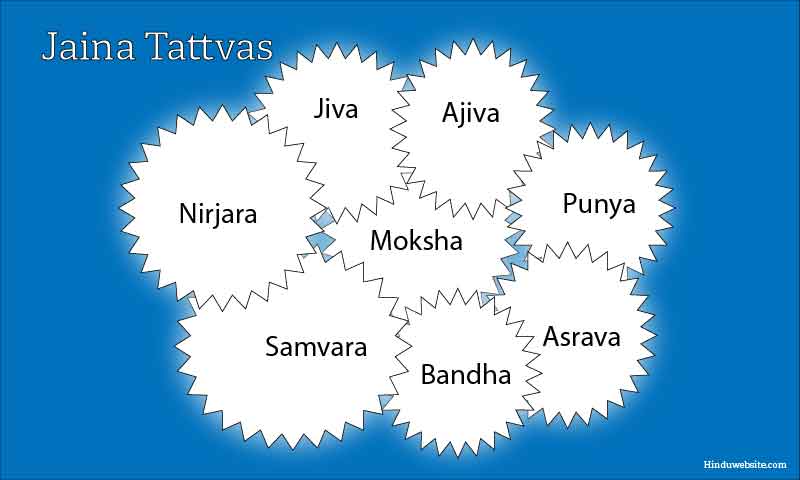
The nine tattvas, or principles, are the single most important subject of Jain philosophy. It deals with the karma theory of Jainism, which provides the basis for the path of liberation. Without the proper knowledge of this subject, a person can not progress spiritually. The true faith and understanding of this subject brings about right faith (samyakdarshana), right knowledge (samyakjnana), and right conduct in an individual.
Nine Tattvas (Principles)
1. Jiva soul or living being (Consciousness)
2. Ajiva nonliving substances
3. Asrava cause of the influx of karma
4. Bandh bondage of karma
5.*Punya virtue
6.*Papa sin
7. Samvara arrest of the influx of karma
8. Nirjara exhaustion of the accumulated karma
9. Moksha total liberation from karma
* Punya and Papa are the diverse results of Asrava and Bandh. Some exponents of Jains do not treat them as separate tattvas. According to them, there are only seven principles instead of nine.
1. Jiva (soul) Substance
Explained in The Six Universal Substances chapter.
2. Ajiva (Nonliving) Substances
Explained in The Six Universal Substances chapter.
3. Asrava (Cause of the influx of karma)
Asrava is the cause which leads to the influx of good and evil karma which lead to the bondage of the soul. Asrava may be described as attraction in the soul toward sense objects. The following are causes of influx of good and evil karma:
- Mithyatva ignorance
- Avirati lack of self restraint
- Kasaya passions like anger, conceit, deceit, and lust
- Pramada unawareness or unmindfulness
- Yoga activities of mind, speech, and body
In addition to the above causes, the five great sins; violence, untruth, stealing, sensual indulgence, and attachment to worldly objects are also the cause of the influx of karmas.
4. Bandha (Bondage of karma)
Bandha is the attachment of karmic matter (karma pudgala) to the soul. The soul has had this karmic matter bondage from eternity. This karmic body is known as the karmana body or causal body. Karmic matter is a particular type of matter which is attracted to the soul because of its ignorance, lack of self restraint, passions, unmindfulness, activities of body, mind, and speech. The soul, which is covered by karmic matter, continues acquiring new karma from the universe and exhausting old karma into the universe through the above mentioned actions at every moment. Because of this continual process of acquiring and exhausting karma particles, the soul has to pass through the cycles of births and deaths, and experiencing pleasure and pain. So under normal circumstances the soul can not attain freedom from karma, and hence liberation.
Karmic matter attaching to the soul assumes four forms:
- Prakriti bandha Type of karma
- Sthiti bandha Duration of karma
- Anubhava bandha Intensity of attachment of karma
- Pradesa bandha Quantity of karma
Prakriti Bandha When karmic matter attaches to the soul, karma will obscure its essential nature of:
- perfect knowledge,
- vision,
- bliss,
- power,
- eternal existence,
- noncorporeal, and
- equanimity.
Prakriti bandha is classified into eight categories, according to the particular attribute of the soul that it obscures.
- Jnanavaraniya It covers the soul's power of perfect knowledge.
- Darasnavaraniya It covers the soul's power of perfect visions.
- Vedniya It obscures the blissful nature of the soul, and thereby produces pleasure and pain.
- Mohniya It generates delusion in the soul in regard to its own true nature, and makes it identify itself with other substances.
- Ayu It determines the span of life in one birth, thus obscuring its nature of eternal existence.
- Nama It obscures the noncorporeal existence of the soul, and produces the body with its limitations, qualities, faculties, etc.
- Gotra It obscures the souls characteristics of equanimity, and determines the caste, family, social standing, etc.
- Antaraya It obstructs the natural energy of the soul and prevents it from attaining liberation. It also prevents a living being from doing something good and enjoyable.
Ghati and Aghati karmas The above eight karmas are also categorized into two groups, known as ghati and aghati karmas.
Ghati Karmas: Jnanavaraniya, Darasnavaraniya, Mohaniya, and Antaraya karmas are called Ghati karmas (dangerous karmas) because they obscure the true nature of the soul.
Aghati Karmas: Ayu, Nama, Gotra, and Vedniya karmas are called Aghati karmas. They do not obscure the original nature of the soul. However, they associate with the body of the soul. Hence they can not destroyed by the soul so long as it possesses a body.
When a person destroys all of his ghati karmas, at that time he attains kevaljnana. However, he continues to live as a human being because none of his aghati karmas are destroyed. He can only attain liberation after all of his aghati karmas are destroyed. Hence he attains liberation after his death.
When a person attains kevaljnana, he is known as an Arihant. If an Arihant establishes the four fold order of Monks, Nuns, Sravaka, (male layperson), and Sravika (female layperson) then the Arihant is called a Tirthankara. Other Arihantas are known as ordinary Kevali. After Nirvana (death) both Tirthankaras and ordinary Kevalis are called Siddhas.
All Siddhas are unique individuals, but they all possess perfect knowledge, vision, power, and bliss. Hence from the qualities and attributes point of view all Siddhas are same.
Sthiti Bandha When karmic matter attaches to the soul the duration of the attachment is determined at that time according to the intensity or dullness of the soul's passions.
Anubhava Bandha or Rasa Bandha What fruits the karmic matter will produce is determined at the time of attachment by varying degrees of passions.
Pradesa Bandha The quantum of karmic matter that is drawn towards the soul for attachment is determined by the intensity or dullness of the soul's action.
5. Punya (Virtue)
The influx of karmic matter due to good activities of the mind, body, and speech with the potential of producing pleasant sensations is called punya or virtue.
Activities such as offering food, drink, shelter, purifying thought, physical and mental happiness, etc. result in producing punya karmic matter.
6. PAPA (Sin)
The influx of karmic matter due to evil activities of the mind, body, and speech with the potential of producing unpleasant sensations is called papa or sin.
Activities such as violence, untruth, theft, unchastity, attachment to objects, anger, conceit, deceit, lust, etc. result in producing papa karmic matter.
7. Samvara (Arrest of Karma)
The method which arrests fresh karma from coming into the soul is samvara. This process is a reverse of asrava.
It can be accomplished by constant practice of: restraint of mind, body, and speech religious meditation conquest of desire forgiveness, tenderness, purity, truth, austerity, renunciation, unattachment, and chastity
8. Nirjara
Nirjara is the exhaustion of karmic matter already acquired. The karmas exhaust themselves by producing their results when it is time for them to do so. Unless they are exhausted before they are mature and start producing results, it becomes difficult to be free. By that time, new karmic matter begins to pour in. Therefore, it becomes necessary for one who desires final liberation to exhaust all karmas before maturity. This is called nirjara. Nirjara is to be done by rigorous austerities.
External Nirjara: Anasan complete abstinence of eating and drinking
- Alpahara reduction in the quantity of food one normally eats
- Ichhanirodha control of desire for food and material things
- Rasatyaga complete abstinence of eating or drinking juicy and tasty foods such as honey, alcohol, butter, milk, tea, sweets, juice etc. (no attachments to the taste of the foods)
- Kayaklesa control of passions by discipline
- Samlinata sitting in a lonely place in due posture with senses withdrawn
Internal Nirjara: Prayaschita repentance for the breach of vows
- Vinaya appropriate behavior towards a teacher
- Vaiyavrata selfless service to the suffering and deserving
- Svadhyaya studying/listening of religious scriptures
- Bhutsarga nonattachment to the body
- Subhadhyana religious meditation
9. Moksha
Moksha is the liberation of the living being (soul) after complete exhaustion or elimination of all karmas. A liberated soul regains totally its original attributes of perfect knowledge, vision, power, and bliss. It climbs to the top of Lokakas and remains there forever in its blissful and unconditional existence. It never returns again into the cycles of birth, life, and death. This state of the soul is the liberated or perfect state, and this is called "Nirvana."
Suggestions for Further Reading
- Twelve Reflections or Bhavanas Of Jain Meditation
- The 12 vows For the Jain Laity and The Monks
- Fourteen Auspicious Dreams of Mother Trishala
- Five Bodies and Eight Vargnas Of Jiva, The Embodied Soul
- Five Great Vows Or Maha Vratas of Jainism
- Six Universal Substances (Dravyas)
- Meaning Of Ashta Prakari Puja
- Nine Tattvas Or Principles of Jainism
- The Akaranga Sutra
- A Treatise On Jainism
- Sacred Literature of Jainism
- The Kalpa Sutra Of Bhadrabahu
- The Ten Virtues of Jain Monks
- Essays On Dharma
- Esoteric Mystic Hinduism
- Introduction to Hinduism
- Hindu Way of Life
- Essays On Karma
- Hindu Rites and Rituals
- The Origin of The Sanskrit Language
- Symbolism in Hinduism
- Essays on The Upanishads
- Concepts of Hinduism
- Essays on Atman
- Hindu Festivals
- Spiritual Practice
- Right Living
- Yoga of Sorrow
- Happiness
- Mental Health
- Concepts of Buddhism
- General Essays
Source: Nine Tattvas (Principles) (E00) 01/19/93 9TATTVAS.A01 Complied by Pravin K. Shah, Jain Study Center of North Carolina