
The Historical Context of The Bhagavadgita
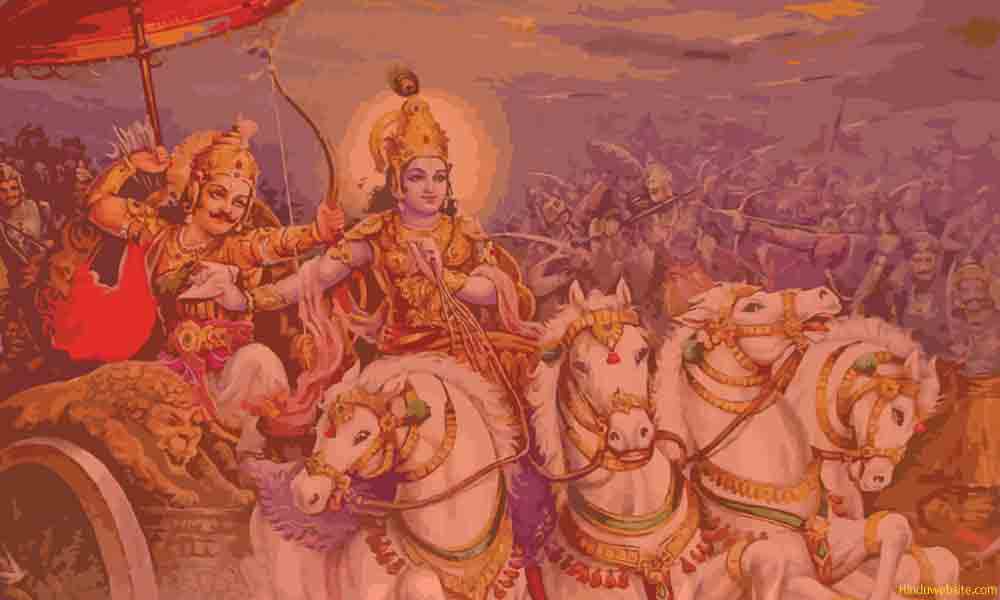
The Bhagavad Gita is perhaps the most famous, and definitely the most widely-read, ethical text of ancient India. As an episode in India's great epic, the Mahabharata, The Bhagavad Gita now ranks as one of the three principal texts that define and capture the essence of Hinduism; the other two being the Upanishads and the Brahma Sutras. Though this work contains much theology, its kernel is ethical and its teaching is set in the context of an ethical problem.
The teaching of The Bhagavad Gita is summed up in the maxim "your business is with the deed and not with the result." When Arjuna, the third son of king Pandu (dynasty name: Pandavas) is about to begin a war that became inevitable once his one hundred cousins belonging to the Kaurava dynasty refused to return even a few villages to the five Pandava brothers after their return from enforced exile, he looks at his cousins, uncles and friends standing on the other side of the battlefield and wonders whether he is morally prepared and justified in killing his blood relations even though it was he, along with his brother Bhima, who had courageously prepared for this war. Arjuna is certain that he would be victorious in this war since he has Lord Krishna (one of the ten incarnations of Vishnu) on his side. He is able to visualize the scene at the end of the battle; the dead bodies of his cousins lying on the battlefield, motionless and incapable of vengeance. It is then that he looses his nerve to fight.
The necessity for the arose because the one hundred cousins of the Panadavas refused to return the kingdom to the Pandavas as they had originally promised. The eldest of the Pandav brothers, Yudhisthir, had lost his entire kingdom fourteen years ago to the crafty Kaurava brothers in a game of dice, and was ordered by his cousins to go on a fourteen-year exile. The conflict between the Pandavas and the Kauravas brewed gradually when the Kauravas refused to return the kingdom to the Panadavas and honor the agreement after the fourteen-year exile, and escalated to a full scale war when the Kauravas refused to even grant Yudhisthir's reduced demand for a few villages instead of the entire kingdom.
As the battle is about to begin, Arjuna, himself an acclaimed warrior, wonders how he could kill his own blood relatives with whom he had grown up as a child. He puts the battle on hold and begins a conversation with Krishna, one of the ten but most important incarnations of the Universal Hindu God, Vishnu. The Bhagavad Gita begins here and ends with Krishna convincing Arjuna that in the grand scheme of things, he is only a pawn. The best he could do is do his duty and not question God's will. It was his duty to fight. In convincing Arjuna, the Lord Krishna provides a philosophy of life and restores Arjuna's nerve to begin the battle -- a battle that had been stalled because the protagonist had lost his nerve and needed time to reexamine his moral values.
Even though The Bhagavad Gita (hereafter referred to as the Gita) is one of the three principal texts that define the essence of Hinduism, and since all over the world Hindus chant from the Gita during most of their religious ceremonies, strictly speaking the Gita is not one of the Hindu scriptures. In light of its inseparable links to one of the two great Hindu epics (Mahabharata and Ramayana) which most Indians hold very dear to their hearts, and because Krishna, the most venerated and popular of the incarnations of Lord Vishnu, figures so prominently in it, the Gita over the years has not only become very popular but has ascended to spiritual heights that are afforded only to the Vedas (and the subsequent reinterpretive philosophies that followed them) and the Upanishads in the ancient Indian literature.
The concept and symbol of God were extremely complicated issues (see below) in the ancient Hindu religious literature prior to the writing of the Gita. The notion of God and the paths to salvation are integral parts of all religions. The manner in which Hinduism originally dealt with these two fundamental issues was very complex and appeared to be too speculative at times. This was one of the reasons for which Buddhism branched out as a separate religion. When Buddhism was beginning to grow in popularity, Hinduism met with its first challenge: To provide a clear-cut, easy-to-worship symbol of God to its followers. For a variety of reasons, Lord Krishna was the obvious choice. Many have even suggested that it was one of the most pivotal choices ever made by ancient scholars to `humanize' the concept of God in the Hindu religion. Molded in the original image of Lord Vishnu, Krishna is an affable Avatar (reincarnation of God) which for the first time provided concrete guidelines for living to all mortals. The average Hindu might not know much about Brahma, but every one knows who Lord Krishna is. Mahatma Gandhi read the Gita often when he was in seclusion and in prison.
But, the universal popularity of the Gita has not detracted Indian scholars from deviating from the fundamental truth about Hinduism. The Gita is not the Hindu scripture even though the literal translation of "Bhagavad Gita" is "The Song of God". The Nobel laureate Indian poet, Rabindra Nath Tagore, rarely quoted from the Gita in his philosophical writings; instead, he chose to refer to the Upanishads, to quote from it, and to use its teachings in his own works. Of course, the teachings of the Upanishads are included in the Gita; they are visible in multiple chapters of the Gita. The kinetic concepts of karma and yoga, which appeared for the first time in the Upanishads (explained below), appear repeatedly in the Gita, often in disguised forms.
As with almost every religious Indian text, it is difficult to pinpoint when exactly the Gita was written. Without a doubt, it was written over a period of centuries by many writers. From the contents of the Gita, it is abundantly clear that both the principal teachings of the Upanishads and of early Buddhism were familiar to the writers of the Gita. So, it has been approximated that the Gita was written during the period 500-200 BCE. Even though India is one of the few nations which has a continuous documented history, very few Indian religious texts exists for which the exact date of publication is established without controversy.
Despite its universal appeal, the Gita is replete with contradictions both at the fundamental level and at the highest level of philosophical discourse. To the discerning eye, it would seem that what has been said in the previous chapter, is contradicted in the very next chapter. This is the fundamental complaint against the Gita, and this fact would appear to be ironic given the fact that the Gita was originally written to reconcile the differences between two of the six major ancient Indian philosophies (Darshans) that evolved over the early years of Hinduism and became integral parts of ancient Indian religious literature. The irony disappears however when one understands what the Gita purported to achieve at the level of philosophical and religious discourse. This fact is crucial not only for the understanding of the principal themes of the Gita but also to locate the essence of the Gita in the overall picture of ancient Indian doctrines. The Gita attempted, for the first time, to reconcile the teachings of two very abstract Indian religious doctrines into one whole. The task was a formidable one.
The Gita tried to include the fundamentals of two ancient Indian philosophies into one document and reconcile the principal differences between them. At the outset, one must note that the two doctrines (Darshans) were often extremely difficult to understand. Hence the inevitable contradictions or duality of interpretation. The Six Darshans of ancient India were actually of differing origin and purpose, but all were brought into the scheme by being recognized as viable ways of salvation. They were divided into three groups of two complementary schools of thought (Darshans) or doctrines: Nyaya and Vaisesika; Sankhyya and Yoga; and Mimamsha and Vedanta. The Bhagavad Gita attempted to reconcile the Sankhyya philosophy with those of the Vedanta doctrine. One must note in passing that the Sankhyya school of thought led to Buddhism while the Vedanta philosophy is at the root of modern Hinduism. In this article, we are only going to discuss briefly the two Darshans -- the Sankhyya and the Vedanta -- the Gita attempted to reconcile.
The Sankhyya is the oldest of the six Darshans while the Vedanta is the most important of the six systems. The various subsystems of the Vedanta doctrine has led to the emergence of modern intellectual Hinduism. The primary text of the Vedanta system is the Brahma Sutras, and its doctrines were derived in great part from the Upanishads, which marked the beginning of Hinduism as is understood and practiced today. Even though the Vedas are India's ancient sacred texts, modern Hinduism begins with the Vedanta (end of Vedas) and attains its zenith with the Brahma Sutras.
The Sankhyya philosophy traces the origins of everything to the interplay of Prakriti (nature) and Purusha (the Self, to be differentiated from the concept of the soul in the latter Indian philosophies). These two separate entities have always existed and their interplay is at the root of all reality. The concept of God is conspicuous by its absence. There is no direct mention of God but only a passing reference as to how one should liberate himself to attain the realization of Is war (a heavenly entity). A very significant feature of Sankhyya is the doctrine of the three constituent qualities (gunas), causing virtue (sattva), passion (rajas), and dullness (tamas). On the other hand, the Vedanta school of thought deals with the concept of Brahman the ultimate reality that is beyond all logic and encompasses not only the concepts of being and non-being but also all the phases in between. It is one of the most difficult concepts in the entire Indian philosophy. At the highest level of truth, the entire universe of phenomena, including the gods themselves, was unreal -- the world was Maya, illusion, a dream, a mirage, a fragment of the imagination. The only reality is Brahman.
One can see quite clearly the sources for the Gita's contradictions. It was dealing with not only two widely-differing Darshans but also with two of the most abstract philosophical systems. We know that the Gita was written long after the emergence of modern Hinduism. So it was able to draw on a wide variety of philosophical themes -- both ancient and relatively modern by comparison, and often opposing -- still present in modern Hinduism. Yet, to consolidate the two schools of thoughts proved to be an extremely difficult task -- a fact which the lyricism of the Gita, in the words of Lord Krishna himself, could not camaflouge. Any serious reader would arrive at the conclusion that even though the Gita mentions the Sankhyya, it more or less elaborates on ideas that originated with the Upanishads.
The fundamental tenets of Hinduism took shape during the period 800-500 BCE. They were set down in a series of treaties called the Upanishads. The Upanishads arise at the end of the Vedas, which earns it the name Veda-anta, which literally means "end (anta) of the Vedas." Almost all philosophy and religion in India rests upon the wealth of speculation contained in these works. The Upanishads center on the inner realms of the spirit. Encompassing the meaning of spiritual unity, the Upanishads point directly to the Divine Unity which pervades all of nature and is identical to the self.
There are four "kinetic ideas" -- ideas that involve action or motion -- that represent the core of Indian spirituality. The ultimate objective is control of the passions and to realize a state of void -- a concept very similar to that of Buddhism. The four kinetic ideas are "karma, maya, nirvana, and yoga" and they appear in the Gita. But one must remember that they appeared for the first time in the Upanishads. A brief summary of the four ideas are provided below.
Karma: The law of universal causality, which connects man with the cosmos and condemns him to transmigrate -- to move from one body to another after death -- indefinitely. In the Gita, Krishna makes an allusion to the eternal soul that moves from body to body as it ascends or descends the ladder of a given hierarchy, conditioned on the nature of one's own karma -- work of life or life deeds.
Maya: refers to cosmic illusion; the mysterious process that gives rise to phenomena and maintains the cosmos. According to this idea, the world is not simply what is seems to the human senses -- a view with which the 20th century western scientists wholly agree. Absolute reality, situated somewhere beyond the cosmic illusion woven by maya and beyond human experience as conditioned by karma. Both Tagore, the renowned Indian poet and Albert Einstein, the famous scientist, agreed on this conclusion. Absolute reality, in their minds, was beyond human perception.
Nirvana: The state of absolute blessedness, characterized by release from the cycle of reincarnations; freedom from the pain and care of the external world; bliss. Union with God or Atman. Hindus call such mystical union with ultimate reality as Samandhi or Moksha.
Yoga: implies integration; bringing all the faculties of the psyche under the control of the self. Essentially, the object of various types of yoga is mind control, and the system lays down the effectual techniques of gaining liberation and achieving divine union. The word yoga is loosely applied to any program or technique which leads toward the union with God or Atman. There are five principal kinds of yoga: Hatha(physical), jnana (the way of knowledge), bhakti (the way of love), karma (the way of work), and rajah (mystical experience).
The Western world's interest in The Bhagavad Gita began around the end of the eighteenth century when the first English translation of the Gita was published. All religious texts of ancient India were written in Sanskrit. In November 1784, the first direct translation of a Sanskrit work into English was completed by Charles Wilkins. The book that was translated was The Bhagavad Gita. Friedreich Max Mueller (1823-1900), the German Sanskritist who spent most of his working life as Professor of Comparative Philology at Oxford University, served as the chief editor of the Sacred Books of the East. (Oxford University Press). The Gita was included in this famous collection. Since then, the Gita has become one of the most widely-read texts of the world. True, there are unexplained contradictions and paradoxes in this brief book, but its wide-ranging implications based on the two ancient Darshans of India and its allegorical meanings are still being examined and reinterpreted.
Suggestions for Further Reading
- The Wisdom of the Bhagavadgita, Main Page
- The Bhagavadgita, Philosophy and Concepts
- The Bhagavad Gita Translation by Jayaram V
- Why to Study the Bhagavad-Gita
- The Abbreviated Bhagavad-gita
- Introduction to the Bhagavad-Gita
- The Bhagavad-gita in a nutshell
- The Bhagavadgita a modern prose translation
- The Mahabharata, the Epic of the Bharatas
- The Ramayana translated by Romesh Dutt
- Essays On Dharma
- Esoteric Mystic Hinduism
- Introduction to Hinduism
- Hindu Way of Life
- Essays On Karma
- Hindu Rites and Rituals
- The Origin of The Sanskrit Language
- Symbolism in Hinduism
- Essays on The Upanishads
- Concepts of Hinduism
- Essays on Atman
- Hindu Festivals
- Spiritual Practice
- Right Living
- Yoga of Sorrow
- Happiness
- Mental Health
- Concepts of Buddhism
- General Essays
Copyright © 1996. Soumen De. This file may be copied for educational and personal use on the condition that the entire contents, including the header and this copyright notice, remain intact. It may not be sold for profit without the written permission of the author.