
A Brief History Of The Soul
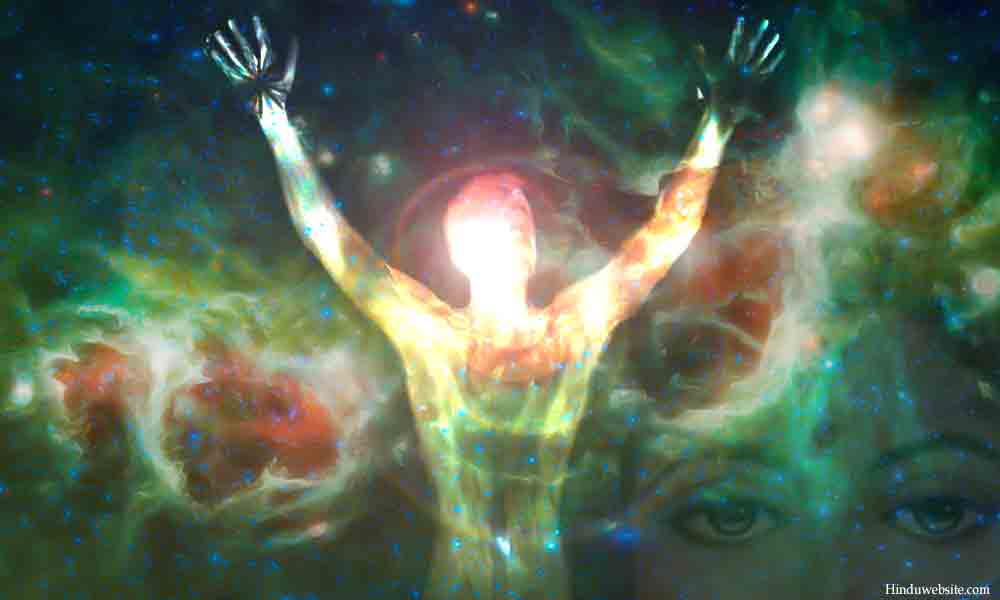
Summary: The article explains the nature of the individual soul, the difference between embodied soul and free soul, how souls become bound to Nature and how they can achieve liberation.
In the lexicon of God there is no "You." There is no otherness. It is all "I." If you permanently remove the second person and the third person expressions from the language and substitute them with only the first person, how will you describe the world or others or relate to them? It is the state of the Self and of Brahman. Jayaram V
The soul of Hinduism is different from that of Abrahamic religions. Soul in Hinduism is without qualities and attributes such as a name or form. According to most schools of Hinduism, all souls in their purest state are indistinguishable, eternal, indestructible, immutable, invisible, formless and infinite. Only when they are bound to Nature, they develop qualities or some distinction.
Hence, in Hinduism an individual soul is more appropriately called the Self (Atma or Atman). The Self is also used in the scriptures to denote the self-sense (aham) or the individuality in first person (I or I am). The Upanishads suggest that the Self is that which experiences all this, and because of which all experience happens. It is not what is perceived, but the perceiving one, the seer. In a simple sense, the soul is consciousness without modifications and impurities. Modifications means thoughts, feelings, emotions, dreams, desires, ego, relationship, etc. Hence, it is also called pure consciousness. It why there is so much emphasis in Yoga on suppressing the modifications of the mind. In a tranquil state you are much closer to your Self than when you are engaged in worldly tasks and preoccupied with worries and concerns.
For this discussion, we will use the word soul rather than Self since it is more commonly used. According to the schools of nondualism, the individual soul is an illusion. It disappears into the Supreme Self when a being attains liberation. The dualistic philosophies (dvaita) however recognize the individual souls as separate and distinct from the Supreme Self. They also suggest that each soul is unique and different from the other, and their size may also vary.
Much of the speculative philosophy of Hinduism is about the nature of individual souls, how they came into existence, the nature of Brahman or the Universal Self, how He manifested creation and the nature of the relationship between the two. Most of the Upanishads, including the Bhagavadgita, try to explain these aspects of Hinduism with convincing arguments, using various pramanas or proofs.
Another important subject which forms part of this complex speculation is Nature or Prakriti and its status and role in the order of things. Without going into details of how various schools of Hindu philosophy view these broader aspects of our existence and reality, we will try to present below some of the speculations that are common to most of them on how the blissful and free souls become involved with Nature and end up as the seeking and suffering Jivas or embodied souls.
Creation and the separation of the triple realities
The Vedas are considered by almost all the schools of Hinduism (darshanas) as the standard bearers of truth, which serve as the verbal testimony (shabda pramanam) to ascertain metaphysical truths. They confirm that in the beginning there was nothing. There was neither light nor darkness, neither the sun nor the moon, nor the earth, but one undivided nothingness. This nothingness is described in the Hindu scriptures as the unknown Brahman or indeterminate (avyakta) Brahman. It is also described as asat or Nonexistence (asat). This nothingness was believed to be the original state of things. The Puranas dramatize this condition as the resting phase of Brahman (the Night of God) which, according to Hindu astronomical calculations, stretches over billions of years in earth time. We do not know for how long the state of nonexistence prevailed. However, at the end of it appeared the Triad, or the following three entities.
- Saguna Brahman or the Awakened Universal Lord.
- Jivatmas or numerous individual souls and
- Prakriti or Nature.
The three entities together constitute the triple realities or the original Trinity of Creation. The Puranas later identified Brahma, Vishnu and Siva respectively as the Triad or the triple forms (Trimurthis). In some ways they personify the triple realities of Creation in their functions as the three dimensions of the One Absolute Truth, who is mentioned in the Upanishads as "Tat" (That). Saguna Brahman or the Universal Lord is the Creator who manifests the worlds through His inviolable will. The Puranas ascribe this function to Brahma Prajapathi, the Creator of all beings. The individual souls, described as Purushas, ensure the continuity of creation and the existence of the worlds in association with Nature (Prakriti). They act as the preservers. The Puranas describe the individual souls as the body of Lord Vishnu, who is traditionally known as the preserver or the upholder of creation. The souls are drawn to Him like the Gopis of Brindavan. Lastly, Nature engages the souls in the cycle of creation through the twin processes of degenerative involution and regenerative evolution. As the destroyer, Lord Shiva performs an identical role by facilitating both degeneration and regeneration or death and renewal of things and beings.
The role of Nature in the bondage of souls
We are not going to discuss how the souls and Nature came into existence because there is no unanimity on this subject among the various schools of Hinduism. Equally controversial is the question of whether Nature or Prakriti is dependent or independent of the Awakened Brahman. According to some schools Prakriti is God's dynamic energy, created by Him to execute His will. According to others, Prakriti is independent of God and not created by Him. Whatever may be the truth, these three are the basic components of the manifest reality, which is described as sat or Truth by the Hindu scriptures.
In the next stage, the individual souls, who are the same as Brahman in their essence, become involved with Nature and end up as the embodied souls or jivas. The Upanishads and Tantras describe this process in considerable detail. They depict Nature not as a single entity but as a collection of diverse finite realities or tattvas which are mutable and destructible. They serve as the standard modules, which Nature uses to create diverse life forms according to God’s will. Knowledge of Nature’s tattvas or modular realities is vital to our understanding of how the pure souls become embodied souls, having been caught in materiality of Nature and the cycle of births and deaths.
We may speculate that the unsuspecting individual souls are not ensnared by Nature with a magical touch, but over time, through a long drawn process, which may be somewhat similar to how newborn babies are soothed and lulled into a comfortable sleep by their mothers. Or it may be how a fisherman casts his net into the ocean and captures the fish. Whatever may be the method, Nature quietly spins its web of deception and illusion around the souls, in incremental steps, first by drawing them and later by clouding them with delusion and ignorance to the extent that they forget who they are. By the time they realize what happened, they find themselves deeply embedded in matter, attached to things and attracted to things, from which any possible escape seems almost impossible.
The souls in the field of Nature
In the Upanishads we find descriptions of how the individual souls are drawn to Nature and develop various parts of their bodies, such as the sense organs, the mind, intelligence, qualities and so on. This transformation from the state of "being" to the state of "becoming" is described as soul's expansion or going forth. In other words, a soul that is immersed in itself and inward looking becomes distracted and outward looking.
A subjective soul becomes objective by coming into contact with the things of Nature. The moment the soul’s attention is diverted from itself to the not Self, it no more remembers who it is. In their purest state the souls exist in the present moment. They do not have a memory system like ours, do not accumulate knowledge, nor do they use any organs to remember things. Without any external aids such as the mind or the senses they directly experience reality in the total awareness of the moment, without the burden of memory or the superimposition of accumulated knowledge.
This is in contrast to the embodied souls (jivas) who experience life in relation to the things they remember or imagine. In their subjective state, the souls remain completely self-absorbed, withdrawn and immersed in themselves. However, when they are drawn into Nature, they experience the duality of subject and object and lose their transcendental self-awareness, as they become enveloped by various impurities. This is described in the Hindu scriptures as the impure state of ignorance or lack of true knowledge.
In their outgoing mode, the souls become attracted to the components of Nature or the tattvas and develop corresponding qualities, abilities and organs to experience them or seize them and hold them for repetitive use. These components are buddhi (intelligence), manas (mind), the three gunas (sattva, rajas and tamas), jnanendriyas (organs of intellect), karmendriyas (organs of action) and annam (gross organic and inorganic matter) which is made up of pancha bhutas or the five elements, namely fire, water, air, earth and ether.
When the souls reach out to the objects of Nature, they develop desire and aversion for them. In their attempt to seek them or repel them, they engage in various kinds of actions. They accomplish these two tasks by acquiring and using respectively the five organs of knowledge (jnanendriyas) namely, the eyes, the nose, the skin, ears and the tongue, and the five organs of actions (karmendriyas), namely, speech, grasping, movement, eliminating and procreating.
As the souls entangle themselves with the things of Nature and develop distinct physical personalities made up of various components of Nature, they indulge in egoistic and selfish actions to preserve themselves or their things. Their actions produce karma, which in turn binds them to the cycle of births and deaths and keep them enslaved to the force of Nature. Thus over a period of a few million years, the souls which were originally free and resplendent filled with the bliss of Brahman, become so involved with Nature and become entangled with its component things that they lose their freedom and become deluded about their true nature, like birds caught in a snare.
Thus the individual souls which are indistinct, eternal, without bodies, sense organs, and the internal organs namely the mind, the ego and the intelligence become distinct and different, in a moment of forgetfulness, induced by the distracting and deluding power of Nature. In reality the souls are none of these, but pure and immutable. However, in the field of Nature they spread out so deeply into its realities and phenomena that they come to believe as embodied and develop desires, attachments, and attraction and aversion. This identification with the materiality of its embodiment, with the ego creating the false sense of Self, is responsible for much of its suffering and bondage. In truth, there is no physical demarcation between the true self and the embodied self. It would be incorrect to say that they are either the same or different. The truth stands somewhere in between. The embodied Self is a projection of the true self. It remains in the field of Nature, sustained by desires, attachments, rebirth and the karma arising from them.
Visualize that a particle of light, possessing the infinity and indestructibility of God and with all his power and brilliance of the universe, descends into the earth's atmosphere and gather energy and matter around itself. Imagine that it results in the formation of a being with distinct, physical and subtle bodies, having awareness, intelligence, the perceptual and cognitive ability to seek things, engage in motivated actions and lives for itself. This is precisely the journey of the soul from the heights of its freedom and blissful state of pure consciousness to its limited condition as an embodied soul having a name and a form.
The liberation of the embodied souls
If in its outward movement an individual soul is drawn to Nature and becomes attached to it, it can also escape from it through the reverse process of withdrawal, detachment and discarding of its mortal body. According to the sprigtail traditions of Hinduism it has to be done through the practice of various yogas or methods whereby the mind and body are cleansed and the soul becomes unburdened by the impurities and the attachments of its past actions. The path of liberation is arduous since one has to go against Nature’s Maya and its overwhelming influence. However, it is not impossible. The transformative process, which precedes liberation and which is impetrative to it, may involve the following steps, not necessarily in the same order.
- Purification of the mind and body for the predominance of sattva through the practice of austerities, righteous conduct, rules and restraints.
- The practice of karma sanyasa yoga by performing actions without desire for their fruit as an offering to God.
- The practice of jnana yoga through self-study, service to enlightened masters and divine worship to cultivate discernment and overcome ignorance and delusion
- Acknowledging your spiritual identity as the eternal Self and becoming stabilized in it through contemplative practices.
- Withdrawing the mind and body from the sense objects and stabilizing them in the contemplation of the Self.
- The continuous practice of detachment, renunciation dispassion, indifference and sameness to stabilize the mind and experience equanimity on a regular basis.
- The continuous practice of concentrated meditation upon the Self (atma samyama yoga) which will lead to self-absorption (samadhi).
- Surrender, divine worship, and devotional service to God to earn his grace, overcome duality and cultivate oneness.
The most distinguishing difference between a pure soul (mukta) and an embodied soul (baddha) is that the latter has a distinct individuality and form, while the former has none. Once an individual soul is caught in the whirlpool of life, it passes through many cycles of births and deaths, before it realizes the importance of liberation. According to Shaivism and Tantra, the three main problems of an embodied soul (jiva) which are responsible for its bondage to the cycle of births and deaths are, egoism (anava), attachments (pasas) and binding actions (karma). They keep the embodied souls impure and bound to the mortal world. From the highest world of Brahman, the souls descend deep into the depths of Nature and partake some of its components. It would be long before they realize their predicament and return to their source to free again. However, for a self-realized yogi the mortal world is a field of experience and an opportunity to witness his own wonder.
Suggestions for Further Reading
- The Concept of Atman or Eternal Soul in Hinduism
- The Samkhya Philosophy and 24 Principles of Creation
- Descriptions of Soul or Atman In The Bhagavadgita
- Atma Samyama Yoga Or The Yoga Of Self-restraint
- Belief In Atman, The Eternal Soul Or The Inner Self
- God and Soul, Atma and Paramatma, in Hinduism
- Atma, Atman, the Eternal Soul
- The Human Body From a Spiritual Perspective
- Shedding Light on Atman, the True Self
- Jivanmukti, the state of Liberation
- Kaivalya, the State of Aloneness
- Self-knowledge, Difficulties in Knowing Yourself
- Do You Have Any Plans For Your Rebirth or Reincarnation?
- Wealth and Duty in Hinduism
- Symbolic Significance of The Hindu Trinity, Brahma, Vishnu And Siva
- Origin, Principles, Practice and Types of Yoga
- The Ego and the Myth of Me and Mine
- Essays On Dharma
- Esoteric Mystic Hinduism
- Introduction to Hinduism
- Hindu Way of Life
- Essays On Karma
- Hindu Rites and Rituals
- The Origin of The Sanskrit Language
- Symbolism in Hinduism
- Essays on The Upanishads
- Concepts of Hinduism
- Essays on Atman
- Hindu Festivals
- Spiritual Practice
- Right Living
- Yoga of Sorrow
- Happiness
- Mental Health
- Concepts of Buddhism
- General Essays