
The Bhagavadgita on Suffering and its Purpose
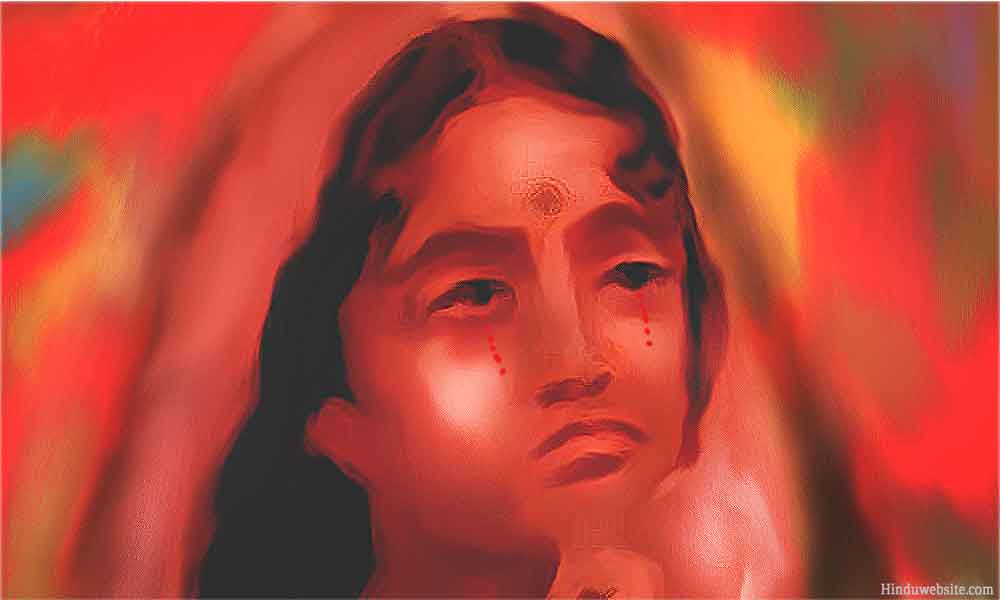
The Bhagavadgita begins with the theme of sorrow and ends with a positive note on the possibility of ending suffering through self-realization. Arjuna like any other human being is prone to the emotion of sorrow in the face of difficulties. He was overwhelmed with sorrow as he contemplated upon the prospect of slaying his own relations to achieve victory in the battle field, despite the fact that he was being assisted in his actions by God Himself in the incarnation of Lord Krishna. A warrior like Arjuna, with God Himself by his side as a charioteer, was unable to deal with his suffering and face his enemies. Imagine the plight of ordinary men and women when they have to take difficult decisions that may often conflict with their long held opinions, morals and values or involve a radical change in their very life styles.
According to the Bhagavadgita human suffering is real, but not permanent. It is caused by faulty thinking, perspectives, beliefs and attitudes. It depends upon the way we perceive things and react to them. The solution to the problem of suffering lies in our understanding of its underlying causes and resolving them effectively through inner transformation. The Bhagavadgita identifies the following causes of human suffering, by dealing with which we can effectively contain our suffering. These causes are still relevant in modern society and they are still effective in making people unhappy in their lives with something or the other. If we look at the world, we realize that a great majority of us suffer, not because we are rich or poor but because we are programmed to suffer by our own thoughts, desires and actions.
- Mistaken identity
- Attachment and involvement
- Lack of True Knowledge
Mistaken Identity
Most of us identify ourselves with what we see, what we feel and experience. We are what we believe ourselves to be. We believe that we are the body and the mind, that we are subject to the process of births and deaths, that we have relations and we are defined by how we look, what we possess and what we can or cannot do. When we believe that we are physical and mental beings, we suffer from many fears and anxieties. When we identify ourselves with unstable and impermanent things, things which are by themselves are subject to death and decay, we cannot live in comfort with that feeling of vulnerability. It is like we are dealing with two poisonous snakes at the same time in the middle of a hostile forest or sailing in a leaking boat in the face of a severe storm. Arjuna believed himself to be a human being, someone with a body and mind and identified himself with his physical self. He believed everyone else also to be the same, mere physical beings, subject to death and decay. He was concerned that his actions would lead to their destruction. Lord Krishna had to explain to him that he was not mere body and mind or the physical self, but true self, who was not subject to death and injury and who was eternal, stable, self-existent and without qualities.
If we look at what is happening today in the world, we realize that we are increasingly identifying ourselves with our physical and mental personalities. We are defined by how we look and what we do with our bodies. Every where we see a great concern about our physical health and looks. Our main concerns are whether we are doing exercises, keeping our bodies in shape, eating proper food, attractive enough to the opposite sex and so on. In the US there is a clear and unwritten bias against age in recruitment, as if looking old is a great sin and old people cannot compete with youngsters in knowledge and wisdom. So many people, as they reach middle age, begin to worry. This tendency is so predominant in the western society (rest of the world is catching up too) that we have begun to use yoga for our physical well being rather than for our spiritual alignment. The yoga teachers are no more the glum looking bearded sadhus, but attractive men and women in skimpy clothes more interested in showing off their bodies rather than the techniques. Socrates with his unattractive physical body and bald head might have found himself unwanted and unsuitable for a teaching job in an American university!
It is not that we should not think about our physical health. It is the way we are prioritizing things based on our short term goals and narrow minded thinking and degrading ourselves as mere physical beings. We should pay adequate attention to our physical wellness, but at the same time also to that which resides within our bodies, which is permanent, stable and by identifying ourselves with which we can seek the permanence, peace, inner harmony and fearlessness that are strikingly missing in our society today. If we identify ourselves with our physical bodies we suffer from the fear of death, aging and loss of things. If we consider ourselves as spiritual entities, we learn to age gracefully, accept life as it comes and prepare ourselves for the inevitable with a vision and attitude that go beyond our physical concerns and this particular existence.
Attachment and involvement
Arjuna suffered because he developed attachment with his family, friends and relations. He believed that his kith and kin would die and his family would fall into confusion if he proceeded with the war. He did not want to commit sin by destroying family traditions and causing confusion in society. Arjuna's reaction to the situation in the battle field was based on his world view, his likes and dislikes and his attachments. When we are faced with dilemmas we are moved by the things we believe in or attached to. Attachments are at the root of human behavior. It is a strong mental connection we develop with things that are part of our sensory experience. What we want to become or not become and what we intend to do or not to do depend upon our attachments. They are also responsible for where we are in our current situation.
Attachment manifests itself in many ways in our consciousness and behavior. We are attached to things and events from the time we are born and as we grow we become attached to more and more things. Our first attachment is with ourselves, what we are, what we have, what we think and what we do. Our likes and dislikes, our opinions, our decisions, our actions and reactions, our dreams and desires, our fears and concerns stem from our attachments. When we are attached to things, we cannot think clearly and we cannot view things clearly. Many vices like greed, anger, selfishness, pride, envy arise out of our desires and our desires in turn arise out of our attachment to things.
There are two aspects in our personality, the outer aspect, which is attached to things in our lives, and the inner aspect which is unattached and therefore completely free. We are familiar with the outer because we experience it every day and identify ourselves with it. The inner self is completely detached and free. We have no clue what it is and what it does. It remains in the background, incognito. In reality there are no two selves in us. There is only one. We do not have split personalities, but one indivisible self. The inner self extends itself as the outer through the senses and becomes attached with the things. In the process it remains extended and involved. It is like someone stretching himself out of a window and becomes so involved with the scenery that he temporarily forgets every thing else. As long as the self remains extended outwardly through the senses, it is subject to the experiences of loss and gain, attachment and detachment, coming into contact or losing contact, which lead to its flitting moments of happiness or unhappiness and a host of other conflicting emotions.
When we think of higher self or the inner self, we believe as if it is something that does not belong to us or outside of us or distant from us. It is not true. In reality there is nothing like inner self. It is the same self that we experience in our waking consciousness. It is the one that experiences the world through the senses when it is attached and without the senses when it becomes completely detached. It is self-knowing. So it does not have to actually depend upon any external source for information. But when it is extended, it becomes outward looking and sense dependent. Self realization is a process of knowing who you truly are by freeing yourself completely from all the baggage that you carry in yourselves. It is also a process of liberation, because you will realize who you are only when you are completely free from all attachments.
Part of Arjuna's hesitation to wage the war was his fear of death. He was afraid that his actions would lead to the death of his own kinsmen and thousands of others. Most of us are also afraid of death and deal with it by behaving as if it is not going to happen to us. Our attachment and involvement with our lives and things, in a way, help us forget about death temporarily. The fact is death is God's way of dealing with our attachments. Death destroys most of our attachments in a rather crude way. Because we cannot otherwise eliminate our attachment death comes to us as a cleansing force, removing all the unnecessary and excess energy accumulated around ourselves. It is like dragging away children from the playground when they are deeply immersed in playing and do not want to return home. Without death we would keep developing attachments with things forever and become involved with them to a point where it would perhaps be impossible to continue. So death prevents that possibility by forcibly separating us from our environment and our attachments and giving us an opportunity to rest temporarily before we return to the world once again in a new body to begin a new life. Only the strongest of our attachments remain with us like reminders of our past, things with which we have bound ourselves so deeply that we cannot escape from them even in death.
Lack of True Knowledge
Our actions and decisions, whether mental or physical, greatly influence the course of our lives and our well being. They are mostly influenced by our thoughts, beliefs, knowledge, desires and attitudes. Each of them result in some consequence, either good or bad or neutral, leading to our happiness or unhappiness, success or failure. Because we do not have correct knowledge and our minds are fickle and imperfect, we are not sure of our actions and decisions and how they turn out to be. We suffer from stress and anxiety and severe doubts, when we do not know clearly what to do or what we are doing and where it would lead us. Arjuna experienced a similar state as he took a view of the battle field and saw his own kinsmen on the other side. He was not sure whether what he decided to do was right or wrong. He had knowledge of the scriptures and some sense of right and wrong. But he lacked the discretion to interpret them correctly. It is easy to rationalize the knowledge of our scriptures to justify our actions. We see it happening every day. When we do not have the right knowledge, we suffer from indecision, doubt, rationalization and confusion.
Our knowledge is basically sensory knowledge processed by our minds or knowledge that we gain through study or observation. It is not very useful in deciding the right from the wrong, because it is derived from imperfect and unstable sources, which are never the same, which are time oriented, space oriented and dependent upon a specific set of conditions and perspectives. Most of it is lost any way as it is pushed into the deeper layers of our minds and forgotten. Our lack of true knowledge is by itself a great source of our suffering because we are never sure of what we are doing and we can take nothing for granted. We can cultivate discrimination and learn to use it wisely, but as long it remains within the domain of the mind and the senses, under the control of our egos, we cannot be sure how far our knowledge is pure and free from the influence of our prejudices and preferences.
Part of Arjuna's suffering was caused by his egoistic thinking. He believed himself to be the doer and responsible for his actions. He took pride in the fact that he had a role in society and in shaping the lives of his family members and of his own. He would have felt otherwise had he seen the role of God in his life, leading a divine centered life, marked by surrender, humility, sense of sacrifice and devotion. We believe ourselves to be the doers, because we do not know the truth. We cannot perceive the true self that is enveloped by our egoism, as we depend upon the senses and the mind to gather information about ourselves and our environment. If we can learn to see ourselves clearly, by withdrawing our senses into our minds and our minds into our intelligence, we become wiser and realize the true nature of our existence.
Arjuna believed in what he saw. He could not think beyond. He was aware of the physical injury that his actions might cause, but he was not aware of the forces that were at work and shaping his world and those of others. He believed himself to be responsible for his actions and thoughts and was afraid that his actions would lead to unhappy consequences. If he would have realized that he was just playing a role, under the guidance of God, he would have probably experienced peace within himself.
If we want to free ourselves from the limitations of our mental knowledge while making important choices in our lives, we must develop alternative ways of looking at things and knowing the right from the wrong. We must seek knowledge that is independent of mind and its limitations and comes from a source that is not oriented in our egos. Such a knowledge can come only from enlightened people who have transcended the limitations of human mind and their limited selves. We can seek the help of enlightened people and their wisdom in resolving the tougher issues of our lives. Arjuna sought the help of Lord Krishna. Hinduism rightly stresses the need for a guru in every one's life, who can guide us and help us in resolving our problems and suffering. Prayer is a very effective tool in times of suffering. If we do not have a guru, we can pray to God directly for help.
Conclusion
Our lives are very unstable. We live in a world that is constantly in a state of turmoil. The world that exists in each of us is also not much different from it. Both these are connected through senses, which are by themselves unstable. Thus our very existence is marked by a state of instability. There is no exaggeration if we declare that our suffering is caused mostly by the instability we experience in our lives, both within and without. Arjuna's predicament in the battle field is a perfect example of how people are driven into desperation by conflicting ideas, values and thoughts. As we develop attachment or desire for things, as we are united or separated from things through our senses, we experience conflicting emotions and suffering.
Suffering is an integral part of human life. We suffer because of lack of knowledge, our identification with our false selves and our attachment with the outside world. Our dependence upon senses for our knowledge and activities, is another important cause. The easy way out of such a situation is by developing a state of mind and attitude that is not driven by the mechanism of the mind, but by a higher awareness, in which the senses are withdrawn into the mind and the mind into the inner self. It can be achieved by exercising control on our desires and thoughts through the practice of physical and mental discipline such as yoga and meditation. The Bhagavadgita suggests that we can deal with these problems through faith and devotion to God and by cultivating equanimity of mind through detachment and the practice of yoga and meditation.
Suggestions for Further Reading
- Healing Through Compassion
- Creating Harmony In You And Around You
- Spiritual Laws That Govern Our Lives
- Are You Different From Others?
- A Healthy Recipe for Life
- How You Can Attract Abundance, Healing Others
- The Power of Intention
- Finding Your Peace and Harmony
- Three Important Mind Tools
- Truths About Pain and Suffering
- Spirituality For Worldly People
- Finding Your Soul
- Friendship with God
- God As Your Role Model
- Hinduism, Buddhism, Jainism, Sikhism, Zoroastrianism and Other Resources
- Famous Quotations on Spirituality
- Seeing God Everywhere
- Mental Liberation: Achieving Mental Freedom
- Individuality in the Five Sheaths (Kosas) of the Body
- Hinduwebsite - Essays on Practical Spirituality
- Present Moment Awareness in Everyday Life
- Emptying Your Mind and Becoming Zero
- The Bhagavad-Gita on Suffering
- The Way of Peace by James Allen
- Awakening Your Mind and Body To Higher Consciousness
- For the Ego Religion is a Tool
- Conquering Fear
- Healing Your Consciousness - Advanced Self-healing Techniques
- How to Solve Problems With Spiritual Help?
- Relevance of Scriptures in Modern Life
- Making Peace With The Imperfections of Your Existence
- Materialism and Spirituality, The Two Paths of Life
- The Soul and the Mind
- Morality and Nature in Good Vs. Evil
- What is Your Natural State of Mind?
- Why Gandhi's Non-violence Was not True Non-violence
- Objective Concentration Techniques
- The Soul, The Ego and The Process of Liberation
- Tapping Into The Hidden Intelligence
- Ten Reflections For a Spiritual Person
- The Mind and The Illusion of Reality
- Books on Vegetarian Cooking
- Is Enlightenment the Right Word for Spiritual Liberation?
- Who Am I?
- Why do we want our World to End?
- Why is Life Such a Struggle?
- The Witness Self or the Observing Self
- Essays On Dharma
- Esoteric Mystic Hinduism
- Introduction to Hinduism
- Hindu Way of Life
- Essays On Karma
- Hindu Rites and Rituals
- The Origin of The Sanskrit Language
- Symbolism in Hinduism
- Essays on The Upanishads
- Concepts of Hinduism
- Essays on Atman
- Hindu Festivals
- Spiritual Practice
- Right Living
- Yoga of Sorrow
- Happiness
- Mental Health
- Concepts of Buddhism
- General Essays