
Practice on the Eightfold Path, Right Livelihood
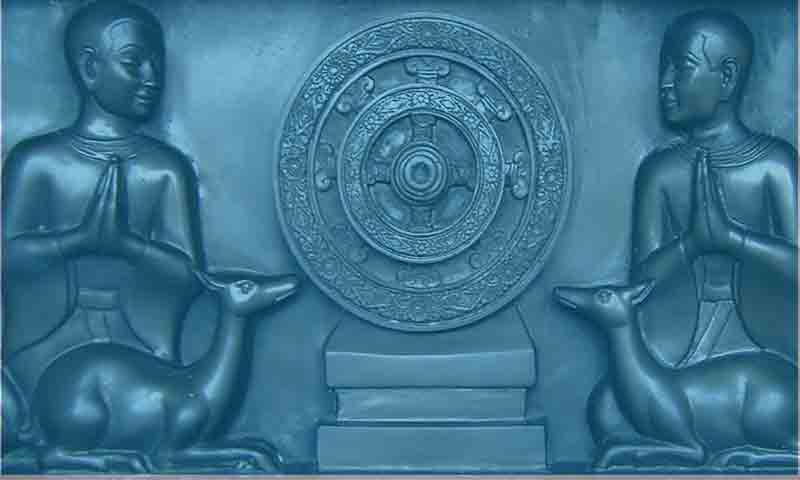
Disciples of the Buddha Paying Respects to the Wheel of Dhamma
This article expalins how a monk practices Right Livelihood in Buddhism on the Eightfold Path observing the code of conduct after he is initiated on the path and after he renounces worldly pleasures. It speaks of the monastic discipline the monks should follow to prepare for their Nirvana.
MN 117 defines wrong livelihood as scheming, persuading, hinting, belittling and pursuing gain with gain.
General
Deliberately lying to another person that one has attained a superior human state is a parajika offense. (Pr 4)
Acting as a go-between to arrange a marriage, an affair or a date between a man and a woman not married to each other is a sanghadisesa offense. (Sg 5)
Engaging in trade with anyone except one's co-religionists is a nissaggiya pacittiya offense. (NP 20)
Persuading a donor to give to oneself a gift that he or she had planned to give to the Community — when one knows that it was intended for the Community — is a nissaggiya pacittiya offense. (NP 30)
Telling an unordained person of one's actual superior human attainments is a pacittiya offense. (Pc 8)
Persuading a donor to give to another individual a gift that he or she had planned to give to a Community — when one knows that it was intended for the Community — is a pacittiya offense (Pc 82)
Robes
Keeping a piece of robe-cloth for more than ten days without determining it for use or placing it under dual ownership — except when the end-of-vassa or kathina privileges are in effect — is a nissaggiya pacittiya offense. (NP 1)
Being in a separate zone from any of one's three robes at dawn — except when the end-of-vassa or kathina privileges are in effect, or one has received formal authorization from the Community — is a nissaggiya pacittiya offense. (NP 2)
Keeping out-of-season cloth for more than 30 days when it is not enough to make a requisite and one has expectation for more — except when the end-of-vassa and kathina privileges are in effect — is a nissaggiya pacittiya offense. (NP 3)
Accepting robe cloth from an unrelated bhikkhuni without giving her anything in exchange is a nissaggiya pacittiya offense. (NP 5)
Asking for and receiving robe cloth from an unrelated lay person, except when one's robes have been stolen or destroyed, is a nissaggiya pacittiya offense. (NP 6)
Asking for and receiving excess cloth from unrelated lay people when one's robes have been stolen or destroyed is a nissaggiya pacittiya offense. (NP 7)
When a lay person who is not a relative is planning to get a robe for one, but has yet to ask one what kind of robe one wants: Receiving the robe after making a request that would raise its cost is a nissaggiya pacittiya offense. (NP 8)
When two or more lay people who are not one's relatives are planning to get separate robes for one, but have yet to ask one what kind of robe one wants: Receiving a robe from them after asking them to pool their funds to get one robe — out of a desire for something fine — is a nissaggiya pacittiya offense. (NP 9)
Making a felt blanket/rug with silk mixed in it for one's own use — or having it made — is a nissaggiya pacittiya offense. (NP 11)
Making a felt blanket/rug entirely of black wool for one's own use — or having it made — is a nissaggiya pacittiya offense. (NP 12)
Making a felt blanket/rug that is more than one-half black wool for one's own use — or having it made — is a nissaggiya pacittiya offense. (NP 13)
Unless one has received authorization to do so from the Community, making a felt blanket/rug for one's own use — or having it made — less than six years after one's last one was made is a nissaggiya pacittiya offense. (NP 14)
Making a felt sitting rug for one's own use — or having it made — without incorporating a one-span piece of old felt is a nissaggiya pacittiya offense. (NP 15)
Seeking and receiving a rains-bathing cloth before the fourth month of the hot season is a nissaggiya pacittiya offense. Using a rains-bathing cloth before the last two weeks of the fourth month of the hot season is also a nissaggiya pacittiya offense. (NP 24)
Taking thread that one has asked for improperly, and getting weavers to weave cloth from it — when they are unrelated and have not made a previous offer to weave — is a nissaggiya pacittiya offense. (NP 26)
When donors who are not relatives — and have not invited one to ask — have arranged for weavers to weave robe cloth intended for one: Receiving the cloth after getting the weavers to increase the amount of thread used in it is a nissaggiya pacittiya offense. (NP 27)
Keeping robe cloth offered in urgency past the end of the robe season after having accepted it during the last eleven days of the Rains Retreat is a nissaggiya pacittiya offense. (NP 28)
When one is living in a dangerous wilderness abode during the first month of the cold season, and has left one of one's robes in the village where one normally goes for alms: Being away from the abode and the village for more than six nights at a stretch — except when authorized by the Community — is a nissaggiya pacittiya offense. (NP 29)
Making use of an unmarked robe is a pacittiya offense. (Pc 58)
Acquiring an overly large sitting cloth after making it — or having it made — for one's own use is a pacittiya offense requiring that one cut the cloth down to size before confessing the offense. (Pc 89)
Acquiring an overly large skin-eruption covering cloth after making it — or having it made — for one's own use is a pacittiya offense requiring that one cut the cloth down to size before confessing the offense. (Pc 90)
Acquiring an overly large rains-bathing cloth after making it — or having it made — for one's own use is a pacittiya offense requiring that one cut the cloth down to size before confessing the offense. (Pc 91)
Acquiring an overly large robe after making it — or having it made — for one's own use is a pacittiya offense requiring that one cut the robe down to size before confessing the offense. (Pc 92)
Food
Eating any of the five staple foods that a lay person has offered as the result of a bhikkhuni's prompting — unless the lay person was already planning to offer the food before her prompting — is a pacittiya offense. (Pc 29)
Eating food obtained from the same public alms center two days running, unless one is too ill to leave the center, is a pacittiya offense. (Pc 31)
Eating a meal to which four or more individual bhikkhus have been specifically invited — except on special occasions — is a pacittiya offense. (Pc 32)
Eating a meal before going to another meal to which one was invited, or accepting an invitation to one meal and eating elsewhere instead, is a pacittiya offense except when one is ill or at the time of giving cloth or making robes. (Pc 33)
Accepting more than three bowlfuls of food that the donors prepared for their own use as presents or for provisions for a journey is a pacittiya offense. (Pc 34)
Eating staple or non-staple food that is not left-over, after having earlier in the day finished a meal during which one turned down an offer to eat further staple food, is a pacittiya offense. (Pc 35)
Eating staple or non-staple food in the period after noon until the next dawn is a pacittiya offense. (Pc 37)
Eating food that a bhikkhu — oneself or another — formally received on a previous day is a pacittiya offense. (Pc 38)
Eating finer foods, after having asked for them for one's own sake — except when ill — is a pacittiya offense. (Pc 39)
Eating food that has not been formally given is a pacittiya offense. (Pc 40)
Eating staple or non-staple food, after having accepted it from the hand of an unrelated bhikkhuni in a village area, is a patidesaniya offense. (Pd 1)
Eating staple food accepted at a meal to which one has been invited and where a bhikkhuni has given directions, based on favoritism, as to which bhikkhu should get which food and none of the bhikkhus have dismissed her, is a patidesaniya offense. (Pd 2)
Eating staple or non-staple food, after accepting it — when one is neither ill nor invited — at the home of a family formally designated as "in training," is a patidesaniya offense. (Pd 3)
Eating an unannounced gift of staple or non-staple food after accepting it in a dangerous wilderness abode when one is not ill is a patidesaniya offense. (Pd 4)
A bhikkhu who is not ill should not ask for rice, bean curry or any other food not covered by Pacittiya 39. (Sk 37)
Lodgings
Building a plastered hut — or having it built — without a sponsor, destined for one's own use, without having obtained the Community's approval, is a sanghadisesa offense. Building a plastered hut — or having it built — without a sponsor, destined for one's own use, exceeding the standard measurements, is also a sanghadisesa offense. (Sg 6)
Building a hut with a sponsor — or having it built — destined for one's own use, without having obtained the Community's approval, is a sanghadisesa offense. (Sg 7)
When a bhikkhu is building or repairing a large dwelling for his own use, using resources donated by another, he may not reinforce the window or door frames with more than three layers of roofing material or plaster. To exceed this is a pacittiya offense. (Pc 19)
Acquiring a bed or bench with legs longer than eight Sugata fingerbreadths after making it — or having it made — for one's own use is a pacittiya offense requiring that one cut the legs down before confessing the offense. (Pc 87)
Acquiring a bed or bench stuffed with cotton down after making it — or having it made — for one's own use is a pacittiya offense requiring that one remove the stuffing before confessing the offense. (Pc 88)
Medicine
Keeping any of the five tonics — ghee, fresh butter, oil, honey or sugar/molasses — for more than seven days, unless one determines to use them only externally, is a nissaggiya pacittiya offense. (NP 23)
When a supporter has made an offer to supply medicines to the Community: Asking the donor for medicine outside the terms of the offer when one is not ill, or asking him/her for medicine to use for a non-medicinal purpose, is a pacittiya offense. (Pc 47)
Money
When a fund has been set up with a steward indicated by a bhikkhu: Obtaining an article from the fund as a result of having prompted the steward more than the allowable number of times is a nissaggiya pacittiya offense. (NP 10)
Taking gold or money, having someone else take it, or consenting to its being placed down as a gift for oneself, is a nissaggiya pacittiya offense. (NP 18)
Obtaining gold or money through trade is a nissaggiya pacittiya offense. (NP 19)
Bowls and other requisites
Carrying wool that has not been made into cloth or yarn for more than three leagues is a nissaggiya pacittiya offense. (NP 16)
Keeping an alms bowl for more than ten days without determining it for use or placing it under dual ownership is a nissaggiya pacittiya offense. (NP 21)
Asking for a new alms bowl when one's current bowl is not beyond repair is a nissaggiya pacittiya offense. (NP 22)
Acquiring a needle box made of ivory, bone or horn after making it — or having it made — for one's own use is a pacittiya offense requiring that one break the box before confessing the offense. (Pc 86)
Communal Harmony
To persist in one's attempts at a schism, after the third announcement of a formal rebuke in a meeting of the Community, is a sanghadisesa offense. (Sg 10)
To persist in supporting a potential schismatic, after the third announcement of a formal rebuke in a meeting of the Community, is a sanghadisesa offense. (Sg 11)
To persist in being difficult to admonish, after the third announcement of a formal rebuke in the Community, is a sanghadisesa offense. (Sg 12)
To persist — after the third announcement of a formal rebuke in the Community — in criticizing an act of banishment performed against oneself is a sanghadisesa offense. (Sg 13)
When a trustworthy female lay follower accuses a bhikkhu of having committed a parajika, sanghadisesa or pacittiya offense while sitting alone with a woman in a private, secluded place, the Community should investigate the charge and deal with the bhikkhu in accordance with whatever he admits having done. (Ay 1)
When a trustworthy female lay follower accuses a bhikkhu of having committed a sanghadisesa or pacittiya offense while sitting alone with a woman in a private place, the Community should investigate the charge and deal with the bhikkhu in accordance with whatever he admits having done. (Ay 2)
Telling an unordained person of another bhikkhu's serious offense — unless one is authorized by the Community to do so — is a pacittiya offense. (Pc 9)
Persistently replying evasively or keeping silent when being questioned in a meeting of the Community in order to conceal one's own offenses — after a formal charge of evasiveness or uncooperativeness has been brought against one — is a pacittiya offense. (Pc 12)
If a Community official is innocent of prejudice, criticizing him within earshot of another bhikkhu is a pacittiya offense. (Pc 13)
When one has set a bed, bench, mattress or stool belonging to the Community out in the open: Leaving its immediate vicinity without putting it away or arranging to have it put away is a pacittiya offense. (Pc 14)
When one has spread bedding out in a dwelling belonging to the Community: Departing from the monastery without putting it away or arranging to have it put away is a pacittiya offense. (Pc 15)
Encroaching on another bhikkhu's sleeping or sitting place in a dwelling belonging to the Community, with the sole purpose of making him uncomfortable and forcing him to leave, is a pacittiya offense. (Pc 16)
Causing a bhikkhu to be evicted from a dwelling belonging to the Community — when one's primary motive is anger — is a pacittiya offense. (Pc 17)
Sitting or lying down on a bed or bench with detachable legs on an unplanked loft in a dwelling belonging to the Community, is a pacittiya offense. (Pc 18)
Saying that a properly authorized bhikkhu exhorts the bhikkhunis for the sake of personal gain — when in fact that is not the case — is a pacittiya offense. (Pc 24)
Deliberately tricking another bhikkhu into breaking Pacittiya 35, in hopes of finding fault with him, is a pacittiya offense. (Pc 36)
Speaking or acting disrespectfully when being admonished by another bhikkhu for a breach of the training rules is a pacittiya offense. (Pc 54)
Agitating to re-open an issue, knowing that it was properly dealt with, is a pacittiya offense. (Pc 63)
Not informing other bhikkhus of a serious offense that one knows another bhikkhu has committed — either out of a desire to protect him from having to undergo the penalty, or to protect him from the jeering remarks of other bhikkhus — is a pacittiya offense. (Pc 64)
Acting as the preceptor in the ordination of a person one knows to be less than 20 years old is a pacittiya offense. (Pc 65)
Refusing to give up the wrong view that there is nothing wrong in intentionally transgressing the Buddha's ordinances — after the third announcement of a formal rebuke in a meeting of the Community — is a pacittiya offense. (Pc 68)
Consorting, joining in communion or lying down under the same roof with a bhikkhu who has been suspended and not been restored — knowing that such is the case — is a pacittiya offense. (Pc 69)
Supporting, receiving services from, consorting or lying down under the same roof with an expelled novice — knowing that he has been expelled — is a pacittiya offense. (Pc 70)
Saying something as a ploy to excuse oneself from training under a training rule when being admonished by another bhikkhu for a breach of the rule is a pacittiya offense. (Pc 71)
Criticizing the discipline in the presence of another bhikkhu, in hopes of preventing its study, is a pacittiya offense. (Pc 72)
Using half-truths to deceive others into believing that one is ignorant of the rules in the Patimokkha, after one has already heard the Patimokkha in full three times, and a formal act exposing one's deceit has been brought against one, is a pacittiya offense. (Pc 73)
Giving a blow to another bhikkhu, when motivated by anger, is a pacittiya offense. (Pc 74)
Making a threatening gesture against another bhikkhu when motivated by anger is a pacittiya offense. (Pc 75)
Saying to another bhikkhu that he may have broken a rule unknowingly, simply for the purpose of causing him anxiety, is a pacittiya offense. (Pc 77)
Eavesdropping on bhikkhus involved in an argument over an issue — with the intention of using what they say against them — is a pacittiya offense. (Pc 78)
Complaining about a formal act of the Community to which one gave one's consent — if one knows that the act was carried out in accordance with the rule — is a pacittiya offense. (Pc 79)
Getting up and leaving a meeting of the Community in the midst of a valid formal act — without having first given one's consent to the act, and with the intention of invalidating it — is a pacittiya offense. (Pc 80)
After participating in a formal act of the Community giving robe-cloth to a Community official: Complaining that the Community acted out of favoritism is a pacittiya offense. (Pc 81)
When the Community is dealing formally with an issue, the full Community must be present, as must all the individuals involved in the issue; the proceedings must follow the patterns set out in the Dhamma and Vinaya. (As 1)
If the Community unanimously believes that a bhikkhu is innocent of a charge made against him, they may declare him innocent on the basis of his memory of the events. (As 2)
If the Community unanimously believes that a bhikkhu was insane while committing offenses against the rules, they may absolve him of any responsibility for the offenses. (As 3)
If a bhikkhu commits an offense, he should willingly undergo the appropriate penalty in line with what he actually did and the actual seriousness of the offense. (As 4)
If an important dispute cannot be settled by a unanimous decision, it should be submitted to a vote. The opinion of the majority, if in accordance with the Dhamma and Vinaya, is then considered decisive. (As 5)
If a bhikkhu admits to an offense only after being interrogated in a formal meeting, the Community should carry out an act of censure against him, rescinding it only when he has mended his ways. (As 6)
If, in the course of a dispute, both sides act in ways unworthy of contemplatives, and the sorting out of the penalties would only prolong the dispute, the Community as a whole may make a blanket confession of its light offenses. (As 7)
The Etiquette of a Contemplative
Training a novice or lay person to recite passages of Dhamma by rote is a pacittiya offense. (Pc 4)
Lying down at the same time, in the same lodging, with a novice or layman for more than three nights running is a pacittiya offense. (Pc 5)
Digging soil or commanding that it be dug is a pacittiya offense. (Pc 10)
Intentionally cutting, burning or killing a living plant is a pacittiya offense. (Pc 11)
Handing food or medicine to a mendicant ordained outside of Buddhism is a pacittiya offense. (Pc 41)
When on almsround with another bhikkhu: Sending him back so that he won't witness any misconduct one is planning to indulge in is a pacittiya offense. (Pc 42)
To sit down intruding on a man and a woman in their private quarters — when one or both are sexually aroused, and when another bhikkhu is not present — is a pacittiya offense. (Pc 43)
Watching a field army — or similar large military force — on active duty, unless there is a suitable reason, is a pacittiya offense. (Pc 48)
Staying more than three consecutive nights with an army on active duty — even when one has a suitable reason to be there — is a pacittiya offense. (Pc 49)
Going to a battlefield, a roll call, an array of the troops in battle formation or to see a review of the battle units while one is staying with an army is a pacittiya offense. (Pc 50)
Taking an intoxicant is a pacittiya offense regardless of whether one is aware or not that it is an intoxicant. (Pc 51)
Tickling another bhikkhu is a pacittiya offense. (Pc 52)
Jumping and swimming in the water for fun is a pacittiya offense. (Pc 53)
Attempting to frighten another bhikkhu is a pacittiya offense. (Pc 55)
Lighting a fire to warm oneself — or having it lit — when one does not need the warmth for one's health is a pacittiya offense. (Pc 56)
Bathing more frequently than once a fortnight when residing in the middle Ganges Valley, except on certain occasions, is a pacittiya offense. (Pc 57)
Hiding another bhikkhu's bowl, robe, sitting cloth, needle case or belt — or having it hid — either as a joke or with the purpose of annoying him, is a pacittiya offense. (Pc 60)
Traveling by arrangement with a group of thieves from one village to another — knowing that they are thieves — is a pacittiya offense. (Pc 66)
Entering a king's sleeping chamber, unannounced, when both the king and queen are in the chamber, is a pacittiya offense. (Pc 83)
Picking up a valuable, or having it picked up, with the intent of putting it in safe keeping for the owner — except when one finds it in a monastery or in a dwelling one is visiting — is a pacittiya offense. (Pc 84)
A bhikkhu should wear his upper and lower robes even all around. (Sk 1 & 2)
Etiquette in inhabited areas
When going or sitting in inhabited areas, a bhikkhu should:
wear his robes so that they hang down evenly, covering his chest, knees, wrists, and everything in between.
refrain from playing with his hands or feet.
keep his gaze lowered except when it is necessary to look up.
refrain from hitching up his robe so that it exposes the side of his body.
refrain from laughing loudly or speaking loudly.
refrain from swinging his body, arms or head.
refrain from putting his arms akimbo.
refrain from covering his head unless the weather is unbearably cold or hot.
refrain from walking on tiptoe or just on his heels.
refrain from sitting with his arms around his knees. (Sk 3-26)
Receiving and eating almsfood
When receiving alms, a bhikkhu should:
be mindful to receive them appreciatively.
focus his attention on the alms bowl.
take bean curry only in proper proportion to the rice.
accept no more food than will fill the bowl level to the top rim. (Sk 27-30)
When eating, a bhikkhu should:
be mindful to eat his food appreciatively.
focus his attention on the bowl.
eat his food methodically, from one side of the bowl to the other.
eat bean curry only in proper proportion to the rice.
level his rice before eating from it.
refrain from hiding his substantial food with rice, out of a hope of getting more.
refrain from looking at another bhikkhu's bowl intent on finding fault with him for not sharing his food.
refrain from making extra-large mouthfuls.
eat his rice in rounded mouthfuls.
refrain from opening his mouth until he has brought food to it.
refrain from putting his whole hand in his mouth.
refrain from speaking when there is so much food in his mouth that it affects his pronunciation.
refrain from lifting a large handful of food from his bowl and breaking off mouthfuls with the other hand.
refrain from nibbling bit by bit at his mouthfuls of food.
refrain from stuffing out his cheeks.
refrain from shaking food off his hands or scattering rice about.
refrain from sticking out his tongue or smacking his lips.
refrain from making a slurping noise.
refrain from licking his hands, his bowl or his lips.
refrain from accepting a water vessel with a hand soiled by food.
refrain from throwing away — in an inhabited area — bowl-rinsing water that has grains of rice in it.(Sk 31-36, 38-56)
Teaching Dhamma
When his listener is not ill, a bhikkhu should not teach Dhamma if the listener:
has an umbrella in his/her hand.
has a staff in his/her hand.
has a knife in his/her hand.
has a weapon in his/her hand.
is wearing shoes, boots or sandals.
is sitting in a vehicle when the bhikkhu is in a lower vehicle or not in a vehicle at all.
is lying down when the bhikkhu is sitting or standing.
is sitting holding his/her knees.
is wearing a hat or a turban, or has covered his/her head with a scarf or shawl.
is sitting on a seat while the bhikkhu is sitting on the ground.
is sitting on a high seat while the bhikkhu is sitting on a lower seat.
is sitting while the bhikkhu is standing.
is walking ahead of the bhikkhu.
is walking on a path while the bhikkhu is walking beside the path. (Sk 57-72)
Urinating, defecating & spitting
Unless he is ill, a bhikkhu should not urinate or defecate while standing. (Sk 73)
Unless he is ill, a bhikkhu should not urinate, defecate or spit on living crops or in water that is fit for bathing or drinking. (Sk 74-75)
Suggestions for Further Reading
- Buddhism - The Concept of Anatta or No Self
- Anatta or Anatma in Buddhism
- Anicca or Anitya in Buddhism
- The Buddha on God
- The Buddha on Avijja or Ignorance and on the Origin of Life
- The Buddha On the Self And Anatta, the Not-Self
- History Of The Four Buddhist Councils
- Chinese Buddhism
- The Eightfold Path Of Buddhism
- The Four Noble Truths of Buddhism
- Four Stages of Progress on the Middle Way in Buddhism
- The Practice of Friendliness, Kalyanamittata, in Buddhism
- Karma or Kamma In Buddhism
- Mahayana Buddhism
- Buddha's Last Days and Final Words
- Buddhism - The Middle Way
- The Buddha's Teaching on Right Mindfulness
- The Meaning and Practice of Mindfulness
- Buddhism - Vinaya or Monastic Discipline
- Right Conduct For Lay Buddhists
- Nirvana or Nibbana in Buddhism
- Buddhism - Objects of Meditation and Subjects for Meditation
- Buddhism - Right Speech and Mind Training
- Buddhism - Right Living On The Eightfold Path
- Handbook for the Relief of Suffering by Ajaan Lee
- Theravada Buddhism
- Meat Eating or Vegetarianism in Buddhism
- Essays On Dharma
- Esoteric Mystic Hinduism
- Introduction to Hinduism
- Hindu Way of Life
- Essays On Karma
- Hindu Rites and Rituals
- The Origin of The Sanskrit Language
- Symbolism in Hinduism
- Essays on The Upanishads
- Concepts of Hinduism
- Essays on Atman
- Hindu Festivals
- Spiritual Practice
- Right Living
- Yoga of Sorrow
- Happiness
- Mental Health
- Concepts of Buddhism
- General Essays
Image Attribution: The images of the heaven and Buddhist deities used in this article are licensed under the Creative Commons Attribution-Share Alike 2.0 Generic license.