
Amma, The Mother of All - A Book Review
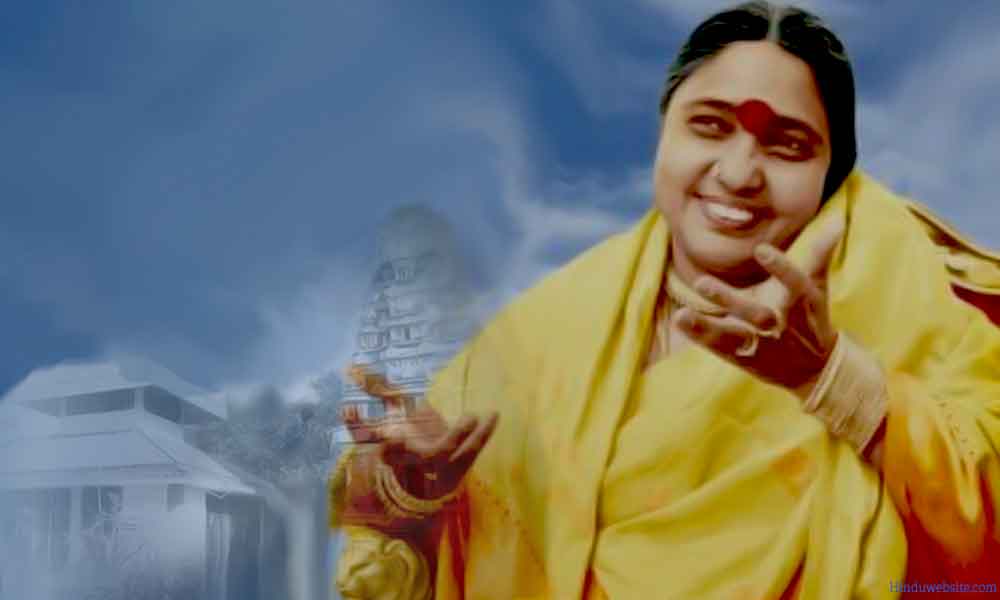
Spiritually India is the blessed land of mystics and yogis. From time to time God either reincarnates Himself there to restore Dharma or sends his manifestations to help the people to regain their spirituality. In the latter category are those who come into this world with a divine mission and live like ordinary people amidst the hustle and bustle of normal life but charge the earthly consciousness with their powerful vibrations. Through their words and deeds they transform the lives of many and help the planet to regain its balance.
Those who come into contact with them and succeed in establishing an inner spiritual connection, the way Richard Schiffman did with Amma, undergo an extraordinary degree of inner transformation. They experience a greater calm and an enhanced sense of detachment, a soul stirring touch with the Reality that cannot be explained in plain words, nor can be appreciated by the ordinary and the materialistic, but which becomes for a seeker of Truth the very reason for the continuation of his spiritual journey.
Richard Schiffman has done an excellent job of portraying the events in the life of Amma in an objective and truthful manner and helping the readers to understand her true divinity.
The Mother of Jillellamudi lived a very ordinary life, but in an extraordinary way. In the course of her eventful life, through her unbound love and miraculous powers, she transformed the lives of many and provided solace to many. Richard Schiffman was one of the few westerners who had the rare privilege of coming into contact with Amma to experience the joy and peace of living in the presence of the Universal Mother and see Her unbound love manifesting itself towards all Her creation.
His book the Mother of All is an irrefutable evidence that proves beyond doubt that the universe is pervaded by the unbound love and energy of the Divine Mother who can manifest herself in various forms and play different roles in whatever way she chooses to and that she can be the source of all illusions as well as enlightenment depending upon Her will.
The life of Jillellamudi Amma proves that to the ordinary the Reality is duality, the sense of many, the feeling of you and I, the sense of separation that leads to insecurity, conflict and sorrow, but to the enlightened it is one, indeed, not just one, but the undivided everlasting feeling of "I" ness, the disappearance of all sense of duality and sense of egoism.


LOST AND FOUND - Excerpt from the book
"That which is not found even by searching is God" -Amma
AMMA SPENT THE entire night inside the temple engaged in the heartfelt praises of Mother Earth. As the first tentative brightness lit the eastern horizon, she left the inner sanctum and went out into the cool stillness of the morning to the locked main gate of the temple compound to await her release. At precisely eight-thirty, the temple priest, Rangacharyulu, arrived to commence his daily rounds of worship. No sooner had the massive wooden temple doorway creaked open than his gaze fell upon the young girl standing serenely inside the courtyard. The priest was so overwhelmed that he hardly had a chance to consider who she was and how she had come to be inside the locked temple grounds. He just stared mutely at the child, whose calm figure and beatific visage wreathed in an angelic smile, sent thrills of bliss coursing through his body.
A warm haze of light seemed to engulf his heart and simultaneously the realization dawned that the child was Ammavaru herself, the temple deity of stone turned flesh and blood to grant him darshan His body trembled as if from an electric shock. Losing all control of his limbs, he dropped down limply at Amma's feet. She touched him once lightly on the head, the trembling stopped, and his supine form became transfixed in blissful trance.
Slowly, Amma ambled out of the temple compound. By the time Rangacharyulu had finally regained consciousness of the external world, she was no longer to be seen.
He had an agonizing moment of doubt. Had his blissful vision been real or the illusion of an overheated imagination? With this question bearing heavily on him, he rushed into the inner sanctum and caught hold of the two feet on the idol of Ammavaru, as a drowning man clutches a floating plank.
"Mother! Have you granted me darshan he cried out, and almost immediately became lost again in self-forgetful bliss. His abundant tears of joy now bathed in earnest the stone feet of the idol which he had so often washed mechanically during the daily ritual of abhisheka. 1
At that very moment, the temple trustee Ranga Rao strode purposefully into the sanctum in a far less exalted, but equally oblivious haze of his own. He didn't seem to notice the ecstatic state of his priest, but was struck immediately by the idol of Ammavaru, bereft of its usual silk coverings and valuable ornaments.
"What, Rangacharyulu! Is today a special festival for the Goddess without clothing and without jewelry?" he cried out sarcastically.
The priest lifted his head from the idol's feet with difficulty and noticed for the first time that Ammavaru was indeed missing her usual adornments. His mood of devotion quickly gave way to panic. Though he could barely rouse himself to move, due to his temporary trance, he somehow managed to locate another sari and to dress the idol. But the ornaments were still nowhere to be seen.
In his anxiety to recover the jewels, Rangacharyulu prayed fervently within himself: "Mother, have you left this idol of stone and entered into my heart with all of your ornaments? Is the idol now merely a lifeless hunk of stone? Even if I lose my job on this account, please never leave me. Remain installed forever in my heart! But, if it be your will, let me have the ornaments, Mother, in order to wipe out this blot on my character. What is more, I can't bear to look at you like this (bereft of ornaments)."
No sooner had he prayed in this way, than it flashed on him intuitively where he should search for the ornaments. He found the jewels and brought them eagerly back to replace upon the idol. But it was already too late to placate the incensed Ranga Rao. The trustee's outrage only increased, and he addressed Rangacharyulu in summary fashion. "What is this? Having stolen the ornaments, you are returning them again? Look into your account and take whatever back-pay is due to you."
The temple priest gazed imploringly at the idol of Ammavaru as to an old and trusted friend and bowed low before the image that he had worshipped so devotedly and for so long. "Whether I lose my job or not, please keep your blessed form always fresh before my sight, Mother," he prayed.
The priest lifted himself up from his prostration and was about to leave the sanctum, when Ranga Rao called out harshly, "You're going-let it be for good!"
The dazed Rangacharyulu walked through the main gate into the town with a sinking heart. Almost immediately, he came upon Amma standing in the street outside, as if she had been waiting for him. His present depressed state of mind was like a heavy veil and it did not occur to him that this was, in fact, the same "Child-Goddess" he had seen earlier that morning.
He questioned Amma in an offhanded way. "Whose girl are you?"
"I belong to whatever person I am with at the moment," she replied.
"In that case, do you belong to me?" the priest asked.
"Why not? If you regard me as your own, wouldn't it be so?"
Rangacharyulu became suddenly abstracted, mindful of his earlier experience. "I have seen my Mother today," he confided dreamily. "Did my Mother appear to you too? What an extraordinary Mother she is." He closed his eyes as if to better visualize the morning's darshan. But when he opened them again, the child's form was already vanishing down the road. As he watched Amma disappear into a side street, it occurred to him how closely she resembled the young Ammavaru he had seen earlier in the temple courtyard. He brought to mind Amma's suggestive words of a few moments back, her mature and self-assured manner. "Perhaps this child is the same one who appeared to me earlier," he mused.
Suddenly feeling a keen desire to test this theory, the priest started running off down the road. The impulsive chase through the quiet residential streets ended by the town railroad station, where he found Amma seated contentedly under a spreading jumbu tree. Panting and gasping for breath, he went up to her and blurted out, "Mother, tell me the truth. Are you the one who granted me darshan yesterday?"
"Tell me the truth, was it yesterday, or the day before yesterday that you had darshan?" she teased him.
"My mistake, it was early this morning," he remembered.
"Did I appear to you in the early morning? Tell me exactly." But before he could answer, Amma addressed him again, this time with a mischievous glint in her eyes. "I think you've come to steal my jewels like you stole Ammavaru's jewels at the temple!"
Rangacharyulu was stunned by her knowledge of what had transpired between himself and the temple trustee in the seclusion of the inner sanctum. Instantly, he fell at the child's feet, crying out: "Mother, don't cover me up again with your maya. Take me quickly into yourself."
But Amma, in a playful mood, feigned surprise. "Why do you fall at my feet and call me 'Mother'? I'm only a little girl, the daughter of Chidambara Rao's brother-in-law. I am here because I lost my own mother. I visit the temple now and again to have the darshan of the Mother in the temple, that's all. Please call me ammayee (little girl) and not Ammavaru, as you seem to imagine me to be.
The priest was once more thrown into confusion. Struck as he was by the reasonableness of her words and the utter unreasonableness of his taking her to be a flesh and-blood deity, he wandered off without saying anything, embarrassed at his own erratic behavior. As he made his way home sunk deeply in thought, he heard the same comforting words of assurance echoing again and again in his mind. "There is no cause for fear. You will get your job back," promised the inner voice.
Meanwhile, Amma had returned to Chidambara Rao's residence, stopping briefly on the way under a flowering punnaga tree to collect some delicate white blossoms. Entering the house unobtrusively, she placed the flowers on the ground near the family shrine. It seems that, in the hectic preparation for the Navaratri festival of the Divine Mother, nobody had taken notice of the fact that she had been out all of the previous night. When Aunt Annapurnamma came into the hall and saw the blossoms which Amma had placed so unorthodoxly on the floor, she flew into a fury.
"Why do you put them on the ground? Get some roses from the backyard!" she ordered in a huff.
Amma immediately went out to fulfill her aunt's instructions. Returning with a handful of fresh blossoms, she asked, "Auntie, where should I put them now?"
"Put them on your head!" Annapurnamma fumed. And Amma, in literal obedience, did just that. Which further enraged Annapurnamma. "What! Is it for this that I asked you to fetch the roses?" she bellowed.
"Since you told me to collect the flowers, I did so. When you asked me to put them on MY head, I followed your instructions. It is only because I did not know what to do with them that I asked you for directions," Amma explained.
Prakya Subbiah, the priest who had been called in to perform the special festival worship of the household deities, was impressed by the child's calm and mature replies. He tried to placate Annapurnamma. "What does it matter if she did place them on her head? Is she not bala?(2) There is no defilement in the innocent acts of a child. You can go ahead and offer the flowers."
The priest scrutinized Amma thoughtfully for a few moments and then addressed Annapurnamma.
"I saw this girt at the temple yesterday. She was talking with some elders there. How is she related to you?" he asked with ill-concealed admiration.
"She doesn't even know how to ask for food," Annapurnamma snapped. "You must have seen someone else."
"No, this is the same girl. I saw her clearly. I have heard people say that there is something unique about her."
Annapurnamma grew irritated at this talk, the likes of which she had already heard more than enough in the household of Chidambara Rao. She ordered the priest to go ahead with the pooia (ritual worship).
He reluctantly complied, but all the while he was worshipping the household deity and reciting the Lalita Sahasranamam (the thousand names of the Divine Mother), his attention was riveted on Anasuya Devi, whose liquid eyes and soothing features held a strange fascination for him. When it came time to break the coconut and wave the camphor flame before the idol, he unconsciously performed these facing the child instead of offering them to the idol of the Goddess as was expected.
As soon as the pooia was completed, Amma left the hall and wandered over to the nearby residence of Ranga Rao, sitting down casually on the doorstep outside his house. When he returned from some business in town and saw Amma resting by the house, he called out and asked her who she was.
"I am a relative of Rangacharyulu," she claimed.
"How is he related to you?"
"He is like a son to me. That is to say, his mother and I are sisters.113
"Are you coming from his house?" Ranga Rao asked.
"No, I am just on my way there now. It seems that someone fired him from his job. He is a good man with a fine disposition. It is the temple's loss that he is being asked to leave."
Hearing these innocent words of truth, Ranga Rao became engrossed in thought. Rangacharyulu's years of devoted service passed before his mind's eye and he felt suddenly remorseful for his hasty action. Taking along some back pay, fruits and ten rupees extra as a token of his repentance, the temple trustee went directly to the priest's home. After offering his sincere apologies to Rangacharyulu, he handed him the money and fruit asking him to perform a pooja to Ammavaru and offer her the fruits. Ranga Rao walked off without any further words, leaving the priest alone to ponder this latest shift in the words of fortune.
Rangacharyulu was hard pressed to understand what had caused the trustee's sudden change of heart. Dazed, he wandered over to the open window of his upstairs room and peered out reflectively at the busy town life below. In a flash, he spotted Amma's diminutive figure weaving its way through the crowd.
"Mother!" he called out in exaltation, and rushed headlong down the stairs. But by the time he had reached the road, she was gone, having vanished tracelessly amid the busy throng of faces that swirled and eddied about him.
Sadly, he turned back to his house, praying inwardly with the intensity of his thwarted devotion: "Mother, why do you play hide-and-seek with this child of yours? Be kind enough to grant him your darshan completely and permanently. I can't stand being tossed about in the ocean of this world any longer. Amma, draw back this curtain of maya and take me into your blessed lap, once and for all!"
Reviews by others
I have read this book before in the original Indian edition. This new edition by Blue Dove Press is a definite improvement. The book is a true work of love by the author, Richard Schiffman, who is a devotee of Jillellamudi Mother and spent several years with her. I too am her devotee as well as one of Sathya Sai Baba's. The inspiration for my looking her way - for which I am eternally grateful - came principally from Richard's wonderful book. In the past, I have given and lent copies to others on the spiritual path. Many of them were extremely devoted to their gurus and reluctant to read about other holy beings. Nevertheless, literally everyone who read this book was truly inspired, and many insisted that their friends read "Mother of All" as well. Books with this kind of power and ability to transmit the love of God are rare and should be treasured.
I have had several remarkable personal experiences with Mother including being put into a state of bliss lasting over three hours resulting from just a half a second glance at one of her photographs. Jillellamudi Mother, though not well known even in India, seems to have been an Avatar of Adi Shakti, the primordial creative power - truly, the Divine Mother and the mother of us all. To say that such a being is rare is an understatement, and not to find out more about her would be unwise. To be able to look her way with love and an open heart would be a great blessing. Many high souls have said that the path to God realization always goes through the Divine Mother. That's why this book is such a gift to the seeker.
Even though I have never seen Mother in the flesh, when I think of her or see her picture, I feel tremendous longing and tears come to my eyes. With her, teachings and practice don't matter. Of course, it is a good thing to know her life story, but her very being engenders tremendous love - no real need for details. I feel she is my true mother and always has been. Spend a little time thinking of her or concentrating on her picture and you can't help but feel the love which she so perfectly embodies. We are all her children.
There is no better introduction to the Jillellamudi Mother than Richard Schiffman's book, and few books give such heartfelt glimpses into how wonderful the Divine Mother aspect of the Godhead can be. (Reviewer: Dimitri Drivas, Charlottesville, Virginia)
Suggestions for Further Reading
- Hinduwebsite Books
- Afghanistan - The World's Most Dangerous Place
- Amma, The Mother of All - A Book Review
- Books On Hinduism
- Books On Buddhism
- Books On Hindu Festivals And Worship
- Books On Gods and Goddesses
- Thus Sayeth Gurbani- a Book Review With Quotations
- God in the Gurbani
- Book On Hinduism, Hindu Religious Beliefs and Practices
- Books on the Saints and Gurus of Hinduism
- Books On The History Of Hinduism And India
- Books on Jainism And Jain Philosophy
- The Mother of all by Richard Schiffman: Chapter 11
- Books On Hindu Prayers And Mantras
- Books On Hindu Mythology And Puranas
- The Song of Rama - A Book Review
- Books on Saivism
- Books on Self-help And Self Development
- Books On Sikhism And Sikh Faith
- Books on Spiritualism, Occult & Mysticism
- Books on Tantra and Tantra Yoga
- A Book Review Three Phases of Struggle
- Books On The Upanishads and Vedanta
- Books On Vaishnavism And Vaishnava Tradition
- Books on the Vedas, Vedic Culture and Religion
- Books on Yoga, Yogasanas, Philosophy And Practice
- Books On Zoroastrianism And Zoroaster
- Essays On Dharma
- Esoteric Mystic Hinduism
- Introduction to Hinduism
- Hindu Way of Life
- Essays On Karma
- Hindu Rites and Rituals
- The Origin of The Sanskrit Language
- Symbolism in Hinduism
- Essays on The Upanishads
- Concepts of Hinduism
- Essays on Atman
- Hindu Festivals
- Spiritual Practice
- Right Living
- Yoga of Sorrow
- Happiness
- Mental Health
- Concepts of Buddhism
- General Essays
Footnotes
1. The temple idol is bathed in a variety of liquids during daily worship, called abhisheka.
2. A word meaning "child" and also used to refer to the deity.
3. Amma is making a statement of her spiritual kinship with the Goddess Ammavaru (His mother and myself are sisters"). There were no actual family ties.