Comets as Omens and Celestial Messengers in Hinduism
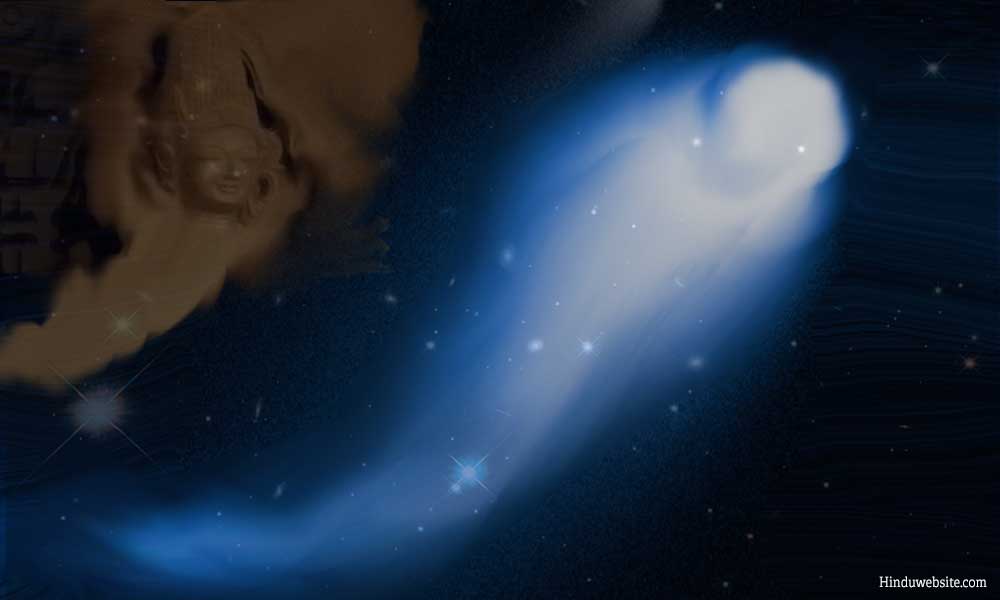
Summary: Hindu tradition views comets as more than astronomical phenomena, interpreting them as manifestations of shadowy planetary forces with deep mythological significance. This examination reveals their association with the serpent deities Rahu and Ketu, their perceived influence on earthly events, and their symbolic representation of disruption in cosmic order. Through understanding these celestial visitors, one gains insight into how the tradition interprets signs of change and transformation.
Comets in Hinduism symbolize both good and evil, and disruption in the order and regularity of the world. Since they are light bodies that shine brightly in darkness but seem mysterious, they are considered to be troublesome and a cause of worry. Etymologically they are considered extension of starts (kethu-thara) or stars with tails.
In the Hindu mythology, comets are associated with two demons, Rahu and Kethu. According to one account Vishnu cut off the head of an asura. The head without body became Ketu and the body without head became Rahu. Later Ketu assumed a serpent body.
According to another account, Vishnu cut off the heads of two demons named Rahu and Ketu as they tried to drink elixir along with the gods using a deception. The sun and the moon gods who noticed it reported to Vishu, who then cut off their heads to prevent the elixir entering their bodies.
As a result, their bodies perished, but their heads remained immortal. Later they assumed serpent bodies and became comets. Hence like comets they have shining heads and serpent tails. It is believed that every year out of spite they temporarily swallow the sun and the moon and release them, causing the solar and lunar eclipses. In Vedic astrology both Rahu and Ketu are considered planetary deities (grahas). Ketu is also described as a descending node of the waning moon.
The Vedas describe the appearance of comets (dhumakethu) in the sky as aspects of Agni, a celestial horse with a flying tail, and the weapon of Maruths. They have the tendency to cover the celestial phenomena in smoke and strike fear in the hearts of the people on earth.
In Saiva tradition, comets are believed to be the manifestations of Ganesha. The word Dhumketu, by which comets are known in Sanskrit, is an epithet of Ganehsa, who at one time was considered the lord of destruction. According to legends he acquired the name after he killed a smoke demon named Dhumasur.
Comets are associated with both auspicious and inauspicious events. Hence, many superstitions are associated with them Their appearance in the sky is viewed as a bad omen porending the death of a king, or an important person, and cause natural calamities, civil unrest the death of a close relation, etc. When they appear, people refrain from celebrating important events such as marriage the construction of a house, or purchase of property. According to the Parashara-samhita two comets appeared in the sky before the great flood took place during which everything on earth was submerged and Vishnu having incarnated as a giant fish (matsya) had to rescue the Vedas along with Manu, the progenitor of mankind. The appearance of comets was also mentioned by ancient Indian astronomers such as Varahamihira and Vallalasena.
Astrologically, comets may exert both positive and negative influences. The adverse influence of Rahu and ketu is said to be responsible for childlessness, for which the texts prescribe atonement ceremonies.
They may aggravate negative situations to help people overcome their weaknesses and character flaws.