An Overview of Sikhism and the Guru Granth Sahib
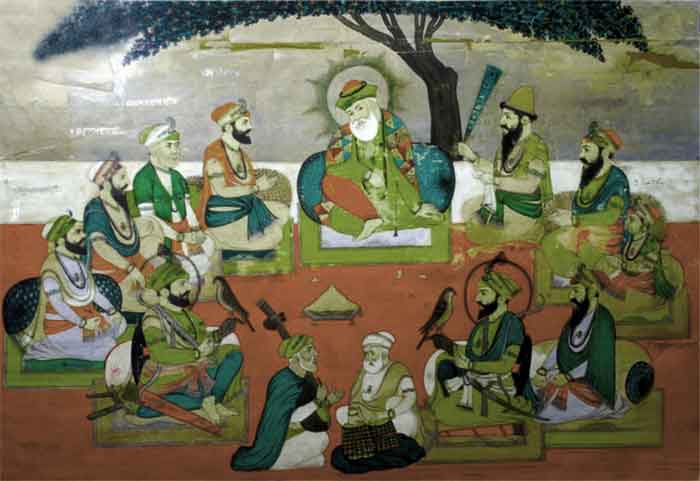
A paiting depicting the the ten Sikh Gurus
Summary: This page introduces the origins, history, and core teachings of Sikhism, beginning with Guru Nanak and the line of ten Gurus who shaped the tradition’s doctrine, institutions, and community life. It explains how the Guru Granth Sahib was compiled, expanded, and ultimately established as the eternal Guru and central scripture of Sikhism. The summary highlights key themes such as devotion to one God, ethical living, service, equality, and the importance of kirtan and the sangat Current page. It also outlines major historical developments, including the Sikh community’s growth, reform movements, and global presence, offering readers a concise understanding of Sikh philosophy and scriptural tradition.
Introduction
Sikhism is a monotheistic religion that emerged in the Punjab region of South Asia in the late fifteenth century through the teachings of Guru Nanak (1469–1539) and the nine Gurus who succeeded him. It developed in a historical setting shaped by interactions among devotional Hindu traditions, Islamic thought, and the social and political conditions of northern India, while establishing a distinct religious identity of its own. Sikh teachings emphasize devotion to one God, ethical living, service to others, equality, and remembrance of the divine name.
Historical Context and Development
Scholars often describe Sikhism as having arisen in dialogue with both Hindu and Islamic traditions, particularly in the religious environment of Punjab. Sikh thought shares some vocabulary and concepts with other South Asian traditions, such as karma and rebirth, but it interprets them within its own theological framework centered on the oneness of God and the authority of the Gurus. For this reason, Sikhism is best understood not as a branch of another religion, but as a distinct tradition that emerged in conversation with its wider cultural setting.
The Sikh community took shape over the course of the ten Gurus, whose teachings and institutions helped define Sikh religious life. The Gurus challenged caste hierarchy, emphasized the importance of honest labor and service, and encouraged forms of worship centered on devotion, singing of hymns, and communal gathering. Over time, Sikh institutions expanded across Punjab and beyond. Relations between Sikh communities and Mughal authorities varied across periods and rulers, but several major conflicts, including the executions of Guru Arjan in 1606 and Guru Tegh Bahadur in 1675, became defining moments in Sikh history.
The Ten Gurus and the Establishment of Scriptural Authority
Sikhs recognize a line of ten human Gurus, from Guru Nanak to Guru Gobind Singh, whose teachings and institutions shaped the religion over more than two centuries. This succession provided continuity in doctrine, community formation, and religious practice. The Gurus also contributed to the development of key Sikh institutions, including the sangat (congregation), langar (communal kitchen), and forms of collective discipline that strengthened the cohesion of the community. After the death of Guru Gobind Singh in 1708, the line of personal Gurus came to an end, and spiritual authority was vested in the Guru Granth Sahib. This transition established the scripture as the enduring guide of the Sikh community and marked a decisive moment in the formation of Sikh religious identity.
The Guru Granth Sahib
The Guru Granth Sahib is the central scripture of Sikhism. Its first recension, known as the Adi Granth, was compiled by the fifth Guru, Guru Arjan, in 1604. Later, Guru Gobind Singh oversaw the incorporation of the hymns of Guru Tegh Bahadur and affirmed the text as the enduring spiritual authority of the Sikh community in 1708. The scripture contains 1,430 pages, traditionally called angs, and approximately 5,894 hymn compositions arranged primarily by musical modes known as ragas.
The scripture includes the compositions of six Sikh Gurus as well as writings by a range of devotional figures, including Bhagats such as Kabir and Sheikh Farid. It is written in Gurmukhi script and incorporates several languages and dialects used in northern South Asia, including Punjabi and forms of Hindi, alongside Persian and other linguistic influences. This diversity reflects both the historical setting of the text and the broad spiritual conversation represented within it.
Beliefs and Religious Practice
Key themes in Sikh thought include remembrance of the divine name, the importance of the divine word or shabad, and participation in the sangat, or religious congregation. Sikh teachings place strong emphasis on inner devotion rather than ritual formalism, while also linking spiritual life to ethical conduct, service, and community responsibility. Singing scripture in the form of kirtan has a central place in Sikh worship, and the organization of the Guru Granth Sahib by ragas underscores the close relationship between music and devotion in the tradition.
Japji Sahib, a foundational composition by Guru Nanak, appears at the beginning of the Guru Granth Sahib. It opens with the Mul Mantar and is followed by an opening salok, thirty-eight pauris, and a concluding salok. Because it introduces major theological themes such as divine unity, hukam (divine order), and the path of spiritual discipline, it is often treated as a concise expression of central Sikh teachings. The Guru Granth Sahib is treated with deep reverence in gurdwaras, where it occupies the central place of worship and serves as the basis for prayer, recitation, and instruction.
Sikhism after the Ten Gurus to the Late Nineteenth Century
After the establishment of scriptural authority in 1708, Sikh history entered a new phase in which leadership continued through the Guru Granth Sahib and the collective community, or Panth. In the early eighteenth century, Sikh groups faced periods of severe persecution under Mughal rule, but they also developed new forms of political and military organization. Under Banda Singh Bahadur, Sikhs briefly established territorial control in parts of Punjab in the early 1710s. Later in the century, Sikh power became more decentralized through the formation of confederacies known as misls, which collectively shaped the political landscape of the region.
By the early nineteenth century, Maharaja Ranjit Singh had unified many of the Sikh misls and established the Sikh Empire, which ruled much of Punjab from 1799 until its annexation by the British in 1849. His reign is often noted for political consolidation, military modernization, and a relatively plural administrative structure. After annexation, Sikh institutions and identity were reshaped under colonial rule. In the later nineteenth century, the Singh Sabha movement emerged as an important reform initiative that promoted education, Punjabi in the Gurmukhi script, and clearer definitions of Sikh belief and practice. These developments played a major role in shaping modern Sikh identity before the twentieth century.
Sikhism in the Twentieth Century
In the early twentieth century, Sikh reform movements played a major role in reshaping religious institutions and public identity. The Gurdwara Reform Movement of the 1920s sought to place major Sikh shrines under representative Sikh management rather than under hereditary custodians or colonial oversight. This movement contributed to the establishment of the Shiromani Gurdwara Parbandhak Committee (SGPC), which received legal recognition under the Sikh Gurdwaras Act of 1925 and became a central institution in the administration of many historic gurdwaras. These developments strengthened institutional authority within the Sikh community and helped define public understandings of Sikh doctrine and practice.
The Partition of British India in 1947 had profound consequences for Sikhs, many of whom were displaced from regions that became part of Pakistan and resettled in India. In the decades that followed, Sikh political leaders participated in debates over language, federalism, and regional autonomy, including the Punjabi Suba movement, which contributed to the reorganization of the Indian state of Punjab in 1966. The later twentieth century also saw periods of severe political tension, especially in the 1980s, including the Indian army’s assault on the Harmandir Sahib complex during Operation Blue Star in 1984, the assassination of Prime Minister Indira Gandhi by two of her Sikh bodyguards, and subsequent anti-Sikh violence in several parts of India. At the same time, the twentieth century witnessed the continued expansion of Sikh communities outside South Asia, leading to the growth of a substantial global diaspora that established gurdwaras, educational institutions, and community organizations in many countries.
The Guru Granth Sahib: Contents, Organization, and Significance
The Guru Granth Sahib is a compilation of devotional poetry, musical compositions, and theological reflection that brings together the writings of six Sikh Gurus along with compositions by Bhagats, Bhatts, and other contributors associated with diverse religious and social backgrounds. Its contents address themes such as the nature of God, meditation on the divine name, the rejection of empty ritual, ethical living, and liberation through devotion and discipline. The range of voices preserved in the text reflects a broad devotional milieu while also expressing the distinctive theological orientation of Sikhism.
The scripture is organized primarily according to musical principles rather than chronology or narrative sequence. After an opening section that includes Japji Sahib and other foundational compositions, the main body of the text is arranged by thirty-one principal ragas, or musical modes. Within these divisions, hymns are further ordered by author, poetic form, and meter. This structure reflects the central place of recitation and singing in Sikh religious practice, since the hymns are meant not only to be read but also to be performed as kirtan. The standardized pagination of 1,430 angs also allows passages to be cited and located consistently across copies of the scripture.
The significance of the Guru Granth Sahib in Sikhism extends beyond its role as scripture. Since the end of the line of human Gurus, it has functioned as the eternal Guru and the highest source of spiritual authority in the tradition. In gurdwaras it is installed with ceremonial respect, and readings from it shape worship, instruction, and major life-cycle events. Its authority lies not only in its sacred status, but also in its role as a guide to personal devotion, communal identity, and ethical life. For this reason, the Guru Granth Sahib remains at the center of Sikh religious thought and practice in both historical and contemporary contexts.
We have included in this section the complete translation of Guru Granth Sahib: The Sacred Scripture of Sikhism. You can access it from here.