Sant Kabir: Teachings, Life and Legacy
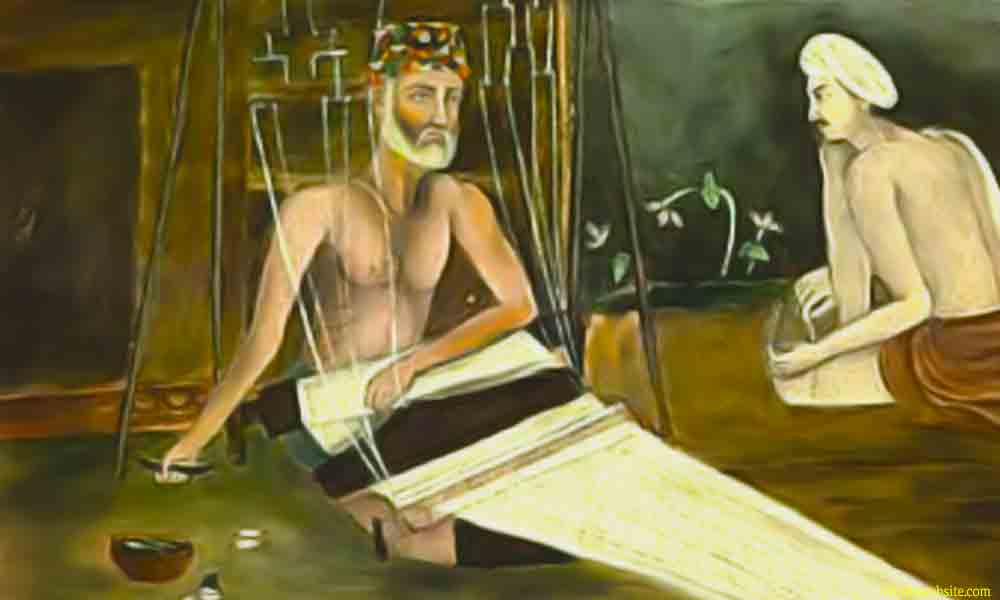
Summary: Kabir stands as one of the most significant figures in Indian mysticism, born near Benares around 1440 to Muslim parents and later becoming a devoted disciple of the Hindu ascetic Râmânanda. This introduction presents a selection of Kabir's 100 songs, translated into English by Rabindranath Tagore and edited by Evelyn Underhill, offering English readers their first accessible encounter with this remarkable poet-saint. The page explores Kabir's role in the religious revival of Northern India, tracing his spiritual lineage to Râmânuja's transformative reform movement in South Indian Brâhmanism.
Early Life and Background
Kabir, one of the most remarkable poet-saints of medieval India, stands at the heart of the Bhakti movement as a voice of spiritual courage, social criticism, and devotional intensity. He lived in the fifteenth century, most likely in or around Varanasi, though the precise dates of his birth and death remain uncertain. Historical traditions differ, with some placing him between 1398 and 1448 and others between 1440 and 1518. This uncertainty itself reflects the way Kabir belongs not merely to one community or one historical record, but to a wide popular memory shared across regions and religions. He is remembered as a weaver by profession, a mystic by temperament, and a poet whose short but powerful verses transformed the religious imagination of India.
According to widely accepted tradition, Kabir was raised in a family of Muslim weavers, often named Niru and Nima in popular legend. Although many stories surround his birth, what matters more than literal biography is the world in which he lived: a society deeply marked by caste divisions, ritualism, and tension between religious communities. Kabir is often associated with the Hindu teacher Ramananda, who is said to have influenced his spiritual outlook. Yet Kabir cannot be confined within either orthodox Hinduism or orthodox Islam. He drew from both traditions while challenging the externalism and empty formalism he saw in each. For him, the true path to the Divine lay not in labels, ceremonies, or inherited status, but in inward realization, ethical living, and sincere devotion. A true worshipper of God, he emphasized the purity of mind and selfless devotion to God. He openly opposed the weaknesses of both Hinduism and Islam. The following verse amply illustrates his fearless assessment of these two religions
The images are all lifeless, they cannot speak: I know, for I have cried aloud to them. The Purâna and the Koran are mere words: lifting up the curtain, I have seen.
Teachings and Spiritual Vision
Kabir’s teachings were revolutionary because they attacked the superficial forms of religion while preserving its spiritual core. He criticized idol worship when it became mechanical, and he was equally critical of those who reduced faith to scriptural recitation, priestly authority, or social superiority. He questioned sacred thread ceremonies, hollow pilgrimages, and sectarian pride, but he also rejected a merely legalistic or external understanding of Islam. Again and again, his poems insist that God is not found in stone images, temple walls, or formal ritual alone, but in the purified heart. This direct and fearless tone gave Kabir’s poetry immense power. He spoke in the language of ordinary people, not in elite scholarly idioms, and therefore his message traveled widely among artisans, laborers, seekers, and singers.
Poetry and Literary Works
Kabir’s literary legacy rests mainly on his songs, shabdas, sakhis, and especially his famous dohas, or rhyming couplets. These concise verses compress profound spiritual insight into memorable everyday language. Their simplicity is deceptive: behind their plain speech lies a deep philosophical vision shaped by devotion, mysticism, and ethical reflection. Kabir’s poetry often belongs to the stream known as nirgun bhakti, devotion to a formless, attributeless God. Instead of worshipping the Divine through image and ritual alone, he emphasized the interior experience of the One beyond name and form, though he freely used names such as Ram and Allah to point toward the same ultimate reality. Many poems attributed to him were transmitted orally for centuries, and later collections such as the Bijak became especially important among Kabir’s followers.
Contribution to the Bhakti Movement and Legacy
Kabir’s contribution to the Bhakti movement was both spiritual and social. The Bhakti movement, in broad terms, emphasized personal devotion to God over ritual complexity, priestly mediation, and rigid social hierarchy. Kabir gave this movement a sharp ethical edge. He insisted that no one could claim superiority by birth, caste, dress, or religious title. In a society stratified by inherited privilege, his assertion of the equality of all human beings was radical. Because he came from a weaver background and addressed common people directly, his poetry carried the message that divine truth was accessible to everyone. He helped shape a democratic religious culture in which devotion mattered more than status and inner sincerity mattered more than outward identity.
Kabir’s significance extends far beyond the history of one movement. His verses entered the Sikh scripture, the Guru Granth Sahib, where he is one of the most extensively represented non-Guru contributors. This inclusion shows how deeply his spiritual insights resonated across traditions. He also inspired the Kabir Panth, a devotional community that preserves and interprets his teachings. More broadly, Kabir occupies a unique place in Indian cultural history because he cannot be neatly claimed by any one religion. Hindus, Muslims, Sikhs, and secular readers alike have found meaning in his words. Modern scholars and readers continue to return to Kabir because he speaks to enduring human concerns: truth, ego, mortality, hypocrisy, compassion, and the search for a reality beyond division.
In conclusion, Kabir was not simply a poet of devotion; he was also a critic of narrow-mindedness and a prophet of spiritual freedom. His life as a humble artisan gave authenticity to his message, and his poetry gave language to a form of religion rooted in experience rather than dogma. By rejecting caste barriers, ritual excess, and sectarian hostility, he became one of the boldest representatives of the Bhakti movement. His dohas continue to be quoted because they unite poetic beauty with moral clarity. Even today, Kabir remains relevant as a voice of conscience who reminds humanity that the Divine is not the possession of any one community, but a truth discovered through love, humility, and inner awakening.