Vymaanika-Shaastra: Chapter‑Wise Summaries
Summary: The Vymaanika-Shaastra is an ancient Hindu Sanskrit text attributed to Maharshi Bharadwaaja that explores aeronautical principles and flying vehicles. Propounded by Venerable Subbaraya Shastry and translated into English by G.R. Josyer, a noted Sanskrit scholar and historian, this scholarly work represents a significant contribution to understanding Hindu scientific and philosophical traditions. This title page introduces readers to the text's origins, translation history, and archival significance.
Chapter 1 - Vimanas and Pilots for Navigation
1. Invocation and Purpose
Bharadwaja begins with a traditional invocation, offering reverence to the divine source of knowledge. He states that aeronautics is drawn from Vedic wisdom and earlier scientific teachers. The purpose of the treatise is to present a systematic science of flight, organized into eight chapters and hundreds of concise sutras.
2. Lineage of Earlier Teachers
The text acknowledges earlier masters who wrote works on aerial travel, flight mechanisms, and celestial vehicles. Their contributions form the foundation on which Bharadwaja builds his system.
3. Definition of a Vimana
A vimana is defined as a vehicle capable of moving through the sky with the speed and freedom of birds. Various ancient authorities describe it as a craft that can travel on land, water, air, and even between worlds.
4. Qualifications of a Pilot
The pilot must master thirty‑two operational “secrets” of flight. These include knowledge of atmospheric layers, visibility and invisibility techniques, maneuvering, energy management, defensive measures, and methods for observing or disabling enemy craft. These abilities are described as essential for safe and skillful operation.
5. Atmospheric Regions and Flight Routes
The sky is described as divided into five major regions, each containing numerous aerial routes used by beings of different worlds. The pilot must understand these pathways and the conditions that govern safe travel.
6. Aerial Whirlpools and Hazards
Five types of dangerous atmospheric whirlpools are identified—energy vortices, wind disturbances, solar‑ray turbulence, cold‑current whirlpools, and collision zones. The pilot must recognize and avoid these hazards.
7. Structure of the Vimana
The craft is said to consist of thirty‑one essential components, including mirrors, energy devices, tubes, mechanisms for expansion and contraction, and instruments for perception, propulsion, and defense. Each part has a specific location and function.
8. Clothing for Pilots
Pilot clothing must vary by season to protect the body from harmful atmospheric influences. Textiles are prepared through elaborate purification and oiling processes to enhance durability and protect health.
9. Food for Pilots
Diet is adjusted according to seasonal conditions. Different grains, milks, and meats (or vegetarian equivalents for certain castes) are recommended to maintain strength and counteract environmental stresses.
10. Seasonal Effects and Protective Diet
The text describes harmful seasonal forces and prescribes dietary adjustments to neutralize them. Proper food selection is considered essential for maintaining physical and mental fitness during flight.
11. Meal Timing
Pilots have specific meal schedules, distinct from householders, ascetics, and laborers. Their regimen includes multiple meals during day and night to maintain stamina.
12. Emergency Rations
When regular food is unavailable, concentrated essence‑based food balls or extracts are recommended as substitutes during long flights.
13. Foods from Roots, Fruits, and Herbs
The text lists roots, bulbs, fruits, grasses, and herbs as alternative food sources, each contributing different benefits to vitality, clarity, and strength.
14. Metals for Vimana Construction
Three base metals—soma, soundala, and mourthwika—are said to combine into sixteen heat‑resistant alloys suitable for aircraft construction. Their origins, properties, and classifications are described in detail.
15. Origin and Purification of Metals
The text describes how metals form within the earth through the interaction of cosmic and terrestrial forces. It then outlines purification procedures involving oils, acids, and herbal decoctions to prepare metals for use in aircraft.
Chapter 2 - Metals and Metallurgy for Vimana Construction
Chapter 2 presents a highly technical system of ancient metallurgical science. It classifies thirty‑three foundational metals into three groups and explains how dozens of specialized alloys are created through precise mixing and melting procedures. The chapter also describes the construction of crucibles, furnaces, and bellows required for metal purification and alloy production. Together, these details form the metallurgical foundation for building the structural components of a vimana.
1. Three Fundamental Metal Groups
The chapter begins by stating that all heat‑resistant metals used in vimana construction arise from three primary groups — Souma, Soundaala, and Mourthweeka . Each group contains eleven distinct seed‑metals, giving a total of thirty‑three foundational substances used for alloying .
2. Alloy Formation Through Proportional Mixing
The text describes a systematic method of creating specialized alloys by mixing specific seed‑metals in precise ratios, often with tankana (borax), and melting them in a crucible . Dozens of alloys are listed, each with a unique name and purpose — such as ushnambhara, ooshma, ooshmahana, raaja, veerahaa, agnitrit, garalaghna, and others — all produced through carefully calibrated combinations of the three metal groups .
3. Crucibles for Metal Purification
Metallurgy requires 407 types of crucibles, grouped into twelve classes. For melting the root‑metals used in vimanas, the text recommends the second class, specifically the fifth crucible, called antarmukha (“inward‑mouthed”) . A detailed recipe describes how this crucible is made from a mixture of organic materials, minerals, gums, ashes, and herbs, all baked together to form a durable melting vessel Current page.
4. The Furnace (Vyaasatika)
The chapter next describes the tortoise‑shaped furnace (koorma‑vyaasatika), considered ideal for melting vimana metals . It is built on prepared ground, ten feet wide, with spaces for bellows, charcoal storage, and channels for receiving molten metal Current page.
5. Bellows for Metalworking
There are said to be 532 varieties of bellows, divided into eight classes. For the tortoise‑shaped furnace, the text prescribes bellows number 16 in the eighth class . Bellows are made from processed tree bark, leather, special cloths, grasses, and fibers, producing hundreds of possible fabric types suitable for high‑temperature work Current page.
Chapter 3 - Mirrors & Lenses (Darpanaadhikaranam)
Chapter 3 describes seven specialized mirrors and lenses required for a vimana. Each mirror serves a protective or perceptual function during flight. The text lists mirrors for all‑direction viewing, absorbing harmful forces, altering appearance to confuse enemies, shielding the pilot from disorienting winds and solar rays, neutralizing poisonous atmospheric currents, and projecting counter‑forces against hostile aircraft. Each mirror is produced from complex mixtures of minerals, metals, salts, organic substances, and purified essences, melted at high temperatures and cast into precise optical forms. Together, these mirrors form the vimana’s optical, defensive, and sensory system, enabling safe navigation through hazardous atmospheric regions.
Chapter 4 - Power Sources (Shaktyadhikaranam)
Chapter 4 explains the seven fundamental power sources that drive a vimana. These include forces for ascent, descent, solar‑energy absorption, counteracting hostile energies, generating twelve types of motion, producing special kinetic effects, and supplying the primary motive force. Each power arises from a dedicated motor or yantra installed at specific points in the craft. The text also records differing ancient opinions: some sages describe twelve forces, others five, and some claim a single master‑force. Bharadwaja reconciles these views by stating that all subsidiary forces ultimately arise from the seven primary ones. These seven powers collectively enable the vimana’s 32 aerial maneuvers, including rising, circling, speeding, hovering, reversing, and complex directional shifts.
Chapter 5 - Mechanical Systems & Yantras (Yantraadhikaranam)
Chapter 5 catalogues 32 mechanical devices (yantras) essential for the operation of a vimana. These include mirrors for observation, machines for absorbing or neutralizing harmful forces, mechanisms for expanding or contracting structural parts, devices for generating darkness or light, systems for manipulating air currents, electrical generators, sound‑based instruments, and solar‑energy collectors. The chapter then describes the construction and operation of several major yantras in detail, such as the universal viewing mirror, the force‑absorbing mechanism, and the halo‑forming device that guides the craft along safe aerial routes. These systems combine optics, electricity, magnetism, solar energy, and mechanical engineering, forming the technological core of the vimana’s defensive and navigational capabilities.
Chapter 6 - Types of Vimanas (Jaatyadhikaranam)
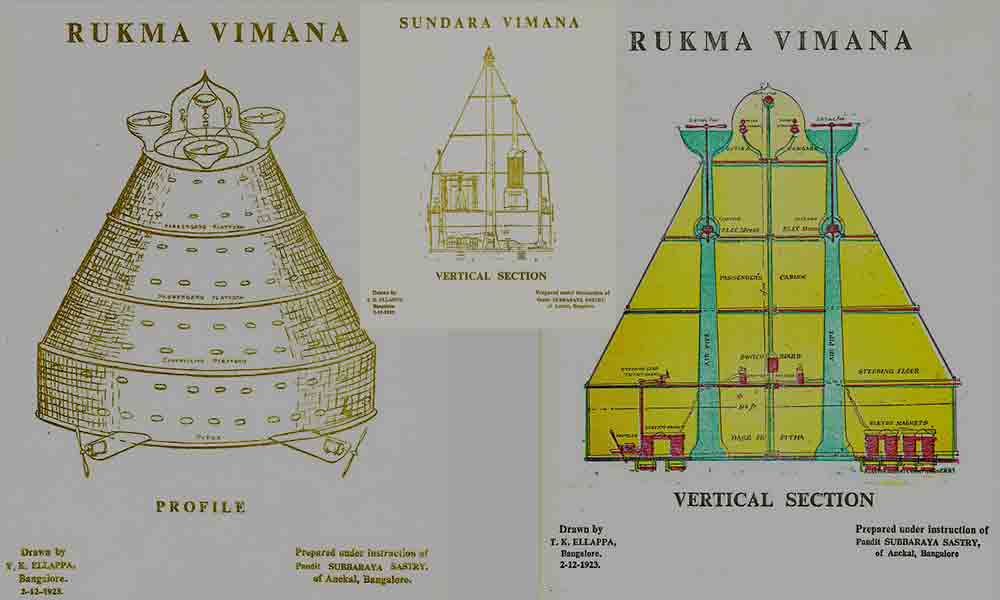
Chapter 6 classifies vimanas into three major types, each associated with a cosmic age (yuga): 1. In the Krita Yuga, humans possessed innate yogic powers and required no mechanical aircraft. 2. In the Treta Yuga, vimanas were created through mantric methods and numbered twenty‑five varieties. 3. In the Dvapara Yuga, vimanas were produced through tantric methods and expanded to fifty‑six varieties. 4. In the Kali Yuga, where both mantra and tantra have weakened, vimanas are artificial (kritaka) and number twenty‑five types. The chapter lists these varieties and explains that although their shapes and movements are similar, their power sources and construction methods differ according to the spiritual and technological conditions of each age. It also notes that artificial vimanas must be built from Raajaloha, a specialized alloy described earlier.
Source: Vymaanika‑Shaastra (Aeronautics) Attributed to Maharshi Bharadwaaja Propounded by Subbaraya Shastry English translation and edition originally printed and published by G. R. Josyer, Coronation Press, Mysore, India (1973). This text was reproduced and reformatted from Sacred‑Texts.com, based on the edition made available there by the late John Bruno Hare, founder of Sacred‑Texts.
Copyright Status: The English translation published by G. R. Josyer is formally still under copyright; however, extensive research by Sacred‑Texts determined that this edition constitutes an orphaned copyright. No rights‑holder, estate, or legal representative has ever been identified, and no copyright claims have been asserted for several decades. Sacred‑Texts published the text with this understanding, and this reproduction follows the same good‑faith assessment of its cultural and historical significance.
Editorial Note: The information on this page consists of chapter‑wise summaries of the Vymaanika‑Shaastra and does not form part of the original text or its translation. These summaries were prepared with AI assistance and subsequently checked, edited, and refined for accuracy.