Vymaanika-Shaastra Contents - Ancient Hindu Text on Aeronautics
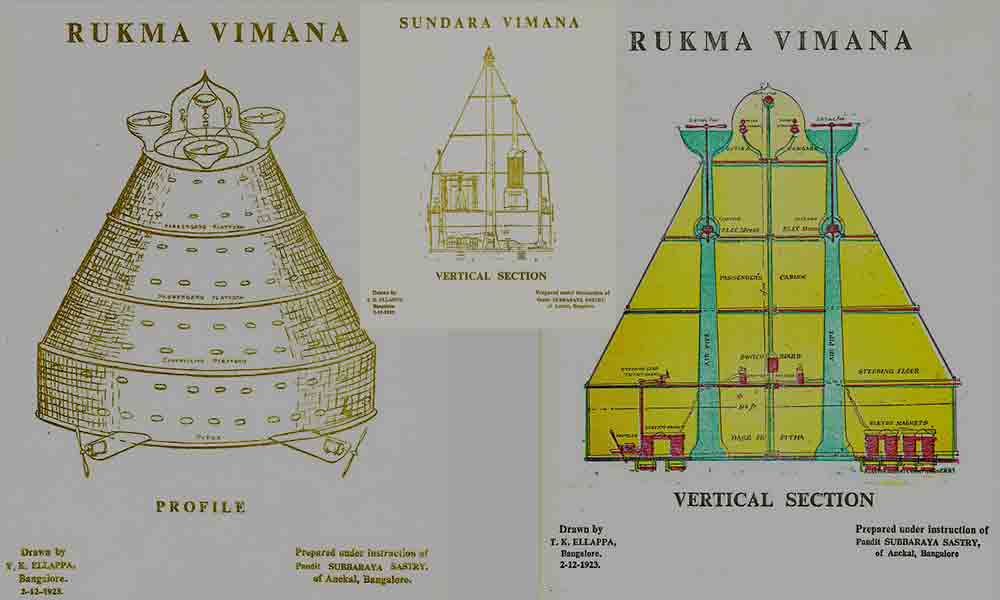
Summary: The Vymaanika-Shaastra is an ancient Hindu scientific treatise attributed to Maharshi Bharadwaja that details the principles of aeronautics and vimana (aircraft) construction. Translated and edited by G.R. Josyer from the original Sanskrit work propounded by Venerable Subbaraya Shastry, this page presents the complete table of contents organizing the text's six chapters. Readers will find detailed sections covering definitions, pilot qualifications, aerial routes, aeroplane components, materials, machinery, and descriptions of various vimana types.
Table of Contents
| FIRST CHAPTER | Page No. |
| 1. Definition | 2 |
| 2. The Pilot | 3 |
| 3. Aerial Routes | 7 |
| 4. Aeroplane Parts | 8 |
| 5. On Clothing | 10 |
| 6. On Food | 11 |
| 7. On Metals | 15 |
| SECOND CHAPTER | |
| 8. Heat Absorbing Metals | 18 |
| 9. Melting | 19 |
| THIRD CHAPTER | |
| 10. Mirrors | 22 |
| FOURTH CHAPTER | |
| 11. Power | 28 |
| FIFTH CHAPTER | |
| 12. Yantras or Machinery | 31 |
| 13. Parts of Yantras | 36 |
| SIXTH CHAPTER | |
| 14. Varieties of Aeroplanes | 84 |
| 15. Shakuna Vimana | 89 |
| 16. Sundara Vimana | 94 |
| 17. Rukma Vimana | 107 |
| 18. Tripura Vimana | 111 |
Source: Vymaanika‑Shaastra (Aeronautics) Attributed to Maharshi Bharadwaaja Propounded by Subbaraya Shastry English translation and edition originally printed and published by G. R. Josyer, Coronation Press, Mysore, India (1973). This text was reproduced and reformatted from Sacred‑Texts.com, based on the edition made available there by the late John Bruno Hare, founder of Sacred‑Texts.
Copyright Status: The English translation published by G. R. Josyer is formally still under copyright; however, extensive research by Sacred‑Texts determined that this edition constitutes an orphaned copyright. No rights‑holder, estate, or legal representative has ever been identified, and no copyright claims have been asserted for several decades. Sacred‑Texts published the text with this understanding, and this reproduction follows the same good‑faith assessment of its cultural and historical significance.
Editorial Note: This material is presented here for general reading and educational purposes only. While care has been taken to reproduce the text accurately, we do not guarantee the absence of errors or omissions. Readers undertaking academic or scholarly work are encouraged to consult the original printed edition where possible. Commercial reproduction of this work is strictly prohibited. Chapter summaries are added by Jayaram V and do not form part of the original text.