Hymns to the Horse from the Rig-Veda - Book I
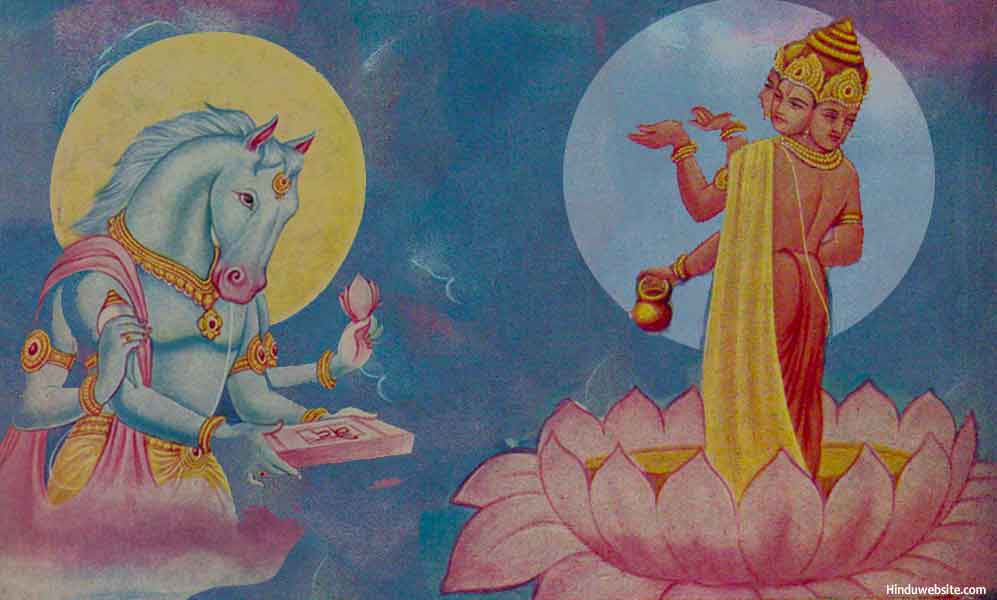
Summary: This page presents sacred hymns dedicated to the sacrificial horse from the Rig-Veda, one of Hinduism's oldest and most revered scriptures. The content features Hymn 209 translated by Ralph T.H. Griffith, exploring the spiritual significance and divine nature of the horse in Vedic ritual and philosophy. Readers will discover how ancient Hindu texts honored this sacred animal and its role in religious ceremonies.
HYMN 209 The Horse.
1. SLIGHT us not Varuna, Aryaman, or Mitra, Rbhuksan, Indra, Ayu, or the Maruts,
When we
declare amid the congregation the virtues of the strong Steed, God-descended.
2 What time they
bear before the Courser, covered with trappings and with wealth, the grasped oblation,
The
dappled goat goeth straightforward, bleating, to the place dear to Indra and to Pusan.
3 Dear.
to all Gods, this goat, the share of Pusan, is first led forward with the vigorous Courser,
While Tvastar sends him forward with the Charger, acceptable for sacrifice, to glory.
4 When thrice the men lead round the Steed, in order, who goeth to the Gods as meet oblation,
The goat precedeth him, the share of Pusan, and to the Gods the sacrifice announceth.
5 Invoker,
ministering priest, atoner, fire-kindler Soma-presser, sage, reciter,
With this well ordered
sacrifice, well finished, do ye fill full the channels of the rivers.
6 The hewers of the post
and those who carry it, and those who carve the knob to deck the Horse's stake;
Those who prepare
the cooking-vessels for the Steed,-may the approving help of these promote our work.
7 Forth,
for the regions of the Gods, the Charger with his smooth back is come my prayer attends him.
In him rejoice the singers and the sages. A good friend have we won for the Gods' banquet.
8 May the fleet Courser's halter and his heel-ropes, the head-stall and the girths and cords about
him.
And the grass put within his mouth to bait him,-among the Gods, too, let all these be
with thee.
9 What part of the Steed's flesh the fly hath eaten, or is left sticking to the
post or hatchet,
Or to the slayer's hands and nails adhereth,-among the Gods, too, may all
this be with thee.
10 Food undigested steaming from his belly, and any odour of raw flesh remaining,
This let the immolators set in order and dress the sacrifice with perfect cooking.
11 What
from thy body which with fire is roasted, when thou art set upon the spit, distilleth,
Let
not that lie on earth or grass neglected, but to the longing Gods let all be offered.
12 They
who observing that the Horse is ready call out and say, the smell is good; remove it;
And,
craving meat, await the distribution, -may their approving help promote labour.
13 The trial-fork
of the flesh-cooking caldron, the vessels out of which the broth is sprinkled,
The warming-pots,
the covers of the dishes, hooks, carving-boards,-all these attend the Charger.
14 The starting-place,
his place of rest and rolling, the ropes wherewith the Charger's feet were fastened,
The water that he drank, the food he tasted, -among the Gods, too, may all these attend thee.
15 Let not the fire, smoke-scented, make thee crackle, nor glowing caldron smell and break to
pieces.
Offered, beloved, approved, and consecrated,-such Charger do the Gods accept with favour.
16 The robe they spread upon the Horse to clothe him, the upper covering and the golden trappings,
The halters which restrain the Steed, the heel-ropes,-all these, as grateful to the Gods, they
offer.
17 If one, when seated, with excessive urging hath with his heel or with his whip distressed
thee,
All these thy woes, as with the oblations' ladle at sacrifices, with my prayer I banish.
18 The four-and-thirty ribs of the. Swift Charger, kin to the Gods, the slayer's hatchet pierces.
Cut ye with skill, so that the parts be flawless, and piece by piece declaring them dissect them.
19 Of Tvastar's Charger there is one dissector,-this is the custom-two there are who guide him.
Such of his limbs as I divide in order, these, amid the balls, in fire I offer.
20 Let not
thy dear soul burn thee as thou comest, let not the hatchet linger in thy body.
Let not a greedy
clumsy immolator, missing the joints, mangle thy limbs unduly.
21 No, here thou diest not,
thou art not injured: by easy paths unto the Gods thou goest.
Both Bays, both spotted mares
are now thy fellows, and to the ass's pole is yoked the Charger.
22 May this Steed bring us
all-sustaining riches, wealth in good kine,good horses, manly offspring.
Freedom from sin may
Aditi vouchsafe us: the Steed with our oblations gain us lordship!
HYMN 163. The Horse.
1. WHAT time, first springing into life, thou neighedst, proceeding from the sea or upper waters,
Limbs of the deer hadst thou, and eagle pinions. O Steed, thy birth is nigh and must be lauded.
2 This Steed which Yama gave hath Trita harnessed, and him, the first of all, hath Indra mounted.
His bridle the Gandharva grasped. O Vasus, from out the Sun ye fashioned forth the Courser.
3 Yama art thou, O Horse; thou art Aditya; Trita art thou by secret operation.
Thou art divided
thoroughly from Soma. They say thou hast three bonds in heaven
that hold thee.
4 Three bonds,
they say, thou hast in heaven that bind thee, three in the waters,
three within the ocean.
To me thou seernest Varuna , O Courser, there where they say is thy sublimest birth-place.
5 Here-, Courser, are the places where they groomed thee, here are the traces of thy hoofs as
winner.
Here have I seen the auspicious reins that guide thee, which those who guard the holy
Law keep safely.
6 Thyself from far I recognized in spirit,-a Bird that from below flew through
the heaven.
I saw thy head still soaring, striving upward by paths unsoiled by dust, pleasant
to travel.
7 Here I beheld thy form, matchless in glory, eager to win thee food at the Cow's
station.
Whene'er a man brings thee to thine enjoyment, thou swallowest the plants most greedy
eater.
8 After thee, Courser, come the car, the bridegroom, the kine come after, and the charm
of maidens.
Full companies have followed for thy friendship: the pattern of thy vigour Gods
have copied.
9 Horns made of gold hath he: his feet are iron: less fleet than he, though swift
as thought, is Indra.
The Gods have come that they may taste the oblation of him who mounted,
first of all, the Courser.
10 Symmetrical in flank, with rounded haunches, mettled like heroes,
the Celestial Coursers
Put forth their strength, like swans in lengthened order, when they,
the Steeds, have reached the heavenly causeway.
11 A body formed for flight hast thou, O Charger;
swift as the wind in motion is thy spirit.
Thy horns are spread abroad in all directions: they
move with restless beat in wildernesses.
12 The strong Steed hath come forward to the slaughter,
pondering with a mind directed God-ward.
The goat who is his kin is led before him the sages
and the singers follow after.
13 The Steed is come unto the noblest mansion, is come unto his
Father and his Mother.
This day shall he approach the Gods, most welcome: then he declares
good gifts to him who offers.
Source: These hymns are reproduced from An English translation of the Vedas by Ralph T.H. Griffith, 1896. Griffith wrote in a poetic, archaic style. In order to make the hymns sound like English poetry, he often compromised the original meaning of the Sanskrit words. Further, his Sanskrit knowledge was limited by the scholarship of the 19th century. For many Indian readers, this feels distant, making his work less accessible than modern prose translations. This page has been formatted, and the hymns are selected and organized by Jayaram V for Hinduwebsite.com. Hymn numbers have been changed from Roman numerals to standard numbers.