Hinduism and Child Loss: Understanding Death Through Karma
Summary: Hindu tradition views child death through karma, where a soul's lifespan reflects past actions from this life or previous births. Whether caused by personal karma, others' actions, or divine will, early death may serve spiritual purposes beyond punishment. Hindu families traditionally bury rather than cremate infants under one year, recognizing their underdeveloped subtle bodies. Though abortion remains controversial and culturally complex, most Hindu families demonstrate deep parental love, viewing children's welfare as sacred obligation.
Few experiences are as painful for a family as the death of a child. In India, child mortality was a serious concern in earlier centuries, when famines and epidemics were common. The problem appears to have been even more acute in ancient times, as suggested by the Vedas, which include hymns addressed to the gods seeking protection for children from death and disease.
Child mortality remains a significant challenge for some low-income families, especially where healthcare is costly and medical facilities are limited in many rural areas. Often, the longer a child lives and the stronger the bond that forms, the more intense the grief may be after a loss. Whether due to natural or accidental causes, the death of a child can lead to profound suffering, and some people take a long time to recover.
For various cultural and historical reasons, Hindu families may differ in how they respond to the death of children. The premature death of a child is devastating for any parent. At the same time, in some traditional contexts where male children are viewed as carriers of the family name and lineage, the death of a son may be felt more acutely than the death of a daughter. In some communities, girls have also faced discrimination that may include pressure to terminate pregnancies, or neglect and abandonment after birth.
Among many present-day Hindus, abortion may be viewed as a practical decision rather than primarily as a religious transgression. The Dharma Shastras describe abortion or the killing of a human fetus (bhrunahatya) as a grave sin and equate it with the sin of killing a Brahmana. However, many people do not interpret it in those terms today. Some consider it part of a woman’s right to decide whether to continue a pregnancy, though in practice such decisions may also be shaped by family dynamics and, in some cases, by men. For some, abortion is also seen as a way to avoid social stigma associated with premarital relationships and pregnancy outside marriage.
Although India is the world’s largest democracy and has made progress in many fields, some aspects of society retain feudal features, where money and power can strongly influence people’s lives. Social inequalities remain pronounced, as does social pressure on individuals regarding social norms and religious customs.
Women are often disproportionately affected by these conditions. In many parts of India, particularly in some rural settings, women may face social and personal constraints and limited freedom. Some families view a girl child as an economic burden, citing lower perceived earning opportunities and the expectation in certain communities that parents will provide substantial dowry at marriage.
In India, public mobilization around issues such as abortion, birth control, or same-sex marriage has often taken different forms than in the United States, where organized conservative movements have been highly visible. To the extent that religious orthodoxy exists, it is sometimes less prominent in mainstream politics, which in many periods has emphasized secular values and socialist principles in the name of modernism. From an early age, many people are exposed to the idea that the state should play a central role in addressing poverty and suffering, including through public programs and subsidies.
As a result, some people may view family planning as a social obligation or economic necessity rather than as a sinful act or a source of bad karma. Sex-selective abortions have been reported in India and are often discussed as a serious social concern. In this short article, we examine how Hindus view the death of children and how they understand and respond to the suffering associated with it.
Philosophically speaking, Hinduism views death as a temporary phase in the soul’s existence on earth. Souls are bound to the cycle of death and rebirth. Over the course of a long existence, there may be occasions when a person is born prematurely or dies prematurely because of past karma. If a fetus is aborted by its parents, one may attribute the event either to the parents’ karma or to the karma of the soul that was destined to be born through them.
In this framework, a being’s lifespan depends on karma. Therefore, whether a person lives a long life or dies young is often understood primarily in terms of karma. The soul itself is considered unaffected, since it is viewed as eternal and unchangeable. People may grieve deeply and experience depression after the death of loved ones, but from this philosophical perspective such suffering is associated with ignorance of the soul’s true nature.
As Swami Vivekananda once said, people should rejoice when someone dies rather than weep, because the soul has escaped the wheel of life and death. In this view, death and suffering pertain to the body; the soul is immortal and cannot be slain or injured. While this is the philosophical position, for many Hindus death is still experienced as painful, and it may be regarded as misfortune or calamity. Grief can be especially intense when a child dies, even when the loss is understood in terms of karma.
Karma is central to the Hindu worldview. Events and actions are often understood as causes or consequences of karma. In this approach, whether someone lives a long life or dies early is explained by past karma. However, the law of karma is not always presented as simple. According to many Hindu beliefs, a person’s current life is not shaped only by present actions; other factors may also be involved. Broadly, three types of actions are said to influence life and destiny.
- One’s own actions, past and present
- Actions of others, past and present
- Acts of God, past and present
A child’s life on earth may be cut short for any of these reasons. A person may die because of one’s own actions, the actions of others, or acts of God, whether in past lives or in the present life. In all three instances, karma is understood to accrue to those who perform the actions. If the intentions were harmful, the resulting karma is considered severe for those involved. What is sometimes described as fate may, in this view, reflect past karma rather than a deliberate act of God.
If a soul arrives in this world and remains for only a short time, it does not necessarily mean it occurred because of past sins. In this tradition, virtuous or meritorious souls may be believed to take birth briefly to learn certain lessons, overcome weaknesses, or fulfill obligations. The Hindu Puranas include accounts in which seers and sages—and even deities—take human birth for a limited period to fulfill duties or help maintain order in the world.
For example, in traditional accounts, eight babies preceded the birth of Lord Krishna. They were all born to his mother, Devaki, and were killed by his maternal uncle, the demon king Kamsa. Their birth and death are presented as part of God’s plan to incarnate on earth. Similarly, the goddess Ganga is said to have sacrificed her seven newborn babies before giving birth to the legendary Bhisma, who was blessed with the boon to live as long as he wished and to choose the time of his death. These narratives are examples in which the birth and death of a child or person are attributed to the acts of God.
When a child dies, the most intense trauma is often experienced by family members, especially the parents. Therefore, within this karmic framework, some may interpret the death of a child as connected to the parents’ past karma—perhaps as a lesson, a settlement of past debts, or the resolution of prior wrongdoing.
Cremation is the norm in Hinduism for disposing of the dead body. However, this norm does not always apply to children. The bodies of young children who die within a year of birth are often buried rather than cremated; in some instances, they are consigned to rivers. In other words, their bodies may be offered to water or the earth rather than to fire. One traditional explanation is that the subtle bodies of children are considered underdeveloped and therefore unfit for fire sacrifice.
Although abortion is often discussed as a serious concern and is sometimes linked to social changes associated with urbanization, Hindus have also traditionally emphasized family values and affection for children. Whether rich or poor, many parents sacrifice personal comfort for their children. They care for them despite economic hardship and personal challenges, and their love and concern often continue even after their children grow up and start families of their own.
For many, caring for children is viewed as a moral and religious obligation and as part of one’s karma—something that should not be ignored without consequences. Parents often form strong emotional bonds with their children and may maintain close involvement throughout their lives, sometimes to the point that children feel closely monitored. Many also believe they will be reborn within the same family, returning to earth as children or grandchildren. While child neglect and abuse are reported, many Hindus raise their children with care and affection and seek to bring them up responsibly. Many also regard the death of a child as one of the most painful misfortunes a family can face.
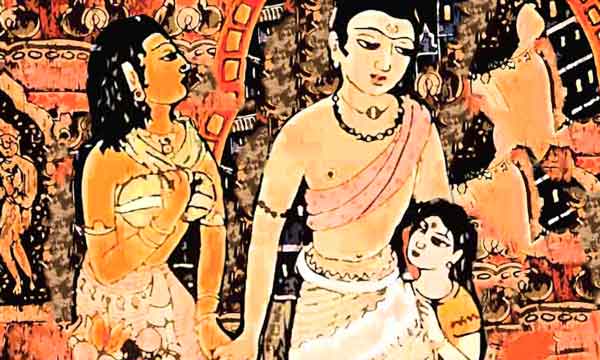
The image for this essay has been adapted with alterations from a public domian image from the Himalayan Academy Archives