Six Chief Obstacles to Liberation
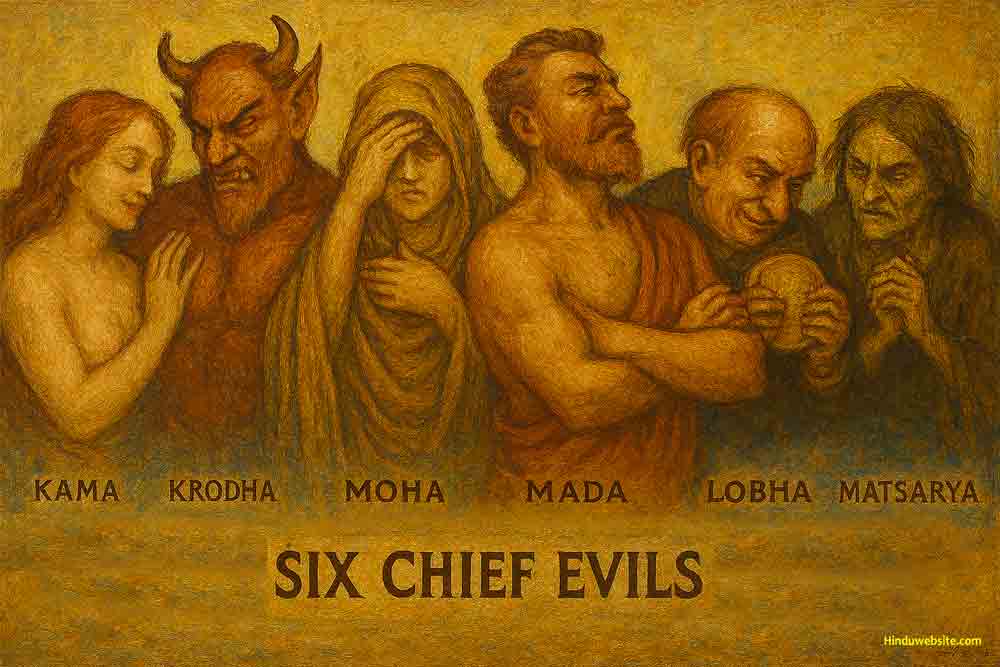
Summary: Hindu texts identify six primary vices that prevent spiritual progress and inner peace. This essay explores each obstacle—lust, anger, delusion, intoxication, jealousy, and greed—examining their origins in the modes of nature and their effects on consciousness. Drawing from the Bhagavadgita and other scriptures, it shows how these forces arise from ego and attachment while offering guidance for transcending them through self-control and devotion.
In Hinduism, the six chief evils (mahapatakas) hold significant importance. They are considered chief enemies because they obscure human wisdom and lead them astray. This is why in the Bhagavadgita, Lord Krishna, the divine guide, referred to them as gates to hell (16.21). They are also seen as vikaras (distortions) of the mind. In some esoteric traditions of Tantra, they are personified as deities and attendants of Lord Shiva. These evils, Kama, Krodha, Moha, Mada, Matsarya, and Lobha, arise from the impure modes of Rajas and Tamas and act as obstacles to liberation. Under their influence, people develop demonic qualities (asura sampada), disregard the Lord who resides in them and the world, and engage in wicked actions. According to Patanjali, they arise because of vitarka, negative thinking, due to the influence of rajas and tamas, and should countered with positive and sattvic thoughts (2.34). Lord Krishna states (18.52-53) that through practice, a yogi should overcome these evil passions. He becomes fit to abide in Brahman when he frees himself from egoism, strength, pride, lust, anger, covetousness, ownership, and the feeling of me and mind, taking refuge in detachment (vairagya), dwelling in solitude, eating little, controlling speech, body, and mind and practicing dhyana yoga on the highest, supreme Self.
Kama (Lust)
In a very simple sense, kama means any desire. It has both positive and negative connotations. In a positive sense, the Rigveda describes kama (desire) as the primal seed (retas) that manifested in the consciousness (manas) of the Creator and became the source of all creation. As a positive force, kama is the source of pleasure and happiness and is worthy of pursuing. Hence, in Hinduism, it is considered one of the chief aims of human life, along with Dharma, Artha, and Moksha. Kama is also personified in Hinduism as amorous love with Kamadev (Manmadha) as its presiding deity. Thus, Kama, when properly pursued, is a positive, constructive, and generative force, without which creation or preservation is not possible. It is the force that keeps the world going. Even gods succumb to desires and indulge in their pursuit of pleasure and happiness.
At the same time, Hinduism recognizes the evils of excessive desires and material pursuits. Hence, it puts Dharma (righteousness) at the forefront of these aims. In other words, kama that is in harmony with the goals or aims of Dharma is acceptable, but not desires that are opposed to it. The Bhagavadgita and several other scriptures go a step further and identify in any form or intensity as detrimental to one’s liberation, peace, and happiness since all desire-ridden actions produce consequences and bind the jivas to samsara. Ashtavakra states that kama (desires) veils knowledge and steals discernment (vivekam).
The Bhagavadgita contains at least a dozen references to the word kama and uses it mostly in the formal sense of desire. However, it identifies desire of any kind as the root cause of sinful karma, bondage, and suffering. In some verses, Lord Krishna goes a step further and describes it as an enemy. For example, in the third chapter (37, 39 & 43), he says: This lust (kama), this anger (krodha), which is born of rajoguna, is a great devourer and great sinner. Know that in this world, it is the enemy…O Kaunteya, wisdom is enveloped by this constant enemy of the wise ones in the form of desire, which is like an insatiable fire…Thus, knowing him who is beyond or higher than intelligence, stabilizing the mind by intelligence, O mighty-armed one, slay the formidable enemy in the form of desire.”
Krodha (Anger)
Krodha, which means anger, also has both positive and negative connotations. The scriptures draw a fine distinction between the anger of the righteous and pious and the anger of the destructive and evil. Almost every god and goddess has pleasant and fierce forms. Isvara, the Lord of the Universe, himself has a fierce aspect as the Destroyer. Sages such as Durvasa and Vishwamitra were prone to bouts of anger. The Hindu Puranas and epics illustrate how anger leads to delusion and suffering and results in the destruction of oneself and others. According to Manu (1.25), Brahma produced anger along with desires, speech, pleasure, etc. Eight vices manifest in people due to krodha: gossiping, violence, betrayal, envy, slandering, unjust seizure of property, insulting, and assault. Even learned men can become enslaved to anger and desires when they lose discretion. He also included abstention from anger as one of the ten laws prescribed for the pious Brahmanas.
Anger played an important role in the Mahabharata War. Indeed, the Kauravas were prone to all the five chief evils. However, anger was the most common reason since Duryodhana was angered by Draupadi’s behavior of Draupadi in the Maya Sabha and decided to teach her a lesson. Anger on his part and indignation on the part of the Pandavas led to the final battle. The Bhagavadgita explains how anger arises from desires and attachments and results in confusion, loss of mental stability, and one’s destruction. Lord Krishna states that whoever controls anger and lust before leaving this world is a skillful yogi (yukta) and a happy human being. In Tantra, anger is personified by a goddess named Krodhini. Krodha is also known as one of the eight forms of Bhairava and one of the 64 gods (Abhasvaras/Abhasuras) mentioned in the Puranas.
Many Hindu scriptures describe anger as one of the formidable enemies of virtuous people. It can arise for any number of reasons, making it difficult to control, especially when one lacks mental discipline and is driven by desires and attachments. It should be controlled through atma-samyama (self-control) by controlling the mind and senses, suppressing desires, and stabilizing the mind in the Self, practicing meditation, detachment, nonviolence, devotion, keeping the mind and ego under control, suppressing desires, and cultivating divine qualities, patience or endurance, knowledge, and wisdom. The same effort involved in subduing the gunas is effective in the case of all the vices listed here.
Moha (Delusion)
Moha is identified as one of the triple impurities of the jivas, the other two being egoism and desires. Moha means delusion or entertaining mistaken notions about oneself and the world. It is mistaking one’s possessions, qualities, achievements, and attributes representing oneself or one’s reality. The truth is that the mind and body do not represent the Self. As the Bhagavadgita states, they are like the clothes the Self wears at each birth and discards at the end of it. In the deluded state, the jiva thinks that his body or his name and form are real and represent his true Self. He also perceives the world as real, ignoring its impermanence and how it keeps him bound. Because of this delusion, jivas engage in desire-ridden actions, accumulate sins, and become bound. The thinking that “I am this and that,” “I own this and that,” or “I have this, and I should have more” thoughts like this arise because of delusion only. They keep the jivas ignorant and deluded and keep them craving and striving in search of identity, security, conformity, and happiness. Unfortunately, they are not lasting solutions for our suffering or bondage.
At the deepest level, the source of this delusion is God himself. He is Mayavi, the magician who casts the net of Maya on all being to keep them bound to the world and ensure the continuity of creation. The body is the field of Maya (Prakriti), where she enacts her play with the help of Maya Shaktis for the enjoyment of the Lord in the body. The deluded state is our natural state, which makes it even more formidable to overcome. Because of this, we mistake our relationships, possessions, and actions for truth, engage in desire-ridden actions, go through the roller coaster of passions and emotions, and experience suffering. The answer to this is to go beyond the apparent reality and perceive the real, permanent, and indestructible truth that is hidden in it.
Lord Krishna addresses this problem at the very beginning of his discourse by suggesting to Arjuna that the body is subject to death and destruction. In contrast, the Self is indestructible and neither slays nor is slain. The main culprit behind moha is tamas. The remedy to overcome moha is prajna, the discriminating knowledge or wisdom. It is attained by cultivating the right knowledge through self-study (svadhyaya), detachment (vairagya), devotion (bhakti), and contemplation. When intelligence is purified and shines with the light of the Self, one overcomes delusion and abides in the Self. It is knowing that all that one has, one is, and one does, is but unreal, an illusion (Maya) and as unstable and fleeting as a dream. They do not enhance a person's inherent worth, give him happiness, or secure his standing in the world. They only create the chains of karma and keep the jivas stuck in Samsara.
In a worldly or secular sense, moha refers to love or infatuation and thus is closely related to sexual desires, lust, or Kama. It is true that in the enchanted state, one loses touch with reality, remains fixated on the object of love, and acts foolishly. This is moha on top of the moha (the state of delusion) in which we are already caught in which we take our knowledge, intelligence, and awareness for granted and depend upon them to make sense of the world and ensure our survival and continuity.
Mada (Intoxication)
Mada refers to an attitude rather than a particular quality that induces several evil qualities all at once. It is a combination of madness, intoxication, stubbornness, disregard for norms and rules, lust, anger, pride, arrogance, brute strength, egotism, perversion, and foolishness. It is chiefly induced by tamas. It can also arise from imbalance due to the excessive presence of something that enhances one’s pride and prestige. Thus, knowledge, wealth, strength, looks, status, family, name, fame, support, following, etc., can induce excessive pride and make one indulge in its ostentatious display. Even one’s virtue, spirituality, or holiness can induce it and lead to one’s downfall.
Whatever may be the cause, mada is certainly a demonic quality, destructive and deluding. The strength (balam) of a righteous person is filled with the light of sattva (purity) and noble intentions, but that of an evil person is filled with the darkness of tamasic mada. Perhaps the very word “mad” has its origin in Sanskritic “mada.” An asura with the same name, Mada, with a gigantic body is mentioned in the Mahabharata. Even Indra was said to be afraid of his brute power and strength. The quality is also associated with elephants when they become wild, aggressive, or violent due to biological, physiological, or environmental reasons.
Mada arises due to excessive reliance and attachment to the body, wealth, religion, virtue, name, fame, etc. Hence, it is a major obstacle to overcome the delusion of the mind and body and to become established in contemplation or realization of the Self. Only by cultivating detachment, humility, and devotion, renouncing evil nature, desires, and worldly possessions, surrendering to the Supreme Being, and establishing the mind in contemplation can one eventually overcome it. One can also temper and balance excessive pride, arrogance, and self-conceit by acknowledging God as the true source of everything and offering all actions and their fruit to him, with the awareness that none of the things here belong to anyone but God himself.
Matsarya (Jealousy)
Matsarya means envy or jealousy. It may arise from the dissatisfaction, discontent, or displeasure that one lacks something or does not have something that others have. Like all other evil qualities, it is induced by egoism, desires, and delusion. Envy can work positively or negatively. It can inspire people to transcend their limitations and realize their dreams or induce unhappiness, discontentment, and low self-esteem and drive them to engage in destructive actions and harmful actions to bring down those who are the source of their envy and feel good about themselves. Envy was one of the main causes of the Mahabharata war. The Kauravas were envious of the Pandavas from their childhood. Even their father, Dhritarashtra, was envious of them.
Envy distorts the thinking and discernment of a person and induces him to engage in destructive actions. The Bhagavadgita identifies Matsarya as one of the triple gates to hell. It is a form of negative desire arising from attachments that induce people to take or steal what does not rightfully belong to them or harm those who possess them just for the satisfaction of it. It may also induce to prevent others from realizing their goals or fulfilling their desires even if it does not serve any purpose for them. According to Manu, evil qualities such as envy shorten a person’s life as he is constantly afflicted with misfortunes and diseases. On the other hand, a person who follows the conduct of virtuous people, who has faith and is free from envy, lives a hundred years even if he lacks auspicious qualities.
The Isvasya Upanishad declares that all this is the habitation of the Brahman, and everything belongs to him. Therefore, one should not covet the wealth that does not belong to them and wish to live here by performing their actions selflessly without desires. However, envy is not confined to evil people only. Even the wise ones can succumb to it if they do not practice dama (self-control) and establish their minds in detachment and renunciation.
Lobha (Greed)
Lobha means greed or covetousness. However, it has other meanings. It arises from excessive attraction (as opposed to aversion) or attachment to things, desires, and loss of discernment. It is also induced in most cases by Rajas. According to the Brihadaranyaka Upanishad, Brahma advised humans to practice charity. He said so because humans are, by nature, selfish and greedy and do not like to share their wealth with others, whereas wealth belongs to God, who is the source of all types of abundance. Through charity, they can overcome this negative quality and become righteous. In the Bhagavadgita (14.12), Lord Krishna states, “Greed, activity, the undertaking of desire-ridden actions, absence of sameness, and craving - these manifest when the mode of rajas increases.” He reaffirms the same in the same chapter in another verse (14.17). “From sattva is born knowledge, and from rajas surely greed; from tamas arise negligence, delusion, and, indeed, ignorance. “ According to Manu, the same set of eight vices that arise from Krodha also arise from lobha. Therefore, the wise ones should conquer both. He also advises kings not to be greedy and levy excessive taxes on people or confiscate their property out of greed. At the same time, he should ensure that people do not steal from others due to greed.